
Tutorial Categories
Last Updated: May 19, 2026 at 10:30
Exchange Rates in Macroeconomics: Fixed Versus Floating Systems, Currency Appreciation and Depreciation, and the Impossible Trinity
A Clear Guide to How Currencies Are Valued, Why They Change, and What It Means for Economies and Central Banks
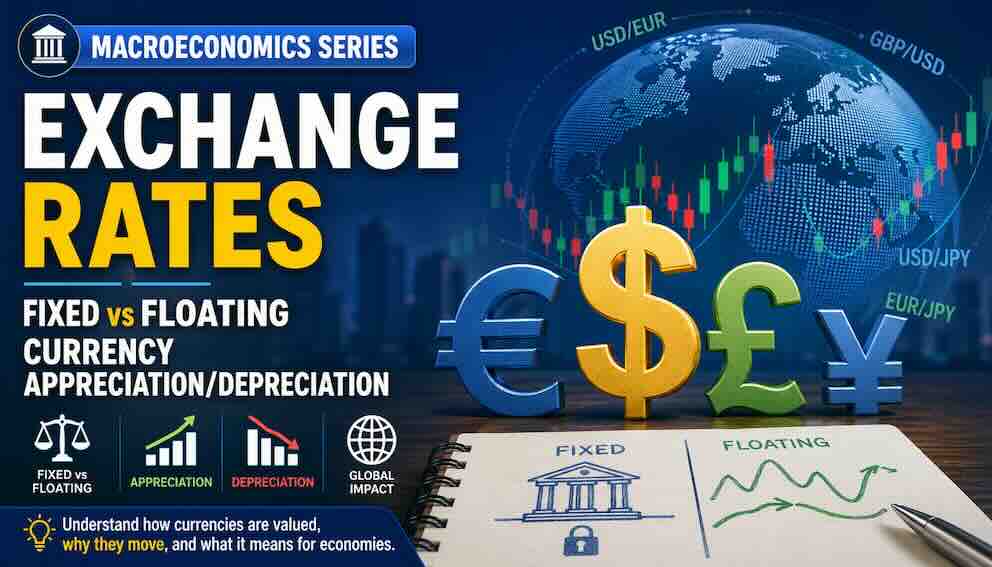
This tutorial explains how exchange rates work and why they matter in macroeconomics, with a focus on fixed and floating systems, managed floats, and the mechanisms of currency appreciation and depreciation. You will learn what causes currencies to rise or fall in value, how interest rates and investor sentiment drive exchange rate movements, and why the impossible trinity means countries cannot have fixed exchange rates, free capital mobility, and independent monetary policy all at once. Through extended real-world examples — including the British pound after the Brexit referendum, the carry trade involving the Japanese yen, and the Black Wednesday crisis of 1992 — the tutorial shows how exchange rates connect to central bank policy, trade competitiveness, and inflation. By the end, you will understand why exchange rates are constantly in the news and how they serve as one of the central transmission mechanisms between the global economy and domestic economic conditions.
Introduction: Why Exchange Rates Matter
When most people hear the term exchange rate, they think about travel. You might imagine yourself at an airport currency counter, wondering how many euros you will get for your pounds. This everyday example is useful because it makes the abstract idea of a currency price feel tangible. But exchange rates play a far more important role in the broader economy.
An exchange rate is simply the price of one currency in terms of another. When we say that one British pound equals 1.25 US dollars, we are stating an exchange rate. That number tells you how much of one currency you need to buy a unit of the other. But this number is not fixed in most countries. It moves constantly in response to economic forces, and when it moves, it sends ripples through the entire economy.
When a country's currency becomes cheaper relative to others, its exports become more affordable for foreign buyers, which can boost manufacturing and create jobs. But the same movement makes imports more expensive, raising the cost of everything from fuel to medicine. When a currency becomes more expensive, the opposite happens: imports become cheaper, helping to control inflation, but exporters struggle to sell abroad. These are not small effects. They influence whether factories stay open, whether prices rise or fall, and whether living standards improve or decline.
In this tutorial, we will move through these ideas at a steady pace. We will examine fixed and floating exchange rate systems, explore what causes currencies to appreciate or depreciate, and introduce the impossible trinity — a concept that explains why countries face difficult trade-offs when choosing how to manage their currencies. Along the way, we will ground every concept in real-world events and connect each idea to the Balance of Payments framework from the previous tutorial.
Fixed Exchange Rate Systems
What a Fixed Exchange Rate Means
In a fixed exchange rate system, the government or central bank ties the value of its currency to another currency or a basket of currencies. This is often called a currency peg. The central bank commits to maintaining the exchange rate at a specific target level and takes active steps to enforce that commitment.
For example, suppose a country decides that its currency should always be worth exactly half of one US dollar. If market forces push the currency above or below this value, the central bank intervenes to bring it back. The central bank buys or sells its own currency in foreign exchange markets, using its foreign currency reserves to offset any movements that would break the peg.
Maintaining a fixed exchange rate requires sufficient reserves. If reserves run low and investors suspect that the peg cannot be defended, they may launch speculative attacks, selling the currency in large volumes. When this happens, the peg can break suddenly and disastrously.
The Real Exchange Rate and Purchasing Power Parity
Before we look at real-world examples, we need to introduce two concepts that help explain when fixed exchange rates become unsustainable: the real exchange rate and purchasing power parity.
The nominal exchange rate is the market price of one currency in terms of another. But economists often care more about the real exchange rate, which adjusts the nominal rate for differences in inflation between countries. The real exchange rate tells you how expensive a country's goods are relative to another country's goods. A country can maintain a fixed nominal exchange rate, but if its inflation is higher than its trading partners, its real exchange rate will appreciate, making its exports less competitive over time. This gradual loss of competitiveness is often what makes pegs unsustainable.
Purchasing power parity, or PPP, is the theory that a basket of identical goods should cost the same in different countries when prices are converted to a common currency. In practice, PPP holds reasonably well for tradable goods over long periods, but transportation costs, trade barriers, and non-tradable services mean that exchange rates can deviate from PPP for years. The Economist's Big Mac Index illustrates these deviations in an accessible way. When a fixed exchange rate implies a currency value that is far from PPP for a sustained period, that is often a sign that the peg is under strain.
A Successful Peg: The Hong Kong Dollar
The Hong Kong dollar peg to the US dollar, in place since 1983, is one of the most successful fixed exchange rate systems. The Hong Kong Monetary Authority maintains a fixed rate of approximately 7.8 Hong Kong dollars to one US dollar. The system has survived financial crises, political transitions, and massive economic changes.
The benefit of this peg is stability. Businesses in Hong Kong know exactly what their currency is worth in US dollars, which makes trade and investment easier to plan. The cost is that Hong Kong cannot pursue its own independent monetary policy. Because the currency is pegged to the US dollar, Hong Kong's interest rates must generally move in line with US interest rates. If the US Federal Reserve raises rates, Hong Kong must raise rates as well, even if its own economy is weak.
When Pegs Break: The Argentine Crisis of 2001-2002
Argentina provides a powerful example of what happens when a peg becomes unsustainable. In 1991, Argentina fixed the peso at one-to-one with the US dollar. For several years, the system worked well, bringing down high inflation and attracting foreign investment.
But over time, the US dollar grew stronger against other major currencies, and the Argentine peso strengthened with it. Argentine exports became expensive, imports became cheap, and trade deficits grew. The economy lost competitiveness. By 2001, investors had lost confidence, and the central bank was spending its limited reserves trying to defend the peg.
In early 2002, Argentina abandoned the fixed exchange rate. The peso immediately lost about seventy percent of its value. The human cost was devastating: bank accounts were frozen, debts went into default, and the country fell into a deep depression. The Argentine experience teaches that a fixed exchange rate can provide stability under the right conditions, but when the fixed rate becomes misaligned with economic fundamentals, the eventual adjustment can be sudden and brutal.
Floating Exchange Rate Systems and Managed Floats
What a Floating Exchange Rate Means
In a floating exchange rate system, the government and central bank do not set a target for the currency's value. Instead, the exchange rate is determined by market forces of demand and supply. The currency moves up and down freely based on interest rates, economic growth, trade flows, and investor sentiment.
Most major economies today use floating exchange rates. The United States, the United Kingdom, Japan, Canada, and the eurozone countries all allow their currencies to float, though central banks may occasionally intervene to smooth excessive volatility.
How Demand and Supply Determine Exchange Rates
Demand for a currency comes from foreign buyers who want to purchase domestic goods, services, or assets. Supply of a currency comes from domestic residents who want to buy foreign goods, services, or assets. In the Balance of Payments framework from the previous tutorial, these are exactly the flows recorded in the current account and the financial account. The exchange rate is the price that balances those flows in a floating system.
When demand for a currency increases faster than supply, the currency appreciates. When supply increases faster than demand, the currency depreciates.
Several factors drive these shifts. Higher interest rates attract foreign capital, increasing demand and causing appreciation. Strong economic growth makes a country more attractive to investors, also causing appreciation. A large trade deficit increases the supply of the domestic currency as residents buy foreign goods, putting downward pressure on the currency. Investor sentiment and risk appetite can cause sudden large movements, with investors fleeing to safe currencies like the US dollar during crises.
The Exchange Rate Channel of Monetary Policy
The connection between interest rates and exchange rates is not just an interesting fact; it is one of the primary ways that monetary policy affects the economy. When a central bank raises interest rates, its currency tends to appreciate because international investors buy it to earn higher returns. An appreciating currency makes imports cheaper, which directly reduces inflation, and makes exports more expensive, which slows economic activity. Both effects help the central bank achieve its goals.
This exchange rate channel is why central banks watch currency markets so closely, even when they have no explicit exchange rate target. The exchange rate is not just an outcome of monetary policy; it is a transmission mechanism that amplifies or dampens policy effects.
Managed Floats: The Reality for Most Countries
Pure fixed and pure floating systems are the extremes, but most countries operate somewhere between them in what are called managed floats or dirty floats. In a managed float, the exchange rate is primarily determined by market forces, but the central bank intervenes periodically to smooth excessive volatility or resist movements that seem inconsistent with economic fundamentals.
China provides the most important example. The People's Bank of China sets a daily reference rate for the renminbi and allows the currency to trade within a narrow band around that rate. The band has widened over time, but the central bank remains actively involved. This system gives China more stability than a pure float while retaining more flexibility than a fixed peg. India, Singapore, and many other large economies use similar arrangements.
When you read that a country "lets its currency float," the reality is often more complicated. The central bank is probably watching, and it may step in if it does not like what it sees.
Currency Appreciation and Depreciation
Currency appreciation means a currency becomes more valuable relative to another currency. Depreciation means it becomes less valuable. The causes and effects are mirror images.
What Causes Currency Movements
Interest rate differentials are among the most powerful drivers. When a country's interest rates rise relative to other countries, its currency tends to appreciate because investors move money there to earn higher returns. When rates fall, the currency tends to depreciate.
Economic performance matters as well. A country that grows faster than its trading partners attracts investment, which appreciates its currency. A country in recession or political turmoil sees its currency depreciate as investors pull money out.
Trade balances exert a more gradual influence. A country with a sustained trade surplus tends to see its currency appreciate over time because foreign buyers consistently need its currency. A country with a sustained trade deficit tends to see its currency depreciate.
Investor sentiment can cause sudden large movements. Safe currencies like the US dollar, Swiss franc, and Japanese yen tend to appreciate during global crises as investors flee to safety. Riskier currencies depreciate sharply during crises.
How Currency Movements Affect the Economy
When a currency appreciates, imports become cheaper, benefiting consumers and helping control inflation. Exports become more expensive, hurting domestic producers who sell abroad and potentially causing job losses in export industries.
When a currency depreciates, exports become cheaper, helping domestic producers sell abroad and creating jobs in export industries. Imports become more expensive, hurting consumers and businesses that rely on imported goods, and usually leading to higher inflation.
Countries that depreciate significantly while carrying a large negative Net International Investment Position — as covered in the Balance of Payments tutorial — face an additional burden, because their foreign-currency debts become larger in domestic currency terms. This mechanism made currency crises particularly damaging in countries that had borrowed heavily in dollars.
Real-World Example: The British Pound After the Brexit Referendum
The Brexit referendum on June 23, 2016, provides a clear example of how a floating exchange rate responds to a major shock. When the results showed that the UK had voted to leave the European Union, the pound fell sharply. On the night of the vote, it dropped by more than ten percent against the dollar, moving from around 1.50 dollars per pound to about 1.35 dollars per pound. In the weeks that followed, it drifted further downward.
Why did the pound depreciate? Investors reevaluated the UK's economic prospects. Trade relationships would need to be renegotiated. Some financial firms considered relocating. Foreign investment became less certain. All of these factors reduced demand for the pound.
The depreciation had clear effects. British exports became more competitive, helping manufacturers. But imports became more expensive, and inflation rose. The Bank of England faced a dilemma: raise rates to fight inflation or cut rates to support growth. It chose to cut rates, accepting temporarily higher inflation.
This example shows how exchange rates serve as shock absorbers. The depreciation absorbed some of the economic impact of the Brexit vote, even as it imposed costs through higher import prices.
The Carry Trade
The carry trade is one of the most important activities in international finance. Investors borrow money in a currency with a very low interest rate and use that money to buy assets denominated in a currency with a higher interest rate. The profit comes from the difference between the interest rates.
The classic example involves the Japanese yen. For many years, Japan's interest rates were near zero. Investors could borrow yen at almost no cost, sell those yen to buy Australian dollars or US dollars, and invest in bonds paying much higher interest rates. As long as the yen did not appreciate, the carry trade generated steady profit.
The carry trade creates a powerful force in currency markets. When many investors borrow a low-interest currency to buy a high-interest currency, they increase demand for the high-interest currency, causing it to appreciate. This appreciation can persist as long as the interest rate differential remains.
But carry trades can unwind suddenly. If the low-interest currency starts to appreciate, or if the high-interest currency starts to depreciate, investors rush to close their positions. That rush can cause rapid and large currency movements. During the 2008 financial crisis, the Japanese yen appreciated sharply as carry trades unwound, contributing to broader financial market stress.
The Impossible Trinity (Trilemma)
The impossible trinity, also known as the trilemma, is one of the most important concepts in international macroeconomics. It states that a country cannot simultaneously achieve all three of the following goals: free capital mobility (allowing money to flow freely across borders), a fixed exchange rate, and an independent monetary policy (the ability to set interest rates according to domestic needs). A country can have at most two of these three.
Let me explain why. Suppose a country wants both a fixed exchange rate and free capital mobility. If capital can flow freely and the central bank tries to set interest rates lower than those in other countries, investors will move money out to seek higher returns elsewhere. That capital outflow would put downward pressure on the currency, making it difficult to maintain the fixed exchange rate. To keep the rate fixed, the central bank must match foreign interest rates. It loses independent monetary policy.
Alternatively, suppose a country wants both a fixed exchange rate and independent monetary policy. To keep the exchange rate fixed while setting its own interest rates, the country must restrict capital flows. If capital cannot move freely, investors cannot exploit the interest rate difference. Many countries with fixed exchange rates impose capital controls for this reason.
Finally, suppose a country wants both free capital mobility and independent monetary policy. In that case, it must allow its exchange rate to float. The exchange rate will adjust to balance capital flows and interest rate differences, freeing the central bank to set rates according to domestic conditions. This is why most advanced economies have chosen floating exchange rates.
Black Wednesday, 1992: The Trilemma in Action
The most famous illustration of the impossible trinity is the United Kingdom's forced exit from the European Exchange Rate Mechanism, or ERM, on September 16, 1992.
In the early 1990s, the UK was a member of the ERM, a fixed exchange rate system that tied European currencies to each other. The British pound was required to stay within a narrow range against the German deutsche mark.
Germany faced inflationary pressures after reunification, so the Bundesbank kept interest rates high. The UK was in a recession and would have benefited from lower rates. But because the pound was fixed to the deutsche mark and capital could move freely, the UK could not cut rates independently. The trilemma was binding: the UK had chosen fixed exchange rates and free capital mobility, which meant it had to give up independent monetary policy.
Currency speculators, most famously George Soros, believed the UK could not maintain the peg. They began selling pounds massively. On September 16, the British government raised interest rates to twelve percent and announced plans to go to fifteen percent if necessary. It spent billions of pounds from its reserves buying its own currency. But the selling continued.
By evening, the government conceded defeat. It announced that the UK would leave the ERM and allow the pound to float. The pound immediately depreciated by about fifteen percent against the deutsche mark. The UK then cut interest rates and recovered from recession. The speculators made enormous profits; the British government lost over three billion pounds.
Black Wednesday shows what happens when a country commits to a peg that conflicts with domestic economic needs. The trilemma is not a theoretical curiosity. It is a binding constraint that policymakers ignore at their peril.
Conclusion
Exchange rates are not obscure financial numbers. They are one of the central mechanisms through which the global economy connects to local economic conditions. When a currency appreciates or depreciates, it affects the price of every imported good, the competitiveness of every exported product, and the returns on every international investment. These changes influence whether factories hire or lay off workers, whether inflation rises or falls, and whether an economy grows steadily or stumbles.
The choice of exchange rate system is a fundamental policy decision with profound consequences. A fixed exchange rate offers stability but requires sacrificing independent monetary policy. A floating exchange rate offers flexibility but introduces volatility. Most countries operate somewhere between these extremes, managing their floats while retaining the option to intervene.
The impossible trinity explains why these trade-offs are unavoidable. A country cannot have fixed exchange rates, free capital mobility, and independent monetary policy all at once. It must choose two. The real-world events we have explored — the Hong Kong dollar peg, the Argentine collapse, the Brexit depreciation, the carry trade, and Black Wednesday — all illustrate this constraint.
Understanding exchange rates gives you a tool for interpreting economic news, for anticipating how global events might affect your own finances, and for evaluating the policy choices that governments face. The exchange rate you see quoted on a news website is not just a number. It is a summary of the economic relationship between two countries, a snapshot of market forces in constant motion, and a reminder that in a globalized world, no economy is an island.
About Swati Sharma
Lead Editor at MyEyze, Economist & Finance Research WriterSwati Sharma is an economist with a Bachelor’s degree in Economics (Honours), CIPD Level 5 certification, and an MBA, and over 18 years of experience across management consulting, investment, and technology organizations. She specializes in research-driven financial education, focusing on economics, markets, and investor behavior, with a passion for making complex financial concepts clear, accurate, and accessible to a broad audience.
Disclaimer
This article is for educational purposes only and should not be interpreted as financial advice. Readers should consult a qualified financial professional before making investment decisions. Assistance from AI-powered generative tools was taken to format and improve language flow. While we strive for accuracy, this content may contain errors or omissions and should be independently verified.