Tutorial Categories
Last Updated: May 19, 2026 at 10:30
Global Economic Institutions Explained: IMF, World Bank, WTO, BIS, OECD, BRICS, and G20 Coordination
Understanding how the world manages economic stability, development, trade, banking regulation, and governance challenges
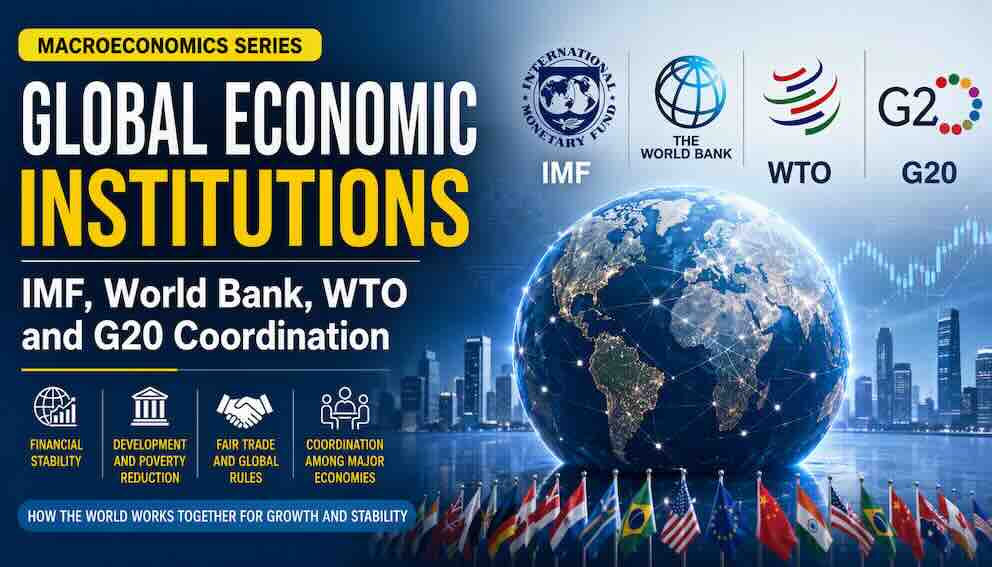
Why do countries accept painful economic conditions from the International Monetary Fund during a crisis? This tutorial explores the major global economic institutions that shape the international economy, including the International Monetary Fund (IMF), the World Bank, the World Trade Organization (WTO), the Bank for International Settlements (BIS), the OECD, BRICS, and the G20. It explains why these institutions were created, how they operate, and the roles they play in maintaining financial stability, promoting development, facilitating trade, regulating global banking, and setting international tax standards. Through real-world examples such as the Asian Financial Crisis, the Greek debt crisis, the 2008 global financial crisis, the COVID-19 pandemic, and recent sovereign debt restructurings in Zambia and Sri Lanka, the tutorial breaks down complex ideas into clear explanations. By the end, readers will understand how these institutions interact, where they fall short, and why they remain central to global economic governance.
Introduction: Why Global Economic Institutions Exist
When we study macroeconomics at the national level, we often focus on how governments manage inflation, unemployment, and growth within their own borders. However, in reality, no country operates in isolation. Trade flows connect economies. Financial markets transmit shocks across continents. A banking crisis in one country can quickly spread to others.
Because of this deep interdependence, there has long been a need for institutions that operate beyond national boundaries. These institutions help coordinate economic policies, provide financial support during crises, establish rules for trade, regulate the global banking system, and set international standards.
Global economic institutions emerged largely in response to periods of instability. The most important turning point came after the Second World War. Policymakers had witnessed the economic collapse of the 1930s. The Great Depression had shown how damaging protectionism, competitive devaluations, and financial instability could be when countries acted independently without a shared framework.
Understanding these institutions allows us to see that global economic outcomes are not simply the result of market forces. They are also shaped by collective decisions, negotiated rules, and coordinated actions.
The Bretton Woods System: The Origin Story
In July 1944, representatives from 44 Allied nations gathered in Bretton Woods, New Hampshire. The Second World War was still raging, but policymakers were already thinking about the post-war order. They wanted to avoid the mistakes that had followed the First World War: competitive devaluations, trade barriers, and financial instability that had contributed to the Great Depression.
The Bretton Woods system they designed had three main components.
First, a new set of institutions: the International Monetary Fund (IMF) to manage exchange rates and provide short-term financing, and the World Bank to fund long-term reconstruction and development.
Second, a system of fixed exchange rates. Currencies were pegged to the US dollar, and the US dollar was convertible to gold at $35 per ounce. This provided stability while still allowing adjustments when necessary.
Third, a commitment to gradual trade liberalization, which later led to the creation of the General Agreement on Tariffs and Trade (GATT) , the predecessor to the World Trade Organization.
The Bretton Woods system worked reasonably well for about twenty-five years. Exchange rates were stable. Trade expanded. Economies grew.
But the system contained a fundamental flaw, known as the Triffin dilemma. The US dollar was both the national currency of the United States and the international reserve currency. To supply the world with dollars, the US had to run balance of payments deficits. But large deficits eventually undermined confidence in the dollar's convertibility to gold.
By the late 1960s, US gold reserves were dwindling. Foreign central banks held more dollars than the US could redeem. In August 1971, President Richard Nixon announced that the US would no longer convert dollars to gold. The Bretton Woods system of fixed exchange rates collapsed.
This collapse matters for our tutorial because it changed the roles of the institutions we are about to discuss. The IMF shifted from managing fixed exchange rates to crisis lending. The world moved to floating exchange rates, but without a clear framework. Some economists call the current system a "non-system." Understanding Bretton Woods explains why the institutions exist in their current form.
The International Monetary Fund (IMF): Guardian of Financial Stability
What the IMF Does
The International Monetary Fund plays a central role in maintaining global financial stability. Its primary responsibilities are to monitor the international monetary system, provide financial assistance to countries facing balance of payments problems, and offer policy advice to member countries.
A balance of payments problem occurs when a country cannot meet its international financial obligations. This might happen because it imports more than it exports, experiences capital flight, or faces a sudden loss of investor confidence. When such situations arise, the IMF provides loans to help stabilize the country's economy.
However, IMF loans are not unconditional. They are typically accompanied by policy requirements, often called conditionality. These conditions are designed to address the underlying economic problems that led to the crisis. This is why countries sometimes accept painful austerity measures when they borrow from the IMF.
The Debate Over Conditionality
The IMF's justification for conditionality is straightforward. Without reforms, the underlying problems that caused the crisis will persist. Countries might borrow again. Creditors might lose confidence. Conditionality is intended to restore economic stability and rebuild trust.
However, critics argue that IMF conditions have sometimes made crises worse. In Argentina (2001-2002), the IMF required austerity measures that deepened the recession. Unemployment soared. Poverty increased sharply. Argentina eventually defaulted on its debt and abandoned its currency peg. Many economists argue that the IMF's conditions were inappropriate for Argentina's situation.
In Indonesia during the 1997 Asian Financial Crisis, the IMF required the closure of several banks. This triggered a nationwide bank run, making the crisis worse than it might otherwise have been. Critics argue that the IMF should have focused on stabilizing the banking system first and restructuring later.
These cases do not mean the IMF never helps. But they show that conditionality is a blunt instrument. The same policy that works in one country may fail in another.
Currency Manipulation and Exchange Rate Politics
The IMF has a mandate to oversee members' exchange rate policies and discourage competitive devaluations. Competitive devaluation occurs when a country deliberately weakens its currency to gain an unfair trade advantage.
In practice, this mandate has been largely ineffective. China has been accused for years of keeping its currency undervalued to support exports. The IMF has raised concerns but has not taken enforcement action. The problem is that the IMF's tools are limited. It can offer advice and conduct surveillance, but it cannot force a country to change its exchange rate policy.
This creates a significant gap in global economic governance. The WTO has trade rules but no authority over exchange rates. The IMF has exchange rate authority but limited enforcement power. Currency manipulation remains a source of ongoing friction.
Special Drawing Rights (SDRs)
The IMF has a unique financial instrument called Special Drawing Rights (SDRs) . An SDR is a reserve asset that the IMF creates. It is not a currency but can be exchanged for currencies among member countries.
During the COVID-19 pandemic, the IMF allocated $650 billion worth of SDRs to help countries manage liquidity needs. This was the largest allocation in history. It allowed countries to access foreign currency reserves without taking on new debt. This example shows how the IMF can act decisively in a global crisis.
Governance and Voting Shares
The IMF is governed by its member countries, but not all countries have equal voting power. Voting shares are weighted by financial contributions. The United States has the largest share, around 16.5 percent, which gives it significant influence. Other large economies such as Japan, China, Germany, and the United Kingdom also have substantial shares.
This weighted voting system means that richer countries have more control over IMF decisions. Critics argue that this reflects the interests of wealthy nations rather than the global community. Supporters argue that those who contribute more money should have more say.
The World Bank: Promoting Long-Term Development
Core Mission
Unlike the IMF, which focuses on short-term financial stability, the World Bank is primarily concerned with long-term economic development and poverty reduction. It provides loans and grants to developing countries for projects that improve infrastructure, education, healthcare, and living standards.
The World Bank operates through two main arms:
- The International Bank for Reconstruction and Development (IBRD) lends to middle-income countries at market-based rates.
- The International Development Association (IDA) provides concessional loans and grants to the poorest countries.
Real-World Examples of World Bank Projects
In many developing countries, lack of reliable roads, electricity, and water systems severely limits economic growth. The World Bank funds projects that address these gaps.
Across Sub-Saharan Africa, the World Bank has financed rural electrification projects. By expanding access to electricity, these projects enable businesses to operate more efficiently, allow students to study after dark, and improve healthcare services.
In India, the World Bank has supported programs to improve rural road connectivity. Better roads allow farmers to bring goods to market, children to attend school, and families to access healthcare.
The World Bank has also invested heavily in education. In Pakistan, it has supported programs that build schools, train teachers, and provide learning materials, particularly for girls who have historically been excluded from education.
Governance
Like the IMF, the World Bank has weighted voting. The United States holds the largest share. The President of the World Bank has traditionally been an American, while the Managing Director of the IMF has traditionally been European. This informal agreement reflects the post-war balance of power.
The World Trade Organization (WTO): Rules of Global Trade
Purpose and Function
The World Trade Organization is responsible for overseeing the rules that govern international trade. Its main objective is to ensure that trade flows as smoothly, predictably, and freely as possible.
The WTO provides a framework for negotiating trade agreements and a system for resolving disputes between countries. When countries believe their trading partners are violating agreed rules, they can bring cases to the WTO's dispute settlement mechanism.
How Trade Rules Affect Economies
Trade rules have very real effects on everyday life. Tariffs, which are taxes on imports, raise the price of goods for consumers. By reducing tariffs, trade agreements negotiated within the WTO framework can make products more affordable and increase the variety of goods available.
A well-known example of WTO dispute resolution is the long-running trade conflict between the United States and the European Union over aircraft subsidies. Both sides accused each other of providing unfair support to their respective aerospace industries, Boeing and Airbus. The WTO examined the claims and authorized retaliatory tariffs when violations were found.
Current Challenges Facing the WTO
The WTO has faced significant challenges in recent years. The Doha Development Round, launched in 2001 to address developing country concerns, never concluded. After nearly two decades of negotiations, members could not agree.
The dispute settlement system has also been weakened. The United States blocked appointments to the appellate body, which hears appeals in trade disputes. As a result, the system has been partially paralyzed.
Some observers question whether the WTO is losing relevance. Bilateral and regional trade agreements have proliferated, in part because global negotiations have stalled. Nevertheless, the WTO remains the only global forum for trade rules.
The Currency-Trade Gap
The WTO has no clear rules on currency manipulation. This creates a significant gap. A country could violate WTO trade rules by subsidizing exports directly, but it might be able to achieve the same effect by keeping its currency undervalued with no consequence. This gap between trade and monetary governance generates ongoing friction.
The Bank for International Settlements (BIS): The Central Bank for Central Banks
What the BIS Does
The Bank for International Settlements is often called the "central bank for central banks." Based in Basel, Switzerland, it serves as a forum for central bank cooperation. It is less well known than the IMF or World Bank, but it plays a crucial role in global financial stability.
The BIS hosts regular meetings of central bank governors. It provides a space for them to discuss policy challenges, share information, and coordinate responses to financial crises.
Research and Analysis
The BIS produces some of the most influential macroeconomic research in the world. Its work on credit cycles, global dollar funding, and financial stability is widely cited by central banks and academics. The BIS's annual reports are considered essential reading for policymakers. This research function is as important as its role as a meeting forum.
The Basel Accords
The BIS's most visible contribution to global economic governance is the Basel Accords on banking regulation.
- Basel I (1988) established minimum capital requirements for banks.
- Basel II (2004) introduced more risk-sensitive capital requirements.
- Basel III (2010–2017) was developed after the 2008 financial crisis. It increased capital requirements, introduced liquidity standards, and required banks to hold buffers against future losses.
These accords do not have the force of law, but they are implemented by national regulators. They have made the global banking system more resilient, though critics argue they are still insufficient.
Why the BIS Matters
The BIS matters because banking is global but regulation is national. A bank that fails in one country can cause damage worldwide. The BIS provides a forum for regulators to agree on common standards. Without it, each country would set its own rules, leading to a race to the bottom and increased financial instability.
The OECD: Setting Global Standards Through Research and Tax Policy
What the OECD Is
The Organisation for Economic Co-operation and Development (OECD) is less prominent than the IMF or World Bank, but it plays an important role in global economic governance. Based in Paris, the OECD has 38 member countries, mostly high-income economies.
Unlike the IMF or World Bank, the OECD does not lend money. Its influence comes from data, research, and standard-setting.
The OECD produces economic surveys, forecasts, and comparative statistics that are widely used by policymakers. It also develops international standards in areas such as taxation, corporate governance, and anti-corruption.
The Global Minimum Corporate Tax
The OECD's most significant recent achievement is the global minimum corporate tax. After years of negotiation, more than 130 countries agreed to a minimum corporate tax rate of 15 percent. This agreement addresses the problem of profit shifting, where multinational companies book profits in low-tax jurisdictions regardless of where they actually produce goods or provide services.
The OECD also coordinates the Base Erosion and Profit Shifting (BEPS) project, which aims to close loopholes in international tax rules.
Why the OECD Matters
The OECD matters because it fills governance gaps that other institutions cannot address. The IMF deals with macroeconomic stability. The World Bank deals with development. The WTO deals with trade. The OECD deals with standards and norms that underpin all these areas. A tutorial on global economic institutions that omits the OECD is missing a key piece.
Sovereign Debt Restructuring: The Missing Mechanism
One of the most significant gaps in global economic governance is the lack of a formal mechanism for sovereign debt restructuring. When a country cannot repay its debts, who decides how losses are shared between creditors? There is no global bankruptcy court for countries.
Currently, the IMF plays an informal role. It assesses whether a country's debt is sustainable and provides financing to support restructuring. But the process is messy and contested.
Zambia provides a recent example. Zambia defaulted on its debt in 2020. Negotiations with creditors dragged on for years. The country had many different creditors: traditional bondholders, China, other bilateral lenders, and private banks. Coordination was extremely difficult because there was no single forum to bring everyone together.
Sri Lanka followed a similar path. After defaulting in 2022, Sri Lanka faced prolonged negotiations with multiple creditor groups. The IMF provided a bailout, but the restructuring process remained slow and uncertain.
Ghana also defaulted and is going through a similar painful process.
These cases illustrate a real-world problem. When a country defaults, it needs a fast, predictable process to restructure its debts and return to growth. Instead, it gets years of uncertainty, which prolongs the economic pain and delays recovery. This is a significant gap in global economic governance.
Regional Institutions: The Eurozone Crisis as a Case Study
Global institutions are not the only players. Regional institutions also play important roles, and the eurozone crisis illustrates both their strengths and limitations.
The European Union (EU) is the most advanced regional institution. It has its own currency (the euro), its own central bank (the European Central Bank), and its own system of trade and competition rules.
When the eurozone crisis began in 2010, the European Central Bank acted decisively. It provided liquidity to banks and bought government bonds. This helped stabilize financial markets. In that sense, the ECB did what a central bank should do.
But the crisis also revealed a severe limitation. The eurozone had a monetary union (a single currency and central bank) but not a fiscal union (shared budget and coordinated tax policies). When countries like Greece, Ireland, Portugal, and Spain faced debt crises, there was no eurozone-wide fiscal authority to help them. The IMF and EU had to cobble together bailout programs, but these were slow and politically contentious.
The eurozone crisis taught a clear lesson. Regional institutions can be powerful, but they are not complete substitutes for global ones. They have their own governance gaps.
The African Development Bank and the Asian Development Bank complement the World Bank by funding development projects in their regions. They are often better attuned to local conditions.
ASEAN (the Association of Southeast Asian Nations) facilitates economic cooperation among ten Southeast Asian countries. It has helped reduce trade barriers and increase regional stability.
These regional institutions do not replace global ones. They work alongside them.
The G20: Coordination Among Major Economies
What the G20 Is
The G20 is a forum that brings together the world's largest economies, including both developed and emerging countries. Its members include the United States, China, Germany, Japan, India, the United Kingdom, France, Brazil, and others.
Unlike the IMF, World Bank, WTO, BIS, and OECD, the G20 is not a formal institution with a permanent structure. It has no staff, no budget, and no enforcement powers. It is a platform for discussion and coordination.
Historical Evolution
The G20 began as a meeting of finance ministers and central bank governors. It was elevated to the level of heads of state during the 2008 global financial crisis. Leaders recognized that coordinated action was necessary to prevent a repeat of the Great Depression.
Role in Crisis Management
During the 2008 crisis, the G20 played a key role in coordinating policy responses. Governments agreed to implement stimulus measures, support financial institutions, and avoid protectionist trade policies.
Many countries increased government spending to boost demand and prevent deeper recession. Central banks coordinated efforts to provide liquidity to financial markets. These actions helped stabilize the global economy.
Ongoing Challenges: Climate Change
Today, the G20 continues to address a wide range of issues, including climate change, digital taxation, international debt, and pandemic preparedness. However, the G20 has struggled significantly on climate change. Member countries have sharply divergent interests. Major oil producers resist rapid transition. Large developing countries argue that they should not bear the same costs as wealthy nations. As a result, G20 climate commitments have been weak, and implementation has been uneven.
The G20's effectiveness depends on cooperation among countries with different interests. This can make decision-making challenging, but it also reflects the reality of a multipolar world.
BRICS: A Challenge to the Bretton Woods Order
The weighted voting systems of the IMF and World Bank mean that developing countries have long felt underrepresented in global economic governance. BRICS is the most substantive institutional response to this grievance.
BRICS began as an acronym coined by Goldman Sachs economist Jim O'Neill in 2001 to group Brazil, Russia, India, China, and South Africa. It has since evolved into a formal forum with real institutional weight. The 2023 Johannesburg summit expanded membership to six additional countries: Saudi Arabia, the United Arab Emirates, Iran, Ethiopia, Egypt, and Argentina, though Argentina subsequently withdrew under its new government.
The most concrete institutional development is the New Development Bank (NDB), founded in 2015 and headquartered in Shanghai. Unlike the World Bank, the NDB operates on the principle of equal voting shares among founding members, regardless of economic size. It has approved over $30 billion in financing across infrastructure, clean energy, and development projects in member states.
BRICS does not yet constitute a rival system to Bretton Woods. Its members have divergent interests — India and China maintain significant geopolitical tensions, and no common currency has materialized despite recurring discussion. But its significance lies less in what it has built than in what it represents: a serious and growing political constituency for reforming global economic governance from the outside if reform from within proves too slow.
How These Institutions Work Together: The COVID-19 Pandemic
The COVID-19 pandemic provides a clear example of how these institutions interact, both succeeding and failing.
Successes:
- The IMF provided financial assistance to countries facing economic shocks and allocated $650 billion in SDRs.
- The World Bank funded healthcare systems, vaccine distribution, and social protection programs.
- The BIS helped central banks coordinate liquidity support.
- The OECD contributed analysis and data on the economic impact of the pandemic.
Failures:
- Vaccine nationalism was rampant. Wealthy countries secured vaccine supplies for themselves before doses were available to developing countries. The WTO struggled to facilitate vaccine distribution because its mandate is trade rules, not health logistics.
- Export restrictions on medical supplies were imposed by dozens of countries. The WTO was largely powerless to stop them.
- Debt relief moved slower than promised. The G20's Debt Service Suspension Initiative helped, but the process for long-term restructuring remained uncertain, as seen in Zambia and Sri Lanka.
The COVID-19 pandemic shows both the value of global economic institutions and their limitations. They helped prevent a full-scale depression. But they could not overcome nationalism, coordination failures, and governance gaps.
This balanced assessment supports the conclusion that these institutions are imperfect but necessary.
Conclusion: Imperfect but Necessary, and Under Pressure
Global economic institutions remain central to the functioning of the modern world economy. They provide structure, stability, and a framework for cooperation in an otherwise complex and interconnected system.
Their roles have evolved over time in response to new challenges: financial crises, the rise of emerging economies, global pandemics, climate change, digital taxation, and now the emergence of alternative institutions like the New Development Bank.
The Bretton Woods system collapsed in 1971, but the institutions created there endure. The IMF now lends to rich and poor countries alike. The World Bank has added climate goals to its mission. The WTO struggles to adapt but remains essential. The BIS continues to strengthen global banking standards. The OECD sets tax rules that affect billions of people. The G20 coordinates policy among the world's largest economies. BRICS and the NDB represent a challenge to the existing order.
These institutions are imperfect. The weighted voting systems of the IMF and World Bank favor wealthy countries. The WTO's dispute settlement system is partially paralyzed. There is no formal mechanism for sovereign debt restructuring. Currency manipulation continues with little consequence. The G20 cannot enforce its decisions. BRICS members have divergent interests.
But they are also necessary. Without them, managing the global economy would be far more difficult and far less stable. When a crisis hits, countries turn to these institutions not because they are perfect, but because they are the only framework available. Understanding how they work, their strengths and their limitations, and the political pressures they face from alternatives like BRICS, is essential for anyone who wants to understand the global economy.
About Swati Sharma
Lead Editor at MyEyze, Economist & Finance Research WriterSwati Sharma is an economist with a Bachelor’s degree in Economics (Honours), CIPD Level 5 certification, and an MBA, and over 18 years of experience across management consulting, investment, and technology organizations. She specializes in research-driven financial education, focusing on economics, markets, and investor behavior, with a passion for making complex financial concepts clear, accurate, and accessible to a broad audience.
Disclaimer
This article is for educational purposes only and should not be interpreted as financial advice. Readers should consult a qualified financial professional before making investment decisions. Assistance from AI-powered generative tools was taken to format and improve language flow. While we strive for accuracy, this content may contain errors or omissions and should be independently verified.