Tutorial Categories
Last Updated: May 19, 2026 at 10:30
The Solow Growth Model Explained: How Capital, Savings, Population, and Technology Shape Long-Run Prosperity
Understanding Why Some Nations Grow Rich While Others Stay Poor — A Step-by-Step Guide to the Most Influential Framework in Growth Economics
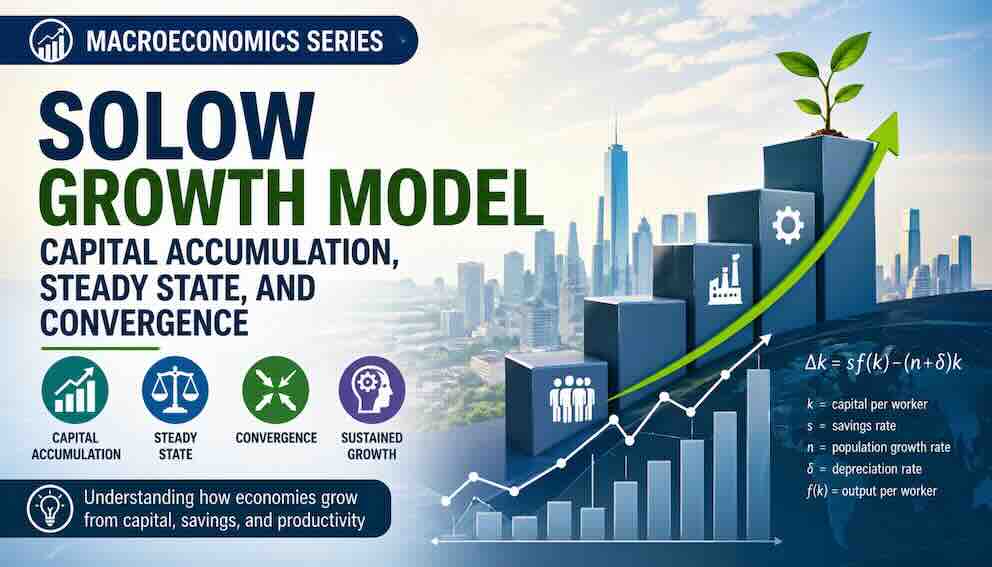
Why did South Korea grow so fast while the Philippines, with a similar starting point, did not? The Solow Growth Model provides the answer. This tutorial introduces one of the most influential frameworks in macroeconomics for understanding long-run economic growth. It walks through how capital accumulation, savings, population growth, depreciation, and technology interact to determine a country's path from poverty to prosperity. You will learn what the steady state means for living standards, why diminishing returns ensure that capital alone cannot sustain growth forever, and how the concept of conditional convergence explains why some poor countries catch up while others fall further behind. With a detailed numerical example and plain-language explanations of every equation, this guide makes complex growth theory accessible and intuitive.
Introduction: The Puzzle of Diverging Fortunes
In 1960, South Korea and the Philippines had similar income levels. Both were poor by global standards, with economies built on agriculture and light manufacturing. An observer from that time might have predicted roughly similar futures for both nations.
They would have been wrong. By 2020, South Korea had become a high-income country with world-leading industries in electronics, automobiles, and shipbuilding. The Philippines, while having made progress, remained far behind. What explains this dramatic divergence? What determines why some economies grow rich while others do not?
The answer lies in understanding the building blocks of economic growth itself. At its core, the Solow Growth Model — developed by economist Robert Solow in the 1950s — does something simple but powerful: it explains how an economy's standard of living is shaped by how much it saves, how fast its population grows, and how quickly it adopts new technology. Think of it as a framework that tracks how a country builds up its stock of tools, machines, and factories over time, and asks: when does that process slow down, and what keeps living standards rising in the long run?
The model's central insight is that simply investing in more machinery cannot sustain growth forever. Due to diminishing returns, each additional machine added to an economy contributes less than the one before it. Every economy therefore drifts toward a steady state — a point where new investment merely replaces worn-out capital and keeps pace with a growing population, but stops raising living standards further. Only continuous technological progress can push past this ceiling.
This framework helps explain precisely why South Korea and the Philippines diverged. Differences in savings rates, population growth, and above all the ability to absorb new technology set the two nations on very different long-run paths — exactly the kind of divergence the Solow model was built to illuminate.
The Building Blocks: Capital, Labor, and Technology
At its simplest level, the Solow model asks a straightforward question: what determines how much an economy can produce? The answer, according to the model, is three things.
The first is capital, which economists denote with the letter K. Capital includes everything that workers use to produce goods and services that is itself produced. Factories are capital. Machines are capital. Trucks, computers, office buildings, and software are all capital. A worker with a bulldozer can dig more holes than a worker with a shovel, so more capital means more output.
The second is labor, denoted by L. Labor is simply the number of workers in the economy, or more precisely the total hours they work. More workers mean more output, all else equal. However, adding more workers while holding capital constant means each worker has less capital to work with, which will matter when we discuss diminishing returns.
The third is technology, denoted by A. Technology is the efficiency with which capital and labor are combined. Better technology means that the same factory with the same workers produces more output. Technology includes not just high-tech inventions like computer chips but also better management practices, more efficient supply chains, and improvements in how work is organised.
The relationship between these three inputs and total output is captured by a production function. The Solow model typically uses a specific form called the Cobb-Douglas production function:
Y = K^α × (A × L)^(1-α)
Let us unpack what this means. Y is total output, or GDP. α (alpha) is a number between zero and one that measures how sensitive output is to changes in capital. Standard research estimates put α at about one-third. This means that capital contributes about one-third of output, while labor (adjusted for technology) contributes about two-thirds.
The term A × L is sometimes called effective labor. It captures the idea that a worker with better technology is like having more workers. One worker using a computer is more productive than one worker without a computer. Multiplying A and L together allows us to treat technological progress as making the labor force more effective.
This production function has two properties that are essential to understanding the Solow model.
The first property is constant returns to scale. If you double both capital and effective labor, output doubles. This seems straightforward: a bigger economy produces more. The implication is that the size of the economy does not affect its growth rate just by being larger.
The second property is diminishing returns to capital. If you increase capital while holding effective labor constant, output increases, but each additional unit of capital adds less than the previous one. This is the most important intuition in the entire Solow model, and it deserves a concrete example.
Understanding Diminishing Returns: The Bakery and the Bulldozer
Imagine a small bakery with one baker. The baker works with one oven. That oven allows the baker to produce one hundred loaves of bread per day. Now suppose the bakery buys a second oven. The baker can now use two ovens, but because there is still only one baker, the second oven adds perhaps sixty additional loaves. The first oven added one hundred loaves. The second added sixty. The return has diminished.
Now add a third oven. The baker cannot use three ovens at once. The third oven might add only twenty loaves when the baker occasionally uses it. Add a fourth oven, and it adds almost nothing. Each additional oven contributes less than the one before.
This is diminishing returns. It applies to capital broadly, not just ovens. A farmer with one tractor can plow many fields. A second tractor helps, but less than the first. A tenth tractor adds almost nothing because there is only so much land and only one farmer.
The critical implication for the Solow model is this: if diminishing returns apply to capital, then simply adding more and more capital cannot sustain growth forever. Eventually, each new machine adds so little output that the economy stops growing unless something else changes. That something else is technology.
This intuition is the heart of why the Solow model predicts that capital accumulation alone leads to a steady state rather than endless growth. Before we introduce the equations, let us walk through the full story of how an economy moves from poverty to steady state.
The Journey from Poverty to Steady State: A Conceptual Walkthrough
Now that we understand diminishing returns, let us think carefully about what happens when an economy begins with very little capital and then starts saving and investing. The intuition behind the steady state is more important than any set of numbers, and that intuition comes from understanding three simple forces: the high returns to investment in poor economies, the gradual exhaustion of those returns as capital accumulates, and the constant drag of depreciation and population growth.
Why Poor Economies Grow Fast
Imagine an economy that is very poor. Capital per worker is low. In this situation, each new machine or new factory adds a great deal to output because there are so few machines already in place. A single tractor can transform a farm. A single welding machine can help rebuild a factory. The return on investment is high.
When investment adds a lot to output, saving a portion of that output generates a large amount of new investment. That new investment raises the capital stock substantially. So poor economies, when they save and invest, tend to grow rapidly.
The Forces That Slow Growth Down
Two forces work against this accumulation over time. The first is depreciation. Every year, capital wears out. Machines break. Buildings age. Computers become obsolete. A certain fraction of the capital stock disappears each year simply through use and the passage of time.
The second force is population growth. If the number of workers is increasing, the existing capital must be spread across more people. Even if the total capital stock is growing, capital per worker might not rise much if the population is growing quickly. Some of the new investment must go just to equip new workers with the same amount of capital as existing workers.
How Diminishing Returns Gradually Bite
As capital per worker rises, the marginal product of capital falls. This is diminishing returns in action. The tenth machine in a factory adds less to output than the first machine did. The hundredth adds even less. So each new unit of investment generates less additional output than the previous unit did.
Because investment is a fraction of output, and output grows more slowly as diminishing returns set in, the amount of new investment generated by saving also grows more slowly. The engine of accumulation loses power over time.
At the same time, the amount of investment needed just to keep capital per worker constant is rising. Why? Because depreciation is a fixed fraction of a larger capital stock. A five percent depreciation rate on a small capital stock is a small number. The same five percent on a large capital stock is a much larger number. The same logic applies to population growth: equipping new workers with capital costs more when the capital stock is larger.
The Steady State as a Natural Destination
Eventually, these forces meet. The extra output generated by the last unit of capital becomes exactly equal to the amount of investment needed to keep that unit of capital in place and to provide for new workers. At that point, the economy stops accumulating capital per worker. It has reached its steady state.
The steady state is not a sudden stop. It is a gradual approach. In the early stages of development, growth is fast. A little saving goes a long way. In the middle stages, growth is slower. The easy gains have been made. In the later stages, growth from capital accumulation slows to a crawl. The economy is near its steady state, and only technological progress can raise living standards further.
Real-World Patterns
This pattern matches the experience of many countries. South Korea in the 1960s grew extremely rapidly. The same South Korea in the 2010s grew much more slowly. It was not because South Korea stopped investing. It was because South Korea had accumulated so much capital that the returns to further investment had diminished. The economy was approaching its steady state.
The same pattern appears in the history of the United States. In the nineteenth century, when capital was scarce, growth from capital accumulation was rapid. In the twentieth century, after the capital stock had been built up, growth from capital alone slowed, and technological progress became the main driver of rising living standards.
What the Steady State Does and Does Not Mean
The steady state is not a trap. It is not a failure of the economy. It is simply where the economy naturally settles when the forces of diminishing returns, depreciation, and population growth balance the forces of saving and investment.
Reaching the steady state does not mean the economy stops growing. It means that growth from capital accumulation has stopped. Any further growth in output per worker must come from improvements in technology or increases in human capital. We will turn to those forces later in this tutorial.
How Capital Changes Over Time: The Accumulation Equation
Now that we have a clear conceptual understanding of the journey from poverty to steady state, we can introduce the equation that formalizes this process. The Solow model captures how the capital stock evolves from year to year with a simple but powerful equation:
ΔK = sY - δK
Let us break this down piece by piece, connecting each term back to the intuition we just developed.
ΔK (delta K) means the change in the capital stock from one year to the next. If ΔK is positive, the economy has more capital this year than last year. If ΔK is negative, the capital stock is shrinking.
s is the savings rate. This is the fraction of output that the economy saves rather than consumes. If a country has an output of one hundred billion dollars and saves twenty percent of it, then s equals 0.2. The savings rate is not determined within the Solow model. It comes from culture, policy, demographics, and other factors outside the model. This is one of the model's limitations, but it also makes the model flexible.
sY is total saving, which in a closed economy equals total investment. When people save money, that money does not just sit in a bank. It is lent to firms that use it to buy new machines, build new factories, and invest in new capital. So sY represents the flow of new capital being added to the economy each year. This is the force that pushes capital up.
δ (delta) is the depreciation rate. Capital does not last forever. Machines break. Buildings age. Trucks wear out. Computers become obsolete. Depreciation is the fraction of the capital stock that disappears each year due to wear, tear, and obsolescence. A typical value used in research is five percent per year, so δ = 0.05.
δK is total depreciation. If the capital stock is one million dollars and depreciation is five percent, then fifty thousand dollars worth of capital wears out each year. This is the force that pushes capital down.
The equation ΔK = sY - δK therefore says something very intuitive: the capital stock increases when the amount of new investment (sY) is larger than the amount of capital that wears out (δK). The capital stock decreases when depreciation exceeds investment. The capital stock stays constant when investment exactly equals depreciation.
Adjusting for Population Growth
Now consider what happens to this equation when we care about living standards. What matters for the quality of life in an economy is not the total capital stock but the amount of capital per worker. A country with a huge capital stock but a huge population might have very little capital per worker. So we need to adjust for population growth.
Let n be the population growth rate. If the population is growing, then even if the total capital stock is growing, capital per worker might be falling because there are more workers to share the capital. The equation for the change in capital per worker becomes:
Δ(K/L) = sY - (δ + n)K
The term (δ + n)K represents the amount of investment needed just to keep capital per worker constant. The δK part replaces worn-out capital. The nK part provides capital for new workers. If a country has a population growth rate of two percent per year, it must invest two percent of its capital stock each year simply to equip new workers with the same amount of capital as existing workers. Only investment above this amount raises capital per worker.
This explains why countries with rapid population growth often struggle to raise living standards. They are running on a treadmill: much of their investment goes just to keep capital per worker from falling, not to increasing it.
The Steady State: Where the Forces Balance
Now we arrive at the mathematical definition of the steady state, which should feel familiar from our conceptual walkthrough. The steady state is a situation in which capital per worker remains constant over time. In steady state, investment exactly equals the amount needed to cover depreciation and population growth:
sY = (δ + n)K
When this equation holds, Δ(K/L) = 0. Capital per worker stops changing. Output per worker stops changing. Growth from capital accumulation comes to a halt.
Why does the economy not keep growing forever? The answer is diminishing returns, which we explored earlier. As capital per worker increases, each additional unit of capital produces less and less additional output. Eventually, the extra output from adding one more machine is so small that it barely covers the cost of replacing that machine when it wears out and providing a machine for each new worker. At that point, the economy stops accumulating capital. It has reached its steady state.
If the savings rate increases, the economy will transition to a new, higher steady state. During that transition, growth accelerates. But once the new steady state is reached, growth from capital stops again. The only way to get sustained growth in output per worker in the Solow model is technological progress.
The Role of Technology: The Only Source of Sustained Growth
If capital accumulation cannot sustain growth forever, how have rich countries continued to grow for two centuries? The answer is technological progress.
In the Solow model, technological progress is represented by improvements in A, the technology term in the production function Y = K^α × (A × L)^(1-α). When technology improves, the entire production function shifts upward. The same amount of capital and labor produces more output.
Let us be clear about what this means in practice. In 1900, a farmer with a horse and a plow could produce a certain amount of grain. In 2020, a farmer with a tractor, GPS-guided seeding, and genetically modified seeds can produce many times more grain with the same or even less labor. That is technological progress. The capital stock (the tractor) matters, but so does the knowledge embedded in the seeds and the GPS system.
When technology improves, the steady state itself moves. The economy is no longer at its old steady state. It is now below its new steady state, so growth resumes. As technology continues to improve, the economy can grow indefinitely. This matches what we observe in the real world: living standards in advanced economies have been rising for generations not because savings rates keep increasing, but because of steam engines, electricity, the internal combustion engine, computers, and the internet.
The Solow model treats technological progress as exogenous. This means it comes from outside the model. The model does not explain why technology improves. It simply takes technological progress as given. This is a limitation, but it is also a deliberate choice. The Solow model is designed to show that even without explaining technology, capital accumulation alone cannot sustain growth. Something else must be doing the work. That something else is technology.
In later tutorials in this series, we will explore endogenous growth theory, which tries to explain where technology comes from and why some countries innovate while others do not. For now, the key takeaway is that in the Solow model, sustained growth in output per worker requires sustained technological progress.
Human Capital: The Missing Piece That Explains South Korea Versus the Philippines
The basic Solow model we have been discussing includes only physical capital: machines, buildings, infrastructure. But any parent knows that a child's education matters for their future earnings. The same logic applies to countries. A workforce with more education and better skills is a more productive workforce.
In 1992, economists Mankiw, Romer, and Weil published a landmark paper extending the Solow model to include human capital. Human capital (denoted H) represents the skills, education, training, and health of the workforce. Their augmented production function takes the form:
Y = K^α × H^β × (A × L)^(1-α-β)
Where α and β are numbers between zero and one. A typical estimate is that α ≈ 1/3 for physical capital and β ≈ 1/3 for human capital, leaving about one-third for raw labor.
Adding human capital changes the model in two important ways.
First, it raises the steady state level of output. Countries that invest in education have higher steady-state incomes than countries that do not, even if they have the same physical capital.
Second, it helps explain the real-world divergence between countries like South Korea and the Philippines. South Korea did not just invest in factories. It invested heavily in education. In 1960, South Korea's primary school enrollment rate was already high. By 1980, secondary school enrollment had soared to nearly ninety percent, and tertiary enrollment followed in the 1990s. The Philippines, by contrast, had lower secondary and tertiary enrollment throughout this period. The same savings rate with different human capital investments leads to different outcomes.
Of course, school enrollment is only a rough measure of human capital. South Korea's investment in human capital went far beyond enrollment numbers, focusing on the quality of education and the development of a highly skilled, adaptable workforce. The Philippines, by contrast, struggled to translate schooling into the same level of productive capability, a gap that reflects not only education quality but also the broader economic environment in which human capital is used.
The augmented Solow model is now the standard framework for empirical growth research. It explains cross-country income differences far better than the basic model. A country can have plenty of machines, but without the skilled workers to run them, those machines will not produce as much output.
Convergence and Conditional Convergence: Why Some Poor Countries Catch Up While Others Fall Behind
One of the most intuitive predictions of the Solow model is convergence. Poor countries, which have low levels of capital per worker, should grow faster than rich countries. The reasoning is straightforward: diminishing returns mean that a given amount of investment produces a larger increase in output when capital is scarce than when capital is abundant. A thousand dollars of new machinery in a poor country with very few machines raises output a lot. The same thousand dollars in a rich country with many machines raises output very little.
The post-war experience of Western Europe and Japan is often cited as an example of convergence. After 1945, these economies had very low capital stocks. They grew rapidly, catching up to the United States over several decades. Germany and Japan in particular experienced economic miracles.
However, the evidence on unconditional convergence between all rich and poor countries globally has been weak. Many poor countries in Africa and South Asia have not caught up at all. Some have fallen further behind. This seems to contradict the convergence prediction. The resolution is conditional convergence.
Conditional convergence means that countries converge to their own steady states, not to a common steady state. Each country's steady state depends on its structural characteristics: its savings rate, its population growth rate, its human capital levels, and the quality of its institutions. Countries with high savings rates, low population growth, high human capital, and strong institutions will have high steady-state incomes. Countries with the opposite will have low steady-state incomes.
Thus, a poor country with a high savings rate and high human capital will grow quickly and converge to a high steady state. A poor country with a low savings rate and low human capital will grow slowly and converge to a low steady state. That explains South Korea versus the Philippines. Both were poor in 1960. But South Korea had a high savings rate, invested heavily in education, and built strong institutions. The Philippines did not. So South Korea converged to a high steady state while the Philippines converged to a much lower one.
This is why the policy implications of the Solow model are so important. Countries are not doomed by their history. They can raise their steady state by increasing savings, investing in education, reducing population growth, and improving institutions.
Policy Implications: What the Solow Model Tells Us About Helping Countries Grow
The Solow model, especially in its augmented form with human capital, has clear implications for economic policy.
First, policies that increase the savings rate and investment can raise the steady-state level of output. Governments can encourage saving through tax incentives, financial market reforms, and stable macroeconomic policies that reduce uncertainty. However, increasing the savings rate only raises the level of output, not its long-run growth rate. Once the new steady state is reached, growth from capital stops again.
Second, policies that reduce population growth can increase capital per worker. This is one reason why family planning programs and education for women are considered development priorities. Lower population growth means less investment is needed just to equip new workers, so more investment can go toward raising capital per worker.
Third, policies that promote human capital accumulation are essential. The augmented Solow model shows that human capital is at least as important as physical capital. Investment in education, training, and health raises the steady state and directly improves living standards. South Korea's rapid growth was as much about schools as it was about factories.
Fourth, policies that promote technological progress are essential for sustained long-run growth. This includes funding for basic research, patent protection to encourage innovation, and policies that facilitate the adoption of technologies developed elsewhere.
The model also has implications for foreign aid. If poor countries are poor because they have low capital, aid that increases investment can help them grow faster. This is the view associated with economist Jeffrey Sachs. But if they are poor because of weak institutions, low savings rates, or low human capital, aid may have only temporary effects unless it addresses those underlying factors. This is the view associated with economist William Easterly. The Solow model does not resolve this debate, but it provides the framework for having it.
Conclusion: The Enduring Legacy of the Solow Model
The Solow Growth Model provides a clear and structured way to understand how economies grow over time. By focusing on capital accumulation, population growth, depreciation, and technological progress, it explains both the opportunities and the limits of economic expansion.
The journey from poverty to prosperity begins with high returns to investment, which generate rapid growth. As capital accumulates, diminishing returns gradually slow the engine of growth. Depreciation and population growth act as constant drags, requiring ever more investment just to stay in place. Eventually, the economy reaches its steady state, where growth from capital alone stops. From there, only technological progress can raise living standards further.
Human capital matters enormously, as the augmented Solow model shows. Countries that invest in education do not just grow faster in the short run; they also settle at higher steady-state levels of income. Conditional convergence explains why some poor countries catch up while others do not: they converge to their own steady states, which depend on their savings rates, population growth, human capital, and institutions.
The model has limitations. It does not explain savings rates, population growth, or technological progress. It assumes perfect competition. But these limitations are not fatal. They are invitations to further work, including endogenous growth theory, which explores where technology comes from and why some societies innovate faster than others.
Despite these limitations, the Solow Growth Model remains the foundation of modern growth theory. It is the starting point for any serious discussion of why countries are rich or poor. Understanding it is essential for understanding the long-run trajectory of the global economy. The journey from poverty to prosperity is a journey of diminishing returns, steady states, and the relentless pursuit of better ways of doing things. The Solow model gives us the map for that journey.
About Swati Sharma
Lead Editor at MyEyze, Economist & Finance Research WriterSwati Sharma is an economist with a Bachelor’s degree in Economics (Honours), CIPD Level 5 certification, and an MBA, and over 18 years of experience across management consulting, investment, and technology organizations. She specializes in research-driven financial education, focusing on economics, markets, and investor behavior, with a passion for making complex financial concepts clear, accurate, and accessible to a broad audience.
Disclaimer
This article is for educational purposes only and should not be interpreted as financial advice. Readers should consult a qualified financial professional before making investment decisions. Assistance from AI-powered generative tools was taken to format and improve language flow. While we strive for accuracy, this content may contain errors or omissions and should be independently verified.