
Tutorial Categories
Last Updated: April 17, 2026 at 10:30
Mathematical Preliminaries for Macroeconomics: A Conceptual Guide to the Tools Economists Use
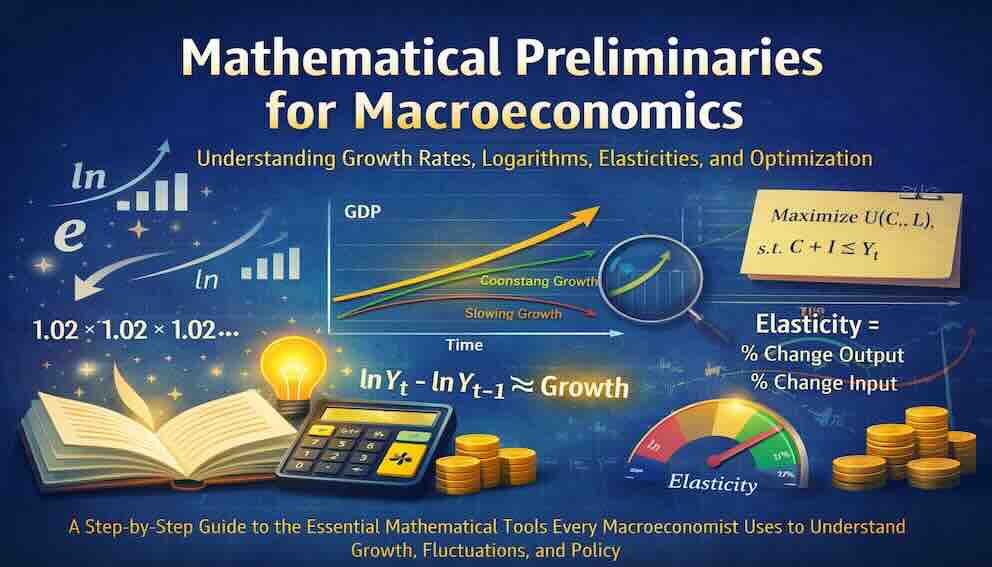
Understanding Growth Rates, Logarithms, Elasticities, and Optimization – Without Getting Lost in the Math
What do economists mean when they talk about growth rates, logarithms, or elasticities? This tutorial explains the essential mathematical tools of macroeconomics in plain language, focusing on the intuition behind each concept rather than the calculations. You will learn why a small difference in growth rates transforms living standards over time, how logarithms turn complicated multiplication into simple addition, and what economists mean when they say a household is "optimising" subject to constraints. Whether you are a student starting your economics journey or a curious reader trying to make sense of economic news, this guide provides the conceptual foundation you need to understand how economists think about growth, fluctuations, and policy.
Introduction: Why Math? The Language of Economic Precision
Imagine trying to describe the path of a hurricane without using any numbers. You could say it is moving quickly and getting stronger, but you could not say whether it will make landfall in three hours or three days, whether the winds will be dangerous or catastrophic, or how much rain will fall. Without numbers, your description would be vague and your predictions unreliable.
Economics faces a similar challenge. The economy is a complex system with millions of moving parts—households deciding how much to spend, firms deciding how much to invest, central bankers setting interest rates, governments designing tax policies. To understand this system, to make predictions about its future path, and to evaluate whether one policy is likely to work better than another, economists need more than words. They need mathematics.
Mathematics in macroeconomics is a tool—a precise language that allows economists to state assumptions clearly, to derive conclusions rigorously, and to compare predictions with data. When an economist says that a one percent increase in interest rates will reduce investment by two percent, that statement is built on a foundation of mathematical concepts: growth rates, logarithms, elasticities, and optimization. These tools may seem abstract at first, but they are simply ways of making precise the kinds of reasoning that people already do intuitively.
This tutorial is designed for readers who may not have studied mathematics beyond high school. We will move slowly, use plenty of examples, and focus on intuition rather than technical detail. By the end, you will understand why macroeconomists use these tools, what they mean, and how they help us understand the economy more clearly. You will not become a mathematician, but you will become a more sophisticated reader of economic analysis—able to better follow the logic behind the headlines and to think more precisely about the economic questions that matter.
Time Indexing – The Language of When Things Happen
Before we can discuss growth rates, we need a way to talk about variables at different points in time. Economists use time indexing to indicate when a variable is measured. If we let t represent the current time period—say, the year 2024—then Yₜ represents the value of GDP in that year. Yₜ₋₁ represents GDP in the previous year (2023), and Yₜ₊₁ represents GDP in the next year (2025). This simple notation allows us to write precise statements about change over time.
The growth rate of GDP from one year to the next can be written as:
(Yₜ − Yₜ₋₁) / Yₜ₋₁ × 100
Or, using our growth rate formula: (new minus old) divided by old, multiplied by 100.
Time indexing becomes essential when we start building models that describe how the economy evolves over time. A typical macroeconomic model might consist of equations that describe how Yₜ (output today) depends on Kₜ (capital today) and Lₜ (labor today), and then another set of equations that describe how Kₜ₊₁ (capital tomorrow) depends on Kₜ (capital today) and Iₜ (investment today). This is how economists model the dynamics of growth and business cycles: by specifying the relationships between variables at different points in time.
Time indexing also allows us to distinguish between levels and changes. The level of GDP in 2024 is Y₂₀₂₄. The change in GDP from 2023 to 2024 is Y₂₀₂₄ − Y₂₀₂₃. The growth rate is (Y₂₀₂₄ − Y₂₀₂₃) / Y₂₀₂₃. When you see a subscript t, it means "at time t." When you see t+1, it means "one period ahead." When you see t−1, it means "one period behind." This notation is the foundation of dynamic economic analysis.
Key takeaway: Time indexing (using subscripts like Yₜ) allows economists to write precise statements about how variables change over time and how current decisions affect future outcomes.
Growth Rates and Percentage Change – The Language of Economic Movement
When economists talk about the economy, they are almost always talking about change. How fast is the economy growing? How quickly are prices rising? How much has unemployment increased? These are all questions about growth rates and percentage changes. Understanding how to work with them is the first essential skill.
Suppose we want to measure how the U.S. economy performed in 2023. The most common measure is the growth rate of real GDP—the percentage change in the inflation-adjusted value of everything the country produced. If real GDP was $20 trillion in 2022 and $20.5 trillion in 2023, we calculate the growth rate as:
(New Value − Old Value) / Old Value × 100
In this case: (20.5 − 20) / 20 × 100 = 0.5 / 20 × 100 = 2.5 percent.
The U.S. economy grew by 2.5 percent in 2023. This single number tells us that the economy expanded at a moderate pace, not too fast to overheat but fast enough to keep unemployment low.
The difference between growth rates that seem small can be enormous over time. Consider two countries. South Korea grew at an average rate of about 7 percent per year from 1960 to 1990. Argentina grew at an average rate of about 1 percent per year over the same period. At 7 percent growth, an economy doubles roughly every 10 years (using the rule of 70: 70 / 7 = 10). At 1 percent growth, it takes 70 years to double. Over three decades, South Korea transformed from a poor agricultural country to an industrial powerhouse, while Argentina stagnated. The difference in annual growth rates—just six percentage points—created a chasm in living standards. This is why economists care so much about growth rates: small differences compounded over time create enormous outcomes.
In macroeconomics, we often work with annualized growth rates. Annualized growth is a way of taking short-term data—like quarterly growth—and expressing it as if that same pace continued for a full year, so a 0.5% increase in one quarter is roughly reported as 2% annually (0.5 × 4). This allows us to compare growth across different time periods. However, growth doesn’t simply add up; it compounds, meaning each period’s growth builds on the previous one, so the exact annual growth would be slightly higher than 2%. This leads to the distinction between discrete compounding, where growth happens in steps (like each quarter), and continuous compounding, where growth is imagined as happening smoothly all the time. In practice, the difference between the two is very small when growth rates are low, but economists often prefer continuous compounding because it has the mathematical advantage of working seamlessly with natural logarithms, making calculations and models much simpler to handle. We will see this shortly.
The rule of 70 is a useful shortcut for understanding the power of growth rates. To find out how many years it will take for an economy to double in size, divide 70 by the annual growth rate. At 2 percent growth, it takes about 35 years to double (70 / 2 = 35). At 3 percent growth, it takes about 23 years (70 / 3 ≈ 23.3). At 7 percent growth—the rate South Korea achieved for decades—it takes only 10 years. This rule makes vivid why growth rates matter so much.
One of the most common confusions in economics—and one that frequently leads to misleading headlines—is the difference between a percentage point change and a percentage change. A percentage point change is simply the straight subtraction of two percentages. If the unemployment rate rises from 4 percent to 5 percent, it has increased by one percentage point. This tells us how many points it moved on the scale. But the percentage change asks a different question: how big is that move relative to where we started? Using the formula ((New Value − Old Value) / Old Value × 100, the increase from 4 percent to 5 percent is (5 − 4) / 4 × 100 = 25 percent. So the unemployment rate increased by 25 percent, even though it only moved by one percentage point.
The distinction matters because these two measures tell very different stories, and the choice of which to report can dramatically shape how a reader perceives the news. The same one-percentage-point increase from 4 percent to 5 percent sounds like a 25 percent jump when reported as a percentage change—a number that feels alarming. But from an economic perspective, a move from 4 to 5 percent is a relatively mild deterioration; the economy is still near what many economists consider full employment. Conversely, a one-percentage-point increase from 10 percent to 11 percent yields only a 10 percent relative increase—a number that sounds smaller—yet this move is economically far more serious because it means the unemployment rate is already high and rising further into distressed territory.
In other words, the percentage change number tells you how large the move is relative to the starting point, but it does not tell you whether the starting point itself is healthy or unhealthy. A 25 percent increase from a low base (4 to 5) is often less concerning than a 10 percent increase from a high base (10 to 11), because the latter means the economy is already in a difficult position. This is why economists are careful to specify both the percentage point change and the context of the starting level. A headline that screams "unemployment rises by 25 percent" could be describing a move from 4 to 5 percent—a significant but not catastrophic shift. A headline that quietly notes a "one percentage point increase" could be describing a move from 10 to 11 percent—a serious deterioration in labor market conditions. The simple way to remember the distinction is this: percentage points tell you how much something moved; percentage changes tell you how big that move is compared to where it started. But neither number alone tells you whether the starting point itself was healthy. That is why economists always look at both the change and the level.
A crucial distinction: Economists focus on changes (differences) rather than levels because most macroeconomic variables—GDP, prices, money supply—trend upward over time. A graph of GDP in levels shows a steady upward slope, but it is difficult to see patterns or compare different periods. By looking at growth rates (differences), economists can see whether the economy is accelerating or slowing, and they can compare the performance of economies of very different sizes. When you hear about "quarter-over-quarter" or "year-over-year" changes, this is the reason: levels tell you where we are; changes tell you where we are going.
Key takeaway: Growth rates and percentage changes are the basic vocabulary of macroeconomics. A small difference in growth rates, compounded over time, can transform living standards. The rule of 70 provides an intuitive way to understand how long it takes for an economy to double at a given growth rate. Economists focus on changes (differences) rather than levels because changes reveal patterns that levels obscure.
Logarithms – The Mathematician's Tool for Growth
Logarithms – A Simple Way to Handle Growth
If growth rates are the language of economic change, logarithms are what make that language easy to work with. The key idea is much simpler than it first appears:
Logarithms turn multiplication into addition.
This matters because economic growth is all about multiplication. If an economy grows by 2 percent each year, we keep multiplying by 1.02 again and again. Over many years, this becomes complicated to track.
To understand what "turning multiplication into addition" means, consider a simple example using base‑10 logarithms. The logarithm of 100 is 2 because 10 × 10 = 100 (you multiply 10 by itself twice). The logarithm of 1,000 is 3 because 10 × 10 × 10 = 1,000 (three multiplications). Now notice: 100 × 1,000 = 100,000. Instead of multiplying the numbers themselves, we can add their logarithms: 2 + 3 = 5. And indeed, the logarithm of 100,000 is 5. That is what the property means: multiplication becomes addition.
Logarithms simplify growth in exactly the same way. Suppose an economy starts at 100 and grows at 2 percent per year. Normally, we would write this as:
100 × (1.02) × (1.02) × … (repeated over time)
With logarithms, we can instead think of it differently. When we take the natural log of the economy's size, each year of growth adds a constant amount to that log. For a 2 percent growth rate, ln(size) increases by approximately 0.02 each year. Instead of multiplying by 1.02 repeatedly, we add 0.02 repeatedly. Addition is much easier.
This leads to the most important shortcut economists use:
For small growth rates, the change in the natural log is approximately equal to the growth rate.
Why is this true? For very small changes, the natural logarithm behaves almost like a straight line. A 2 percent increase (multiplying by 1.02) produces a natural log increase of about 0.0198, which is very close to 0.02. For a 1 percent increase, it is even closer. The smaller the growth rate, the better the approximation. Economists use this because it makes calculations simple and the error is tiny.
In symbols, this shortcut means:
- growth ≈ ln(Yₜ) − ln(Yₜ₋₁)
In plain English:
The growth rate is approximately the change in the natural log.
This is why economists almost always use natural logarithms (ln) . They make it possible to treat growth as something that adds over time, which greatly simplifies both calculations and economic models.
Logarithms also make it easier to work with ratios. For example, if we want to study the ratio of consumption to GDP, logs turn that ratio into a subtraction:
- ln(C / Y) = ln(C) − ln(Y)
This means changes in the ratio can be understood as the difference between the growth rates of consumption and GDP—again turning something complicated into something simple.
You will often see economists plot data like GDP on a logarithmic scale. On these graphs:
- a straight line means constant growth
- a curve upward means growth is speeding up
- a curve downward means growth is slowing
The reason is simple: when you take logs, steady growth becomes a straight line. So you can see at a glance whether growth is accelerating or decelerating.
Key takeaway
Logarithms make growth easier to work with by turning multiplication into addition. Because the change in the natural log is approximately equal to the growth rate, economists can analyze growth using simple differences instead of complicated compounding formulas. When you see an economist talk about "log GDP" or "log differences," remember: they are using a tool that turns the messy arithmetic of compounding into the simple addition of numbers. That is all a logarithm really does.
Log-Linearization – Making Complicated Relationships Simple
Logarithms are so useful that economists have developed a technique called log-linearization that allows them to approximate complicated, nonlinear relationships with simpler, linear ones. This may sound technical, but the intuition is straightforward: many economic relationships are easier to understand and work with if we express them in terms of percentage changes rather than absolute changes.
The problem economists face:
Many economic relationships are not simple. If you double the inputs, you do not always get double the output in a straight line way. The math gets messy.
The trick they use:
Instead of looking at the actual numbers (like £1 million of capital), they look at percentage changes (like capital grew by 3%). Percentage changes are much easier to work with because you can just add and subtract them.
What log-linearization does:
It takes a complicated, messy equation and turns it into a simple one where you multiply some percentages and add them up.
Imagine a factory that makes cars using machines (capital) and workers (labour). Economists want to know: if machines increase by 5% and workers increase by 2%, how much will car production increase?
Without log-linearization, the answer requires a complicated formula. With log-linearization, the answer is simple: you take 5% times a weight (say 0.3) plus 2% times another weight (say 0.7). That gives you roughly 2.9% growth in car production.
Key takeaway: Log-linearization is a mathematical technique that converts complicated economic relationships into simple percentage-based ones so economists can easily calculate how changes in one thing (like capital) affect another thing (like output).It is a workhorse tool in modern macroeconomics, allowing economists to simplify complex models without losing their essential insights.
Elasticity – Measuring Responsiveness
How responsive is the quantity of gasoline people buy to a change in price? How much does investment increase when interest rates fall? How much do exports rise when the exchange rate depreciates? These are all questions about elasticity—a measure of how much one variable responds to changes in another.
The price elasticity of demand is the most common example. It measures the percentage change in quantity demanded divided by the percentage change in price. If the price of gasoline rises by 10 percent and the quantity demanded falls by 2 percent, the price elasticity of demand is −2% / 10% = −0.2. The negative sign indicates that price and quantity move in opposite directions (when price goes up, quantity goes down). Economists often focus on the absolute value, so we would say the elasticity is 0.2.
What does an elasticity of 0.2 mean? It means that demand is inelastic: a 10 percent increase in price leads to only a 2 percent decrease in quantity. People still need to drive to work, so they cut back a little but not a lot. If the elasticity were 2, demand would be elastic: a 10 percent price increase would cause a 20 percent decrease in quantity, meaning people would dramatically change their behavior.
The 1970s oil shocks provide a classic example. When OPEC cut oil production in 1973, the price of oil quadrupled. In the short run, the price elasticity of demand for oil was very low—people could not immediately change their cars or their commuting patterns—so the quantity demanded fell only slightly. Over time, however, as people bought more fuel-efficient cars, insulated their homes, and changed their behavior, the long-run elasticity proved to be much higher. This distinction between short-run and long-run elasticities is crucial for understanding how markets adjust to shocks.
In macroeconomics, elasticities appear everywhere. The interest elasticity of investment measures how much investment changes when interest rates change. If this elasticity is large, monetary policy—which works through interest rates—will have a big effect on investment and therefore on GDP. If it is small, monetary policy will have a smaller effect. The income elasticity of consumption measures how much consumption increases when income increases. This is closely related to the marginal propensity to consume, which we encountered in the multiplier tutorial. The elasticity of substitution measures how easily firms can replace labor with capital (or vice versa) in production—a key determinant of how wages and profits respond to technological change.
Elasticities are also crucial for policy. When a government considers raising taxes on cigarettes, the effectiveness of the policy depends on the price elasticity of demand for cigarettes. If demand is inelastic, a tax increase will raise revenue without reducing smoking much. If demand is elastic, the tax will significantly reduce smoking but may not raise as much revenue. Estimating these elasticities using real-world data is a major part of empirical economics.
Key takeaway: Elasticity measures the responsiveness of one variable to changes in another, expressed as the ratio of percentage changes. It is unit-free, making it comparable across different contexts. In macroeconomics, elasticities determine how powerfully policy tools affect outcomes like investment, consumption, and trade.
Basic Optimization – The Logic of Making the Best Choice
At the heart of modern macroeconomics is a simple assumption: households and firms make decisions to maximize something they care about, subject to the limits they face. Households want the best possible standard of living they can achieve given their income and the prices they pay. Firms want the highest possible profits given their technology and the costs of their inputs. Optimization – the mathematics of making the best choice – is how economists model this behaviour.
The Logic of "One More Unit"
Imagine a bakery deciding whether to bake one more loaf of bread. The baker asks two questions. First, how much extra revenue will that loaf bring in? Second, how much extra cost will it take to bake it? If the extra revenue is greater than the extra cost, the baker should bake it. If the extra cost is greater than the extra revenue, the baker should not. The baker should keep baking as long as each additional loaf adds more to revenue than to cost. The best stopping point – the optimal quantity – is where the extra revenue from the last loaf exactly equals the extra cost.
This is called marginal reasoning – thinking about the next unit, not the average. A bakery might be profitable on average but still be baking too many loaves if the last few loaves cost more to make than they bring in. The decision about whether to bake one more loaf is a marginal decision. The decision about whether the bakery is profitable overall is an average decision. Economists focus on margins because real-world choices – should I work one more hour? Should I save one more pound? Should I hire one more worker? – are almost always about doing a little more or a little less.
The Same Logic Applies to Households
Consider a household deciding how much to save for retirement. Each extra pound saved means one less pound spent today. The household compares the benefit of spending that pound today (a nice meal, a new shirt) with the benefit of saving that pound for retirement (security, comfort in old age). The household should keep saving as long as the benefit of saving one more pound is greater than the benefit of spending it today. The best saving amount – the optimum – is where the benefit of saving one more pound exactly equals the benefit of spending it today.
If the household is saving too little, then saving one more pound would make it better off. If the household is saving too much, then spending one more pound today (saving one less) would make it better off. The optimum is the point where you are exactly balanced – where the marginal benefit of doing more equals the marginal cost of doing more.
What "Optimal" Means in Economics
At the best possible choice, you cannot improve by doing a little more or a little less. This is the defining feature of an optimum. It does not mean that the outcome is perfect in any absolute sense. It means that, given the constraints the decision-maker faces, no small change would make them better off.
This is why economists say that at the optimum, the marginal benefit equals the marginal cost. If the marginal benefit were greater than the marginal cost, you could improve by doing more. If the marginal cost were greater than the marginal benefit, you could improve by doing less. Only when they are equal are you at the best possible point.
The Role of Constraints
Households and firms cannot do whatever they want. A household cannot spend more than its income plus its savings. A firm cannot use more resources than it has. These are constraints. Optimization is always about making the best choice within these limits. The constraint defines what is possible; the optimization picks the best among the possible options.
Consider a household with a fixed monthly income. It faces a budget constraint: spending on rent, food, transport, and entertainment cannot exceed that income. The household optimizes by choosing the combination of goods that gives the most well-being without breaking the budget. If the household wants to buy something that would push spending over the limit, it must give up something else. The constraint forces trade-offs.
A Household Saving for Retirement – A Complete Example
The most important constrained optimization problem in macroeconomics is the household saving decision. A household chooses how much to consume today and how much to save for retirement. The constraint is that lifetime spending cannot exceed lifetime income – what the household earns today plus what its savings will grow to by retirement.
The household compares the benefit of spending an extra pound today (immediate enjoyment) with the benefit of saving that pound (more consumption in retirement). The optimal saving rate is where these two benefits are exactly balanced. If the interest rate rises, saving becomes more attractive because each pound saved grows into more future consumption. The household will save more. If the household becomes more impatient (wanting enjoyment now rather than later), it will save less.
This simple logic is the foundation of the permanent income hypothesis and the life-cycle model of consumption – two of the most important ideas in macroeconomics. The mathematics of optimization allows economists to work out precisely how changes in interest rates, income expectations, or preferences should affect saving behaviour. Those predictions can then be tested against real-world data.
Why Marginal Reasoning Is Central to Economics
Marginal reasoning – comparing the benefit of doing a little more with the cost of doing a little more – is not just a mathematical trick. It is how people actually make decisions, often without realising it. When you decide whether to stay at work for one more hour, you compare the extra pay (marginal benefit) with the value of your free time (marginal cost). When you decide whether to buy a second coffee, you compare the enjoyment of that coffee with the cost of the coffee. When a firm decides whether to hire another worker, it compares the extra output that worker will produce with the wage it must pay.
Economics simply takes this everyday logic and applies it systematically across the entire economy. By assuming that millions of households and firms are each making the best choices they can given their constraints, economists can build models of how the whole economy behaves. These models predict how people will respond to changes in taxes, interest rates, and other policy tools.
Key takeaway: Optimization is the assumption that households and firms make the best choices they can given their constraints. The logic is marginal: compare the benefit of doing a little more with the cost of doing a little more. Keep doing more as long as the benefit exceeds the cost. Stop when they are equal. That is the best possible choice. You do not need calculus to understand this idea – you use it every day. Economics just applies the same logic systematically to entire economies.
A Note on Depth
The optimization problems that economists solve in practice are often more complex than the examples here. They involve multiple choices (how much to consume, how much to save, how much to work), multiple time periods (today, next year, retirement), and uncertainty about the future (will I keep my job? how long will I live?). Solving these problems requires more advanced mathematical tools – derivatives, partial derivatives, Lagrange multipliers, and dynamic programming. You learn these techniques when you study Optimization in greater depth. The purpose of this section has been to give you the underlying intuition – marginal reasoning, constraints, and the logic of "one more unit" – so that when you encounter those advanced tools, you understand what they are trying to achieve.
Expectations – The Forward-Looking Dimension
One of the most important concepts in modern macroeconomics is expectations. What households, firms, and investors expect to happen in the future shapes what they do today. This forward-looking behavior adds a crucial dimension to the mathematical tools we have been discussing.
Consider a household deciding how much to save. The decision depends not only on current income (Yₜ) but also on expected future income (Yₜ₊₁ᵉ, where the superscript e denotes expectation). If the household expects a promotion next year, it may save less today and borrow more, knowing it can repay later. If it expects a recession and possible job loss, it will save more today as a precaution. The household's consumption today (Cₜ) is a function of its expectations about the future.
Economists model expectations in different ways. The simplest assumption is static expectations: people expect the future to be like the present. If inflation is 2 percent today, they expect it to be 2 percent next year. A more sophisticated assumption is adaptive expectations: people form expectations based on past experience, gradually updating as new information arrives. The most common assumption in modern macroeconomics is rational expectations: people use all available information to form expectations that are, on average, correct. This does not mean they never make mistakes; it means they do not make systematically predictable mistakes.
The rational expectations assumption has profound implications. If a central bank announces that it will raise interest rates next year, and if households and firms believe the announcement, they will adjust their behavior today in anticipation. Investment that depends on future borrowing costs may slow before the rate hike actually occurs. This means that policy can work through expectations, not just through direct effects. Conversely, if a central bank announces a policy that people do not believe—if they expect inflation to rise despite the central bank's promises—the policy may fail to achieve its intended effect.
Expectations also play a central role in the relationship between inflation and unemployment. If workers expect high inflation, they will demand higher wages today to compensate. Those higher wages become costs for firms, which raise prices, creating the very inflation workers expected. This is why central banks spend so much effort on communication—trying to shape expectations by making their intentions clear and credible. When the Federal Reserve says it is "committed to bringing inflation back to 2 percent," it is trying to anchor expectations so that workers and firms do not build high inflation into their decisions.
In mathematical models, expectations are usually denoted with an e superscript or with Eₜ[·] to indicate the expectation formed at time t. For example, Eₜ[Yₜ₊₁] means "the expectation of Y in period t+1, formed based on information available at time t." This notation allows economists to write equations like:
Cₜ = f(Yₜ, Eₜ[Yₜ₊₁], rₜ, …)
Consumption today depends on current income, expected future income, the current interest rate, and other factors.
Key takeaway: Expectations about the future shape economic decisions today. Modern macroeconomics typically assumes rational expectations: people use all available information to form expectations that are, on average, correct. Expectations are central to the effectiveness of policy and the dynamics of inflation.
Why Macroeconomics Uses Mathematical Models
With these tools in hand—growth rates, logarithms, log-linearization, elasticities, optimization, time indexing, and expectations—we can now address the larger question: why does macroeconomics use mathematical models at all?
A mathematical model forces economists to be precise about their assumptions. If a model assumes that consumption depends only on current income, that assumption is out in the open where it can be examined and criticized. If a model assumes that expectations are formed in a particular way, that assumption can be tested against the data. Mathematics does not eliminate disagreement, but it makes the sources of disagreement clear.
Mathematical models also allow economists to derive logical consequences that might not be obvious from intuition alone. The multiplier and the paradox of thrift emerged not from intuition but from working through the logic of a model. Expectations amplify these effects: if households expect a stimulus to be temporary, they may save rather than spend it; if they expect it to be permanent, they may spend more. The model forces us to think through these distinctions.
Finally, mathematical models allow economists to quantify their predictions. Instead of saying "a stimulus package will help the economy," a model can say "a $1 trillion stimulus will increase GDP by $1.5 trillion in the first year, reduce unemployment by 0.5 percentage points, and increase inflation by 0.2 percentage points." This prediction can be tested against what actually happens, and the model can be refined based on the evidence.
Acknowledging the criticism: It is fair to say that mathematical models are simplifications. They leave out many real-world complexities—institutions, politics, psychology, history. This is not a flaw; it is their purpose. A map that included every tree and rock would be useless for navigation. The art of modeling is knowing what to include and what to leave out. Good models capture the essential mechanisms while abstracting from the details that are not relevant to the question at hand.
Key takeaway: Mathematical models are tools for thinking clearly about complex systems. They force assumptions to be explicit, allow logical consequences to be derived, and produce quantitative predictions that can be tested against data. They are simplifications by design, not flaws.
Conclusion
The mathematical tools introduced in this tutorial – growth rates, logarithms, log-linearization, elasticities, optimization, time indexing, and expectations – are the building blocks of modern macroeconomics. They are not just abstract concepts for textbooks; they are the actual tools that economists use every day to build models, analyse data, and evaluate policy. However, it is important to be clear about what this tutorial has done and what it has not done. We have explained the intuition behind each tool – what it means, why economists use it, and how to think about it. But using these tools yourself – calculating elasticities from real data, solving optimization problems, building log-linearized models – requires deeper study. These techniques are typically taught in university-level macroeconomics and econometrics courses, where you learn not just the intuition but the actual calculations, derivations, and applications. The purpose of this tutorial has been to give you a conceptual foundation so that when you encounter these tools in articles, reports, or further study, you will understand what they are doing and why. You will not become a macroeconomist by reading this tutorial, but you will become a more informed and critical reader of macroeconomic analysis. And if you choose to go deeper, you will have a clear map of the territory you are about to enter.
Mathematics in macroeconomics is not about turning economics into an arcane technical field. It is about equipping anyone who wants to understand the economy with tools for clear thinking. The economy is too important to be left to intuition alone. Intuition is a starting point, but it needs to be disciplined by logic and tested against evidence. Mathematics provides that discipline. That is the purpose of these mathematical preliminaries: not to make economics harder, but to make understanding deeper and clearer.
About Swati Sharma
Lead Editor at MyEyze, Economist & Finance Research WriterSwati Sharma is an economist with a Bachelor’s degree in Economics (Honours), CIPD Level 5 certification, and an MBA, and over 18 years of experience across management consulting, investment, and technology organizations. She specializes in research-driven financial education, focusing on economics, markets, and investor behavior, with a passion for making complex financial concepts clear, accurate, and accessible to a broad audience.
Disclaimer
This article is for educational purposes only and should not be interpreted as financial advice. Readers should consult a qualified financial professional before making investment decisions. Assistance from AI-powered generative tools was taken to format and improve language flow. While we strive for accuracy, this content may contain errors or omissions and should be independently verified.