
Tutorial Categories
Last Updated: May 19, 2026 at 10:30
Income Inequality Explained: Why Some Earn So Much More Than Others and What It Means for Society
Understanding How Income Gaps Arise, How Economists Measure Them, and Why They Matter for Growth, Mobility, and Stability
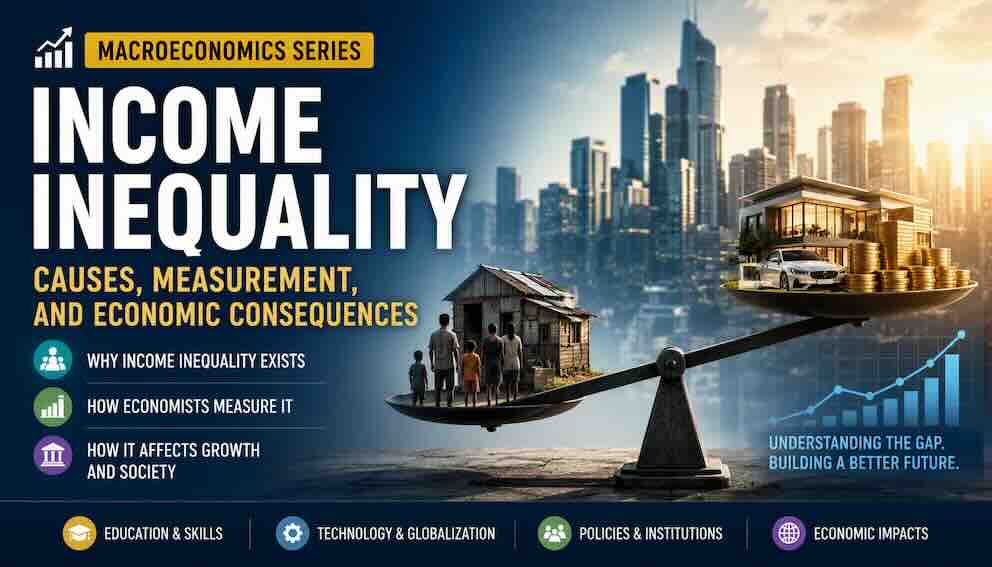
The gap between high earners and low earners has widened dramatically in most rich countries since 1980. Income inequality is one of the most contentious issues in modern economics, yet it is often reduced to simple talking points. This tutorial cuts through the noise, explaining what income inequality actually means, how economists measure it using tools like the Gini coefficient, and the real-world forces that drive gaps between rich and poor. Drawing on examples from the United States, South Africa, Denmark, South Korea, and the United Kingdom, it explores how inequality affects economic growth, social mobility, and political stability. By the end, you will understand not just the numbers, but the human and economic trade-offs that make this topic so challenging. (Note: wealth inequality, intergenerational effects, and labor versus capital shares are covered in separate tutorials in this series.)
Introduction: Two Neighbours on the Same Street
Consider two neighbours on the same street. Both work full time. One is a software engineer earning ninety thousand pounds a year. The other is a supermarket cashier earning twenty-two thousand pounds a year.
Income inequality is not simply the fact that they earn different amounts. That is expected in any economy where different jobs require different skills, different levels of education, and different levels of responsibility. The question is about the size of that gap, whether it has grown over time, and what it means for the cashier's ability to afford housing, healthcare, and education for their children.
In 1970, that gap was smaller. In most rich countries today, it is considerably wider. The software engineer's income has grown substantially over the past fifty years, while the cashier's income has barely kept pace with inflation. The reasons for this divergence are complex, and they lie at the heart of modern debates about inequality.
This tutorial will walk through those reasons. It will explain how economists measure inequality, what forces drive it in different countries, and what consequences — both positive and negative — flow from it. By the end, you will understand why the gap between the software engineer and the supermarket cashier has widened, and what might be done about it.
What Exactly Is Income Inequality?
Income inequality refers to the uneven distribution of income across individuals or households in an economy. It is not about whether people have different incomes — that is normal and expected. It is about the size of the gap between those at the top and those at the bottom.
Every country has some degree of inequality. But the magnitude varies enormously. In the United States, the top ten percent of earners receive nearly fifty percent of all national income. In South Africa, one of the most unequal countries in the world, the top ten percent receive closer to sixty-five percent. In Denmark, one of the most equal, the top ten percent receive about twenty-five percent.
These differences are not random. They reflect different histories, different policies, different economic structures, and different social values. Understanding why some countries are more equal than others requires looking at the forces that drive inequality in the first place.
How Economists Measure Inequality
Before we can compare inequality across countries or track how it changes over time, we need reliable ways to measure it. Economists have developed several tools for this purpose.
The Lorenz Curve
The Lorenz curve is a simple visual tool. Imagine lining up every person in a country from the poorest to the richest. The horizontal axis shows the cumulative percentage of the population. The vertical axis shows the cumulative percentage of total income earned by that portion of the population.
If income were distributed perfectly equally, the poorest twenty percent would earn twenty percent of all income, the poorest forty percent would earn forty percent, and so on. The Lorenz curve would be a straight diagonal line.
In reality, the poorest twenty percent earn far less than twenty percent of income. The Lorenz curve bows downward away from the diagonal line. The more it bows, the more unequal the distribution.
The Gini Coefficient
The Gini coefficient turns the Lorenz curve into a single number between zero and one. Zero means perfect equality. One means perfect inequality, where one person has all the income and everyone else has none.
Real-world Gini coefficients typically range from about 0.25 to 0.65. South Africa has a Gini of approximately 0.63. The United States has a Gini of about 0.41. Denmark has a Gini of approximately 0.27.
What does a change in the Gini coefficient actually mean for ordinary people? A move from 0.30 to 0.40 represents a substantial increase in inequality. It typically means that the middle class is shrinking — fewer households are in the middle of the distribution, and more households are either moving up into higher-income brackets or falling down into lower-income brackets. It also means that the top earners are pulling away from the rest. For a country like the United States, the increase from about 0.36 in 1970 to 0.41 in 2020 represents hundreds of billions of dollars shifting from the bottom ninety percent to the top one percent. The numbers are not abstract. They translate directly into the gap between what the software engineer and the supermarket cashier can afford.
Top Income Shares and the Palma Ratio
Sometimes what matters most is what is happening at the very top or the very bottom. Top income shares measure the percentage of total income earned by the top one percent or top ten percent. In the United States, the top one percent earned about ten percent of all income in 1980. By 2019, that share had risen to roughly twenty percent.
The Palma ratio compares the income share of the top ten percent to the income share of the bottom forty percent. A Palma ratio of two means the top ten percent earn twice as much as the bottom forty percent. This measure is useful because the middle fifty percent of the distribution often behaves similarly across countries, while the extremes show the most variation.
Income Versus Wealth: A Brief Distinction
Before exploring the causes of income inequality, it is important to distinguish income from wealth. They are related but not the same.
Income is the flow of money received over time from work, investments, or transfers. Wealth is the stock of assets owned at a point in time — houses, savings, stocks, and businesses. Wealth is typically much more concentrated than income. In the United States, the top one percent own about thirty-five percent of all wealth, while they earn about twenty percent of all income.
This distinction matters for real lives. A family can have low income but high wealth if they own their home and have retirement savings. Another family can have high income but low wealth if they carry large student debts. Policies aimed at reducing inequality need to consider both dimensions.
A full exploration of wealth inequality, including its historical evolution and intergenerational transmission, will be covered in a separate tutorial. For now, we focus on income.
The Forces That Shape Income Inequality
With the measurement tools in hand, we can now turn to the causes. Rather than listing them mechanically, let us walk through a narrative about how inequality actually emerges in a real economy. This narrative will then guide us toward what can be done.
Education and the Race Between Technology and Skills
Workers with more education and specialized skills earn more than those without. This is not controversial. What matters for inequality is how much the return to education changes over time.
The economists Claudia Goldin and Lawrence Katz describe this as a race between technology and education. Technology increases the demand for skilled workers. If the supply of skilled workers keeps pace, the wage gap between skilled and unskilled workers does not widen. If the supply lags, the gap grows.
In the United States, the supply of educated workers grew rapidly in the mid-twentieth century. High school graduation rates soared. College attendance expanded. The gap between skilled and unskilled wages narrowed. After 1980, however, the growth in educational attainment slowed while technology continued to advance rapidly. The race was lost. The wage gap widened dramatically.
South Korea took a different path. In 1960, South Korea was as poor as many countries in Africa. But it invested heavily in education at all levels. Primary school enrollment became nearly universal. Secondary school enrollment rose from about thirty percent to nearly ninety percent. Tertiary education expanded rapidly. By the time technology began demanding highly skilled workers, South Korea had them. The wage gap remained more moderate.
How Technology Actually Changes Jobs: Task Replacement and Task Upgrading
To understand why technology widens inequality, we need to look at how it actually changes specific jobs. Automation does not affect all workers the same way. It tends to replace routine tasks while complementing non-routine tasks.
Consider a supermarket. Twenty years ago, a cashier scanned each item, handled cash, and bagged groceries. These were routine tasks that could be learned quickly. Today, self-checkout machines perform the scanning and payment processing. The cashier's role has been partially automated away. Fewer cashiers are needed, and those who remain focus on customer assistance and troubleshooting — tasks that are harder to automate.
At the same time, the same technology has increased demand for software engineers who design and maintain the self-checkout systems, for data analysts who track usage patterns, and for network technicians who keep the system running. These are high-skill, high-wage jobs.
The result is a dual impact. Workers who perform routine tasks that can be automated face falling wages or job loss. Workers who perform non-routine tasks that complement technology see their wages rise. This is skill-biased technological change in action, and it is a major driver of income inequality.
Gender and Race: Structural Drivers of Inequality
Income inequality is not only about skills and technology. It is also about who gets access to opportunities and how different groups are valued in the labor market.
The gender wage gap persists in every country. Women earn less than men on average, even when controlling for education and experience. The gap varies widely. In the United States, women earn about eighty-two cents for every dollar earned by men. In South Korea, the gap is even larger — women earn about sixty-five cents for every dollar earned by men. In the Nordic countries, the gap is smaller but has not disappeared.
The causes are multiple. Occupational segregation pushes women into lower-paid fields like care work and teaching. Career interruptions for childbearing and caregiving reduce lifetime earnings. Discrimination, both overt and subtle, remains a factor. Even within the same occupations, women often earn less than men.
Race and ethnicity are equally powerful drivers. In the United States, Black and Hispanic households earn significantly less than white households. The gap persists across education levels. A Black worker with a college degree earns about the same as a white worker with only some college education. The wealth gap is even larger.
South Africa provides a stark example of racial inequality shaped by history. The apartheid system explicitly excluded Black South Africans from good jobs, quality education, and property ownership. Although apartheid ended in 1994, the legacy persists. Black South Africans on average earn far less than white South Africans, and the wealth gap is even larger.
Geographic Inequality: The Growing Gap Between Thriving Cities and Declining Regions
One of the most politically consequential forms of inequality today is geographic. In many rich countries, a handful of thriving cities have pulled away from the rest of the country.
London, New York, San Francisco, and Seoul have become hubs for finance, technology, and professional services. Wages in these cities have grown rapidly. Meanwhile, former industrial regions — the north of England, the American Rust Belt, the German Ruhr, the French Nord-Pas-de-Calais — have seen factories close, jobs disappear, and wages stagnate.
This geographic divide has profound effects. Young people with ambition and skills leave declining regions for the thriving cities, further depleting the economic base of their home towns. Housing prices in thriving cities soar, making it difficult for low-income workers to live there. Declining regions face falling property values, shrinking tax bases, and deteriorating public services.
The political consequences have been dramatic. The vote for Brexit in the United Kingdom was concentrated in declining regions, not in thriving London. The election of Donald Trump in the United States was fueled by white working-class voters in the Rust Belt and rural areas.
The Role of Housing Markets in Amplifying Inequality
Housing markets deserve special attention because they sit at the intersection of income inequality and wealth inequality. Rising housing prices have two opposite effects depending on whether you own your home or rent.
For homeowners, rising prices increase wealth. Someone who bought a house in London twenty years ago may have seen its value triple. That wealth can be borrowed against, passed to children, or used to fund retirement. For renters, rising prices increase costs. A larger share of monthly income goes to housing, leaving less for everything else. Renters cannot benefit from price appreciation.
Over time, this creates a durable divide between those who entered the housing market early and those who did not. In many countries, homeownership rates have fallen among young adults. This is not just a housing issue. It is a driver of both income inequality (higher housing costs for renters) and wealth inequality (asset appreciation for owners).
A full treatment of wealth inequality will explore this dynamic in more depth. For now, the key point is that housing markets amplify the inequality generated by labor markets.
Superstar Economics and Winner-Take-All Markets
Some markets are winner-take-all. A slightly better singer can sell out stadiums while a slightly worse singer plays empty clubs. A slightly faster software algorithm can capture an entire market. In these markets, small differences in talent produce enormous differences in income. This is called superstar economics.
Taylor Swift is the classic example, but the phenomenon extends far beyond entertainment. Consider a successful app developer. A single developer can write an app that is downloaded by millions of people globally. The cost of serving an additional user is near zero, so the developer captures almost all the revenue from each additional user. The result is enormous income for the developer at the top of the market, while thousands of other app developers earn very little.
The same logic applies to a top surgeon who develops a reputation for a rare, life-saving procedure. Patients and insurers will pay premium fees. A corporate lawyer who wins landmark cases can command thousands of pounds per hour. In each case, the market rewards the very best far more than those who are merely good.
This drives inequality at the very top. The top one percent is increasingly composed not of inherited wealth but of high-earning professionals in winner-take-all fields.
Globalization: An Ongoing Process, Not a Closed Chapter
Globalization has a dual effect on inequality. On one hand, manufacturing jobs have moved to lower-cost countries. The United States lost about five million manufacturing jobs between 2000 and 2010. Communities that depended on those jobs have never fully recovered.
But globalization is not a closed chapter. It is evolving. Services are now being outsourced and offshored as well. Call centres in India and the Philippines handle customer service for Western companies. Accounting and legal research are increasingly done remotely. Software development teams span multiple continents. Remote white-collar work is becoming global competition.
This means that high-skill workers are now facing global competition too, not just low-skill workers. A graphic designer in the United States competes with designers in Eastern Europe and Southeast Asia. A software developer in London competes with developers in India and Nigeria. This may put downward pressure on middle-skill and high-skill wages in wealthy countries, though the full effects are still unfolding.
On the other hand, globalization has lowered prices for many goods. Clothing, electronics, furniture, and household goods became cheaper as production moved to lower-cost countries. For low-income households, who spend a larger share of their income on these goods, the price reductions were a significant benefit.
The net effect of globalization on inequality is therefore still evolving. It is not a closed chapter. The policy challenge is to support those who lose while preserving the benefits for consumers.
The Role of Institutions: Unions, Minimum Wages, and Taxes
Labor market institutions shape how the gains from growth are distributed. Countries with strong unions tend to have more equal wage distributions. In the United States, union membership fell from about thirty percent of workers in the 1950s to about ten percent today. Over the same period, wage inequality rose.
Minimum wage laws also matter. In countries with high minimum wages relative to average wages, the bottom of the distribution is lifted. Denmark has no official minimum wage, but strong unions set high floor wages through collective bargaining. The result is a very compressed wage distribution.
Taxation is the most direct tool for redistribution. Progressive taxes, where higher earners pay a larger share of their income, can reduce inequality after taxes and transfers. But the extent of redistribution varies enormously across countries.
What Does Inequality Do to an Economy and Society?
Having explored the causes, we can now turn to the consequences. The evidence is not one-sided.
Economic Growth
Some inequality can be beneficial. If higher incomes reward innovation, risk-taking, and hard work, then some level of inequality provides incentives for economic activity. A society that paid everyone the same regardless of effort would quickly stagnate.
But very high inequality may harm growth. The International Monetary Fund and the OECD have both published research finding that high inequality reduces the pace and durability of growth. The channels include underinvestment in education by low-income families, poorer health outcomes that reduce productivity, and political instability that disrupts economic activity.
Other economists argue that the relationship is weaker once you account for institutional quality. The cause of inequality — whether it comes from productive innovation or from rent-seeking — may matter more than the level.
Social Mobility and the Gatsby Curve
One of the most robust findings is the Gatsby Curve. Countries with higher income inequality tend to have lower intergenerational mobility. In unequal countries, your parents' income is a stronger predictor of your own future income.
Denmark has low inequality and high mobility. A child born to a low-income family in Denmark has a good chance of reaching the middle class or higher. The United States has high inequality and lower mobility.
Health and Political Stability
Within countries, richer individuals live longer and healthier lives. The gap in life expectancy between the richest and poorest Americans is about ten to fifteen years. There is also evidence that inequality itself, beyond just poverty, affects health outcomes.
High inequality can also erode trust in institutions. When people perceive the economic system as rigged, they lose faith in democracy, markets, and the rule of law.
What Has Actually Worked? Policy and Evidence
If inequality is a concern, what can governments do? The evidence on what works is clearer than often acknowledged. The Nordic experience is instructive.
The Nordic Model: What Denmark Actually Did
Denmark combines high taxes with high growth and high mobility. How? First, it has a high and broad tax base. The value-added tax is high. Income taxes are high, even for middle-income earners. But the returns are visible. University tuition is free, and students receive a monthly stipend. Healthcare is universal and free at the point of use. Childcare is heavily subsidized.
Second, Denmark has flexicurity — a combination of flexible labor markets and social security. Employers can fire workers relatively easily, which encourages hiring. But workers who lose their jobs receive high unemployment benefits and access to retraining programs.
Third, Denmark has strong unions that bargain collectively. About two-thirds of Danish workers are union members. The unions negotiate wages centrally, which reduces wage dispersion.
The result is an economy that is both dynamic and equal, with a Gini coefficient of about 0.27.
What Else Has Evidence Behind It?
The earned income tax credit in the United States provides a refundable tax credit to low-income workers. Studies have found that it increases employment and reduces poverty.
Universal pre-kindergarten and early childhood education improve long-term outcomes for low-income children, increasing their future earnings and reducing the persistence of poverty.
Moderate minimum wage increases have little negative effect on employment while meaningfully raising wages at the bottom.
What Has Not Worked?
Blanket trade protectionism has not reduced inequality. The costs to consumers and other industries have generally outweighed the benefits. Limiting immigration has not reduced inequality, as immigrants often complement rather than compete with native-born workers.
Conclusion: The Balance Between Fairness and Dynamism
This tutorial has focused on income inequality. Several related topics are covered in other tutorials in this series: wealth inequality, intergenerational effects, and labor versus capital shares.
Income inequality is not a problem with a single solution because it is not a single problem. Some people earn more because they have more education. Some because they work in winner-take-all markets. Some because of technology that rewards their skills. Some because of discrimination. Some because they grew up in a thriving city while others grew up in a declining region.
Some inequality is necessary. A society that rewarded everyone equally regardless of effort, talent, or risk-taking would lack the dynamism that drives innovation and growth. The question is not whether inequality should exist. It is how much is too much and what kind is harmful.
The evidence suggests that very high inequality carries risks: lower social mobility, poorer health outcomes, political instability, and the erosion of trust. The countries that have managed inequality best did not eliminate it. They balanced dynamism with fairness through investment in education, strong labor institutions, and progressive taxation.
What economics can do — and what this tutorial has attempted — is to clarify the trade-offs, measure the magnitudes, and illuminate the consequences of different choices. The rest is up to citizens and their leaders.
About Swati Sharma
Lead Editor at MyEyze, Economist & Finance Research WriterSwati Sharma is an economist with a Bachelor’s degree in Economics (Honours), CIPD Level 5 certification, and an MBA, and over 18 years of experience across management consulting, investment, and technology organizations. She specializes in research-driven financial education, focusing on economics, markets, and investor behavior, with a passion for making complex financial concepts clear, accurate, and accessible to a broad audience.
Disclaimer
This article is for educational purposes only and should not be interpreted as financial advice. Readers should consult a qualified financial professional before making investment decisions. Assistance from AI-powered generative tools was taken to format and improve language flow. While we strive for accuracy, this content may contain errors or omissions and should be independently verified.