
Tutorial Categories
Last Updated: May 19, 2026 at 10:30
Endogenous Growth Theory Explained: Where Technological Progress Really Comes From
Opening the Black Box of Technology — Moving Beyond Solow's Residual
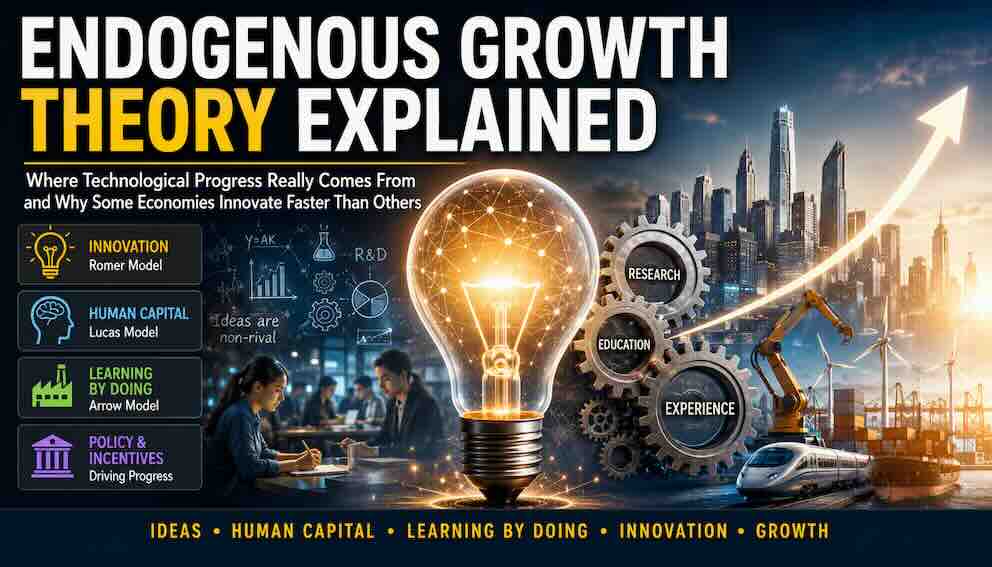
Every previous tutorial in this series has pointed to the same conclusion: technology is the ultimate source of sustained growth in living standards. But every model so far has treated technology as exogenous — arriving from outside the economy like manna from heaven, unexplained and unexamined. Endogenous growth theory finally opens this black box. This tutorial walks through the foundational frameworks that explain where technological progress comes from, including the AK model, Romer's model of innovation and product variety, Lucas's model of human capital spillovers, and Arrow's learning-by-doing mechanism. You will learn why ideas are fundamentally different from physical capital, why markets tend to underinvest in knowledge creation, and what policy implications follow for research subsidies, patent protection, education, and industrial strategy. By the end, you will understand why some economies generate rapid technological change while others stagnate — and why that difference is not an accident.
Introduction: Gathering the Thread
Let us take a moment to look back at where this series has been.
The Solow Growth Model taught us that capital accumulation faces diminishing returns. Each additional machine adds less than the last, and eventually growth stops unless something external intervenes. That something was labelled technological progress, but the model never explained what caused it. Technology arrived at a constant rate regardless of anything the economy did — a parameter passed in from outside without justification.
The Golden Rule asked what level of capital maximises long-run consumption but still took the rate of technological progress as given. The Ramsey-Cass-Koopmans model endogenised the savings rate through optimising households — a significant advance — but even in that framework technological progress remained exogenous. The Total Factor Productivity tutorial then examined the residual itself, showing that TFP reflects management quality, institutional arrangements, and the diffusion of knowledge across firms. It described the channels through which productivity flows but left the deeper question open: where does new knowledge originate?
Endogenous growth theory, developed primarily by Paul Romer in the 1980s and 1990s with foundational contributions from Robert Lucas and Kenneth Arrow, provides that answer. It treats technological progress as the outcome of deliberate decisions made by researchers, firms, governments, and workers responding to the incentives their economic environment creates. Researchers pursue new ideas because they expect to be rewarded for them. Firms invest in research because successful innovations generate profits. Workers accumulate skills. Firms learn through experience. Whether and how quickly an economy innovates depends on the incentives embedded in its institutions, its policies, and its markets.
This tutorial walks through the main frameworks of endogenous growth theory, starting with the simplest case and building toward richer and more realistic models. It connects each framework to real events and real places, and it acknowledges where early predictions ran into empirical difficulties and where the theory had to adapt.
Why Sustained Growth Requires Something That Does Not Wear Out
To appreciate why endogenous growth theory was necessary, it helps to sit with the fundamental problem of the earlier models. In both Solow and Ramsey-Cass-Koopmans, physical capital faces diminishing returns at the aggregate level. A farm with one tractor benefits enormously from a second but barely at all from a twentieth. A factory floor can absorb a certain number of machines before adding more creates congestion rather than output. As the capital stock grows, each additional unit of capital contributes less to output. If an economy can only grow by accumulating more capital, the growth rate must eventually slow toward zero.
The earlier models escaped this logic by assuming exogenous technological progress. But that assumption carries an uncomfortable implication. It would mean that the United States and a much poorer economy, given the same savings rate and population growth, would experience exactly the same rate of technological progress. The quality of their universities would be irrelevant. The size of their research budgets would not matter. The incentives facing their engineers and scientists would have no effect on how fast productivity improved. Technology would simply arrive, like rainfall, distributed by a mechanism nobody could observe or influence.
The observation at the heart of endogenous growth theory is that knowledge and ideas behave differently from physical capital. When a pharmaceutical company discovers a new drug formulation, that formula can be used to manufacture millions of doses without ever being depleted. When an engineer develops a more efficient way to organise an assembly line, every factory in the world can adopt the method simultaneously. When a mathematician proves a theorem, every mathematician can use it without reducing its availability to others. Economists describe this property as non-rivalry: one person's use of an idea does not prevent another from using the same idea.
Non-rival ideas can spread across an economy and be applied to every firm, every worker, and every production process at once. And unlike a machine that eventually rusts and becomes obsolete, an idea does not wear out with use. This is the property that makes sustained growth possible. If knowledge accumulates without facing the same diminishing returns as physical capital, an economy that invests in creating new knowledge can grow indefinitely.
The AK Model — A Simple World Without Diminishing Returns
The cleanest way to see what changes when diminishing returns are removed is to examine the AK model. This is a minimal construction designed to illustrate a single idea rather than to capture all the complexity of reality.
In the AK model, output is simply proportional to capital: Y = A × K. Here Y is total output, K is capital, and A is a constant representing the productivity of capital. Each unit of capital always contributes the same amount to output, regardless of how much capital already exists. There are no diminishing returns.
This becomes more defensible when capital is defined broadly enough to include human capital alongside physical machines. A doubling of factories alongside a doubling of the educated, skilled workforce that knows how to use them might plausibly produce close to a doubling of output. The AK formulation captures this idea in its simplest form.
The implications differ strikingly from the Solow framework. In Solow, a higher savings rate leads to a higher level of output in steady state but does not permanently change the growth rate. Once the economy has adjusted, it grows only as fast as exogenous technological progress allows. In the AK model there is no steady state in that sense. Each unit of saving adds exactly as much output as the previous unit, so a permanently higher savings rate produces permanently faster growth.
This prediction is too strong for the data. Countries do tend toward similar growth rates even with different investment levels, which fits the Solow view more comfortably than the AK extreme. The AK model is best understood as a theoretical benchmark showing what the world would look like if diminishing returns were completely eliminated, rather than a literal description of how economies work. The real world lies somewhere between these two poles, which is the territory that Romer's richer models attempt to occupy.
Romer's Model — Inventing New Products and the Incentive to Research
Paul Romer's contribution was to move beyond the AK abstraction and provide a specific, realistic mechanism through which new knowledge is deliberately created. His key observation was that innovation is an economic activity shaped by the rewards available to innovators.
Consider the pharmaceutical industry. Developing a new drug can cost hundreds of millions of dollars in research and clinical trials. If a successful drug could immediately be copied by competitors, no firm would undertake that investment — the moment the drug succeeded, generic manufacturers would enter the market, drive the price down to production cost, and leave the innovating firm unable to recover what it had spent. Patent protection exists to prevent this outcome. A patent grants the innovating firm temporary exclusive rights to produce and sell the drug. During the patent period, the firm earns profits that compensate for the upfront research investment. Once the patent expires, competition enters, prices fall, and the knowledge embedded in the drug becomes broadly available.
Romer formalised this logic into a model of economic growth. The economy contains a research sector whose job is to invent new varieties of intermediate goods — new tools, machines, chemical compounds, software programs, or any other input that makes the rest of the economy more productive. Researchers invest their time and effort because successful innovation earns patent rights and the monopoly profits that come with them. The more varieties available, the more productive the final goods sector becomes, because a greater range of specialised inputs allows production to be organised more efficiently. And because each new idea adds to the stock of knowledge that future researchers can draw upon, the process can sustain itself without running into diminishing returns.
The policy implications of this framework are direct. Since researchers cannot fully capture the benefits of their inventions — knowledge leaks to other firms, diffuses across industries, and eventually spills across national borders — the social return to research exceeds the private return. Markets will invest less in research and development than is socially optimal. Governments can partially correct this by subsidising research directly, through grants and contracts for basic science, or indirectly, through tax credits for private research and development spending. Countries with higher research intensity, measured as a fraction of GDP, tend to achieve faster productivity growth over the long run, which is broadly consistent with this prediction.
Patent policy is the other major instrument. Patents provide the incentive to innovate by granting temporary monopoly profits, but they also create costs. During the patent period, prices are higher than in a competitive market, which reduces access to the innovation for users who could benefit from it. If patents are too broad or last too long, they can impede subsequent innovation by blocking researchers who would otherwise build on the patented idea. Optimal patent policy tries to balance the need to reward invention against these costs — a balance that remains genuinely difficult to strike and that generates substantial disagreement across industries and countries.
One significant prediction of Romer's original formulation did not hold up against the evidence. In the original model, larger economies should grow faster because they have more potential researchers. Economists call this the scale effects prediction. But empirical tests failed to support it. Ireland and Singapore, tiny economies, grew as fast as much larger ones during their development takeoffs. The United States employed far more researchers in 2000 than in 1950, yet did not grow proportionally faster. This failure prompted a second generation of models, particularly the work of Charles Jones, in which the difficulty of finding genuinely new ideas increases as the stock of existing ideas grows. In these semi-endogenous models, the long-run growth rate is ultimately tied to population growth rather than to research subsidies, which means policy can raise the level of productivity rather than its permanent growth rate. That remains a meaningful gain, but a more modest claim than the original theory made.
Horizontal and Vertical Innovation — Two Ways Progress Happens
Romer's model describes what economists call horizontal innovation, where growth comes from expanding the number of distinct products and tools available. Think of the proliferation of software applications since the 1990s. In 1990, a handful of word processing programs existed. Today there are thousands of specialised tools for every conceivable task. Each new tool makes certain workers more productive, and the expansion of variety drives aggregate growth.
A complementary account of innovation focuses on quality improvement rather than variety expansion. Instead of inventing an entirely new product category, a firm takes an existing product and makes it better. The new version replaces the old. This process was formalised by Philippe Aghion and Peter Howitt in 1992, building on ideas Schumpeter had described half a century earlier. Aghion and Howitt called it creative destruction: progress is creative because each new innovation raises productivity, and destructive because it makes the previous innovation economically obsolete.
The history of mobile phones illustrates this cleanly. The first smartphones were genuinely transformative compared with what preceded them, but they were quickly superseded by better versions offering more processing power, better cameras, and longer battery life. Each generation of device captured market share from the previous generation. The firms behind the improvements earned temporary profits before the next wave of innovation arrived.
Both horizontal and vertical innovation operate simultaneously in most economies. Understanding both forms enriches the picture of how technological progress works and provides somewhat different guidance for policy, particularly around patent design in industries where innovations build directly on each other rather than opening entirely new product categories.
Human Capital and Spillovers — The Lucas Model
While Romer focused on deliberate innovation through research and development, Robert Lucas developed a complementary framework centred on human capital. His starting point was a question about education and what happens when the skills workers accumulate do not stay entirely within the individuals who acquired them.
This model differs importantly from the augmented Solow framework covered in an earlier tutorial. In the Mankiw-Romer-Weil model, human capital is treated like physical capital — accumulated through education and training, subject to depreciation, and facing diminishing returns at the aggregate level. That raises the steady state level of output but cannot generate sustained growth on its own, for the same reason that physical capital cannot.
Lucas made a different assumption. He proposed that human capital generates externalities. When workers become more skilled, they do not only become more productive themselves. They also raise the productivity of those around them through knowledge sharing, collaboration, and the informal transmission of expertise that happens when skilled people work near each other. A senior engineer working alongside a junior colleague teaches through proximity and example as much as through formal instruction. These benefits are not fully captured by the worker who generated them, which means the social return to education exceeds the private return that any individual can expect.
Silicon Valley has become the canonical illustration of this dynamic. The concentration of engineers, computer scientists, and entrepreneurs in a small region of California has generated productivity spillovers that no single firm could have created in isolation. Ideas travel across company boundaries. Workers move between firms, carrying tacit knowledge with them. Research by the economist AnnaLee Saxenian documented how this density of talent creates informal networks of collaboration and mutual learning that explain much of the region's sustained productivity advantage over similarly well-resourced but more dispersed technology communities.
The policy implication is straightforward in principle. If education generates spillovers that individual students cannot fully capture, private investment in education will be lower than what society would optimally choose. This provides an efficiency case for public investment in education that sits alongside the more familiar equity case — not only because poor families cannot afford it, but because the market, left to itself, will systematically underprovide it relative to what is socially optimal.
An honest qualification is necessary here. The empirical evidence on the magnitude of human capital spillovers is genuinely mixed. Some studies find substantial external returns, particularly in dense urban labour markets. A careful study by Acemoglu and Angrist using United States data found relatively little evidence of spillovers in that context. The size of the effect likely varies considerably across settings — larger in cities with strong concentrations of knowledge-intensive activity, smaller in more dispersed or lower-skill environments. The theoretical case is compelling. Whether the spillovers are large enough in any particular context to justify specific policy interventions requires evidence that is often difficult to gather.
Learning by Doing — Arrow's Insight
Not all knowledge comes from deliberate research or formal education. Much of it accumulates as a byproduct of production itself. Workers become more skilled by performing their jobs repeatedly. Firms discover more efficient methods through sustained operation. Engineers identify improvements by working with equipment day after day. Kenneth Arrow formalised this observation in 1962, drawing on a striking empirical pattern from wartime aircraft manufacturing.
During the Second World War, researchers studying American aircraft production found that the number of labour hours required to build a single airframe fell steadily as cumulative production increased. Each time total production doubled, labour requirements per unit fell by approximately twenty percent. This was not the result of new machines or deliberate research investment. Workers had found better ways to organise the assembly line. Supervisors had developed more effective ways to coordinate the work. Small improvements in technique accumulated into large efficiency gains. The learning came from doing, and it followed a remarkably predictable curve.
The contemporary solar panel industry makes the same point with striking force. When photovoltaic panels were first manufactured commercially in the 1970s, they cost roughly one hundred dollars per watt of capacity. As cumulative production expanded — driven partly by government mandates and subsidies in early adopter markets and partly by private investment — costs fell along a learning curve that proved remarkably stable across decades and geographies. By 2023, the cost had fallen below thirty cents per watt, a reduction of more than ninety-nine percent. Much of this reflected accumulated manufacturing experience rather than entirely new underlying technology. China's current dominance in solar panel production is partly a consequence of the learning it accumulated by producing panels at enormous scale during an extended period when other large markets were still debating whether to invest.
Arrow's original model captures the spillover mechanism clearly, and it is supported by evidence from a wide range of industries. A careful note is worth adding: in its original formulation, learning by doing faces diminishing returns over time, which means the mechanism alone cannot sustain indefinite growth without additional assumptions. Paul Romer's 1986 paper, which was in some ways the founding document of the endogenous growth literature, built on Arrow's intuition while adding the assumption that knowledge spillovers do not diminish at the aggregate level. That extension is what gives the mechanism the power to explain sustained productivity growth.
The policy implication associated with learning by doing concerns what is sometimes called the infant industry argument. If a new industry generates spillovers through learning that individual firms cannot fully internalise, the market will underinvest in getting the industry started. Each firm considering entry weighs only its own expected profits against its own learning costs. It does not account for the benefit its accumulated experience creates for other firms that can observe and copy what it learns. In principle, government support — through subsidies, directed credit, or temporary protection — can help firms move down the learning curve faster than the market would achieve on its own.
South Korea's semiconductor industry is the most cited example. When Samsung began producing memory chips in the early 1980s, it competed against Japanese and American manufacturers with years of experience and far lower production costs. Government support — subsidies, directed credit from state-influenced banks, domestic market protection — helped Korean firms sustain losses during the years when their costs were still above world prices. Over time, cumulative production accumulated. Costs fell. Quality improved. By the 1990s, Korean manufacturers had become world leaders in memory chip production. Whether the government's support was the decisive factor or whether Korean firms would have made the same journey more slowly without it is a question economists still debate. The learning-by-doing framework identifies the theoretical basis for the intervention. Whether any particular government can implement such a policy without creating dependency or protecting industries that would never have become competitive regardless of support is a separate question, and the historical record on industrial policy is mixed enough to warrant genuine caution.
What Endogenous Growth Theory Tells Us About Policy
Across the frameworks explored in this tutorial — Romer's model of innovation, Lucas's model of human capital spillovers, and Arrow's learning-by-doing mechanism — a common structure emerges. In each case, knowledge-generating activities produce benefits that extend beyond the individuals and firms directly responsible for creating them. Researchers cannot fully capture the value of their inventions. Educated workers cannot fully internalise the productivity gains their skills generate for colleagues and employers. Firms that accumulate experience through production cannot prevent other firms from observing and learning from what they do. This gap between private and social returns is the shared market failure that endogenous growth theory identifies.
The natural policy response is to correct this gap. Governments can fund basic scientific research directly, through universities and public research institutes, ensuring that knowledge with high social value but low appropriability gets produced even when private firms would not find it profitable to invest. They can offer tax credits for private research and development, reducing the cost of innovation and narrowing the gap between private and social returns. They can invest in public education, recognising that a more skilled workforce generates productivity benefits that extend beyond individual workers. In certain circumstances, they can support industries in their early years when learning spillovers are likely to be large and cumulative production is essential to reducing costs.
These are not simple or certain prescriptions. Identifying which research projects will succeed, which industries generate the largest spillovers, and how long support should last before it becomes counterproductive requires information that governments rarely possess reliably. The history of industrial policy contains genuine successes alongside costly failures, and distinguishing between them in advance is considerably harder than doing so in retrospect.
The debate between fully endogenous and semi-endogenous growth models also matters here. In the original Romer framework, policy can permanently raise the long-run growth rate of the economy by increasing the resources devoted to research. In the semi-endogenous models of Jones, the long-run growth rate is ultimately determined by population growth, and policy affects the level of productivity rather than its permanent trajectory. The empirical evidence has not yet decisively favoured one view over the other, and the appropriate degree of ambition for growth policy depends substantially on which account is closer to correct.
Institutions as the Foundation
Endogenous growth theory describes the mechanisms through which knowledge is created and diffuses through an economy. But it leaves a deeper question only partially addressed: why do some countries build the institutions that allow these mechanisms to operate while others do not?
The most developed answer comes from Daron Acemoglu and James Robinson, whose work on institutions argues that the willingness to invest in knowledge depends fundamentally on political and economic arrangements. In societies with inclusive institutions — where property rights are broadly enforced, where competition is encouraged, where new firms can enter markets and challenge incumbents, and where political power is not permanently concentrated among those who benefit from the existing order — the conditions for endogenous growth can flourish. Innovators can expect to capture at least part of the returns from their discoveries. Educated workers can expect their skills to be rewarded. Firms can invest in research without excessive fear of expropriation.
In societies with extractive institutions, these conditions do not hold. Patents may not be enforced or may benefit only connected parties. Research produces results that can be appropriated by those with political connections rather than retained by those who invested in creating them. Education may be restricted in ways that preserve existing hierarchies rather than generate broadly distributed human capital. In such environments, the mechanisms of endogenous growth are present in the theoretical models but absent in practice, because the incentives that are supposed to motivate innovation and human capital investment have been undermined.
This institutional dimension helps explain patterns that the growth models on their own struggle to account for — why some countries with similar initial conditions and similar access to technology have diverged so dramatically in their long-run prosperity. South Korea built institutions that were inclusive enough to allow the mechanisms of endogenous growth to operate. The returns to innovation were protected. Human capital was rewarded. Learning-by-doing spillovers were partly internalised through industrial policy. Argentina, with which South Korea had roughly comparable income in 1960, did not build those institutions with the same consistency, and the growth trajectories diverged accordingly.
Institutions, in this framework, are the foundation beneath the mechanisms. The models of Romer, Lucas, and Arrow describe what happens when that foundation is solid. Institutional economics explains why some places succeed in building it.
Closing the Loop on the TFP Residual
We can now return to the Total Factor Productivity tutorial and close the loop left open there. The Solow residual was presented as a large and genuine puzzle — the part of growth that measurable increases in capital and labor could not explain. The TFP tutorial showed that much of this residual reflects better management practices, stronger institutions, more efficient resource allocation, and the gradual diffusion of knowledge across firms. But it left the most fundamental question open: where does new knowledge come from, and why does it accumulate faster in some economies than others?
The answer this tutorial has assembled is that the residual is not mysterious in the sense of being inexplicable. It is the measurable outcome of the processes that Romer, Lucas, and Arrow described. When an economy invests more in research and development, its stock of productive ideas grows faster, and TFP grows with it. When its workforce accumulates human capital that spills across firms and workplaces, the productivity of the whole economy rises beyond what any individual's private returns would suggest. When its industries accumulate experience through sustained production, and when that learning spreads beyond the firms that generated it, TFP improves. When its institutions protect the returns to innovation reliably enough to sustain the incentive to create new knowledge, the entire process continues.
The large residuals that Solow found were evidence that the inputs to growth are considerably broader than the physical capital and labor that his original model measured. Endogenous growth theory tells us what those broader inputs are, how they generate productivity, why markets tend to underinvest in them, and what policies can partially correct that tendency. The residual is not eliminated by this account, but it is explained — transformed from a measure of ignorance into a measure of knowable and at least partially manageable forces.
Conclusion: The Cumulative Picture
Let us step back and see the full picture that this series has assembled across its five tutorials.
The Solow Growth Model gave us the foundational framework: capital accumulation faces diminishing returns, and without technological progress an economy will settle into a steady state where growth from capital stops. Solow pointed to technology as the answer but treated it as something that simply arrives from outside.
The Golden Rule asked what level of capital maximises long-run consumption and introduced the possibility of dynamic inefficiency — saving so much that every generation would be better off with less. It provided a benchmark for evaluating savings rates without explaining what determines them.
The Ramsey-Cass-Koopmans model replaced the fixed savings rate with optimising households who weigh present against future consumption. It showed how patience and the return to capital jointly determine the economy's trajectory, and it made the discount rate explicit in the steady state condition.
The Total Factor Productivity tutorial dug into the Solow residual, showing that it reflects management quality, institutional quality, the allocation of resources across firms, and the diffusion of knowledge. It described the channels through which productivity flows and pointed forward to the need for a theory of where knowledge originates.
Endogenous growth theory has provided that theory. The AK model showed that eliminating diminishing returns is sufficient to generate sustained growth, even if the formulation is too stark to match all the evidence. Romer's product-variety model showed how deliberate research, motivated by the prospect of monopoly profits from patents, generates innovation and growth — while the scale effects problem prompted a second generation of semi-endogenous models that fit the data more comfortably. The distinction between horizontal and vertical innovation added richness to the picture of how new products and quality improvements each contribute to progress. Lucas's human capital model showed how spillovers from education can raise productivity beyond private returns to schooling, with the honest caveat that empirical measurement of those spillovers remains contested. Arrow's learning-by-doing mechanism showed how experience accumulates through production and how the spillovers from that experience can in principle justify support for industries in their formative years. The connection to institutions reminded us that all of these mechanisms require an underlying political and economic environment that protects the returns to knowledge creation.
The question that opened this series — why did South Korea grow so fast while the Philippines, with a similar starting point, did not — now has its fullest answer. South Korea's growth reflected high savings, patient households, and substantial investment in education, all of which the first four tutorials help explain. But endogenous growth theory adds the final layer: South Korea built institutions that rewarded innovation, protected the returns to research, and allowed firms to move down learning curves in industries that generated broader spillovers. It created the conditions under which the mechanisms of knowledge accumulation could operate at their full potential.
Progress at the level of entire economies is the result of deliberate choices about how much to invest in new ideas, how to educate the workforce, which industries to nurture and for how long, and above all what kind of institutions to build and maintain. The models explored across this series provide a framework for understanding those choices, their costs, their benefits, and their long-run consequences for the people who live within them.
About Swati Sharma
Lead Editor at MyEyze, Economist & Finance Research WriterSwati Sharma is an economist with a Bachelor’s degree in Economics (Honours), CIPD Level 5 certification, and an MBA, and over 18 years of experience across management consulting, investment, and technology organizations. She specializes in research-driven financial education, focusing on economics, markets, and investor behavior, with a passion for making complex financial concepts clear, accurate, and accessible to a broad audience.
Disclaimer
This article is for educational purposes only and should not be interpreted as financial advice. Readers should consult a qualified financial professional before making investment decisions. Assistance from AI-powered generative tools was taken to format and improve language flow. While we strive for accuracy, this content may contain errors or omissions and should be independently verified.