
Tutorial Categories
Last Updated: June 7, 2026 at 11:30
Energy Transition Explained: From Fossil Fuels to Renewables and Its Economic Impact
How the Global Shift in Energy Systems Reshapes Industries, Jobs, and the Financial Health of Nations
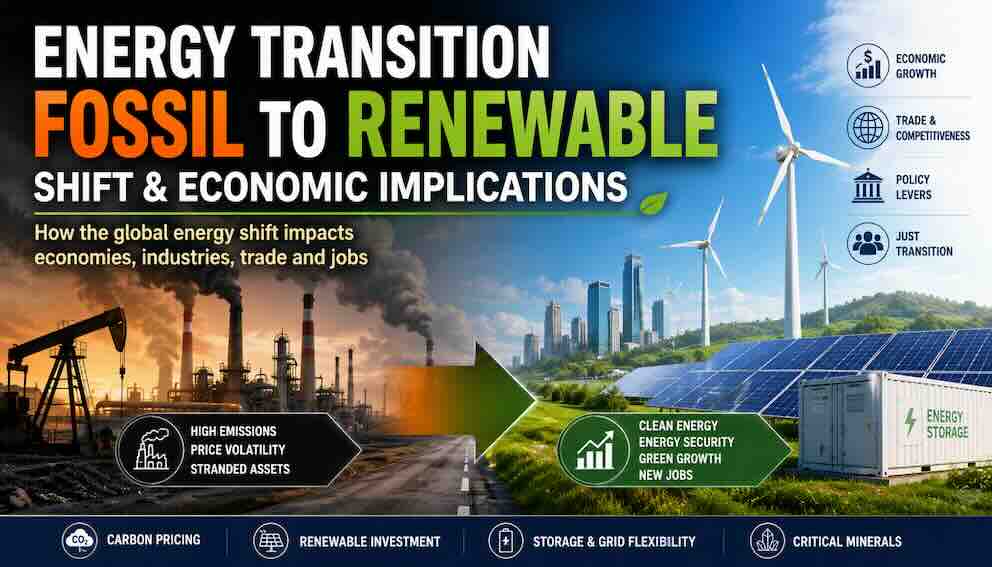
The global move away from coal, oil, and gas toward solar, wind, and other renewable sources is not merely an environmental project. It is one of the most profound economic reallocations since the Industrial Revolution, affecting everything from the price of gasoline to the stability of national pension funds. This tutorial explains why the transition happens at different speeds in different places, starting with the falling cost of solar panels and the challenge of storing energy for calm, dark days. You will learn about the rebound effect and the Jevons paradox—the counterintuitive finding that making energy more efficient can sometimes increase total consumption rather than reduce it—and why decarbonizing electricity is the easy part while industrial heat, shipping, and aviation represent the harder frontier. Using real-world examples like Germany's Energiewende, the United States' Inflation Reduction Act, Poland's fierce political battles over coal phase-out, and the 2022 drought that cut China's hydropower and forced a return to coal, the tutorial walks through how firms adapt, how workers navigate dying and growing industries, and how governments use carbon taxes, subsidies, and industrial policy to steer the ship. By the end, you will understand why this transition is less like flipping a switch and more like rebuilding an airplane while it is flying, and why economists argue that delaying the work only makes the landing rougher.
Introduction: Why a Sunny Day and a Windy Coast Now Shape National Economies
For most of modern economic history, the price of a country's energy was largely the price of digging something up. You dug coal from the ground, pumped oil from the desert, or extracted natural gas from shale. The economy revolved around those geological deposits. Wars were fought over them. Trade routes were built for them. Fortunes were made and lost based on who controlled the fossil fuels.
That era is slowly ending, and the transition to a new system based on solar radiation, wind patterns, and lithium-ion batteries is not a simple technological swap. It is a structural transformation on the scale of the move from horses to cars or from steam to electricity. The difference is that this transition is not optional in the long run. The physical risks we discussed in Tutorial 59—the floods, the fires, the collapsing crop yields—are the bill coming due for the fossil fuel age. Rebuilding the energy system while the global economy continues to run is an act of extraordinary complexity, and economists often say it is like rebuilding an airplane while it is flying. You cannot land the economy to fix the engine. You have to replace the parts in midair.
This tutorial walks through the economic machinery of that midair rebuild. It starts with the physics and costs of renewable energy, then moves to how companies and workers cope, then to the big macroeconomic questions of inflation and trade, and finally to the policy levers governments use to speed up or slow down the shift. The key takeaway is that the transition is uneven, expensive, and politically fraught, but the alternative—staying on the fossil fuel path—has become even more expensive.
The Shift from Fossil Fuels to Renewables: Drivers, Costs, and Physical Realities
What Determines the Speed of the Transition?
If you want to understand why some countries are racing toward renewables while others are dragging their feet, you have to start with a number called the levelized cost of energy, or LCOE. This is the average cost of building and operating a power plant over its entire lifetime, divided by the total electricity it produces. It is the closest thing the energy world has to a sticker price.
Ten years ago, coal and natural gas were almost always cheaper than solar and wind. Building a new solar farm was an expensive statement of environmental virtue. That has reversed dramatically. According to the International Energy Agency, solar power is now the cheapest source of electricity in history for new capacity in most of the world. The qualification matters—this applies to new builds in sunny regions, not retrofitting an existing coal plant in a cloudy country—but the trend is unmistakable. The reason is manufacturing scale. China invested heavily in solar panel production, drove down the cost of photovoltaic cells by more than eighty percent over a decade, and the rest of the world bought those cheap panels. A similar story unfolded for wind turbines, though with different supply chains.
But cost is not the only driver. Solar and wind have a physical characteristic that coal and nuclear do not: they are intermittent. A coal plant runs when you tell it to run. A solar farm produces nothing at night. A wind turbine stops spinning on a calm day. This creates the central engineering challenge of the transition: grid flexibility.
Grid flexibility means the ability of an electricity system to balance supply and demand in real time. When a cloud covers a solar farm, something else has to ramp up instantly. Historically, that something else was natural gas. But as the share of renewables grows, the system needs alternatives. This is where energy storage enters the picture. Batteries, pumped hydro, and hydrogen storage are the tools that turn an intermittent source into a reliable one. Batteries respond in milliseconds, making them ideal for short-term fluctuations. Hydrogen can store energy for weeks or months, making it suitable for seasonal shifts.
The Electricity Transition Is the Easy Part
Here is a crucial distinction that many discussions of the energy transition miss. Decarbonizing electricity is the easy part. The harder frontier is everything else: industrial heat, shipping, aviation, and long-distance trucking.
Industrial heat is the biggest challenge. A blast furnace for steel needs temperatures around 1600 degrees Celsius. A cement kiln needs similar extremes. Electricity can provide heat, but doing so at the required temperatures is currently much more expensive than burning coal or natural gas directly. Green hydrogen—hydrogen produced by splitting water with renewable electricity—is the leading candidate to replace fossil fuels in these applications. But green hydrogen is expensive, energy-intensive to produce, and difficult to transport. It works on a pilot scale but not yet at the scale of the global steel or cement industry.
Shipping and aviation pose different challenges. Cargo ships and long-haul aircraft cannot carry batteries; the weight would be prohibitive. They need fuels with high energy density. Sustainable aviation fuels made from biomass or captured carbon and hydrogen exist but are currently two to five times more expensive than conventional jet fuel. They also cannot be scaled to meet global demand without competing for land with food production. Ammonia and methanol are candidates for shipping—major shipping companies and the International Maritime Organization are actively pursuing both—but each has problems. Ammonia is toxic and releases nitrogen oxides when burned. Methanol has lower energy density than conventional marine fuels and requires different engine designs. The problems are real but not necessarily disqualifying; research continues.
What this hierarchy reveals is that the energy transition will happen in waves. Electricity decarbonization is already underway. Light-duty transport is next, with electric vehicles reaching cost parity with gasoline cars in many markets. Heavy industry, shipping, and aviation are the third wave, still waiting for technological breakthroughs that may or may not arrive at the required scale. Understanding this three-wave structure prevents the assumption that the transition is nearly complete when only the easiest sector has been addressed.
The Real-World Constraint: Critical Minerals
These technologies do not come from nowhere. They depend on a specific set of materials—lithium for batteries, cobalt for certain battery chemistries, rare earth elements for wind turbine magnets, copper for transmission lines. The global supply chains for these critical minerals are concentrated in a few countries. The Democratic Republic of Congo produces most of the world's cobalt. China dominates rare earth refining. Australia and Chile lead in lithium.
This creates a new kind of resource dependency. In the fossil fuel era, geopolitical power flowed to countries with oil and gas. In the renewable era, it will flow to countries that control the materials for batteries and motors. The transition does not eliminate resource politics. It changes the map of who has leverage over whom.
Countries are not standing still in response. The United States has released a Critical Minerals Strategy that maps supply chain vulnerabilities and funds domestic mining and recycling. The European Union proposed the Critical Raw Materials Act, which sets targets for domestic extraction, refining, and recycling while diversifying imports away from single suppliers. China, for its part, has used its dominance in rare earth refining as a bargaining chip in trade disputes, restricting exports in 2010—a restriction targeted at Japan during a territorial dispute that was subsequently ruled a violation of World Trade Organization rules—and again in more targeted ways since. The WTO ruling shows that even dominant suppliers face legal constraints on export restrictions, though enforcement remains imperfect. The policy response to critical mineral dependency is active, incomplete, and increasingly contested.
When Climate Change Undermines Renewables: The China Drought Example
There is a deeply ironic feedback loop that the energy transition must confront: climate change itself can undermine the renewable energy systems designed to stop it. The 2022 drought in China provided a vivid example. China is the world's largest generator of hydropower, with massive dams on the Yangtze and other rivers. The 2022 drought, exacerbated by the same climate patterns that brought heatwaves to Europe and North America, reduced river flows dramatically. Hydropower output fell sharply. To keep the lights on, China was forced to restart coal plants that had been idled. Emissions rose even as the country continued building solar and wind farms.
The lesson is not that renewables are unreliable. It is that climate change affects all energy systems, including the ones meant to save us. A future with more droughts means less reliable hydropower. A future with more extreme heat means lower efficiency for solar panels and higher demand for air conditioning. A future with more storms means more damage to transmission lines. The energy transition must be built to withstand the climate conditions it is trying to stabilize, creating a design challenge that earlier energy transitions never faced.
Microeconomic Implications: How Firms, Workers, and Sectors Cope
Stranded Assets: The Billions Buried in the Ground
For a coal mining company or an oil producer, the energy transition is not an abstract policy discussion. It is a threat to the value of their existing investments. An asset becomes stranded when it loses economic value before the end of its expected useful life because of changes in regulation, market prices, or technology.
Consider an oil field that a company spent five billion dollars to develop, expecting to extract oil over thirty years. If governments impose strict carbon regulations ten years into that timeline, or if electric vehicles reduce oil demand so much that the price collapses, the remaining twenty years of production may become unprofitable. The asset is stranded. The five billion dollars may never be fully recovered.
This is not a hypothetical risk. The Carbon Tracker Initiative, a financial think tank, has estimated that under plausible climate policy scenarios aligned with the Paris Agreement, trillions of dollars in fossil fuel assets are at risk of stranding. Coal assets are the most vulnerable because coal is the dirtiest and most easily replaced by renewables. Oil and gas assets are more resilient in the medium term because oil remains essential for aviation, shipping, and petrochemicals, but they are not immune.
The economic consequence of stranding is not just a loss for shareholders. If banks have lent money against those assets, the loans may default. If pension funds own those assets, retirees may see lower returns. Stranding is a wealth destruction event that transmits through the financial system, much like the subprime mortgage crisis transmitted through housing markets.
Green Premiums: When Clean Energy Gets Cheaper and When It Stays Expensive
If you walk into a car dealership today, an electric vehicle generally costs more upfront than a comparable gasoline car. That difference is a green premium—the extra cost of choosing a low-carbon alternative over a fossil fuel incumbent. Green premiums exist because the low-carbon technology is newer, has smaller production volumes, and requires different supply chains.
The most important fact about green premiums is that they do not stay the same over time. Some have already turned negative. Solar power and onshore wind are now cheaper than new coal or gas plants in most of the world. The green premium for solar electricity is negative—meaning the clean option is also the cheap option, and the market can drive adoption without policy support. For onshore wind in good locations, the same is true. For electric vehicles, the upfront premium remains positive but the total cost of ownership (including fuel and maintenance) has reached parity in many markets. The premium is shrinking rapidly.
Other green premiums remain prohibitively large. Green hydrogen for steelmaking is currently two to three times more expensive than using coal or natural gas. Sustainable aviation fuel is two to five times more expensive than conventional jet fuel. Direct air capture of carbon dioxide—a technology that might be necessary to offset hard-to-eliminate emissions—costs hundreds of dollars per ton of CO2 removed while the social cost of carbon is a fraction of that. For these sectors, market forces alone will not drive the transition. Policy intervention—carbon pricing, subsidies, mandates—is necessary to close the gap between the clean option and the fossil incumbent.
The green premium framework thus provides a diagnostic tool. Where the premium is negative or small, policy can focus on removing barriers to adoption. Where the premium remains large, policy must focus on research, demonstration, and early deployment subsidies to drive costs down the learning curve.
Labor Markets: The Coal Miner and the Solar Installer
The energy transition is often described as a job killer or a job creator, depending on who is talking. The truth is that it kills some jobs and creates others, and the two sets rarely overlap geographically or skill-wise.
In the coal regions of Appalachia in the United States or the Ruhr Valley in Germany, mining jobs have been declining for decades. Automation played a role, but the energy transition accelerates the trend. A coal miner who has spent twenty years underground does not automatically become a solar panel installer. Solar installation requires comfort with heights, electrical certification, and often travel to scattered sites. The miner's skills are not easily transferred.
Meanwhile, renewable energy creates jobs in manufacturing (building turbines and panels), installation (putting them in place), and maintenance (keeping them running). These jobs are often located in different places. Wind turbines go where the wind is—offshore or across rural plains. Solar farms go where the land is cheap and the sun is strong.
This mismatch is why economists and labor advocates talk about a just transition. A just transition means providing retraining programs, income support, and regional development funding for communities that lose fossil fuel jobs. Germany's coal commission negotiated a phase-out plan with a 40 billion euro support package for affected regions. Spain has a similar agreement with its coal-mining provinces. Without such measures, the political resistance to transition becomes fierce enough to stop it entirely.
The Rebound Effect and the Jevons Paradox
There is a counterintuitive risk built into any efficiency improvement, and it carries the name of a nineteenth-century English economist. William Stanley Jevons observed that when more efficient steam engines reduced the amount of coal needed to produce a given amount of work, the price of coal-powered work fell, and industries responded by using more of it. Total coal consumption rose, not fell. This is the rebound effect, and it remains central to energy economics today.
The logic is simple. When something becomes cheaper—whether a kilowatt-hour of electricity, a mile of driving, or a degree of heating—people tend to use more of it. If electric vehicles cost less per mile to operate than gasoline cars, some people will drive more miles than they would have. If a factory becomes more energy efficient, it may lower its prices and expand production, consuming more total energy even as each unit of output uses less. If a household installs better insulation and saves money on heating, it may spend some of that savings on additional energy-using activities.
Economists distinguish between direct rebound (using the same service more intensively, like driving more miles) and indirect rebound (spending the savings on other energy-using goods and services). The size of the rebound effect varies by sector and context. For residential lighting, the rebound effect is small because people do not turn on more lights just because LEDs are efficient. For heating and cooling, the rebound effect is larger because people may set their thermostats more comfortably. For industrial processes, the rebound effect can be substantial because lower production costs can expand market share and total output.
The extreme case, where efficiency improvements lead to no net reduction in energy consumption, is called the Jevons paradox. It does not always occur—in many cases, efficiency gains do reduce total consumption. But the possibility is real enough that policies focused solely on efficiency must be paired with carbon pricing or absolute caps to ensure that the rebound does not erase the gains. This is why economists who study energy transition emphasize that efficiency is a complement to carbon pricing, not a substitute. Efficiency alone may be swallowed by the rebound. Efficiency plus a price on carbon ensures that the price signal dampens the increased demand that efficiency creates.
Macroeconomic Implications: Inflation, Trade, and the Government Balance Sheet
Inflation and Price Volatility
There is no OPEC for sunlight. No one can invade the wind. These two sentences capture the strongest economic argument for renewable energy's long-run price stability. Once a solar farm is built, the marginal cost of producing another kilowatt-hour is near zero. There are no fuel supply chains to disrupt, no cartels to manipulate prices, no pipelines to bomb.
But the long run is not the present. The transition period is likely to be volatile because the energy system is being rebuilt. Energy prices feed into everything. They determine the cost of transporting goods, heating homes, running factories, and growing food. When energy prices spike, inflation follows.
The 2022 energy crisis in Europe is a case study. When Russia reduced natural gas supplies after its invasion of Ukraine, European countries scrambled to replace that gas. Prices skyrocketed. Fertilizer plants shut down because natural gas is a key input. Steel mills reduced output. Households faced heating bills that tripled or quadrupled. Inflation reached levels not seen in a generation. The crisis accelerated the transition in some ways—Germany moved up its coal phase-out and accelerated renewable deployment—but it also exposed how vulnerable economies remain during the transition window.
Trade Balances, Energy Independence, and Natural Capital
Countries that currently import large amounts of oil and gas have a powerful economic incentive to transition: improving their trade balance. A country that spends five percent of its gross domestic product on imported fossil fuels can reduce that outflow by generating its own renewable electricity. Germany, which imports most of its fossil fuels, has invested heavily in renewables partly for this reason.
There is a deeper connection here to the previous tutorial on Green GDP. When a country imports fossil fuels, it is effectively paying for natural capital depletion occurring somewhere else. The exporting country extracts its oil or gas, depletes its natural capital, and records the extraction as positive GDP. The importing country records the fuel as an input to production. Neither country's national accounts subtract the depletion. The Green GDP tutorial showed that this creates a blind spot: both countries appear wealthier than they are, because the natural capital loss is hidden. The energy transition, by reducing fossil fuel imports, also reduces a country's indirect contribution to natural capital depletion elsewhere. Energy independence is not just a trade balance argument. It is also a recognition that the natural capital being depleted to fuel the economy is not unlimited.
However, new trade dependencies emerge. A country that builds many electric vehicles needs lithium. If it does not have domestic lithium mines, it becomes dependent on lithium imports. The transition reshapes the map of who is dependent on whom, but it does not eliminate dependence.
The Fossil Fuel Revenue Trap
Some governments rely heavily on fossil fuel revenues. Saudi Arabia, Russia, Nigeria, and many other oil-exporting countries derive a large share of their government budgets from oil and gas taxes, royalties, and state-owned enterprises. The energy transition threatens to collapse that revenue base. These countries face a difficult adjustment: diversify before the revenue dries up, or face fiscal crisis when it does. Norway managed this by investing its oil wealth in a sovereign wealth fund, now worth more than one trillion dollars. Others have not been so foresighted. The transition is not just a challenge for energy-importing countries. It is a fiscal challenge for energy-exporting ones as well.
Public Finance and Carbon Pricing
Governments play three roles in the transition: investor, subsidizer, and taxer. The investment role is about infrastructure—building transmission lines to connect wind farms to cities, upgrading grids to handle intermittent power, funding research into storage technologies. The subsidy role includes feed-in tariffs (guaranteed prices for renewable power) and tax credits for electric vehicles. The tax role is carbon pricing.
Carbon pricing comes in two forms. A carbon tax sets a fixed price per ton of emissions and lets the market determine how much emissions fall. An emissions trading system caps total emissions and lets the market set the price by trading allowances. The European Union has the world's largest trading system.
The distributional dimension of carbon pricing is where economic theory meets political reality. Carbon taxes are regressive in their direct impact. Poorer households spend a larger share of their income on energy, so a carbon tax that raises energy prices hits them harder as a percentage of their budget. This is not an argument against carbon pricing. It is an argument for designing carbon pricing with the revenue side in mind.
British Columbia provides the most studied example. The province introduced a carbon tax in 2008 that started low and rose steadily. Crucially, it paired the tax with equal per-capita dividends—every adult resident received a quarterly rebate check funded entirely by the carbon tax revenue. Households that reduced their carbon footprint came out ahead because they paid less tax and still received the full rebate. Households that could not reduce their footprint were compensated. The overall effect, after accounting for the rebate, was distributionally progressive. Low-income households received more in rebates than they paid in higher energy costs. This design—tax, rebate, and gradual escalation—is now the gold standard for carbon pricing that can survive democratic politics.
Growth and the Investment Multiplier
The transition requires an enormous amount of capital. The International Energy Agency estimates that annual clean energy investment will need to roughly double from current levels to meet climate goals. This scale of investment has macroeconomic effects through the investment multiplier.
When a government or private company builds a wind farm, it hires construction workers, buys steel and concrete, and pays engineers. Those workers spend their wages on rent, groceries, and entertainment. The steel company buys more iron ore. This ripple effect means that a dollar of investment generates more than a dollar of economic activity.
The empirical evidence on green investment multipliers is surprisingly rich. Research from the International Monetary Fund suggests that fiscal multipliers for green infrastructure are among the highest of any category of public spending, particularly in periods of slack demand when the economy has unemployed resources. The reason is that green investment tends to have high domestic content—you cannot outsource the installation of a solar panel or the construction of a wind farm. The United States' Inflation Reduction Act, passed in 2022, is projected by some analyses to create hundreds of thousands of manufacturing jobs, not just installation jobs, because its subsidies are structured to encourage domestic production of batteries, panels, and components. The multiplier effect is not theoretical. It is visible in the investment numbers.
Policy Levers: How Governments Steer the Ship
The Four Tools and Their Interactions
Governments have four main policy tools to accelerate the energy transition.
Carbon taxes put a price on emissions, creating a universal incentive to reduce fossil fuel use. They are efficient because they let the market find the cheapest way to cut emissions. The challenge is political—voters see the price rise directly—and the distributional impact requires careful revenue recycling as the British Columbia example shows.
Feed-in tariffs and subsidies lower the cost of renewable energy directly. Germany's feed-in tariff drove the early expansion of solar and wind at the cost of higher electricity prices. The United States' production tax credit pays a per-kilowatt-hour subsidy for renewable electricity, creating a predictable revenue stream that investors can finance against.
Green industrial policy goes beyond subsidies to actively build domestic supply chains. The Inflation Reduction Act's domestic content requirements mean that a manufacturer gets the full tax credit only if it sources materials from the United States or countries with free trade agreements. The European Union's Green Deal Industrial Plan responds in kind. China has been playing this game for a decade.
Just transition mechanisms address the distributional consequences for workers and communities. Retraining programs retool coal miners for wind turbine maintenance. Income support cushions the transition period. Regional development funds attract new industries to areas that lost fossil fuel jobs. The European Union's Just Transition Fund, worth 19 billion euros, is the largest dedicated program, targeting the regions most dependent on coal. Without these mechanisms, the political resistance to transition can become fierce enough to stop it entirely. Poland, whose electricity grid still relies on coal for more than seventy percent of generation, has successfully negotiated a slower phase-out timeline within the EU precisely by mobilizing just transition arguments on behalf of its mining regions. The fund exists because the political obstacle was otherwise insurmountable.
The interactions between these tools matter as much as the tools themselves. Carbon taxes and subsidies can work at cross purposes. A carbon tax on electricity generation while also subsidizing renewable energy is redundant for the renewable sector but still necessary for the fossil sector. Green industrial policy can undermine carbon pricing by protecting domestic producers from competitive pressure to decarbonize. Consider a steel plant that receives government support under a green industrial policy. If that support shields the plant from international competition, the plant has less incentive to invest in expensive hydrogen-based steelmaking. The carbon price, if it exists, provides the incentive, but industrial policy that reduces competitive pressure can blunt it. Policy coherence is not automatic. It requires active coordination across instruments.
Conclusion: The Transition as a Long-Term Investment
The energy transition is not a one-time event but a decades-long process of reallocating capital, retraining workers, and rebuilding infrastructure. It is expensive, uneven, and politically contentious. Decarbonizing electricity is the easy part; the three-wave structure shows that heavy industry, shipping, and aviation still await technological breakthroughs. The rebound effect and the Jevons paradox remind us that efficiency improvements alone are not enough—without carbon pricing or absolute caps, some of the emissions gains may be swallowed by increased consumption.
The China drought of 2022 shows that climate change can undermine renewable energy systems even as they are being built, a feedback loop that policymakers must design around. The British Columbia carbon tax demonstrates that distributionally progressive carbon pricing is possible, but only if revenue recycling is designed as carefully as the tax itself. Poland's resistance within the EU shows that just transition mechanisms are not a charitable add-on but a political precondition for progress in countries where fossil fuels remain central to employment and electricity supply.
On the macroeconomic side, the evidence suggests that green investment has high fiscal multipliers. The International Monetary Fund research on this point is clear: investments in renewable energy, grid modernization, and energy efficiency create more jobs per dollar than many other forms of public spending, particularly when the economy is operating below capacity. The Inflation Reduction Act's projected employment effects are consistent with this evidence.
The policy question is not whether to transition but how fast, with what mix of tools, and with what attention to the distribution of costs and benefits. The countries and companies that manage this transition well will gain competitive advantages in the industries of the future. Those that manage it poorly will find themselves paying twice: once for the transition they delayed and once for the climate damages they failed to prevent. The economics alone is enough to make the argument.
About Swati Sharma
Lead Editor at MyEyze, Economist & Finance Research WriterSwati Sharma is an economist with a Bachelor’s degree in Economics (Honours), CIPD Level 5 certification, and an MBA, and over 18 years of experience across management consulting, investment, and technology organizations. She specializes in research-driven financial education, focusing on economics, markets, and investor behavior, with a passion for making complex financial concepts clear, accurate, and accessible to a broad audience.
Disclaimer
This article is for educational purposes only and should not be interpreted as financial advice. Readers should consult a qualified financial professional before making investment decisions. Assistance from AI-powered generative tools was taken to format and improve language flow. While we strive for accuracy, this content may contain errors or omissions and should be independently verified.