
Tutorial Categories
Last Updated: June 7, 2026 at 11:30
Green GDP: Environmental Accounting and the Quest to Measure Sustainable Economic Growth
Why Standard GDP Misses Natural Capital Depletion, How Alternative Metrics Can Fix That Blind Spot, and Why the Fix Remains Deeply Contested
This tutorial explains why standard gross domestic product fails to account for the depletion of natural resources and the costs of pollution, and how economists have developed Green GDP and other environmental accounting frameworks to correct this blind spot. You will learn the crucial distinction between weak sustainability—which assumes produced capital can substitute for natural capital—and strong sustainability, which argues that certain natural assets like a stable climate or biodiversity are non-substitutable and must be preserved in absolute terms. The tutorial covers the United Nations SEEA framework, the World Bank's Genuine Savings metric, the Inclusive Wealth Index, and the Ecological Footprint, along with major critiques including the footprint's assumption about technological carbon capture. Real-world evidence from Gulf states shows that high GDP per capita can coexist with persistently negative genuine savings, revealing the gap between conventional economic success and genuine sustainability. You will also learn why environmental accounting remains politically resisted due to fiscal rules, debt ratios, and institutional lock-in, and why distributional issues—both within the current generation across race and class lines, and across generations—mean that aggregate sustainability metrics can conceal deep inequities.
Introduction: The Problem That Standard GDP Cannot See
Every three months, national statistical agencies release the latest gross domestic product figures. Journalists report whether the economy grew or shrank. Politicians celebrate growth or explain away contraction. Financial markets move on the news. GDP has become the single most influential measure of economic performance in the modern world, and for good reason: it tells us, however imperfectly, how much economic activity is taking place within a country's borders. But GDP has a blind spot that becomes more problematic with each passing year of environmental degradation. GDP counts the value of oil extracted from the ground as a positive contribution to economic output. It does not subtract the value of the oil reserve that has been permanently depleted. GDP counts the value of timber harvested from a forest as a positive contribution. It does not subtract the value of the forest that is no longer standing. GDP counts spending on cleaning up an oil spill as a positive contribution—that spending creates jobs and generates economic activity. It does not subtract the value of the damaged coastline, the dead wildlife, or the lost recreational opportunities.
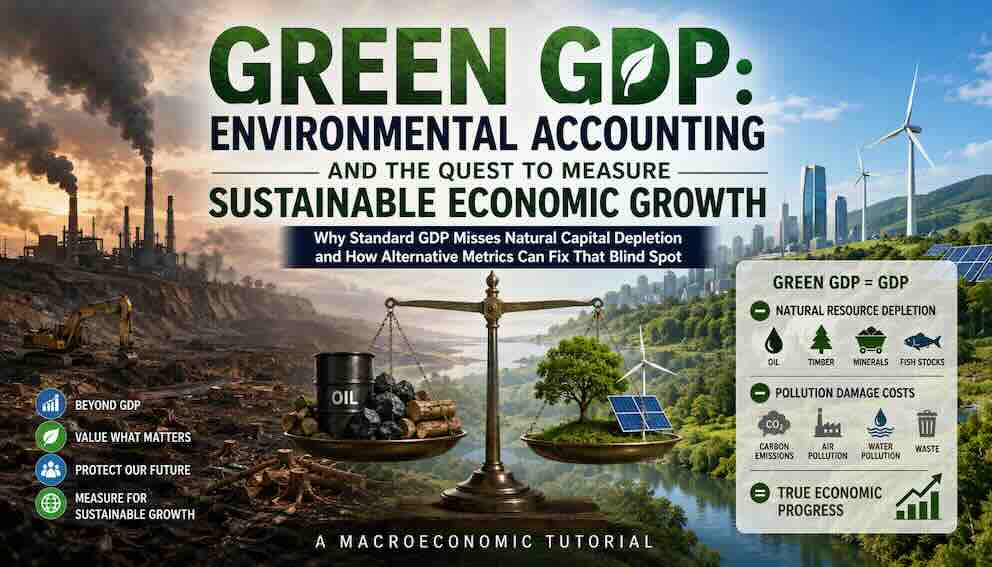
This blind spot is not a minor technical oversight. It is a fundamental conceptual limitation that flows from how GDP was originally designed. GDP measures market transactions—the buying and selling of goods and services. It was never intended to measure the sustainability of economic activity or the depletion of the natural assets that underpin long-term prosperity. As environmental pressures have mounted, from climate change to biodiversity loss to resource scarcity, economists have worked to develop alternative metrics that correct GDP's blind spot. The most direct of these alternatives is Green GDP, which starts with conventional GDP and subtracts two categories: the depletion of natural resources and the costs of pollution.
However, Green GDP is not an unambiguously correct measure. It embodies a specific set of assumptions about the relationship between natural capital and produced capital that many economists reject. Before we can understand what Green GDP tells us, we need to understand what it assumes. This tutorial walks through the logic, methods, and deep conceptual debates of environmental accounting.
Flows, Stocks, and the Capital Account: The Conceptual Foundation
To understand what Green GDP is trying to accomplish, we need to revisit a distinction that appears throughout macroeconomics: the difference between flows and stocks. A flow is a quantity measured per unit of time—income, spending, production, investment. A stock is a quantity measured at a point in time—wealth, capital, debt, inventories. GDP is a flow measure. It tells us how much the economy produced in a quarter or a year. It does not tell us, except indirectly through investment, how those production decisions affect the stock of productive assets that will generate future output.
In conventional national accounting, the stock of produced capital—factories, machines, roads, buildings—is tracked through the capital account. When a company invests in a new factory, that investment appears in GDP as part of gross fixed capital formation. Over time, the factory depreciates—it wears out, becomes obsolete, or requires replacement. That depreciation is subtracted when moving from gross to net measures. Net domestic product is gross domestic product minus the depreciation of produced capital. This accounting adjustment is standard and uncontroversial.
The insight behind environmental accounting is that the same logic should apply to natural capital—the stock of natural assets that provide goods and services to the economy. Natural capital includes mineral deposits, timber stands, fish stocks, fertile soil, clean water, and the atmosphere's capacity to absorb carbon dioxide. When an economy extracts oil, it depletes its stock of oil reserves. When it harvests timber faster than forests regrow, it depletes its stock of forest capital. When it emits carbon dioxide, it uses up some of the atmosphere's limited capacity to absorb greenhouse gases without causing climate change. The physical damages described in the previous tutorial—the destroyed crops, the flooded factories, the lost labor productivity—are precisely what pollution damage costs attempt to capture in monetary terms. The only reason these depletions are not subtracted from GDP is that they do not pass through market transactions.
But here we encounter the first major conceptual divide. When a factory depreciates, we replace it with another factory. The produced capital stock can be maintained or increased through investment. But when an oil reserve is depleted, can we replace it with something else? The answer depends on whether you believe that natural capital and produced capital are substitutable.
Weak Versus Strong Sustainability: The Deep Theoretical Divide
Weak sustainability is the assumption that natural capital and produced capital are largely substitutable. Under this view, what matters for future generations is the total stock of capital—produced, natural, and human—not the composition of that stock. If we deplete a forest but use the proceeds to build a factory and train workers, future generations are not necessarily worse off. They have less natural capital but more produced and human capital. Weak sustainability is the assumption built into Green GDP and genuine savings. A dollar of natural capital depletion can be offset by a dollar of investment in produced or human capital.
Strong sustainability rejects this assumption. Certain natural assets are non-substitutable because they perform unique functions that produced capital cannot replicate. A stable climate system is not substitutable. Once the climate passes certain thresholds, no amount of factories or educated workers can restore it. Biodiversity is not substitutable. The extinction of a species is irreversible, and the ecosystem services that species provided—pollination, water filtration, pest control—cannot be replicated by technology at any feasible scale. The ozone layer was not substitutable, which is why the Montreal Protocol banned ozone-depleting substances rather than trying to offset ozone depletion with other forms of capital. Under strong sustainability, the goal is not to maintain total capital but to preserve critical natural capital stocks above certain thresholds.
This debate has concrete policy implications. Under weak sustainability, a country might be justified in clearing old-growth forest if it invests the proceeds in education. Under strong sustainability, that same forest would be protected because its ecological functions cannot be replaced. Most environmental economists position themselves between these poles, accepting substitution for some forms of natural capital but insisting on preservation for critical natural capital that exhibits irreversibility and threshold effects. Green GDP is not a neutral technical adjustment. It embodies weak sustainability. If you believe in strong sustainability, you will find Green GDP inadequate regardless of how accurately it measures depletion, because it treats natural capital as fungible with produced capital in ways that ecological systems are not.
Irreversibility, Tipping Points, and the Limits of Marginalism
The weak sustainability framework assumes environmental damages are continuous, reversible, and can be valued at the margin. A ton of carbon emissions causes a small increment of damage. A hectare of forest cleared causes a small loss of ecosystem services. But real environmental systems exhibit tipping points—thresholds beyond which a small additional change triggers a large, abrupt, and potentially irreversible shift. The previous tutorial covered these in detail: ice sheet collapse, permafrost methane release, Amazon rainforest dieback. The economic implication is that standard damage functions dramatically underestimate the risks of crossing ecological thresholds. If an ecosystem has a tipping point, the damage from crossing that threshold is not the incremental cost of the last unit of pressure. It is the entire value of the lost ecosystem.
The same logic applies to biodiversity loss. The extinction of a species is irreversible. Once a species is gone, no amount of future economic growth can bring it back. The value of that species is not its marginal contribution to current ecosystem services but the option value of its genetic information, its role in ecosystem functioning, and its intrinsic existence value. Standard environmental accounting misses irreversibility entirely. A forest that is logged and converted to agriculture is treated as a transfer of value from natural to produced capital. But if that forest contained unique species that go extinct as a result, no substitution is possible. The loss is permanent.
This is not a peripheral objection. Proponents of weak sustainability argue we should estimate prices for everything using options pricing methods and precautionary adjustments. Proponents of strong sustainability argue that certain natural assets should be subject to absolute preservation constraints that no cost-benefit analysis can override. Green GDP is a particular approach rooted in weak sustainability and marginalism. For some environmental problems, that approach is appropriate. For others, it is dangerously misleading.
From Theory to Calculation: Green GDP
With the conceptual framework established, we can now turn to the calculation itself. Green GDP is standard GDP minus natural resource depletion minus pollution damage costs. Some formulations also subtract defensive expenditures, but this is controversial because it can amount to double-counting.
Natural resource depletion is valued using the net price method: the market price of the resource minus the cost of extracting it. If a ton of crude oil sells for sixty dollars on world markets and extraction costs forty dollars, the depletion value per ton is twenty dollars. Multiply that by the number of tons extracted in a year, and you have an estimate of natural capital depletion from oil for that year. For renewable resources like timber and fish, the calculation is more nuanced: only the excess over sustainable yield counts as depletion, because harvesting at or below the regeneration rate does not reduce the long-term stock. The United Nations Food and Agriculture Organization (FAO) estimates that approximately one-third of global fish stocks are overfished, meaning the catch rate exceeds the reproduction rate. For those fisheries, the difference between the actual catch and the sustainable yield represents depletion of natural capital.
Pollution damage costs are more difficult to estimate because there is no market price for a ton of carbon dioxide emissions or a liter of untreated sewage. The social cost of carbon is the most prominent example. It is the present value of the economic damages caused by emitting one additional ton of carbon dioxide—damages that include reduced crop yields, increased heat-related mortality, sea-level rise damage to coastal property, and the other physical harms documented in the previous tutorial. But the social cost of carbon is highly sensitive to the discount rate. A low discount rate, like the one Nicholas Stern used, produces a high social cost—several hundred dollars per ton. A high discount rate, like the one William Nordhaus used, produces a low cost—less than fifty dollars per ton. The choice of discount rate is not a technical decision. It is an ethical choice about how much weight to place on the welfare of future generations. There is no single agreed value.
For other pollutants—sulfur dioxide, nitrogen oxides, particulate matter, mercury—economists use methods like the human capital approach (estimating lost earnings and medical costs) and the willingness-to-pay approach (surveying what people would pay to avoid exposure). Each method has strengths and weaknesses, and different methods can produce very different numbers for the same pollutant.
The United Nations SEEA: Framework and Implementation Failures
Before any country can calculate Green GDP, it needs standardized definitions, classifications, and methods. That is the purpose of the System of Environmental-Economic Accounting (SEEA), adopted as an international statistical standard in 2012. The SEEA has three core accounts: the asset account tracking natural resource stocks; the physical flow account tracking materials, energy, and water; and the environmental protection expenditure account tracking pollution abatement spending. More than eighty countries have engaged with SEEA.
But engagement is not the same as implementation. Relatively few countries have produced comprehensive accounts across all three modules. Data quality varies enormously. Many developing countries—precisely those with the most significant natural capital depletion—lack the statistical capacity to implement the framework properly. The difficulty is not abstract. Consider artisanal fisheries in West Africa. Millions of small-scale fishers operate from thousands of landing sites. Their catches are not recorded in any centralised system. There is no fleet of research vessels to assess fish stocks. Satellite monitoring cannot track what is caught by a dugout canoe with a hand line. Yet these fisheries are among the most overexploited in the world, and the depletion of fish stocks directly affects the food security and livelihoods of coastal communities. The SEEA framework assumes the existence of data that simply does not exist in the places where natural capital depletion is most acute. This is not a failure of will. It is a resource and infrastructure constraint that no accounting standard can magically overcome.
The same problem applies to soil carbon, groundwater depletion, and biodiversity. Forest monitoring via satellite is improving rapidly, but ground-truthing remains expensive. Countries that lack the capacity to measure their natural capital cannot manage it, and they certainly cannot produce reliable Green GDP estimates. The implementation gap is the single most important reason that environmental accounting remains more aspirational than operational in much of the world.
Genuine Savings: Wealth-Based Accounting
Green GDP focuses on the flow of national income. Genuine savings—published annually by the World Bank—focuses on whether total wealth is increasing or decreasing over time. It starts with gross national savings, subtracts depreciation of produced capital, subtracts natural resource depletion, and adds education spending as investment in human capital. Positive genuine savings means total wealth is increasing. Negative genuine savings means wealth is being consumed.
The World Bank's estimates contain striking findings. Several Gulf states—Kuwait, the United Arab Emirates, Saudi Arabia—have had persistently negative genuine savings rates for decades. These are wealthy countries with high GDP per capita. By conventional measures, they appear successful. But genuine savings reveals that they have been converting their natural capital into consumption without adequately reinvesting in other capital forms. The contrast between high GDP per capita and negative genuine savings is the metric's most powerful illustration. A country can look prosperous while quietly running down its natural inheritance.
However, genuine savings has significant limitations. It assumes correct pricing of all capital types. If the social cost of carbon is undervalued, then the depletion of atmospheric capacity is understated. It may miss ecosystem collapse risks. A fishery that has been overfished for years shows gradual depletion in genuine savings, but the actual economic loss when the fishery collapses is not gradual at all. And education spending is not the same as human capital accumulation—spending more on schools does not guarantee that students are learning more or acquiring skills that will be productive in the future labour market.
The Inclusive Wealth Index: GDP Growth with Declining Wealth
The Inclusive Wealth Index, developed under the United Nations Environment Programme, measures total wealth in three categories: produced capital, natural capital, and human capital. It tracks changes over time. A country is sustainable if inclusive wealth per capita is increasing, even if conventional GDP is volatile.
The most powerful empirical finding is the divergence between GDP and inclusive wealth. Some countries show positive GDP growth but declining inclusive wealth per capita. Conventional statistics send an optimistic signal while the underlying asset base erodes. For countries that rely heavily on natural resource extraction, the gap can be substantial. The apparent prosperity is partly an illusion—financed by drawing down natural assets. Like Green GDP, the Inclusive Wealth Index embodies weak sustainability. It allows substitution across capital types. A country that depletes its forests but builds more schools can show positive inclusive wealth growth even if the forests provided non-substitutable ecological services.
The Ecological Footprint: Biophysical Critique
For those who believe monetary valuation fundamentally misrepresents ecological value, biophysical alternatives offer a different starting point. The Ecological Footprint, developed by Mathis Wackernagel and William Rees, measures how much biologically productive land and water area is required to produce the resources a population consumes and to absorb the waste it generates. This is measured in global hectares and compared to biocapacity. Globally, the human Ecological Footprint exceeds biocapacity by approximately seventy-five percent—equivalent to 1.75 planet Earths.
However, the Ecological Footprint has major limitations. Carbon dominates the metric, accounting for more than half the total footprint for many high-income countries. It is often effectively a carbon measure in disguise. More fundamentally, the footprint assumes that all carbon must be sequestered by biological land rather than accounting for technological carbon capture. Carbon capture and storage technologies are still in early development and not yet deployed at scale, but the footprint methodology makes no provision for them even in principle. This assumption artificially inflates the footprint and is contested even among environmental economists sympathetic to biophysical approaches. The land-equivalence assumptions are also controversial—a global hectare in a temperate country may not be equivalent to one in a tropical country in terms of the ecosystem services provided. Despite these limitations, the footprint remains a powerful communication tool and a useful check on purely monetary approaches.
Political Economy: Institutional Lock-In
The deepest obstacle to adopting Green GDP is political. GDP is embedded in the institutional fabric of modern governance in ways that make it extraordinarily resistant to replacement.
Fiscal rules in many countries are tied to GDP. The European Union's Maastricht criteria require government debt below sixty percent of GDP and budget deficits below three percent of GDP. If the denominator were replaced by a smaller Green GDP, many countries would suddenly violate these rules. Debt-to-GDP ratios would rise overnight, not because anything changed in the real economy but because the accounting framework changed. The same logic applies to credit ratings and international comparisons. Changing the headline metric would disrupt all of these institutions simultaneously. The coordination costs are enormous. No single country can unilaterally switch without disrupting its relationships with international financial markets. This is why even countries that piloted Green GDP, like China, have not adopted it as their official metric. The problem is structural—institutional lock-in—not a failure of political will.
Distributional Issues: Race, Class, and Intergenerational Equity
All the metrics discussed are aggregates. They summarize the national economy as a whole. But environmental damages are not distributed evenly, and a sustainable aggregate can conceal deeply inequitable outcomes.
Consider a country that extracts oil, depletes natural capital, but invests the proceeds in education. Aggregate genuine savings might be positive. But if the environmental damages from extraction—air pollution, water contamination, land degradation—are concentrated on a poor, indigenous community living near the site, while the benefits are distributed across the entire population, then the aggregate masks a transfer of welfare from the poor community to everyone else. The community loses access to clean water and traditional livelihoods and suffers health impacts. None of this appears in the aggregate metrics.
The environmental justice literature documents this pattern systematically. Robert Bullard's work on toxic facility siting shows that polluting industries are disproportionately located in poor communities and communities of color. There is a well-documented correlation between poverty, race, and proximity to environmental hazards. Aggregate sustainability metrics are blind to this. A country can be sustainable in the weak sustainability sense while being deeply unjust in how environmental harms are distributed.
There is also an intergenerational dimension. All sustainability metrics frame the question as current generation versus future generations. But within the current generation, environmental degradation is distributed unequally by race, class, and geography. The same political economy forces that lock in GDP also tend to serve those who benefit from concealing natural capital depletion. The political economy problem and the distributional problem are not separate issues. They are aspects of the same underlying challenge.
Conclusion: The Measure of What We Lose
The central insight of environmental accounting is that we have been keeping the books with one ledger missing. For decades, national statistical systems have measured produced capital in exquisite detail while treating natural capital as a free gift. Countries that grew rich by converting natural capital into consumption looked like success stories by the lights of conventional GDP. Only when the wells ran dry, the forests were gone, and the fish stocks collapsed did the illusion become apparent.
Green GDP, genuine savings, the Inclusive Wealth Index, and the Ecological Footprint all attempt to add the missing ledger. Each has strengths. Each has weaknesses. And each embodies assumptions about substitutability and valuation that can and should be debated. Weak sustainability is one legitimate approach. Strong sustainability is another. The choice between them depends on which environmental problems you care about and which risks you consider most pressing. What the technical debates should not obscure is that the very act of measuring changes what we see as success. A country that reports rising GDP and falling inclusive wealth is not succeeding. It is borrowing from its future to inflate its present.
The movement for environmental accounting is not just a technical reform. It is an attempt to make visible what has been hidden, to count what has been ignored, and to hold the present generation accountable to the future. But accountability requires more than measurement. It requires that the measurements matter—that they enter into fiscal rules, debt sustainability analysis, and political accountability. That is where the institutional lock-in becomes a binding constraint. The same forces that have made GDP the dominant metric also benefit from its dominance. Changing the metric is not merely a matter of better data. It is a matter of shifting the distribution of power over what counts as progress.
The next tutorial in this series turns to the energy transition. That transition will require new technologies and new policies. But first, it requires new measures of what we stand to gain and what we stand to lose. Environmental accounting provides those measures. The question is whether we will let them matter.
About Swati Sharma
Lead Editor at MyEyze, Economist & Finance Research WriterSwati Sharma is an economist with a Bachelor’s degree in Economics (Honours), CIPD Level 5 certification, and an MBA, and over 18 years of experience across management consulting, investment, and technology organizations. She specializes in research-driven financial education, focusing on economics, markets, and investor behavior, with a passion for making complex financial concepts clear, accurate, and accessible to a broad audience.
Disclaimer
This article is for educational purposes only and should not be interpreted as financial advice. Readers should consult a qualified financial professional before making investment decisions. Assistance from AI-powered generative tools was taken to format and improve language flow. While we strive for accuracy, this content may contain errors or omissions and should be independently verified.