
Tutorial Categories
Last Updated: April 18, 2026 at 10:30
What Is GDP? A Complete Guide to Gross Domestic Product, Its Components, and What It Tells Us About the Economy
Understanding the Single Most Important Measure of Economic Activity—What It Captures, What It Leaves Out, and Why It Matters
This tutorial introduces Gross Domestic Product (GDP), the most widely used measure of a country's economic output. You will learn the formal definition of GDP, the intuition behind why economists count only final goods and services, and the formula that breaks GDP down into consumption, investment, government spending, and net exports. Using real-world examples from the 2008 financial crisis and the COVID-19 pandemic, this tutorial shows how GDP is measured, where to find the data, and what GDP can—and cannot—tell us about the health of an economy. This is the first in a series of tutorials that will explore GDP in depth; future tutorials will cover real vs nominal GDP, alternative measures, and the critical limitations of GDP as a measure of well-being.
Introduction: The Number That Tells Us How Big the Economy Is
Imagine you are a doctor trying to assess the health of a patient. You would take their temperature, check their blood pressure, listen to their heart, and run blood tests. No single measurement gives you the complete picture, but some measurements are so fundamental that you cannot do without them. For the economy, Gross Domestic Product—or GDP—is that kind of fundamental measurement. It is the single most widely used indicator of how an economy is performing. When newspapers report that "the economy grew by 2.5 percent last quarter," they are reporting the growth rate of GDP. When politicians debate whether the country is in a recession, they are asking whether GDP has been shrinking. When economists compare the size of the United States economy to that of China or India, they are comparing GDP.
But what exactly is GDP? Where does this number come from? What does it include, and what does it leave out? How can you find the latest GDP data, and what should you look for when you read it? These are the questions this tutorial will answer. We will move slowly, using everyday examples to build intuition. And because this is the first in a series of tutorials on GDP, we will focus on the core concepts—the definition, the components, and what GDP measures at its most basic level. Later tutorials in this series will explore the distinction between real and nominal GDP, the different methods of calculating GDP, the relationship between GDP and other measures like GNP, and the critical limitations of GDP as a measure of well-being. For now, let us start at the beginning: what GDP actually is.
What is GDP
At its core, Gross Domestic Product is the total market value of all final goods and services produced within a country's borders during a specific period of time, typically a quarter or a year. Let us unpack that definition piece by piece.
"Market value" means that GDP is measured in money terms. If a country produces one million cars that sell for $30,000 each, those cars contribute $30 billion to GDP. If it produces ten million loaves of bread that sell for $2 each, those loaves contribute $20 million. Using market value allows us to add up very different things—cars, haircuts, computers, restaurant meals—by converting them into a common unit: dollars. This is the only way to combine the output of a steel mill with the output of a hair salon; both are measured in the prices they command in the marketplace.
"Final goods and services" is a crucial qualifier. GDP counts only final goods—things sold to the end user—not intermediate goods that are used to produce other things. To understand why this matters, consider a simple cup of coffee that you buy at a local café for $4. That cup of coffee is a final good; it is what you, the consumer, ultimately enjoy. But before it reached you, there were many intermediate transactions. The coffee farmer sold beans to a roaster for $1. The roaster sold roasted beans to the café for $2. The café then brewed the coffee, served it to you, and charged $4. If we added up all these transactions—the farmer's $1, the roaster's $2, and your $4—we would get $7. But the only thing of value to the end consumer is the $4 cup of coffee. The beans and the roasted coffee were intermediate inputs; their value is already contained in the final price you paid. By counting only final goods, GDP avoids double-counting and measures the actual value of what the economy produces.
"Produced within a country's borders" distinguishes GDP from another measure called Gross National Product, or GNP. GDP counts production that happens inside the country, regardless of who owns the factory. If a Japanese-owned car factory operates in Tennessee, the cars it produces count as part of U.S. GDP because they are produced in the United States. If an American-owned factory operates in Mexico, its output counts as part of Mexico's GDP, not the United States'. GDP is about geographic location, not nationality. This distinction matters for countries with many foreign-owned factories or many citizens working abroad. We will explore the relationship between GDP and GNP in a later tutorial.
"During a specific period of time" means GDP is a flow, not a stock. It measures production over a period – a quarter or a year – not the total wealth accumulated over history. Your bank account balance at the end of the year is a stock; it tells you how much you have accumulated. Your monthly salary is a flow; it tells you how much you earn each month. GDP is like your monthly salary: it tells us how much the economy is producing each quarter or each year, not how much the economy has accumulated in total. When we say GDP grew by 2.5 percent last year, we mean that the flow of new production increased by that amount compared to the year before. The distinction matters because a country could have a large stock of existing wealth (factories, roads, buildings) but a small flow of new production if its economy is stagnant. Conversely, a country could have a small stock of wealth but a rapidly growing flow of new production if it is developing quickly.
Key takeaway: GDP is the total market value of all final goods and services produced within a country's borders in a given period. It measures the flow of new production, not accumulated wealth, and it counts only final goods to avoid double-counting intermediate inputs.
The Components – Breaking GDP into C, I, G, and Net Exports
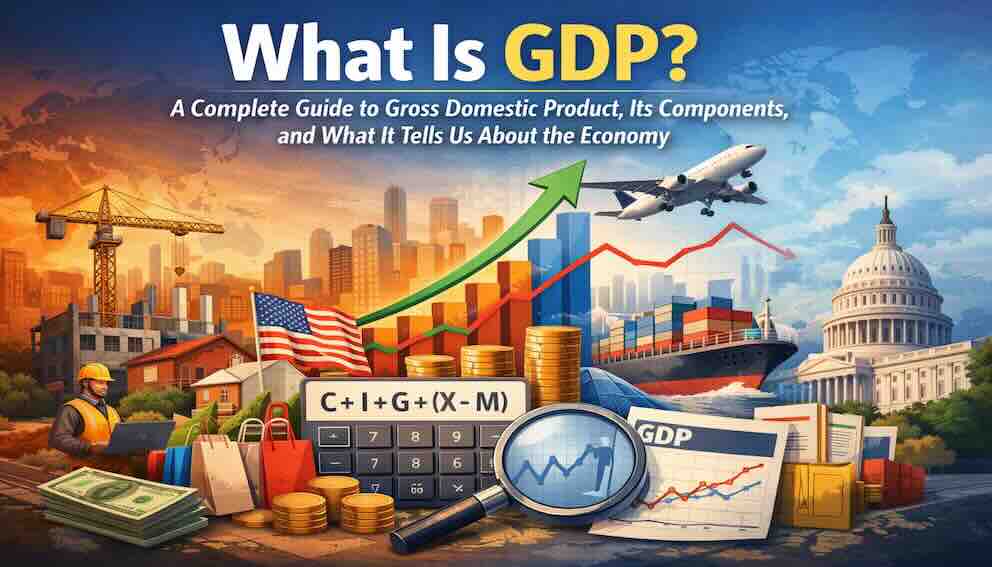
One of the most useful ways to understand GDP is to break it down into its components. Every final good or service produced in the economy is purchased by someone. That someone is either a consumer, a business, the government, or a foreign buyer. This gives us the GDP formula:
GDP = C + I + G + (X − M)
Where C stands for consumption, I for investment, G for government spending, X for exports, and M for imports. Let us walk through each component.
Consumption – The Spending of Households
Consumption is the largest component of GDP in most economies. In the United States, it typically accounts for about 68 to 70 percent of total GDP. Consumption includes everything households spend on: food, rent, gasoline, clothing, healthcare, entertainment, restaurant meals, and so on. When you buy a cup of coffee, that spending is part of consumption. When you pay your rent, that is consumption. When you go to the movies, that is consumption. When you fill up your car with gasoline, that is consumption. Consumption captures the daily economic activity of households—the millions of transactions that make up the rhythm of economic life.
During the COVID-19 pandemic, consumption collapsed in ways that were visible to everyone. In April 2020, as lockdowns took effect and people stayed home, spending on restaurants, travel, entertainment, and clothing fell by more than 20 percent in a single month. Restaurants that had been full of diners were suddenly empty. Airplanes that had been packed with travelers flew with only a handful of passengers. Stores that had been bustling with shoppers stood quiet. This collapse in consumption was the primary driver of the deep but short recession. As the economy reopened and stimulus checks arrived in bank accounts, consumption surged, driving the rapid recovery.
Investment – Spending on New Physical Capital
Investment, in economic terms, does not mean buying stocks or bonds. Those are financial investments—transactions in existing assets—and they do not count toward GDP because they do not represent the production of new goods. Instead, investment in GDP terms refers to spending on new physical capital: factories, machinery, computers, trucks, office buildings, and new housing. It also includes inventory investment—changes in the stock of unsold goods. When a car manufacturer builds a new factory, that is investment. When it buys new machinery for that factory, that is investment. When it produces cars that are not sold immediately, those unsold cars are counted as inventory investment—they are treated as if the manufacturer bought them from itself.
It is worth pausing here because this definition often trips people up. If you buy a used house, that transaction is not counted in GDP—the house was already counted when it was first built. If you buy shares of Apple stock, that is not counted—it is a transfer of ownership, not new production. Only when something new is created—a new building, a new machine, a new piece of software—does it count as investment in the GDP accounts. This distinction matters because it focuses GDP on new production rather than the transfer of existing assets.
Investment is the most volatile component of GDP. When businesses are confident about the future, they invest heavily. When they are uncertain, they pull back. During the 2008 financial crisis, investment collapsed by more than 20 percent as businesses canceled expansion plans and housing construction ground to a halt. Construction cranes that had dotted city skylines disappeared. Factories that had been planning to add new production lines put those plans on hold. This collapse in investment was a major factor in the severity of the recession and the slowness of the recovery.
Government Spending – Purchases of Goods and Services
Government spending includes purchases of goods and services by federal, state, and local governments. This includes spending on national defense, schools, roads, police, fire services, and public parks. It also includes salaries of government employees—teachers, police officers, firefighters, and administrative staff. What it does not include are transfer payments like Social Security, Medicare, unemployment benefits, or welfare. These are payments to individuals that do not represent a purchase of a new good or service; they simply transfer money from one group to another. When the government sends a Social Security check to a retiree, that money is not counted in G. When the retiree spends that money on groceries, that spending is counted in C.
Government spending can be a powerful tool for stabilizing the economy. During recessions, when private sector spending (C and I) falls, governments can increase G to offset the decline. This is exactly what happened during the 2008 crisis and the COVID-19 pandemic, when governments around the world enacted large stimulus packages. The idea is simple: if households and businesses are pulling back, the government can step in to keep the flow of spending moving.
Net Exports – The Balance of Trade
Net exports are exports minus imports. Exports (X) are goods and services produced in the country and sold to foreigners. Imports (M) are goods and services produced abroad and purchased by domestic consumers, businesses, or the government. Net exports can be positive (a trade surplus) or negative (a trade deficit). The United States has run a trade deficit for decades, meaning imports exceed exports, so net exports are negative. This subtracts from GDP.
Why do we subtract imports? Because consumption, investment, and government spending all include spending on both domestic and foreign goods. To get GDP—which measures only domestic production—we must subtract the value of imports that are included in C, I, and G. For example, if a consumer buys a car imported from Japan, that purchase is counted in C, but the car was not produced in the United States. So we subtract the value of the import in the net exports term. If a U.S. company buys a machine made in Germany, that purchase is counted in I, but the machine was not produced in the United States. So again, we subtract.
A Simple Numerical Example
To make the formula concrete, let us work through a simple example. Imagine an economy in a particular year. Households spend $500 billion on goods and services—that is consumption. Businesses spend $200 billion on new factories, machinery, and housing—that is investment. Governments at all levels spend $300 billion on roads, schools, defense, and employee salaries. The country exports $100 billion worth of goods to other nations, and it imports $150 billion worth of goods from abroad. Net exports are therefore negative $50 billion. Adding it all up: $500 billion plus $200 billion plus $300 billion equals $1,000 billion. Subtract the $50 billion trade deficit, and we get GDP of $950 billion. This is the total value of final goods and services produced in that country that year.
Key takeaway: GDP is the sum of four components: consumption (household spending), investment (business spending on new physical capital), government spending (purchases of goods and services), and net exports (exports minus imports). Investment in GDP terms refers only to new physical capital, not financial assets like stocks and bonds.
The Three Ways to Measure GDP – An Overview
When economists measure GDP, they have three different approaches, and all three arrive at the same number. This is not a coincidence; it is a fundamental identity of national income accounting. Every transaction has two sides: one person's spending is another person's income, and production creates both.
The first approach is the expenditure method, which is what we have been discussing: add up all spending on final goods and services. This gives us C + I + G + (X − M). This is the most intuitive approach for many people because it follows the money as it moves through the economy.
The second approach is the income method. Instead of adding up spending, it adds up all the income earned in producing goods and services. This includes wages and salaries paid to workers, rents paid to landowners, interest paid to lenders, and profits earned by business owners. Since every dollar spent on a good or service becomes income for someone—the worker who made it, the owner of the factory, the landlord who rented the space—the total income earned must equal total spending.
The third approach is the output method, sometimes called the value-added approach. Instead of adding up spending or income, it adds up the value added at each stage of production. Recall our coffee example: the farmer added $1 of value, the roaster added $1, the café added $2. The sum of value added across all stages equals the final value of the cup of coffee. This approach is particularly useful for understanding which industries are contributing most to economic growth.
These three approaches are not separate; they are three sides of the same coin. The fact that they always give the same number is a fundamental identity of national income accounting. In a later tutorial in this series, we will explore each of these methods in detail, looking at how they are implemented in practice and what they reveal about the economy.
Key takeaway: GDP can be measured in three equivalent ways—expenditure (adding up spending), income (adding up earnings), and output (adding up value added). They all give the same number because every dollar spent becomes income for someone, and the value added at each stage adds up to the final selling price.
What GDP Measures – The Flow of Goods and Services
At its best, GDP measures the total market value of everything a country produces. When GDP is growing, it generally means that the country is producing more goods and services, which typically translates into more jobs, higher incomes, and the ability to afford better healthcare, education, and infrastructure. A growing GDP is associated with rising living standards, though not perfectly.
Think about what a growing GDP represents. When a new factory is built, that shows up in investment (I). When that factory hires workers, their wages show up in the income approach. When those workers spend their wages on groceries, that shows up in consumption (C). The factory produces goods that may be exported, showing up in net exports (X − M). Each transaction in the economy—from buying a cup of coffee to building a skyscraper—is part of the GDP flow.
Real-world events illustrate what GDP measures. During the 2008 financial crisis, GDP fell by more than 4 percent in the United States. That decline represented factories closing, construction projects halting, stores selling fewer goods, and millions of workers losing their jobs. The decline was not an abstract statistic; it was a concrete measure of the economy's contraction. During the COVID-19 pandemic, GDP fell at an annual rate of 31 percent in the second quarter of 2020—the sharpest decline on record. That represented restaurants shuttered, airlines flying empty planes, and millions of people staying home instead of spending.
Conversely, when GDP grows, it represents real changes in people's lives. The decades of rapid GDP growth in China since the 1980s have lifted hundreds of millions of people out of poverty. The growth represented new factories, new roads, new schools, and millions of new jobs. The number—GDP—captured the scale of that transformation.
Key takeaway: GDP measures the total flow of goods and services the economy produces. When GDP grows, the economy is producing more; when it shrinks, the economy is contracting. This flow is directly connected to jobs, incomes, and living standards.
A Brief Note on What GDP Does Not Measure
For all its importance, GDP is not a measure of everything that matters. There are several things that GDP does not capture, and understanding these limitations is essential for interpreting GDP data responsibly. Because this is such an important topic, we will devote an entire later tutorial in this series to exploring these limitations in depth. For now, a brief overview will suffice.
GDP does not count non-market activities. If you hire a nanny to care for your children, that spending is counted in GDP. If you care for your own children, that work is not counted. If you pay a landscaper to mow your lawn, that is counted. If you mow it yourself, it is not. This means that GDP systematically understates economic activity when people do things for themselves or within families.
GDP does not capture the underground economy—economic activity that is hidden from the government, either because it is illegal or because people are trying to avoid taxes. Estimates suggest that the underground economy accounts for anywhere from 7 to 20 percent of economic activity in advanced economies, and much more in developing countries.
GDP does not reflect environmental costs. If a factory produces goods worth $1 million but pollutes a river, the $1 million is added to GDP, and the pollution is not subtracted. If an oil spill occurs and cleanup crews are hired, the spending on cleanup adds to GDP. This means that GDP can rise while the environment is being destroyed.
GDP says nothing about inequality. It tells us the total size of the economic pie, but it tells us nothing about how that pie is divided. A country can have growing GDP while most of the population experiences stagnant incomes. This was the case in the United States in the decades after 1980: GDP per capita grew substantially, but median household income grew much more slowly, and inequality increased.
These limitations are real and important. They remind us that GDP is a measure of market output, not a comprehensive measure of well-being. We will return to these themes in a later tutorial, exploring alternative measures like Green GDP and the Genuine Progress Indicator that attempt to capture what GDP leaves out.
Key takeaway: GDP measures market output, but it does not capture non-market activities, the underground economy, environmental costs, or inequality. These limitations are significant, and we will explore them in depth in a later tutorial.
Where to Find GDP Data – A Practical Walkthrough
If you want to find GDP data for the United States or other countries, there are several reliable sources. Knowing where to look and what to look for will help you follow economic news with confidence.
In the United States, GDP data is produced by the Bureau of Economic Analysis (BEA) , which is part of the Department of Commerce. The BEA releases GDP reports on a regular schedule. About 30 days after the end of a quarter, the BEA releases the "advance estimate"—the first look at GDP for that quarter, based on incomplete data. This is the number that gets the most media attention. About 60 days after the quarter ends, the BEA releases a "second estimate," incorporating more complete data. And about 90 days after the quarter ends, it releases a "third estimate," which is the final number for that quarter. The BEA also releases annual revisions each summer, which can revise multiple years of data. These revisions can be significant; the initial estimate of GDP for the first quarter of 2008 showed a small decline, but later revisions showed a much deeper contraction. You can find all of this data at www.bea.gov.
For other countries, GDP data is typically produced by national statistical agencies. For international comparisons, several organizations compile data. The International Monetary Fund (IMF) publishes the World Economic Outlook database, one of the most widely used sources for cross-country GDP data. The World Bank publishes the World Development Indicators. The OECD provides detailed data for its member countries. And Trading Economics, a private website, aggregates data from hundreds of sources, making it easy to access GDP data for almost any country.
Now, imagine a GDP report has just been released. How do you read it in a way that makes sense? Let us walk through a hypothetical example.
You see a headline: "GDP grew at 2.5 percent in the third quarter." The first question to ask is: 2.5 percent of what? Is this real or nominal? In this case, the headline is almost certainly real GDP growth—the number that matters for understanding actual economic expansion. If it were nominal, it would be reported as "current-dollar GDP." The distinction between real and nominal GDP—adjusting for inflation—is so important that we will devote an entire tutorial to it later in this series.
The second question: is this annualized? In the United States, GDP is reported at an annualized rate. That means the 2.5 percent figure is not the growth rate for the quarter itself; it is the rate at which the economy would grow if that quarter's performance continued for a full year. The actual quarterly growth rate is about one-fourth of that, around 0.6 percent. This annualization helps compare growth across different periods, but it can also make small changes sound larger than they are.
The third question: what drove the growth? A good GDP report will tell you not only the headline number but also the contributions of each component. Was growth driven by strong consumer spending? By a surge in business investment? By government spending? By exports? Understanding the drivers helps you assess whether the growth is sustainable. Consumer-led growth may be more stable than export-led growth; investment-led growth may signal future productivity gains.
The fourth question: was this number revised? If you are reading about an earlier quarter, check whether the number has been revised. The advance estimate is based on incomplete data and can change significantly.
The fifth question: what is happening with GDP per capita? If population is growing, total GDP growth overstates the change in average living standards. For comparing well-being, GDP per capita is often more meaningful.
Key takeaway: GDP data is produced by official agencies like the U.S. Bureau of Economic Analysis. When reading GDP reports, ask: is it real or nominal? Is it annualized? What drove the growth? Was it revised? What is happening per capita? These questions will help you interpret the numbers like an economist.
Looking Ahead – What’s Next in This Series
This tutorial has introduced the core concept of GDP: what it is, how it is defined, and how it is broken down into its components. But this is only the beginning. The story of GDP is much richer, and the remaining tutorials in this series will explore the topics we have only touched upon.
In the next tutorial, we will explore the crucial distinction between real and nominal GDP. We will learn how economists adjust for inflation using the GDP deflator, what it means to choose a base year, and why real GDP growth is what economists mean when they talk about economic growth.
Following that, we will examine the relationship between GDP, GNP, and national income. We will learn how to move from domestic production to national income, what net factor income from abroad means, and how these different measures help us understand the economy from different angles.
We will then dedicate a tutorial to the three methods of calculating GDP—expenditure, income, and output—exploring each in detail and showing how they are implemented in practice.
Another tutorial will focus on inflation measurement, comparing the GDP deflator with the Consumer Price Index (CPI), explaining why they sometimes tell different stories, and exploring the problems with measuring inflation.
Finally, we will conclude the series with a deep dive into the limitations of GDP and the efforts to go beyond it. We will explore the informal economy, environmental costs, inequality, and alternative measures like Green GDP and the Genuine Progress Indicator that attempt to capture what GDP leaves out.
Each tutorial in this series builds on the foundation we have laid here, taking you deeper into the world of macroeconomic measurement. By the end, you will have a comprehensive understanding of GDP—what it is, how it is measured, what it tells us, and what it cannot tell us.
Key takeaway: This tutorial is the first in a series. Upcoming tutorials will cover real vs nominal GDP, GNP and national income, the three methods of calculation, inflation measurement, and the limitations of GDP. Each builds on the foundation we have established here.
Conclusion: The Measure and Its Place in the Larger Picture
We began this tutorial with the image of a doctor taking a patient's vital signs. GDP is the most important vital sign for the economy—the measure that tells us whether it is growing or shrinking, and by how much. We have explored what GDP is, how it is defined, and the formula that breaks it down into consumption, investment, government spending, and net exports. We have seen that GDP can be measured in three equivalent ways—expenditure, income, and output—and that these approaches all tell the same story because every transaction has two sides. We have walked through where to find GDP data and how to read a GDP release with a critical eye.
But we have also acknowledged that GDP is not the whole story. It leaves out non-market activities, the underground economy, environmental costs, and inequality. It does not tell us whether the air is clean, whether communities are strong, or whether people are happy. These limitations are not reasons to dismiss GDP; they are reasons to use it wisely, as one measure among many.
The economist who first developed the modern system of national accounts, Simon Kuznets, understood this. When he presented his work to the U.S. Congress in 1934, he warned: "The welfare of a nation can scarcely be inferred from a measurement of national income." That warning is as relevant today as it was ninety years ago. GDP is a powerful tool, but it is only one tool. It tells us about the flow of market production, which is essential for understanding jobs, incomes, and economic stability. But it does not tell us about the quality of life that production enables.
The remaining tutorials in this series will deepen your understanding of GDP—how it is adjusted for inflation, how it relates to other national income measures, how it is calculated in practice, and what its limitations are. Each tutorial will add a layer to your understanding, building toward a comprehensive picture of this foundational economic measure.
The next time you read that GDP grew by 2.5 percent, you will know what that number means: it means the economy produced 2.5 percent more goods and services than it did the year before, measured in real terms. You will know how to find the data, how to read the report, and what questions to ask. And you will know what the number cannot tell you—the stories of the people who are working, or not working; the state of the environment; the distribution of the gains. GDP is an indispensable measure, but it is not the whole story. Understanding both its power and its limits is the mark of economic literacy—and the foundation for the deeper exploration to come.
About Swati Sharma
Lead Editor at MyEyze, Economist & Finance Research WriterSwati Sharma is an economist with a Bachelor’s degree in Economics (Honours), CIPD Level 5 certification, and an MBA, and over 18 years of experience across management consulting, investment, and technology organizations. She specializes in research-driven financial education, focusing on economics, markets, and investor behavior, with a passion for making complex financial concepts clear, accurate, and accessible to a broad audience.
Disclaimer
This article is for educational purposes only and should not be interpreted as financial advice. Readers should consult a qualified financial professional before making investment decisions. Assistance from AI-powered generative tools was taken to format and improve language flow. While we strive for accuracy, this content may contain errors or omissions and should be independently verified.