
Tutorial Categories
Last Updated: March 29, 2026 at 15:30
The Theory of Interest
How Fisher Explained the Price of Time and Built the Foundations of Modern Finance
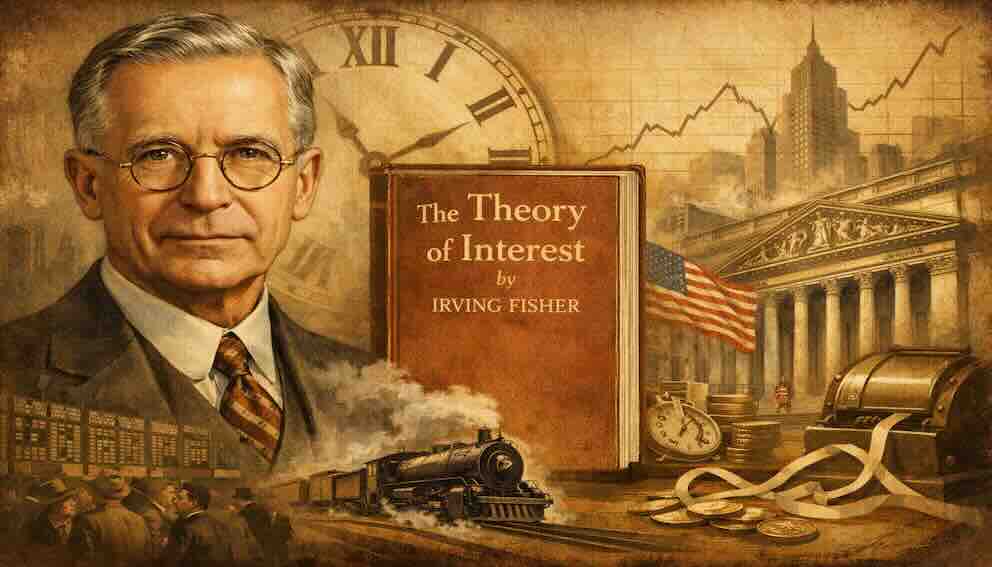
In 1930, as the world economy entered the turmoil of the Great Depression, the American economist Irving Fisher published what would become one of the most influential works in financial economics: The Theory of Interest. The book tackled a deceptively simple question that had puzzled economists for centuries: why does money today command a premium over money tomorrow? Fisher's answer reshaped finance. Interest, he argued, is the price of time, emerging from the interaction between human impatience—the tendency to prefer consumption today—and the productivity of investment that can expand wealth in the future. By formalizing concepts such as present value, discounting, and intertemporal choice, Fisher provided the mathematical language that modern finance still uses to evaluate investments, price assets, and make decisions across time. More than ninety years later, every time an investor discounts a future cash flow, a company evaluates a capital project, or a family decides how much to save for retirement, Fisher's framework is quietly at work.
Introduction to the Book
Interest is one of the most ordinary things in the financial world. We see it on our credit card statements, our mortgage documents, our savings account summaries. It seems simple: money today is worth more than money tomorrow, and interest is what compensates for the difference.
But for centuries, this apparent simplicity masked profound confusion. Why does money tomorrow become worth less than money today? Why do interest rates rise and fall? Why do some people borrow while others save? These questions, which now appear straightforward in finance textbooks, were once surrounded by philosophical debate, moral arguments, and economic reasoning that could never quite get to the heart of the matter.
When The Theory of Interest appeared in 1930, it offered something radically different: a systematic, mathematical explanation of how interest rates emerge from the most basic facts of human existence. Rather than treating interest as a mysterious financial phenomenon—the price of money, the reward for abstinence, the return to capital—Fisher framed it as the natural outcome of two forces that shape every economic decision.
The first force is human impatience, the universal tendency of people to prefer present enjoyment over future enjoyment. The second force is investment opportunity, the ability of capital to produce more over time, to turn a seed into a harvest, a machine into a stream of products, an education into a lifetime of higher earnings.
Where these two forces meet, Fisher argued, interest rates are determined. Understanding this relationship provides a lens through which much of finance—saving, investment, and the valuation of capital—can be analyzed.
The Man Behind the Book: Irving Fisher's Extraordinary Life
Irving Fisher was born in 1867 in Saugerties, New York, the son of a Congregational minister. From an early age, he displayed extraordinary mathematical ability, and he entered Yale University at just seventeen years old. At Yale, he studied everything: mathematics, science, philosophy, and the emerging field of economics. In 1891, he completed one of the first PhDs in economics ever awarded in the United States.
But Fisher was never content with pure theory. He was also an inventor and entrepreneur. Early in his career, he designed an innovative visible filing system—a precursor to the way offices organize information—that became commercially successful and made him wealthy long before his academic fame fully emerged. He held patents, started businesses, and thought constantly about how ideas could be turned into practical tools.
His personal life was marked by both achievement and suffering. In his thirties, he contracted tuberculosis, a disease that nearly killed him and forced him into years of convalescence in Colorado. During this period of isolation, unable to teach or engage in normal academic life, he devoted himself to writing and thinking deeply about economics. Some scholars believe this forced solitude sharpened his theoretical work.
Later, he became famous for a prediction that would shadow the rest of his career. Just days before the stock market crash of 1929, Fisher declared that stock prices had reached what he called a "permanently high plateau." The crash that followed wiped out much of his personal fortune—he lost millions—and severely damaged his public reputation.
Yet while this single mistaken prediction overshadowed his career in popular memory, Fisher's theoretical work—especially The Theory of Interest—would eventually be recognized as some of the most profound and enduring research in the history of economics. The man who could not foresee the Depression had, in fact, built the intellectual framework that would help future generations understand it.
The Era That Produced the Book: 1930 and the Great Depression
The timing of the book's publication could hardly have been more dramatic.
In 1930, the world was entering the most devastating economic collapse of the modern era. Banks were failing by the hundreds. Businesses were closing their doors. Unemployment was rising at terrifying speed. The global financial system appeared to be breaking down before everyone's eyes.
Yet behind this chaos, something else was happening. Economists were beginning to realize that modern economies required a deeper scientific understanding of financial mechanisms, especially credit, saving, investment, and interest.
Interest rates were central to almost everything happening in the economy. They determined whether businesses could borrow to survive. They influenced whether families could keep their homes. They shaped the decisions of savers watching their nest eggs dwindle. And yet, for all their importance, economists lacked a clear analytical framework explaining how interest rates actually emerged.
Fisher's book stepped directly into this intellectual vacuum. Drawing on mathematics, psychology, and economic logic, he built a model that connected human behavior with financial outcomes. Instead of viewing interest rates as arbitrary numbers set by banks or governments, he showed that they were the natural result of how people value time.
The book was not a response to the Depression—Fisher had been developing these ideas for decades. But its publication at that particular moment meant that it would be read, debated, and eventually recognized as offering something essential: a way of thinking about time and money that transcended the chaos of any particular crisis.
Understanding Fisher's Insight Through a Simple Example
Imagine you receive a bonus of ten thousand dollars today.
You have two choices.
You could spend it immediately—perhaps on travel, a new laptop, or improvements to your home. That would give you satisfaction today.
But you could also invest it. Suppose you place the money in an investment that yields five percent per year. Next year, the ten thousand dollars becomes ten thousand five hundred dollars.
Now a question naturally arises: which option should you choose?
The answer depends on how much you value present consumption relative to future consumption.
If you strongly prefer enjoyment today, the extra five hundred dollars next year may not feel worth the wait. But if you are patient, the additional future wealth may easily justify postponing spending.
This simple dilemma—consume now or later—is what Fisher called an intertemporal choice.
When millions of individuals make these choices simultaneously, their collective preferences determine how much society saves. Businesses, meanwhile, evaluate how productive new investments might be—whether factories, machines, software, or research projects will generate returns.
Where the willingness to save meets the desire to invest, interest rates emerge.
Interest, in Fisher's view, is simply the price that balances these two sides of the economy.
The Architecture of the Book: How Fisher Builds His Argument
The Theory of Interest unfolds as a carefully constructed argument. Fisher builds his case step by step, starting from the most basic facts about human behavior and moving toward a complete theory of how interest rates emerge in markets. The book is structured in three parts: the first develops the theory from first principles, the second applies it to practical problems, and the third engages with the history of interest theory. Throughout, Fisher combines mathematical rigor with clear prose, making the work accessible to determined readers.
The Two Fundamental Forces
Fisher begins with a simple observation. Every human being, every day, faces a choice: consume now, or save for later. This choice is universal. It applies to the farmer deciding whether to eat his harvest or save some for seed. It applies to the worker deciding whether to spend his paycheck or put some aside for retirement. It applies to the entrepreneur deciding whether to pay out profits or reinvest in the business.
Why would anyone choose to save rather than consume? Two reasons.
The first is what Fisher called time preference, or what we might call impatience. Most people naturally prefer present enjoyment to future enjoyment. The future is uncertain. We might not live to enjoy it. Even if we do, waiting requires self-control. This preference for the present is built into human psychology. Fisher recognized that this is the most fundamental insight about interest: interest is not the price of money but the price of time. It is what people pay to bring future consumption into the present, and what they earn for deferring present consumption to the future. The more impatient people are, the higher interest rates will tend to be.
The second is investment opportunity. Sometimes, by deferring consumption, we can actually create more to consume later. A farmer who eats all his seed grain will starve next season. A farmer who plants some of his grain can harvest far more. Saving can be productive. The productivity of capital—the ability of investment to generate returns over time—is the second fundamental force shaping interest rates. The more productive investment opportunities are, the higher the demand for capital, and the higher interest rates will tend to be.
Interest rates emerge from the tension between these two forces. They are the price that balances the willingness to save with the desire to invest.
Understanding Through a Simple Example
Before diving deeper into Fisher's framework, it helps to see how these forces operate in a concrete situation.
Imagine you receive a bonus of ten thousand dollars today. You have two choices. You could spend it immediately—perhaps on travel, a new laptop, or improvements to your home. That would give you satisfaction today. But you could also invest it. Suppose you place the money in an investment that yields five percent per year. Next year, the ten thousand dollars becomes ten thousand five hundred dollars.
Now a question naturally arises: which option should you choose?
The answer depends on how much you value present consumption relative to future consumption. If you strongly prefer enjoyment today, the extra five hundred dollars next year may not feel worth the wait. Your time preference is high. But if you are patient, the additional future wealth may easily justify postponing spending. Your time preference is low.
This simple dilemma—consume now or later—is what Fisher called an intertemporal choice. When millions of individuals make these choices simultaneously, their collective preferences determine how much society saves. Businesses, meanwhile, evaluate how productive new investments might be—whether factories, machines, software, or research projects will generate returns. Where the willingness to save meets the desire to invest, interest rates emerge.
The Fisher Diagram
One of the most famous contributions of the book is the Fisher diagram, a visual representation of intertemporal choice. Imagine a graph with current consumption on one axis and future consumption on the other. A person's preferences can be represented by indifference curves showing combinations of present and future consumption that give equal satisfaction. The available investment opportunities can be represented by a curve showing how much future consumption can be obtained by sacrificing present consumption.
The point where these curves meet—where the individual's preferences align with the available opportunities—determines how much they will save or borrow at a given interest rate.
This diagram, simple in concept, became one of the most powerful tools in economics. It showed that the choice between present and future is not mysterious. It can be analyzed, measured, and understood. It remains one of the most influential visuals in economic theory, taught to generations of students as the fundamental representation of intertemporal choice.
The Three Interest Concepts
With this foundation laid, Fisher carefully distinguished between three related concepts that are often confused.
The market interest rate is what we observe in financial markets—the rate at which people can borrow and lend. This is the visible, quotable number that appears in newspapers and on screens.
The rate of return on investment is what businesses can earn by putting capital to productive use—building factories, developing new products, expanding operations. This is determined by the real opportunities available in the economy.
The rate of time preference is how much individuals discount future consumption relative to present consumption—their innate patience or impatience. This is rooted in human psychology.
In equilibrium, these three are connected. The market interest rate adjusts until it balances the willingness of savers to defer consumption with the desire of investors to borrow for productive projects. Understanding their interaction is essential to understanding how interest rates are determined.
Present Value and Discounting
One of Fisher's most practical contributions was the concept of present value. He showed that any future payment can be converted into an equivalent present amount by discounting it at the appropriate interest rate.
A dollar received a year from now is worth less than a dollar today. How much less? Exactly the amount that would grow to one dollar if invested at the current interest rate. If the interest rate is five percent, a dollar next year is worth about ninety-five cents today.
This idea seems obvious now, but it was revolutionary when Fisher formalized it. It meant that all sorts of financial decisions—comparing investments, pricing bonds, evaluating business projects—could be reduced to a single calculation. Present value became a unifying concept that ties together all of finance. Stocks, bonds, real estate, and businesses are all worth the discounted value of the future income they will generate.
The Separation Theorem
One of Fisher's most powerful insights was that investment decisions and consumption decisions can be separated.
A firm should pursue all investments that yield returns above the market interest rate, regardless of the personal consumption preferences of its owners. The market interest rate provides an objective benchmark: if a project returns more than the rate, it creates value; if it returns less, it destroys value.
This idea, now known as the Fisher separation theorem, became the foundation of modern corporate finance. It means that firms can make investment decisions independently of how their shareholders prefer to consume. The theorem liberated corporate decision-making from the subjective preferences of individual investors, providing a clear, objective criterion for evaluating projects.
Income vs Capital
Fisher emphasized a distinction that remains fundamental in finance: income is a flow over time, while capital is a stock at a point in time.
Capital is the present value of future income flows. A machine is valuable because it will produce goods over time. A bond is valuable because it will pay coupons over time. A rental property is valuable because it will generate rent over time.
This distinction, once understood, clarifies countless financial puzzles. The value of any asset depends on the future income it can generate, discounted to the present. This is not merely an accounting convention; it is a fundamental truth about how value is created and measured.
Financial Markets as Time Machines
Building on these insights, Fisher showed that financial markets serve a profound function: they allow people to trade across time.
Through borrowing and lending, individuals can shift purchasing power between present and future periods. Someone with a promising investment opportunity but no current savings can borrow against future returns. Someone with current savings but no immediate use for them can lend and earn interest. Financial markets coordinate these trades, matching those who want to consume later with those who want to consume now.
In this sense, interest rates are the prices that make this coordination possible. They are the mechanism through which the economy balances present and future.
The Fisher Equation
Although developed across his broader body of work, Fisher also contributed what became known as the Fisher equation: the insight that nominal interest rates approximately equal real interest rates plus expected inflation.
This relationship is fundamental to understanding how inflation affects borrowing and lending. If lenders do not account for inflation, they will be repaid in money that buys less than they lent. The Fisher equation shows how interest rates adjust to preserve the real value of loans.
What the Book Actually Looks Like
For readers who have never seen a copy, The Theory of Interest is a substantial work of economic theory. It runs to more than five hundred pages and is filled with mathematical appendices, diagrams, and careful derivations. Fisher was trained as a mathematician before he became an economist, and it shows. The argument proceeds through equations and graphs, but Fisher always explains his reasoning in clear prose, making the book accessible to determined readers.
The book is structured in three parts. The first part develops the theory of interest from first principles, starting with individual choice and moving to market equilibrium. This section contains the famous diagrams and the core theoretical framework. The second part applies the theory to various practical problems—the valuation of bonds, the choice between different investments, the effects of inflation. The third part engages with the history of interest theory, showing how Fisher's framework improves on earlier attempts from Böhm-Bawerk, Ricardo, and others.
Through this progression—from the basic facts of human impatience and investment opportunity, through the diagrams and concepts, to the practical applications and historical engagement—Fisher builds a complete theory of interest. Each step follows logically from the one before, each insight building on what came earlier. By the time the reader reaches the end, interest is no longer a mysterious force but a measurable phenomenon rooted in the most fundamental facts about human beings and the world they inhabit.
How the Book Was Received
When The Theory of Interest first appeared in 1930, it was not an instant popular success. The book was dense, mathematical, and addressed primarily to academic economists. The timing was also unfortunate: as the Depression deepened, few people had the patience for abstract theory.
But among serious scholars, the book gradually gained respect. Economists recognized that Fisher had provided something that had long been missing: a rigorous, consistent framework for thinking about interest rates.
Over the following decades, as economics became increasingly mathematical, Fisher's work appeared remarkably ahead of its time. The concepts he introduced—present value, discounting, intertemporal choice—became standard tools in every economist's toolkit.
By the mid-twentieth century, The Theory of Interest was widely recognized as a masterpiece. Today, it is considered one of the foundational texts of modern financial economics, alongside the work of economists like Keynes, Hicks, and Samuelson.
How It Changed the World of Finance
The true impact of The Theory of Interest becomes clear when you look at modern finance. Many core ideas that now seem obvious originated directly from Fisher's work.
Discounted cash flow analysis, the standard method for valuing investments, is Fisher's present value concept applied systematically. Every time an analyst builds a spreadsheet to value a company, they are using Fisher's framework.
Bond pricing models use Fisher's discounting framework to calculate what a stream of future coupon payments is worth today. The entire bond market rests on this foundation.
Capital budgeting techniques—the methods firms use to evaluate investment projects—rest on Fisher's insight that projects should be accepted if their returns exceed the market interest rate. The net present value rule is pure Fisher.
Consumption smoothing in macroeconomics builds directly on Fisher's analysis of intertemporal choice. Theories of saving and spending across the life cycle trace back to his work.
Modern asset pricing theories, from the Capital Asset Pricing Model to more advanced frameworks, all rely on the idea that future cash flows must be discounted. The discount rate may be adjusted for risk, but the basic logic remains Fisher's.
The Fisher equation connecting nominal interest rates, real interest rates, and inflation remains a cornerstone of monetary economics and central banking.
In many ways, Fisher transformed finance from a practical craft into a scientific discipline grounded in mathematics. Every time an analyst opens a spreadsheet and discounts a stream of cash flows, every time a family calculates whether to refinance a mortgage, every time a student decides whether an education is worth the cost, Fisher's framework is at work.
What Still Stands—and What Has Not Survived
A book written in 1930 cannot capture every development of the subsequent century. Some aspects of Fisher's framework have been refined, extended, or revised.
What Still Stands
The present value concept is universal. No serious financial analysis proceeds without it.
The discounting of future cash flows is the foundation of asset valuation.
The separation theorem remains central to corporate finance.
The analysis of intertemporal choice underpins modern macroeconomics and behavioral finance.
The idea that interest rates emerge from the interaction of time preference and investment opportunities remains the basic framework for understanding interest.
The Fisher diagram is still taught in economics courses as the fundamental representation of intertemporal choice.
The distinction between income and capital remains essential in finance and accounting.
What Has Not Survived
Fisher's assumptions about certainty have been relaxed. Modern finance incorporates risk, uncertainty, and behavioral biases in ways Fisher did not. The framework for decision-making under uncertainty owes more to later thinkers like Frank Knight.
The mathematical simplicity of Fisher's models has been supplemented by far more complex frameworks. Modern asset pricing theories incorporate multiple factors, time-varying risk premiums, and sophisticated statistical methods.
Fisher's treatment of money and inflation, while insightful, has been refined by later work. The modern understanding of monetary policy and central banking goes well beyond his framework.
Some of Fisher's policy views, particularly his later advocacy for certain monetary reforms, have not been widely adopted.
The assumption of perfect foresight in some parts of his analysis has been replaced by models that incorporate expectations, learning, and adaptation.
Why This Book Still Matters Today
More than ninety years after its publication, The Theory of Interest remains essential reading for anyone who wants to understand finance at a fundamental level.
Consider the decisions you face in your own life. When you decide how much to save for retirement, you are making an intertemporal choice. When you take out a mortgage to buy a house, you are trading future income for present consumption. When you evaluate whether to pursue an advanced degree, you are comparing the present cost to the discounted value of future earnings. Fisher's framework illuminates all of these decisions.
Consider how financial markets work. Bond prices move inversely with interest rates because of discounting. Stock valuations depend on expectations about future earnings and the rates used to discount them. Real estate prices reflect the present value of future rent. Fisher's concepts are embedded in all of these calculations.
Consider the global economy. Central banks set monetary policy by influencing interest rates, which in turn affect investment, consumption, and growth. The transmission mechanism they rely on is Fisher's mechanism: interest rates coordinate decisions across time.
Consider a concrete example. Suppose you are offered an investment that promises to pay you one thousand dollars five years from now. How much is that promise worth today? The answer depends entirely on the interest rate. At two percent, it's worth about nine hundred five dollars. At five percent, it's worth about seven hundred eighty-four dollars. At ten percent, it's worth about six hundred twenty-one dollars. Fisher's framework tells you why these numbers differ and how to calculate them.
Fisher's great achievement was to show that interest is not a mysterious force but a measurable phenomenon rooted in basic facts about human beings and the world they inhabit. We are impatient, so we demand compensation for waiting. Capital is productive, so we can create more by investing. Interest sits at the intersection of these truths.
In an age of complex financial instruments and global capital markets, this insight is more valuable than ever. The instruments change. The markets evolve. But the fundamental relationship between time and money remains what Fisher discovered.
Conclusion
When The Theory of Interest appeared in 1930, it arrived in a world that was financially frightened and intellectually uncertain. Economies were collapsing, banks were failing, and confidence in financial institutions had evaporated. Yet Fisher's book was not written as a response to crisis. It was something more ambitious: an attempt to understand one of the deepest structures of economic life.
Fisher showed that interest is not merely a number quoted by banks or central banks. It is the price that connects present desires with future possibilities. Every time someone saves money rather than spending it, every time a company borrows to build a factory, every time an investor evaluates the value of future earnings, they are participating in the same intertemporal exchange that Fisher described.
The instruments of finance have changed enormously since 1930. Markets are global, algorithms execute trades in milliseconds, and the scale of capital flows would have astonished Fisher. Yet the logic underlying these systems remains the same. Wealth still unfolds across time, and decisions still involve trade-offs between present and future.
That is why Fisher's book continues to matter. It reminds us that beneath the complexity of modern finance lies a simple truth: economics is ultimately about how human beings choose to allocate their lives across time.
And once that is understood, interest is no longer mysterious. It is simply the price we pay—or receive—for the privilege of moving resources from today into tomorrow.
About Swati Sharma
Lead Editor at MyEyze, Economist & Finance Research WriterSwati Sharma is an economist with a Bachelor’s degree in Economics (Honours), CIPD Level 5 certification, and an MBA, and over 18 years of experience across management consulting, investment, and technology organizations. She specializes in research-driven financial education, focusing on economics, markets, and investor behavior, with a passion for making complex financial concepts clear, accurate, and accessible to a broad audience.
Disclaimer
This article is for educational purposes only and should not be interpreted as financial advice. Readers should consult a qualified financial professional before making investment decisions. Assistance from AI-powered generative tools was taken to format and improve language flow. While we strive for accuracy, this content may contain errors or omissions and should be independently verified.