
Tutorial Categories
Last Updated: March 28, 2026 at 15:30
Risk, Uncertainty, and Profit: A Walk Through the Book That Explained Why Profit Exists
How Frank Knight Distinguished Between What We Can Measure and What We Cannot Know
In 1921, a thirty-six-year-old economist published a book that grew directly from his doctoral dissertation at Cornell University. Risk, Uncertainty, and Profit by Frank Hyneman Knight arrived at a time when economists were becoming increasingly confident in statistics and probability, believing that the future could be tamed through calculation. Knight looked at the same world and saw something different. He distinguished between risk, which can be measured and insured against, and uncertainty, which cannot be measured at all—situations where the future is so unknown that probabilities cannot be assigned. This seemingly simple distinction had profound implications. It explained why profits exist in a competitive economy, a question that had puzzled economists for generations. It revealed the essential function of the entrepreneur as the one who bears uncertainty. And it showed why firms exist as institutions for organizing this burden. Today, economists still use the phrase "Knightian uncertainty" to describe situations where the rules of probability no longer apply. More than a century later, Knight's insight remains central to how we think about markets, innovation, entrepreneurship, and the limits of prediction.
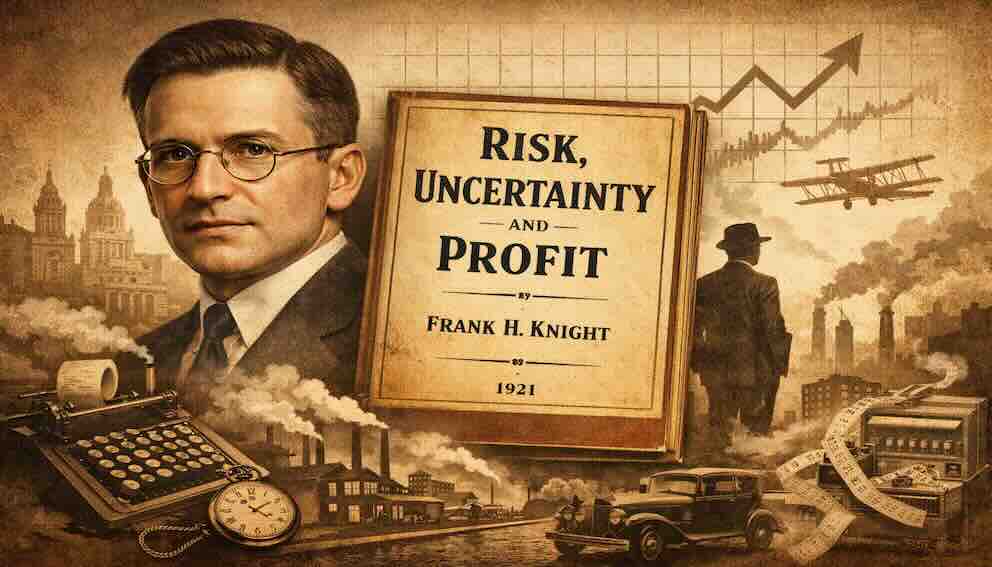
Introduction to the Book
Imagine you are standing at the edge of a familiar forest. You know the terrain: the paths, the streams, the occasional wild animal. You have walked here before, or perhaps others have, leaving a trail of experience to guide you. You can estimate, with reasonable confidence, how long it will take to cross, what dangers might arise, and what preparations you will need. You cannot know everything, but you can assign probabilities to the likely outcomes. This is risk—the future is unknown, yes, but it can be measured and managed. You can calculate, plan, and prepare because there is a basis for prediction..
Now, imagine a different forest: one that no one has ever entered. There are no paths, no stories, no maps. Nothing in the past gives you a clue about what awaits inside. You cannot assign probabilities, because there is no precedent. Every choice is a leap into the unknown. This is uncertainty—the future is unknowable. There is no way to calculate odds or plan precisely. Decisions here require judgment, courage, and intuition rather than calculation. It is in this world of true uncertainty that entrepreneurs operate, making decisions where the future is not just unknown—it is fundamentally unknowable.
Knight’s insight, at the heart of Risk, Uncertainty, and Profit, is that profit is the reward for navigating this uncharted territory, and that those who dare to face the unknowable are the ones who drive innovation and economic progress.
In the early twentieth century, economists were becoming increasingly fascinated with mathematics and statistics. They believed that if they could measure enough data, they could predict economic outcomes with reasonable accuracy. Insurance companies had already shown that risks like fire, death, and accidents could be calculated across large populations. Why not extend this approach to all economic decisions?
Knight saw a flaw in this thinking. Some economic decisions, he argued, are fundamentally different. They involve situations so novel, so unprecedented, that no statistical basis for prediction exists. In these situations, probabilities cannot be calculated. The future is not merely unknown—it is unknowable.
Risk, Uncertainty, and Profit was his attempt to work through the implications of this distinction. The book is dense, philosophical, and structured like the doctoral dissertation it originally was. But at its heart is a simple idea that changed economics: profit exists because the future is uncertain.
The Man Behind the Book: Frank Knight's Unlikely Path
Frank Hyneman Knight was born in 1885 on a farm in McLean County, Illinois, the eleventh of twelve children. His parents were deeply religious, and the family lived a life of modest means and hard work. There was nothing in his early years to suggest that he would become one of the most influential economists of the twentieth century, let alone a founder of what would become known as the Chicago School of Economics.
Knight's intellectual path was circuitous. He first attended American University in Tennessee, then Milligan College, where he studied a broad curriculum that included philosophy and the classics. For a time, he considered entering the ministry. The questions that preoccupied him were not initially economic—they were theological and philosophical: What can we know? How can we be certain? What is the basis of faith?
These questions would follow him into economics.
After completing a master's degree at the University of Tennessee, Knight entered Cornell University to study philosophy. But he soon found himself drawn to economics, partly through the influence of a professor who recognized his unusual analytical abilities. He switched fields and began working on what would become his doctoral dissertation.
That dissertation grew into Risk, Uncertainty, and Profit, published in 1921 when Knight was thirty-six years old. It was not an instant sensation, but it established his reputation among serious scholars. He went on to teach at the University of Iowa and later at the University of Chicago, where he became one of the most influential figures in American economics, shaping generations of students including Milton Friedman, George Stigler, and James Buchanan.
Knight was not an easy man. His students found him brilliant but demanding, capable of tearing apart arguments with surgical precision. His writing was dense and philosophical, far removed from the mathematical elegance that was beginning to characterize the field. He had little patience for intellectual shortcuts and even less for those who accepted ideas without scrutiny.
Yet this stubbornness was also his strength. He refused to accept the comfortable assumption that the world could be fully understood through statistics. He insisted on recognizing the limits of knowledge. And in doing so, he opened a line of inquiry that would shape economics for generations.
The Era That Produced the Book: Statistics and the Dream of Prediction
To understand why Knight's distinction mattered, you have to understand the intellectual atmosphere of the early twentieth century.
The years before World War I had seen extraordinary advances in statistics and probability. Francis Galton and Karl Pearson had developed methods for measuring correlation and variation. Insurance companies had built thriving businesses on the insight that risks could be calculated across large populations. If you could measure enough data, it seemed, you could predict the future.
This confidence extended to economics. Irving Fisher in America and others were developing mathematical models of markets and prices. The dream of a fully scientific economics, grounded in statistics and probability, seemed within reach.
But there was a problem. The statistical approach worked best for situations that repeated themselves—for events that happened often enough to generate reliable data. It worked for insurance because fires and deaths, while unpredictable for any individual, followed predictable patterns across large groups.
Business decisions were different. When an entrepreneur decided to launch a new product, enter a new market, or develop a new technology, there was often no historical data to guide them. The situation was genuinely novel. Consider the early days of radio. When the technology first emerged, no one could have predicted how it would transform entertainment, advertising, and communication. There were no statistics to consult because the industry did not yet exist. The entrepreneurs who built radio empires acted under pure uncertainty.
This was the gap Knight identified. The confidence in prediction, he argued, rested on confusing two very different things. Measurable risk was one thing. True uncertainty was another. And the failure to distinguish them had led economists astray.
The Architecture of the Book: How Knight Builds His Argument
Risk, Uncertainty, and Profit unfolds as a carefully constructed theoretical treatise. Knight begins with the theory of competition, then introduces his central distinction, and finally shows how uncertainty explains the existence of profit and the structure of firms. Each step follows logically from the one before, building toward a complete picture of economic life under conditions of genuine unpredictability.
The Problem of Profit
Knight starts where economic theory started: with the model of perfect competition. In this idealized world, everyone has perfect knowledge. All prices are known. All future outcomes can be predicted. Resources flow to their most efficient uses. And in this world, profits do not exist. Competition drives them to zero.
This was the puzzle that launched Knight's inquiry. If perfect competition eliminated profits, why did real businesses earn them? Earlier economists had offered various explanations: profit as exploitation, as monopoly power, as a return to capital, as a reward for management. But Knight found these answers unsatisfying. Something was missing—some element of real economic life that the perfect competition model had assumed away.
The missing element, Knight realized, was the future itself. The perfect competition model assumed that all relevant information was known. But in reality, the future is unknown. And not just unknown in ways that can be calculated, but unknown in deeper, more fundamental ways. This realization led Knight directly to his foundational insight: the problem of profit is inseparable from the problem of knowledge. To understand why profits exist, we must first understand what we cannot know.
The Distinction Between Risk and Uncertainty
Knight's next step was to clarify what "not knowing" actually means. He drew a sharp distinction between two very different kinds of ignorance.
Risk refers to situations where outcomes are unknown but probabilities can be calculated. When an insurance company sells a fire policy, it does not know which houses will burn. But it knows, from decades of data, approximately how many will burn. It can calculate premiums accordingly. Risk is measurable. It can be insured against.
Uncertainty refers to situations where probabilities cannot be calculated at all. When an entrepreneur decides to invest in a new technology, there is no database of similar investments to consult. The situation is unique. No one can assign a probability to success or failure. Uncertainty is not measurable. It cannot be insured against.
This distinction may seem subtle, but its implications are profound. Knight recognized that economists had been conflating two fundamentally different phenomena. They treated all ignorance as if it were risk—as if probabilities could always be assigned. But real economic life is filled with situations where probabilities cannot be assigned, where the future is not merely unknown but unknowable. This is not a minor technical point but a fundamental difference in kind, and grasping it is essential to understanding why profit exists at all.
Profit as the Reward for Bearing Uncertainty
With this distinction established, Knight could now explain profit. In a world of pure risk, all outcomes could be predicted statistically. Insurance markets would develop to cover every contingency. Profits would disappear, just as the perfect competition model predicted.
But the world is not a world of pure risk. It is a world of uncertainty. And in a world of uncertainty, someone must make decisions without knowing the outcome. Someone must commit resources, place bets, take action, even though the future cannot be calculated.
Those who do this successfully earn profits. Profit is not a return to capital, not a reward for efficiency, not a monopoly rent. It is the reward for bearing uncertainty. The entrepreneur who bets on a new product, who enters a new market, who develops a new technology, is placing a bet that no one else is willing to place. If they are right, they earn profit. If they are wrong, they suffer losses. This is why profits exist in a competitive economy. They are not a sign of inefficiency or market power. They are the necessary reward for facing the unknown. And if uncertainty enables profit, it also enables loss—the two are inseparable.
The Role of Judgment
If profit is the reward for bearing uncertainty, what determines who succeeds and who fails? Knight's answer was judgment.
In situations where probabilities cannot be calculated, decision-makers cannot rely on mathematical formulas. They must rely on something else: intuition, experience, interpretation, the ability to see possibilities that others miss. This is judgment. It is not a mechanical process. It is a distinctively human capacity.
Knight emphasized that judgment cannot be reduced to calculation. It cannot be programmed or automated. It is what entrepreneurs bring to the table. And it is why some entrepreneurs succeed while others fail. This emphasis set Knight apart from economists who wanted to reduce everything to mathematical models. He insisted that some aspects of economic life would always resist formalization.
Competition Eliminates Predictable Profits
Knight's framework also explains why profits are not permanent. If an opportunity is widely understood and its risks can be calculated, competition will quickly eliminate excess profits. Investors will pour in, prices will adjust, and the opportunity will disappear.
Sustained profits arise only where uncertainty remains—where the opportunity is not fully understood, where outcomes cannot be predicted, where judgment matters. This is why entrepreneurs are constantly seeking new frontiers. The known opportunities are already competed away. Profits exist only where uncertainty persists.
The Firm and the Entrepreneur
Knight now turned to a different question: if uncertainty is central to economic life, how do societies organize it? His answer connected uncertainty to the existence of firms.
Most individuals, Knight observed, prefer stable income rather than uncertain rewards. They want predictable wages, not the gamble of entrepreneurial profit. Workers therefore accept fixed wages, while entrepreneurs absorb the uncertainty of future profits and losses.
The firm emerges as the institutional structure through which uncertainty is concentrated in the hands of decision-makers willing to bear it. This organization of uncertainty-bearing is one of the fundamental functions of the business enterprise. The firm exists because it provides a way for those who are willing to bear uncertainty to do so, while allowing those who prefer stability to earn predictable incomes.
Insurance Works for Risk, Not Uncertainty
Knight's framework also clarifies the role of insurance. Insurance markets demonstrate how measurable risk can be managed. Fire insurance, life insurance, shipping insurance—all work because probabilities can be estimated from large datasets. These institutions convert risk from an individual burden into a collective responsibility.
But uncertainty cannot be insured. No one can insure against the success of a new product or the emergence of a disruptive technology. These are unique events, not repeatable occurrences. They fall outside the scope of insurance precisely because they fall outside the scope of calculable probability. This distinction explains why some economic dangers can be managed collectively while others must be borne individually.
The Critique of Static Economics
Stepping back, Knight offered a broader critique of the economics profession. Traditional economics, he argued, had focused too narrowly on static equilibrium—worlds where everything is already known and all adjustments have already been made. These models were useful abstractions, but they missed the real action.
Real economies are dynamic and uncertain. They are characterized by change, by novelty, by the constant emergence of new possibilities. Static economics could explain how markets allocate resources under perfect knowledge. It could not explain why entrepreneurs take risks, why new industries emerge, or why profits appear and disappear. For that, a theory of uncertainty was required. The models that dominated the profession were not wrong, but they were incomplete. They captured the routine but missed the revolutionary.
The Limits of Prediction
Knight's final contribution was a warning against overconfidence. If uncertainty is real—if the future is genuinely unknowable in fundamental ways—then prediction has inherent limits. Models can capture risk. They cannot eliminate uncertainty.
This does not mean that economic analysis is useless. It means that economists must be humble about what they can know and what they can predict. The future will always surprise us. That is not a failure of economics; it is a fact of life. Knight's work is a warning against the temptation to treat all uncertainty as calculable risk.
Through this progression—from the puzzle of profit to the distinction between risk and uncertainty, from the role of judgment to the structure of firms, from the critique of static economics to the limits of prediction—Knight builds a complete theory of economic life under uncertainty. Each step follows logically from the one before, each insight building on what came earlier. By the time the reader reaches the end, the neat world of perfect competition has been replaced by something richer and more realistic: a world where the future cannot be known, where judgment matters, where profit is the reward for facing the unknown.
What the Book Actually Looks Like
For readers who have never seen a copy, Risk, Uncertainty, and Profit is a theoretical treatise, not a popular book. It runs to nearly four hundred pages and is structured like the doctoral dissertation it originally was. The prose is dense and philosophical, with extended discussions of methodological issues that Knight considered essential. There are no mathematical formulas, no statistical tables, no diagrams. The argument proceeds through careful reasoning rather than calculation. This is both the book's strength and its limitation: it asks readers to think, not just to compute. And for those willing to follow Knight's logic step by step, the reward is a framework that has proven remarkably durable—a way of understanding profit, entrepreneurship, and uncertainty that remains essential more than a century later.
How the Book Was Received
When Risk, Uncertainty, and Profit first appeared in 1921, it did not become an immediate bestseller. The book was dense, philosophical, and addressed primarily to academic economists. Many readers found it difficult. Its arguments challenged the growing confidence in statistical methods.
But among serious scholars, the book gradually gained respect. Economists recognized that Knight had identified a fundamental flaw in traditional theory. His distinction between risk and uncertainty became a touchstone for later work.
The book's influence grew over decades rather than years. It became a foundational text at the University of Chicago, where Knight taught for many years, and it shaped generations of economists who passed through that institution. Today, it is widely regarded as one of the most important works in the history of economic thought, and economists still use the phrase "Knightian uncertainty" to describe situations where probabilities cannot be assigned.
How It Changed the World of Finance and Economic Thinking
Knight's ideas eventually shaped several major areas of economics and finance.
Risk theory. Modern finance distinguishes between quantifiable risk and deeper uncertainty. The entire field of risk management rests on this foundation, even though financial models have often assumed away Knightian uncertainty in practice. The periodic crises that shake markets serve as reminders that uncertainty never fully disappears.
Entrepreneurship studies. Knight's explanation that profit rewards uncertainty-bearing entrepreneurs became central to how economists think about startups, innovation, and business formation.
Investment thinking. Sophisticated investors recognize that some outcomes cannot be predicted through historical data. They think in terms of uncertainty, not just risk.
Insurance and derivatives. The development of markets for hedging risk reflects Knight's insight that institutions can convert some uncertainty into measurable risk.
Behavioral economics. Knight's emphasis on judgment and interpretation anticipated later work on how people actually make decisions under uncertainty.
Theory of the firm. Knight's argument that firms exist to organize uncertainty-bearing influenced later work on the nature of business enterprise.
What Still Stands—and What Has Not Survived
A book written in 1921 cannot capture every development of the subsequent century. Some aspects of Knight's framework have been refined, challenged, or superseded.
What Still Stands
The risk-uncertainty distinction remains foundational. No serious economist or finance professional confuses the two. The distinction is taught in every introductory course.
The explanation of profit as a reward for bearing uncertainty is widely accepted. It provides a compelling answer to the question of why profits exist in competitive markets.
The role of the entrepreneur as uncertainty-bearer is central to modern entrepreneurship theory.
The limits of prediction are more widely recognized than in Knight's time. Financial crises, technological disruptions, and black swan events have repeatedly demonstrated that uncertainty cannot be eliminated.
The importance of judgment is acknowledged even in quantitative fields. Models are tools, not oracles.
What Has Not Survived
Some of Knight's broader philosophical framework has been less influential. His skepticism about mathematical economics placed him outside the mainstream as the field became increasingly technical.
Modern finance built powerful tools for managing measurable risk, often assuming that uncertainty could be approximated through probability models. The tension between Knight's vision and the practice of financial modeling remains unresolved.
The sharp boundary between risk and uncertainty has been blurred by advances in probability theory. Some situations that Knight would have called uncertain can now be modeled with Bayesian approaches. But the fundamental distinction remains.
Knight's specific policy views have not endured. He was skeptical of many government interventions, but his influence lies in his theoretical contributions, not his political positions.
Why This Book Still Matters Today
More than a century after its publication, Risk, Uncertainty, and Profit remains essential reading for anyone who wants to understand how markets actually work.
Consider the world around you. Every startup founder who launches a new product is acting under Knightian uncertainty. There is no database of similar ventures to consult. No statistical model can predict the outcome. The founder must rely on judgment, intuition, and courage.
Consider every financial crisis. Before each one, models suggested that risks were contained. After each one, we discover that the models confused measurable risk with fundamental uncertainty. The future surprised us, as it always does.
Consider technological innovation. When the internet emerged, no one could have predicted its trajectory. When artificial intelligence began advancing, its implications were unknowable. Entrepreneurs who bet on these technologies acted under true uncertainty. Those who were right earned enormous profits.
Consider your own decisions. When you choose a career, start a business, or make a major investment, you face uncertainty. You cannot calculate the odds. You must rely on judgment.
Knight's great achievement was to name this phenomenon, to distinguish it from mere risk, and to show why it matters. He gave economists a language for talking about what they could not calculate. He reminded us that the future is genuinely open, that human judgment matters, and that profit is not a flaw in the system but a sign that someone was willing to face the unknown.
In an age of big data and complex models, this reminder is more valuable than ever. No amount of data can eliminate uncertainty. No model can predict the genuinely novel. The future will always surprise us, and that is why entrepreneurship, judgment, and profit will always exist.
Conclusion
Frank Knight published Risk, Uncertainty, and Profit in 1921, at a time when economists were becoming increasingly confident in statistics and prediction. His book, which grew from his doctoral dissertation at Cornell University, was a warning against that confidence, but it was also something more: a positive theory of why profits exist, why entrepreneurs matter, and why uncertainty is not a flaw but a fundamental feature of economic life.
Profit exists because the future cannot be known. That is the simple, profound insight at the heart of Knight's work. In a world of perfect knowledge, profits would disappear. In a world of measurable risk, they could be competed away. But in a world of genuine uncertainty—where probabilities cannot be assigned and outcomes cannot be calculated—there is room for something else. There is room for judgment, for courage, for the entrepreneur who bets on an unknown future and sometimes wins.
Knight's distinction between risk and uncertainty has proven remarkably durable. It survives in every economics textbook, every finance course, every serious discussion of decision-making under imperfect information. It has shaped how we think about entrepreneurship, innovation, and the limits of prediction.
The world has changed enormously since 1921. The technologies that Knight knew—the telegraph, the railroad, the factory—have been superseded by digital technologies he could not have imagined. The financial system has grown in complexity beyond anything he might have anticipated. But the fundamental uncertainty of the future remains.
Knight's book matters because it identifies something permanent about the human condition. We act without knowing the outcome. We make decisions under conditions of genuine uncertainty. And when we are right, we earn profit—not as a reward for risk, but as a prize for facing the unknown.
About Swati Sharma
Lead Editor at MyEyze, Economist & Finance Research WriterSwati Sharma is an economist with a Bachelor’s degree in Economics (Honours), CIPD Level 5 certification, and an MBA, and over 18 years of experience across management consulting, investment, and technology organizations. She specializes in research-driven financial education, focusing on economics, markets, and investor behavior, with a passion for making complex financial concepts clear, accurate, and accessible to a broad audience.
Disclaimer
This article is for educational purposes only and should not be interpreted as financial advice. Readers should consult a qualified financial professional before making investment decisions. Assistance from AI-powered generative tools was taken to format and improve language flow. While we strive for accuracy, this content may contain errors or omissions and should be independently verified.