
Tutorial Categories
Last Updated: March 29, 2026 at 15:30
The General Theory of Employment, Interest, and Money
How Keynes Revolutionized Economics and Gave Government a Role in the Economy
In 1936, as the world struggled to escape the deepest economic crisis in modern history, the British economist John Maynard Keynes published a book that would permanently alter the relationship between governments and their economies. The General Theory of Employment, Interest, and Money arrived at a moment when classical economics had no answer to mass unemployment, when factories sat idle while workers went hungry, when the old certainties had failed. Keynes offered something new: a systematic explanation of why economies could stagnate indefinitely, why the classical faith in self-correcting markets was wrong, and why government intervention was not a violation of economic law but a necessary response to its failures. The book introduced concepts that would reshape policy for generations—aggregate demand, the multiplier, liquidity preference, the paradox of thrift. More than eighty years later, every time a government deploys fiscal stimulus to fight a recession, every time a central bank cuts interest rates to encourage borrowing, every time policymakers debate the proper role of the state in the economy, Keynes's framework is quietly at work.
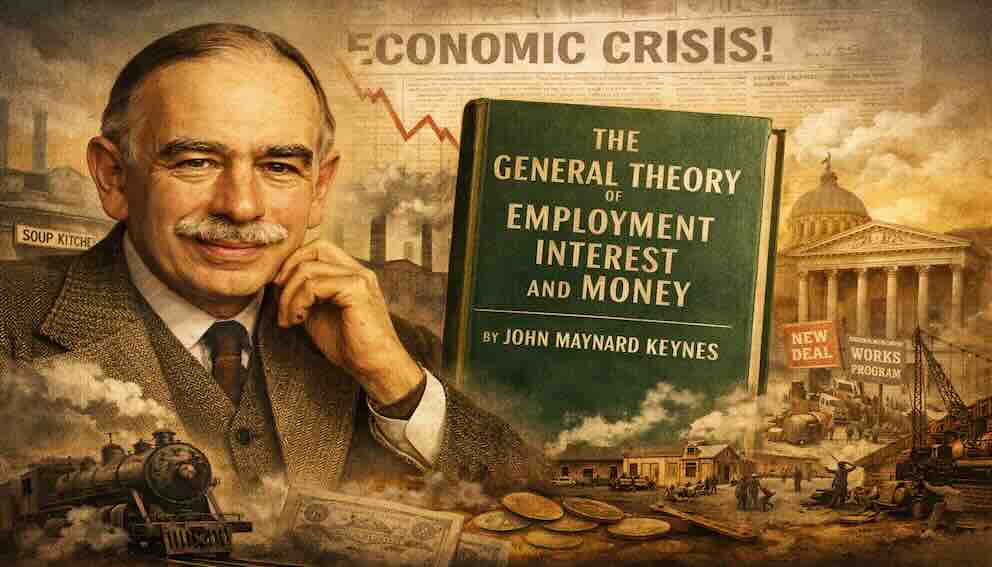
Introduction to the Book
Imagine you are an economist in 1930. You have been trained to believe that markets are self-correcting, that supply creates its own demand, that any deviation from full employment will be temporary. Then you look out the window.
Factories stand silent. Men who want to work cannot find jobs. Families go hungry while fields lie fallow. The economy, which was supposed to tend naturally toward health, is obviously and catastrophically ill.
What do you conclude?
Most economists of the time concluded that the problem must be temporary, that wages must be too high, that workers were pricing themselves out of jobs. Their theories told them that the market would eventually correct itself if only everyone would wait.
John Maynard Keynes concluded something different. He concluded that the theory was wrong.
"The long run is a misleading guide to current affairs. In the long run we are all dead. Economists set themselves too easy, too useless a task if in tempestuous seasons they can only tell us that when the storm is past the ocean is flat again."
The General Theory of Employment, Interest, and Money was not just another economics book. It was an intellectual revolution. Keynes challenged the most fundamental assumptions of classical economics and offered a new way of understanding how economies actually work. He argued that economies could get stuck in equilibrium with high unemployment, that there was no automatic mechanism guaranteeing a return to health, and that government intervention was not an interference with the natural order but a necessary response to its failures.
The book is dense, sometimes difficult, and filled with arguments that Keynes had been developing for years. But at its heart is a simple, radical idea: the level of employment in an economy is determined not by the price of labor but by the total demand for goods and services. And when that demand falls short, only government has the power to restore it.
The Man Behind the Book: John Maynard Keynes's Unusual Path
John Maynard Keynes was born in 1883 in Cambridge, England, into a world of intellectual privilege. His father was a lecturer in economics at Cambridge University; his mother was one of the first women to graduate from the university. From childhood, he moved among the brightest minds of his generation.
He studied mathematics at King's College, Cambridge, where he distinguished himself academically and socially. But mathematics was not his only interest. He was drawn to philosophy, particularly the work of G.E. Moore, and to the intellectual circles that included Virginia Woolf, E.M. Forster, and the other members of the Bloomsbury Group. Keynes was never a narrow specialist; he was a man of wide culture, comfortable with art, literature, and ideas of all kinds.
His career was anything but conventional. He worked in the India Office, taught economics at Cambridge, served as a Treasury official during World War I, and represented Britain at the Versailles peace conference. He resigned from the conference in protest over the harsh terms imposed on Germany and wrote a book, The Economic Consequences of the Peace, that made him famous. In it, he predicted that the reparations demanded of Germany would lead to economic collapse and political instability—a prediction that proved tragically accurate.
He also speculated successfully in financial markets, amassing a personal fortune, and ran an insurance company. He was an investor, a journalist, a patron of the arts, and a controversialist. When he died in 1946, he had transformed not only economics but the way governments thought about their responsibilities to their citizens.
Yet for all his achievements, Keynes was not immune to struggle. He faced fierce resistance from the economics establishment, which was deeply invested in the classical theories he challenged. His ideas were dismissed, ridiculed, and attacked. But he persisted, convinced that the orthodoxy was not merely wrong but dangerously so.
The Era That Produced the Book: The Great Depression
To understand why The General Theory mattered, you have to understand the world it was written in.
The 1930s were a decade of economic catastrophe. The Wall Street Crash of 1929 had triggered a downward spiral that seemed to have no end. By 1933, unemployment in the United States had reached 25 percent. In Britain, it exceeded 20 percent. In Germany, it was even higher, fueling the political extremism that would lead to World War II.
A Scene from the Depression
In Manchester, once the proud heart of the Industrial Revolution, the great textile mills stood silent. Men who had worked in those mills since they were boys now gathered on street corners, hands in pockets, eyes downcast. The soup kitchens run by charities could barely keep up. Families fell behind on rent, then were evicted. Children went to school hungry.
Meanwhile, economists explained that the market was self-correcting, that wages would eventually fall enough to make hiring attractive again, that the suffering was temporary and necessary.
In Washington, Franklin Roosevelt was experimenting with something different. The New Deal put people to work building roads, schools, and dams. The government spent money it did not have, running deficits that horrified orthodox economists. But the work got done, and people got paid, and they spent their wages in local stores, and slowly, painfully, the economy began to move again.
Keynes watched these experiments closely. He saw that Roosevelt's approach, however halting and inconsistent, was working where classical remedies had failed. The New Deal was Keynesianism before Keynes had fully articulated it.
The Intellectual Crisis
Yet the economics profession had little to offer. The classical theory, inherited from Adam Smith and David Ricardo and refined by generations of thinkers, held that markets naturally tended toward full employment. If there was unemployment, it must be because wages were too high. The solution was to cut wages, to wait, to let the market do its work.
This advice was not merely unhelpful; it was cruel. Workers who had lost their jobs through no fault of their own were told that their suffering was necessary, that the market would eventually correct itself, that intervention would only make things worse.
Keynes saw the absurdity. The storm was not passing. Something had to be done.
The Architecture of the Book: How Keynes Builds His Argument
The General Theory is not an easy book. Keynes was working out ideas as he wrote, and the argument is sometimes messy, sometimes repetitive, sometimes unclear. But beneath the surface complexity lies a clear logical structure. Keynes builds his case step by step, each concept emerging from the one before, each insight revealing another piece of the puzzle.
The Failure of Classical Theory
Keynes begins by attacking the foundations of classical economics. The classical theory, he argues, rests on a mistaken assumption: that supply creates its own demand. This idea, known as Say's Law, held that the very act of producing goods generates enough income to purchase them. There could be no general glut, no prolonged unemployment, because production itself would create the demand needed to clear markets.
Keynes rejected this entirely. It is possible, he argued, for total demand to fall short of total supply. People can decide to save rather than spend. Businesses can decide to invest less. When this happens, goods go unsold, workers are laid off, and the economy can get stuck in a low-employment equilibrium.
This leads to Keynes's first fundamental claim: Say's Law is false. Supply does not automatically create its own demand. Production can outpace spending, and when it does, the result is unemployment and wasted capacity. More broadly, classical economics is wrong about self-correction—there is no automatic mechanism guaranteeing a return to full employment. Economies can get stuck in equilibrium with high unemployment.
The Principle of Effective Demand
From this critique emerges the central concept of the book: effective demand. Effective demand is the total spending in an economy—from consumption, investment, government, and net exports. When effective demand falls short of what the economy is capable of producing, output falls and unemployment rises.
This is Keynes's second major claim: effective demand determines employment. The level of employment is not determined by the price of labor, as classical economics held, but by the total demand for goods and services. If people are not buying, businesses will not hire. It is that simple.
The Propensity to Consume
Keynes next examines what determines how much people spend. People do not spend all their income. They save some portion of it. Keynes called this the propensity to consume. As incomes rise, consumption rises too, but not by as much. The gap between income and consumption is saving.
This seems harmless enough, but it has a consequence. If people save more and consume less, total demand falls unless something else fills the gap. That something else is investment. Here Keynes introduces a distinction that runs throughout his work: macroeconomics is different from microeconomics. What is true for an individual—that saving is prudent—may not be true for the economy as a whole.
The Role of Investment
Investment, Keynes argues, is the volatile element in the system. It depends not on current income but on expectations about the future. Businesses invest when they expect to earn a return. But expectations about the future are unstable, driven by what Keynes called animal spirits—the spontaneous urge to action rather than inaction, the confidence that can evaporate without warning.
This yields another insight: investment is volatile. It is not a stable function of current conditions but a creature of psychology and expectation. Expectations matter—economic decisions are shaped by views about the future, which are uncertain and can change rapidly.
When investment falls, total demand falls. When total demand falls, incomes fall. When incomes fall, consumption falls too. The economy spirals downward. Keynes emphasizes that the economy is inherently unstable—there is no tendency toward equilibrium with full employment. Fluctuation is the norm, not the exception.
The Multiplier
One of Keynes's most important insights was the multiplier. An initial increase in spending—say, by the government—does not just increase income by that amount. It sets off a chain reaction. The people who receive that income spend some of it, creating income for others, who spend some of it, and so on.
The total increase in income can be several times the initial spending. This is why government intervention can be so powerful. A relatively small amount of public spending can generate a much larger increase in total demand. The multiplier amplifies spending changes, turning modest interventions into substantial economic effects.
Liquidity Preference and Interest Rates
Keynes also offered a new theory of interest. In classical theory, interest was the reward for saving—the price that brought saving and investment into balance. Keynes saw it differently.
Interest, he argued, is the reward for parting with liquidity. People prefer to hold their wealth in liquid form—cash—because it gives them flexibility and security. They will only lend it out if they are compensated. This is liquidity preference, and it means that interest rates reflect the desire for liquidity, not the price of saving.
This theory explained why interest rates might not fall enough to stimulate investment during a depression. Even if the central bank increases the money supply, people might simply hoard the extra cash rather than lend it out. The liquidity trap—a situation where monetary policy becomes ineffective—follows directly from this analysis.
The Paradox of Thrift
Building on these ideas, Keynes articulated one of his most striking insights: the paradox of thrift. What is good for an individual—saving more—can be disastrous for the economy as a whole. If everyone tries to save more, total demand falls, incomes fall, and in the end, total saving may not increase at all.
This paradox illustrates the fundamental difference between microeconomics and macroeconomics. What is true for one person is not necessarily true for everyone. The paradox of thrift is not a logical contradiction; it is a feature of how interconnected economies work.
The Case for Government Intervention
If the economy can get stuck in a low-employment equilibrium, and if private forces cannot reliably restore full employment, then government must act. Keynes argued for fiscal policy—government spending and taxation—as the primary tool for managing aggregate demand. Government must intervene during slumps because the private sector alone cannot guarantee stability.
During a slump, the government should spend more, even if that means running a deficit. The spending would boost demand, set off the multiplier, and restore employment. Once the economy recovered, the government could repay its debt. Keynes was emphatic that deficits are not always bad—government borrowing during a slump is not irresponsible but a necessary response to economic failure.
This was not just theory. It was a practical program for addressing the crisis that classical economics could not solve.
Through this progression—from the critique of Say's Law to the principle of effective demand, from the propensity to consume to the volatility of investment, from the multiplier to liquidity preference, from the paradox of thrift to the case for government intervention—Keynes builds a complete theory of how economies work and why they fail. Each step follows logically from the one before, each insight building on what came earlier. By the time the reader reaches the end, the classical vision of self-correcting markets has been replaced by something more realistic: an economy that can stagnate, that needs management, that depends on the delicate balance of spending, saving, and expectation.
What the Book Actually Looks Like
The General Theory is a substantial work of economic theory, running to nearly four hundred pages. It is divided into six books, each addressing a different aspect of Keynes's argument.
Book I introduces the central concepts and critiques classical economics. Book II develops the theory of effective demand. Book III explores the propensity to consume and the multiplier. Book IV presents the theory of investment and liquidity preference. Book V examines money wages and prices. Book VI offers reflections on the implications of the theory for economic policy and philosophy.
The prose is Keynes at his best: clear, forceful, occasionally witty, but also dense and sometimes repetitive. This is not a book for casual readers, but for those willing to work through it, the rewards are immense.
How the Book Was Received
When The General Theory appeared in 1936, it was met with a mixture of excitement, confusion, and hostility. Young economists embraced it eagerly, seeing in it a new way of understanding the world. Older economists resisted, defending the classical orthodoxy they had spent their careers mastering.
The book was difficult, and many readers misunderstood it. Keynes himself complained that reviewers often missed his central points. But gradually, the ideas spread. By the end of the 1930s, Keynesian economics was being taught at major universities. By the 1940s, it was influencing government policy.
The war accelerated this process. Wartime spending demonstrated the power of fiscal policy: massive government expenditure finally ended the Depression. After the war, governments around the world committed themselves to maintaining full employment, using the tools Keynes had described.
By the 1950s, Keynesian economics was the mainstream. It remained dominant until the 1970s, when new challenges emerged. But even its critics could not escape its influence.
The Postwar Keynesian Consensus
In the decades after World War II, Keynesian ideas shaped the economic policies of Western nations. In Britain, the government committed to maintaining full employment. In the United States, the Employment Act of 1946 made it official policy to promote maximum employment. In Europe, reconstruction was guided by Keynesian principles.
Japan's postwar miracle was built on aggressive fiscal policy and export-led growth. Germany's social market economy incorporated Keynesian demand management. For a generation, the developed world experienced unprecedented stability and growth—the "golden age" of capitalism.
How It Changed the World of Finance and Economic Thinking
The impact of The General Theory on economics and policy is almost impossible to overstate.
It created macroeconomics as a distinct field. Before Keynes, economists studied individual markets, prices, and firms. After Keynes, they also studied the economy as a whole—aggregate demand, total output, national income.
It transformed government policy. Governments took responsibility for managing the economy, using fiscal and monetary policy to smooth fluctuations and maintain employment. This was a fundamental shift in the relationship between the state and the economy.
It changed how we think about unemployment. Before Keynes, unemployment was seen as a personal failing or a temporary market adjustment. After Keynes, it was recognized as a systemic problem requiring systemic solutions.
It influenced every subsequent school of economics. Even economists who rejected Keynes's conclusions had to engage with his arguments. The terms of debate were permanently altered.
It shaped the postwar economic order. The Bretton Woods system, the International Monetary Fund, the World Bank—all were influenced by Keynesian thinking. For a generation, Keynesian economics was the framework within which policy was made.
It entered popular consciousness. Concepts like aggregate demand, fiscal stimulus, and the multiplier became part of political discourse. Keynes's name became attached to a whole way of thinking about the economy.
What Still Stands—and What Has Not Survived
A book written in 1936 cannot capture every development of the subsequent century. Some aspects of Keynes's framework have been refined, challenged, or superseded.
What Still Stands
The importance of aggregate demand is universally accepted. No serious economist denies that demand fluctuations drive business cycles.
The possibility of prolonged unemployment is recognized. Economies can indeed get stuck below full employment.
The role of expectations is central to modern macroeconomics. Animal spirits may not be the precise term, but the idea that psychology matters is uncontroversial.
The multiplier remains a useful tool for policy analysis, though its precise size and timing are debated.
The paradox of thrift is widely understood. The distinction between micro and macro behavior is fundamental.
Fiscal policy is accepted as a legitimate tool for managing the economy, though its use remains contested.
The critique of Say's Law is definitive. No one believes that supply automatically creates its own demand.
What Has Not Survived
Some of Keynes's specific theoretical formulations have been replaced by more rigorous models. The neoclassical synthesis integrated Keynesian insights with microeconomic foundations.
The neglect of inflation in the original theory was addressed by later work. Keynes wrote during a depression, when inflation was not a concern. Later economists had to incorporate it.
The role of monetary policy has been reevaluated. Keynes emphasized fiscal policy, but modern central banks use monetary policy actively.
Supply-side factors have received more attention. Keynes focused on demand; later economists emphasized productivity, technology, and institutions.
Globalization introduced complexities Keynes did not address. Open economies face constraints that closed economies do not.
Rational expectations theory challenged Keynesian assumptions about how people form expectations. This debate continues.
Five Essential Ideas for Today
For readers who want to carry Keynes's insights with them, these five ideas are the most essential:
1. Aggregate Demand Drives Employment
The total spending in an economy determines how many people work. When demand falls, jobs disappear. This is the fundamental Keynesian insight.
2. Government Can Stabilize Recessions
When private demand collapses, government can fill the gap. Fiscal stimulus—spending more, taxing less—is a legitimate response to economic crisis.
3. Saving vs. Spending Is Not Neutral
What is prudent for an individual can be disastrous for the economy. The paradox of thrift reminds us that macroeconomics is different from microeconomics.
4. Expectations Shape Investment
Business decisions depend on confidence, which is fragile and unpredictable. Animal spirits matter as much as rational calculation.
5. Fiscal Policy Multiplies Impact
Government spending sets off a chain reaction. The multiplier means that a relatively small intervention can have large effects.
Why This Book Still Matters Today
More than eighty years after its publication, The General Theory remains essential reading for anyone who wants to understand how economies work and what governments can do about them.
Consider the 2008 financial crisis. When the global economy spiraled downward, governments around the world turned to Keynesian remedies. They cut interest rates, increased spending, ran deficits. The stimulus packages of 2008 and 2009 were pure Keynesianism, applied on a scale he would have recognized.
Consider the COVID-19 pandemic. When economies shut down, governments again deployed fiscal stimulus, sending checks to households, supporting businesses, borrowing massively. The logic was Keynesian: when private demand collapses, government must fill the gap.
Consider the debates that never end. Should the government run deficits? Is debt a problem? Can we afford to spend more? These questions, which dominate political discourse, are Keynesian questions. They cannot be answered without engaging his framework.
Consider your own life. If you have ever wondered why the economy sometimes booms and sometimes busts, why jobs disappear in a recession, why governments talk about stimulus and austerity, you are thinking Keynesian thoughts. His ideas have permeated our culture so thoroughly that we hardly notice them.
Keynes's great achievement was to show that economics is not just about markets and prices. It is about people—their hopes, their fears, their decisions, their lives. The economy is not a machine that runs itself. It is a human creation, and humans can shape it.
Conclusion
John Maynard Keynes published The General Theory of Employment, Interest, and Money in 1936, at the depths of the Great Depression, when classical economics had failed and millions were suffering. His book was not merely a critique of existing theory but a new way of seeing the world.
He showed that economies can get stuck, that unemployment can persist, that the old faith in self-correcting markets was a dangerous illusion. He showed that government has a responsibility to act, that deficits are not always sins, that spending can heal. He gave policymakers the tools to fight depressions and the confidence to use them.
The world has changed enormously since 1936. The economy is more global, more complex, more interconnected than Keynes could have imagined. New challenges have emerged—inflation, stagnation, inequality—that require new thinking. But the fundamental insight remains: aggregate demand matters, expectations matter, and governments can make a difference.
That is why The General Theory still matters. It is not a bible to be followed literally but a framework for thinking, a set of questions to ask, a reminder that economics is ultimately about human welfare. In a world of uncertainty, that reminder is as valuable as ever.
Keynes once wrote: "The ideas of economists and political philosophers, both when they are right and when they are wrong, are more powerful than is commonly understood. Indeed the world is ruled by little else." He was right. And his own ideas have ruled the world for more than eighty years.
About Swati Sharma
Lead Editor at MyEyze, Economist & Finance Research WriterSwati Sharma is an economist with a Bachelor’s degree in Economics (Honours), CIPD Level 5 certification, and an MBA, and over 18 years of experience across management consulting, investment, and technology organizations. She specializes in research-driven financial education, focusing on economics, markets, and investor behavior, with a passion for making complex financial concepts clear, accurate, and accessible to a broad audience.
Disclaimer
This article is for educational purposes only and should not be interpreted as financial advice. Readers should consult a qualified financial professional before making investment decisions. Assistance from AI-powered generative tools was taken to format and improve language flow. While we strive for accuracy, this content may contain errors or omissions and should be independently verified.