
Tutorial Categories
Last Updated: March 29, 2026 at 15:30
Theory of Speculation: The Forgotten Thesis That Invented Quantitative Finance
How a Little-Known French Mathematician Laid the Groundwork for Modern Markets in 1900
In 1900, a thirty-year-old French mathematician named Louis Bachelier defended his doctoral thesis at the University of Paris. The thesis was titled Theory of Speculation, and it was unlike anything the examining professors had ever seen. Bachelier proposed that financial markets—those chaotic, noisy places where traders shouted orders and prices changed by the minute—could be understood through mathematics. He suggested that price movements follow probabilistic laws, that randomness itself has structure, and that the value of options could be calculated with equations. His advisor, the great mathematician Henri Poincaré, recognized the thesis as original but could not have imagined its future significance. Decades later, long after Bachelier had died in obscurity, his ideas would be rediscovered and recognized as the foundation of modern quantitative finance. Today, every time a trader prices an option, every time a risk manager calculates value at risk, every time an algorithm executes a trade based on stochastic models, Bachelier's legacy is quietly at work.
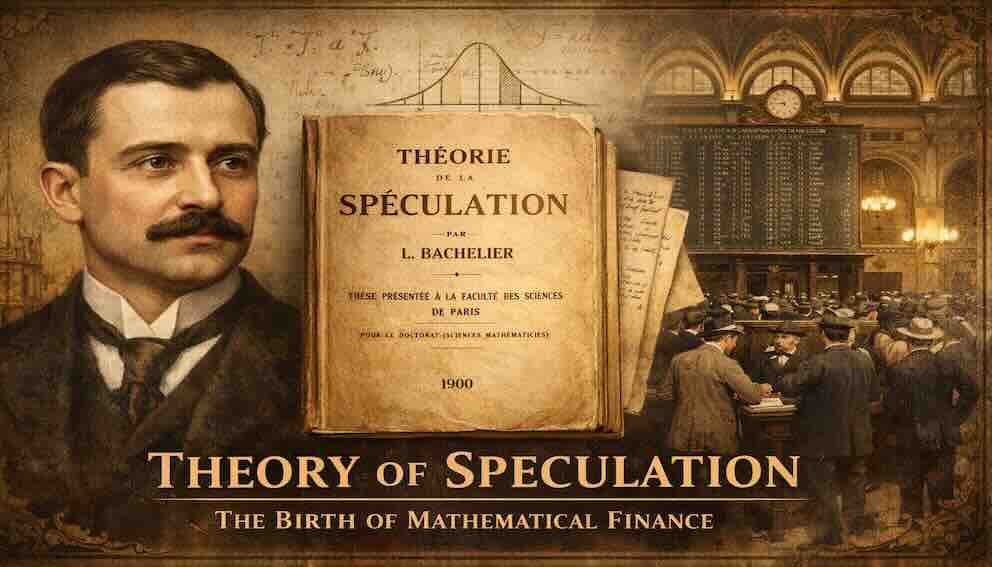
Introduction to the Book
Imagine a trading floor in Paris at the turn of the twentieth century. The Paris Bourse is one of the busiest exchanges in the world. Men in suits crowd around the floor, shouting prices, waving slips of paper, watching chalkboards where numbers are constantly erased and rewritten. Fortunes are made and lost in minutes. The atmosphere is chaotic, emotional, and utterly unscientific.
Now imagine a young mathematician standing in the corner, watching this spectacle not as a trader but as a scientist. He does not see chaos. He sees data. He sees patterns waiting to be discovered. He asks a question that no one else has thought to ask: what if the movement of prices can be described by probability?
This was Louis Bachelier. And his question would eventually give birth to an entirely new field of knowledge: mathematical finance.
Theory of Speculation, his doctoral thesis, was the first work ever to treat financial markets as a mathematical system. Bachelier proposed that price movements are random, that they follow probabilistic laws, and that financial instruments like options can be valued using equations. These ideas were so far ahead of their time that they were almost entirely ignored for half a century.
Yet today, every quantitative model used in finance traces its intellectual lineage back to that forgotten thesis. Bachelier did not just study speculation. He transformed it from an art into a science.
The Man Behind the Book: Louis Bachelier's Obscure Genius
Louis Bachelier was born in 1870 in Le Havre, a port city on the coast of Normandy. His family was connected to the world of commerce and trade, which may have given him an early exposure to the rhythms of markets. But his childhood was marked by tragedy. Both of his parents died when he was young, leaving him to navigate the world with little family support.
He interrupted his education to work, then served in the French military, and only later returned to academic life. When he finally entered the University of Paris, he was already older than most students, but he brought with him a perspective shaped by experience rather than just books.
At the university, Bachelier studied under Henri Poincaré, one of the greatest mathematicians of the era. Poincaré was known for his work on probability, celestial mechanics, and the philosophy of science. He recognized immediately that Bachelier's thesis was original—perhaps too original.
The thesis passed, and Bachelier received his doctorate. But recognition did not follow. He struggled for years to secure a stable academic position, moving from one temporary job to another, never quite finding a place where his ideas were appreciated. He published more work, but it attracted little attention. By the time he died in 1946, he was virtually unknown.
Only decades later, when economists and mathematicians began developing modern financial theory, was Bachelier's work rediscovered. The economist Paul Samuelson, who would later win a Nobel Prize, came across Bachelier's thesis in the 1950s and recognized its brilliance. He called Bachelier a pioneer of stochastic finance and helped restore his reputation. Scholars realized that many ideas thought to be new—the random walk, the martingale, the mathematics of option pricing—had already been explored by Bachelier in 1900. The forgotten genius finally received the recognition that had eluded him in life.
The Era That Produced the Book: Paris at the Turn of the Century
To understand why Bachelier's ideas were so radical, you have to imagine the world he lived in.
The late nineteenth century was a period of explosive growth in financial markets. Stock exchanges had expanded across Europe and America, trading everything from government bonds to railway shares. At the Paris Bourse, one of the most active instruments was the rente—a French government bond that paid fixed interest and was actively traded. Alongside these bonds, there was also a market for options, contracts that gave the buyer the right to buy or sell the underlying bond at a future date at a predetermined price.
This was the market Bachelier studied. He was not modeling stocks in general. He was specifically analyzing options on French government bonds, using real data from the Paris Bourse.
Yet the intellectual understanding of markets was still primitive. Economists studied value, trade, and production, but almost none had attempted to analyze price movements mathematically. Speculation was viewed as a psychological phenomenon—driven by greed, fear, rumor, and instinct—not as something that could be reduced to equations.
Probability theory itself was still developing. Mathematicians had made progress in understanding games of chance, insurance, and statistical regularities, but no one had applied these tools to financial markets. The idea that price movements might follow probabilistic laws was not just new; it was almost unimaginable.
Bachelier's thesis was therefore a leap into uncharted territory. He was not refining existing ideas; he was creating an entirely new field.
What Made This Thesis Revolutionary
Three things made Theory of Speculation unlike anything that had come before. Each represented a leap into completely uncharted territory, and together they founded an entirely new field of knowledge.
The First Revolution: Modeling Prices as Stochastic Processes
Before Bachelier, mathematicians and economists had thought about probability in static terms. They calculated the odds of drawing certain cards from a deck, or the likelihood of a die landing on a particular face. Probability was about isolated events, not about processes unfolding through time.
Bachelier introduced something entirely different. He treated price movements as stochastic processes—mathematical descriptions of systems that evolve randomly over time. Think of it this way: if you want to describe how a dust particle moves in the air, or how a stock price moves from one moment to the next, you need mathematics that can handle randomness and time together. The price at any given moment is not independent of what came before; it is part of a continuous path, a trajectory through time.
Bachelier provided the tools to describe that path mathematically. He showed that even though individual price movements are unpredictable, the overall process follows laws that can be studied and modeled. This was the birth of continuous-time finance. Many of the stochastic models used in modern derivatives pricing trace their lineage back to this insight.
The Second Revolution: The First Mathematical Option Pricing Formula
Options had existed for centuries, but no one had figured out how to value them mathematically. Traders bought and sold options based on intuition, experience, and guesswork. There was no way to know whether a given price was fair.
Bachelier changed that. He recognized that an option's value depends on the probability that the underlying price will move above (or below) a certain level before expiration. If you can calculate those probabilities, you can calculate what the option should be worth.
He derived one of the first mathematical formulas for pricing options, calculating their value using probability integrals of future price distributions. This was not a rough approximation or a rule of thumb. It was a precise mathematical relationship, grounded in the same probability theory used to analyze games of chance.
This achievement is even more remarkable considering that options were not yet widely traded or understood. Bachelier was not refining an existing body of knowledge; he was creating it from scratch. The formula he derived anticipated concepts that would later be formalized in the Black–Scholes model, which revolutionized finance seven decades later.
The Third Revolution: Brownian Motion Before Einstein
One of the most astonishing facts about Bachelier's thesis is that it used the mathematics of Brownian motion—the random movement of particles suspended in a fluid—five years before Albert Einstein's famous 1905 paper on the subject.
Brownian motion had been observed by the botanist Robert Brown in 1827, but no one had developed a mathematical description of it. Bachelier, working independently and with no knowledge of the physics problem, derived the same mathematical structure that Einstein would later use to explain the motion of particles. He called it "the law of radiation of probability," and he applied it to financial markets.
This is a remarkable case of parallel discovery. Einstein used Brownian motion to explain physical phenomena—to provide evidence for the existence of atoms. Bachelier used the same mathematics to explain financial phenomena—to describe how prices move. The mathematical structure was identical, but the domains could not have been more different.
These three revolutions established Bachelier as the founder of mathematical finance. His thesis was ignored in its own time, but its ideas were so powerful that they eventually reshaped how the world understands markets, risk, and the mathematics of uncertainty.
The Architecture of the Book: How Bachelier Builds His Argument
Theory of Speculation is not a long book, but it is dense with ideas. Bachelier proceeds step by step, building a mathematical framework for understanding financial markets. Each concept emerges from the one before, each insight adding another layer to a revolutionary vision of how prices move and how speculation can be studied scientifically.
The Market He Studied
Bachelier was not writing abstract theory. He was modeling a real market: the Paris Bourse's trading in options on French government bonds, known as rentes. These options gave traders the right to buy or sell bonds at specified future dates, and Bachelier had access to price data from this market that he used to test his ideas. This grounding in actual market data is itself an important insight: the specific market matters. Bachelier's work was not pure mathematics; it was an attempt to understand real financial phenomena. His thesis demonstrated that mathematical finance could be a legitimate discipline, grounded in observation and tested against reality.
The Random Nature of Price Movements
Bachelier begins with a radical proposition: price movements are random. The direction of the next price change cannot be predicted from past movements. This idea, which would later become known as the random walk hypothesis, was revolutionary in 1900.
If prices are random, then technical analysis—the attempt to predict future prices from past patterns—is futile. The past contains no information about the future because price changes are independent. This is Bachelier's first major insight: markets incorporate information quickly, and predictable opportunities for profit disappear almost as soon as they appear. The idea would later evolve into the Efficient Market Hypothesis, but its seeds are here in Bachelier's thesis.
The Mathematics of Probability
Having established randomness, Bachelier turns to probability. He argues that price movements can be described using the mathematics of probability theory. The distribution of price changes over time follows a pattern that can be modeled mathematically.
Specifically, Bachelier proposed that price changes follow a normal (Gaussian) distribution—the familiar bell curve. This meant that small price changes occur frequently, while large changes become progressively less likely. The variance of price changes grows linearly with time, a property that would become fundamental to later models.
This was a profound insight. It meant that even though individual price movements were unpredictable, their collective behavior could be understood. Probability provides a way to measure uncertainty, and Bachelier was the first to apply this systematically to financial markets. The normal distribution assumption, while later refined, was a crucial first step.
The Principle of Expected Value
From probability theory, Bachelier moves to decision-making. He introduces the concept of expected value as central to speculation. Traders, he argues, evaluate positions based on the average outcome they would expect if the same situation were repeated many times. This expected value can be calculated mathematically.
This idea would later become fundamental to risk management, portfolio theory, and derivative pricing. Expected value drives trading decisions—not hopes, not fears, but the mathematical expectation of gain or loss. Bachelier was among the first to see that speculation could be analyzed through this lens.
The Martingale Property
One of Bachelier's most sophisticated insights was the concept that would later be formalized as a martingale—a stochastic process in which the expected future value, given all past information, equals the current value. In a fair market, Bachelier argued, the expected price at any future date should be the current price. If this were not true, predictable profits would exist and traders would exploit them until the pattern disappeared.
This is the martingale property in essence: in a market without arbitrage opportunities, prices follow a martingale. The concept became central to modern finance, particularly in the theory of efficient markets and derivative pricing. Bachelier had grasped this fundamental idea decades before it would be formally developed and named.
Continuous-Time Modeling
Bachelier treated price movements as continuous processes evolving through time, rather than discrete jumps. This allowed markets to be described using differential equations and continuous probability distributions. Continuous-time modeling became fundamental to modern financial mathematics, which relies heavily on this approach. Bachelier was the first to see that time in financial markets could be modeled as a continuous variable, not a series of discrete steps.
The Mathematics of Option Pricing
Perhaps the most remarkable part of Bachelier's thesis is his attempt to value options. He recognized that an option's value depends on the probability that the underlying price will move above a certain level before expiration. By calculating these probabilities using the normal distribution, he could determine what the option should be worth.
Bachelier derived one of the first mathematical formulas for pricing options, calculating their value using probability integrals of future price distributions. This was decades before the Black–Scholes model would revolutionize the derivatives industry. He had shown that option pricing is mathematically possible—that options are not merely speculative instruments but securities whose values can be derived from underlying principles.
However, there was a limitation in Bachelier's approach. He modeled absolute price changes, not percentage returns. This meant that his model allowed prices to become negative—a logical impossibility for most financial assets. This is the key limitation: the normal model has its limits. Later models, including Black–Scholes, would correct this by modeling returns as lognormal, ensuring prices always remain positive. But the fundamental insight—that options could be priced mathematically—was Bachelier's.
What the Book Actually Looks Like
For readers who have never seen a copy, Theory of Speculation is a relatively short work, running to about sixty pages in its original form. It is dense with mathematical notation and assumes a reader comfortable with probability theory. There are no historical anecdotes, no descriptions of trading floors, no colorful stories. Bachelier goes straight to the mathematics.
The thesis is divided into three parts. The first part develops the probability framework. The second part applies this framework to price movements. The third part derives formulas for options and other derivatives.
For a modern reader, the mathematics can be challenging, but the clarity of Bachelier's thinking is evident throughout. He knew exactly what he was trying to accomplish.
How the Book Was Received
When Bachelier submitted his thesis in 1900, it received a passing grade but little enthusiasm. His advisor, Henri Poincaré, wrote a report acknowledging its originality but also noting that it was somewhat removed from the mainstream of mathematical research. The report said: "The manner in which the author derives the law of probability is very original, and all the more so because his reasoning could be extended with some changes to various problems of probability."
The thesis was published, but it attracted almost no attention. The financial world was not ready for mathematical abstraction. Traders and bankers had no interest in probability theory. Mathematicians had no interest in finance.
Bachelier continued to publish work throughout his career, but he never gained the recognition he deserved. His ideas were simply too far ahead of their time.
It was only in the 1950s and 1960s, when economists and mathematicians began developing modern financial theory, that Bachelier's thesis was rediscovered. The economist Paul Samuelson, working on the mathematics of speculation, came across Bachelier's work and recognized its brilliance. He called Bachelier a pioneer and helped restore his reputation. Scholars realized that many ideas thought to be new—the random walk, the martingale, option pricing formulas—had already been explored by Bachelier decades earlier.
Today, Theory of Speculation is recognized as a foundational text in mathematical finance.
How It Changed the World of Finance
Although its influence was delayed, Theory of Speculation ultimately reshaped finance in profound ways.
It introduced the idea that markets could be studied scientifically using mathematics. Before Bachelier, finance was a practical craft. After Bachelier, it became a field for mathematical analysis.
It laid the intellectual groundwork for stochastic models. Many models that treat price movements as random processes—from simple random walks to complex stochastic calculus—draw inspiration from Bachelier's framework.
It inspired later breakthroughs in derivative pricing. The Black–Scholes model, which transformed the global derivatives industry, built on concepts that Bachelier had explored decades earlier. Black–Scholes used a lognormal model to correct Bachelier's negative-price problem, but the fundamental insight was the same: options can be priced mathematically.
It influenced the development of portfolio theory. The idea that risk can be measured and managed mathematically owes a debt to Bachelier's framework.
It shaped quantitative finance as a discipline. Today, virtually every hedge fund, investment bank, and trading firm relies on mathematical techniques whose roots trace back to Bachelier's thesis.
What Still Stands—and What Has Not Survived
A thesis written in 1900 cannot capture every complexity of modern markets. Some aspects of Bachelier's framework have been refined, extended, or revised.
What Still Stands
The random walk hypothesis remains fundamental to financial modeling, though its limitations are now understood.
The martingale property is central to modern asset pricing theory.
The idea that options can be priced mathematically is universally accepted.
The application of probability to markets is now standard.
The concept that markets incorporate information quickly underlies the Efficient Market Hypothesis.
Continuous-time modeling is a cornerstone of modern financial mathematics.
What Has Not Survived
Bachelier's specific distributional assumptions have been refined. Real markets exhibit "fat tails"—extreme events occur more often than simple normal distributions predict.
The normal model allows negative prices, which is unrealistic for most financial assets. Modern models use lognormal distributions or other specifications that keep prices positive.
The assumption of constant volatility has been replaced by models that allow volatility to change over time.
The neglect of transaction costs, liquidity, and market frictions has been addressed by later research.
The mathematical simplicity of Bachelier's models has been supplemented by far more complex frameworks.
Why This Book Still Matters Today
More than a century after its publication, Theory of Speculation remains essential reading for anyone who wants to understand the intellectual foundations of modern finance.
Consider the world of quantitative finance today. Every day, thousands of traders, risk managers, and analysts use mathematical models to price derivatives, measure risk, and execute trades. Many of these models are intellectual descendants of Bachelier's thesis.
Consider the options market. Every time an investor buys or sells an option, the price is determined by models that trace their lineage to Bachelier. The Black–Scholes model, the binomial tree, the stochastic calculus approaches—all build on ideas that Bachelier first explored.
Consider the concept of market efficiency. Every debate about whether markets are predictable, whether technical analysis works, whether active management can beat passive investing, ultimately engages with Bachelier's insight about randomness.
Consider risk management. Every calculation of value at risk, every stress test, every measure of portfolio volatility rests on probability models that Bachelier pioneered.
Bachelier's great achievement was to show that markets, for all their apparent chaos, can be understood through mathematics. He revealed that randomness itself has structure, that uncertainty can be measured, that speculation can be studied scientifically.
In an age of algorithmic trading, complex derivatives, and global financial markets, this insight is more relevant than ever.
The Forgotten Pioneer
The story of Louis Bachelier is also a story about how ideas travel through time. His thesis was ignored, his career was obscure, his death was unnoticed. Yet his ideas survived, waiting for the world to catch up.
When Paul Samuelson rediscovered his work in the 1950s, he was astonished by its prescience. Here was a thesis written in 1900 that anticipated concepts that would not be formally developed for another fifty years.
Bachelier reminds us that genius is not always recognized in its own time. The most revolutionary ideas often begin as obscure papers, understood by almost no one, waiting patiently for the world to become ready for them.
Conclusion
Louis Bachelier published Theory of Speculation in 1900, at a time when financial markets were bustling with activity but almost entirely lacking in scientific understanding. He studied options on French government bonds at the Paris Bourse and derived mathematical formulas to describe their behavior. He modeled price movements as random processes, used Brownian motion years before Einstein, and calculated option prices using probability theory.
His thesis was ignored, his career was marginalized, and his name faded into obscurity.
But ideas have a way of persisting. Decades later, when economists and mathematicians began developing modern financial theory, they rediscovered Bachelier's work and recognized it as foundational. The forgotten pioneer was finally given his due.
Bachelier's great achievement was to show that markets could be studied mathematically, that randomness has structure, that speculation could become a science. Many of the quantitative models used in finance today trace their lineage back to that quiet thesis written in Paris in 1900.
The world of finance has changed enormously since then. Markets are global, trading is electronic, derivatives are everywhere. But the fundamental insight remains: beneath the apparent chaos of price movements, there are mathematical laws waiting to be discovered.
That is why Theory of Speculation still matters. It reminds us that the most profound ideas often begin in obscurity, that the future belongs to those who see patterns where others see noise, and that mathematics can illuminate even the most unpredictable corners of human activity.
About Swati Sharma
Lead Editor at MyEyze, Economist & Finance Research WriterSwati Sharma is an economist with a Bachelor’s degree in Economics (Honours), CIPD Level 5 certification, and an MBA, and over 18 years of experience across management consulting, investment, and technology organizations. She specializes in research-driven financial education, focusing on economics, markets, and investor behavior, with a passion for making complex financial concepts clear, accurate, and accessible to a broad audience.
Disclaimer
This article is for educational purposes only and should not be interpreted as financial advice. Readers should consult a qualified financial professional before making investment decisions. Assistance from AI-powered generative tools was taken to format and improve language flow. While we strive for accuracy, this content may contain errors or omissions and should be independently verified.