
Tutorial Categories
Last Updated: March 29, 2026 at 15:30
Portfolio Selection: A Walk Through the Paper That Turned Portfolio Construction from Art into Science
How Harry Markowitz Showed That Diversification Has Mathematics, Not Just Folklore
In 1952, a twenty-five-year-old graduate student named Harry Markowitz published a paper in the Journal of Finance that would forever change how the world thinks about investing. Portfolio Selection was barely twenty pages long, but it contained an idea so powerful that it would eventually earn its author a Nobel Prize and reshape the management of trillions of dollars. At a time when investors picked stocks based on reputation, intuition, or simple rules like "don't put all your eggs in one basket," Markowitz introduced something radically different: a mathematical framework for understanding how assets work together inside a portfolio. He showed that risk could be measured, that diversification had precise limits, and that the right combination of assets could deliver the highest return for any given level of risk. The paper gave birth to mean–variance analysis and Modern Portfolio Theory, and today, every time a pension fund allocates assets, every time a wealth manager builds a diversified portfolio, every time an investor asks not just "what should I buy?" but "how do these assets work together?"—Markowitz's quiet revolution is at work.
Introduction to the Paper
Imagine you are an investor in the early 1950s. You have money to put to work, and you want to do it wisely. How do you proceed?
If you ask the experts of the day, they will tell you to study individual companies. Look at their earnings, their management, their prospects. Pick the ones that seem most promising. And remember the old saying: don't put all your eggs in one basket.
But no one can tell you how many baskets you need. No one can tell you which eggs belong together. No one can tell you whether you have too much risk or too little. The old saying is wisdom, but it is not science.
This was the world Harry Markowitz encountered as a young graduate student at the University of Chicago. He was reading a book about investing when he noticed something odd. The book talked about risk and return, but it never explained how risk should be measured. It advised diversification, but it never explained how much diversification was enough.
Markowitz realized that economics had no rigorous answer to a fundamental question: how should an investor combine assets to achieve the best possible balance between risk and return?
He set out to answer that question. The result was a twenty-page paper that launched a revolution.
Portfolio Selection did not tell investors which stocks to buy. It gave them something more valuable: a way of thinking about investing that turned portfolio construction from an art into a science. It introduced the idea that risk could be measured mathematically, that diversification had precise limits, and that the relationship between assets mattered as much as the assets themselves. As Markowitz himself later wrote, the core insight was deceptively simple: "A good portfolio is more than a long list of good stocks."
Today, those ideas are so fundamental that we hardly notice them. But in 1952, they were intellectually disruptive.
What the Paper Actually Looks Like
For readers who have never seen it, Portfolio Selection is a short academic paper, about twenty pages long, published in the Journal of Finance. It is dense with equations and assumes a reader comfortable with basic statistics. There are no colorful stories, no anecdotes about investors, no historical narratives. Markowitz goes straight to the mathematics.
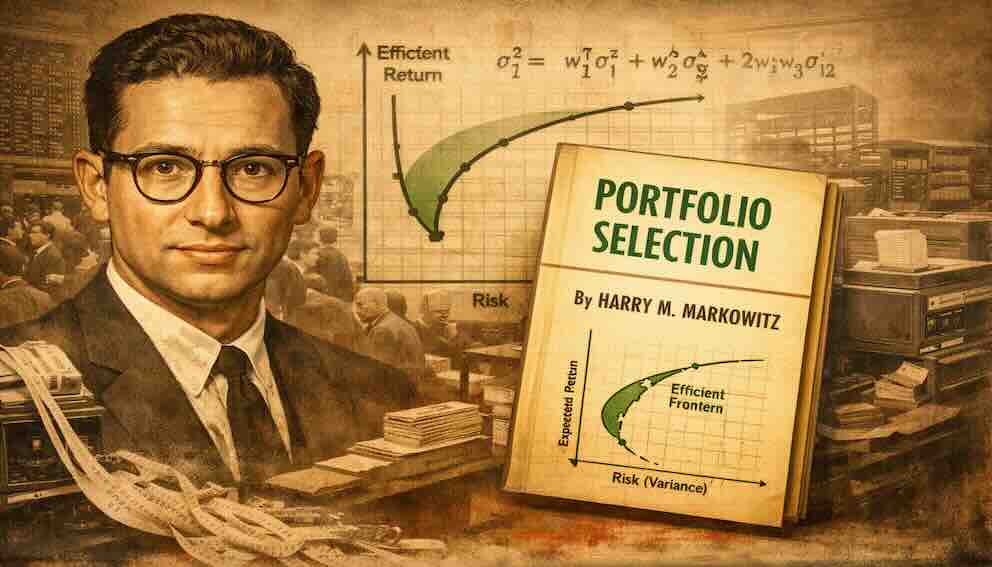
The paper is divided into several sections. The first introduces the problem. The second develops the concepts of expected return and variance. The third introduces covariance and shows how portfolio risk depends on asset relationships. The fourth presents one of the most famous visuals in financial economics: a simple graph plotting expected return against variance, with the efficient portfolios forming a curved boundary. The final sections discuss implications and limitations.
For a modern reader, the mathematics is accessible with some effort. The ideas, once grasped, seem almost obvious—a sign of how thoroughly they have permeated financial thinking. To demonstrate his framework, Markowitz constructed numerical examples using actual securities, showing how different combinations produced different risk–return outcomes. The paper was theory, but it was theory grounded in the possibility of practice.
The Man Behind the Paper: Harry Markowitz's Accidental Revolution
Harry Markowitz was born in Chicago in 1927, the son of a grocery store owner. He grew up in a city of neighborhoods, markets, and practical commerce. But his interests were not practical; they were philosophical and mathematical.
As a student at the University of Chicago, he found himself surrounded by some of the most formidable economists of the twentieth century. Milton Friedman taught there. So did Jacob Marschak, Tjalling Koopmans, and others who were reshaping economics with mathematics and statistics.
Markowitz was drawn to these new methods. He studied economics, but he also studied philosophy and mathematics, trying to understand how decisions should be made under uncertainty.
The idea that would make him famous came from an almost accidental moment. One day, while working on his doctoral studies, he was reading a book about investing in the university library. The book suggested that investors should consider both return and risk, but it never explained precisely how risk should be measured or managed. Markowitz realized that economists had not yet provided a clear mathematical model for portfolio decision-making.
He took his idea to his doctoral advisor, the renowned economist Jacob Marschak. Marschak was intrigued but cautious. He told Markowitz that the topic was not really economics—it was more like business or finance. But he encouraged him to pursue it anyway.
When Markowitz later presented his work to Milton Friedman, the response was even cooler. Friedman reportedly told him that the idea was not economics and that it would never earn him a doctorate. This was not mere skepticism; it reflected a genuine intellectual divide. Many economists believed that diversification meant simply buying many stocks. Markowitz's argument that diversification must consider correlation, not just the number of assets, was a novel and uncomfortable idea.
But Markowitz persisted. He believed that the problem of how to allocate wealth under uncertainty was fundamental, and that mathematics could illuminate it.
In 1952, he published Portfolio Selection in the Journal of Finance. It was his doctoral dissertation, compressed into twenty pages of dense argument.
Decades later, in 1990, he stood on a stage in Stockholm to receive the Nobel Prize in Economic Sciences, sharing it with William Sharpe and Merton Miller. The man who had been told his work was not economics had helped create a new branch of the discipline.
The Era That Produced the Paper: Post-War Optimism and Primitive Finance
To understand why Markowitz's ideas were so transformative, you have to understand the world he was writing into.
The early 1950s was a moment of economic transformation. The Second World War was over, and the industrial economies were rebuilding. Corporations were expanding, raising capital, and listing their shares on stock exchanges. Pension funds and insurance companies were growing rapidly, accumulating pools of money that needed to be invested systematically.
Yet investment management remained surprisingly primitive.
Portfolio managers typically followed one of two approaches. The first was security selection: trying to pick individual winning stocks by studying companies, industries, and management teams. The second was rule-of-thumb diversification: spreading money across several companies based on the vague wisdom that holding multiple stocks was safer than holding one.
Neither approach offered a rigorous way to think about risk. Neither approach explained how much diversification was enough. Neither approach acknowledged that the relationships between assets might matter.
Meanwhile, the tools that would eventually make Markowitz's framework practical did not yet exist. Computers were enormous, expensive, and rare. Solving the optimization problems his theory required was difficult, sometimes impossible. Implementing mean–variance optimization required solving quadratic programming problems; with dozens of securities, the number of covariances quickly became enormous. Early researchers sometimes relied on primitive machines at places like the RAND Corporation, or even hand calculations. For many years, Portfolio Selection remained an intellectual achievement rather than a practical tool.
But the theory was waiting for the technology to catch up.
The Architecture of the Paper: How Markowitz Builds His Argument
Portfolio Selection unfolds in a logical progression. Markowitz moves step by step, building a framework that would become the foundation of modern investment theory. Each concept emerges from the one before, each insight building on what came earlier.
The Problem with Conventional Wisdom
Markowitz begins by identifying the problem with conventional wisdom. Investors have been told to diversify, but no one has explained what diversification really means. Holding fifty different stocks is not necessarily safer than holding five if all fifty move in the same direction at the same time. The old saying "don't put all your eggs in one basket" is true as far as it goes, but it does not go nearly far enough. It tells you to spread your risk, but it does not tell you how much spreading is enough, or which baskets belong together.
The key, Markowitz argues, is not the number of assets but their relationships to one another. This insight leads directly to the paper's central message: investors should consider entire portfolios, not individual assets. An asset's risk cannot be judged in isolation. Its contribution to portfolio risk depends on how it interacts with everything else. A stock that looks wildly volatile on its own might actually reduce the risk of a portfolio if it moves in the opposite direction from other holdings.
Measuring Return and Risk
Markowitz then introduces the mathematical tools needed to analyze these relationships. Return is straightforward: the expected return of a portfolio is simply the weighted average of the expected returns of its individual assets. If you put half your money in a stock expected to return ten percent and half in a stock expected to return six percent, your portfolio's expected return is eight percent. This part was not controversial.
Risk requires more subtlety. Before Markowitz, risk was a vague concept. Investors described certain stocks as "safe" or "speculative" without using precise metrics. Markowitz changed this by proposing that risk must be measured quantitatively. He suggested measuring it with variance or its square root, standard deviation. Variance captures how much returns fluctuate around their average. A stock whose returns bounce wildly has high variance; a stock whose returns are steady has low variance.
This was a radical departure. Before Markowitz, risk was a subjective judgment. After Markowitz, it became a number that could be calculated and compared. His framework became known as mean–variance analysis: investors evaluate portfolios using two statistics—the expected return (the mean) and the variance of returns. Every portfolio can therefore be represented by a pair of numbers, its expected return and its risk. This is the foundation: risk and return must be considered together. Return alone is meaningless without understanding the risk required to achieve it.
Markowitz links his framework to the emerging theory of decision-making under uncertainty. Investors, he argues, choose portfolios that maximize expected utility. Under certain assumptions about preferences or return distributions, this decision reduces to a trade-off between expected return and variance. This intellectual bridge connected portfolio theory to the broader project of understanding how people make choices when the future is uncertain.
The Crucial Role of Covariance
But the real insight was still to come. Markowitz showed that the risk of a portfolio depends not only on the risks of individual assets but also on how those assets move together. This relationship is measured by covariance or correlation.
When two assets move in the same direction at the same time, they are positively correlated. When one rises while the other falls, they are negatively correlated. And when their movements are unrelated, they have zero correlation. This insight is fundamental: covariance is crucial. The relationship between assets—how they move together—determines the benefits of diversification.
Here is the magic: by combining assets that are not perfectly correlated, an investor can reduce the overall risk of the portfolio. The fluctuations of one asset cancel out the fluctuations of another. The whole becomes safer than the sum of its parts. This is why correlation is the key to diversification. The degree to which assets move together determines how much diversification benefits an investor.
The Mathematics of Diversification
Markowitz formalized this intuition mathematically. The variance of a portfolio depends on three things: the variances of the individual assets, the covariances between them, and the weights assigned to each.
This formula revealed something important: diversification has mathematical foundations. The old folk wisdom was true, but Markowitz showed precisely why. Diversification works because assets are not perfectly correlated.
The formula also revealed that diversification has limits. Adding more assets reduces risk, but only up to a point. Once a portfolio contains enough assets with low correlations, the remaining risk comes from the covariances that cannot be eliminated. No amount of diversification can remove this residual risk, because it is built into the relationships between assets.
The Efficient Frontier
With these tools in place, Markowitz introduces one of the most famous concepts in finance: the efficient frontier.
Imagine all possible portfolios that can be constructed from a given set of assets. Some will be inefficient: for the same level of risk, there exists another portfolio with higher return. Some will be efficient: no other portfolio offers higher return for the same risk. This is the core idea: the efficient frontier defines optimal portfolios.
Plot all the efficient portfolios on a graph, with risk on one axis and return on the other, and you get a curve. This is the efficient frontier. Every rational investor should choose a portfolio somewhere on this curve.
The choice depends on the investor's tolerance for risk. Markowitz assumes that investors are risk-averse—they prefer higher returns but dislike risk, and they seek the best trade-off between the two. A highly risk-averse investor might choose a low-risk, low-return portfolio near the left end of the frontier. A more risk-tolerant investor might choose a high-risk, high-return portfolio near the right end. But no rational investor should choose a portfolio below the frontier, because for the same risk they could have higher return, or for the same return they could have lower risk.
The Investor's Problem as Optimization
Markowitz framed investing as an optimization problem. Given a set of assets with known expected returns, variances, and covariances, and given an investor's preferences for risk and return, there is a mathematically optimal portfolio. This formulation transformed investing from an art into a problem that could be solved with mathematics. Portfolio construction is an optimization problem, and the efficient frontier is its solution.
A Concrete Example
To understand how Markowitz's framework works, imagine a simple choice between two assets.
Asset A is a technology stock. It has an expected return of twelve percent, but its returns are volatile—its standard deviation is twenty percent.
Asset B is a utility company. It has an expected return of six percent, and its returns are steady—its standard deviation is only eight percent.
If you put all your money in Asset A, you get high return but high risk. If you put all your money in Asset B, you get low risk but low return. Neither is obviously better; it depends on your tolerance for risk.
But what if you split your money between them?
Suppose you put half in each. Your expected return is the average: nine percent. But your risk is not the average of twenty percent and eight percent—it depends on how the two assets move together.
If they move in perfect lockstep—if every time the technology stock rises five percent, the utility rises five percent as well—then your portfolio risk might be around fourteen percent, the average of the two. Not much improvement. You have diversified, but you have not gained much because the assets move together.
But if they move independently—if the technology stock soars while utilities slump, and vice versa—something interesting happens. The fluctuations cancel out. When one is up, the other is down. Your portfolio risk might be lower than either individual asset. You might achieve nine percent return with only ten percent risk.
This is the magic of diversification. By combining assets that do not move together, you can reduce risk without sacrificing return. The mathematics behind this insight is what Markowitz contributed. The example shows why covariance matters, why correlation is the key, and why the simple folk wisdom of diversification was never enough.
Through this progression—from the failure of conventional wisdom to the measurement of risk, from the crucial role of covariance to the mathematics of diversification, from the efficient frontier to the formulation of investing as an optimization problem—Markowitz builds a complete framework for thinking about portfolios. Each step follows logically from the one before, each insight building on what came earlier. By the time the reader reaches the end, the old world of intuitive stock-picking has been replaced by something more powerful: a science of portfolio construction grounded in mathematics and probability.
How the Paper Was Received
When Portfolio Selection first appeared in 1952, it did not transform Wall Street overnight.
The paper was published in an academic journal, not a popular magazine. It was mathematical, abstract, and addressed primarily to other economists. Most practitioners had neither the training nor the inclination to work through its equations.
Even within academia, the reception was mixed. Some economists recognized its originality. Others, like Milton Friedman, remained skeptical. The idea that investing could be reduced to mathematics seemed implausible to many.
For years, the paper remained an intellectual curiosity rather than a practical tool. Computers were not yet powerful enough to implement its methods. The data needed to estimate expected returns and covariances was not readily available.
But the ideas did not disappear. They circulated among a small group of researchers who recognized their importance.
In the 1960s, William Sharpe and others built on Markowitz's foundation to develop the Capital Asset Pricing Model, which linked portfolio theory to the pricing of individual assets. This extension gave Markowitz's framework even greater power.
By the 1970s, as computing power grew and financial data became more accessible, institutional investors began to apply Markowitz's framework. Pension funds, endowments, and large asset managers adopted mean–variance optimization as a tool for asset allocation.
By the time Markowitz received the Nobel Prize in 1990, his paper had become one of the most cited and influential works in the history of finance.
A Brief Timeline of Influence
1952 – Paper published
1960s – Sharpe extends the theory into CAPM
1970s – Institutional investors begin adopting mean–variance optimization
1990 – Markowitz receives Nobel Prize
How It Changed the World of Finance
The impact of Portfolio Selection on finance is almost impossible to overstate. Before Markowitz, the field existed as a collection of practices, intuitions, and rules of thumb. After Markowitz, it became a science.
The Creation of Modern Portfolio Theory
Before Markowitz, there was no rigorous framework for thinking about portfolio construction. After him, investors had a mathematical way to evaluate portfolios based on risk and return together. He showed that the risk and return of a portfolio cannot be understood by examining its components in isolation. The relationships between assets matter as much as the assets themselves. This insight—that a portfolio is more than the sum of its parts—became the foundation of modern portfolio theory. Every subsequent development in the field has built upon it.
The Introduction of Quantitative Risk Management
Before Markowitz, risk was a vague concept described with words like "safe" or "speculative." After him, risk became a number—variance and standard deviation—that could be calculated, compared, and managed. Today, every institutional investor uses these tools. Pension funds measure the volatility of their portfolios. Mutual funds report standard deviations in their prospectuses. Risk managers calculate value at risk using the same statistical foundations that Markowitz laid.
The Transformation of Institutional Investing
Pension funds and endowments once allocated capital based on tradition and intuition. Markowitz's framework changed this by providing a systematic method for asset allocation. Institutions could now use historical data to estimate expected returns, variances, and covariances. They could then run optimization algorithms to find the portfolio that offered the highest expected return for a given level of risk, or the lowest risk for a given level of return. This transformed asset allocation from an art into a discipline. Today, sovereign wealth funds, university endowments, and corporate pension plans all use tools derived from Markowitz's work to decide how much to invest in stocks, bonds, real estate, private equity, and every other asset class.
The Influence on Index Funds
One of the most profound implications of Markowitz's framework was its logic about diversification. If investors should hold broadly diversified portfolios, and if the relationships between assets determine the benefits of diversification, then perhaps the most rational strategy is to hold everything.
This insight laid the intellectual groundwork for index funds. John Bogle, who founded Vanguard and launched the first index mutual fund in 1976, was influenced by the academic work that Markowitz had set in motion. The logic was simple: if the market portfolio represents the collective wisdom of all investors, and if trying to beat the market is a game that most will lose, then the rational choice is to buy the market and hold it. Today, index funds manage trillions of dollars, and the passive investing revolution that Markowitz helped enable has reshaped the entire investment industry.
The Shaping of Asset Allocation as a Discipline
Before Markowitz, the question "how much should I put in stocks and how much in bonds?" had no good answer. Investors relied on rough rules of thumb—the "100 minus your age" rule for stock allocation, or simply whatever felt comfortable. There was no way to know whether a given allocation was appropriate for a particular investor's goals and risk tolerance.
Markowitz's framework provided a way to answer this question systematically. By understanding the expected returns and risks of different asset classes, and the correlations between them, investors could construct portfolios tailored to their specific circumstances. This gave birth to asset allocation as a distinct discipline within finance. Today, financial advisors use sophisticated tools to help clients determine their optimal mix of assets, and the entire field of financial planning rests on foundations that Markowitz helped build.
The Inspiration for Generations of Research
Portfolio Selection was not the end of a conversation; it was the beginning. The paper opened up a new field of inquiry that would occupy researchers for decades to come.
Within a few years, William Sharpe had built on Markowitz's foundation to develop the Capital Asset Pricing Model (CAPM) , which explained how assets should be priced in relation to the market portfolio. This work earned Sharpe a Nobel Prize and became the basis for much of modern finance.
Later researchers developed the Arbitrage Pricing Theory, which extended the insights of CAPM to multiple factors. Others built multifactor models that explained returns in terms of size, value, momentum, and other characteristics. All of these developments trace their lineage back to Markowitz's original insight that portfolios should be evaluated in terms of risk and return, and that the relationships between assets matter.
Even the efficient market hypothesis, which emerged in the 1960s and 1970s, was shaped by the framework Markowitz had created. If markets are efficient, then the optimal strategy is to hold the market portfolio—exactly the conclusion that follows from Markowitz's logic.
The Filtering into Popular Consciousness
Perhaps most remarkably, Markowitz's ideas have filtered from academic journals into the way ordinary people think about investing. Concepts that were once the exclusive province of PhDs are now taught in introductory finance courses and discussed in everyday conversation.
The idea that risk and return must be considered together is now common sense. No serious investor looks only at returns without asking what risks were taken to achieve them. The idea that diversification matters is universally accepted. Even casual investors know that they should not put all their money in one stock. The idea that portfolios should be evaluated as wholes has become standard practice. Financial advisors do not ask about individual holdings in isolation; they ask about the overall allocation and how it fits the client's goals.
These concepts seem obvious now, but they were not obvious before Markowitz. They had to be discovered, articulated, and proven. That is the mark of a truly transformative idea: it becomes so embedded in our thinking that we forget the world before it existed.
The Man Who Won the Nobel Prize
In 1990, Harry Markowitz stood on a stage in Stockholm to receive the Nobel Prize in Economic Sciences, sharing it with William Sharpe and Merton Miller. The Nobel committee recognized that his 1952 paper had fundamentally changed how the world thinks about investing.
Markowitz later joked about the practical application of his own theory. When it came time to allocate his own retirement savings, he faced a dilemma. His framework suggested that he should consider the covariance between different asset classes, but the calculations were complex and he was busy with other work. So he did something simpler: he split his money equally between stocks and bonds, reasoning that if the market went up he would be happy, and if it went down he would not be devastated. It was not the mathematically optimal portfolio, but it was good enough.
The story illustrates something important about Markowitz's contribution. He gave the world a rigorous framework for thinking about portfolios, but he also understood that theory must serve human purposes, not the other way around. That balance—between mathematical precision and practical wisdom—is part of why his work has endured.
What Still Stands—and What Has Not Survived
A paper written in 1952 cannot capture every complexity of modern markets. Some aspects of Markowitz's framework have been refined, extended, or challenged.
What Still Stands
The measurement of risk as variance or standard deviation remains standard practice.
The importance of covariance is universally accepted.
The efficient frontier remains a powerful conceptual tool.
The idea that diversification reduces risk is fundamental.
The principle that return cannot be evaluated without risk is axiomatic.
The formulation of portfolio construction as an optimization problem underlies much of quantitative finance.
What Has Not Survived
The assumption that returns follow stable statistical distributions has been challenged. Real markets exhibit "fat tails"—extreme events occur more often than simple models predict.
The reliance on historical data to estimate expected returns is problematic. Past returns do not guarantee future results, and small estimation errors can lead to poor portfolios.
The model's static nature—it assumes a single period—has been extended to multi-period settings.
The assumption that investors care only about mean and variance has been questioned. Real investors may have more complex preferences.
The neglect of transaction costs, taxes, and liquidity has been addressed by later research.
The assumption that all investors have the same information is unrealistic. Markets are not always efficient.
Why This Paper Still Matters Today
More than seventy years after its publication, Portfolio Selection remains essential reading for anyone who wants to understand how modern investing works.
Consider how money is managed today. A pension fund with billions of dollars to invest does not simply pick stocks based on hunches. It decides how much to allocate to equities, bonds, real estate, and other assets. It studies the relationships between these asset classes. It measures risk and return. It tries to find the optimal balance. This is Markowitz's framework in practice.
Consider how financial advisors work with individual clients. They ask about risk tolerance. They build diversified portfolios. They explain that different assets behave differently. They show how combining assets can reduce risk without sacrificing return. This is Markowitz's framework, translated for ordinary investors.
Consider how quantitative funds operate. They build mathematical models of asset returns, covariances, and risks. They optimize portfolios using algorithms. They trade based on statistical relationships. This is Markowitz's framework, extended and refined.
Consider the most basic question of investing: "How much should I put in stocks and how much in bonds?" This question cannot be answered without Markowitz's framework. The answer depends on the expected returns of stocks and bonds, their risks, and how they move together. It depends on the efficient frontier and the investor's tolerance for risk.
Markowitz's great achievement was to show that investing could be systematic. It could be analyzed. It could be optimized. It was not just a matter of judgment and intuition. It was a problem that mathematics could illuminate.
In an age of complex financial markets, this insight is more valuable than ever.
What Was Truly New in This Paper
To understand why Portfolio Selection was such a breakthrough, it helps to compare what investors believed before Markowitz with what his paper made possible.
Before Markowitz, diversification was folk wisdom. Investors knew they should not put all their eggs in one basket, but no one could explain why diversification worked or how much of it was enough. Risk was vaguely defined. Investors described certain stocks as "safe" or "speculative," but these were subjective judgments without mathematical foundation. Portfolios were built by intuition, by reputation, by hunches. Assets were judged individually, based on their own merits, without considering how they might interact with other holdings. And there was no framework for thinking about trade-offs between risk and return—no way to ask whether a higher return was worth the additional risk.
After Markowitz, everything changed. Diversification was no longer just a wise saying; it was mathematically explained, grounded in the relationships between assets. Risk became measurable, captured by variance and standard deviation. Portfolios could be optimized mathematically rather than assembled by intuition. Assets were judged not in isolation but by how they interacted with everything else in the portfolio. And the efficient frontier provided a clear framework for understanding trade-offs: for any level of risk, there was a maximum achievable return, and rational investors should choose somewhere along that frontier.
This was the transformation Markowitz achieved. He did not merely refine existing ideas; he created an entirely new way of thinking about investing, one that turned portfolio construction from an art into a science.
Conclusion
Harry Markowitz published Portfolio Selection in 1952, at a time when investing was still guided by intuition and simple rules of thumb. His paper was short, mathematical, and addressed primarily to other academics. It did not transform Wall Street overnight.
But its ideas were too powerful to remain obscure. Markowitz showed that risk could be measured, that diversification had mathematical foundations, that the relationships between assets mattered as much as the assets themselves. He introduced mean–variance analysis, the efficient frontier, and framed portfolio construction as an optimization problem.
The paper faced resistance. Markowitz was told his work was not economics. It took decades for the ideas to be fully absorbed. But they spread. They influenced the development of the Capital Asset Pricing Model, the rise of index funds, and the practice of institutional asset management. They changed how pension funds allocate billions, how advisors work with clients, how quantitative funds trade.
Today, every time an investor asks not just "what should I buy?" but "how do these assets work together?"—every time a portfolio is evaluated for risk as well as return—Markowitz's quiet revolution is at work.
Portfolio Selection is not a long paper. It is barely twenty pages. But it contains an idea that reshaped finance: that investing is not about picking winners but about building portfolios, that risk is as important as return, that the whole is different from the sum of its parts.
That idea changed everything.
About Swati Sharma
Lead Editor at MyEyze, Economist & Finance Research WriterSwati Sharma is an economist with a Bachelor’s degree in Economics (Honours), CIPD Level 5 certification, and an MBA, and over 18 years of experience across management consulting, investment, and technology organizations. She specializes in research-driven financial education, focusing on economics, markets, and investor behavior, with a passion for making complex financial concepts clear, accurate, and accessible to a broad audience.
Disclaimer
This article is for educational purposes only and should not be interpreted as financial advice. Readers should consult a qualified financial professional before making investment decisions. Assistance from AI-powered generative tools was taken to format and improve language flow. While we strive for accuracy, this content may contain errors or omissions and should be independently verified.