
Tutorial Categories
Last Updated: March 29, 2026 at 15:30
Portfolio Theory and Capital Markets: A Walk Through the Book That Turned Risk into a Measurable Number
How William Sharpe Gave Us Beta and the Capital Asset Pricing Model
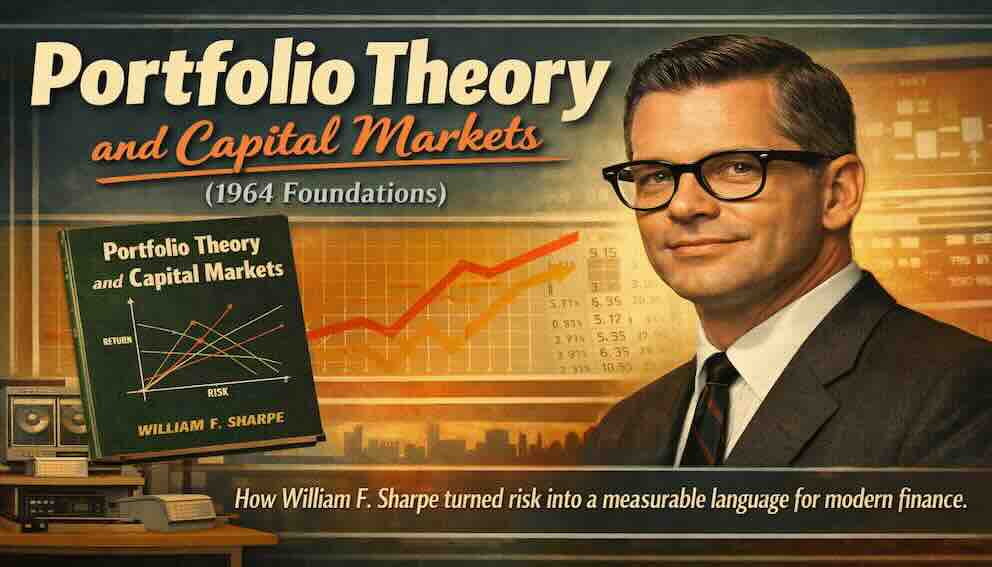
In 1964, a young economist named William F. Sharpe published a paper in the Journal of Finance that would forever change how investors understand the relationship between risk and return. The ideas in that paper, later expanded and formalized into the book Portfolio Theory and Capital Markets, introduced what became known as the Capital Asset Pricing Model (CAPM) —a framework for understanding how financial markets price risk. Sharpe showed that not all risk matters to investors. Some risks can be diversified away, while other risks—systematic risks embedded in the market itself—cannot be avoided and therefore determine expected returns. He gave the world a simple number, beta, to measure an asset's sensitivity to the overall market. At a time when investing was still guided by intuition and reputation, Sharpe's ideas provided a rigorous, mathematical foundation for thinking about risk. The book codified these insights into a coherent framework that could be taught, debated, and applied. Today, more than half a century later, every finance student learns CAPM, every portfolio manager thinks about beta, and every conversation about risk-adjusted returns traces back to Sharpe's quiet revolution.
Introduction to the Book
Imagine you are an investor in the early 1960s. You have money to manage, perhaps for a pension fund or an insurance company. You want to invest wisely, but how do you know whether you are being rewarded for the risks you are taking?
You can look at returns, of course. One fund delivers twelve percent; another delivers eight percent. The first must be better, right? But what if the first fund took enormous risks to achieve those returns—risks that could wipe out gains in a bad year? What if the second fund delivered its returns with steady, predictable performance? How do you compare them?
This was the puzzle that confronted investors in the mid-twentieth century. They had no consistent way to measure risk, no framework for asking whether a return was adequate compensation for the risk taken, no language for discussing these questions with precision.
William Sharpe changed that.
Portfolio Theory and Capital Markets built on the foundation laid by Harry Markowitz, who had shown how diversification could reduce risk. But Markowitz's work left a crucial question unanswered: how should individual securities be priced in relation to the overall market?
Sharpe's answer became the Capital Asset Pricing Model, one of the most influential ideas in the history of finance. The 1964 paper introduced the core concepts, but the book that followed—Portfolio Theory and Capital Markets—expanded and formalized them into a comprehensive framework. It laid out the mathematics, explained the assumptions, illustrated the relationships with graphs, and showed how the theory could be applied to real-world investing. For generations of students and practitioners, this book became the definitive statement of how to think about risk and return.
The Man Behind the Ideas: William Sharpe's Intellectual Journey
William F. Sharpe did not set out to revolutionize finance. Born in 1934 in Boston, he grew up in a world still shaped by the Great Depression, when questions about economic stability and market behavior were deeply personal. His family moved to California, and he eventually enrolled at the University of California, Berkeley, intending to study medicine. But after a year, he transferred to UCLA and discovered economics.
It was at UCLA that Sharpe encountered the ideas that would shape his career. He studied under economists who were beginning to apply mathematical tools to economic questions. And he discovered the work of Harry Markowitz, whose 1952 paper on portfolio selection had introduced the idea that diversification could be understood mathematically.
Markowitz had shown how to construct efficient portfolios, but his framework left a gap. It explained how investors should behave, but it did not explain how markets actually priced securities. Sharpe took this as his challenge.
His doctoral research aimed to extend Markowitz's insights into a theory of market equilibrium. The journey was not easy. When he submitted his paper to academic journals, it was rejected multiple times. Reviewers found the mathematics challenging and the conclusions bold. But Sharpe persisted, refining his arguments until the now-famous 1964 paper, "Capital Asset Prices: A Theory of Market Equilibrium Under Conditions of Risk," finally appeared in the Journal of Finance.
The book Portfolio Theory and Capital Markets came later, expanding the paper's dense mathematics into a more accessible and comprehensive treatment. It included detailed explanations, graphical illustrations like the Security Market Line, and discussions of the model's assumptions and implications. Where the paper was a breakthrough, the book was a blueprint—a work that could be studied, taught, and applied.
Decades later, in 1990, Sharpe stood on a stage in Stockholm to receive the Nobel Prize in Economic Sciences, sharing it with Harry Markowitz and Merton Miller. The work that had once been rejected by journals had become foundational.
The Era That Produced the Work: Computers, Institutions, and the Search for Scientific Investing
The early 1960s were a moment of transformation in finance.
Computers were beginning to enter universities and research labs, allowing economists to analyze data and test models in ways that had not been possible before. The ability to calculate correlations, run regressions, and process large datasets opened new frontiers for financial research. Sharpe's model, which required estimating betas for thousands of securities, would have been unthinkable without this emerging technology.
At the same time, financial markets were expanding rapidly. Institutional investors—pension funds, insurance companies, mutual funds—were managing ever-larger pools of capital. These institutions had a problem: they needed systematic ways to evaluate investments, measure performance, and manage risk. The old methods of intuition and reputation were no longer adequate.
Consider the experience of a pension fund manager in 1960. He might have a portfolio of hundreds of stocks, but how could he know whether his returns were due to skill or simply to taking on excessive risk? How could he compare his performance to other funds? How could he explain to his board why one stock was included and another was not? These questions had no good answers.
Academics were asking deeper questions about how markets worked. Why did some stocks earn higher returns than others? Was there a rational structure behind market prices? Could risk be measured and priced?
Sharpe's work arrived at precisely the right moment. It offered answers that were mathematically rigorous yet practically applicable. It gave investors a language for talking about risk and a framework for thinking about returns.
A Glimpse into the Investing World Before Sharpe
To appreciate what Sharpe's framework made possible, it helps to understand what investing looked like before his ideas took hold.
In the 1950s and early 1960s, a typical institutional portfolio manager might rely on a combination of company visits, conversations with industry contacts, and reading annual reports. Decisions were made based on judgment and experience. Diversification meant holding many stocks, but no one could say how many was enough or whether the stocks being held together actually provided protection.
When evaluating performance, managers looked at returns. A fund that went up twenty percent was clearly better than one that went up ten percent—never mind that the first fund might have taken risks that could have just as easily produced a forty percent loss. There was no way to adjust for risk, no way to know whether returns were adequate compensation for the dangers incurred.
The introduction of Sharpe's ideas was not immediately embraced. Many practitioners found the mathematics intimidating. Some questioned whether markets could possibly behave as neatly as the model suggested. But over time, as computing power grew and evidence accumulated, the framework proved its value. It gave investors something they desperately needed: a systematic way to think about risk.
The Architecture of the Book: How Sharpe Builds His Argument
The Architecture of the Book: How Sharpe Builds His Argument
Portfolio Theory and Capital Markets is structured to lead readers step by step through the logic of the Capital Asset Pricing Model. Sharpe begins with the foundations laid by Markowitz, then extends them into a theory of market equilibrium. Each concept emerges from the one before, building toward a complete framework for understanding how risk and return relate in financial markets.
The Problem with Traditional Thinking
Sharpe starts where investors have always started: with the puzzle of how to think about risk. Before his work, investors had no consistent way to evaluate the risks they were taking. They could compare returns, but returns alone were misleading. A high return might simply reflect a high-risk investment that could just as easily have produced a disastrous loss. A low return might reflect a conservative strategy that preserved capital through turbulent times. Without a way to adjust returns for risk, meaningful comparison was impossible.
What investors needed was a framework that could answer a fundamental question: is a given return adequate compensation for the risk taken? This question drives everything that follows.
The Distinction Between Two Kinds of Risk
Sharpe's first crucial insight was that not all risk matters. He distinguished between two fundamentally different types.
Unsystematic risk is risk that is specific to a particular company or industry. It might come from a management failure, a product recall, a labor dispute, or any other factor that affects one firm but not the entire market. This kind of risk can be reduced through diversification. By holding many different assets, an investor can ensure that the bad luck of any single company does not devastate the portfolio. Because it can be eliminated, rational investors should not expect to be compensated for bearing it.
Systematic risk is risk that affects the entire market. It comes from broad economic forces—interest rate changes, recessions, political upheavals—that touch every company. Diversification cannot eliminate this risk because it is built into the system itself. This is the risk that matters.
This distinction is fundamental: not all risk matters. Unsystematic risk can be diversified away, so investors should not expect compensation for taking risks they could have eliminated through diversification. Systematic risk is what counts—the only risk that matters for expected returns is the risk that cannot be diversified away. The book illustrates this with examples showing how portfolio variance decreases as more assets are added, approaching the level of systematic risk that remains no matter how many stocks you hold.
Beta: Measuring Systematic Risk
If systematic risk is what matters, how do we measure it? Sharpe's answer was beta.
Beta measures how sensitive an asset is to movements in the overall market. A stock with a beta of 1.5 tends to move one and a half percent for every one percent move in the market. If the market rises, it rises more; if the market falls, it falls more. A stock with a beta of 0.5 is more stable, moving only half as much as the market. A stock with a beta of zero has no relationship to market movements at all.
Beta measures market sensitivity—it captures how sensitive an asset is to movements in the overall market. It is the measure of systematic risk. The book devotes considerable space to explaining how beta is calculated from historical data, how it should be interpreted, and what its limitations are. Sharpe includes numerical examples and graphical illustrations to help readers grasp the concept intuitively.
The Capital Asset Pricing Model
With these concepts in place, Sharpe derived a mathematical relationship between risk and expected return. This relationship became known as the Capital Asset Pricing Model, or CAPM.
The model states that the expected return on an asset equals the risk-free rate—the return on a completely safe investment, like government bonds—plus a premium for taking on market risk. That premium is scaled by the asset's beta. In equation form: expected return = risk-free rate + beta × (market return – risk-free rate) .
The intuition is simple: expected return depends on beta. Investors demand compensation for taking risk, and the amount of compensation depends on how much systematic risk they are bearing. Assets with higher betas should have higher expected returns. This relationship is derived mathematically and illustrated graphically throughout the book.
The Security Market Line
This relationship can be visualized as a straight line on a graph, with beta on one axis and expected return on the other. This line is called the Security Market Line, and it is one of the most famous diagrams in all of finance.
Assets that plot above the line are potentially undervalued—they offer higher returns than their beta would predict. Assets below the line are potentially overvalued—their expected returns are too low for their level of risk. The relationship between beta and expected return can be visualized as a straight line, providing a powerful tool for thinking about market pricing.
The book presents this diagram with careful explanation, showing readers how to interpret it and how to use it in their own analysis. It becomes a central organizing tool for understanding whether assets are fairly priced.
The Market Portfolio
Sharpe also introduced the concept of the market portfolio—a hypothetical portfolio containing every risky asset in the economy, weighted by its market value. In equilibrium, Sharpe argued, all investors should hold some combination of this market portfolio and the risk-free asset.
This idea had profound implications. It suggested that the simplest investment strategy—buying a broad market index—might be the most rational. The market portfolio represents the collective wisdom of all investors, and trying to beat it is a game most will lose. This laid the intellectual foundation for index investing, which would emerge in the 1970s and eventually grow to manage trillions of dollars. The book explains in detail why this conclusion follows from the model's assumptions.
Risk-Adjusted Performance Measurement
If expected returns depend on risk, then comparing raw returns is meaningless. A fund that earned twelve percent might have taken enormous risks to get there; a fund that earned eight percent might have delivered those returns with much less volatility.
Sharpe's framework made it possible to calculate risk-adjusted returns. The most famous measure is the Sharpe Ratio, which divides the excess return of an investment by its volatility. The higher the Sharpe Ratio, the better the investment's risk-adjusted performance. Raw returns are meaningless without understanding the risks taken to achieve them, and the Sharpe Ratio provides a way to compare performance on equal footing.
The book explains how to calculate and interpret this ratio, giving investors a tool they had never possessed before. It shows how to use it to evaluate funds, managers, and strategies.
Diversification Is Rational
Throughout the book, Sharpe emphasizes a corollary of his framework: because unsystematic risk is not rewarded, rational investors should diversify broadly. Concentrated bets are not just risky; they are irrational. They expose the investor to risks that could have been eliminated without any reduction in expected return.
Diversification is rational—the book makes this case with both mathematical reasoning and intuitive examples. A portfolio of many stocks will have the same expected return as a concentrated bet on one stock, but with much lower risk. There is no reward for putting all your eggs in one basket.
Markets Have Structure
Behind the apparent chaos of daily price movements, Sharpe's framework reveals a rational structure determining expected returns. Markets are not random. There is a logic to why some assets earn higher returns than others: they compensate investors for bearing greater systematic risk.
This is a powerful and hopeful conclusion. It suggests that markets are not merely casinos but systems that can be understood, analyzed, and navigated. Markets have structure, and that structure can be described mathematically.
Theory Can Guide Practice
The final message of the book is that theory can guide practice. Sharpe's framework was not merely academic. It provided practical tools for portfolio management, performance evaluation, and investment decision-making. The book concludes with chapters on applications, showing how the theory could be used by real investors.
The concepts introduced—systematic risk, beta, the Security Market Line, the market portfolio, the Sharpe Ratio—are not abstractions. They are tools that working investors can and do use every day. Sharpe's great achievement was to give finance a language for thinking about risk that was both rigorous and practical.
A Concrete Example
To understand how these ideas work, imagine two stocks.
Stock A has a beta of 1.5. It is sensitive to market movements. When the market rises five percent, Stock A tends to rise seven and a half percent. When the market falls five percent, Stock A tends to fall seven and a half percent.
Stock B has a beta of 0.5. It is more stable. It moves only half as much as the market in either direction.
Suppose the risk-free rate is three percent, and the expected return on the market is eight percent. According to CAPM, the expected return on Stock A should be:
3% + 1.5 × (8% – 3%) = 3% + 1.5 × 5% = 3% + 7.5% = 10.5%
For Stock B, the expected return should be:
3% + 0.5 × (8% – 3%) = 3% + 0.5 × 5% = 3% + 2.5% = 5.5%
Now imagine that Stock A is actually trading at a price that implies an expected return of twelve percent. That is higher than the CAPM prediction. Stock A might be undervalued. Stock B, if its expected return is only four percent, might be overvalued.
This framework gave investors a systematic way to evaluate whether an asset was fairly priced. The example shows how the theory translates into practice, providing a lens for seeing opportunities that might otherwise be missed.
Through this progression—from the problem of measuring risk to the distinction between its two forms, from beta to the CAPM, from the Security Market Line to the market portfolio, from the Sharpe Ratio to practical applications—Sharpe builds a complete framework for thinking about risk and return. Each step follows logically from the one before, each insight building on what came earlier. By the time the reader reaches the end, the vague concept of risk has been replaced by something measurable, manageable, and meaningful.
What the Book Looks Like
For readers who have never encountered it, Portfolio Theory and Capital Markets is a work of rigorous exposition. It is not a popular finance book filled with anecdotes and easy promises. It is a serious treatise, with equations, graphs, and careful reasoning.
But it is also a pedagogical work. Sharpe took care to explain his ideas clearly, to illustrate them with examples, and to guide readers through the logic step by step. The book includes:
- Detailed derivations of the key formulas
- Graphical illustrations of the Security Market Line and other concepts
- Numerical examples showing how to apply the theory
- Discussions of the assumptions underlying the model and their implications
- Extensions and qualifications that acknowledge the model's limitations
For generations of finance students, this book was the definitive introduction to thinking about risk and return.
How the Book Was Received
When Sharpe's ideas first appeared, they were met with skepticism. Practitioners found the mathematics intimidating. Academics debated the assumptions. Some questioned whether the model could possibly describe real markets, which were messy, emotional, and far from the idealized world of the theory.
One prominent economist reportedly dismissed CAPM as "too simple to be true." How could the complex reality of financial markets be captured in a single linear relationship?
But over time, the evidence accumulated. Researchers found that beta did explain a significant portion of the differences in stock returns. Universities began teaching CAPM as part of the standard finance curriculum. Business schools trained generations of students in Sharpe's framework.
By the 1970s and 1980s, the ideas had moved from academia into practice. Pension funds and asset managers began using beta and the Sharpe Ratio to evaluate investments. Index funds, built on the logic of the market portfolio, gained popularity. Corporate finance departments used CAPM to estimate the cost of capital for investment projects.
When Sharpe received the Nobel Prize in 1990, it was recognition that his once-controversial ideas had become central to how the world understands finance.
A Brief Timeline of Influence
1964 – Sharpe publishes his paper in the Journal of Finance
Late 1960s – The book Portfolio Theory and Capital Markets appears, expanding and formalizing the ideas
1960s–1970s – CAPM becomes a standard part of finance education
1970s – Institutional investors begin adopting beta and risk-adjusted performance measures
1976 – The first index funds appear, based on market portfolio logic
1990 – Sharpe shares the Nobel Prize with Markowitz and Miller for the body of work that transformed finance
How It Changed the World of Finance
The impact of Sharpe's work can be seen everywhere in modern finance.
It gave investors a language for risk. Before Sharpe, risk was vague. After Sharpe, it was beta, systematic and unsystematic, measurable and manageable.
It made risk-adjusted performance possible. The Sharpe Ratio and similar measures allow investors to compare funds and strategies on equal footing. A pension fund can now ask not just "how much did you return?" but "how much risk did you take to get that return?"
It laid the foundation for index investing. The idea that the market portfolio is the rational benchmark led directly to the creation of index funds, which now manage trillions of dollars. Jack Bogle, who founded Vanguard and popularized index investing, drew directly on this intellectual tradition.
It shaped corporate finance. Companies use CAPM to estimate their cost of equity capital, influencing decisions about which projects to pursue. A firm considering a new factory will calculate its expected return and compare it to the cost of capital derived from CAPM.
It became part of everyday investing. Beta numbers appear on financial websites, in research reports, in conversations between investors. They are part of the common language of finance.
It inspired generations of research. The Capital Asset Pricing Model was just the beginning. It sparked decades of work on multifactor models, behavioral finance, and asset pricing theory.
What Still Stands—and What Has Not Survived
More than half a century later, some elements of Sharpe's framework remain central to finance, while others have been refined or challenged.
What Still Stands
The distinction between systematic and unsystematic risk is fundamental. Every finance student learns it. Every investor implicitly uses it. It is one of those ideas that, once understood, seems obvious—but someone had to see it first.
The idea that diversification eliminates unnecessary risk remains one of the strongest lessons in investing. It is taught in every introductory finance course and practiced by every prudent investor.
Risk-adjusted performance measurement is now standard practice. The Sharpe Ratio is used everywhere, from hedge fund reports to retirement account statements.
Beta remains a widely used measure of market sensitivity, despite its known limitations. It is not the whole story, but it is a useful starting point.
The CAPM framework continues to be taught as the starting point for thinking about risk and return. Even researchers who have moved beyond it still begin with it.
What Has Been Challenged or Refined
The assumption that investors care only about mean and variance has been questioned. Real investors have more complex preferences, and behavioral finance has documented many deviations from the rational actor model.
Empirical tests have found factors beyond beta that explain returns. Size, value, momentum, and other factors have been shown to matter. The Fama-French three-factor model and its successors have extended CAPM in productive directions.
The model's assumptions—including frictionless markets, no taxes, and homogeneous expectations—do not hold in the real world. Sharpe was aware of these limitations and discussed them in the book.
Beta itself is not perfectly stable over time, making it harder to use for precise predictions. A stock's beta can change as its business evolves or as market conditions shift.
Despite these limitations, CAPM remains the foundation. It is the starting point from which more sophisticated models depart. As one economist put it, "All asset pricing models are wrong, but CAPM is usefully wrong."
Why This Book Still Matters Today
More than fifty years after Sharpe's paper first appeared, his ideas remain essential for anyone who wants to understand modern finance.
Consider how money is managed today. A pension fund evaluating its performance does not look only at returns. It looks at risk-adjusted returns. It asks whether the returns were adequate compensation for the risks taken. This is Sharpe's framework in practice.
Consider how financial advisors talk to clients. They explain that some risks can be diversified away, while others cannot. They use concepts that trace directly back to Sharpe's distinction between systematic and unsystematic risk.
Consider how corporate executives make decisions. When they evaluate a new project, they estimate the cost of capital. That estimate often comes from CAPM. They are using Sharpe's formula.
Consider how investors talk about stocks. They ask about beta. They want to know how sensitive a stock is to market movements. They are using Sharpe's measure.
Consider the entire edifice of modern academic finance. The asset pricing models taught in PhD programs, the empirical tests run by researchers, the theories debated in journals—all of it builds on the foundation Sharpe laid.
Sharpe's great achievement was to give finance a language for thinking about risk. Before him, risk was a vague concept, impossible to measure or compare. After him, it became a number—something that could be calculated, analyzed, and priced.
In a world where trillions of dollars are managed based on those numbers, that achievement has never been more relevant.
Conclusion
William Sharpe published his pathbreaking paper in 1964 and followed it with the book Portfolio Theory and Capital Markets, which expanded and formalized his ideas into a comprehensive framework. He wrote at a moment when finance was ready for transformation. Computers were opening new possibilities for analysis. Institutional investors were seeking systematic ways to manage risk. Academics were asking deeper questions about how markets work.
His answers became the Capital Asset Pricing Model, one of the most influential frameworks in the history of finance. He distinguished between systematic and unsystematic risk. He introduced beta as a measure of market sensitivity. He derived a formula for expected returns that gave investors a rational way to think about risk and reward. He illustrated these concepts with graphs and examples that made them accessible to generations of students.
The model was not perfect. Real markets are messier than its assumptions. Researchers have found additional factors that influence returns. Beta itself has limitations.
But the framework endures. It is taught in every finance program. It is used by practitioners around the world. It provides the starting point for thinking about risk and return.
Portfolio Theory and Capital Markets did more than introduce a model. It gave finance a language for thinking about its most fundamental concepts. It transformed risk from a vague intuition into a measurable quantity. It showed that behind the apparent chaos of markets, there is structure and logic.
That is why Sharpe's work still matters. It is not just a set of equations. It is a way of seeing the world.
Key Concepts
Systematic Risk – Risk that affects the entire market and cannot be diversified away. The only risk that matters for expected returns.
Unsystematic Risk – Risk specific to individual companies or industries. Can be eliminated through diversification.
Beta – A measure of how sensitive an asset is to movements in the overall market.
Capital Asset Pricing Model (CAPM) – The formula relating expected return to systematic risk: Expected return = Risk-free rate + Beta × (Market return – Risk-free rate).
Security Market Line – The graphical representation of the CAPM relationship, showing expected return as a function of beta.
Market Portfolio – A hypothetical portfolio containing all risky assets in the economy, weighted by market value.
Sharpe Ratio – A measure of risk-adjusted performance: (Return – Risk-free rate) ÷ Standard deviation.
Risk-Adjusted Return – Return measured relative to the risk taken to achieve it, allowing fair comparison across investments.
About Swati Sharma
Lead Editor at MyEyze, Economist & Finance Research WriterSwati Sharma is an economist with a Bachelor’s degree in Economics (Honours), CIPD Level 5 certification, and an MBA, and over 18 years of experience across management consulting, investment, and technology organizations. She specializes in research-driven financial education, focusing on economics, markets, and investor behavior, with a passion for making complex financial concepts clear, accurate, and accessible to a broad audience.
Disclaimer
This article is for educational purposes only and should not be interpreted as financial advice. Readers should consult a qualified financial professional before making investment decisions. Assistance from AI-powered generative tools was taken to format and improve language flow. While we strive for accuracy, this content may contain errors or omissions and should be independently verified.