
Tutorial Categories
Last Updated: March 30, 2026 at 15:30
Beat the Dealer: A Walk Through the Book That Taught the World to Count Cards
How a Young Mathematician Proved That Casinos Could Be Beaten by Statistics
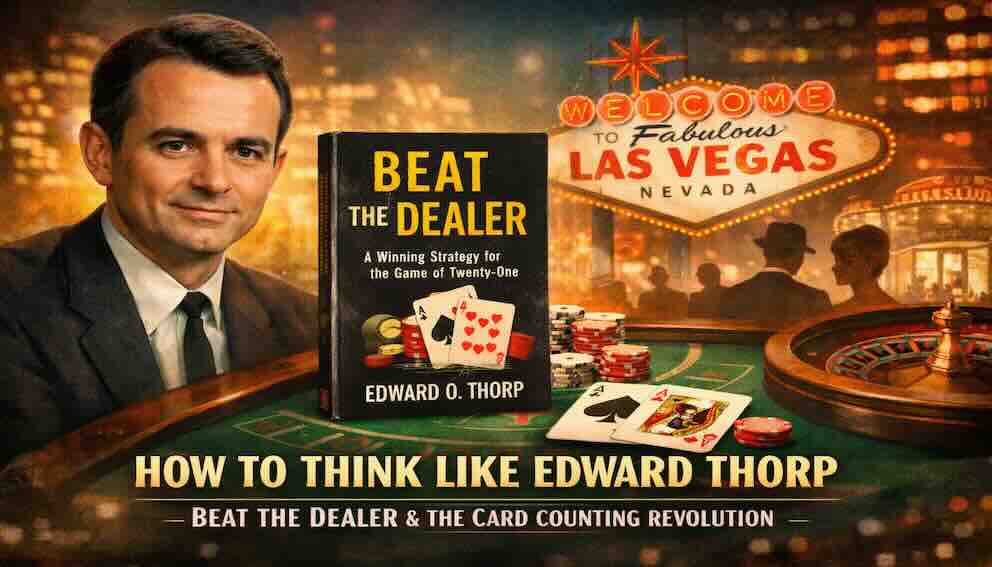
In 1962, a young mathematics professor named Edward Thorp published a book that casinos tried to ban, gamblers treated as scripture, and mathematicians recognized as a quiet revolution. Beat the Dealer was not the first book about blackjack, but it was the first to treat the game as a problem to be solved rather than a gamble to be endured. Thorp applied probability theory, computer simulations, and careful observation to develop card-counting techniques that gave players a genuine statistical edge over the house. The book became an immediate sensation, selling hundreds of thousands of copies and forcing casinos to change their rules. But its real legacy runs deeper. Thorp demonstrated that mathematical thinking could uncover hidden patterns in seemingly random systems—an insight he would later carry from the blackjack table to Wall Street. Beat the Dealer is not merely a gambling manual. It is a case study in how disciplined reasoning can overcome systems designed to defeat it.
Introduction to the Book
Imagine sitting down at a blackjack table in Las Vegas in 1960. The cards are dealt, the chips move, and the house wins more often than it loses. Everyone knows this. Casinos are not charities; they are businesses built on probabilities that favor them. The question is not whether the house has an edge, but whether that edge can be overcome.
Most gamblers accepted the answer as obvious: no. The house always wins.
Edward Thorp was not most gamblers.
Beat the Dealer grew out of a simple but radical premise: if the house's advantage could be calculated mathematically, perhaps it could also be neutralized mathematically. Thorp approached blackjack the way a physicist approaches an experimental problem—with hypotheses, data, and rigorous testing. He spent countless hours at casino tables, not gambling but observing. He ran simulations on early computers, then a novelty. He refined his methods based on what worked and discarded what did not.
The result was a system that gave players a genuine statistical edge. Thorp calculated that a skilled card counter could gain an advantage of roughly one to two percent over the house—enough, over time, to turn the odds in the player's favor. For anyone who had ever accepted the casino's odds as immutable, this was startling.
The book that emerged was part mathematics lesson, part gambling guide, and part challenge to conventional wisdom. It explained card counting in terms that an ordinary reader could understand and, with practice, apply.
The Man Behind the Book: Edward Thorp's Unusual Path
Edward Thorp was born in Chicago in 1932 and grew up in Southern California. From an early age, he was drawn to puzzles, numbers, and games that rewarded clear thinking. He built radios, solved mathematical problems for pleasure, and read widely in physics and astronomy. His mind worked best when presented with a system to understand.
He studied physics at UCLA, then moved to graduate work in mathematics. By the late 1950s, he was teaching at MIT and considering problems in probability theory. It was during this period that he encountered blackjack—not as a gambler, but as a mathematician wondering whether the game could be solved.
What set Thorp apart was not just his mathematical ability but his willingness to test his ideas in the real world. Many academics would have stopped at the theory. Thorp took his probability calculations to Las Vegas, sat down at the tables, and played for real money. He learned that theory and practice do not always align. Dealers have bad days. Pit bosses get suspicious. Casino security watches. The human element matters.
In one telling episode from the book, Thorp describes being spotted by casino personnel who suspected he was counting cards. He had to vary his betting patterns, play multiple tables, and sometimes leave before his edge could be neutralized. These real-world tests shaped the practical advice in Beat the Dealer—not just how to count, but how to survive while doing it.
When Beat the Dealer appeared in 1962, Thorp was still in his twenties. He had accomplished something that professional gamblers had spent lifetimes attempting. But for him, blackjack was always a means rather than an end. The real prize was understanding how mathematics could uncover hidden opportunities in systems that others took as fixed.
The Era That Produced the Book: Las Vegas Before the Countermeasures
To understand why Beat the Dealer landed with such force, you have to understand what Las Vegas looked like in the early 1960s.
The casinos were booming. Post-war prosperity had turned gambling from a fringe activity into mainstream entertainment. The Rat Pack—Frank Sinatra, Dean Martin, Sammy Davis Jr.—glamorized the scene. Tourists flocked to the Strip. The house edge was treated almost like a law of nature—something gamblers accepted and casinos exploited.
But beneath the surface, the games were simpler than they would later become. Blackjack was dealt from single decks. Dealers shuffled by hand. Casino surveillance was primitive compared to what exists today. A sharp-eyed player with a good memory could track cards in ways that would later become impossible.
Thorp recognized that blackjack was fundamentally different from games like roulette or craps. In those games, each spin or roll is independent of the last. The wheel has no memory. But blackjack has a memory. As cards are dealt, the composition of the remaining deck changes. A player who can track those changes gains information that the casino does not have.
This was the opening Thorp exploited. He was not cheating; he was simply paying attention and using mathematics to interpret what he saw.
The Architecture of the Book: How Thorp Builds His Argument
Beat the Dealer is structured to take the reader from confusion to competence. Thorp begins by explaining why blackjack is different from other casino games. He then introduces the mathematics of card counting, starting with simple systems and progressing to more sophisticated methods. He provides practice techniques, advice on casino etiquette, and warnings about the limits of the approach. Throughout, he returns to a central theme: mathematics can beat the house, but only if the player maintains discipline.
Why Blackjack Is Different
Most casino games are designed so that each bet is independent. In roulette, the ball has no memory of where it landed before. In craps, each roll is unaffected by previous rolls. The house edge is constant, unchanging, and unavoidable.
Blackjack is different. As cards are removed from the deck, the probabilities shift. A deck rich in high cards favors the player; a deck rich in low cards favors the dealer. By tracking which cards have already appeared, a player can know—approximately—what kind of deck remains. Thorp put numbers to this. He calculated that a deck rich in tens and aces could shift the odds in the player's favor by as much as two percent. That may sound small, but over hundreds of hands, it turns the house's edge into the player's edge.
The Ten-Count System
Thorp's first and simplest system involved tracking tens and aces, the cards most favorable to the player. When the remaining deck had a high proportion of these cards, the player bet more. When the proportion was low, the player bet less or sat out. The system was simple enough that a patient player could learn it with practice. It did not require memorizing every card, only keeping a rough mental tally. Thorp estimated that with this system alone, a player could gain a small but real advantage.
The Complete Point-Count System
For readers willing to put in more work, Thorp offered a more sophisticated system that tracked all cards, assigning positive or negative values to each. This method provided greater accuracy but required more concentration and practice. Thorp explained both systems in detail, with examples and practice exercises. He wanted readers to understand not just what to do, but why it worked.
A Concrete Example: When the Deck Turns in Your Favor
Thorp illustrates his method with a simple example. Imagine a single-deck game. You have been watching the cards and notice that all the twos, threes, and fours have already appeared. The remaining deck contains a higher-than-normal proportion of tens and aces. In a normal deck, the chance of being dealt a natural blackjack is about 4.8 percent. In this enriched deck, the probability rises. The dealer's chance of busting when showing a weak card also increases.
Thorp advises increasing your bet in this situation. Not doubling recklessly, but raising it enough to capitalize on the favorable odds. Over many hands, this disciplined adjustment turns the odds. He also provides a sobering counter-example. When the deck is rich in low cards, the edge shifts to the dealer. The smart play is to bet the minimum or leave the table entirely. Discipline means knowing when not to play.
Practical Advice and Casino Survival
The book also addressed the human side of card counting. Thorp warned readers that casinos would notice players who varied their bets dramatically. He suggested ways to blend in, to avoid detection, to leave before security became suspicious. He understood that mathematical advantage meant nothing if the player was thrown out before it could be realized. He wrote about the importance of composure, of acting like an ordinary tourist, of knowing when to walk away. These were not mathematical lessons, but they were essential to applying the mathematics successfully.
Computers as a Testing Ground
One of the more subtle innovations in Thorp's approach was his use of computers. In the early 1960s, computers were still novelties—large, expensive, and accessible only to researchers with institutional backing. Thorp used them to simulate millions of hands, testing his systems before ever risking real money. This was a novel approach in 1962, and it allowed him to refine his methods with a rigor that would have been impossible through casino observation alone.
Theory and Practice Must Align
Thorp did not stop at theory. He took his calculations to Las Vegas and played for real money. He learned that real-world conditions matter—distractions, fatigue, suspicion. A system that works in a computer simulation may fail when a cocktail waitress interrupts your count or a pit boss starts watching your bets. Thorp's willingness to test his ideas in actual casinos gave his advice a credibility that purely theoretical treatments lacked. He had made the mistakes so his readers would not have to.
The Edge Is Small but Real
Throughout the book, Thorp emphasizes that card counting does not turn the player into an invincible winner. It shifts the odds by a few percentage points. Over a single night, luck still matters. But over time, the edge asserts itself. The player who maintains discipline, who bets appropriately, who walks away when conditions turn unfavorable—that player will win in the long run. This is not a promise of immediate riches. It is a statement of mathematical fact.
The Same Thinking Applies Elsewhere
Thorp hints throughout the book that the methods he developed for blackjack could be applied to other domains. If probabilities could be tracked in a deck of cards, why not in financial markets? If a player could gain an edge by knowing when the deck was favorable, why not an investor who knew when a security was mispriced? These hints would later become the foundation of Thorp's second career as a quantitative investor. But in Beat the Dealer, they remain tantalizing suggestions—a glimpse of a larger vision beyond the casino floor.
How It Changed the World of Finance and Thinking
The direct impact of Beat the Dealer was on gambling, but its indirect impact transformed how people think about markets, risk, and the very nature of uncertainty. To understand why, you have to see what Thorp's method represented, not just what it accomplished.
The Shift from Intuition to Analysis
Before Thorp, beating a casino was a matter of luck, instinct, or outright cheating. Gamblers relied on streaks, systems that had no mathematical basis, or simply hope. The house edge was accepted as a fact of life.
Thorp replaced intuition with analysis. He showed that a system—blackjack—could be studied, modeled, and understood. Its apparent randomness concealed structure. Once that structure was revealed, the game could be beaten not through luck but through disciplined application of probability.
This shift—from accepting randomness to searching for hidden structure—would echo through every field Thorp touched.
The Birth of Quantitative Investing
Thorp did not stop at blackjack. He recognized that the same mindset could be applied to financial markets. If card counting revealed hidden patterns in a shuffled deck, what patterns might exist in the movements of stock prices?
In 1969, Thorp published Beat the Market with Sheen Kassouf. The book extended his quantitative approach to investing, introducing concepts that would later become standard in quantitative finance: statistical arbitrage, hedging, and the use of mathematical models to identify mispriced securities.
Thorp went on to manage a successful hedge fund, Princeton-Newport Partners, which compounded returns at an extraordinary rate for nearly two decades. His fund was one of the first to use quantitative methods systematically—trading not on hunches or earnings reports, but on mathematical relationships between securities.
The Template for Quantitative Finance
Thorp's approach became a template. He demonstrated that financial markets, like blackjack, could be studied as systems. They had rules, probabilities, and exploitable inefficiencies. The task of the quantitative investor was to find those inefficiencies, test them rigorously, and execute with discipline.
This may sound obvious today, when hedge funds employ armies of mathematicians and computer scientists. In the 1960s and 1970s, it was radical. Most investing was still based on fundamentals—studying companies, reading annual reports, talking to management. Thorp offered an alternative: let the numbers speak.
His methods influenced a generation of quantitative analysts. Ed Thorp's hedge fund was a training ground for talent that would go on to shape the industry. His ideas diffused through academic papers, conferences, and the growing community of "quants" who saw markets as puzzles to be solved.
The Rise of Statistical Arbitrage
One of Thorp's key insights was that mispricings between related securities could be exploited systematically. If two assets tended to move together and temporarily diverged, a trader could buy the cheaper one and sell the more expensive one, betting that the relationship would reassert itself.
This is statistical arbitrage. Today, it is a cornerstone of quantitative investing, practiced by hedge funds and proprietary trading desks around the world. Thorp was among the first to recognize its potential and to implement it with mathematical rigor.
The Kelly Criterion and Risk Management
Thorp also popularized the Kelly Criterion, a formula for determining optimal bet sizes when an edge exists. Originally developed by Bell Labs scientist John Kelly for analyzing information transmission, Thorp recognized its application to both gambling and investing.
The Kelly Criterion balances risk and reward, telling the investor how much to allocate to each opportunity to maximize long-term growth while avoiding ruin. It became a foundational tool in quantitative finance, used by everyone from hedge fund managers to individual investors.
Thorp's emphasis on risk management—on surviving long enough for the edge to assert itself—was as important as his methods for finding edges. He understood that even a winning strategy could fail if risk was mismanaged.
The Intellectual Lineage of Modern Finance
If you trace the intellectual lineage of modern quantitative finance, Thorp appears near the root. His work influenced:
- Edward O. Thorp & Sheen Kassouf, Beat the Market (1969) – Direct extension of his methods to finance.
- Fischer Black, Myron Scholes, and Robert Merton – Their option pricing model, developed in the early 1970s, shared the same mathematical sensibility, though they arrived at it independently.
- The first generation of quantitative hedge funds – Funds like Renaissance Technologies, D.E. Shaw, and others built on the foundation Thorp helped lay.
- Modern statistical arbitrage – Pairs trading, mean reversion strategies, and market-neutral approaches all trace back to Thorp's insights.
The Democratization of Quantitative Thinking
Beat the Dealer also did something more subtle. It brought quantitative thinking to a popular audience. Readers who would never study advanced mathematics could grasp the basic idea: that careful observation and disciplined execution could overcome systems designed to defeat you.
This mindset spread far beyond finance. It influenced how people thought about games, about business, about any domain where probability and strategy intersect. The idea that hidden patterns exist, that they can be discovered, that they can be exploited—this was Thorp's gift to popular culture.
The Limits of the Analogy
Of course, markets are not blackjack. In blackjack, the rules are fixed. The dealer does not change the odds mid-game. In markets, rules change, participants adapt, and edges erode. Thorp understood this. His hedge fund evolved constantly, finding new opportunities as old ones disappeared.
But the fundamental insight endured: systems that appear random often contain structure. The task is to find it.
What Still Stands—and What Has Not Survived
More than sixty years after publication, some aspects of Beat the Dealer remain relevant, while others have been overtaken by changes in the casino industry.
What Still Stands
The fundamental insight—that blackjack probabilities change as cards are dealt—remains true. The game is still vulnerable to card counting in principle.
The mathematical methods Thorp developed are still taught as examples of applied probability.
The disciplined mindset—testing ideas, keeping records, avoiding emotional decisions—remains essential for anyone trying to beat any system.
The broader lesson that hidden patterns can be discovered through careful analysis applies everywhere.
The practical advice about bankroll management, emotional control, and knowing when to walk away is timeless.
What Has Not Survived
Casinos have adapted. Most now use multiple decks—often six or eight—making card counting much harder. Continuous shuffling machines have eliminated the advantage entirely in some venues.
The specific systems Thorp described are less effective against modern casino practices. The single-deck games he exploited are now rare, and those that remain are watched closely.
Card counting is harder than it was. The edge available to a modern counter is smaller, and the risk of detection is higher. Casino surveillance has improved dramatically since the 1960s.
The legal environment has shifted. While card counting itself is not illegal, casinos can and do ban suspected counters. The game has become more adversarial.
The simple ten-count system is no longer powerful enough to beat modern multi-deck games. More sophisticated methods are required.
Why This Book Still Matters Today
More than sixty years after its publication, Beat the Dealer remains essential reading for anyone who wants to understand how disciplined thinking can overcome apparently fixed odds.
Consider how quantitative investing works today. Hedge funds employ teams of mathematicians and computer scientists to find patterns in market data. They run simulations, test hypotheses, refine strategies. This is exactly what Thorp did with blackjack, applied to a different domain.
Consider how risk management is taught. The idea that probabilities can be calculated, that edges can be measured, that discipline matters more than intuition—all of this traces back to the mindset Thorp popularized.
Consider how we think about games of chance. Before Thorp, blackjack was gambling. After Thorp, it was a problem to be solved. That shift in perspective—from acceptance to analysis—has spread far beyond the casino.
Thorp's great achievement was not just a card-counting system. It was a demonstration that the world is more knowable than it seems. Systems that appear random often contain hidden structure. Patterns exist, waiting to be discovered by those willing to look.
In a world of complexity and uncertainty, that lesson has never been more valuable.
Conclusion
Edward Thorp published Beat the Dealer in 1962, at a time when Las Vegas was booming and casinos treated the house edge as invincible. He was a young mathematician with a computer, a curiosity about probability, and the willingness to test his ideas in the real world. He discovered that blackjack was not a game of pure chance but a system that could be understood and exploited.
The book that emerged was part mathematics lesson, part gambling guide, and part challenge to conventional wisdom. It taught ordinary readers to count cards, to think probabilistically, and to question systems designed to defeat them. It became a bestseller, forced casinos to change their rules, and launched a new way of thinking about games of chance.
But its real legacy runs deeper. Thorp went on to apply the same methods to investing, becoming one of the founders of quantitative finance. The hedge funds, trading algorithms, and risk models that dominate modern markets all trace something back to the mindset he demonstrated.
Beat the Dealer is not merely a book about blackjack. It is a book about how to think. It shows that careful observation, rigorous testing, and disciplined execution can uncover opportunities where others see only randomness.
That is why it still matters. Not because anyone needs to count cards—though some still do—but because it reminds us that the world is more knowable than it appears. The patterns are there. We just have to look.
About Swati Sharma
Lead Editor at MyEyze, Economist & Finance Research WriterSwati Sharma is an economist with a Bachelor’s degree in Economics (Honours), CIPD Level 5 certification, and an MBA, and over 18 years of experience across management consulting, investment, and technology organizations. She specializes in research-driven financial education, focusing on economics, markets, and investor behavior, with a passion for making complex financial concepts clear, accurate, and accessible to a broad audience.
Disclaimer
This article is for educational purposes only and should not be interpreted as financial advice. Readers should consult a qualified financial professional before making investment decisions. Assistance from AI-powered generative tools was taken to format and improve language flow. While we strive for accuracy, this content may contain errors or omissions and should be independently verified.