
Tutorial Categories
Last Updated: March 30, 2026 at 15:30
Beat the Market: A Walk Through the Book That Launched Quantitative Finance
How Thorp and Kassouf Found a "Can't Lose" Trade and Published the Formula for All to See
1967, a mathematician and an economist published a book that should not have existed. Edward Thorp and Sheen Kassouf had found a way to beat the stock market—systematically, mathematically, with risk carefully controlled—and instead of keeping the method secret, they wrote it all down. Beat the Market laid out a precise strategy for exploiting mispricings between stocks and their warrants, complete with a valuation formula readers could use themselves. The book emerged at a time when Wall Street still ran on intuition and tips, and it offered something unprecedented: a scientific approach to investing. The warrant strategies Thorp and Kassouf described became the foundation of convertible arbitrage, and the quantitative mindset they demonstrated helped launch a revolution that would eventually reshape how money is managed around the world.
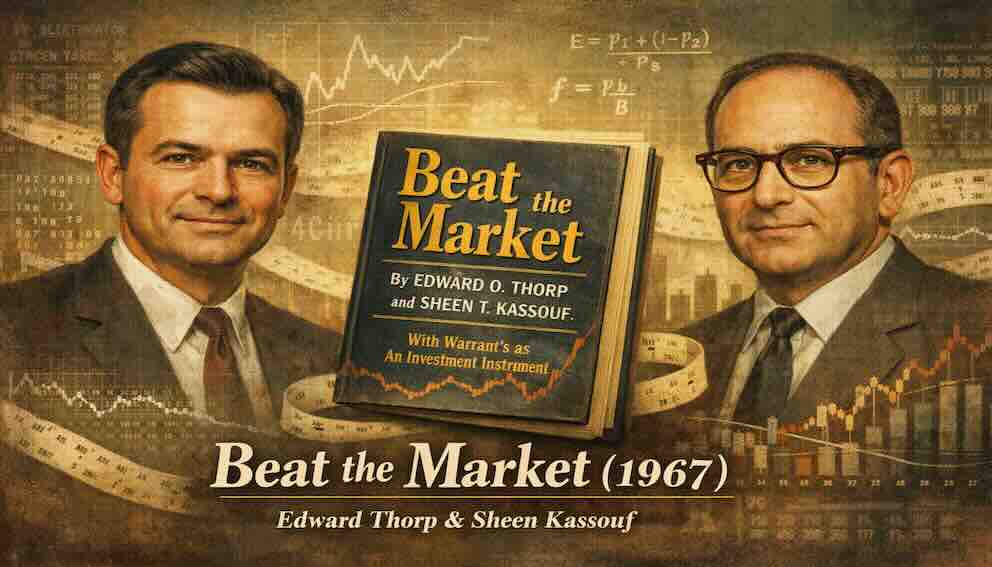
Introduction to the Book
By 1967, Edward Thorp had already accomplished something that mathematicians and gamblers had considered impossible. He had cracked the game of blackjack, developing card-counting techniques that gave players a genuine edge over the casinos. His first book, Beat the Dealer, had become a bestseller and forced Las Vegas to change its rules.
But Thorp had moved on to a larger game.
Wall Street in the 1960s was still a place where investing was guided more by gut feeling than by mathematics. Analysts studied companies, read annual reports, and made judgments based on experience and intuition. The idea that markets could be analyzed quantitatively—that hidden patterns might be discovered through equations—was barely on the horizon.
Thorp, trained as a mathematician and now teaching at the University of California, Irvine, saw something others missed. In the arcane world of stock warrants and convertible securities, he discovered pricing anomalies that could be exploited systematically. Working with economist Sheen Kassouf, he developed a method that allowed investors to construct hedged positions with remarkably low risk.
Beat the Market was the result: a step-by-step explanation of how to identify mispriced warrants, how to hedge them against their underlying stocks, and how to manage the positions over time. The book included actual formulas, worked examples, and records of real trades. It was not theory; it was a manual.
The Men Behind the Book
Edward Thorp was born in Chicago in 1932 and grew up in Southern California. From an early age, he was drawn to puzzles, numbers, and games that rewarded clear thinking. He studied physics at UCLA, then earned a PhD in mathematics. By the late 1950s, he was teaching at MIT, where he began applying probability theory to blackjack.
His transition from gambling to finance was natural. Both domains, he recognized, involved incomplete information, probabilistic outcomes, and the challenge of finding an edge. Thorp approached the stock market the same way he had approached the casino: as a problem to be solved.
Sheen Kassouf was an economist who shared Thorp's interest in applying quantitative methods to markets. Together, they spent years gathering data, testing hypotheses, and refining their strategies. They ran calculations by hand and on early computers, building a system that could identify when warrants were overpriced or underpriced relative to their underlying stocks.
The partnership produced a book that was part mathematics, part investing guide, and part challenge to conventional wisdom. It also produced a friendship and collaboration that would shape the future of quantitative finance.
The Era in Which the Book Was Written
The late 1960s were a strange time for Wall Street. The long post-war boom was still running, but markets were becoming more volatile. The Dow had climbed steadily through much of the decade, then suffered a sharp decline in 1966—a warning of the turbulence to come. Thorp later recalled a wealthy friend, a Los Angeles oil executive, who had grown accustomed to 30 or 40 percent annual returns from speculative stocks. When the market turned, he lost sixty percent of his fortune in a matter of months. The contrast could not have been starker: the speculator's luck ran out, while Thorp's mathematically controlled positions weathered the storm.
Institutional investing was growing. Pension funds, mutual funds, and insurance companies were accumulating massive pools of capital that needed to be managed systematically. Yet the tools for managing that capital were still primitive. Most investing was based on fundamentals—studying companies, reading annual reports, talking to management.
The warrant market, where Thorp and Kassouf found their opportunities, was a backwater. Warrants were long-term options issued by companies, often attached to bonds or preferred stock to make them more attractive to investors. They traded in small volumes, followed by few analysts, and priced inefficiently. One contemporary described warrant trading as "the province of specialists and eccentrics"—a perfect hunting ground for mathematicians.
This was exactly the kind of environment where a systematic approach could thrive. While the rest of Wall Street focused on blue-chip stocks and growth stories, Thorp and Kassouf quietly exploited pricing anomalies that no one else had noticed.
The Architecture of the Book: Thorp and Kassouf's Strategy
Beat the Market is structured as both an explanation and a manual. Thorp and Kassouf walk readers through their discovery, their reasoning, and their methods. The book includes mathematical derivations, practical instructions, and enough detail that a determined reader could actually implement the strategy.
What Is a Warrant?
Before explaining their strategy, Thorp and Kassouf had to explain what they were trading. A warrant is a security issued by a company that gives the holder the right to buy a specified number of shares at a fixed price within a certain time period. Warrants were often attached to bonds or preferred stock to make them more attractive to investors.
The key insight was that warrants were frequently mispriced. Sometimes they traded for more than they could possibly be worth given the underlying stock's price. Sometimes they traded for less. These mispricings created opportunities.
The Valuation Formula
The heart of the book was a formula for calculating what a warrant should be worth. Thorp and Kassouf derived a relationship between the warrant price, the stock price, the exercise price, the time to expiration, and the volatility of the underlying stock.
This formula allowed them to identify warrants that were overpriced or underpriced. When a warrant was overpriced, they could sell it short and buy the underlying stock as a hedge. When a warrant was underpriced, they could buy it and sell the stock short.
The Hedged Position
The brilliance of the strategy was that it eliminated most of the market risk. By holding both sides of the trade—long the undervalued security, short the overvalued one—Thorp and Kassouf created a position that was largely immune to market movements.
If the stock price rose, the long position gained value while the short position lost value, roughly canceling out. If the stock price fell, the reverse happened. The profit came from the mispricing itself, which would correct over time.
To visualize this, imagine two lines on a graph. One line slopes upward—the profit from the long position as the stock rises. The other slopes downward—the loss from the short position. Where they cross is the current stock price. The distance between them represents the mispricing. As the stock moves, the lines move together, but the gap remains. That gap is the profit, waiting to be captured.
Thorp and Kassouf called this a "can't lose" trade—not literally, but as close as anyone had come. The positions had such a large margin of safety that losses were extremely unlikely.
A Concrete Example
Suppose a company's stock is trading at $50. Its warrant, exercisable at $60 for another two years, is trading at $5. Thorp and Kassouf's formula might show that the warrant is worth only $3 based on the stock's volatility and time remaining.
The trade would be: sell short the overpriced warrant at $5, and buy a certain number of shares of the stock as a hedge. If the stock price rises, the warrant price will rise too, but not as much—the short position loses less than the long position gains. If the stock price falls, the warrant falls more, so the short position gains more than the long position loses. Either way, the mispricing eventually corrects, and the profit is realized.
In one documented trade from the book, Thorp and Kassouf identified a warrant for a small utility company trading at $4 when their formula valued it at $2. They sold short the warrant and bought the underlying shares. Within weeks, the market corrected, and they pocketed a near risk-free profit—an event that convinced a skeptical friend, an oil executive, that mathematics could indeed outperform intuition.
The Kelly Criterion
Thorp also introduced readers to the Kelly Criterion, a formula for determining optimal bet sizes when you have an edge. Originally developed by Bell Labs scientist John Kelly for analyzing information transmission, Thorp recognized its application to both gambling and investing.
The Kelly Criterion tells you what fraction of your capital to allocate to each opportunity to maximize long-term growth while avoiding ruin. It became a cornerstone of Thorp's approach and, later, of quantitative finance.
Why Publish?
One of the most famous passages in the book addresses a question readers were surely asking: why would Thorp and Kassouf publish their secrets? Wouldn't that destroy the opportunities they had found?
Their answer was honest and disarmingly simple: "We have moved on to more sophisticated opportunities, and the market will have caught up with these methods by now. Sharing them is no longer a threat, only a lesson." They had developed better strategies and were willing to let the world learn from their earlier work.
Other Insights
Systematic Rules Beat Intuition. Thorp and Kassouf's approach was completely rules-based. They didn't make judgments based on feelings or opinions; they followed their formulas. This discipline was essential to their success.
The Strategies Evolve. The warrant strategies described in the book were not the end of the story. Thorp and Kassouf continued to develop new methods, and the publication of Beat the Market marked a waypoint, not a destination.
Small Edges Add Up. The profit from any single warrant hedge might be modest, but over many positions, the edges compounded. Thorp demonstrated that consistent, disciplined application of a small edge could produce substantial returns.
Risk Control Is Paramount. Throughout the book, Thorp and Kassouf emphasized the importance of managing risk. Their hedged positions were designed to protect against losses, and their position sizing formulas ensured they wouldn't bet too much on any single trade.
How It Changed the World of Finance
The impact of Beat the Market extended far beyond its immediate readership. It planted seeds that would grow into entire fields of quantitative finance.
The Birth of Convertible Arbitrage
The warrant hedging strategy described in the book was the direct ancestor of modern convertible arbitrage. Today, hedge funds around the world trade convertible bonds and their underlying stocks using the same basic logic: find mispricings, hedge the market risk, capture the spread. The tools have grown more sophisticated, but the fundamental insight remains Thorp and Kassouf's.
The Quantitative Mindset
More important than any specific strategy was the way of thinking Thorp and Kassouf demonstrated. They showed that markets could be analyzed mathematically, that patterns could be discovered, that edges could be measured. This mindset—rigorous, systematic, data-driven—became the foundation of quantitative finance.
When the book first appeared, it was met with curiosity and skepticism in equal measure. One prominent investment newsletter dismissed it as "academic theory with no practical application." Another called it "dangerous for the average investor." But among a small group of quantitatively inclined readers, it was a revelation. Here was proof that mathematics could work in markets.
Influence on a Generation
Thorp's work influenced many who would later shape the industry. His books were read by a young Bill Gross, who would become the "bond king" and credit Thorp as an inspiration. A generation of quantitative analysts cut their teeth on Beat the Market, learning that investing could be a science.
The First Quant Hedge Fund
In 1969, two years after Beat the Market appeared, Thorp started managing money professionally. His partnership, Princeton-Newport Partners, became one of the first quantitative hedge funds. Over nearly two decades, it never had a losing year and compounded at remarkable rates—proof that the methods worked not just in theory, but in practice.
Statistical Arbitrage
The warrant strategies led naturally to broader applications. Thorp and his team later developed statistical arbitrage techniques that looked for pricing anomalies across entire baskets of stocks. These methods, refined and extended, became staples of quantitative trading.
The Kelly Criterion in Finance
Thorp's advocacy for the Kelly Criterion introduced a generation of investors to the importance of position sizing. The formula is now widely used in hedge fund management, though often in modified form. It remains one of the most powerful ideas in risk management.
The Madoff Connection
In a bizarre footnote, Thorp's quantitative approach led him to discover that Bernie Madoff's reported returns were mathematically impossible. Years before Madoff's fraud became public, Thorp had concluded that the numbers didn't add up. He recognized that the returns Madoff claimed could not be achieved with the strategies he supposedly used. This was quantitative analysis applied not just to markets, but to detecting fraud—a testament to the power of the mindset Thorp had spent his career developing.
What Still Stands—and What Has Not Survived
What Still Stands
The quantitative mindset. The idea that markets can be analyzed mathematically, that edges can be measured, that discipline matters more than intuition—this is now fundamental to modern finance.
The importance of hedging. Thorp's insight that market risk could be neutralized remains central to many investment strategies.
Position sizing. The Kelly Criterion and its variants are still used by sophisticated investors to manage risk.
Convertible arbitrage. The specific strategy Thorp and Kassouf pioneered is still practiced, though markets have evolved.
The value of systematic rules. The discipline of following a system rather than making emotional decisions is as important as ever.
What Has Not Survived
The specific warrant strategies. The opportunities Thorp and Kassouf exploited are largely gone. Markets became more efficient, competition increased, and the simple mispricings they found no longer exist. As they predicted, the market caught up.
The manual approach. Thorp and Kassouf calculated by hand and with early computers. Today's quantitative trading is done at speeds they could not have imagined.
The transparency. Thorp and Kassouf published their methods because they had moved on. Modern quantitative firms guard their strategies as trade secrets.
The warrant market itself. The market for individual stock warrants is much smaller than it was in the 1960s, replaced by exchange-traded options and other derivatives.
Why This Book Still Matters Today
More than fifty years after its publication, Beat the Market remains essential reading for anyone who wants to understand the origins of quantitative finance.
Consider how money is managed today. Hedge funds employ teams of mathematicians and computer scientists to find patterns in market data. They run simulations, test hypotheses, refine strategies. This is exactly what Thorp and Kassouf did, with 1960s technology.
Consider the concept of market-neutral investing. The idea that you can construct portfolios that are immune to market movements—that profit from mispricings rather than directional bets—traces directly back to Thorp's warrant hedges.
Consider the importance of risk management. Thorp's emphasis on position sizing, on never betting too much, on surviving long enough for edges to compound—these lessons are timeless.
Consider the ethos of systematic investing. Thorp and Kassouf didn't make emotional decisions. They didn't rely on gut feelings. They followed their formulas. This discipline is the foundation of quantitative finance.
Beat the Market is also a reminder that the most powerful ideas often start in obscure places. Thorp found his opportunity not in blue-chip stocks or hot growth stories, but in the overlooked corner of the warrant market. He applied rigorous thinking to a problem others had ignored, and he changed finance as a result.
The book's publication—with its full disclosure of methods—stands as a remarkable act of intellectual generosity. Thorp and Kassouf could have kept their secrets and profited in silence. Instead, they wrote them down, trusting that their next discoveries would be even better.
That is the spirit of science, applied to finance.
Conclusion
Edward Thorp and Sheen Kassouf published Beat the Market in 1967, at a time when Wall Street still ran on intuition and hunches. They had discovered that warrants—obscure securities ignored by most investors—were systematically mispriced. They developed a formula to identify these mispricings and a hedging strategy to exploit them with minimal risk.
The book that emerged was part mathematics, part investing guide, and part revelation. It showed that markets could be understood quantitatively, that edges could be measured, that risk could be controlled. It laid the foundation for convertible arbitrage, statistical arbitrage, and the entire field of quantitative finance.
Thorp went on to manage one of the first quantitative hedge funds, compounding returns at extraordinary rates for nearly two decades. His influence spread through the industry, shaping how generations of investors think about markets.
But the book itself remains the starting point. It is where Thorp and Kassouf wrote it all down—the formulas, the strategies, the reasoning—and trusted that their next discoveries would be even better.
Beat the Market is not a practical guide for today's markets. The specific opportunities it describes are long gone. But as a window into the birth of quantitative finance, as a demonstration of how systematic thinking can uncover hidden opportunities, as a reminder that the most powerful ideas often start in overlooked places—it has no equal.
About Swati Sharma
Lead Editor at MyEyze, Economist & Finance Research WriterSwati Sharma is an economist with a Bachelor’s degree in Economics (Honours), CIPD Level 5 certification, and an MBA, and over 18 years of experience across management consulting, investment, and technology organizations. She specializes in research-driven financial education, focusing on economics, markets, and investor behavior, with a passion for making complex financial concepts clear, accurate, and accessible to a broad audience.
Disclaimer
This article is for educational purposes only and should not be interpreted as financial advice. Readers should consult a qualified financial professional before making investment decisions. Assistance from AI-powered generative tools was taken to format and improve language flow. While we strive for accuracy, this content may contain errors or omissions and should be independently verified.