Tutorial Categories
Last Updated: March 30, 2026 at 17:30
Financial Contagion: A Walk Through the Paper That Mapped How Crises Spread
How Allen and Gale Explained Why Some Shocks Remain Local While Others Topple the System
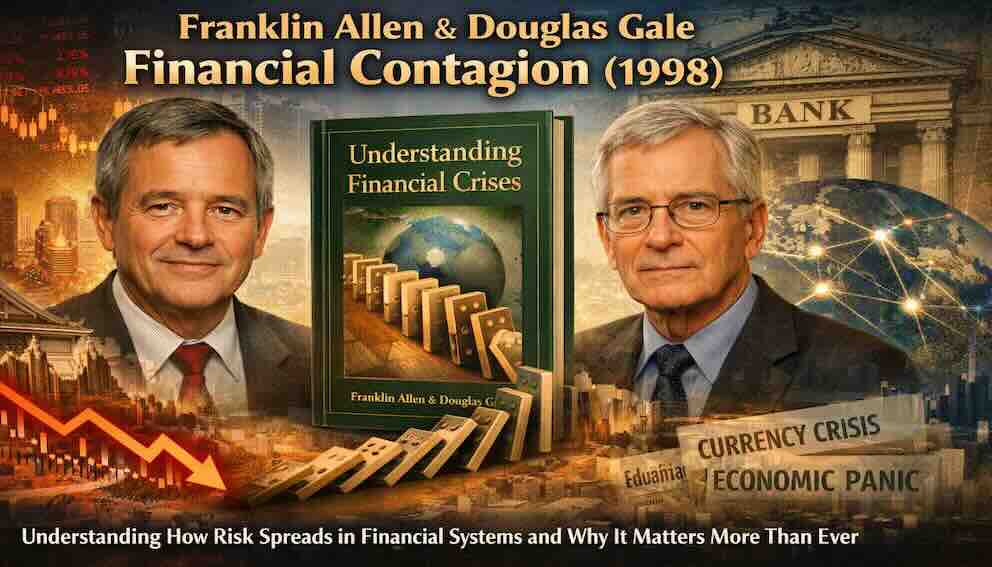
In 2000, Franklin Allen and Douglas Gale published a paper in the Journal of Political Economy that would fundamentally change how scholars and policymakers understand the spread of financial crises. Titled simply "Financial Contagion," it introduced a rigorous framework for analyzing how shocks in one part of the financial system could ripple through interconnected institutions and across borders. The work arrived at a moment when the world was still digesting the Asian financial crisis of 1997–1998—a crisis that had spread from Thailand to Indonesia, Malaysia, South Korea, and beyond with terrifying speed. Allen and Gale provided something the policy world desperately needed: a way to think systematically about how financial systems are connected, where vulnerabilities lie, and why some shocks cascade while others remain contained. Their insights would go on to shape how central banks monitor systemic risk, how regulators design stress tests, and how economists model financial networks. The paper later became the foundation for their 2007 book Understanding Financial Crises, which synthesized their work on this topic with broader research on banking, liquidity, and asset prices.
Introduction to the Paper
The summer of 1997 began quietly enough. Thailand's economy had been growing steadily, its currency pegged to the US dollar, its markets open to foreign capital. International investors had poured money into Bangkok's booming property market and its soaring stock exchange. The country was held up as a model of development—an "Asian tiger" whose success others should emulate.
Then, in July, something broke.
The Thai baht collapsed. Within weeks, the crisis jumped to Indonesia, where the rupiah lost eighty percent of its value. It spread to Malaysia, to the Philippines, to South Korea. Currencies fell. Banks failed. Economies that had been celebrated as miracles found themselves begging for international bailouts. By the end of 1998, the crisis had even reached Russia and Brazil, thousands of miles from where it began.
Watching from the United States, economists Franklin Allen and Douglas Gale saw a pattern that existing theories could not explain. The standard models of financial crises focused on individual banks or individual countries. They explained why a single institution might fail, or why a single currency might come under attack. They did not explain why failures spread.
The speed of the contagion was especially puzzling. Thailand and South Korea had few direct economic links. Their trade with each other was modest. Their financial systems were separate. Yet within months, the crisis had jumped from one to the other. It moved not through obvious channels but through something harder to see: the expectations of investors, the structure of interbank connections, the fragile architecture of global finance.
Allen and Gale set out to build a theory of contagion—the process by which a shock in one part of the financial system propagates to others. Their work drew on network theory, game theory, and the economics of incomplete information. The result was a series of papers that would redefine how economists think about systemic risk.
The 2000 paper "Financial Contagion" in the Journal of Political Economy was the centerpiece of this project. It laid out a simple but powerful model of how financial institutions connected through interbank lending could either share risk or spread disaster, depending on the structure of their connections.
The Authors
Franklin Allen and Douglas Gale were an unlikely pair to become the architects of modern contagion theory.
Allen, a British economist trained at Oxford and Cambridge, had built his early career studying financial innovation and corporate finance. His work was applied, grounded in real markets, and attentive to institutional detail. He was not a theorist in the pure sense; he wanted models that could explain what he saw in the world. Before turning to contagion, he had written extensively on how firms raise capital and how financial systems evolve.
Gale, a Canadian economist who had studied at Cambridge and the London School of Economics, came from a different tradition. He was a theorist's theorist, drawn to the deep structure of economic problems. His early work on banking and liquidity had already established him as one of the most rigorous thinkers in the field. He had spent years developing formal models of financial institutions, asking questions that others had not thought to ask.
Their collaboration began in the 1980s and would span decades. They complemented each other perfectly: Allen's eye for real-world relevance and Gale's taste for theoretical elegance. According to those who knew them, their partnership was marked by intense debates that somehow produced papers neither could have written alone.
In 1997, both attended an academic conference where the emerging Asian crisis was the dominant topic of conversation. The speed of contagion shocked them, as it shocked everyone. But unlike many economists, who saw the crisis as evidence of irrational panic or corrupt crony capitalism, Allen and Gale recognized something else: a structural phenomenon that could be modeled, understood, and perhaps predicted.
That conference conversation, and the questions it raised, set them on the path to their contagion model.
The Era That Produced the Paper
The late 1990s were a time of profound unease in global finance.
The Asian financial crisis had shattered the assumption that emerging markets could grow forever. Investors who had poured money into Thailand, Indonesia, and South Korea fled just as quickly. Currencies that had been stable for years lost half their value in months. Banks that had seemed solid collapsed.
What troubled economists most was the speed and unpredictability of the contagion. Thailand's problems should not, in theory, have affected South Korea. Their economies were different, their trade linkages modest, their financial systems separate. Yet the crisis jumped anyway.
The prevailing theories offered little help. The first-generation crisis models, developed in the wake of Mexico's 1976 and 1982 crises, focused on unsustainable government policies. They explained why a country might run out of foreign reserves. They did not explain why that problem should spread to other countries with entirely different policies.
The second-generation models, developed after Europe's exchange rate mechanism crisis in 1992–1993, introduced the idea of multiple equilibria. They showed that crises could be self-fulfilling—that a country might be forced to devalue simply because investors expected it to. But these models still focused on individual countries in isolation.
No one had a good explanation for contagion across borders.
This was the gap Allen and Gale addressed. They recognized that the old models, useful as they were, missed something essential: the connections between financial institutions. Those connections were invisible in normal times, but in crises they became transmission lines for disaster.
How Allen and Gale Build Their Model: The Architecture of Contagion
The 2000 paper is a masterpiece of economic modeling. Allen and Gale strip away complexity to reveal the essential mechanism driving contagion. The model is elegant, but its implications are profound.
The Basic Setup
Imagine a financial system with four regions. In each region, banks collect deposits from consumers and invest in long-term assets. These assets are productive but illiquid—they cannot be sold quickly without losing value.
But banks also hold deposits in other regions' banks. A bank in Region A might keep some of its funds on deposit with a bank in Region B. A bank in Region B might hold deposits with banks in Regions C and D. This creates a network of interbank claims.
This network serves a useful purpose. If one region experiences unexpectedly high demand for withdrawals, it can draw on its claims on other regions to meet that demand. The interbank connections allow regions to share liquidity risk. In normal times, this makes the system more efficient.
But the same connections that allow risk-sharing can also transmit shocks.
The Mechanism of Contagion
Now suppose one region experiences a shock. Perhaps some of its long-term assets turn out to be worth less than expected—loans go bad, investments fail. To cover its losses, the region's banks must liquidate their claims on other regions.
Those other regions, suddenly facing withdrawals they did not anticipate, may be forced to liquidate their own assets. If they must sell quickly, they may have to accept fire-sale prices. Those fire sales create losses, which may force them to liquidate their claims on still other regions.
The shock propagates through the network.
Allen and Gale's key insight is that the structure of connections matters enormously. Some network structures are robust; others are fragile.
Complete Networks vs. Incomplete Networks
Consider two extreme cases.
In a complete network, every region holds claims on every other region. The interbank connections form a dense web. When a shock hits one region, the burden of meeting its withdrawals is spread evenly across the entire system. Each other region loses a little, but no single region loses enough to fail. The shock is absorbed.
In an incomplete network, regions are connected only in chains. Region A holds claims on Region B. Region B holds claims on Region C. Region C holds claims on Region D. There are no direct connections between A and C, or between B and D.
Now a shock to Region A forces it to liquidate its claims on Region B. Region B, facing unexpected withdrawals, must liquidate its claims on Region C. Region C must liquidate its claims on Region D. The shock cascades down the chain. Each region in turn faces a larger burden than it would in a complete network, because the shock is concentrated rather than spread.
The paper shows that incomplete networks are more prone to contagion. The very structure that seems efficient in normal times—specialized relationships, focused connections—becomes dangerous in crisis.
Why This Matters
This result has profound implications. It means that the stability of a financial system depends not just on the health of individual banks, but on the pattern of connections between them. Two systems with identical banks—same capital, same assets, same liabilities—can have very different levels of systemic risk, depending on how those banks are linked.
It also means that diversification can be a double-edged sword. In normal times, spreading connections across many counterparties reduces risk. But in crises, those same connections can transmit shocks. The paper forces us to confront a tradeoff built into the structure of finance.
Multiple Equilibria: When Crises Become Self-Fulfilling
A second key insight involves the possibility of multiple equilibria. This is a subtle but crucial idea.
In some situations, the same set of fundamentals can produce either stability or crisis, depending on what people expect. If depositors believe that other depositors will leave their money in the bank, they will leave theirs too. The bank survives. If depositors believe that others will run, they will run as well. The bank fails.
This is not irrational panic. It is a rational response to the logic of the situation. Each individual depositor, seeing no reason to be the last one in line, withdraws. Their collective action makes their fears come true.
This insight matters because it means that crises can occur even without any change in underlying conditions. A bank that is fundamentally sound can still fail if enough depositors believe it will. A country with strong policies can still suffer a currency crisis if investors expect one.
For policymakers, this creates both a challenge and an opportunity. The challenge is that vulnerabilities can be invisible until they suddenly become visible. The opportunity is that interventions—lender of last resort facilities, deposit insurance, coordinated guarantees—can shift expectations away from crisis. If people believe the government will act, they may not need to run.
Liquidity and Fire Sales
The paper also emphasizes the central role of liquidity in contagion. When institutions must sell assets quickly, they often cannot get full value. Fire-sale prices create losses. Those losses may force other institutions to sell, creating more fire sales, in a downward spiral.
This mechanism is distinct from solvency. A bank can be perfectly solvent—its assets worth more than its liabilities—and still fail if it cannot convert those assets to cash quickly enough. Liquidity is not just about having enough money; it's about having it when you need it.
Allen and Gale show that fire sales can amplify contagion even in networks that would otherwise be stable. The interaction between network structure and asset prices creates additional channels for crisis propagation.
Information and Uncertainty
Finally, the paper touches on the role of information—or rather, the lack of it. In real-world crises, banks often do not know exactly who is exposed to whom. They cannot trace the web of connections. This uncertainty can itself amplify contagion.
If Bank A does not know whether Bank B is exposed to a troubled institution, it may assume the worst. It may cut off lending to Bank B, even if Bank B is actually healthy. That lending freeze can then become a self-fulfilling prophecy, pushing Bank B toward failure.
This insight anticipates later work on how uncertainty and information asymmetries can magnify financial crises.
Key Insights Flowing from the Model
From this framework, several core ideas emerge:
Financial Systems Are Networks. Banks and other financial institutions are connected through interbank lending, payment systems, and common exposures. These connections create the potential for contagion. You cannot understand systemic risk by looking at banks one by one; you must look at the whole web.
Connections Serve Two Roles. The same interbank links that allow risk-sharing in normal times can transmit shocks in crises. There is a tradeoff built into the structure of the financial system. The very mechanisms that make it efficient also make it fragile.
Network Structure Determines Vulnerability. Complete networks, where every institution is connected to every other, spread shocks broadly but thinly. Incomplete networks, where connections are sparser, can produce cascading failures. The pattern of connections is as important as the health of individual banks.
Small Shocks Can Have Large Effects. Because of network effects, a shock that would be trivial in isolation can propagate through the system and cause widespread damage. Contagion is not about the size of the initial event; it's about how that event moves through the system.
Multiple Equilibria Are Possible. In some situations, the same fundamentals can produce either stability or crisis, depending on expectations. Crises can be self-fulfilling. This means that a system can be vulnerable even when nothing visible is wrong.
Liquidity Is Central. Contagion often operates through liquidity channels. When institutions must sell assets quickly, prices fall, forcing more sales, in a downward spiral. Liquidity is not just about having enough; it's about having it when you need it.
Fire Sales Amplify Shocks. Forced asset sales at depressed prices transmit losses from distressed institutions to otherwise healthy ones that hold similar assets. This creates a second channel of contagion, independent of direct interbank exposures.
Information Matters. Uncertainty about other institutions' exposures can amplify contagion. If banks do not know who is exposed to whom, they may assume the worst, cutting off lending and creating crises where none existed.
Regulation Must Be Systemic. Supervising individual banks is not enough. Regulators must monitor the network as a whole and identify potential transmission channels. The health of the system is not the sum of the health of its parts.
International Coordination Is Essential. Because financial systems cross borders, contagion does as well. No single country can protect itself without international cooperation. A crisis in one country can become a crisis everywhere.
How the Paper Was Received
When "Financial Contagion" appeared in 2000, it was immediately recognized as a major contribution. The paper combined theoretical elegance with obvious real-world relevance. Economists who had struggled to make sense of the Asian crisis now had a framework for thinking about how crises spread.
The paper became a staple of graduate curricula and central bank research departments. Its insights were cited in policy debates about financial stability, bank regulation, and crisis management. Researchers began applying its methods to new contexts—not just banking, but also sovereign debt, currency markets, and trade linkages.
In 2007, Allen and Gale published Understanding Financial Crises, a book that synthesized their work on this topic with their broader research on banking, liquidity, and asset prices. The Clarendon Lectures volume brought their ideas to a wider audience and cemented their status as leading thinkers on financial instability.
How It Changed the World of Finance
The influence of Allen and Gale's work extends across multiple domains.
Central bank monitoring. Before their work, central banks focused primarily on the health of individual institutions. After, they began to develop tools for monitoring systemic risk—the risk that cascading failures could bring down the entire system. The Bank for International Settlements, the European Central Bank, and the Federal Reserve all incorporated network analysis into their surveillance frameworks.
Stress testing. The idea that networks matter led to new forms of stress testing that consider not just how a single bank would fare in a crisis, but how the system as a whole would respond to shocks. The Comprehensive Capital Analysis and Review in the United States and similar exercises in Europe reflect this shift.
Basel regulations. The Basel framework for bank regulation has increasingly incorporated systemic considerations. Capital surcharges for systemically important banks, requirements for stable funding, and limits on interconnectedness all reflect the insights of contagion theory.
Crisis management. During the 2008 global financial crisis, policymakers drew on these ideas as they scrambled to contain contagion. The decision to rescue certain institutions while letting others fail reflected judgments about which failures would propagate through the system. The concept of "too big to fail" is, at its core, a contagion concept.
Research agenda. Allen and Gale's work spawned an entire literature on financial networks, systemic risk, and contagion. Researchers continue to refine and extend their models, applying them to new contexts and testing them against new data.
What Still Stands—and What Has Not Survived
What Still Stands
The network approach is now standard. No serious analysis of financial stability ignores the structure of connections between institutions.
The importance of liquidity is universally recognized. The 2008 crisis demonstrated, once again, that liquidity can evaporate faster than solvency.
Multiple equilibria remain a central concept in understanding crises. The idea that expectations can be self-fulfilling is woven into modern macroeconomics.
The tradeoff between risk-sharing and contagion is understood as a fundamental feature of financial systems.
The need for systemic regulation is now widely accepted. The old approach of supervising banks one by one is recognized as inadequate.
What Has Not Survived
The specific models have been refined and extended. Later work introduced more complex network structures, endogenous bank behavior, and richer treatments of information.
The assumption of symmetric information has been relaxed. Real-world contagion often involves uncertainty about who is exposed to whom.
The focus on pure interbank lending has expanded to include other channels of contagion: common asset holdings, payment systems, derivative exposures.
The policy prescriptions have evolved as regulators have gained experience with systemic risk management.
Why This Paper Still Matters Today
More than two decades after its publication, Allen and Gale's work on financial contagion remains essential reading for anyone who wants to understand how crises spread.
Consider the 2008 global financial crisis. When Lehman Brothers failed, the shock propagated through the financial system in ways that surprised even sophisticated observers. Counterparties faced losses. Money market funds broke the buck. Credit markets froze. The cascade was exactly the kind of phenomenon Allen and Gale had modeled. Their framework helped explain why a single failure could bring the system to its knees.
Consider the European sovereign debt crisis. When Greece's problems emerged, they spread to Ireland, Portugal, Spain, and Italy—not because those countries shared Greece's fiscal problems, but because they were connected through bank exposures and market confidence. The network structure of European finance determined who was vulnerable and who was safe.
Consider the ongoing evolution of financial regulation. The Basel III framework, with its capital surcharges for systemically important banks, its liquidity coverage ratios, and its stress testing requirements, reflects the influence of contagion theory. Regulators now explicitly consider how shocks might propagate through the system.
Consider the challenges of cryptocurrencies and decentralized finance. These new systems create new forms of interconnectedness and new potential for contagion. When a crypto exchange fails, when a stablecoin depegs, when a lending protocol collapses—these events propagate through networks that are not yet well understood. The tools Allen and Gale developed for analyzing traditional financial networks apply here as well.
Consider climate risk. As the world shifts toward a low-carbon economy, certain assets will lose value. Those losses will be concentrated in the portfolios of banks, insurers, and investors. The structure of connections between these institutions will determine whether the transition is smooth or crisis-ridden.
Allen and Gale's great achievement was to show that contagion is not mysterious. It follows predictable patterns, depends on identifiable structures, and can be analyzed with the tools of economic theory. They gave policymakers a language for talking about systemic risk and a framework for thinking about how to manage it.
In a world where financial systems grow more interconnected by the day, where new technologies create new linkages, where climate change and geopolitical shifts threaten to generate new shocks—that achievement has never been more relevant.
Conclusion
Franklin Allen and Douglas Gale published "Financial Contagion" in 2000, at a moment when the world was still trying to understand why the Asian financial crisis had spread so far so fast. They offered a rigorous framework for analyzing how shocks propagate through interconnected financial systems.
Their model showed that the structure of connections matters. Some networks share risk; others transmit disaster. They showed that multiple equilibria are possible—that crises can be self-fulfilling, driven by expectations rather than fundamentals. They showed that liquidity, fire sales, and information all play roles in the spread of contagion.
The paper became a classic, cited by economists, studied by regulators, and applied by policymakers. Its insights shaped the response to the 2008 crisis and the evolution of financial regulation that followed. It spawned an entire literature and influenced how central banks monitor systemic risk.
But the paper is more than a historical artifact. It is a way of thinking. It teaches us to look beyond individual institutions to the connections between them. It teaches us that small shocks can have large effects. It teaches us that stability depends not just on the health of each bank, but on the structure of the system as a whole.
That lesson is timeless. In a world of global finance, interconnected markets, and complex institutions, understanding contagion is not optional. It is essential.
About Swati Sharma
Lead Editor at MyEyze, Economist & Finance Research WriterSwati Sharma is an economist with a Bachelor’s degree in Economics (Honours), CIPD Level 5 certification, and an MBA, and over 18 years of experience across management consulting, investment, and technology organizations. She specializes in research-driven financial education, focusing on economics, markets, and investor behavior, with a passion for making complex financial concepts clear, accurate, and accessible to a broad audience.
Disclaimer
This article is for educational purposes only and should not be interpreted as financial advice. Readers should consult a qualified financial professional before making investment decisions. Assistance from AI-powered generative tools was taken to format and improve language flow. While we strive for accuracy, this content may contain errors or omissions and should be independently verified.