
Tutorial Categories
Last Updated: March 30, 2026 at 17:30
Fooled by Randomness: Understanding How Luck Masquerades as Skill in Markets and Life
Nassim Nicholas Taleb's Guide to Survivorship Bias, the Narrative Fallacy, and Thriving in a World of Uncertainty
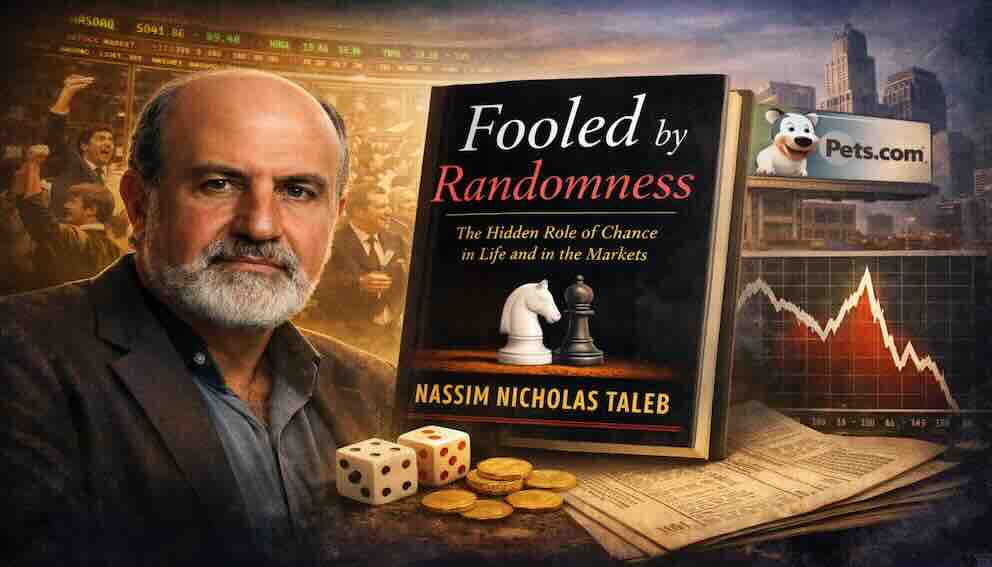
In 2001, a former options trader named Nassim Nicholas Taleb published a book that would forever change how investors, traders, and thinkers understand the role of luck in human affairs. Fooled by Randomness arrived at the peak of the dot-com boom, when the financial world was drunk on its own success and convinced that a new era of prosperity had arrived. Taleb offered a sobering counter-narrative: much of what looked like skill was actually luck, many of the wealthy were simply the winners of a cosmic coin flip, and the stories we tell ourselves about success are largely illusions. Drawing on probability theory, behavioral psychology, and his own years on trading floors, Taleb wove together a meditation on uncertainty that was at once deeply intellectual and urgently practical. The book did not just teach readers about randomness; it taught them to see the world differently—to question narratives, to doubt success stories, and to recognize that the future is far more unpredictable than we imagine. This tutorial focuses specifically on the ideas introduced in Fooled by Randomness, the book that launched Taleb's career and set the stage for his later work.
Introduction to the Book
Imagine two traders. Both start with the same capital, the same information, the same access to markets. One makes a series of bold bets and ends the year with a fifty percent return. The other plays it safe and ends flat. Who is the better trader?
Conventional wisdom says the first. He had vision. He took calculated risks. He knew something others didn't.
But what if his success was simply luck? What if he flipped a coin and happened to land on heads five times in a row? What if the second trader was actually more skilled, but the randomness of markets hid his ability?
This is the question at the heart of Fooled by Randomness. Nassim Taleb asks us to consider that much of what we attribute to skill, talent, and foresight is actually the result of chance. The successful trader, the star CEO, the hedge fund wizard—they may be no more skilled than their less celebrated peers. They may simply be the lucky survivors of a process that eliminates most participants.
The book is not a dry statistical treatise. It is a collection of essays, anecdotes, and reflections, drawing on Taleb's years as a trader, his reading of philosophy and history, and his deep engagement with probability theory. It ranges from the trading floors of New York to the casinos of Monte Carlo, from ancient philosophy to modern behavioral finance. It is personal, opinionated, and often funny. And it is driven by a single, unsettling idea: randomness is far more powerful than we think, and we are far more fooled by it than we realize.
The Man Behind the Book: Nassim Taleb's Unusual Path
Nassim Nicholas Taleb was born in 1960 in Amioun, Lebanon, into a family of Greek Orthodox intellectuals. The civil war that erupted in 1975 scattered his family and disrupted his education, forcing him to navigate a world where order could dissolve into chaos without warning. This early experience of unpredictability would shape his thinking for decades.
He studied mathematics and philosophy in Paris, then moved to the United States for an MBA and a PhD in management science. But his real education came in the financial markets. Taleb spent years as a trader, working on options desks in New York and London. He watched markets soar and crash, saw traders rise and fall, and observed firsthand how randomness could make geniuses of fools and fools of geniuses.
Taleb was never a conventional trader. He was skeptical of the mathematical models that dominated finance, suspicious of the narratives that traders told about their success, and acutely aware of the role of luck in his own career. He began writing essays and articles that would eventually become Fooled by Randomness, blending his experiences on trading floors with his reading of philosophy and probability.
The book made him famous, but it also made him controversial. His sharp critiques of established figures, his refusal to soften his arguments, and his willingness to call out what he saw as intellectual dishonesty earned him admirers and enemies in equal measure. But in Fooled by Randomness, his voice was still fresh, his arguments still taking shape. The ideas that would later become The Black Swan and Antifragile are here in embryonic form, but the focus remains tightly on the problem of randomness in markets and in life.
The Era That Produced the Book: The Dot-Com Boom
To understand why Fooled by Randomness landed with such force, you have to understand the world of the late 1990s.
The stock market was on a historic run. Technology stocks were doubling and tripling in value. Day traders were quitting their jobs to play the markets from home. CNBC was on every screen, and everyone seemed to have a story about someone who had gotten rich on the latest initial public offering.
Consider Pets.com. Launched with great fanfare in 1998, it raised millions in its IPO, spent lavishly on advertising, and became a symbol of the new economy. Its stock price soared. Its founder was celebrated as a visionary. By 2000, it was bankrupt. The vision had evaporated. The genius was revealed to be ordinary.
Or consider Long-Term Capital Management, the hedge fund run by Nobel laureates and celebrated as the smartest money on Wall Street. In 1998, it lost billions in a matter of weeks, requiring a Federal Reserve–brokered bailout to prevent systemic collapse. The smartest guys in the room had been fooled by randomness.
The prevailing narrative was that a new era had arrived. The old rules no longer applied. The internet was transforming everything, and those who understood it were making fortunes. Success was attributed to vision, intelligence, and foresight. The winners were celebrated as geniuses.
Taleb looked at this spectacle and saw something else. He saw randomness. He saw that for every successful tech entrepreneur, there were thousands who had tried and failed. He saw that the same forces that had produced the boom could just as easily produce a bust. He saw that the stories being told about success were narratives imposed after the fact, not explanations of what had actually happened.
When the dot-com bubble burst in 2000, Taleb's arguments suddenly seemed prophetic. The geniuses of the 1990s were revealed to be ordinary mortals after all. The fortunes that had been made evaporated. And the world was left to wonder: had any of it ever been real?
The Architecture of the Book: How Taleb Builds His Argument
Fooled by Randomness is not a linear argument in the traditional sense. Taleb writes in essays, anecdotes, and reflections, circling around his themes from different angles. But beneath the surface, a coherent structure emerges. Each chapter introduces a concept, illustrates it with stories, and then shows how it applies to markets and life. The effect is cumulative: by the end, the reader has been equipped with a new way of seeing.
The Problem of Luck
Taleb begins by posing a question that most of us never think to ask: how can we tell skill from luck? In domains where randomness plays a large role—financial markets, for example—the two are easily confused. A trader who makes money for five years in a row might be brilliant, or might simply be the beneficiary of a long winning streak. The problem is that the results look the same either way.
This is the central puzzle of the book. Taleb does not offer a simple solution, but he does offer a way of thinking. He encourages readers to consider alternative histories—the paths not taken, the outcomes that could have happened but didn't. If a trader's strategy would have failed under slightly different conditions, then his success is fragile. It may be luck, not skill.
This insight has a practical edge. Before trusting a successful investor or fund manager, we should ask: how many others tried the same approach and failed? The answer is almost always hidden from view.
Survivorship Bias
Which brings us to one of the most powerful concepts in the book: survivorship bias. We see only the winners. The losers have disappeared from view. This creates a distorted picture of reality.
The mathematician Émile Borel first popularized a famous thought experiment in 1913: if you had an infinite number of monkeys typing randomly on typewriters for an infinite amount of time, one of them would eventually produce the complete works of Shakespeare. The statement is mathematically true, but it relies on infinity—a concept that has little to do with our finite world.
Taleb adapts this idea to make a different point. He asks us to imagine that among this infinite sea of monkeys, one eventually produces an exact copy of Homer's Iliad. Now that we have found this "genius" monkey, would any rational person bet their life savings that this same monkey will next produce The Odyssey? Of course not. The monkey's past success was a statistical fluke, not evidence of skill. But in financial markets, we do exactly this. We celebrate the few traders who succeed, ignoring the many who failed. We build narratives around their brilliance, their discipline, their unique insights. We forget that with enough traders, some will succeed by chance alone. Their past performance tells us little about their future results.
Taleb drives this point home with a vivid image. Imagine a population of traders, each flipping a coin. After a few rounds, some will have flipped all heads. They will be hailed as geniuses. They will write books, give speeches, and manage other people's money. But they are no more skilled than anyone else. They are simply lucky.
The lesson is not that skill never matters. It is that we cannot tell skill from luck by looking only at outcomes. We have to look at the process, at the underlying probabilities, at the unseen failures. And we have to be humble about what we think we know.
The Narrative Fallacy
Humans are storytelling animals. We crave explanations. When something happens, we want to know why. This is the narrative fallacy: our tendency to impose causal stories on random events.
Taleb illustrates this with a simple thought experiment. Imagine a sequence of coin flips: heads, tails, heads, heads, tails. A narrative thinker might see patterns, might invent reasons for each outcome. But the sequence is random. There is no pattern to explain.
In financial markets, this fallacy is everywhere. When a stock rises, analysts invent reasons: strong earnings, new products, favorable regulations. When it falls, they invent other reasons: weak guidance, competitive threats, macroeconomic concerns. But much of the movement is random noise. The narratives are fictions.
This is not harmless entertainment. These fictions shape decisions. They lead us to believe we understand what we do not. They give us a false sense of control. The antidote is to be skeptical of every story, especially the ones that make the most sense. The neat narrative is often the one that is most wrong.
The Problem with Normal Distributions
Many financial models assume that price changes follow a normal distribution—the familiar bell curve. In this mathematical world, extreme events are possible in theory but so vanishingly rare that they can be treated as irrelevant for practical purposes. A six-standard-deviation move, according to these models, should happen once in several million years.
Taleb argues that this assumption is not just wrong but dangerously wrong. Real markets exhibit what statisticians call fat tails: extreme events occur far more often than the bell curve predicts. Financial crises, market crashes, and sudden spikes in volatility are not million-to-one anomalies. The 1987 crash, the 1998 Long-Term Capital Management collapse, the 2000 dot-com bust—these happen regularly enough that any model ignoring them is a hazard to those who rely on it.
This matters because most risk-management systems are built on these flawed assumptions. They tell traders and investors that certain losses are impossible, when in fact they are merely improbable. When the improbable happens, the models fail catastrophically.
The practical implication is straightforward: do not assume that the future will look like the past. Do not assume that the models capture all possibilities. Prepare for the unexpected. Build margin into your plans. Avoid excessive leverage. The goal is not to predict extreme events but to survive them.
Emotional Biases
Taleb also explores the emotional dimension of randomness. Humans are not rational calculators. We are driven by fear, greed, pride, and regret. These emotions distort our perception of risk and reward.
He draws on his own experience as a trader, describing the emotional roller coaster of gains and losses. He notes that the pain of losing is far more intense than the pleasure of winning—a phenomenon that psychologists call loss aversion. This asymmetry leads traders to make irrational decisions, holding losing positions too long and selling winning positions too soon.
The trader who has just lost money takes reckless risks to recover. The trader who has just made money becomes overconfident and stops respecting the market. These emotional dynamics amplify the effects of randomness. They turn lucky streaks into disasters and unlucky streaks into panics.
Understanding this about ourselves is the first step to counteracting it. If we know we are prone to loss aversion, we can build systems that force us to behave rationally—stop-losses, position limits, pre-commitment strategies.
Practical Skepticism
Throughout the book, Taleb advocates for a stance of practical skepticism. He urges readers to question conventional wisdom, to doubt success stories, to be wary of narratives. He is not arguing that skill never matters, only that it is harder to identify than we think.
This skepticism has practical implications. In investing, it suggests humility. If you cannot distinguish skill from luck, you should be cautious about attributing your own success to talent. You should diversify, manage risk, and prepare for the unexpected.
In evaluating others, it suggests looking for the unseen failures. The trader who quietly manages risk may be more skilled than the flamboyant star. The investor who avoids the hottest trends may outperform over time. The stories we hear are about the winners; the truer story is often told by those we never hear from.
A Concrete Example from the Era
In the late 1990s, a young trader named Victor Niederhoffer was one of the most celebrated investors on Wall Street. He had written books, managed billions, and been featured in financial publications as a genius. His returns were spectacular. His strategies seemed flawless.
Then came 1997. A series of bad bets wiped out his fund. Niederhoffer lost everything—his investors' money, his own fortune, his reputation. The genius was revealed to be mortal.
Taleb uses stories like this to illustrate his central point. Niederhoffer may have been skilled, but he was also lucky. The luck ran out, and the skill was no longer visible. The same randomness that had made him famous had also made him vulnerable.
The lesson is not that Niederhoffer was a fraud. It is that we cannot tell, from the outside, how much of his success was skill and how much was luck. And neither could he. That is the problem of randomness.
Through these concepts—alternative histories, survivorship bias, the narrative fallacy, fat tails, emotional biases, practical skepticism—Taleb builds a coherent framework for thinking about uncertainty. Each concept reinforces the others. Each points toward the same conclusion: we are fooled by randomness, but we do not have to be. By understanding how we are fooled, we can begin to see more clearly.
How the Book Was Received
When Fooled by Randomness first appeared in 2001, it did not become an immediate bestseller, but it quickly gained a devoted following among traders, investors, and thinkers. Its blend of intellectual rigor and personal storytelling was unlike anything else in the finance genre.
The timing was perfect. The dot-com bubble had just burst, and the world was suddenly receptive to arguments about the role of luck in financial success. Taleb's critiques of the financial establishment, his skepticism toward conventional wisdom, and his willingness to name names made the book controversial but also compelling.
Academics appreciated the engagement with probability theory and behavioral psychology. Practitioners appreciated the practical insights drawn from real trading experience. Philosophers appreciated the engagement with ideas about knowledge, uncertainty, and the limits of human understanding.
Critics, however, noted that Taleb's style could be abrasive, his examples sometimes anecdotal rather than rigorously statistical. Some argued that he overstated the role of randomness and understated the role of genuine skill. Others pointed out that his own success as a trader and author could itself be subject to the same randomness he described.
These critiques have merit, but they do not diminish the book's central contribution. Taleb forced a conversation that needed to happen. He made it impossible to ignore the role of luck in markets and in life.
What the Book Does Not Address
No book can do everything. Fooled by Randomness is brilliant at diagnosing the problem of randomness but offers less guidance on solutions. Taleb tells us that we are fooled by randomness, but he does not always tell us what to do about it.
Later books—The Black Swan, Antifragile, Skin in the Game—would fill this gap, offering frameworks for thriving in a world of uncertainty. But in Fooled by Randomness, the focus remains on the diagnosis. The cure would come later.
Readers should also note that Taleb's arguments are most powerful in domains where randomness dominates—financial markets, for example. In domains where skill plays a larger role—surgery, athletics, craftsmanship—his framework applies less directly. The balance between luck and skill varies across fields, and Taleb's emphasis on randomness should not be taken as a universal truth.
What Still Stands—and What Has Not Survived
Nearly a quarter century after its publication, many of Taleb's insights remain vital, while others have been refined or debated.
What Still Stands
The problem of distinguishing skill from luck remains central to investing and decision-making. No serious investor ignores it.
Survivorship bias is now widely recognized as a pitfall in analysis. Researchers and practitioners actively work to account for it.
The narrative fallacy is understood as a fundamental feature of human cognition. Behavioral economics has documented countless examples of our tendency to impose stories on randomness.
The existence of fat tails in financial markets is now broadly accepted. The 2008 crisis and other events have confirmed that extreme outcomes are more common than normal distributions predict.
The importance of humility in the face of uncertainty is widely acknowledged. Overconfidence is recognized as a dangerous flaw.
What Has Not Survived
Some of Taleb's specific critiques of individuals and institutions were tied to particular moments in time. The names may fade, but the principles remain.
The sharp distinction between skill and luck has been nuanced by later research. In many domains, skill and luck interact in complex ways.
The emphasis on randomness sometimes leads readers to underestimate the role of genuine skill. Taleb himself acknowledges this, but readers can overcorrect.
Some of the mathematical details have been refined by later work. The literature on extreme value theory and tail risk has advanced since 2001.
Why This Book Still Matters Today
More than twenty years after its publication, Fooled by Randomness remains essential reading for anyone who wants to understand how luck and skill shape our lives.
In investing, the lessons land hardest. Every day, fund managers report their returns. Every day, investors decide where to put their money. Every day, stories are told about why one strategy worked and another failed. Taleb's framework provides a lens for seeing through these narratives, for distinguishing signal from noise, for recognizing that much of what looks like skill is actually luck.
The same dynamics play out in business. Entrepreneurs succeed and fail. Companies rise and fall. The stories we tell about these events are often narratives imposed after the fact. Taleb encourages us to consider the role of chance, to imagine the alternative histories that might have unfolded, to be skeptical of easy explanations.
And then there is the personal. The career you have, the relationships you value, the successes you celebrate—all are shaped by randomness. This is not a counsel of despair. It is an invitation to humility, to gratitude, to awareness. The recognition of luck does not diminish achievement; it places it in perspective.
Taleb's great achievement in Fooled by Randomness was to make these ideas accessible, to weave them into stories and anecdotes that stick in the mind. He did not invent the concepts of survivorship bias or narrative fallacy. But he brought them to life, showed how they operate in the real world, and gave readers a way of seeing that they could carry with them.
The later books would expand and deepen these ideas, but Fooled by Randomness remains the essential starting point. It is where Taleb first articulated his vision, where he first challenged readers to question their assumptions, where he first showed that randomness is not just a mathematical curiosity but a force that shapes every aspect of our lives.
Lessons You Can Apply Today
While Fooled by Randomness is filled with abstract ideas, it also offers practical guidance for anyone navigating uncertainty.
In investing: Diversify across strategies and asset classes. Be skeptical of fund managers with hot streaks. Remember that past performance does not guarantee future results, especially when randomness is involved.
In career decisions: Recognize that success is partly luck. Be humble about your own achievements and generous in acknowledging the role of chance. When you fail, don't assume it was entirely your fault; when you succeed, don't assume it was entirely your merit.
In decision-making: Consider alternative histories. Before acting, ask yourself: what could go wrong? How would this decision look if the randomness went against me? This simple mental exercise can reveal hidden vulnerabilities.
In evaluating others: Look for the unseen failures. When you read about a successful entrepreneur or investor, remember that for every success story, there are thousands who tried and failed. The survivors are not necessarily the most skilled; they are often the luckiest.
In building resilience: Prepare for the unexpected. Since extreme events happen more often than models predict, build margin into your plans. Avoid excessive leverage. Keep reserves. The goal is not to predict black swans but to survive them.
Conclusion
Nassim Taleb published Fooled by Randomness in 2001, at a moment when the financial world was recovering from the dot-com crash and beginning to question its assumptions. The book was a product of its time, but its insights are timeless.
Taleb showed that much of what we call skill is actually luck. He showed that the stories we tell about success are often fictions. He showed that the models we use to manage risk are often blind to the extremes that matter most. He showed that humility, skepticism, and awareness are not just philosophical virtues but practical necessities.
The book did not offer easy answers. It did not provide a formula for beating the market or a system for predicting the future. It offered something more valuable: a way of thinking. It taught readers to question narratives, to imagine alternative histories, to recognize the role of chance in every outcome.
That is why Fooled by Randomness still matters. Not because it has all the answers, but because it asks the right questions. Not because it eliminates uncertainty, but because it helps us live with it.
In a world where randomness is everywhere, where luck masquerades as skill and narratives obscure reality, Taleb's voice remains essential. He reminds us that the future is unpredictable, that success is fragile, that humility is the only sensible response to the chaos of existence.
And that, perhaps, is the most important lesson of all.
About Swati Sharma
Lead Editor at MyEyze, Economist & Finance Research WriterSwati Sharma is an economist with a Bachelor’s degree in Economics (Honours), CIPD Level 5 certification, and an MBA, and over 18 years of experience across management consulting, investment, and technology organizations. She specializes in research-driven financial education, focusing on economics, markets, and investor behavior, with a passion for making complex financial concepts clear, accurate, and accessible to a broad audience.
Disclaimer
This article is for educational purposes only and should not be interpreted as financial advice. Readers should consult a qualified financial professional before making investment decisions. Assistance from AI-powered generative tools was taken to format and improve language flow. While we strive for accuracy, this content may contain errors or omissions and should be independently verified.