
Tutorial Categories
Last Updated: March 28, 2026 at 15:30
Principles of Political Economy and Taxation: A Walk Through the Book That Explained Why Trade Benefits Everyone
How Ricardo Discovered Comparative Advantage and Changed How We Think About Global Commerce
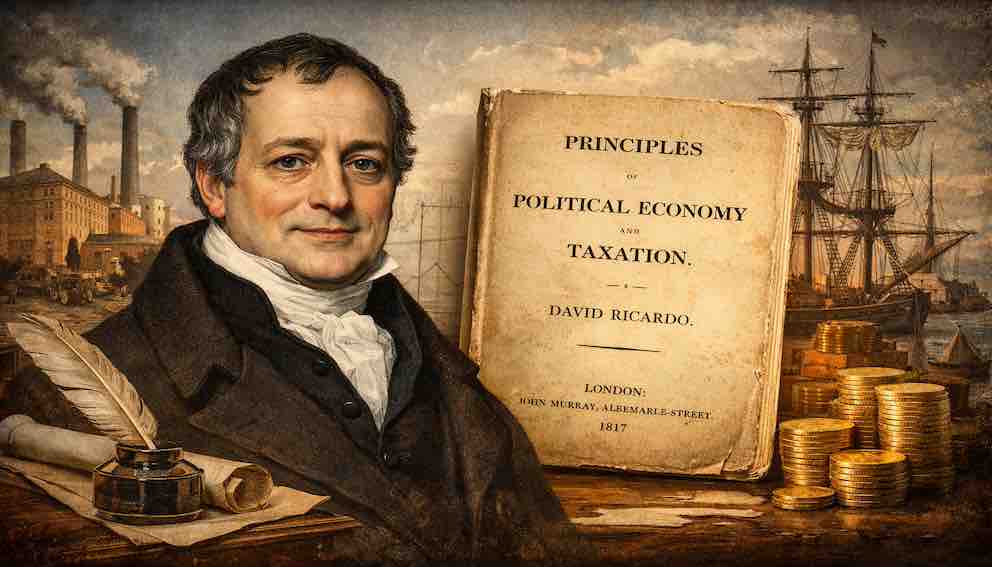
Published in 1817, Principles of Political Economy and Taxation by David Ricardo is one of the most influential books ever written in the history of economics and finance. Ricardo introduced the revolutionary idea of comparative advantage, explaining why countries benefit from trade even when one nation is better at producing everything. The book also explored how wages, profits, rents, and taxes shape the distribution of wealth in an economy. Written during the economic upheaval of the early Industrial Revolution, Ricardo's ideas reshaped how economists and policymakers understood markets, trade, and economic growth. More than two centuries later, many of the foundations of modern economic theory still trace back to this remarkable work.
Why This Tutorial Matters
For students, Ricardo is simply unavoidable. Open any economics textbook and you will find comparative advantage within the first few hundred pages. Sit for any major exam and a question about trade and opportunity cost will appear. Not sometimes but regularly. Understanding his logic is the starting point for thinking systematically about trade, value, and choice.
For finance and economics professionals, his presence is quieter but no less foundational. Every time you encounter a debate about tariffs, every analysis of who wins and loses from trade, every discussion of how growth gets distributed through an economy—these are conversations Ricardo started. The terms have changed, the data is richer, but the questions remain his.
For investors, his value is different. He provides a lens for seeing where returns actually flow. His analysis of rent—who captures value from scarce assets—maps directly onto modern markets. Land, intellectual property, network effects, regulatory advantages: these are all forms of the same dynamic he identified two centuries ago.
This tutorial is written for all three. Each section can be read on its own. What you do not need now will be waiting when you are ready.
Introduction to the Book
Imagine walking through London in 1817.
Smoke pours from factory chimneys. Horse-drawn carriages clog the streets. The clatter of machinery echoes through neighborhoods that were quiet farmland a generation ago. The Industrial Revolution is transforming everything.
Fortunes are being made overnight.
And yet, steps away from the grand townhouses of merchant princes, children with hollow eyes beg for bread.
Something strange was happening. Britain was becoming richer as a nation, yet vast numbers of its people remained desperately poor. Landlords grew fat on rising rents while factory workers struggled to afford bread. New machines threw skilled artisans out of work. Trade policies enriched some interests while strangling others.
Parliamentarians, merchants, philosophers—all were asking the same urgent questions:
Why do some grow wealthy from economic progress while others sink deeper into poverty?
Why do wages seem stuck while landlords grow richer without lifting a finger?
How can government tax fairly without strangling the economy that creates wealth?
Into this debate stepped a man who was not an academic, not a philosopher, not a politician—but a stockbroker who had made his fortune in the City of London. His name was David Ricardo, and the book he published in 1817 would fundamentally change how humanity understands economics.
Principles of Political Economy and Taxation did something revolutionary: instead of treating economics as moral philosophy or political argument, Ricardo approached it as a system of logical principles. He built models in his mind. He traced cause and effect. He found the hidden machinery beneath the visible chaos of markets, wages, and trade.
The result shaped economic thinking for the next two centuries.
The Man Behind the Book: David Ricardo
The Stock Exchange, 1793
A young man of twenty-one stands on the trading floor of the London Stock Exchange. He has been here since fourteen, learning from his father, a successful stockbroker from a Portuguese-Jewish merchant family.
His path seems fixed. He will marry within his community, inherit the business, live comfortably among London's prosperous Sephardic merchants.
Then he fell in love with a Quaker named Abigail Delvalle.
When he married her, his orthodox Jewish family reacted with the severity of their time. They cut him off completely. No inheritance. No business partnership. No support. At twenty-one, he found himself with nothing—no wealth, no degree, no connections. He did not fold. He assessed his situation coldly—the way he had learned on the trading floor—and went to work.
Using the reputation built during years with his father, Ricardo began trading on his own account. He was meticulous, disciplined, and possessed an uncanny ability to analyze complex situations and identify essential forces. Within a few years, he had rebuilt his fortune. Within a decade, he was one of the wealthiest stockbrokers in Britain.
The Accidental Economist
On holiday in Bath in 1799, Ricardo picked up Adam Smith's The Wealth of Nations. Perhaps it was leisure or perhaps his restless mind needed stimulation beyond daily markets. Whatever the reason, the book seized him.
Smith's ideas sparked something. Here was the same systematic thinking Ricardo applied to finance, but applied to the entire economy. He began writing essays. He corresponded with leading intellectuals—Thomas Malthus, James Mill, Jeremy Bentham. These men, astonished to find a stockbroker who could match them in analytical rigor, welcomed him into their circles.
James Mill became a close friend and intellectual collaborator. It was Mill who finally pushed Ricardo to write systematically.
"Ricardo," Mill reportedly told him, "you must write a book. You have the clearest head of any man I know for these subjects."
The result, in 1817, was Principles of Political Economy and Taxation.
What makes this story remarkable is not that a stockbroker became history's great economist. It is that the qualities making Ricardo successful in finance—clear analysis, willingness to follow logic wherever it led, ability to see through complexity—were precisely what made his economics so powerful.
He was not trained as an economist. Perhaps that was exactly why he could see what others missed.
The World Ricardo Wrote In
To understand Ricardo's ideas, step into his world. It was transforming so rapidly that people felt the ground shifting beneath their feet.
The Industrial Revolution
When Ricardo was born in 1772, Britain was largely agricultural. Most people lived in villages and worked the land. By 1817, the landscape had changed forever.
Factories filled northern cities. Steam engines pumped mines and drove textile mills. Canals cut through countryside, carrying coal and finished goods. Productivity soared. Goods once made by hand in days could now be produced in hours.
But the revolution was not kind to everyone.
Agricultural laborers, pushed off common lands by enclosure acts, flooded into cities desperate for work. They found factory jobs paying barely enough to survive—often not enough. Men, women, and children worked fourteen-hour days in horrific conditions. Industrial slums were overcrowded and disease-ridden.
In the countryside, landowners grew richer. Demand for food from exploding urban populations drove up agricultural prices. Landlords raised rents. Farmers leasing land struggled to keep up.
Wealth alongside poverty. Progress alongside suffering. New fortunes alongside old misery.
The Corn Laws
As if economic transformation weren't enough, Britain had spent two decades at war with Napoleonic France. The wars disrupted trade and drove up food prices dramatically.
When peace returned, British landowners faced a problem. Cheap grain from continental Europe threatened to flood the market and drive down prices. Lower grain prices meant lower rents—and landowners controlled Parliament. So in 1815, they passed the Corn Laws, a set of tariffs designed to keep foreign grain out.
The mechanism was straightforward. When grain imports were restricted, domestic prices stayed high. High grain prices meant bread cost more. Workers, who spent most of their wages on food, had no choice but to pay. Employers, in turn, had to raise wages to keep workers alive. Landowners collected higher rents from tenant farmers benefiting from protected prices. Everyone else—workers and industrial capitalists alike—absorbed the cost.
Critics saw the Corn Laws for what they were: a wealth transfer from the poor and manufacturing classes to the landed aristocracy. But landowners controlled Parliament. The laws stayed.
The Intellectual Climate
This was a time of intellectual ferment. Adam Smith's Wealth of Nations (1776) had laid foundations for classical economics. Thomas Malthus's Essay on Population (1798) argued that population growth would always outstrip food production, condemning most to subsistence living.
Thinkers across Europe wrestled with industrialization, trade, and growth. Old certainties were gone. New ones had not yet crystallized.
Into this debate stepped Ricardo— with cold, clear analysis of how the economic system actually worked.
Key Ideas from the Book
Principles is not easy reading. Its prose is dense, arguments tightly woven, examples sometimes abstract. But beneath the challenging surface lie ideas of startling power.
1. The Theory of Comparative Advantage
This idea made Ricardo immortal.
Before Ricardo, most thought about trade simply: if one country could produce something more cheaply than another, it should produce and export it. If not, import it. Obvious, even today.
Ricardo showed this intuition is wrong.
Here's his argument.
Imagine two countries: England and Portugal. Two goods: cloth and wine. Portugal can produce both more efficiently than England. Common sense says Portugal should produce everything itself. Why trade with a less efficient country?
Common sense is wrong.
What matters is not absolute advantage but comparative advantage—what each does relatively better.
Suppose Portugal produces wine with 80 labor units and cloth with 90. England produces wine with 120 and cloth with 100. Portugal is better at both, but its advantage in wine is greater (saving 40 units versus 10 for cloth).
If Portugal specializes in wine, England in cloth, and they trade, both end with more of both goods than if each produced everything itself.
The logic is simple; implications are enormous. Trade is not zero-sum where one wins and another loses. Trade can make everyone richer—even countries less efficient at everything.
This insight remains the foundation of international trade theory. Every economics student learns it. Every trade agreement rests, implicitly, on Ricardo's logic.
Why this matters today: When politicians debate tariffs or trade wars, the intellectual defense of free trade rests on arguments Ricardo first articulated. When companies decide where to locate production, they're unconsciously applying comparative advantage logic. When you buy a product made in another country, you're benefiting from it.
2. The Distribution of Wealth
Ricardo shifted economics in a fundamental way. Adam Smith asked, "How do nations become wealthy?" Ricardo asked a different question: "How is that wealth divided among those who create it?"
He identified three great classes in industrial society:
- Workers, who earn wages for labor
- Capitalists, who earn profits from investments in machinery, factories, businesses
- Landlords, who earn rent from land ownership
Each had different interests. Economic changes helping one might hurt another. Growth enriching landlords might impoverish workers. Policies benefiting capitalists might come at everyone else's expense.
This framework—focusing on distribution rather than just production—opened new ways of thinking. It connected economic theory directly to social conflicts Ricardo saw around him. It made economics, for the first time, a science not just of wealth but of inequality.
Why this matters today: Every debate about income inequality, every study of labor's share of national income, every discussion of whether the rich are getting richer while workers stagnate—all trace back to Ricardo's framing. The question "who gets what?" remains central.
3. The Theory of Rent
Landlords in Ricardo's Britain grew rich without effort. Their land increased in value. Their tenants paid higher rents. Why?
Ricardo's answer was brilliant.
Not all land is equally fertile. Some fields produce abundant crops with little labor. Others, rocky or poorly situated, yield barely enough to justify farming.
As population grows, Ricardo argued, society needs more food. Farmers must cultivate increasingly less fertile land. The cost of producing food on this marginal land determines food prices for everyone.
Now the key: owners of better land can charge rent equal to the difference between production costs on their land and on the worst land in use.
Suppose worst land costs £100 to produce a given amount of grain. Best land costs only £50. The owner can charge rent up to £50—the entire advantage—and still find a tenant, because the tenant can pay that rent and still break even compared to farming worst land.
Rent, in Ricardo's analysis, is not payment for landlord effort or investment. It is payment for the scarcity of fertile land. As economy grows and more land is cultivated, rents rise—not because landlords do anything, but simply because they own something becoming more valuable as others struggle.
Why this matters today: This theory extends far beyond farmland. "Economic rent"—income from scarcity rather than contribution—applies to monopoly profits, returns to unique talent, gains from patents, and the soaring value of prime real estate in global cities. When you hear about London property prices or Silicon Valley stock options, you're hearing echoes of Ricardo.
4. Wages and Profits: The Inverse Relationship
Ricardo believed wages and profits moved in opposite directions. When wages rose, profits fell. When wages fell, profits rose.
This insight seems simple, but implications were profound. It meant worker and capitalist interests were fundamentally in conflict. What helped one necessarily hurt the other.
This built tension into the capitalist system. Workers wanted higher wages. Capitalists wanted higher profits. Both couldn't have what they wanted simultaneously—at least, not without expanding the economy's size.
Why this matters today: This framework shaped later debates about class conflict. Karl Marx, reading Ricardo carefully, built his entire theory of exploitation on this insight. But even economists rejecting Marx's conclusions continue wrestling with this basic relationship. The ongoing debate about whether corporate profits are squeezing workers' wages is a Ricardian debate.
5. The Labor Theory of Value
What determines how much a thing is worth? Why is one commodity more valuable than another?
Ricardo built on Smith to argue that most goods' value depends primarily on labor required to produce them—not just direct labor of the final worker, but all labor embodied in raw materials, tools, and machinery.
This made sense for many goods. A coat required more labor than a shirt, so it cost more. A table required more labor than a chair.
But Ricardo recognized problems. What about goods requiring scarce natural resources? Goods produced with expensive machinery taking years to build? Goods whose value came partly from fashion or scarcity?
He wrestled with these complications honestly, acknowledging the labor theory worked best for goods reproducible at will—manufactured goods—and less well for unique items like art or scarce resources.
Despite limitations, this theory became enormously influential. It provided a framework connecting economic value directly to human effort and social organization.
Why this matters today: Though modern economics replaced the labor theory with subjective utility and marginal value, the questions Ricardo raised haven't disappeared. Debates about whether workers receive fair compensation for value created, whether corporations capture value workers produce—these echo Ricardo's framework. And for investors in commodity industries, understanding production costs (largely labor) remains essential.
6. The Machinery Question
In his book's third edition (1821), Ricardo added a chapter surprising many followers. He argued that machinery introduction could sometimes harm workers.
This might seem obvious today, but then, many economists believed machinery could never really hurt workers. Machines increased productivity, lowered costs, expanded markets, increased employment. Displaced workers would eventually find new jobs in the expanding economy.
Ricardo reconsidered. He constructed examples where machinery introduction permanently reduced labor demand—at least within given industries. Capitalists might invest in machines replacing workers, and while society as whole might benefit from lower prices, displaced workers might never find equally good jobs.
This was remarkably honest from an economist generally supporting free markets and progress. Ricardo didn't oppose machinery. But he refused to pretend progress came without costs.
Why this matters today: Every debate about automation, AI replacing workers, technological unemployment—every anxious discussion of whether this time is different—is a Ricardian discussion. He saw the problem two centuries ago.
7. The Effects of Taxation
Ricardo devoted substantial attention to taxation—urgent in a Britain struggling with massive Napoleonic War debts.
His analysis was systematic. Taxes inevitably fell on one of three classes: workers (through taxes on wages or consumption), capitalists (taxes on profits), or landlords (taxes on rent).
But taxes did more than transfer money from citizens to government. They changed incentives. They altered behavior. They could reduce capital available for investment and slow growth.
Ricardo analyzed different taxes to determine ultimate incidence—who really bore the burden. A tax on wages seemed straightforward—workers would pay it. But he disagreed. Wages, he believed, tended toward subsistence in the long run. If wages were already at that floor, they could not fall further. So when a tax was levied on wages, workers could not absorb it. Instead, wages had to rise to keep workers alive, and the higher cost fell on the employers—the capitalists. The tax on wages was really a tax on profits. A tax on profits would reduce investment. A tax on rent would fall entirely on landlords, because rent was surplus not affecting production decisions.
Why this matters today: These analyses founded modern public finance. Every discussion today about who really pays corporate taxes, whether consumption taxes are regressive, how tax policy affects investment—all trace to Ricardo's systematic thinking about tax incidence.
8. Comparative Advantage Extended
Beyond his famous two-country, two-good example, Ricardo developed more sophisticated implications.
He showed gains from trade depended on relative costs, not absolute. He explained why money prices alone couldn't determine whether trade was beneficial. He analyzed how technology or productivity changes could shift comparative advantage over time.
These extensions mattered for policy. They implied protectionist tariffs, like the Corn Laws, not only hurt consumers by raising prices but distorted entire production and trade patterns. Countries protecting inefficient industries weren't just making consumers pay more—they were making the whole economy less productive.
Why this matters today: When economists model the effects of trade agreements, when they calculate the costs of protectionism, when they advise countries on development strategy, they're using extensions of Ricardo's framework.
Why It Became a Masterpiece
When Principles appeared in 1817, it didn't become an immediate bestseller. It was difficult, dense, written for serious readers rather than general audience. But among those serious readers—economists, politicians, intellectuals—its impact was immediate and profound.
Malthus engaged deeply. The two men disagreed on many points—Malthus worried about insufficient demand, Ricardo focused on production and distribution—but their debate elevated economic thinking to new sophistication.
James Mill became Ricardo's enthusiastic promoter. Through Mill's influence, Ricardo's ideas spread through British intellectual circles and into emerging political economy.
John Stuart Mill, raised in Ricardian economics, built explicitly on Ricardo's foundation in his own Principles (1848).
Ricardo's analysis of the Corn Laws couldn't have been more timely. Parliament was deeply divided over agricultural protection. Ricardo's arguments—grounded in systematic theory rather than partisan interest—gave free traders intellectual ammunition. In 1819, Ricardo himself entered Parliament, serving until his death in 1823, speaking frequently on economic questions and advocating free trade. The Corn Laws weren't repealed until 1846, twenty-three years after Ricardo's death. But when repeal finally came, Ricardian arguments underlay the free trade position.
By mid-century, "Ricardian economics" dominated the English-speaking world. Every educated person thinking about economic questions grappled with Ricardo's ideas.
How It Changed the World
Ricardo's influence extended far beyond academic economics. His ideas reshaped how people thought about trade, policy, and economic life.
The Free Trade Movement
Comparative advantage became the intellectual foundation of free trade. If trade benefited all parties, protectionist barriers like the Corn Laws weren't just politically corrupt—they were economically irrational. This argument had practical consequences. The Anti-Corn Law League, founded 1838, used Ricardian arguments to build public support for repeal. When the Corn Laws fell in 1846, it was victory not just for political interests but for an economic idea. Throughout the nineteenth century, as Britain moved toward free trade, Ricardo's ghost hovered over every debate. His framework shaped policies making Britain the world's dominant trading nation.
Economics as a Discipline
Before Ricardo, economics was observations and arguments—insightful, brilliant often, but not yet systematic. Ricardo transformed it into something closer to a science. His method was crucial. He built abstract models. He traced logical implications. He separated essential relationships from accidental details. Later economists, even rejecting his conclusions, adopted his approach. When Alfred Marshall wrote his Principles of Economics (1890), defining economics teaching for the next half-century, he built on Ricardo's foundation. When Paul Samuelson formalized trade theory with mathematical precision, he was formalizing Ricardo's insights.
The Inequality Debate
Ricardo's focus on distribution—how economic growth's fruits were divided among workers, capitalists, landlords—opened a conversation continuing today. Marx took Ricardo's categories and gave them darker twist. If workers created value but received only subsistence wages while capitalists appropriated surplus, exploitation was built into the system. Non-Marxist economists also wrestled with distribution. The marginalist revolution of the 1870s offered new ways of thinking about wage and profit determination. But Ricardo had framed the question: who gets what, and why?
International Trade Theory
Every modern economics student learns comparative advantage. It remains one of the few propositions virtually all economists agree on. Debates rage about trade policy—tariffs, agreements, globalization—but comparative advantage's underlying logic is accepted across the ideological spectrum. This is Ricardo's enduring legacy. When a trade negotiator in Geneva argues for lower barriers, when a development economist in Nairobi advises on export strategy, when a journalist explains why trade deficits don't mean what they seem—they're all, whether they know it or not, speaking Ricardo's language.
What Still Holds — What Didn't
Two centuries have passed. Economics has transformed. The world Ricardo analyzed has vanished. What remains?
Still Powerful Today
- Comparative advantage remains as powerful as ever. Economists have refined it, generalized it, expressed it mathematically. But the core insight—countries gain from specializing in what they do relatively best—has never been seriously challenged.
- The focus on distribution—how economic growth affects different classes—remains central. Modern economics studies inequality, labor's share, returns to capital. All descends from Ricardo's insistence on asking not just "how much?" but "for whom?"
- The analysis of rent—income flowing to owners of scarce resources—has proved durable. Economists study "economic rent" in many contexts: land, certainly, but also monopoly profits, returns to unique talent, gains from patents. Ricardo's insight that some income reflects scarcity rather than contribution remains fundamental.
- The relationship between policy and incentives—Ricardo's insistence that taxes change behavior—is now built into economics' DNA. Every policy analysis considers incentive effects. This wasn't obvious before Ricardo.
- The importance of trade—Ricardo made trade central. No serious economist today analyzes a national economy in isolation. The global perspective that seems natural now was, in large part, Ricardo's creation.
Ideas That Proved Incomplete
- The labor theory of value has been abandoned by mainstream economics. The marginalist revolution replaced it with theory based on subjective utility and marginal value. Goods are valuable not because of labor embodied but because people want them and they're scarce.
- The iron law of wages proved wrong. Wages in industrial societies have risen far above subsistence. Technological progress, productivity growth, institutional changes broke the Malthusian logic Ricardo accepted.
- The tendency toward a stationary state didn't materialize—at least not yet. Technological innovation continuously pushes back limits Ricardo thought fixed. Energy, machinery, chemistry, biology—all have transformed production beyond his imagining.
- The specific policy prescriptions—Ricardo's opposition to poor relief, skepticism about government intervention—reflected his time. Modern welfare states have shown it's possible to support poor without destroying incentives, within limits. Ricardo's logic was too rigid, too dismissive of possibilities he couldn't see.
The Incomplete but Generative
- Perhaps the most striking thing about Ricardo's work is how much, even when wrong or incomplete, proved generative. The labor theory of value was wrong, but wrestling with it produced deeper understanding. The stationary state didn't arrive, but thinking about limits to growth remains urgent. The iron law was refuted, but the relationship between population, resources, and wages remains a live question in development economics.
- Ricardo gave economics not just answers but questions. And good questions outlast good answers.
A Ricardian Lens for Investors
Ricardo wasn't writing for investors. But his framework offers powerful tools for thinking about where returns flow.
Comparative Advantage and Capital Allocation
If you're allocating capital globally, you want to invest in countries specializing in activities where they have genuine comparative advantage—and where those activities become more valuable over time. Vietnam's comparative advantage in low-cost manufacturing has driven its stock market performance for decades. Switzerland's comparative advantage in precision pharmaceuticals has done the same. Companies that understand comparative advantage don't try to do everything. They outsource activities where they lack advantage and focus capital where they excel. When Apple designs chips but contracts manufacturing to TSMC, it's applying Ricardian logic. When you evaluate a company, ask: are they investing in activities where they have genuine advantage, or dissipating capital trying to be competitive where they're structurally weak?
Rent and Returns
Ricardo's theory of rent identifies where excess returns flow: to owners of scarce, non-reproducible assets.
In today's markets, these include:
- Prime real estate in growing cities
- Intellectual property with strong patent protection
- Platforms with network effects (once dominant, hard to displace)
- Natural resource deposits (lithium, copper, rare earths)
- Brands with lasting consumer loyalty
When you identify an asset becoming scarcer relative to demand, you're identifying potential Ricardian rents. When you see returns flowing to asset owners rather than those developing or operating assets, you're seeing Ricardo's distribution framework in action.
Distribution and Value Capture
Ricardo's focus on who captures value matters for investment. An economy can grow rapidly while certain asset classes stagnate, if returns flow to different groups. Investors who bought Japanese real estate in 1989 assumed Japan's manufacturing advantage would last forever and enrich all assets. It didn't. Comparative advantage shifted, and asset prices shifted with it. Today, similar questions apply: Will returns from AI flow to hardware manufacturers, platform companies, or electricity generators? Will energy transition profits flow to renewable developers, equipment manufacturers, or owners of lithium deposits? Ricardo's framework suggests asking: who owns the scarce assets? Who captures the rents?
A Ricardian Checklist
When analyzing any investment:
- What comparative advantage drives returns here? Is it sustainable?
- Who captures the value—operators, capital providers, or owners of scarce assets?
- Could this advantage be disrupted by technology, policy, or competition?
- Are returns flowing to those creating value or those simply owning something becoming scarce?
- What would Ricardo say about where the money goes?
Conclusion
There's something extraordinary about David Ricardo's story. A young man, cut off by his family for love, rebuilds his life from nothing and becomes one of London's wealthiest financiers. On vacation, he picks up a book sparking his curiosity. He begins writing essays. He corresponds with intellectuals. And then, almost accidentally, he produces a work reshaping human understanding of how economies work. Ricardo had no formal economics training. He never held an academic position. He remained a working stockbroker throughout his life. Yet his ideas have outlasted almost all his professional contemporaries. Why?
Perhaps because he brought something unusual to economics: the clear, analytical mind of a successful trader. In financial markets, sentiment and wishful thinking are punished immediately. The market doesn't care about your hopes. It only cares about what's true. Ricardo learned to see through complexity to underlying reality, to trace cause and effect, to follow logic where it led even when conclusions were uncomfortable. These qualities made him wealthy. They also made him the founder of modern economic theory.
Principles of Political Economy and Taxation isn't easy. Its prose is dense, arguments tightly packed, examples sometimes obscure. But the ideas within it—comparative advantage, distribution of wealth, nature of rent, relationship between wages and profits—have shaped two centuries of economic thinking. Every time an economist discusses international trade, she builds on Ricardo's foundation. Every time a policymaker considers how taxes affect different groups, he works in Ricardo's framework. Every time someone asks whether economic growth benefits everyone equally, she continues a conversation Ricardo began in 1817. The factories Ricardo saw are gone. The Corn Laws are forgotten. The Britain he knew has vanished into history. But his questions remain, and his insights still illuminate. That's why this book endures. That's why, more than two hundred years after it was written, we still read David Ricardo.
He saw the machinery beneath the surface of economic life. And once seen, it cannot be unseen.
For Further Reading
For Students:
- Heilbroner, Robert. The Worldly Philosophers — includes an excellent chapter on Ricardo
- Buchholz, Todd. New Ideas from Dead Economists — accessible introduction
For Professionals:
- Sraffa, Piero. The Works and Correspondence of David Ricardo — the definitive collection
- Blaug, Mark. Economic Theory in Retrospect — rigorous treatment of Ricardo's economics
For Investors:
- Gomory, Ralph and Baumol, William. Global Trade and Conflicting National Interests — extends Ricardian analysis to modern trade conflicts
- Ricardo's original Chapter on Machinery — still surprisingly relevant to automation debates
About Swati Sharma
Lead Editor at MyEyze, Economist & Finance Research WriterSwati Sharma is an economist with a Bachelor’s degree in Economics (Honours), CIPD Level 5 certification, and an MBA, and over 18 years of experience across management consulting, investment, and technology organizations. She specializes in research-driven financial education, focusing on economics, markets, and investor behavior, with a passion for making complex financial concepts clear, accurate, and accessible to a broad audience.
Disclaimer
This article is for educational purposes only and should not be interpreted as financial advice. Readers should consult a qualified financial professional before making investment decisions. Assistance from AI-powered generative tools was taken to format and improve language flow. While we strive for accuracy, this content may contain errors or omissions and should be independently verified.