
Tutorial Categories
Last Updated: March 28, 2026 at 15:30
Principles of Political Economy: A Walk Through the Last Great Attempt to Make Economics a Moral Science
How John Stuart Mill Insisted That How We Distribute Wealth Is a Choice, Not a Law of Nature
In 1848, as revolutions swept across Europe and the industrial order trembled, John Stuart Mill published a book that would define economic thinking for the next fifty years. Principles of Political Economy was not just a textbook—it was an audacious attempt to hold two ideas together that were already pulling apart: the rigorous analytical engine of classical economics and the deep ethical concern for how people actually live. Mill was uniquely suited to this task. He had been trained from childhood to be a reasoning machine, suffered a breakdown when he realized logic alone could not sustain a life, and emerged with a philosophy that honored both head and heart. His book became the standard work in its field not because it had all the answers, but because it asked the right questions—questions about production and distribution, about efficiency and fairness, about what economies are for in the first place.
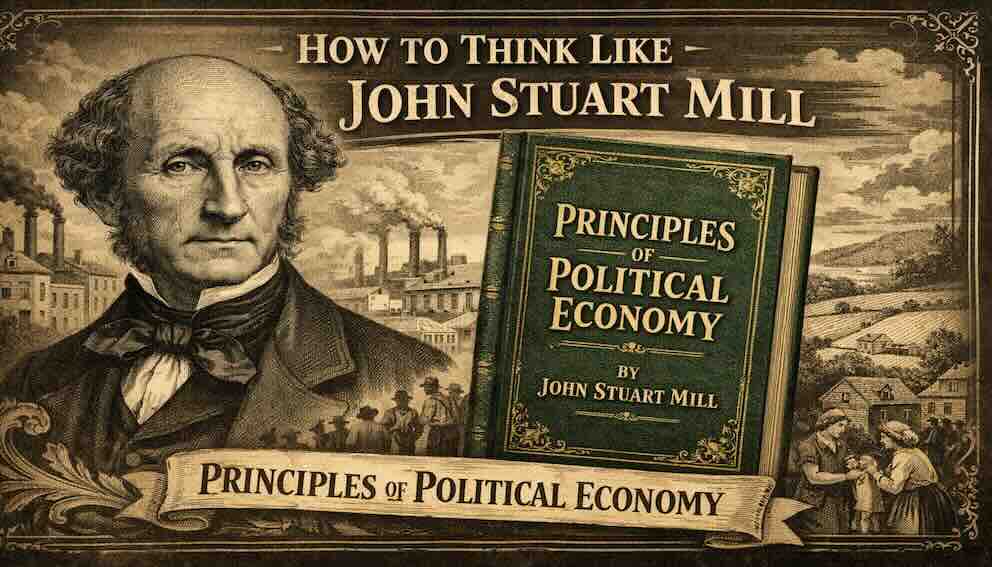
Introduction to the Book
There are books that teach you economics, and then there are books that teach you how to think about economics. John Stuart Mill's Principles of Political Economy, first published in 1848, belongs emphatically to the second category.
It is a strange book by modern standards. Open it today and you will find no mathematical formulas, no graphs, no econometric tables. What you will find are long, carefully constructed sentences that move at their own pace—patient, deliberate, and built to carry complex ideas from first principles to conclusion. Mill wrote in what one observer called "the rich tone of grandeur," a prose style that assumed its readers had time to think and the patience to follow a complex thought to its conclusion.
The book's full title is Principles of Political Economy with Some of Their Applications to Social Philosophy, and that second half matters. Mill was not content to explain how economies worked. He wanted to explore how they should work, and what kind of lives they made possible for the human beings caught up in them.
For nearly half a century, this book was the dominant economics text in the English-speaking world. Oxford University used it until 1919. It shaped the thinking of economists, philosophers, politicians, and ordinary readers across continents. It was translated into multiple languages and read as far away as Imperial Russia, where intellectuals pored over its pages searching for guidance on land reform and the ethics of capitalism.
But to understand why this book mattered—and why it still matters—you have to understand the man who wrote it, and the strange, painful journey that made him who he was.
The Man Behind the Book
John Stuart Mill was born in London on May 20, 1806, into an experiment.
His father, James Mill, was a formidable Scottish philosopher and historian, a close friend and intellectual ally of Jeremy Bentham and David Ricardo. James held a powerful belief: that the human mind was shaped entirely by education and environment, and that if you wanted to create a great thinker, you simply had to design the right curriculum and apply it with sufficient intensity.
He decided to prove this theory on his son.
The education that followed is almost impossible to imagine today. John Stuart Mill began learning Greek at the age of three. By eight, he had read Herodotus, Xenophon, and Plato in the original, along with substantial amounts of history and English literature. At twelve, he began a rigorous course in logic and philosophy. At thirteen, he studied political economy with his father, working through Ricardo and Adam Smith as if they were schoolbooks.
One biographer described James Mill's aim as turning his son into "a calculation machine." By most measures, he succeeded.The younger Mill became one of the most formidably educated minds of his generation—capable of analytical thought that left his contemporaries breathless.
Then, at twenty, it all fell apart.
Mill describes the breakdown in his Autobiography with a clarity that still stings. He found himself unable to feel anything. The goals that had driven him—social reform, intellectual achievement, the admiration of his peers—suddenly seemed hollow. He asked himself a devastating question: if all the reforms he dreamed of were realized tomorrow, would it make him happy? The answer came back: No. He wrote: "The whole foundation on which my life was constructed fell down."
He recovered slowly, and the agent of his recovery was unexpected: poetry. Reading William Wordsworth taught him that feeling was as important as thought. He emerged from the crisis with a different understanding of what made life worth living. Reason was essential, but it was not enough. A life lived entirely in the head was a life half-lived.
This personal crisis shaped everything Mill later wrote, including his economics. He never abandoned rigorous analysis. He remained capable of reasoning at a level few could match. But he never believed that analysis alone could tell us what kind of society we should want.
In 1851, after a long friendship, he married Harriet Taylor, a woman he credited with influencing almost everything he wrote during their marriage, including Principles of Political Economy. The first edition acknowledged her contributions; after her death in 1858, he dedicated later editions to her memory.
Later in life, Mill served a term in Parliament, where he advocated for women's suffrage, proportional representation, and land reform—positions well ahead of his time. He died in Avignon, France, in 1873, at the age of sixty-six, having spent his last years near the grave of the woman who had helped him see that economics was, at its heart, a humanistic discipline.
The World the Book Was Written In: 1848, the Year of Revolutions
To understand Principles of Political Economy, you have to understand the year it appeared.
1848 was one of the most turbulent years in modern European history. Revolution broke out in Sicily in January. By February, Paris had risen, and King Louis-Philippe had abdicated. In March, the flames spread to Vienna, Berlin, Milan, Venice, Prague, and Budapest. Workers, students, and liberals poured into streets demanding constitutions, rights, and reforms. Thrones trembled. Armies mobilized. The old order, which had seemed permanent, suddenly looked fragile.
Britain escaped revolution, but not tension. The Chartist movement had gathered millions of signatures demanding working-class representation in Parliament. The Irish famine was still a fresh wound, its lessons about poverty and policy still being debated. Factories belched smoke over cities swollen with rural migrants. Poverty was visible, crowded, and angry. The "Hungry Forties" were called that for a reason.
Economically, Britain was the workshop of the world. Railroads were spreading like nervous systems across the landscape, shrinking distances and synchronizing markets. Steam power was transforming production. International trade was expanding as Britain lowered tariffs and embraced free trade. But the benefits of this growth were distributed unevenly, and everyone knew it. The rich built grand houses; the poor crowded into slums.
The intellectual inheritance of economics at this moment came from the classical tradition: Adam Smith's insights about specialization and the division of labor; Thomas Malthus's grim predictions about population outstripping food supply; and above all, David Ricardo's rigorous models of rent, wages, and profits. This tradition had given the world powerful tools for understanding how markets functioned.
But it had also produced a certain fatalism. Ricardo's models seemed to show that wages would always tend toward subsistence, that landowners would capture an ever-larger share of output as population grew, and that growth might eventually stall. The classical economists were not cheerleaders for capitalism. They were analysts of its constraints, and those constraints looked severe.
Into this environment of political upheaval and intellectual ferment, Mill dropped his book. The book attempted something ambitious: to show that economics could be both rigorous and humane, analytical and ethically serious.
The Architecture of the Book: Key Ideas from Mill's Principles
Mill's Principles is a long book—over a thousand pages in some editions—and it ranges across topics from production to distribution to exchange to the role of government. But its intellectual architecture rests on several distinct ideas that form a coherent system.
1. The Distinction Between Production and Distribution
This is Mill's most famous and enduring contribution, the idea that made his book different from anything that had come before.
Mill asks us to separate two questions that people often confuse. First: how is wealth created? Second: how is wealth shared? These might sound like the same question, but Mill insists they are fundamentally different.
The production of wealth, he argues, depends largely on physical realities. If a farmer plants wheat, the harvest depends on things like the fertility of the soil, the amount of labour applied, the tools and machines available, and the state of agricultural knowledge. No law passed in Parliament can make barren soil produce abundant wheat. Nature places limits on what an economy can produce.
Distribution, however, is another matter entirely. Once the wheat has been harvested, society must decide who owns the land, who receives the profits, what wages the workers earn, and what taxes are collected. Those decisions are not dictated by nature. They are shaped by laws, customs, and institutions. Mill writes that the laws governing production have "the character of physical truths," while the distribution of wealth is "a matter of human institution."
This insight allowed Mill to challenge a powerful belief of his time. Many nineteenth-century thinkers treated poverty and inequality as if they were inevitable consequences of economic law, much like gravity or the seasons. Mill disagreed. Economic production may obey constraints, but inequality is not a natural law. It is the outcome of rules that societies create—and therefore rules that societies can change.
To see how this works, imagine two countries with identical farmland, identical technology, and identical populations. In one country, land is owned by a handful of landlords, farmers pay rent, and profits accumulate at the top. In the other country, farms are owned by the people who cultivate them, and profits remain with the farmers. Both countries might produce the same amount of wheat. But the distribution of income would look completely different.
For Mill, this distinction opens a door. If distribution is shaped by institutions, then societies are free to debate which institutions produce the most just and stable outcomes. Economics, in other words, cannot avoid moral questions. It can tell us what is possible, but societies must still decide what is desirable.
2. Productive and Unproductive Labour
Mill devoted considerable attention to distinguishing between types of labour—a classification that mattered greatly to classical economists even though it later faded from the discipline.
Productive labour, in Mill's framework, is labour that creates future wealth. When a worker builds a machine, or clears a field for planting, or constructs a factory, that labour adds to the stock of capital that will produce goods and services in the future. It is, in a sense, labour that builds the foundation for more labour.
Unproductive labour, by contrast, provides immediate services but leaves no lasting capital behind. A domestic servant who cooks a meal or cleans a house is performing valuable work—the household is better off for it—but when the meal is eaten and the cleaning is done, nothing remains that will produce future value. The same could be said of a musician performing for an audience, or a soldier defending a border.
Mill was careful to note that unproductive labour is not useless labour. A society without musicians, servants, or soldiers would be poorer in obvious ways. But he insisted on the analytical distinction because it helped explain how economies grew. Growth required productive labour—labour that added to the stock of capital rather than simply serving immediate needs.
3. The Nature of Capital
Mill defined capital as "the accumulated stock of the produce of labour"—the machinery, buildings, and materials that make production possible.
But he added an important psychological dimension. The distinction between capital and not-capital, he argued, "does not lie in the kind of commodities, but in the mind of the capitalist—in his will to employ them for one purpose rather than another." A loaf of bread is just food, but if it is set aside to feed workers who are building something, it becomes capital. The same physical object can be capital or consumption depending on the intention behind it.
This emphasis on human purpose and choice runs throughout Mill's work.
4. The Wage Fund Doctrine
One of the most controversial arguments in Mill's book—and one he would later publicly abandon—was the wage fund doctrine.
The idea was simple and, to many readers, brutally logical. Mill argued that there is, at any given time, a fixed fund of capital set aside to pay wages. This fund is determined by past savings and investment. The average wage, then, is simply this wage fund divided by the number of workers seeking employment.
Imagine a town where employers have set aside £10,000 to pay workers, and where 1,000 workers are seeking jobs. The average wage will be about £10 per worker. If the population rises to 1,200 workers without any increase in the wage fund, wages must fall. There is simply no other possibility within the logic of the model.
This doctrine had bleak implications. It suggested that workers could not improve their lot through organization or bargaining, because wages were determined not by bargaining power but by the fixed fund of capital. Trade unions, in this view, could only redistribute wages among workers, not raise the total going to labour as a whole.
Mill later reconsidered. In 1869, he publicly repudiated the wage fund doctrine in a famous article, acknowledging that the fund was not fixed and that collective bargaining could indeed raise wages. The episode became legendary in economic theory—a rare example of a major thinker changing his mind in public and admitting his earlier errors.
5. The Theory of Rent
Mill inherited from Ricardo the theory of rent, and he explained it with characteristic clarity.
As population grows, society must cultivate increasingly less fertile land. The price of food is set by the cost of production on the worst land in use. Farmers on better land produce food more cheaply but sell it at the same price. The difference—the surplus—flows to landowners as rent.
Rent, in this formulation, is not a payment for anything landowners do. It is not compensation for effort or investment. It is a pure transfer, made possible by the scarcity of high-quality land.
Mill used this theory to open larger questions about property and justice. If rent was unearned, what did that imply about the legitimacy of concentrated land ownership?
6. Peasant Proprietorship
Mill's travels and reading led him to admire a form of agriculture that was uncommon in Britain but widespread on the European continent: peasant proprietorship, where farmers owned the land they worked.
He argued that peasant farmers who own their land often work more productively than hired labourers. The reason was simple: they reap the full rewards of their effort. A man working his own field has incentives that a hired labourer, however well-supervised, cannot match.
Mill pointed to France after the Revolution as an example. The breakup of large estates had created a class of small landowners who cultivated their holdings with extraordinary care. They drained marshes, improved soils, and experimented with new crops—not because they were ordered to, but because the land was theirs.
This argument connected directly to Mill's views on land reform. He was not a revolutionary, but he believed that concentrated land ownership could be broken up without disaster, and that doing so might produce both greater efficiency and greater justice.
7. Cooperative Production
One of the most surprising arguments in the book—and one that reveals how far Mill was willing to go in questioning existing institutions—is his support for worker cooperatives.
Mill imagined a future in which workers might own and manage enterprises collectively, sharing profits and governing themselves democratically. Instead of a factory owned by a single capitalist who hires workers for wages, we might see a factory owned by the workers themselves, with decisions made collectively and profits distributed among those who did the work.
He believed that cooperative production could potentially combine the best features of capitalism and socialism: the efficiency and incentive of market competition with the fairness and dignity of shared ownership. Workers with a stake in the business, he argued, would work harder, care more, and cooperate more effectively than workers who were simply cogs in someone else's machine.
This was radical stuff for a classical economist. Mill was not advocating the immediate abolition of private property or wage labour. But he was insisting that these institutions should be judged by their effects, not defended by tradition. If cooperatives worked better, societies should be free to adopt them.
8. The Gains from Trade
In his third book, Mill addressed a question that Ricardo had left unresolved: given that trade creates gains, who gets those gains?
His answer was that international trade benefits most the country whose demand for goods is most elastic—in simpler terms, the country that is more flexible in its purchasing patterns. This was a significant refinement of classical trade theory, and it pointed toward the more sophisticated analysis that would come later.
9. The Limits of Laissez-Faire
Mill is often mischaracterized as a pure free-market economist, but his position on government intervention was far more nuanced.
He stated explicitly that laissez-faire—the principle that government should not interfere in markets—should be the general rule, but not the universal rule. He then listed numerous exceptions:
Education, Mill argued, was too important to leave entirely to private provision. Children could not choose their parents, and parents might not choose wisely for their children. Some form of public education, or public support for education, was justified.
Infrastructure projects like roads, canals, and railways might require government involvement because they were too large or too long-term for private capital to handle alone.
Poverty relief was a clear case for intervention. A society that let its members starve was not only cruel but unstable. Mill supported poor laws that provided a safety net.
Regulation of working conditions could be justified where workers lacked the information or bargaining power to protect themselves. Children, especially, needed protection from exploitation.
Public goods—services that benefit everyone but that no private firm can profitably provide—were natural candidates for government provision.
Mill's guiding principle was that government activity is justified so long as it benefits society and does not infringe upon individual freedom beyond what is necessary to prevent harm to others.
10. Taxation and Justice
Mill's discussion of taxation reflected his concern for fairness. He promoted a system of proportional taxation with an exemption for those earning below a certain threshold—an early version of a progressive tax system.
He was also ahead of his time in questioning unlimited inheritance. Large fortunes passed down through generations, he argued, concentrated wealth and opportunity in ways that harmed society. He did not propose abolishing inheritance, but he did suggest that the state had a legitimate interest in preventing the formation of permanent economic dynasties.
11. The Stationary State
One of the most remarkable passages in the entire book comes in Book IV, where Mill reflects on the future of economic growth.
The classical economists had worried about a "stationary state"—a future where population growth and diminishing returns in agriculture would squeeze profits, reduce investment, and bring growth to a halt. Ricardo saw it as a grim prospect.
Mill turned this on its head. What if the stationary state, instead of being feared, could be welcomed? What if, once material wants were satisfied, humanity could turn its attention to higher things: art, culture, philosophy, relationships, the cultivation of character?
He wrote words that still resonate today:
"I confess I am not charmed with the ideal of life held out by those who think that the normal state of human beings is that of struggling to get on; that the trampling, crushing, elbowing, and treading on each other's heels, which form the existing type of social life, are the most desirable lot of human kind, or anything but the disagreeable symptoms of one of the phases of industrial progress."
This was not a rejection of economic progress. It was a refusal to see endless accumulation as an end in itself.
Why the Book Became a Masterpiece
Principles of Political Economy was not an instant bestseller in the way modern books sometimes are. Its influence was slower and deeper. It became the standard text in its field because it did something no previous economics book had done: it combined analytical rigor with moral seriousness.
For nearly fifty years, it shaped how two generations of readers understood economic questions. It was used at Oxford until 1919. It was read across Europe and translated into multiple languages. In Imperial Russia, intellectuals pored over its pages searching for guidance on land reform and the ethics of capitalism—though they often read selectively, focusing on Mill's social concerns rather than his theoretical economics.
The book succeeded for several reasons.
First, it was comprehensive. Mill synthesized the entire classical tradition—Smith, Ricardo, Malthus—into a single coherent framework. A reader who worked through his book came away with a complete education in the economics of the time.
Second, it was beautifully written. Mill's prose had a grandeur and clarity that made complex ideas accessible. He did not lecture his readers; he invited them to think alongside him.
Third, it addressed the questions people were actually asking. In an age of revolution and social upheaval, Mill offered a vision of economics that was neither blindly apologetic for the status quo nor dismissive of market realities. He took seriously both the efficiency of markets and the justice of distribution.
Fourth, it was open-ended. Mill did not pretend to have all the answers. He was willing to consider alternative institutions—worker cooperatives, land reform, profit-sharing arrangements—as experiments worth trying. This openness made his book a living document rather than a closed system.
Fifth, it was willing to change. Mill's later repudiation of the wage fund doctrine showed that he was not dogmatic. He followed the evidence where it led, even when it meant admitting error. This intellectual honesty earned him trust.
How It Changed the World of Finance and Economic Thinking
The influence of Mill's Principles can be traced through several channels.
It defined liberal orthodoxy for a generation. For readers in the mid-nineteenth century, Mill's book was the authoritative statement of what a humane, reform-minded liberalism looked like in economics.
It shaped later economists. Alfred Marshall, who would become the dominant figure in late nineteenth-century economics, studied Mill closely before writing his own Principles. Henry George extended Ricardian rent theory—as interpreted by Mill—into a radical critique of land ownership. And indirectly, through the Cambridge tradition, Mill influenced John Maynard Keynes.
It kept ethical questions alive in economics. At a time when the discipline was beginning to drift toward more technical and mathematical methods, Mill insisted that economics could not escape moral questions. This tradition of ethical reflection never entirely disappeared, and it has seen a revival in recent decades.
It influenced policy debates. Mill's ideas about taxation, inheritance, land reform, and the role of government shaped reform movements on both sides of the Atlantic. His willingness to question existing property arrangements gave intellectual ammunition to those who sought a more equal society.
It introduced generations of readers to economic reasoning. For fifty years, anyone who studied economics in the English-speaking world studied Mill first. His book was the gateway through which students entered the discipline.
What Still Stands—and What Has Not Survived
No book written in 1848 can speak directly to the conditions of the twenty-first century. Mill got some things wrong, and some things have been superseded by later developments.
What Still Stands
The production-distinction distinction remains foundational. Modern economics still recognizes that productivity depends on technology and resources, while distribution depends on institutions, policies, and politics. Debates about inequality, taxation, and social welfare all rest on this distinction.
The focus on institutions has been validated by later research. Development economics, economic history, and political economy have repeatedly shown that institutions—property rights, legal systems, regulatory frameworks—profoundly shape economic outcomes.
The integration of ethics and economics is more relevant than ever. Modern debates about inequality, climate change, and automation all involve questions that cannot be answered by economics alone. They require judgments about what counts as fair, what we owe to each other, and what kind of society we want to live in.
The openness to experimentation looks prescient. Universal basic income trials, worker cooperatives, land value taxation—these are all being explored today as responses to contemporary problems. Mill would recognize them as exactly the kind of institutional experiments he encouraged.
The stationary state as a provocation has become relevant again in debates about sustainability and climate change. Mill's question—what is growth for?—has returned with new urgency.
The limits of laissez-faire are now widely accepted. No serious economist today believes that markets can handle everything without government intervention. Mill's nuanced position has become the mainstream.
The support for worker cooperatives has seen a revival. In an age of rising inequality and workplace dissatisfaction, experiments in cooperative ownership are being tried in many countries.
What Has Not Survived
The labor theory of value was abandoned after the marginalist revolution of the 1870s. Mill worked within the classical tradition, which held that the long-run value of most goods was determined by their cost of production, with labour being the largest component of that cost. Prices in the market could fluctuate with supply and demand, but over time they tended to settle around the cost required to produce the good. Later economists in the marginalist revolution of the 1870s shifted the emphasis toward subjective value and marginal utility, arguing that prices ultimately reflect how much people value goods at the margin rather than the labour embodied in them.The wage fund doctrine was abandoned by Mill himself. It survives only as a historical curiosity.
The distinction between productive and unproductive labour has faded from economics. Modern national income accounting counts services as production regardless of whether they create future capital.
The assumption of national economies has been overtaken by globalization. Mill analyzed economies as national systems; today, capital moves across borders in milliseconds, supply chains span continents, and production is fragmented across multiple countries.
The optimism about gradual reform was challenged by the twentieth century. Mill believed that reasoned argument and institutional change would steadily improve social conditions. The horrors of two world wars, totalitarianism, and genocide offered brutal counterevidence.
Some technical details have been superseded by later economic theory. Mill's specific policy proposals, where they survive, do so as historical artifacts rather than live options.
Why This Book Still Matters Today
So why should a modern reader—especially one interested in finance and economics—bother with a thousand-page book written in 1848?
The answer lies not in Mill's conclusions but in his method.
Mill shows us how to think about economic questions in a way that is both rigorous and humane. He does not let analytical elegance crowd out moral concern. He does not let moral concern excuse sloppy thinking. He holds the two in tension, and he invites his readers to do the same.
Consider the questions he asks:
- How do institutions shape who gets what?
- What constraints are real, and which are choices we could change?
- How should societies balance efficiency and fairness?
- What is the point of economic activity, anyway?
These are not nineteenth-century questions. They are the questions of every age.
When you read Mill, you are not reading someone who claims to have all the answers. You are reading someone who is trying to think clearly about difficult problems, and who wants you to think clearly alongside him. His prose is patient, his arguments are careful, and his conclusions are always provisional.
In an age of hot takes and algorithmic certainty, that kind of thinking is more valuable than ever.
Conclusion
John Stuart Mill's Principles of Political Economy was published in 1848, a year of revolution. It became the standard text in its field for nearly half a century. And then it faded, as textbooks do, replaced by newer formulations that incorporated the marginalist revolution and the mathematical turn in economics.
But the questions Mill asked did not fade. They remain central to any serious engagement with economic life.
How do institutions shape who gets what? What constraints are real, and which are choices we could change? How should societies balance efficiency and fairness? What is the point of economic activity, anyway? Is endless growth an end in itself, or a means to something better?
Mill's answers are not always right. His framework has limitations that later developments exposed. But his way of asking—rigorous yet humane, analytical yet open-ended, grounded in the classical tradition yet reaching toward something new—is a model worth studying.
Great economic books teach us how to ask better questions, not just what answers to believe. By that measure, Mill's Principles remains great.
It reminds us that economics is not just about markets and money. It is about how human beings organize their collective life, how they produce and distribute the things they need, and how they might live together more wisely. Those questions never go out of style.
About Swati Sharma
Lead Editor at MyEyze, Economist & Finance Research WriterSwati Sharma is an economist with a Bachelor’s degree in Economics (Honours), CIPD Level 5 certification, and an MBA, and over 18 years of experience across management consulting, investment, and technology organizations. She specializes in research-driven financial education, focusing on economics, markets, and investor behavior, with a passion for making complex financial concepts clear, accurate, and accessible to a broad audience.
Disclaimer
This article is for educational purposes only and should not be interpreted as financial advice. Readers should consult a qualified financial professional before making investment decisions. Assistance from AI-powered generative tools was taken to format and improve language flow. While we strive for accuracy, this content may contain errors or omissions and should be independently verified.