
Tutorial Categories
Last Updated: March 28, 2026 at 15:30
Principles of Economics: A Walk Through the Book That Gave Us Supply and Demand Curves
How Alfred Marshall Turned Economics into a Visual Science
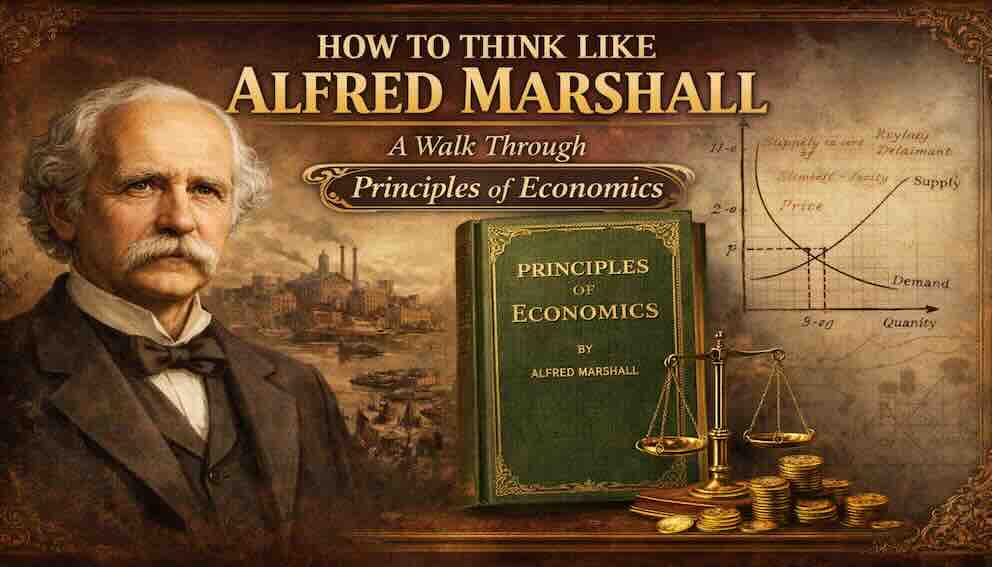
In 1890, a mild-mannered Cambridge professor named Alfred Marshall published a book that would teach generations of students how to see economics for the first time. Principles of Economics did not invent supply and demand curves—earlier thinkers had drawn them—but it brought them together, standardized them, and embedded them in a framework that made visible the hidden logic of markets. Marshall introduced the concept of elasticity to measure how buyers respond to price changes, developed the distinction between short run and long run that every economist still uses, and created a method—partial equilibrium analysis—that allowed complex problems to be tackled one market at a time. Marshall had begun his academic life studying physics and mathematics, and he experienced a profound mental crisis that led him to ask deeper questions about human welfare and the purpose of economic life. His book became the dominant textbook in England for over thirty years, shaping how economics was taught at Cambridge and around the world, and its influence continues in every classroom where students still draw those two crossing lines.
Introduction to the Book
There is a moment in every economics student's life when the teacher draws two lines on a board—one sloping down, one sloping up—and where they cross, writes the word "equilibrium." That familiar diagram took its modern form in 1890, when Alfred Marshall presented it in his book Principles of Economics.
Before Marshall, economics was largely a discipline of words. Adam Smith wrote in long, meandering sentences. David Ricardo built chains of logical deduction. John Stuart Mill composed philosophical arguments that unfolded paragraph by patient paragraph. They described markets; they did not draw them.
Marshall changed that. He gave economics a visual language, a way of representing complex relationships that could be grasped at a glance. But he did something more: he synthesized the competing strands of economic thought into a coherent whole, showing that the classical focus on production costs and the newer marginalist focus on utility were not rival theories but two blades of the same pair of scissors. And he developed a method—partial equilibrium analysis—that allowed economists to isolate individual markets, hold everything else constant, and understand one piece of the economic puzzle at a time.
For more than three decades, this book was the authoritative text in English-speaking economics. It went through eight editions, growing from 750 to 870 pages, and its influence extended far beyond Cambridge, where Marshall taught for most of his career. It trained generations of economists, including Arthur Cecil Pigou and John Maynard Keynes, who would go on to reshape the discipline in their own ways.
To understand why this book mattered—and why it still matters—you have to understand the man who wrote it, the strange path that led him from physics to philosophy to economics, and the world he was trying to make visible.
The Man Behind the Book: The Mathematician Who Burned His Equations
Alfred Marshall was born in Clapham, a suburb of London, on July 26, 1842. His father was a cashier at the Bank of England, a devout Evangelical who wrote a tract called Men's Rights and Women's Duties and hoped his son would become a clergyman.
The young Marshall had other plans. He showed an early aptitude for mathematics, and despite his father's opposition—the story goes that his father refused to let him study algebra, so Marshall studied it secretly before breakfast—he eventually made his way to St John's College, Cambridge. There he distinguished himself by achieving the rank of Second Wrangler in the grueling Mathematical Tripos of 1865, a result that placed him among the top mathematicians of his generation.
Then something happened that would shape the rest of his life.
Marshall experienced what he later described as a mental crisis. The abstract beauty of mathematics, the pure logic of physics—these no longer satisfied him. He began to question what knowledge was for, what purpose it served in the lives of human beings. He turned to metaphysics, then to ethics, and finally to economics, because he came to believe that economics played an essential role in providing the preconditions for human improvement.
This background matters. Marshall never abandoned his mathematical training—he used it constantly—but he developed a deep suspicion of letting mathematics overshadow the human questions at the heart of economics. He wrote in a famous letter to his colleague A.L. Bowley:
"(1) Use mathematics as shorthand language, rather than as an engine of inquiry. (2) Keep to them till you have done. (3) Translate into English. (4) Then illustrate by examples that are important in real life. (5) Burn the mathematics. (6) If you can't succeed in 4, burn 3. This I do often."
The image is striking: the mathematician setting fire to his own equations, not because they were wrong, but because they were not enough. Economics, for Marshall, was ultimately about people—about how they lived, what they struggled for, how material conditions shaped their possibilities.
In 1877, Marshall married Mary Paley, who had been his student at Cambridge. The marriage forced him to resign his fellowship—celibacy rules at the time required fellows to be unmarried—and he spent several years as principal at University College, Bristol, before returning to Cambridge in 1884 as Professor of Political Economy. There he worked for years on the book that would make his reputation, finally publishing it in 1890.
He died in Cambridge in 1924, at the age of eighty-one, having shaped the discipline so profoundly that his influence is still visible in every introductory economics course taught today.
The World the Book Was Written In: Late Victorian Britain, Workshop of the World
To understand what Marshall was attempting, you have to imagine Britain in the late nineteenth century.
This was the height of the Victorian era, the period when Britain was truly the "workshop of the world." Its factories produced more goods than those of any other nation. Its merchant fleet carried a large share of global trade. Its financial institutions in the City of London financed railways, mines, and enterprises across six continents.
But beneath the surface of prosperity, the economy was changing in ways that puzzled observers. Britain's comparative advantage, which had once seemed to rest on its supremacy in manufacturing, was shifting. By 1880, even as the country celebrated its industrial might, it was already at a measurable comparative disadvantage in industries like glass, leather goods, silk manufactures, and clocks and watches. The cotton and iron industries remained strong, but the pattern of specialization was more complex than simple narratives allowed.
The intellectual world of economics was also in flux. The classical tradition of Smith, Ricardo, and Mill had dominated for a century. But in the 1870s, a revolution had occurred. Economists like William Stanley Jevons in England, Carl Menger in Austria, and Léon Walras in Switzerland had independently developed a new approach based on marginal utility—the idea that value depends not on the labor embodied in a good, but on the additional satisfaction a consumer gets from one more unit.
This "marginalist revolution" had thrown the discipline into confusion. The old classical economics and the new marginalist economics seemed to speak different languages, focus on different questions, and reach different conclusions.
Marshall's project was to reconcile them. He wanted to show that both approaches were valid, that they addressed different aspects of the same phenomena, and that they could be brought together into a single coherent framework. His book was an act of synthesis—and the tools he used to achieve it were marginal analysis, partial equilibrium, and the graph.
Marshall's Method: How He Taught Economists to Think
Before diving into the specific ideas, it is worth understanding Marshall's method—the way he approached economic problems. This method was perhaps his most lasting contribution.
Partial Equilibrium Analysis
Marshall's great methodological innovation was to isolate markets one at a time. He called this "partial equilibrium analysis," and it rested on a simple device: the assumption of ceteris paribus—all other things being equal.
To understand the market for coffee, you do not need to model the entire economy simultaneously. You can hold everything else constant and focus on the factors that directly affect coffee: the cost of beans, the wages of baristas, the tastes of consumers, the prices of tea and hot chocolate.
This was a liberating simplification. It allowed economists to make progress on real-world problems without waiting for a complete theory of everything. Later economists, especially Léon Walras, would develop general equilibrium models that tried to capture all interactions at once. But Marshall's partial equilibrium approach remained the workhorse of applied economics.
The Time Dimension
Marshall also taught economists to think about time. The same market, he observed, might behave very differently depending on how much time you allowed for adjustment.
In the market for housing, for example, a sudden increase in demand might push rents up sharply in the short run, because new apartments cannot be built overnight. But in the long run, builders respond, supply increases, and rents moderate.
Marshall gave economists a vocabulary for talking about this: the distinction between short run and long run, which remains central to economic analysis today.
Diagrams as Thinking Tools
Marshall believed that diagrams were not just illustrations but thinking tools. Drawing a supply and demand graph forced you to be precise about what you were assuming, what was shifting, what was staying put. The graph was a way of disciplining thought.
He put his mathematics in footnotes and appendices, keeping the main text accessible. But the diagrams remained front and center, because they translated abstract relationships into something the mind could grasp.
The Architecture of the Book: Key Ideas from Principles of Economics
Marshall's Principles is a dense and carefully constructed work. It unfolds slowly, building its arguments layer by layer. But at its core are several ideas that transformed economics forever.
1. Marginal Analysis: The Unifying Thread
Underlying almost everything in Marshall's system is the concept of the margin. This was the great insight of the marginalist revolution, and Marshall made it central to his synthesis.
Marginal utility is the additional satisfaction a consumer gets from one more unit of a good. As you consume more, marginal utility typically falls. The first cup of coffee in the morning is delightful; the fifth cup leaves you jittery.
Marginal cost is the additional cost of producing one more unit. As you produce more, marginal cost typically rises. The first loaf of bread from a bakery is cheap to produce; the thousandth loaf requires overtime wages and worn-out equipment.
Marginal productivity is the additional output from hiring one more worker or using one more machine.
Marshall showed that these marginal concepts were the key to understanding economic behavior. Consumers adjust their purchases until marginal utility equals price. Firms adjust their production until marginal cost equals price. Workers adjust their labor until the marginal disutility of work equals the wage.
This was the engine that drove his entire system.
2. The Supply and Demand Diagram
Marshall did not invent supply and demand curves. Earlier thinkers had drawn them: Antoine Augustin Cournot used mathematical demand curves in 1838; Jules Dupuit used them in welfare analysis; William Stanley Jevons drew marginal utility diagrams. But Marshall did something different.
He brought the two curves together into a single diagram, with price on the vertical axis and quantity on the horizontal. He showed how they intersected to determine market price. And he embedded this diagram in his time analysis—different curves for the short run and the long run.
This simple diagram did something profound. It made visible the idea of equilibrium—the point at which the plans of buyers and sellers align. It showed that price was not determined by either supply or demand alone, but by their interaction. And it provided a framework that could be applied to almost any market, from wheat to labor to housing.
The graph was so powerful that it soon appeared in textbooks everywhere. Today, it is probably the most recognizable image in all of economics.
3. The Scissors Analogy
Marshall used a memorable image to explain his approach. The determination of price, he wrote, was like the action of a pair of scissors cutting paper. Which blade does the cutting? The question is absurd. Both blades work together.
The same is true of supply and demand. The old classical economists had focused on supply—on costs of production, on the labor required to make things. The marginalists had focused on demand—on utility, on what people wanted. Both were right, and both were incomplete. Price was determined by the interaction of the two.
Marshall wrote:
"We might as reasonably dispute whether it is the upper or the under blade of a pair of scissors that cuts a piece of paper, as whether value is governed by utility or cost of production."
This simple analogy reconciled what had seemed like warring camps and established the framework that would dominate economics for the next century.
4. Elasticity
One of Marshall's most enduring contributions was the concept of elasticity. He wanted a way to measure how responsive demand was to changes in price.
Some goods, he observed, are such that a small change in price leads to a large change in the quantity demanded. Others are such that even a large price change produces little response. Marshall called this property "elasticity."
He illustrated the concept with examples drawn from everyday life. Consider salt. People buy roughly the same amount of salt regardless of its price, because it is a necessity and they use it in small quantities. The demand for salt is highly inelastic.
Now consider concert tickets for a popular band. If the price rises sharply, many people will decide to stay home. The demand is elastic.
Marshall also noted that elasticity could vary at different price levels. At very high prices, demand might be elastic because only the rich can afford the good; as price falls and the good reaches middle-class consumers, demand might remain elastic; but once the price becomes low enough that nearly everyone who wants the good can afford it, demand becomes inelastic again.
This was not just theoretical. Marshall was describing the real world with precision that earlier economists had lacked.
5. Consumer Surplus
Another of Marshall's innovations was the concept of consumer surplus. He defined it as:
"Excess of the price which a consumer would be willing to pay rather than go without a thing over that which he actually does pay."
Imagine you are standing in line at a coffee shop. You would be willing to pay five dollars for your morning coffee—it is that important to you. But the price on the board is three dollars. When you hand over your three dollars and receive your coffee, you have gained two dollars of satisfaction that you did not have to pay for. That is consumer surplus.
The idea was first proposed by the French engineer Jules Dupuit in 1844, but Marshall refined it, popularized it, and integrated it into mainstream economic analysis. He used it to measure the welfare effects of price changes and taxes. If a tax raises the price of a good, consumers lose some of their surplus. If a technological improvement lowers the price, consumers gain surplus. This gave economists a way of thinking about the distributional consequences of policy that went beyond simple statements about efficiency.
6. The Time Dimension: Short Run and Long Run
Perhaps Marshall's most sophisticated contribution was his recognition that time matters profoundly in economics.
In the short run, he argued, supply is relatively fixed. Factories cannot be built overnight. Skilled workers cannot be trained in a week. When demand changes in the short run, prices adjust more than quantities.
Consider a sudden surge in demand for apartments in a city. In the short run, landlords can raise rents, but new apartments cannot appear immediately. Prices rise sharply.
In the long run, however, everything is adjustable. New apartments can be built. New neighborhoods can develop. Capital can flow to where it is most needed. In the long run, quantities adjust more fully, and prices tend toward the cost of production.
This distinction seems obvious now, but before Marshall, economists had treated time as a complication to be ignored rather than a dimension to be analyzed. He showed that the answer to almost any economic question depends on how much time you allow for adjustment.
7. Quasi-Rent
Building on Ricardo's theory of rent, Marshall developed the concept of quasi-rent. In the short run, he observed, certain factors of production can earn returns that look like rent but are temporary.
Imagine a bakery that invents a new technique for making sourdough that produces loaves far superior to anything else in the city. In the short run, before other bakeries can copy the technique, that bakery will earn high profits. Those profits are not true economic rent—they are returns to innovation and entrepreneurship. But in the short run, they function like rent.
Marshall called this quasi-rent. The concept helped bridge classical rent theory with the analysis of profits in a dynamic economy. It also anticipated later work on innovation, intellectual property, and the returns to temporary monopoly power.
8. Internal and External Economies of Scale
Marshall made a crucial distinction between two types of cost advantages that firms might enjoy.
Internal economies are those that a firm creates for itself through growth. A larger bakery can afford larger mixers, can specialize its workers, can negotiate better prices for flour. These are the advantages that come from being big.
External economies are those that accrue to all firms in an industry because of the growth of that industry. If many bakeries locate in the same neighborhood, a specialized flour supplier might open nearby. Workers with baking skills will move to the area. Knowledge about new techniques will spread through casual conversation. These advantages belong to the location, not the individual firm.
This distinction became foundational for later work in economic geography and industrial organization. It explained why industries often cluster in particular places—Silicon Valley for tech, Hollywood for film, the City of London for finance—and why those clusters can persist even when individual firms come and go.
9. The Representative Firm
Marshall faced a difficult problem. Firms within an industry differ—some are efficient, some less so. How do you analyze the industry as a whole without assuming all firms are identical?
His solution was the concept of the "representative firm"—a firm whose costs and behavior were typical of the industry as a whole. This was not necessarily the largest or the most efficient firm. It was the firm that captured the industry's average characteristics.
The concept allowed Marshall to analyze industry dynamics without assuming homogeneity. Later economists found it too vague and largely abandoned it in favor of more precise models of firm heterogeneity. But it represented a genuine attempt to grapple with the complexity of real industries.
10. The Integration of Distribution
Marshall's sixth book addressed the distribution of the national income among wages, profits, interest, and rent. He treated these not as separate phenomena but as different applications of the same supply-and-demand framework.
Wages, in this view, were the price of labor. Profits were the return to capital and enterprise. Interest was the price of waiting—the compensation for deferring consumption. Rent was the return to land and other fixed factors.
By integrating distribution into the same framework as price theory, Marshall made economics more coherent and more powerful. The same tools that explained the price of bread could explain the wages of labor and the profits of capital.
11. The Purpose of Economics
Underlying all of Marshall's technical contributions was a deep commitment to the idea that economics should serve human welfare. He wrote in the preface to the first edition:
"Economic conditions are constantly changing, and each generation looks at its own problems in its own way... The chief purpose of every study should be to give knowledge that will help us to understand the causes of poverty and to discover the remedies for it."
This was not a man interested in abstract models for their own sake. Marshall believed that economics mattered because it could improve the material conditions of ordinary people. His technical apparatus was always in service of that larger goal.
Why the Book Became a Masterpiece
Principles of Economics did not become a masterpiece by accident. It succeeded for several reasons, each worth understanding.
First, it was synthetic. Marshall brought together the classical tradition of Smith, Ricardo, and Mill with the marginalist revolution of Jevons and Menger. He showed that these were not rival theories but complementary perspectives. This act of synthesis gave the discipline a new coherence.
Second, it was visual. Marshall's diagrams made economics accessible in a way that purely verbal arguments could not. Students could see supply and demand, equilibrium, consumer surplus. The ideas became tangible.
Third, it was rigorous but not intimidating. Marshall put his mathematics in footnotes and appendices, keeping the main text accessible to general readers. He wanted to be read, not just cited.
Fourth, it was authoritative. Marshall had spent nearly a decade writing and revising the book. He consulted colleagues, tested arguments, refined his formulations. The result was a work that felt definitive.
Fifth, it was institutionalized. Marshall used his position at Cambridge to create a new economics tripos—a dedicated course of study—in 1903. His book was the natural text for that course, and Cambridge-trained economists carried his ideas with them as they fanned out across the world.
The book appeared in eight editions during Marshall's lifetime, each one carefully revised. It remained the dominant textbook in England until well after his death.
How It Changed the World of Finance and Economic Thinking
The influence of Marshall's Principles can hardly be overstated.
It created the visual language of economics. The supply-and-demand graph, now so familiar it seems inevitable, was standardized by Marshall. Every time a student draws those crossing lines, they are using his tool.
It established microeconomics as a coherent field. Marshall's focus on individual markets, on the behavior of consumers and firms, on the determination of prices and quantities—all of this became the core of microeconomic analysis.
It trained the next generation of economists. Marshall's students included Arthur Cecil Pigou, who developed welfare economics, and John Maynard Keynes, who would revolutionize macroeconomics in the 1930s. The Cambridge tradition that shaped twentieth-century economics was Marshall's creation.
It spread around the world. Marshall's book was read in America, in Europe, in the British Empire. It defined what economics was for a generation of students everywhere.
It made economics useful. By providing tools for analyzing real-world markets, Marshall gave policymakers and businesspeople a way of thinking about prices, costs, and competition that was both rigorous and practical.
What Still Stands—and What Has Not Survived
A book written in 1890 cannot speak directly to every condition of the twenty-first century. Marshall got some things wrong, and some things have been superseded.
What Still Stands
The supply-and-demand framework remains the foundation of microeconomics. Every introductory course still teaches it, and every economist still uses it as a first approximation for thinking about markets.
The concept of elasticity is everywhere. Businesses use it to set prices. Governments use it to predict the effects of taxes. Economists use it to measure consumer responsiveness.
The distinction between short run and long run is now standard. No serious analysis of any market ignores the time dimension.
Consumer surplus is still used to measure the benefits of price changes and to evaluate policy interventions.
Internal and external economies have become central to economic geography, trade theory, and the study of innovation clusters.
Marshall's scissors—the idea that supply and demand jointly determine price—is so deeply embedded that economists rarely think to question it.
Partial equilibrium analysis remains the workhorse of applied economics. When you analyze the effect of a tax on gasoline without modeling the entire global economy, you are using Marshall's method.
Marginal analysis is the backbone of microeconomics. Every time an economist says "on the margin," they are speaking Marshall's language.
What Has Not Survived
The representative firm concept has largely been replaced by more sophisticated models of firm heterogeneity and industry dynamics. Modern economists have better tools for dealing with differences among firms.
Some of Marshall's empirical claims have been overtaken by events. The British economy he described is not the globalized, service-oriented economy of today.
The policy conclusions drawn from Marshall's framework have been debated and revised. His cautious liberalism, his belief in gradual reform, his optimism about progress—these are not universally shared today.
General equilibrium theory has developed in ways that Marshall did not anticipate. While his partial equilibrium approach remains useful for many purposes, economists also have tools for analyzing economy-wide interactions that he lacked.
Why This Book Still Matters Today
So why should a modern reader, living in a world of high-frequency trading and cryptocurrencies and global supply chains, bother with a Victorian economics textbook?
The answer lies not in Marshall's specific conclusions but in his method and his vision.
Marshall teaches us how to see markets. His diagrams are not just pedagogical devices—they are ways of thinking. They train the mind to look for equilibrium, to distinguish shifts along curves from shifts of curves, to separate short-run adjustments from long-run adaptations. When you encounter a news story about rising rents in a city, Marshall's framework immediately prompts questions: Is this a shift in demand or a shift in supply? Is it a short-run phenomenon, or will it persist? What does this imply for consumer surplus, for welfare, for the people who live there?
Marshall teaches us that economics is about people. He never lost sight of the human purpose of the discipline—to understand poverty, to improve material conditions, to create the preconditions for human flourishing. His technical apparatus was always in service of that larger goal. In an age when economics can sometimes seem like a branch of applied mathematics, Marshall's example reminds us of why the questions matter in the first place.
Marshall teaches us that synthesis is valuable. In a time of intellectual fragmentation, when economists often seem to speak past each other, Marshall's example reminds us that the best work brings competing perspectives together. He did not take sides in the battle between classicals and marginalists; he showed how both were right.
Marshall teaches us to be humble about our tools. He put his mathematics in footnotes not because he was ashamed of it, but because he knew that equations were not the point. The point was understanding the world well enough to make it better. He wrote to his colleague: "Burn the mathematics." The advice is startling, but the meaning is clear: the math is a means, not an end.
And Marshall teaches us that economics can be beautiful. His prose has a quiet elegance, his diagrams have a simple clarity, his arguments have a satisfying completeness. Reading him is not just instruction—it is a kind of pleasure.
Marshall built the operating system of microeconomics. The concepts he developed—supply and demand, elasticity, consumer surplus, short run and long run, marginal analysis—are not just historical artifacts. They are the tools that economists use every day, the framework through which they see the world.
Most of today's economics still runs on Marshall's system. Every time a student draws those two crossing lines, every time a policymaker talks about elasticity, every time an analyst distinguishes short run from long run, Marshall's influence is present. He did not just write a book. He gave a discipline its eyes.
Conclusion
Alfred Marshall published Principles of Economics in 1890, at the height of the Victorian era, when Britain was the workshop of the world and economics was still finding its identity as a discipline. His book gave that discipline a visual language, a synthetic framework, and a human purpose.
The world has changed since then. The British Empire is gone. The manufacturing industries that dominated Marshall's economy have moved to other shores. The tools of economics have become vastly more sophisticated—mathematical, statistical, computational in ways Marshall could not have imagined.
But the questions Marshall asked remain. How do markets work? How are prices determined? How is income distributed? What can be done to improve the material conditions of ordinary people?
And the tools Marshall gave us remain. His partial equilibrium method, his marginal analysis, his distinction between short run and long run, his concepts of elasticity and consumer surplus—these are not museum pieces. They are the working instruments of economic analysis.
Great economic books teach us how to ask better questions and how to see more clearly. By that measure, Marshall's Principles remains one of the greatest. It built the operating system that microeconomics still runs on today.
About Swati Sharma
Lead Editor at MyEyze, Economist & Finance Research WriterSwati Sharma is an economist with a Bachelor’s degree in Economics (Honours), CIPD Level 5 certification, and an MBA, and over 18 years of experience across management consulting, investment, and technology organizations. She specializes in research-driven financial education, focusing on economics, markets, and investor behavior, with a passion for making complex financial concepts clear, accurate, and accessible to a broad audience.
Disclaimer
This article is for educational purposes only and should not be interpreted as financial advice. Readers should consult a qualified financial professional before making investment decisions. Assistance from AI-powered generative tools was taken to format and improve language flow. While we strive for accuracy, this content may contain errors or omissions and should be independently verified.