
Tutorial Categories
Last Updated: March 28, 2026 at 15:30
The Theory of the Leisure Class: A Walk Through the Book That Exposed the Economics of Status
How Thorstein Veblen Revealed That We Buy Things to Impress, Not Just to Use
In 1899, as the Gilded Age reached its glittering peak and industrial titans built palaces while workers struggled, a sardonic Norwegian-American economist published a book that dissected the rituals of wealth with surgical precision. The Theory of the Leisure Class by Thorstein Veblen introduced the concept of conspicuous consumption—the idea that people often buy expensive goods not for their usefulness but to signal status and superiority. Writing from the margins of academia, an outsider who had struggled for years to find his place, Veblen produced a work that blended economics with sociology, anthropology, and biting satire. More than a century later, his insights into status, waste, and social display remain essential for understanding everything from luxury handbags to Instagram influencers to the psychology of modern consumer culture.
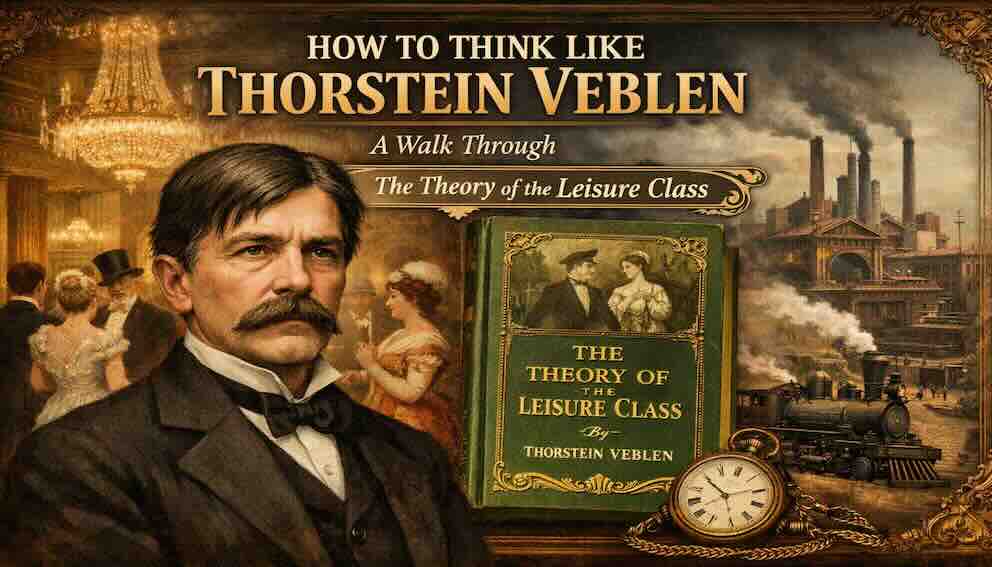
Introduction to the Book
Imagine walking into a room full of economists in the year 1899 and telling them that people buy things not because they need them, but because they want to impress their neighbors. Imagine suggesting that much of what drives the economy has less to do with rational calculation and more to do with envy, status, and the deep human need to feel superior to others.
You would have been met with puzzled looks. Economics in the late nineteenth century was busy becoming a science. It had its laws, its models, its assumptions about rational actors making calculated decisions to maximize their well-being. The idea that social competition might be as important as utility did not fit neatly into the equations.
Thorstein Veblen did not care.
The Theory of the Leisure Class, published in 1899, was a bomb thrown into the comfortable parlor of conventional economics. It argued that much of what people consume has little to do with practical need and everything to do with social signaling. Luxury goods, elaborate homes, extravagant parties, even the choice to remain idle rather than work—these were not merely personal preferences. They were performances. They were ways of saying, without words: I am wealthy. I am powerful. I am above you.
Veblen gave this phenomenon a name that would echo through the next century: conspicuous consumption.
The book was strange by the standards of its time. It was not filled with mathematical formulas or statistical tables. It was written in a dense, ironic prose that often seemed to mock its own subjects. It drew on anthropology, sociology, and history as much as economics. And it refused to take the wealthy elite at their own estimation.
More than 120 years later, the book remains in print, widely read, and deeply influential. Its concepts have entered the everyday language of marketers, social critics, and anyone trying to understand why people buy what they buy. It is one of those rare works that feels as fresh and relevant today as the day it was written.
The Era That Produced the Book: The Gilded Age's Spectacle of Wealth
To understand what Veblen was describing, you have to imagine America in the closing decades of the nineteenth century.
They called it the Gilded Age—a term coined by Mark Twain to capture the thin layer of gold plating that covered deep social problems. It was an era of explosive industrial growth and staggering inequality.
Railroads stretched across the continent. Factories multiplied in rapidly growing cities. New technologies—electricity, steel, the telephone—transformed daily life. Fortunes were made on a scale that had rarely been seen before.
The men who made these fortunes became legendary figures: John D. Rockefeller in oil, Andrew Carnegie in steel, Cornelius Vanderbilt in railroads, J.P. Morgan in finance. They built mansions that resembled palaces, filled them with art imported from Europe, and threw parties that were reported in breathless detail by the newspapers.
Mrs. William Vanderbilt hosted a costume ball in 1883 that cost the equivalent of millions of dollars today. Guests arrived dressed as queens, princesses, and historical figures. The press called it "the party of the century."
At the same time, millions of workers labored in factories for twelve hours a day, six days a week, for wages that barely covered rent and food. Strikes were met with violence. Labor organizers were jailed. The gap between the rich and everyone else grew wider than it had ever been.
This was the world Veblen observed from his perch at the University of Chicago, a city that embodied the contradictions of the age. Chicago was a place of stockyards and skyscrapers, of immigrant laborers and millionaire merchants, of brutal poverty and conspicuous display.
Veblen looked at the wealthy elite and asked a simple question: what are they really doing with their money?
The conventional answer was that they were enjoying the fruits of their enterprise. But Veblen saw something else. He saw performance. He saw ritual. He saw people using wealth to send signals about who they were and where they stood in the social order.
The Gilded Age was the perfect laboratory for studying conspicuous consumption. Never before had so much wealth been concentrated in so few hands, and never before had that wealth been displayed so publicly.
Who Veblen Was: The Outsider Who Saw Through the Performance
Thorstein Veblen was born in 1857 on a farm in rural Wisconsin, the sixth of twelve children. His parents were Norwegian immigrants who had crossed the Atlantic in steerage, settled on the frontier, and built a life through hard work and frugality. The values of that world—practicality, modesty, productive labor—were deeply ingrained in Veblen from childhood.
He was also, by all accounts, a strange child. Quiet, observant, and intensely intelligent, he seemed to view the world from a slight distance, as if watching a play in which he was not quite a participant. His family recognized his gifts and scraped together the money to send him to college.
Veblen's academic path was erratic. He spent a short period studying at Johns Hopkins University before moving to Yale University, where he completed a PhD in philosophy in 1884. His dissertation dealt with moral philosophy and drew heavily on the ideas of Immanuel Kant rather than economics.
What followed was a long and discouraging period. For nearly seven years after earning his doctorate, Veblen was unable to secure a university position. He returned to his family’s farm in rural Minnesota and spent much of that time reading widely—often obsessively—across disciplines such as anthropology, history, sociology, and evolutionary theory.
This intellectual isolation turned out to be formative. Because he was not tied to any single discipline, Veblen began thinking about economic behavior in broader cultural terms. When he eventually returned to academic life in the early 1890s—first spending a brief period studying at Cornell University—he brought with him a deeply unconventional perspective on economic life.
In 1892 he joined the newly founded economics department at University of Chicago, where he began writing the essays and articles that would establish his reputation.
Veblen’s academic career, however, remained turbulent. Although his intellect was widely admired, his personality and behavior often placed him at odds with colleagues and administrators. He was known for his ironic wit, his disdain for academic pretension, and his indifference to professional conventions. Over the years he taught at several universities, including the University of Chicago, Stanford University, and University of Missouri, but he never held a stable long-term position at a major institution.
The Theory of the Leisure Class was published in 1899, when Veblen was forty-two years old. It was not an immediate bestseller, but it attracted attention—partly for its brilliance, partly for its oddity. Readers could not quite decide whether Veblen was a serious scholar or a satirist mocking the pretensions of the rich. The answer was that he was both.
Veblen remained an outsider throughout his career. He never quite fit in anywhere. He had affairs, he was difficult to work with, and he moved restlessly from university to university—Chicago, Stanford, Missouri, the New School for Social Research. He died in 1929, just before the stock market crash that would have given him endless material for his critique.
But his outsider status was also his strength. Standing apart from the mainstream, watching with a cool, ironic eye, he saw patterns that insiders could not see. He understood that the rituals of the wealthy were not just about money—they were about meaning, status, and the eternal human struggle for recognition.
The Architecture of the Book: How Veblen Builds His Argument
The Theory of the Leisure Class unfolds as a carefully constructed argument. Veblen builds his case layer by layer, moving from broad historical observations to specific analyses of consumption, dress, and taste. Understanding this progression helps readers see how each concept flows naturally into the next.
The Origin of the Leisure Class
Veblen starts with the origins of social hierarchy. He traces the leisure class to what he calls the "predatory stage" of human culture, drawing on anthropology and history to support his case.
In early societies, he argues, activities involving aggression and conquest were honored, while peaceful productive labor was despised. The warrior elite—those who hunted, fought, and dominated—established themselves as a class exempt from work. They did not till the soil or craft tools; they raided, displayed, and ruled.
This predatory origin, Veblen suggests, leaves its mark on the leisure class of industrial societies. Their values and habits reflect an ancient heritage in which domination and display mattered more than production. They are, in a sense, living fossils—carrying traits that were adaptive in the distant past but have become obsolete in a world organized around industry and efficiency.
Throughout the book, Veblen returns to this distinction between predatory culture (which values conquest, display, and domination) and industrial culture (which values productive work, efficiency, and material improvement). The leisure class embodies the survival of predatory values in an industrial age.
Conspicuous Leisure
With the origins established, Veblen introduces the first major form of status display: conspicuous leisure.
In traditional societies, the wealthy demonstrated their status by visibly avoiding productive work. They filled their time with activities that served no practical purpose—learning dead languages, practicing elaborate etiquette, pursuing expensive hobbies that produced nothing of value. The message was simple and unmistakable: I am so wealthy that I do not need to work.
Veblen points to examples that would have been familiar to his readers: the country gentleman who spends his days hunting and riding, the aristocrat who engages in scholarly pursuits without any intention of publishing, the lady of the house who oversees servants rather than performing any labor herself. All of these are forms of conspicuous leisure—visible proof that one belongs to the class that does not need to produce.
The logic is straightforward. If you must work for a living, you are clearly not at the top of the social hierarchy. True status means being free from the necessity of labor. The ability to waste time, like the ability to waste money, demonstrates that resources are abundant.
The Shift to Conspicuous Consumption
But as societies become more complex and urbanized, Veblen argues, conspicuous leisure loses its effectiveness as a status signal. In cities, people cannot observe each other's daily lives closely enough to know who is working and who is idling. Your neighbors may not see whether you spend your afternoons at leisure or at labor.
A new form of display emerges to fill the gap: conspicuous consumption.
The wealthy begin to display their status through visible spending. They buy luxury goods, build elaborate homes, host extravagant parties. These expenditures are visible to strangers in ways that leisure is not. Anyone can see the carriage, the mansion, the fine clothing. Consumption becomes the primary vehicle for status signaling.
Veblen's famous definition captures the essence: conspicuous consumption is "the consumption of goods as an evidence of wealth." The purpose is not comfort or utility but display—the public demonstration that one can afford to consume without regard to cost.
Pecuniary Emulation
Status competition does not remain confined to the wealthy. Veblen introduces the concept of pecuniary emulation to explain how it spreads through society.
People naturally imitate those above them in the social hierarchy. The middle classes copy the consumption patterns of the wealthy; the working classes copy the middle classes. Each layer of society looks upward and strives to adopt the standards of the layer just above.
This cascade creates a constant pressure to consume more, to display more, to keep up with those just ahead in the race. No one is immune. Even those with modest incomes feel compelled to participate, stretching their resources to afford the symbols of respectability.
Pecuniary emulation explains why status competition permeates every level of society. It is not a phenomenon confined to the elite; it is a universal feature of social life.
Dress as Status Display
Having established the general framework, Veblen applies it to specific domains. One of his most memorable chapters examines clothing.
Dress, Veblen argues, serves three purposes, each rooted in the dynamics he has already described.
First, it displays wealth. Expensive fabrics, intricate construction, and fashionable design all signal that the wearer can afford things others cannot. The cost of the garment is part of its message.
Second, it demonstrates leisure. Clothing that is impractical—delicate silks that tear easily, high heels that make walking difficult, tight corsets that restrict movement—shows that the wearer does not perform manual labor. The very impracticality is the point.
Third, it shows waste. The constant change of fashion ensures that last year's clothes are obsolete. Garments that are perfectly serviceable must be discarded because they are no longer stylish. This planned obsolescence is itself a form of display, demonstrating that the wearer can afford to replace perfectly good items.
Veblen's analysis of fashion reveals a deeper truth: the rapid turnover of styles is not an accident but a necessary feature of a status-driven system. When a particular style becomes widely adopted, it loses its exclusivity. The wealthy must move on to new markers of distinction, and the cycle repeats.
Waste as a Status Symbol
Underlying much of Veblen's analysis is a striking argument about waste. In many cases, waste itself becomes a form of status display.
Buying something that is unnecessarily expensive—a gold-plated pen, a diamond-encrusted phone case, a watch that costs more than a car—demonstrates that cost is irrelevant to the buyer. The wastefulness of the purchase is precisely what makes it impressive.
From a purely economic perspective, such purchases appear irrational. They do not maximize utility in any straightforward sense. But from a social perspective, they are entirely rational. They send a clear signal about the buyer's place in the hierarchy. The ability to waste resources without consequence is the ultimate proof of abundance.
The Evolution of Taste
Veblen extends this reasoning to aesthetics. He argues that standards of taste are shaped by status competition. What counts as beautiful is often what is expensive or rare.
A handmade object may be valued not because it is more beautiful than a machine-made object, but because it is more costly—because it demonstrates that the owner can afford things that require extensive labor. A painting may be prized not for its intrinsic qualities but for its price and provenance.
This insight leads to what Veblen calls pecuniary standards of taste. People learn to value things that signal wealth and status. Their aesthetic judgments are shaped by social comparison. A neighborhood may be desirable not for its physical qualities—the quality of its housing, the beauty of its landscape—but for its exclusivity. A school may be sought after not for its educational methods but for the social status of its students.
Taste, in Veblen's framework, is never purely individual. It is always shaped by the desire for social distinction.
Veblen Goods
One concept derived from Veblen's work, though he did not use the term himself, is the Veblen good. This is a product whose demand increases as its price increases, because the high price itself confers status.
Examples are everywhere in modern life: luxury handbags from Hermès, watches from Patek Philippe, supercars from Ferrari, rare wines from Burgundy. For these goods, a price cut might actually reduce demand by destroying the exclusivity that makes them desirable. The high price is not a barrier to purchase; it is the point.
Veblen goods represent the logical endpoint of conspicuous consumption. They are pure status signals, goods whose value lies almost entirely in their ability to say: I can afford what others cannot.
The Persistence of Predatory Traits
Throughout the book, Veblen returns to his distinction between predatory and industrial cultures. The leisure class, he argues, carries forward traits that were forged in humanity's predatory past—the love of display, the contempt for productive labor, the desire to dominate.
These traits persist even in industrial societies because the leisure class sets the tone for the rest of culture. Their values trickle down through pecuniary emulation, shaping the aspirations and behaviors of everyone else.
The result is a society caught between two impulses: the industrial impulse toward productive efficiency and the predatory impulse toward display and waste. This tension, Veblen suggests, is fundamental to modern life.
How the Book Was Received
When The Theory of the Leisure Class appeared in 1899, reactions were mixed.
Some readers found it brilliant. They recognized themselves and their neighbors in Veblen's descriptions, and they appreciated the sharpness of his observations. The book appealed to those who were already skeptical of the excesses of the Gilded Age.
Other readers were offended. The wealthy did not appreciate being portrayed as performers in a status drama. Conventional economists were uneasy with a work that mixed economics with sociology, anthropology, and satire. They were not sure what to make of this strange book that did not fit any established category.
The writing style itself was part of the effect. Veblen wrote in a dense, ironic, almost academic prose that could be difficult to follow. He rarely stated his criticisms directly; instead, he described the behavior of the leisure class with a kind of deadpan precision that made the critique all the more cutting. A reader might go several pages before realizing they had been laughed at.
Over time, however, the book's reputation grew. By the early twentieth century, it was widely recognized as a classic. Its concepts entered the language. "Conspicuous consumption" became a phrase that everyone used, even if they had not read the book.
The book went through multiple editions and was translated into several languages. It found readers not only in economics but in sociology, anthropology, and the emerging field of consumer research. Veblen became a figure of lasting influence, even as he remained an outsider to the academic establishment.
How It Changed the World of Finance and Economic Thinking
The influence of Veblen's ideas spread far beyond the narrow boundaries of academic economics.
It expanded the scope of economic inquiry. Before Veblen, economists focused primarily on production, prices, and markets. After Veblen, it became legitimate to ask about the social and psychological dimensions of economic behavior. The door was opened to a wider range of questions.
It laid the groundwork for consumer research. The study of why people buy what they buy—now a massive industry in marketing and business—owes a debt to Veblen's insights about status and display.
It influenced behavioral economics. Modern behavioral economists, who study how psychological factors shape economic decisions, are in many ways extending Veblen's project with better tools and more data.
It shaped the study of luxury goods. The economics of luxury—why people pay enormous sums for goods that are not functionally superior—cannot be understood without Veblen's framework.
It entered popular culture. "Keeping up with the Joneses," "conspicuous consumption," "status symbols"—these phrases, all rooted in Veblen's work, have become part of how ordinary people think about consumption.
It anticipated the sociology of consumption. Later sociologists, from Pierre Bourdieu to Jean Baudrillard, built on Veblen's insights about how consumption is shaped by social position and cultural meaning.
It gave us the concept of Veblen goods. In finance and economics, the idea that some goods become more desirable as they become more expensive has practical implications for pricing, branding, and market analysis.
What Still Stands—and What Has Not Survived
A book written in 1899 cannot capture every dimension of modern consumer society. Some aspects of Veblen's analysis have aged better than others.
What Still Stands
Conspicuous consumption is more visible than ever. Social media has amplified status display, allowing people to broadcast their consumption to global audiences. Every Instagram post featuring a luxury handbag or a fancy restaurant meal is a Veblenian performance.
Status competition remains a powerful driver of economic behavior. The desire to keep up with peers, to signal success, to avoid falling behind—these motivations shape everything from housing choices to education spending to car purchases.
Pecuniary emulation explains the spread of consumption norms. People do imitate those above them, and this imitation creates constant pressure to consume more.
The social meaning of goods is essential to understanding markets. Products are not just bundles of utility; they are symbols that communicate identity and belonging.
Dress as status display is everywhere. Luxury fashion, sneaker culture, and the entire influencer economy are built on the dynamics Veblen described.
Veblen goods continue to shape luxury markets. The demand for exclusive products that signal status shows no sign of diminishing.
Institutions and norms matter. Veblen's insistence that economic behavior cannot be understood in isolation from social context has been validated by decades of research.
What Has Not Survived
The class structure Veblen described has changed. Modern societies are more fluid, with multiple routes to status. Education, creativity, entrepreneurship, and cultural influence all matter alongside inherited wealth.
The atavistic argument—that modern consumption reflects primitive predatory instincts—has not been widely accepted. It is too speculative and too reliant on anthropology that has itself evolved.
Some of Veblen's specific predictions about the future of industrial society did not come to pass. He was better at diagnosing the present than forecasting the future.
The exclusive focus on the wealthy needs to be supplemented by attention to middle-class and working-class consumption. Status competition occurs at every level of society, not just at the top.
Why This Book Still Matters Today
More than a century after its publication, The Theory of the Leisure Class remains essential reading for anyone who wants to understand why people buy what they buy.
Consider the world around you.
Why do people spend thousands of dollars on handbags that cost a fraction of that to produce? Why do luxury car manufacturers emphasize the prestige of their brands rather than merely the reliability of their vehicles? Why do social media influencers build entire careers around displaying their consumption to followers?
Veblen's framework answers these questions. It reveals that much of what we call consumer behavior is actually status behavior—a complex performance in which goods serve as props, signals, and symbols.
Consider the rise of influencer culture. Platforms like Instagram and TikTok have created a global stage for conspicuous consumption. People who were not born into wealth can now achieve status by displaying goods and lifestyles that others admire. The performance has become accessible to anyone with a smartphone and a talent for self-presentation.
Consider the phenomenon of "flexing"—the deliberate display of wealth and success as a form of social media content. The word is new, but the behavior is exactly what Veblen described.
Consider the role of fashion. The constant churn of trends, the rapid obsolescence of last season's styles, the premium placed on novelty—all of this reflects the dynamics Veblen identified. Clothing signals status, demonstrates leisure, and shows waste.
Consider luxury marketing. Brands like Louis Vuitton, Rolex, and Ferrari do not emphasize the functional superiority of their products. They emphasize exclusivity, heritage, and the status that ownership confers. They are selling Veblen goods.
Veblen's insights also illuminate broader social dynamics. The competition for status through consumption can lead to wasteful expenditure, environmental damage, and personal debt. It can distort priorities and create anxiety. Understanding these dynamics is essential for anyone who wants to think clearly about modern society.
Finally, Veblen's book matters because it reminds us that economics is not just about numbers. It is about human beings—their desires, their fears, their need for recognition, their endless struggle for a place in the social order.
Conclusion
Thorstein Veblen published The Theory of the Leisure Class in 1899, at the height of the Gilded Age, when inequality was extreme and the wealthy paraded their riches with theatrical abandon. His book cut through the spectacle and revealed the psychological machinery beneath.
More than 120 years later, the spectacle has changed its forms but not its substance. The mansions are still there, though they may now be photographed for Instagram rather than described in newspapers. The luxury goods are still there, though they may now be displayed by influencers rather than by industrialists. The status games are still there, though they are now played on a global digital stage.
Veblen's great contribution was to show that these games are not peripheral to economics. They are central. They shape what people buy, how they spend, and what they value. They influence markets, prices, and entire industries. They reveal that human beings are not the rational calculators of textbook models but social creatures, deeply concerned with how they appear to others.
The book that emerged from Veblen's outsider perspective remains one of the most original works in the history of economic thought. It is not a book of formulas or equations. It is a book of observations, insights, and provocations. It asks us to look beneath the surface of consumer society and see the status games we all play.
And it leaves us with an uncomfortable question: how much of what we buy is really about need, and how much is about the endless, restless competition for a place in the social order?
About Swati Sharma
Lead Editor at MyEyze, Economist & Finance Research WriterSwati Sharma is an economist with a Bachelor’s degree in Economics (Honours), CIPD Level 5 certification, and an MBA, and over 18 years of experience across management consulting, investment, and technology organizations. She specializes in research-driven financial education, focusing on economics, markets, and investor behavior, with a passion for making complex financial concepts clear, accurate, and accessible to a broad audience.
Disclaimer
This article is for educational purposes only and should not be interpreted as financial advice. Readers should consult a qualified financial professional before making investment decisions. Assistance from AI-powered generative tools was taken to format and improve language flow. While we strive for accuracy, this content may contain errors or omissions and should be independently verified.