
Tutorial Categories
Last Updated: March 28, 2026 at 15:30
Manual of Political Economy: A Walk Through the Book That Discovered the 80/20 Rule
How Pareto Found Hidden Patterns in Wealth, Efficiency, and Human Behavior
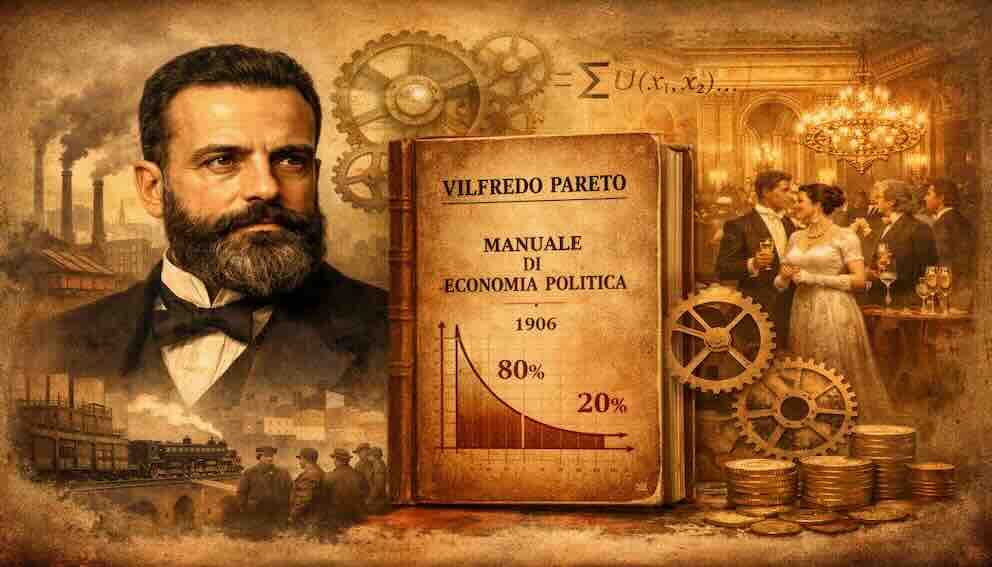
In 1906, an Italian engineer turned economist named Vilfredo Pareto published a book that would quietly transform how we understand wealth, efficiency, and markets. Manual of Political Economy was dense, mathematical, and never intended for popular audiences. Yet within its pages lay two ideas that became foundational to modern economics: the concept of Pareto efficiency, which asks whether resources can be rearranged to make someone better off without harming anyone else, and the striking observation that wealth consistently clusters among a small minority—a pattern later popularized as the Pareto Principle, or the 80/20 rule. Writing during an era of rapid industrialization and rising inequality, Pareto approached economics not as a philosopher but as an engineer searching for measurable patterns beneath the surface of social life. His work built upon the mathematical framework of his predecessor Léon Walras, but Pareto's genius was to simplify, clarify, and generalize, creating tools that would guide economists, investors, and policymakers for more than a century.
Introduction to the Book
At the beginning of the twentieth century, economics stood at a crossroads.
The classical economists—Smith, Ricardo, Mill—had built grand theories about markets, value, and distribution. Their work was philosophical, historical, and literary. They reasoned in paragraphs, not equations. They asked big questions about the nature of wealth and the forces that shaped human society.
But a new generation was emerging. Economists like Léon Walras in Switzerland and William Stanley Jevons in England had begun to apply mathematics to economic questions. They wanted to make economics more like physics—a science with laws expressed in precise formulas. They believed that beneath the apparent chaos of markets lay hidden structures that could be modeled and understood.
Vilfredo Pareto belonged to this new generation, but he brought something different to the project. He was not trained as an economist. He was trained as an engineer. His mind worked in patterns, curves, and statistical distributions. When he looked at society, he saw not just history and politics but data waiting to be analyzed.
Manual of Political Economy, published in 1906, was the result of this perspective. It was not a book for casual readers. It was dense, technical, and filled with mathematical reasoning. Yet buried within its pages were insights that would shape economics for the next century.
Pareto did two revolutionary things. First, he provided a rigorous way of thinking about economic efficiency that avoided subjective judgments about fairness. Second, he documented a pattern in wealth distribution so consistent that it suggested inequality might follow mathematical laws rather than random social accidents.
The book did not merely offer theories. It offered a way of seeing—a lens through which economists could observe the hidden structures of markets and societies.
What Pareto Was Trying to Fix in Economics
To understand why Pareto's book mattered, you have to understand what was wrong with economics before him.
Earlier economists, particularly those in the utilitarian tradition, had tried to measure "utility" as if it were a quantity. They imagined that happiness could be assigned numbers, that gains and losses could be calculated like profits and losses. Jeremy Bentham had famously proposed a "felicific calculus" that would add and subtract units of pleasure and pain.
But this approach had a fatal flaw. There was no way to measure utility. You could not observe happiness directly. You could not compare one person's satisfaction to another's. You could not say that my pleasure from a cup of coffee was twice as intense as your pleasure from a cup of tea.
Pareto saw this clearly. He argued that the entire project of measuring utility was misguided. Economics could not be built on unobservable quantities. It needed a foundation that rested on what could actually be seen and recorded.
His solution was to shift attention from measurable happiness to observable choices. We cannot see how satisfied people are, but we can see what they choose. We can observe that a person prefers a basket of apples to a basket of oranges. We can rank their preferences. But we cannot assign numbers to their satisfaction.
This shift—from cardinal utility to ordinal utility—was profound. It freed economics from the impossible task of measuring happiness and focused attention on what could actually be observed: the choices people make.
The Man Behind the Book: Vilfredo Pareto's Unusual Journey
Vilfredo Pareto was born in Paris in 1848, the same year revolutions swept across Europe. His family was Italian, and his father had been exiled for his political activism. Young Pareto grew up in an atmosphere where ideas about liberty, reform, and social change were debated with passion.
But Pareto did not begin his career as a thinker about society. He trained as an engineer, earning a degree from the Polytechnic University of Turin in 1870. For nearly two decades, he worked in industry—first as a railway engineer, then as a manager in iron and steel companies. He understood how systems worked, how to optimize processes, how to measure performance.
This background shaped everything that followed. Engineers are trained to see patterns, to measure precisely, to distrust explanations that cannot be tested. When Pareto later turned to economics, he brought this sensibility with him. He was not interested in philosophical speculation about human nature. He wanted data. He wanted curves. He wanted laws that could be observed and verified.
Yet Pareto's career was not smooth. He was outspoken, critical of corruption, and unwilling to play political games. He clashed with corporate leaders and government officials. Gradually, he retreated from public life and turned toward academic work.
His intellectual breakthrough came in the 1890s when he began studying wealth statistics. Examining tax records from Italy and other European countries, he noticed something peculiar. No matter which country he examined, the pattern was the same: a small minority controlled the majority of wealth. In Italy, he reportedly observed that about 20 percent of the population owned roughly 80 percent of the land. The numbers varied slightly, but the shape of the distribution remained consistent.
This observation fascinated him. It suggested that inequality might not be a random outcome of history or policy but something deeper—a structural feature of economic systems.
Pareto spent the rest of his career exploring this insight. In 1893, he succeeded Léon Walras as the chair of political economy at the University of Lausanne, becoming the leading figure in what became known as the Lausanne School of economics. He moved from economics into sociology, writing massive treatises on the nature of elites and the cycles of social change. But it was the Manual of Political Economy that contained his most enduring contributions.
The Lausanne School: The Intellectual Context
Pareto did not write in isolation. He inherited an intellectual project from his predecessor at Lausanne, Léon Walras.
Walras had developed the first mathematical model of general equilibrium—the idea that all markets in an economy are interconnected and reach balance simultaneously. His vision was ambitious: a system of equations showing how supply and demand in every market determined prices across the entire economy.
But Walras's work was difficult. His mathematics was complex, his presentation opaque, his assumptions sometimes unrealistic. Pareto's contribution was to simplify, clarify, and generalize Walras's system. He stripped away unnecessary complications, refined the mathematical framework, and showed how it could be applied more broadly.
Together, Walras and Pareto formed the Lausanne School, which pushed economics toward mathematical rigor and equilibrium analysis. Their work laid the foundation for much of modern microeconomics.
The Era in Which the Book Was Written
To understand what Pareto was attempting, you have to imagine Europe in the early twentieth century.
Industrialization had transformed society. Factories belched smoke over cities that had grown tenfold in a generation. Railroads connected regions that had once been days apart. Fortunes were made on a scale that would have astonished earlier centuries.
But alongside this wealth came immense inequality. Industrialists and financiers lived in luxury while factory workers labored long hours for subsistence wages. Political movements—socialism, anarchism, trade unionism—gained strength as people demanded change.
Economists were struggling to make sense of this world. The classical tradition had focused on production and distribution, but its tools were not designed to analyze the complex dynamics of industrial capitalism. New approaches were needed.
Pareto entered this debate as a scientist. He did not begin with a political position about whether inequality was good or bad. He began with data. He asked: what patterns can we observe? What regularities hold across different countries and different times?
This approach was itself revolutionary. Instead of arguing about what should be, Pareto focused on describing what is. And what he found disturbed people on both sides of the political divide. Conservatives did not want to hear that inequality followed predictable laws that might be resistant to policy. Socialists did not want to hear that even if you overthrew the elite, a new elite would likely emerge.
Pareto's work cut against comfortable narratives. It still does.
The Architecture of the Book: How Pareto Builds His Argument
*Manual of Political Economy* is not a book one reads for pleasure. It is a book one studies. Its arguments unfold slowly, building layer upon layer of mathematical and conceptual apparatus. But beneath the technical density lies a clear progression of thought. Pareto begins with individual choice, moves to market exchange, examines the conditions under which markets reach equilibrium, and finally turns to the distribution of wealth across society. Each step builds on the ones before. More than a century later, economists still work within this structure, refining, extending, and sometimes challenging it, but never escaping its influence.
From Measurable Utility to Ordinal Preferences
Pareto begins by clearing the ground. He rejects the idea that utility can be measured.
Earlier economists had tried to treat utility as a quantity. They imagined that happiness could be assigned numbers. Jeremy Bentham had proposed a "felicific calculus" that would add and subtract units of pleasure and pain.
Pareto saw this as a dead end. There was no way to measure utility. You could not observe happiness directly. You could not compare one person's satisfaction to another's.
To escape this dead end, Pareto introduced a new concept: **ophelimity**. He coined the term to avoid the philosophical baggage of "utility." Ophelimity is purely behavioral. It refers to the satisfaction revealed by choice, nothing more.
If a person chooses an apple over an orange, we can say that apple has greater ophelimity for them at that moment. We cannot say how much greater. We can only observe the choice.
This was radical. It meant that economics no longer needed to make claims about happiness or welfare. It could restrict itself to what could be observed: the choices people make.
Indifference Curves
Building on this foundation, Pareto refined the concept of **indifference curves**. These are graphical representations showing combinations of goods that give a consumer equal satisfaction.
Imagine a consumer choosing between apples and oranges. There are many combinations that would leave them equally satisfied—ten apples and two oranges, perhaps, or five apples and five oranges. Plot these points on a graph, connect them, and you have an indifference curve.
Indifference curves became one of the most important tools in microeconomics. They allow economists to analyze consumer choice without measuring utility. They show how people trade off between different goods, how they respond to changes in prices, how they allocate their limited resources.
Consider a simple example. Someone has a lunch budget of ten dollars. They can buy sandwiches for five dollars each or coffee for two dollars each. Their choices will trace out a pattern. They might buy two sandwiches and no coffee, or one sandwich and two coffees, or no sandwiches and five coffees. The combinations that leave them equally satisfied form an indifference curve. The curve does not measure happiness; it maps preferences.
Pareto Efficiency
From this framework emerges Pareto's most famous contribution. He asked: when can we say that an economic system is performing efficiently?
His answer became known as **Pareto efficiency**. A situation is Pareto efficient if no reallocation of resources can make one person better off without making someone else worse off.
This definition says nothing about fairness or equality. It simply identifies situations where all possible gains from exchange have been exhausted.
Imagine two neighbors trading at a weekend market. One grows apples, the other produces honey. If the apple grower trades a basket of apples for a jar of honey, both may feel better off. As long as such mutually beneficial trades exist, the current situation is not Pareto efficient. Only when every possible beneficial trade has already happened—when no exchange can improve someone's situation without hurting someone else—has the system reached an efficient state.
This concept became central to welfare economics. It provides a way of evaluating policies without subjective judgments about who deserves what. If a policy can make some people better off while harming no one, it is clearly desirable.
General Equilibrium
Pareto built on the work of Léon Walras, his predecessor at the University of Lausanne. Walras had developed the theory of **general equilibrium**—the idea that all markets in an economy are interconnected and reach balance simultaneously.
Walras's vision was ambitious: a system of equations showing how supply and demand in every market determined prices across the entire economy. But his work was difficult to follow.
Pareto refined and extended this framework. He showed how the conditions for equilibrium could be expressed more clearly, how changes in one market ripple through others, how the system as a whole tends toward a state where supply and demand balance everywhere.
This work laid the foundation for much of modern microeconomics. It treated the economy as an integrated system with complex interdependencies. A change in the price of wheat affects farmers, bakers, consumers—the entire chain of production and exchange.
Together, Walras and Pareto formed the **Lausanne School**, a tradition that pushed economics toward mathematical rigor and equilibrium analysis.
The Distribution of Wealth
After establishing his framework for analyzing efficiency and exchange, Pareto turned to a different question: how is wealth actually distributed in real societies?
He examined data from multiple countries—tax records from Italy, income statistics from England, inheritance records from France—and found a striking pattern. In every case, wealth followed a consistent distribution. A small fraction of the population held a large fraction of the total wealth.
This pattern could be expressed mathematically. If you plotted wealth on one axis and the number of people holding that wealth on another, the curve had a characteristic shape—steep at the top where the wealthy few sat, sloping downward through the middle classes, with a long tail trailing off.
Pareto derived an equation, now known as the **Pareto distribution**, that described how wealth was spread across populations. The exact numbers varied, but the shape remained remarkably stable.
Pareto did not emphasize the specific numbers 80 and 20. That shorthand was popularized later by quality-management thinker Joseph Juran, who observed that 80 percent of problems often came from 20 percent of causes and named the pattern after Pareto. What Pareto himself discovered was a **power-law distribution**—a mathematical relationship showing that wealth consistently concentrates in a predictable pattern.
Look at the technology sector today. A handful of companies—Apple, Microsoft, Nvidia, Google—represent an enormous share of total stock market value. Thousands of smaller firms exist, but a small minority dominates the wealth created. The shape of this distribution would have looked familiar to Pareto.
Look at venture capital returns. A tiny fraction of investments generate the majority of profits. Look at book sales. A small number of titles account for most revenue. Wherever you find large systems with many participants, the Pareto distribution tends to appear.
The Implications of the Pareto Distribution
Pareto drew two conclusions from his findings.
First, the consistency of the distribution suggested that wealth concentration was not accidental. It appeared to be a structural feature of economic systems.
Second, this meant that efforts to redistribute wealth might face inherent limits. If the distribution followed a mathematical law, attempts to change it might be resisted by underlying economic forces.
These conclusions made people on both sides of the political divide uncomfortable. Conservatives did not want to hear that inequality was structural. Socialists did not want to hear that even after revolution, a new elite might emerge.
Pareto himself drew no simple political conclusions. He was describing patterns, not prescribing policies. But the patterns themselves had implications that could not be ignored.
Efficiency vs. Equality
One of the most provocative implications of Pareto's framework was the distinction between efficiency and equality.
A system can be perfectly Pareto efficient while producing extreme inequality. Imagine a society where one person holds all the wealth and everyone else lives at subsistence. This society could still be Pareto efficient if any attempt to redistribute would make the wealthy person worse off.
This observation sparked decades of debate. Pareto's framework did not resolve it, but it clarified it. By separating efficiency from fairness, he forced economists to be explicit about what they were claiming.
The Mathematical Approach
Underlying all of Pareto's work was a deep commitment to mathematics. He believed that economic relationships could be expressed through equations and statistical patterns.
This was not obvious at the time. Many economists still wrote in prose, reasoning philosophically about human nature. Pareto insisted that if economics wanted to be a science, it needed to measure, to calculate, to express its findings mathematically.
His own work exemplified this approach. He derived equations for indifference curves. He formulated the conditions for general equilibrium. He found a mathematical expression for the distribution of wealth. In each case, the mathematics was the substance of the argument.
This commitment shaped the future of economics. Today, economic theory is expressed in equations, economic data is analyzed with statistical tools, and economic models are built on mathematical foundations. Pareto was one of the pioneers who made this possible.
How the Book Was Received
When Manual of Political Economy first appeared, it was not an immediate sensation. The book was mathematically dense, written for specialists rather than general readers. Its influence grew slowly, filtering through academic circles rather than bursting into public consciousness.
Within economics, however, the work gained recognition as a technical achievement. Economists appreciated its rigor, its mathematical precision, its attempt to build a consistent theoretical framework.
Later economists built on Pareto's foundations. Abba Lerner, John Hicks, and others developed the welfare economics that made Pareto efficiency a practical tool for policy analysis. Paul Samuelson incorporated Pareto's insights into the neoclassical synthesis that dominated mid-century economics.
The book's influence extended beyond economics into other fields. Sociologists drew on Pareto's later work about elites. Management consultants popularized the Pareto Principle. Statisticians studied the properties of Pareto distributions.
How It Changed Finance and Economic Thinking
The influence of Pareto's work spread across multiple domains.
In microeconomics, his concepts of ordinal utility and indifference curves became foundational. They provided tools for analyzing consumer choice without making unrealistic assumptions about measurable happiness.
In welfare economics, Pareto efficiency became the standard framework for evaluating policies. It allowed economists to identify situations where resources could be rearranged to make someone better off without harming others.
In the study of inequality, Pareto's distribution provided a mathematical language for describing how wealth concentrates. Researchers could now measure inequality precisely, compare across countries, track changes over time.
In finance, the Pareto Principle appears everywhere. Analysts observe that a small number of investments often produce the majority of returns. Portfolio managers think about concentration risk in Pareto terms. Venture capitalists know that a few big wins typically drive overall fund performance.
In business strategy, the 80/20 rule became a heuristic for focusing attention. Identify the 20 percent of customers who generate 80 percent of revenue. Identify the 20 percent of efforts that produce 80 percent of results. Focus there.
In public policy, Pareto efficiency provides a benchmark for evaluating regulations, taxes, and programs. Policymakers ask whether a proposed change can make some people better off without harming others.
What Still Stands—and What Has Not Survived
A book written in 1906 cannot capture every dimension of modern economics. Some aspects of Pareto's work have aged better than others.
What Still Stands
Pareto efficiency remains a foundational concept. Every economics student learns it. Every policy analyst uses it, whether consciously or not.
The Pareto distribution continues to appear in studies of income and wealth. Researchers still find that wealth concentrates in patterns that resemble Pareto's original observations.
Ordinal utility is now standard. Economists no longer try to measure utility cardinally; they work with preferences and choices.
Indifference curves are taught in every microeconomics course. They remain essential tools for analyzing consumer behavior.
General equilibrium theory has been refined and extended, but Pareto's contributions to it remain recognized.
The Pareto Principle has become part of popular culture. It is used in business, productivity, investing, and countless other domains.
What Has Not Survived
Some of Pareto's specific mathematical formulations have been superseded by more sophisticated techniques. Modern econometrics offers tools Pareto could not have imagined.
Pareto's broader sociological theories, particularly his later work on elites, have not achieved the same level of acceptance as his economic contributions. They remain influential in certain circles but are not part of mainstream economics.
The idea that inequality is inevitable has been challenged by research showing that policy choices significantly affect distribution. Pareto's observations about consistent patterns do not imply that policy is powerless.
Pareto's skepticism about redistribution was not a necessary conclusion from his empirical work. Later economists have shown that redistribution can improve welfare even when it violates Pareto efficiency in narrow terms.
Why This Book Still Matters Today
More than a century after its publication, Manual of Political Economy remains essential reading for anyone who wants to understand how economists think about efficiency, distribution, and markets.
Consider the debates that dominate contemporary politics.
When policymakers argue about taxes and transfers, they are implicitly wrestling with questions Pareto framed: Can we make some people better off without harming others? How do we evaluate policies that help some while hurting others? What does it mean for an economy to be working well?
Pareto efficiency provides a language for these debates. It does not resolve them—no concept can do that—but it clarifies what is at stake.
Consider the study of inequality. Researchers still use Pareto distributions to describe how wealth concentrates. They still debate whether the patterns Pareto observed are inevitable or responsive to policy. They still grapple with the relationship between efficiency and equality.
Consider financial markets. Investors still observe that a small number of holdings often drive returns. Portfolio managers still think about concentration risk in terms that Pareto would recognize. Venture capitalists still bet on the power law distribution of outcomes.
Consider business strategy. The Pareto Principle remains a useful heuristic for focusing attention. Identify the vital few. Ignore the trivial many. Focus resources where they will have the greatest impact.
Pareto's work matters because it revealed hidden patterns. Before him, people observed that some were rich and most were not. After him, they could see that this distribution was not random—that it followed a shape, a curve, a mathematical regularity.
This insight changes how we see the world. It suggests that beneath the apparent chaos of markets and societies, there are structures waiting to be discovered. It invites us to look for patterns, to measure carefully, to think in terms of distributions rather than anecdotes.
And it reminds us that economics, at its best, is not just about opinions and arguments. It is about finding the hidden regularities that shape human life.
Pareto's work does not tell us whether inequality is good or bad. What it does is force us to confront a deeper question: if certain patterns appear again and again in economic life, are they accidents—or are they structural features of how human societies organize themselves?
Conclusion
Vilfredo Pareto published Manual of Political Economy in 1906, at a time when Europe was wrestling with industrialization, inequality, and social unrest. He approached these questions not as a partisan but as a scientist—an engineer trained to see patterns, to measure precisely, to seek laws beneath the surface of events.
The book that emerged from this perspective gave economics two of its most enduring concepts. Pareto efficiency provided a way of thinking about economic outcomes without subjective judgments about fairness. The Pareto distribution revealed that wealth concentration follows consistent patterns across societies.
More than a century later, these ideas remain foundational. They appear in every economics textbook, every policy analysis, every serious discussion of inequality and efficiency. They have spread beyond economics into business, finance, and popular culture.
But Pareto's deeper contribution may be methodological. He showed that economics could be a science—not in the sense of discovering absolute laws like physics, but in the sense of finding patterns, measuring them carefully, and building theories that can be tested against data.
The Manual of Political Economy is not an easy book. It was never meant to be. But for those willing to work through its arguments, it offers something rare: a way of seeing that transforms how we understand markets, wealth, and the hidden structures of social life.
Beneath the apparent chaos, Pareto showed, there are patterns. Finding them is the work of economics.
About Swati Sharma
Lead Editor at MyEyze, Economist & Finance Research WriterSwati Sharma is an economist with a Bachelor’s degree in Economics (Honours), CIPD Level 5 certification, and an MBA, and over 18 years of experience across management consulting, investment, and technology organizations. She specializes in research-driven financial education, focusing on economics, markets, and investor behavior, with a passion for making complex financial concepts clear, accurate, and accessible to a broad audience.
Disclaimer
This article is for educational purposes only and should not be interpreted as financial advice. Readers should consult a qualified financial professional before making investment decisions. Assistance from AI-powered generative tools was taken to format and improve language flow. While we strive for accuracy, this content may contain errors or omissions and should be independently verified.