
Tutorial Categories
Last Updated: March 28, 2026 at 15:30
The Theory of Economic Development: A Walk Through the Book That Put Entrepreneurs at the Center of Capitalism
How Schumpeter Discovered That Innovation, Not Equilibrium, Drives Economic Growth
In 1911, a brilliant and ambitious Austrian economist named Joseph Schumpeter published a book that would eventually transform how the world understands economic growth, innovation, and capitalism itself. The Theory of Economic Development arrived at a time when most economists still thought of markets as systems that naturally tended toward equilibrium—a gentle balance of supply and demand. Schumpeter saw something else entirely. He looked at the explosive changes of the industrial age—the railways that replaced canals, the factories that swallowed workshops, the new fortunes that appeared seemingly overnight—and asked a different question. What if disruption, not stability, was the real engine of progress? What if economies grew not through gradual accumulation but through violent bursts of innovation that swept away the old to make room for the new? His answers introduced a new way of understanding capitalism itself: the entrepreneur as the agent of change, the banking system as the enabler of transformation, and the concept—later immortalized in a phrase he would coin decades afterward—of creative destruction. Though the book was dense and slow to find its audience, it eventually became one of the most influential works in modern economic thought, shaping how economists, investors, and policymakers understand the restless, relentless energy of capitalism.
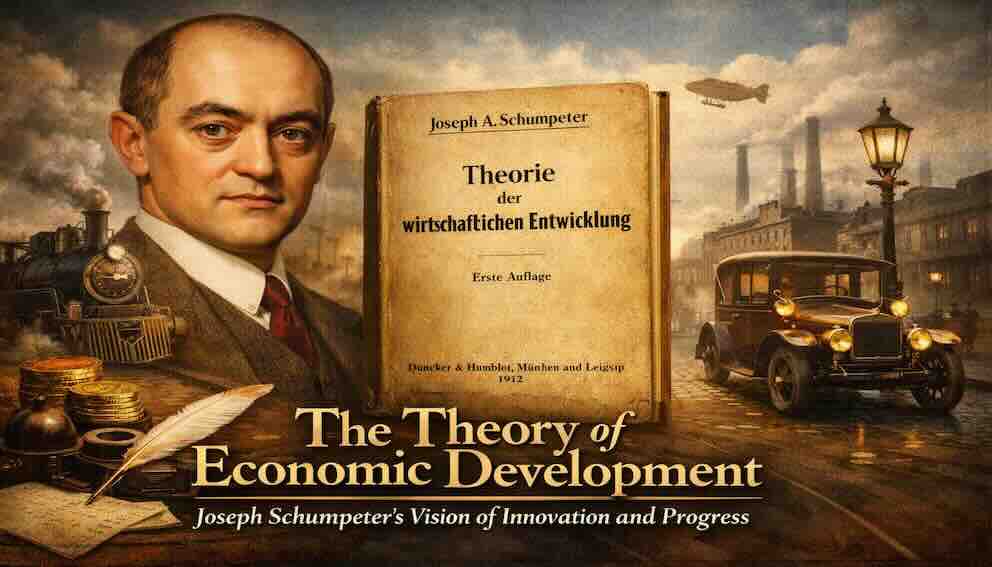
Introduction to the Book
Picture yourself walking through a city in 1910. The streets are filled with horse-drawn carriages, but every year there are more automobiles. Factory smokestacks rise where farms once stood. Electric lights are replacing gas lamps. Telegraph wires crisscross the sky, and telephones are beginning to appear in homes and offices.
Now imagine being an economist trained to believe that the economy is fundamentally stable—a system that naturally moves toward balance, where change happens slowly and predictably. How would you make sense of what you were seeing?
This was the puzzle that confronted Joseph Schumpeter.
Most economists of his era thought about economies the way physicists thought about pendulums: they swing, but they always return to rest. Markets, they believed, tended toward equilibrium. Growth came from accumulating more capital and more labor, not from fundamental disruption.The dominant framework, inherited from classical economists like Adam Smith and David Ricardo and later refined by marginalist economists, focused on equilibrium. It was a static picture of a world that was anything but static.
Schumpeter rejected this entirely. He argued that the real story of capitalism was not equilibrium but upheaval. Economies grow not because they settle into comfortable balance, but because entrepreneurs constantly disrupt the existing order with new technologies, new products, and new ways of doing business.
The Theory of Economic Development was his attempt to build a new framework—one that placed innovation, not stability, at the center of economic life. The question he set out to answer was deceptively simple: what causes economic development? But his answer would reshape how generations of thinkers understood capitalism itself.
The Man Behind the Book: The Brilliant and Unforgettable Joseph Schumpeter
Joseph Schumpeter was born in 1883 in Triesch, a small town in what was then the Austro-Hungarian Empire and is now the Czech Republic. His father died when he was only four years old, and his mother moved the family to Vienna, the imperial capital, where young Schumpeter could receive a proper education.
Vienna at the turn of the century was one of the intellectual capitals of the world. In its cafés and lecture halls, thinkers were reshaping philosophy, psychology, art, and economics. Sigmund Freud was developing psychoanalysis. Gustav Klimt was painting. Gustav Mahler was composing. And in the economics faculty, a generation of brilliant theorists was debating the nature of value, capital, and markets.
Schumpeter absorbed it all. He studied at the University of Vienna under some of the leading economists of the age, including Eugen von Böhm-Bawerk, whose work on capital and interest would influence his own thinking. He immersed himself in the history of economic thought, mastering the theories of everyone from the mercantilists to the marginalists.
Schumpeter was not a man of modest ambitions. As a young man, he reportedly declared that he wanted to achieve three things in life: become the greatest economist in the world, the best horseman in Austria, and the greatest lover in Vienna. Later in life, he joked that he had succeeded in two of the three—though he never clarified which two.
His personal life was marked by both achievement and tragedy. He held academic positions in Vienna, Chernivtsi, Graz, and later Bonn and Harvard. He served briefly as Austria's minister of finance in 1919, a tenure that ended in frustration. He married three times. His second wife, Annie, died in childbirth in 1926, along with their infant son. Schumpeter was devastated, and some believe he never fully recovered.
Despite these personal blows, he continued to produce groundbreaking work. His intellectual courage allowed him to challenge the dominant economic theories of his time, even when those theories were held by colleagues he respected. He was not afraid to be wrong, and he was not afraid to be alone in his views.
By the time he arrived at Harvard in the 1930s, he was one of the most famous economists in the world. His students would go on to shape the discipline for decades. And his ideas, which had seemed radical in 1911, were finally finding their audience.
The Era That Produced the Book: Capitalism in Full Ferment
To understand why Schumpeter saw what others missed, you have to understand the world he was observing.
The year 1911 sat at the crossroads of two economic ages. The first industrial revolution, built on steam and iron, had transformed Britain and then Europe in the eighteenth and nineteenth centuries. The second industrial revolution, built on steel, electricity, and chemicals, was now in full swing.
Railways had spread across continents, shrinking distances and creating national markets. Telegraph cables crossed oceans, allowing information to travel faster than any ship. New industrial giants—Carnegie in steel, Rockefeller in oil, Krupp in armaments—had built fortunes on a scale never seen before.
Entire industries were appearing and disappearing with astonishing speed. In 1880, the automobile barely existed. By 1910, it was beginning to remake transportation, and with it, the geography of cities, the nature of work, and the structure of whole economies.
Consider the automobile itself. When it first appeared, it did not merely create a new product. It destroyed the carriage-making industry. It transformed the oil industry, creating demand for gasoline that had never existed. It reshaped cities, enabling suburbs and commuting. It spawned new industries—road construction, repair shops, traffic management—that no one had imagined. This was exactly the kind of transformation Schumpeter had in mind.
Yet the economic theories of the time had little to say about any of this. They focused on equilibrium, on balance, on the gentle adjustments of supply and demand. They were theories of a world that had already passed.
Schumpeter saw the gap between theory and reality. In the cafés of Vienna, where intellectuals debated everything from psychoanalysis to socialism, he began developing a theory that placed change at the center. Not gradual, incremental change, but violent, disruptive, revolutionary change.
The Architecture of the Book: How Schumpeter Builds His Argument
The Theory of Economic Development unfolds as a carefully constructed argument. Schumpeter begins with the static world of conventional economics, then introduces the forces that shatter it. The book's structure is built on a fundamental contrast: between the circular flow of routine economic life and the disruptive process of development. As his argument progresses, each step reveals a new layer of insight, building toward a complete picture of how capitalism evolves.
The Circular Flow
Schumpeter starts by describing what he calls the **circular flow** of economic life. This is the world of routine, of repetition, of supply and demand finding their balance. In this world, every economic process repeats itself. The same goods are produced the same way year after year. Firms earn just enough to cover their costs. There is no profit, no growth, no development. Managers run businesses, but no one disrupts them.
This circular flow was what most economists studied. It was the world of equilibrium, of stable markets, of predictable outcomes. It was a useful abstraction, but it was not the whole story. And by starting here, Schumpeter establishes a baseline: a world without development. Only by understanding this static world can we appreciate what development actually means.
From this foundation, Schumpeter draws a key insight: development is different from growth. Growth is quantitative—more of the same. Development is qualitative—a transformation in how the economy works. The book is about development, not growth.
Development as a Different Kind of Change
For Schumpeter, development was something qualitatively different from ordinary growth. But what causes it?
The source of this transformation was what Schumpeter called **new combinations**—*neue Kombinationen*. Development occurs when someone introduces a new combination that disrupts the circular flow and reshapes economic life.
These new combinations could take five forms:
First, a new good—something consumers have never seen before. When the automobile appeared, it was not a slightly better horse and carriage. It was something entirely different.
Second, a new method of production—a way of making existing goods more efficiently. The Bessemer process for making steel did not create a new product, but it transformed an industry.
Third, a new market—a place where a product has never been sold before. When American companies began selling in Europe, or European companies in Asia, they created new combinations.
Fourth, a new source of supply—raw materials or components from somewhere new. When Britain began importing wheat from the American prairies, it transformed both British agriculture and the American economy.
Fifth, a new organization of an industry—creating a monopoly, perhaps, or breaking one up. The trust movement in America, the cooperative movement in Europe—these were organizational innovations.
Each of these five forms represents a different way of disrupting the circular flow and creating development.
From this observation Schumpeter arrives at a crucial conclusion: new combinations are the source of development. Without them, the economy would simply repeat itself forever.
The Entrepreneur
If new combinations are the source of development, what brings them into existence? Schumpeter's answer is the entrepreneur.
But Schumpeter's entrepreneur is not just any business owner. The entrepreneur is a special type of person—someone who sees possibilities that others do not, who has the will to act despite uncertainty, who introduces new combinations that disrupt the existing order.
The entrepreneur does not necessarily invent anything. Invention is the work of scientists and engineers. The entrepreneur commercializes inventions, bringing them into the economic world, forcing markets to adapt, creating value where none existed.
There is a crucial distinction here that Schumpeter emphasizes: entrepreneurs are temporary. Once the innovation becomes routine, once the new combination is established, the entrepreneur becomes a manager. The special function disappears until a new innovation is needed. The entrepreneur is not a permanent state but a historical role.
From this emerges Schumpeter’s view of the entrepreneur as the central agent of economic change—a role that is inherently temporary, disappearing once innovation becomes routine.
The Banking System as Enabler
But entrepreneurs cannot act alone. They need resources—materials, labor, equipment—before their innovations generate any revenue. Where do these resources come from?
They come from credit. But Schumpeter's view of credit was distinctive. Banks do not merely transfer existing purchasing power from savers to borrowers. They create new purchasing power that did not exist before.
This was a radical idea. It meant that banks were not neutral intermediaries but active agents of development. By creating credit, they enabled entrepreneurs to bid resources away from their existing uses and reorganize the economy. The banking system, in Schumpeter's framework, was essential to economic transformation.
From this perspective, banks emerge as creators of purchasing power and key agents of development. Without credit, entrepreneurs would lack the resources needed to implement their ideas.
Profit as a Temporary Reward
When an entrepreneur succeeds, they earn profit. But what is this profit?
Schumpeter argues that profit is not a permanent return on capital. It is a temporary reward for being first.
Competitors see the success and imitate. They copy the innovation, adapt it, improve it. As they enter, prices fall, costs rise, and the profit margin shrinks. Eventually, the innovation becomes routine, absorbed into the circular flow. The entrepreneur, having done their work, fades into the background.
This is why Schumpeter saw profit as a signal, not a permanent condition. It is the reward for disruption, and it disappears as disruption becomes routine.
In Schumpeter’s framework, profit is never permanent. It exists only for as long as the innovator remains ahead of those who soon imitate the idea.
The Business Cycle
Schumpeter now asks: if innovation drives development, why does the economy experience cycles of boom and bust?
His answer lies in the observation that innovations do not appear in a smooth, continuous stream. They **cluster**. A major breakthrough in one industry enables breakthroughs in others. The railway makes possible national markets, which make possible mass retailing, which makes possible new forms of advertising and distribution.
This clustering creates the business cycle. A wave of innovation brings rapid growth, then consolidation, then a pause until the next wave. Schumpeter saw the cycle not as a flaw in capitalism but as its essential rhythm. The boom is when new combinations are being implemented. The bust is when the economy adjusts to the changes.From this observation Schumpeter arrives at an explanation for economic cycles. Innovations tend to appear in clusters, creating waves of expansion followed by periods of adjustment.
Creative Destruction
As Schumpeter traces this process, a deeper pattern emerges. Innovation destroys the old to make way for the new. The automobile destroys the horse-and-carriage industry. Electricity destroys the gaslight industry. Digital photography destroys film.
The famous phrase creative destruction does not appear in this book. Schumpeter would coin it decades later, in Capitalism, Socialism and Democracy (1942). But the concept is already here, woven through every page. This destruction is not incidental. It is essential. Capitalism advances by killing its own creations, clearing the ground for something better.
Schumpeter saw this not as a tragedy but as the very mechanism of progress. The pain of disruption was real, but it was inseparable from the gains of innovation.
This is an important insight by Schumpeter: creative destruction is the engine of progress. The new emerges only through the destruction of the old.
Capitalism as Process
Stepping back, Schumpeter arrives at his most fundamental conclusion. Capitalism cannot be understood as a static structure—a set of markets in equilibrium. It must be understood as a process, constantly evolving, always becoming something else.
To understand capitalism, you have to study its history, its dynamics, its patterns of disruption and adaptation. The equilibrium models that dominated economics were not wrong, but they were incomplete. They captured the circular flow but missed the development.
What emerges from Schumpeter’s argument is a powerful conclusion: capitalism is not a static structure but an evolving process. It is always in motion, continually reshaping itself through innovation.
Through this progression—from circular flow to new combinations, from entrepreneur to banker, from profit to cycle to creative destruction—Schumpeter builds a complete theory of economic development. Each step follows logically from the one before, each insight builds on what came earlier. By the time the reader reaches the end, the static world of conventional economics has been replaced by something richer and more dynamic: a vision of capitalism as perpetual revolution, driven by the restless energy of entrepreneurs and the transformative power of innovation.
How the Book Was Received
When The Theory of Economic Development first appeared in German in 1911, it did not become an instant classic. The book was dense, theoretical, and addressed primarily to academic economists. Many readers found it difficult. Its arguments challenged too many assumptions.
The timing was also unfortunate. Within a few years, Europe would be consumed by World War I, disrupting intellectual life across the continent. Schumpeter himself would spend the war years and their aftermath in a series of academic and political posts, including a brief and frustrating tenure as Austria's finance minister.
An English translation did not appear until 1934, by which time Schumpeter had been teaching at Harvard for two years. By then, the world had changed. The Great Depression had shaken faith in classical economics. The rise of socialism and communism posed new challenges to capitalist systems. And Schumpeter's emphasis on innovation, entrepreneurship, and creative destruction suddenly seemed remarkably relevant.
Over the following decades, the book's influence grew. By the mid-twentieth century, it was widely recognized as one of the foundational texts of innovation economics. Today, it is required reading for anyone who wants to understand how economies evolve.
How It Changed the World of Finance and Economic Thinking
The influence of Schumpeter's ideas spread far beyond academic economics.
It reshaped how economists think about growth. Before Schumpeter, growth theory focused on capital accumulation and labor inputs. After Schumpeter, economists began to take seriously the role of innovation, technology, and entrepreneurship.
It created a new field of study. Innovation economics, now a thriving subdiscipline, traces its roots directly to Schumpeter's work.
It influenced business strategy. The concept of creative destruction became a framework for thinking about competitive advantage, disruption, and the need for continuous innovation.
It shaped venture capital and startup culture. Modern venture capital is built on Schumpeterian premises: that new firms can disrupt established industries, that entrepreneurs need external funding to realize their visions, and that the rewards for successful disruption can be enormous.
It entered the language of investors. When technology investors talk about "disruption," they are speaking Schumpeter's language. When they look for companies that can reshape industries, they are applying his framework.
It influenced public policy. Governments around the world now pursue innovation policies—supporting research and development, funding entrepreneurship, building innovation ecosystems—that reflect Schumpeterian thinking.
What Still Stands—and What Has Not Survived
A book written in 1911 cannot capture every dimension of modern capitalism. Some aspects of Schumpeter's framework have been refined, challenged, or superseded.
What Still Stands
The centrality of innovation is now widely accepted. Economists agree that technological progress is the primary driver of long-run growth.
The role of the entrepreneur is recognized as essential. Entrepreneurship research has become a major field, and policymakers around the world seek to foster entrepreneurial ecosystems.
Creative destruction remains the best description of how capitalism evolves. The rise of digital technology, the decline of traditional retail, the transformation of media—all reflect Schumpeter's vision.
The clustering of innovations is observable throughout economic history. Each major technological wave—steam, electricity, computing, the internet—has brought a cluster of related innovations.
The importance of credit for innovation is well understood. Access to capital is recognized as a critical constraint on entrepreneurial activity.
The distinction between entrepreneurs and managers remains useful. Not everyone who runs a business is an innovator.
What Has Not Survived
The exclusive focus on individual entrepreneurs has been modified. Modern research recognizes that innovation also comes from large firms, research institutions, and collaborative networks.
The sharp distinction between inventors and entrepreneurs is less rigid than Schumpeter suggested. Many innovators combine both roles.
The business cycle is now understood through multiple lenses, not only innovation clusters. Monetary policy, financial instability, and global factors also play important roles.
Some of Schumpeter's predictions about the future of capitalism—particularly his later suggestion that it might evolve into socialism—have not come to pass.
Why This Book Still Matters Today
Schumpeter's great achievement in The Theory of Economic Development was to transform the question economists were asking. Instead of asking how markets achieve equilibrium, he asked what forces break equilibrium and create development. Instead of studying stability, he studied disruption. Instead of focusing on managers, he focused on entrepreneurs.
More than a century after its publication, these questions remain central.
Consider the world around you. Smartphones have replaced cameras, GPS devices, maps, newspapers, and music players. Streaming has upended television and film. E-commerce has transformed retail. Ride-sharing has disrupted taxis. Artificial intelligence is beginning to reshape everything from writing to coding to medical diagnosis.
This is creative destruction in action. Each new wave of innovation sweeps away old industries and creates new ones. Jobs disappear and appear. Fortunes are made and lost. The economy transforms itself, continuously and relentlessly.
Schumpeter saw this pattern a century ago. He understood that stability was not the natural state of capitalism. Disruption was. And he understood that this disruption, however uncomfortable, was the source of progress.
For investors, Schumpeter's framework suggests paying attention to companies that can innovate, that can disrupt, that can create new markets. For entrepreneurs, it offers a vision of their role as agents of economic transformation. For policymakers, it raises questions about how to foster innovation while managing the disruptions it creates.
And for anyone trying to understand the modern economy, it provides a lens through which the chaos of technological change becomes visible as a pattern—a rhythm of creation and destruction that has driven progress for centuries.
Schumpeter's great insight was that capitalism is not a machine that tends toward rest. It is a living process that evolves through conflict, through disruption, through the constant overturning of the old by the new. Understanding that process is the beginning of wisdom about economic life.
Conclusion
Joseph Schumpeter published The Theory of Economic Development in 1911, at a time when the industrial age was reaching its peak and a new century of innovation was beginning. His book was dense, difficult, and slow to find its audience. But its ideas were too powerful to remain obscure.
Over the following decades, Schumpeter's vision of capitalism as a process of creative destruction became one of the most influential frameworks in economic thought. It reshaped how economists think about growth, how investors evaluate companies, how entrepreneurs understand their role, and how policymakers approach innovation.
The world has changed enormously since 1911. The technologies that excited Schumpeter—railways, electricity, steel—have been superseded by digital technologies that he could not have imagined. But the dynamics he described remain the same. New innovations still disrupt old industries. Entrepreneurs still challenge established giants. Credit still enables transformation. And creative destruction still drives progress.
Schumpeter's book matters because it reveals the hidden logic beneath the surface chaos of capitalism. It shows us that disruption is not a bug but a feature—that the constant overturning of the old is what makes the system work.
And it leaves us with a question that every generation must answer anew: how do we embrace the creative destruction that drives progress while managing the destruction it leaves in its wake?
About Swati Sharma
Lead Editor at MyEyze, Economist & Finance Research WriterSwati Sharma is an economist with a Bachelor’s degree in Economics (Honours), CIPD Level 5 certification, and an MBA, and over 18 years of experience across management consulting, investment, and technology organizations. She specializes in research-driven financial education, focusing on economics, markets, and investor behavior, with a passion for making complex financial concepts clear, accurate, and accessible to a broad audience.
Disclaimer
This article is for educational purposes only and should not be interpreted as financial advice. Readers should consult a qualified financial professional before making investment decisions. Assistance from AI-powered generative tools was taken to format and improve language flow. While we strive for accuracy, this content may contain errors or omissions and should be independently verified.