
Tutorial Categories
Last Updated: January 31, 2026 at 19:30
Executive Compensation and Incentive Design: Aligning Managerial Decisions with Sustainable Value Creation in Corporations - Corporate Finance Series
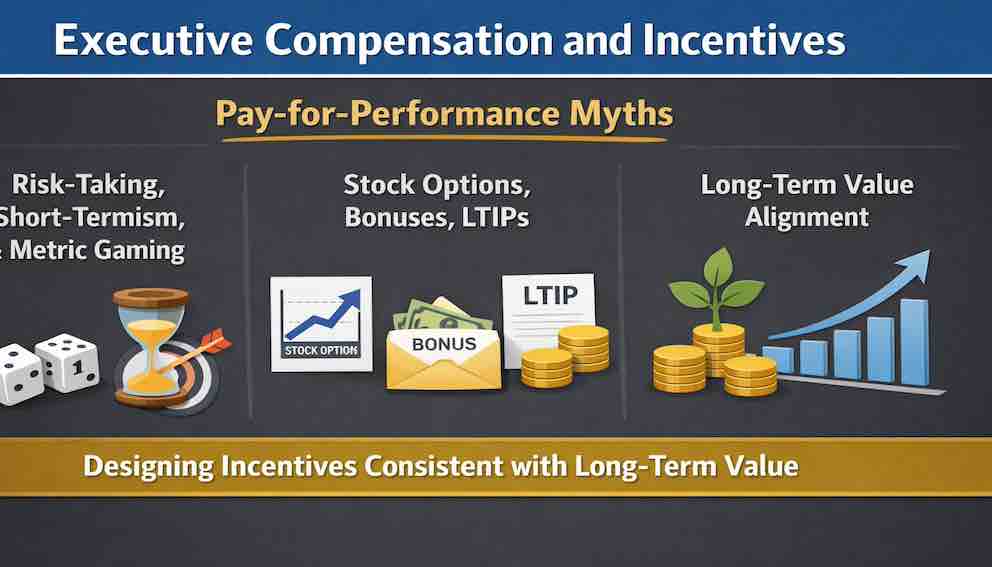
This tutorial explores how executive compensation is the critical transmission mechanism that converts strategy into action. We move beyond the myth of "pay-for-performance" to examine how poorly structured incentives can encourage short-termism and hidden risk, while a strategically-aligned "best-fit" design reinforces long-term value. Through practical frameworks and decision-driven examples, you will learn how to tailor incentive plans to a company's lifecycle and strategic tensions, using metrics that drive disciplined capital allocation and sustainable growth. By the end, you'll understand how to build a compensation system that acts as the engine for your corporate strategy.
Introduction: The Critical Link Between Pay and Performance
In our previous discussion on corporate governance, we established that boards and structures provide the oversight necessary for sound decision-making. However, oversight alone cannot drive behavior. As we learned, governance provides the "rules of the game," but executive incentives are the rules that actually change how the game is played. They are the direct lever that translates oversight into real-world action.
At its core, executive compensation is not an expense to be minimized, but a strategic tool to solve the principal-agent problem. It is the system that answers the question: "How do we ensure the people running the company act like its long-term owners?" When designed poorly, it is the single greatest source of misaligned capital allocation and value destruction. When designed with strategic intent, it becomes the engine that powers sustainable growth.
The Principal-Agent Problem and Behavioral Realities
The fundamental challenge is the separation of ownership and control. Shareholders (principals) own the ship and chart the course toward long-term value. Executives (agents) are the captains hired to navigate.
The captain's decisions, however, are filtered through powerful psychological and behavioral biases. A captain is naturally:
- Present-biased, leaning toward actions that deliver rewards today over a greater reward tomorrow.
- Risk-averse with their own career, potentially avoiding bold but necessary strategic moves.
- Metric-focused, optimizing for what is measured, often at the expense of what is not.
Compensation is the navigation system you give the captain. A simplistic system rewarding only short-term speed (quarterly EPS) will activate these biases, encouraging burning excess fuel (cutting maintenance) to hit targets. A system calibrated for the journey must actively counteract these biases, rewarding prudent risk-taking and long-term stewardship.
The Components of Pay: More Than Just a Paycheck
Executive pay is a portfolio, each component sending a distinct signal:
- Base Salary: Provides stability and attracts talent. It signals competitive value but does little to drive performance.
- Short-Term Incentive (STI - Bonus): Typically an annual cash award tied to 1-year financial/operational metrics. It signals annual priorities (e.g., profit targets, specific project completion).
- Long-Term Incentive (LTI): Equity-based awards (stock options, restricted shares, performance shares) that vest over 3-5 years. This is the most powerful tool, signaling multi-year ownership thinking and alignment with shareholder returns.
The critical insight: The mix and design of these components, not the total dollar amount, determine behavior. A plan heavy on short-term cash bonuses will produce a different managerial approach than one weighted toward long-term equity.
The "Best-Fit" Philosophy: Tailoring Incentives to Strategy
The most common error in compensation design is copying peer benchmarks—adopting "best practice" without asking if it's the "best fit." Your incentive plan must be a deliberate extension of your unique corporate strategy, lifecycle stage, and competitive challenges.
Consider how the design must tilt to serve different strategic imperatives:
| Company Profile | Strategic Imperative | "Best-Fit" Incentive Tilt | What Gets Measured |
| High-Growth Tech Startup | Achieve scale, capture market, secure future funding. | Heavy LTI, minimal STI. Use stock options/RSUs with long vesting. | Revenue growth, user metrics, product milestones, pre-money valuation increases. |
| Mature Industrial Company | Defend position, optimize capital, generate shareholder returns. | Balanced STI/LTI mix. Strong emphasis on profitability and capital efficiency. | ROIC, EBITDA, Free Cash Flow, Relative Total Shareholder Return (TSR). |
| Company in Turnaround | Ensure survival, achieve stability, restore credibility. | Short-term, cash-focused STI. Special retention awards. Critical stability metrics. | Cash flow, cost reduction, debt covenants, operational safety. |
Example: The Green Energy Pivot
An established oil & gas company announces a strategic pivot to become a leading green energy provider by 2040. Its legacy incentive plan, however, still rewards executives purely on reserve replacement costs and quarterly production volumes.
This is a catastrophic misalignment. A "best-fit" redesign would:
- STI: Introduce a metric for capital allocated to green projects versus legacy exploration.
- LTI: Tie a significant portion of performance shares to progress on multi-year decarbonization goals (e.g., carbon intensity reduction, gigawatts of renewable capacity built).
This directly ties executive wealth to the success of the risky, long-term strategic bet.
Designing for Outcomes: Metrics and the Danger of Perverse Incentives
Choosing metrics is the most consequential step. A metric is a signal of what you truly value, and executives will optimize their behavior to "win" based on the rules you set. This creates immense risk of perverse incentives—unintended consequences where hitting the target destroys value.
Classic Perverse Incentives:
- "Maximize EPS": Can lead to excessive share buybacks funded by debt (increasing leverage risk) and the cancellation of value-creating R&D projects (destroying future growth).
- "Grow Revenue": Can encourage low-margin, capital-intensive sales or unsustainable discounting that erodes brand value.
- "Reduce Capex": Can cause critical maintenance and future-capacity investments to be deferred, creating a "time bomb" of operational failure.
The Antidote: The "Saturation" Principle and Balanced Scorecards
Before adding any metric, rigorously ask: "If executives saturated this metric—maximized it at all costs—would it make our company more valuable?" If the answer is no or "only in the short term," the metric is dangerous.
Effective plans use a portfolio of counterbalancing metrics to mitigate this risk:
- Financial (Profit): ROIC, Economic Profit.
- Financial (Health): Free Cash Flow, Debt/EBITDA ratio.
- Strategic: Market share, customer satisfaction (NPS), innovation pipeline strength.
- Operational/Risk: Safety records, employee engagement, compliance outcomes.
Example: The Bank's Balancing Act
A bank designs an STI plan with three equal parts:
- Profitability (ROE): Drives financial performance.
- Customer Net Promoter Score (NPS): Drives long-term franchise health.
- Risk & Compliance Score: Penalizes excessive risk-taking.
- This structure makes it impossible for an executive to "win" by sacrificing customer trust or prudent risk management for short-term profit, actively designing out perverse incentives.
The Governance Safeguards: Clawbacks, Holding Periods, and Ownership
A brilliant design can be undermined without the robust governance structures discussed in our previous tutorial. The board's Compensation Committee must build in enforceable safeguards:
- Clawback Provisions: Contractual rights to recoup paid incentives in cases of financial restatement, misconduct, or excessive risk-taking. This is a critical deterrent and a direct governance tool to uphold accountability.
- Robust Share Ownership Guidelines: Require executives to build and hold a meaningful equity stake (e.g., 5x annual salary). This ensures they experience the long-term consequences of their decisions, aligning their personal balance sheet with shareholder fortunes.
- Post-Vesting Holding Periods: Require executives to hold a percentage of shares earned from equity plans for an additional 1-2 years after vesting, extending the "skin in the game" beyond the vesting date.
- Anti-"Tinkering" Discipline: Resist the urge to change metrics annually based on last year's misses. A strategic incentive framework needs 3-5 years of stability to drive behavior. Change the strategy, not just the metrics.
Case Study: Resolving Strategic Tension Through Incentives
Scenario: "National Airlines" emerges from a restructuring. Its board faces two urgent, competing mandates:
- The Short-Term Imperative: Achieve strict cash flow and profit targets for the next two years to ensure survival.
- The Long-Term Bet: Commit billions to a fleet modernization program for next-generation, fuel-efficient aircraft—a 7-year payoff.
The Incentive Dilemma: A plan focused only on short-term profit kills the fleet bet. A plan focused only on the long-term bet jeopardizes near-term survival.
The "Best-Fit" Design Solution:
- STI (70% weight): Cash Flow Target (50%) + Cost Per Available Seat Mile (50%). Directly addresses the survival imperative.
- LTI (Performance Shares, 3-year vest): Relative TSR vs. Peers (50%) + Fleet Modernization Milestone (50%). The new metric could be "% of fleet meeting new efficiency standards by Year 3." This explicitly funds and rewards the long-term strategic bet.
This plan doesn't choose between the two mandates; it forces the executive team to succeed at both simultaneously, aligning their daily decisions with the complex, multi-year reality of the business and directly managing the behavioral tension between short-term pressure and long-term vision.
Conclusion: Building Your Strategic Incentive Engine
Executive compensation is the most powerful tool you have to translate boardroom strategy into daily managerial action. It is where governance meets human behavior. To build an effective incentive engine:
- Adopt a "Best-Fit" Mindset: Design for your strategy, not your peers' practice.
- Use Metrics as Strategic Levers: Choose a balanced portfolio guided by the "Saturation Principle" to actively design out perverse incentives.
- Govern for the Long Term: Implement clawbacks, ownership rules, and resist disruptive tinkering.
- Embrace Tension: A good plan often balances competing short- and long-term goals, forcing integrated execution that accounts for real human biases.
When compensation is an afterthought, it becomes a source of risk. When it is a deliberate, strategic construct, it becomes the very engine of value creation.
About Swati Sharma
Lead Editor at MyEyze, Economist & Finance Research WriterSwati Sharma is an economist with a Bachelor’s degree in Economics (Honours), CIPD Level 5 certification, and an MBA, and over 18 years of experience across management consulting, investment, and technology organizations. She specializes in research-driven financial education, focusing on economics, markets, and investor behavior, with a passion for making complex financial concepts clear, accurate, and accessible to a broad audience.
Disclaimer
This article is for educational purposes only and should not be interpreted as financial advice. Readers should consult a qualified financial professional before making investment decisions. Assistance from AI-powered generative tools was taken to format and improve language flow. While we strive for accuracy, this content may contain errors or omissions and should be independently verified.