
Tutorial Categories
Last Updated: February 26, 2026 at 10:30
Designing a Sustainable Financial Structure: How CFOs Build Resilience and Ensure Long-Term Organizational Survival
Designing a sustainable financial structure goes beyond surviving immediate stress—it ensures an organization can withstand future volatility while supporting growth. This tutorial shows how CFOs set target leverage, embed scenario buffers, maintain margins of safety, and create policies that build long-term resilience. Through practical, story-driven examples, readers will see how deliberate planning, cash management, and strategic flexibility turn uncertainty into opportunity. Sustainability is not a constraint—it is the foundation for confident decision-making and long-term success.
Introduction: From Survival to Sustainability
Sarah, the Financial Planning & Analysis Lead, sits quietly in her office on a sunny Friday afternoon, reflecting on the past eighteen months. It has been the most intense period of her career. The customer that delayed their order, the bank reviewing credit lines, the 13-week cash flow model updated weekly, sometimes daily. Supplier negotiations, stakeholder communications, sleepless nights—they survived. Not just survived—they emerged stronger.
Financial management can be thought of in two phases: survival and sustainability. The first phase, covered in previous tutorials, focuses on navigating financial stress: prioritizing cash, controlling expenditures, managing debt covenants, and guiding organizations through uncertainty. But once the immediate storm passes, survival alone is not enough.
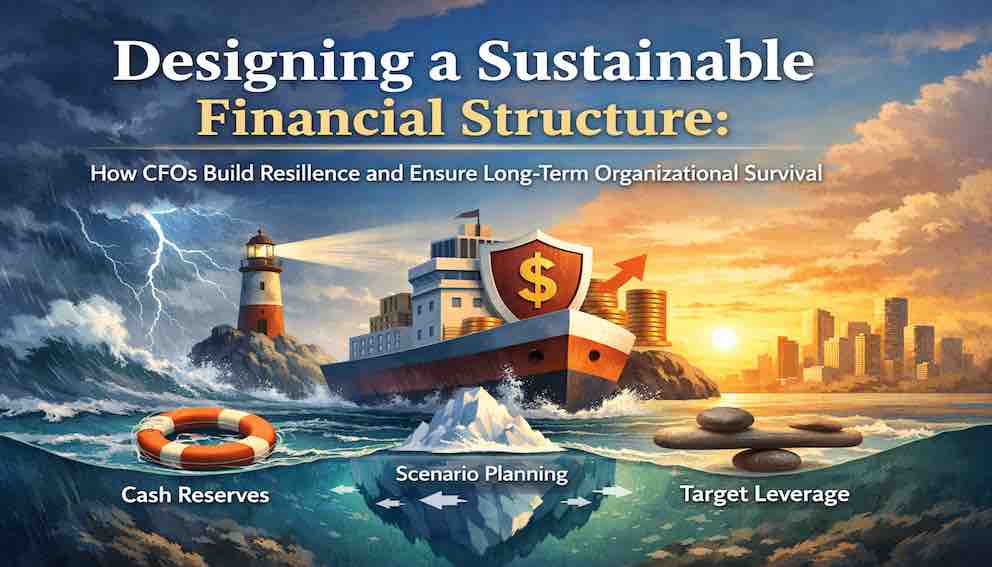
Just as a sailor reinforces their ship after a storm, financial leaders must design a sustainable financial structure—one that absorbs shocks, supports strategic initiatives, and allows management to pursue opportunity without jeopardizing solvency. Sustainability is not stagnation; it is deliberate preparation for future volatility.
The Story of Two Ships
To illustrate the difference between crisis management and sustainable design, Sarah recalls two ships:
- The first ship was built for speed: a light frame, minimal ballast, every inch of space filled with cargo. When a storm hit, it was tossed violently, water poured in, and the crew scrambled to bail it out. It survived, but barely. The ship was damaged, and repairs were slow and expensive.
- The second ship was built for resilience: heavier frame, ballast for stability, and some space reserved for emergency supplies. When the same storm hit, it rode the waves instead of fighting them. Water came over the deck but drained away. The crew stayed calm, knowing the ship could handle worse.
Applied to organizations: the first ship is like a company optimized for rapid growth without buffers. The second ship represents a business designed to survive volatility while maintaining operational flexibility.
Principles of Financial Sustainability
Financial sustainability rests on three pillars: resilience, flexibility, and preparedness.
Resilience
Resilience is an organization’s ability to absorb shocks without collapsing. For example, a company with too much debt and too little cash might thrive during stable periods, but even a minor drop in revenue could trigger solvency issues. Resilient structures mitigate these risks.
Flexibility
Flexibility allows the organization to adapt. This could mean delaying capital expenditures, renegotiating debt, or reallocating resources quickly when circumstances change. During a recent crisis, Sarah’s team could postpone projects, extend supplier terms, and draw on credit lines because flexibility had been intentionally built into their structure.
Preparedness
Preparedness is about embedding buffers that absorb uncertainty. Tools such as scenario planning, stress testing, and margin analysis create readiness for volatility. The 13-week cash flow model Sarah updated weekly existed before the crisis—it was not reactive, it was proactive.
These principles are deliberate design choices. Organizations that ignore them build fragile structures; those that embrace them build financial resilience.
Establishing Target Leverage
Leverage—the ratio of debt to equity—is one of the most critical decisions for financial sustainability. Debt amplifies returns but introduces fixed obligations. Excessive leverage can make a business highly sensitive to revenue fluctuations, interest rate changes, and market shocks. Too little leverage may leave capital idle and opportunities unexploited.
Example: Calculating Safe Leverage
Sarah models debt-to-EBITDA ratios for their moderately cyclical industry:
- 1.5x Debt-to-EBITDA: Extremely safe; could survive major downturns but limits growth.
- 2.5x Debt-to-EBITDA: Comfortable; sufficient headroom for downturns and enough leverage for strategic investment.
- 3.5x Debt-to-EBITDA: Aggressive; would have caused covenant breaches in the recent crisis.
The team selects 2.5x as their target: not too conservative, not too aggressive—allowing them to survive volatility while pursuing opportunity.
Maintaining Margins of Safety
Margins of safety act as financial cushions, giving organizations breathing room when conditions deteriorate. Sarah’s team focuses on three components:
- Cash Reserves: Minimum of three months of operating expenses. In the previous crisis, two months would have been insufficient. Three months provides buffer for unexpected delays or drops in revenue.
- Revenue Buffers: Forecasts assume the worst-case scenario could last longer than anticipated. For example, if expected growth is 5%, they plan for 0% growth.
- Cost Flexibility: Shifting fixed costs to variable where possible and negotiating flexible supplier contracts gives management options during downturns.
Margins of safety are not inefficiencies—they are insurance against failure.
Embedding Scenario Buffers
Scenario planning allows organizations to prepare for multiple futures rather than relying on a single forecast. Sarah categorizes scenarios:
- Best-case: Revenue exceeds projections. Pre-approved criteria trigger growth investments—hiring, CapEx, acquisitions.
- Base-case: Performance aligns with forecasts. Adjustments are minor; operations proceed as planned.
- Worst-case: Revenue drops, costs rise, or external shocks occur. Playbooks dictate cost cuts, supplier engagement, and credit line usage.
- Extreme-case: Severe industry disruption or regional lockdown. Contingency plans include emergency financing, restructuring advisors, and communication templates.
Sarah emphasizes, “For each scenario, we know the triggers and our responses. We don’t guess in the moment—we’ve already planned.”
Ensuring Long-Term Survivability
Designing for long-term survivability means thinking beyond the next quarter or even the next year. Immediate buffers like cash reserves and credit lines help a company survive shocks, but survivability over multiple business cycles requires structural choices that reduce dependency, smooth risk over time, and allow the organization to adapt as conditions change. These strategies are about ensuring that no single event, customer, or financing decision can threaten the company’s existence.
Diversification of Revenue Streams
Diversification reduces the risk that a single failure can destabilize the entire organization. When a company depends heavily on one product, one customer, or one market, any disruption in that area can quickly translate into cash flow stress, covenant pressure, or forced cost cutting.
By spreading revenue across multiple products, customer segments, geographies, or pricing models, the organization reduces volatility in cash flows. During downturns, some areas may weaken, but others may remain stable or even grow, giving management time and flexibility to respond without panic.
Conservative Debt Maturity Profiles
Debt does not become dangerous because it exists; it becomes dangerous when too much of it needs to be refinanced at the same time. A concentrated maturity profile creates a single point of failure, especially if credit markets tighten or business performance weakens at the wrong moment.
By staggering maturities so that no more than a manageable portion of debt comes due in any single year, the organization avoids being forced into distressed refinancing. This approach turns refinancing into a routine financial task rather than an existential event, even during periods of economic stress.
Flexible Covenants
Covenants are designed to enforce discipline, but overly rigid covenants can amplify stress rather than contain it. If a company breaches a covenant during a temporary downturn, it may be forced into defensive actions that harm long-term value, such as asset sales or severe cost cuts.
Flexible covenants allow for temporary volatility while still protecting lenders. Features such as cure periods, step-downs, or adjusted thresholds during extraordinary events give management breathing room to stabilize operations without losing credibility or control. This flexibility is built through transparent communication and long-term relationships with capital providers.
Continuous Monitoring
A sustainable financial structure is not something that can be designed once and forgotten. Business models evolve, markets change, and risks emerge gradually rather than all at once. Continuous monitoring ensures that financial policies remain aligned with reality rather than outdated assumptions.
Quarterly reviews of stress tests, scenario assumptions, liquidity buffers, and leverage targets allow management to detect pressure early. This regular cadence turns financial resilience into an ongoing discipline rather than an emergency response triggered only when conditions deteriorate.
Integrating Growth with Resilience
A common misunderstanding is that financial resilience limits growth. In practice, the opposite is true. A sustainable financial structure creates the freedom to act when opportunities appear, because the organization is not constrained by fear of breaching covenants, running out of cash, or losing lender confidence.
When a competitor struggles, acquisitions, talent hires, or strategic investments often become available at attractive prices. Organizations with liquidity, leverage headroom, and covenant flexibility can move decisively, while fragile competitors are forced to protect survival. Resilience does not slow growth; it creates optionality, allowing leadership to choose when and how to take risk.
Practical Framework for CFOs
Designing a sustainable financial structure becomes manageable when broken into deliberate, repeatable steps. This framework reflects how financial leaders translate principles into practice.
Step 1: Assess Current Financial Health
The starting point is a clear, unvarnished view of the organization’s current position. This includes reviewing debt levels, cash reserves, operating margins, and all covenant obligations, not just in isolation but in how they interact under stress.
The goal is to identify vulnerabilities before they become crises. This assessment answers questions such as: Where would pressure appear first in a downturn? Which assumptions are most fragile? What risks are currently being tolerated without explicit acknowledgment?
Step 2: Define Target Leverage and Margin Policies
Once the current state is understood, the next step is to define what “safe” and “acceptable” look like. Target leverage ratios and minimum liquidity levels should reflect the company’s business model, cyclicality, and risk tolerance rather than industry averages or historical norms.
These are policy decisions, not forecasts. By clearly defining acceptable ranges in advance, management avoids emotional decision-making during periods of stress and ensures consistency across planning cycles.
Step 3: Build Scenario Models
Scenario models translate uncertainty into structured thinking. Rather than relying on a single forecast, the organization models a range of outcomes, from optimistic to severely adverse, and examines how each would affect cash flow, profitability, and covenant compliance.
This process reveals where buffers are sufficient and where they are thin. It also forces explicit discussion of uncomfortable possibilities, reducing the risk of being surprised by predictable events.
Step 4: Implement Buffers and Contingencies
Buffers are only valuable if they are real and usable. This step involves securing committed credit lines, maintaining appropriate insurance coverage, and negotiating supplier agreements that allow flexibility in volumes or timing.
Equally important is operational readiness. Management should know exactly when buffers are triggered, who makes decisions, and how quickly actions can be taken. A buffer that exists only on paper does not provide resilience.
Step 5: Review, Adjust, Repeat
Financial sustainability is not a destination that can be reached and checked off. It is an ongoing practice that requires regular reassessment as the business grows, markets evolve, and risks shift.
By conducting periodic stress tests, updating assumptions, and refining policies, the organization ensures that its financial structure remains aligned with reality. Over time, this discipline compounds, turning resilience into a core organizational capability rather than a reactive response.
Real-World Examples
Manufacturing Firm
Six months of cash reserves
Maintaining cash equal to six months of operating expenses gave the company time to absorb a prolonged downturn without immediately cutting staff or operations. This buffer allowed management to respond thoughtfully rather than react under pressure.
Debt limited to 50% of capital
By keeping debt at half of total capital, the company avoided excessive leverage that could magnify revenue declines into solvency risk. This conservative balance ensured lenders remained confident even as performance weakened.
Staggered debt maturities over three years
Spreading debt repayments across multiple years prevented refinancing pressure from concentrating in a single period. This structure reduced the risk of being forced to refinance under unfavorable market conditions.
Flexible procurement strategy
Supplier contracts allowed the company to adjust purchase volumes and timing without penalties. This flexibility helped align costs with reduced demand while protecting long-term supplier relationships.
Outcome during downturn
When revenue fell by 15 percent, the company avoided layoffs and covenant breaches, preserving morale and operational capability. The excess capacity created by the slowdown was used to invest in efficiency improvements, strengthening performance when demand recovered.
Technology Startup
Minimal leverage with equity financing
The startup avoided debt to reduce fixed obligations during an uncertain growth phase. Relying on equity provided flexibility, allowing management to prioritize long-term value over short-term cash discipline.
Three-month liquidity buffer
Holding three months of operating cash ensured the company could absorb temporary revenue shocks or delayed funding without immediate disruption. This buffer reduced dependence on external financing during volatile periods.
Scenario planning for worst-case churn
Management modeled severe customer churn scenarios to understand how quickly cash would be consumed and which costs could be adjusted. This preparation allowed them to respond calmly rather than react defensively if churn increased.
Outcome when a competitor exited
When a competitor unexpectedly left the market, the startup had the financial capacity to invest in new features and customer acquisition. Sustainability did not slow growth; it created the conditions to seize opportunity.
Common Pitfalls
Over-Optimizing for Growth
Pursuing maximum returns without building resilience often leads to fragile structures that cannot withstand downturns. Growth achieved without buffers tends to reverse sharply when conditions deteriorate.
Ignoring Scenario Planning
Without structured scenarios, organizations are surprised by predictable risks and forced into reactive decision-making. Scenario planning turns uncertainty into manageable choices rather than emergencies.
Neglecting Margins of Safety
Operating with minimal cash, tight covenants, and no flexibility leaves no room for error. Even small deviations from plan can escalate into crises when buffers are absent.
Rigid Policies
Policies that do not allow for temporary adjustment can worsen stress during volatile periods. Financial discipline is important, but rigidity without flexibility increases risk rather than reducing it.
Misunderstanding Sustainability
Sustainability is often mistaken for conservatism or caution. In reality, its purpose is to enable decisive action by ensuring the organization can take risk without threatening survival.
Conclusion: Survival Precedes Success
Designing a sustainable financial structure is the natural next step after mastering crisis management. In this tutorial, we’ve explored how deliberate planning, margins of safety, scenario buffers, and strategic flexibility create resilience.
We learned that:
- Resilience, flexibility, and preparedness are the cornerstones of sustainability.
- Target leverage must balance risk and opportunity.
- Margins of safety—cash reserves, revenue buffers, cost flexibility—act as financial cushions.
- Scenario buffers prepare the organization for multiple futures.
- Long-term survivability requires diversification, conservative debt management, flexible covenants, and continuous monitoring.
- Sustainable structures enable growth, providing the confidence to seize opportunities.
Over a full cycle, organizations designed for sustainability outperform those optimized solely for growth. Resilience is not passive; it is the foundation for strategic advantage.
In finance, survival precedes success, and resilience is the foundation upon which opportunity is built.
Sarah closes her notebook, looking ahead. The next storm will come—it always does. But this time, they won’t just survive. They are designed for it.
About Swati Sharma
Lead Editor at MyEyze, Economist & Finance Research WriterSwati Sharma is an economist with a Bachelor’s degree in Economics (Honours), CIPD Level 5 certification, and an MBA, and over 18 years of experience across management consulting, investment, and technology organizations. She specializes in research-driven financial education, focusing on economics, markets, and investor behavior, with a passion for making complex financial concepts clear, accurate, and accessible to a broad audience.
Disclaimer
This article is for educational purposes only and should not be interpreted as financial advice. Readers should consult a qualified financial professional before making investment decisions. Assistance from AI-powered generative tools was taken to format and improve language flow. While we strive for accuracy, this content may contain errors or omissions and should be independently verified.