
Tutorial Categories
Last Updated: February 26, 2026 at 10:30
Behavioral Biases in Financial Planning
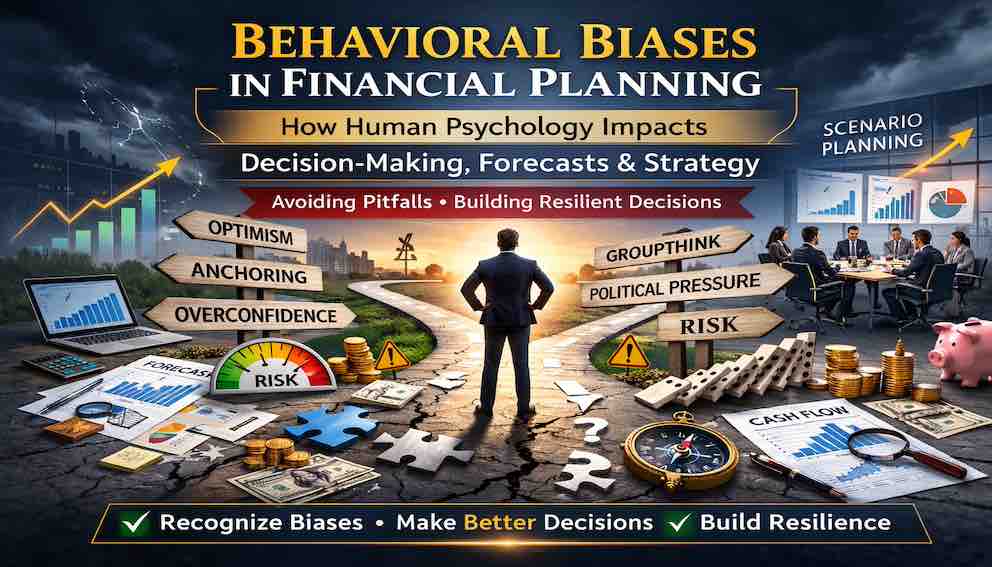
In this tutorial, we explore the human side of financial planning, showing how behavioral biases influence decision-making and can undermine even the most sophisticated models. You will learn how optimism, anchoring, groupthink, overconfidence, political pressures, and subtle cognitive traps shape forecasts, budgets, and scenario plans. Through vivid examples and mini-case studies, we illustrate how human judgment interacts with structural resilience, highlighting gaps that traditional methods often overlook. By the end, you will understand why recognizing and mitigating cognitive biases is essential for creating robust financial strategies that survive both predictable and unexpected challenges.
Introduction: Beyond Numbers – Humans in Financial Planning
Sarah, the Financial Planning & Analysis Lead, sits in her office, reflecting on the past two years. She has learned so much. She has mastered technical tools: the 13-week cash flow model, variance analysis, scenario planning, capital allocation frameworks. She has built sustainable structures. She has navigated crises. She has become the strategic partner she always aspired to be.
And yet.
She thinks about the forecasts that were too optimistic. The budgets anchored on outdated numbers. The meetings where everyone agreed too quickly. The decisions that seemed right at the time but turned out wrong.
She also thinks about her own biases. The times she was overconfident. The times she favored information confirming what she already believed. The times she let recent events overshadow longer-term patterns.
Financial planning is often portrayed as a technical exercise, rooted in precise numbers, rigorous models, and structured processes. Cash flow projections, budgeting, and scenario analyses dominate boardroom discussions, spreadsheet calculations, and executive dashboards. In these exercises, it is easy to assume that accuracy and foresight depend solely on good data and disciplined methodology.
Yet, as any experienced financial manager knows, numbers are only one half of the story. The other half—the human side—can quietly undermine even the most carefully constructed plans. Humans are not perfectly rational machines. We have emotions, habits, cognitive biases, and social influences that shape how we interpret data, make decisions, and respond under stress. Recognizing and addressing these behavioral influences is essential because a plan’s robustness is only as strong as the judgment of the people executing it.
This tutorial focuses on the human factors that affect financial planning. It builds on prior lessons about cash flow management, structural resilience, and scenario planning, serving as the final layer of protection: understanding that even technically sound strategies can fail if human judgment is flawed.
Forecast Optimism Bias: When Numbers Look Better Than Reality
Sarah remembers a specific forecast early in her career.
A new product launch was planned. The marketing team was excited. The sales team was excited. Everyone was excited.
The forecast projected 20 percent revenue growth in the first year. Assumptions were aggressive but plausible, and the presentation was polished. The board approved.
When the actual results arrived, growth was 8 percent. Not a failure by conventional standards, but a miss relative to the forecast. Inventory had been over-ordered, costs were higher, and margins were squeezed. The company had to scramble.
Looking back, the team had used the best-case market research, assumed smooth execution, and underestimated competitive responses and supply chain delays. They weren’t lying—they genuinely believed the optimistic numbers. But unchecked optimism made the forecasts dangerous.
Key insights about optimism bias:
- It is often unintentional, stemming from a natural desire to see positive outcomes.
- Repeated optimism bias erodes credibility, stretches cash reserves, and undermines trust in forecasts.
Mitigation strategies Sarah uses now:
- Stress-test forecasts by asking: What is the worst-case scenario? What evidence would contradict our assumptions?
- Invite external review from someone not involved in the initial projections.
- Balance optimism with realism: Optimism is not bad, but unchecked optimism is dangerous.
Anchoring in Budgeting: Stuck in the Past
Anchoring occurs when financial planners rely too heavily on prior numbers or assumptions, even when circumstances have changed. The past becomes a reference point that constrains reasoning, often leading to decisions that do not reflect current realities.
Sarah recalls a startup she advised. The previous year, marketing was budgeted at $100,000. The next year, market conditions had shifted dramatically: customer acquisition costs doubled, competitors launched aggressive campaigns, and digital channels evolved. Yet the team started budgeting from $100,000, adjusted slightly for inflation, and added a minor growth factor. They never asked the fundamental question: What does it actually cost to achieve our goals today?
Mitigation strategies:
- Consciously separate “what we spent before” from “what we need now.”
- Ask: If we had no historical data, what budget would we create based on today’s reality?
- Regularly question assumptions: challenge historical baselines to reflect current conditions.
The Curse of Knowledge: Assuming Others See What We See
The curse of knowledge is the difficulty of remembering what it was like not to know something. Experienced leaders often assume others understand the context they take for granted. They skip explanations, omit background, or assume clarity.
Example: A CFO presents complex scenario analysis to the board, expecting immediate understanding. Board members nod politely but are confused. The plan is approved anyway. Later, revisiting assumptions becomes frustrating and slow.
Mitigation strategies:
- Test explanations by asking: Does this make sense? What questions do you have?
- Invite confusion rather than assuming clarity.
- Provide context, not just conclusions, and verify comprehension.
Political Pressure: Decisions Beyond the Numbers
Financial planning is rarely insulated from politics. Internal agendas, interpersonal dynamics, and power structures can skew decisions toward appeasing influential voices rather than reflecting objective analysis.
Example: A department head pushes for an inflated revenue projection to secure a larger budget. The team knows it’s optimistic, but the department head is powerful. The projection is approved, falls short, and confidence in planning erodes.
Mitigation strategies:
- Clearly separate budget creators and approvers.
- Implement independent review mechanisms.
- Create space for dissenting views and protect those who ask hard questions.
Groupthink in Planning Cycles: Herding Toward Consensus
Groupthink occurs when consensus is valued over critical examination, leading teams to converge on plans that feel safe rather than rigorous.
Example: In a strategic planning session, initial proposals vary. Over time, members align with the dominant view to avoid conflict, leaving risks understated and assumptions unchallenged.
Mitigation strategies:
- Designate a rotating “devil’s advocate” to challenge assumptions.
- Collect anonymous input before discussions to prevent anchoring by senior voices.
- Encourage honest debate; recognize that discomfort is better than false agreement.
Overconfidence: The Hidden Risk in Leverage and Reserves
Overconfidence makes leaders believe their judgment is more reliable than it is, leading to aggressive borrowing, minimal liquidity buffers, or risky investments.
Example: A company relied on high growth projections to justify leverage. When the market dipped, lack of reserves forced distressed asset sales and costly borrowing.
Mitigation strategies:
- Institutionalize objective review and statistical stress tests.
- Deliberately question assumptions: What would have to be true for this to fail?
- Treat confidence as a variable to be checked against data, not a default strength.
Escalation of Commitment: Throwing Good Money After Bad
Escalation of commitment is the tendency to continue investing in failing projects due to past investments.
Example: A software project experiences delays and low adoption. Instead of stopping, the company invests more, believing past spending justifies continuation. Eventually, millions are lost.
Mitigation strategies:
- Build explicit “stop loss” criteria for projects.
- Separate decision-makers from project champions.
- Focus on future value, not sunk costs.
Cognitive Biases in Scenario Modeling
Scenario planning is designed to help organizations think beyond a single future, yet it can unintentionally reflect the same cognitive biases it is meant to counter. If human judgment is not carefully examined, scenarios can become exercises in reinforcing existing beliefs rather than genuinely exploring uncertainty.
Confirmation Bias
Teams tend to favor scenarios that align with what they already believe to be true, while dismissing unlikely but plausible risks as unrealistic or extreme. This bias often leads to a narrow range of scenarios that feel comfortable rather than a full exploration of what could actually happen.
Recency Bias
Recent events carry disproportionate weight in scenario modeling, making the latest crisis or shock seem more predictive than it truly is. As a result, planners may overprepare for the last problem they experienced while underestimating different risks that have emerged more slowly over time.
Availability Heuristic
Risks that are vivid, dramatic, or frequently discussed receive more attention than quieter, more routine threats. This can cause organizations to focus on sudden crashes or headline risks while neglecting gradual erosion in margins, customer loyalty, or competitive position.
Mitigation approaches Sarah now uses:
- Introduce dedicated “red teams” whose sole purpose is to challenge prevailing assumptions and construct scenarios leadership would rather avoid discussing.
- Ground scenarios in historical analysis across multiple business cycles, ensuring planning is informed by long-term patterns rather than recent memory alone.
- Use systematic risk identification processes that catalogue risks deliberately, rather than relying on what feels most memorable or emotionally salient.
Human Judgment and Structural Resilience
Structural resilience—liquidity buffers, contingency plans, sustainable leverage targets, and diversification—is essential for financial stability. However, even the strongest structures can fail if human behavior consistently undermines their intent or bypasses their safeguards.
A company may design policies that look robust on paper, but biases influence how those policies are interpreted, applied, and sometimes quietly ignored. The structure exists, but behavior determines whether it actually protects the organization.
Common failure patterns Sarah has observed:
- Optimism bias leads leaders to assume cash reserves will not be needed, resulting in premature spending or delayed corrective action.
- Groupthink discourages serious discussion of downside risks, causing contingency plans to remain untested and theoretical.
- Overconfidence pushes organizations to stretch leverage limits, eroding buffers that were meant to absorb shocks.
Mitigation strategies:
- Continuously monitor not only financial metrics, but also the assumptions and narratives behind them, asking whether confidence is creeping ahead of evidence.
- Design stress tests that simulate human errors—such as delayed responses or biased decisions—not just market shocks.
- Embed behavioral awareness directly into decision-making processes so that structures are reinforced by disciplined judgment, not weakened by it.
Decision-Making Under Stress
Stress fundamentally changes how people think and decide. Under pressure, individuals rely more heavily on mental shortcuts, incomplete information, and signals from authority figures, often at the expense of careful analysis.
In moments of crisis, the desire to act quickly can override previously agreed frameworks, even when those frameworks were specifically designed for stressful conditions.
Example:
A sudden market shock forced rapid borrowing decisions. Despite pre-approved funding guidelines, fear and anxiety drove the team toward immediate, high-interest loans rather than structured alternatives. The organization paid a long-term cost for a short-term sense of relief.
Mitigation strategies:
- Run crisis simulations that explicitly include human behavior, not just financial variables, so teams can observe how biases surface under pressure.
- Practice rehearsals that help individuals recognize their own stress responses and pause before defaulting to instinctive reactions.
- Build clear protocols and decision “muscle memory” so that disciplined thinking becomes easier to access when stress is at its peak.
Integrating Behavioral Awareness into Financial Planning
Over time, Sarah realized that awareness of bias must be embedded into everyday financial processes, not treated as a one-off training exercise. Behavioral discipline, like financial discipline, is built through repetition and structure.
Practical steps she now uses:
Bias Training
Teams are trained on common cognitive traps—overconfidence, anchoring, confirmation bias, groupthink, escalation of commitment, and the curse of knowledge—using real internal examples rather than abstract theory.
Checklists and Decision Frameworks
Before major decisions, structured questions force reflection: What would disprove our assumptions? Who disagrees? What are we not seeing?
Independent Reviews
Third-party or cross-functional reviewers provide fresh perspectives, helping surface blind spots that insiders may overlook.
Decision Journals
Major decisions are documented with assumptions and reasoning, creating a record that allows honest post-analysis once outcomes are known.
Iterative Learning
Every forecast, budget, or scenario is treated as a learning opportunity rather than a verdict on competence, reinforcing humility and continuous improvement.
Taken together, these practices transform human limitations from hidden risks into visible signals. They improve judgment, align decisions with reality, and ensure that financial planning supports both immediate resilience and long-term sustainability.
Conclusion: The Final Layer of Resilience
Financial planning is multidimensional. Technical tools, cash management, resilient structures, and scenario analysis are all vital. Yet, human judgment determines whether these tools succeed.
Behavioral biases—optimism, anchoring, overconfidence, groupthink, political pressure, curse of knowledge, escalation of commitment, confirmation, recency, and availability—are natural. Recognizing and mitigating them closes the gap between structural robustness and practical execution.
Awareness of human factors is the final layer of resilience, ensuring forecasts are realistic, budgets are grounded, and contingency plans are actionable.
By integrating behavioral awareness with technical skills, organizations achieve sustainable financial management. Mastering numbers is essential, but mastering the human psychology behind decision-making is what ensures long-term success.
Sarah reflects: she is ready—not because she has all the answers, but because she knows the questions, watches for biases, and understands the limits of human judgment.
This completes the journey from technical precision to holistic, resilient financial strategy.
About Swati Sharma
Lead Editor at MyEyze, Economist & Finance Research WriterSwati Sharma is an economist with a Bachelor’s degree in Economics (Honours), CIPD Level 5 certification, and an MBA, and over 18 years of experience across management consulting, investment, and technology organizations. She specializes in research-driven financial education, focusing on economics, markets, and investor behavior, with a passion for making complex financial concepts clear, accurate, and accessible to a broad audience.
Disclaimer
This article is for educational purposes only and should not be interpreted as financial advice. Readers should consult a qualified financial professional before making investment decisions. Assistance from AI-powered generative tools was taken to format and improve language flow. While we strive for accuracy, this content may contain errors or omissions and should be independently verified.