
Tutorial Categories
Last Updated: February 26, 2026 at 10:30
Before You Forecast: Understanding Economic Engines in Business Forecasting, Unit Economics, Financial Modeling, and Operating Leverage
Before any serious business forecasting begins, there is a deeper question that must be answered: how does this company actually create value? In this tutorial, we explore economic engines across SaaS, retail, and asset-heavy businesses, and we demonstrate how unit economics, contribution margin, and operating leverage determine whether growth strengthens or weakens financial health. Through detailed numerical illustrations, we show how small shifts in retention, conversion, pricing, or utilization can dramatically alter profit and cash flow outcomes. We examine sensitivity, elasticity, breakeven mechanics, and capital intensity to explain why forecasting revenue without understanding drivers is little more than extrapolation. By the end, you will see that financial modeling does not begin with spreadsheets — it begins with understanding how the engine of the business truly works.
The Structural Progression: From Strategy to Liquidity to Mechanics
Let us return to Sarah(the Financial Planning & Analysis Lead).
It is Monday morning. Three meetings are scheduled before lunch. Each business unit leader wants the same thing: an updated forecast. Yet each leader runs a different type of business.
The software division is targeting aggressive customer growth.
The retail director wants to incorporate marketing campaigns into next quarter’s projections.
The infrastructure operations manager wants to model a new contract.
Three meetings. Three forecasts. Three economic engines.
In the first tutorial of this series, we established that Financial Planning and Analysis exists to translate strategy into cash consequences. Strategy is a story about where the business wants to go. Finance translates that story into measurable financial outcomes.
In the second tutorial, we went deeper and confronted a difficult truth: profit is not cash. Liquidity determines survival. Accrual accounting can obscure working capital demands, capital expenditure requirements, and funding gaps. Accounting health does not guarantee financial health.
Now we move one level deeper still.
Before we forecast profit, and before we forecast cash, we must understand what generates them. If we do not understand the economic engine of the business, then every forecast becomes a projection of accounting lines rather than a model of reality.
When Sarah is asked to “update the forecast,” she does not open Excel.
She asks one question:
“What is driving the business?”
What Is an Economic Engine?
An economic engine is the underlying mechanism through which a business creates value. It describes how customers, pricing, cost structure, and capacity interact to generate contribution margin, operating profit, and ultimately cash flow.
Financial statements report outcomes. They summarize what happened. An economic engine explains why it happened.
Revenue, EBITDA, and net income are outputs. Drivers are inputs.
A driver is a measurable variable that causally influences performance. Accounting categories are the result of drivers interacting over time.
If revenue grew by ten percent last year, that growth did not occur because “revenue grows.” It occurred because some combination of customer acquisition, retention, pricing, traffic, conversion, volume, or utilization changed.
Revenue is not a driver. Revenue is the product of drivers.
If you forecast revenue by applying a growth rate without decomposing its components, you are embedding assumptions about drivers without acknowledging them.
That is extrapolation, not forecasting.
Serious financial modeling begins with understanding the engine.
The SaaS Economic Engine: Retention, Acquisition, and Capital Intensity
Sarah begins her first meeting with the head of the software division.
He is enthusiastic about expanding the sales target. He believes the market opportunity justifies accelerating growth.
“Before we update the numbers,” Sarah says gently, “walk me through the engine.”
In a Software-as-a-Service business, the economic engine can be simplified to:
(New Customers × Lifetime Value) − Customer Acquisition Cost
But each term in that expression contains deeper mechanics.
Lifetime Value and Retention Sensitivity
Suppose the company charges £100 per month. Suppose gross margin is 80 percent, meaning that after hosting and service costs, £80 per month remains as contribution margin per customer.
If the average customer remains subscribed for 25 months, then the lifetime contribution margin equals £80 multiplied by 25 months, which equals £2,000.
That is Lifetime Value expressed in contribution terms.
Now consider churn.
If the churn rate increases slightly and average customer lifetime falls from 25 months to 20 months, lifetime contribution margin falls from £2,000 to £1,600.
A relatively small change in retention produces a 20 percent decline in lifetime value.
The engine is highly sensitive to retention.
Customer Acquisition Cost and Payback
Suppose the company spends £500,000 per month on marketing and sales and acquires 1,000 new customers. Customer Acquisition Cost equals £500 per customer.
If LTV is £2,000 and CAC is £500, each customer generates £1,500 in lifetime contribution surplus.
However, timing determines liquidity risk.
Monthly contribution margin per customer is £80. To recover £500 of acquisition cost requires approximately 6.25 months.
If churn increases or margins compress, payback lengthens. If payback extends from six months to nine months while acquisition spending continues, the company must finance three additional months of acquisition cost for every cohort.
Growth becomes more capital-intensive.
The income statement may show rising revenue, but cash may decline if payback stretches.
This is where the economic engine connects directly to liquidity.
Operating Leverage in SaaS
Most operating expenses in SaaS, such as engineering salaries and administrative overhead, are relatively fixed in the short term.
Once the base of recurring revenue grows sufficiently to cover fixed costs, incremental revenue contributes meaningfully to operating profit.
However, if CAC rises from £500 to £700 while LTV remains £2,000, the surplus per customer declines from £1,500 to £1,300. Growth becomes less efficient and more cash-intensive.
If you forecast revenue growth without modeling retention, CAC, payback, and margin structure, you are guessing.
The spreadsheet may balance. The engine may not.
A Structural Reflection: Drivers Come Before Accounting
As Sarah leaves the software division meeting, she does not think first about revenue targets. She thinks about retention curves, acquisition efficiency, and payback periods. She thinks about the mechanics she just discussed.
And that is intentional.
There is something fundamental that many organizations misunderstand about forecasting. Revenue does not grow because revenue “decides” to grow. Revenue grows because something underneath it changes.
In a SaaS business, revenue increases because more customers are acquired, because existing customers stay longer, because pricing improves, or because customers expand their usage. Those are mechanisms. Revenue is the visible outcome of those mechanisms interacting over time.
If retention weakens quietly beneath the surface, revenue growth will eventually slow. If acquisition becomes more expensive, growth may continue temporarily, but cash strain will increase. If pricing power erodes, margins will compress even if top-line growth appears stable.
Revenue itself is not causal. It is the product of causal forces.
Accounting lines are summaries of activity that has already occurred. They are historical reflections of decisions, behaviors, and constraints. When we look at an income statement, we are looking at the shadow cast by operational mechanics.
Shadows move when the object that creates them moves.
If the mechanics shift, the accounting lines will follow. Not immediately, perhaps, but inevitably.
This is why forecasting cannot begin with last year’s revenue number. It must begin with the drivers that produced that number. It must begin with customer behavior, pricing discipline, cost structure, and capacity constraints.
When someone says, “We will grow revenue by ten percent next year,” what they are implicitly saying is that acquisition, retention, conversion, utilization, or pricing will change in a specific way. If those assumptions are not explicitly modeled, they remain hidden inside a percentage.
A growth rate without driver decomposition is not analysis. It is a narrative compressed into a number.
Sarah understands that numbers on financial statements are outcomes. They are not engines. If she wants to forecast responsibly, she must understand what is moving beneath the surface.
Forecasting must begin with drivers because drivers determine outcomes. When drivers are misunderstood, forecasts become fragile. When drivers are understood, forecasts become structured reflections of how the business actually works.
This distinction is subtle, but it is decisive.
It is the difference between projecting yesterday forward and modeling tomorrow intelligently.
The Retail Economic Engine: Traffic, Conversion, Basket Size, and Breakeven
In her second meeting, the retail director wants to adjust the forecast upward based on marketing initiatives.
“Before we adjust anything,” Sarah says, “walk me through the engine.”
The store receives 10,000 visitors per month. Twenty percent make a purchase. That produces 2,000 transactions. The average basket size is £50. Monthly revenue equals £100,000.
The simplified driver equation is:
(Foot Traffic × Conversion Rate × Average Basket Size)
Compounding Effects of Small Shifts
If foot traffic increases by 5 percent to 10,500 visitors while conversion and basket size remain constant, revenue increases to £105,000.
If conversion improves from 20 percent to 22 percent while traffic remains at 10,000, transactions increase to 2,200. Revenue becomes £110,000.
A two percentage point increase in conversion produces a 10 percent revenue increase.
Small shifts compound because drivers multiply.
Contribution Margin and Breakeven
Suppose gross margin is 40 percent. On £100,000 of revenue, gross profit equals £40,000.
Suppose fixed operating costs, including rent and salaried staff, total £35,000 per month.
Operating profit equals £5,000.
Now let us calculate breakeven more explicitly.
At a £50 basket size and 40 percent margin, contribution margin per transaction equals £20.
To cover £35,000 of fixed cost, the store must generate 1,750 transactions per month.
At 20 percent conversion, that requires 8,750 visitors.
If traffic falls from 10,000 to 8,500 due to seasonality, transactions fall to 1,700. The store moves below breakeven and begins to generate losses.
Breakeven is not abstract. It is mechanical.
Operating Leverage and Seasonality
If revenue increases to £110,000 due to improved conversion, gross profit rises to £44,000 while fixed costs remain £35,000. Operating profit increases to £9,000.
A 10 percent revenue increase produces an 80 percent operating profit increase.
This is operating leverage.
However, during low-traffic months, the same fixed cost structure amplifies losses.
If annual growth is forecast at 8 percent but growth is concentrated in peak months while off-peak traffic declines, liquidity stress may emerge even if annual revenue meets expectations.
The income statement averages hide seasonal strain.
The Infrastructure Engine: Utilization, Pricing, and Capital Intensity
In the final meeting, the infrastructure operations manager is confident that a new contract will increase volume.
“Volume up, profit up,” he says.
“Walk me through the engine,” Sarah replies.
Suppose the plant has capacity to produce 100,000 units per month. The contracted price per unit is £10. Variable cost per unit is £4. Fixed operating costs equal £400,000 per month.
At 80 percent utilization, the plant produces 80,000 units.
Revenue equals £800,000.
Variable cost equals £320,000.
Contribution margin equals £480,000.
After fixed cost, operating profit equals £80,000.
If utilization declines to 70 percent, revenue falls to £700,000 and operating profit falls to £20,000.
A 12.5 percent decline in volume produces a 75 percent decline in operating profit.
If price declines modestly from £10 to £9.50 at 80 percent utilization, operating profit falls from £80,000 to £40,000.
Small shifts in utilization or pricing create disproportionate effects because fixed costs magnify changes.
Capital Intensity and Funding Risk
Asset-heavy businesses often require significant capital expenditure and maintenance investment.
If utilization declines but maintenance capex remains necessary, cash flow may deteriorate more rapidly than operating profit suggests.
Similarly, if expansion requires new equipment before contracts are secured, the engine’s capital intensity increases funding risk.
Forecasting revenue growth without modeling utilization, pricing sensitivity, and capex requirements creates a dangerous illusion of stability.
Unit Economics, Sensitivity, and Risk
Across all three businesses, unit economics provides the foundation for understanding viability.
Unit economics examines profitability at the smallest meaningful unit, whether a customer, a transaction, or a unit of output.
Contribution margin determines whether incremental activity adds value.
Breakeven determines vulnerability.
Sensitivity analysis reveals which driver can break the business.
If a one percentage point increase in churn erodes a third of lifetime value, retention is a critical risk variable.
If a two percentage point decline in conversion eliminates operating profit, conversion is fragile.
If a five percent price reduction halves profit, pricing power is strategic.
Sensitivity is not an academic exercise. It is a survival tool.
It tells management where fragility lies.
The Danger of Dashboard Forecasting
Later that afternoon, Sarah reviews a spreadsheet prepared by a junior analyst.
Revenue grows at 10 percent per year. EBITDA margin remains stable. Cash flow trends upward.
The sheet is clean. The formulas are correct.
But when Sarah asks what supports the 10 percent growth assumption, the answer is vague.
This is dashboard forecasting.
Dashboard forecasting projects accounting categories without modeling the drivers beneath them.
It creates numerical elegance without structural insight.
Liquidity crises rarely begin with arithmetic errors. They begin with misunderstood engines.
If retention weakens, if traffic softens, if utilization slips, revenue will miss expectations. Working capital needs may rise. Fixed costs may strain cash flow. Funding gaps may emerge.
By the time the dashboard reflects the problem, the engine has already deteriorated.
Modeling the Engine, Not the Dashboard
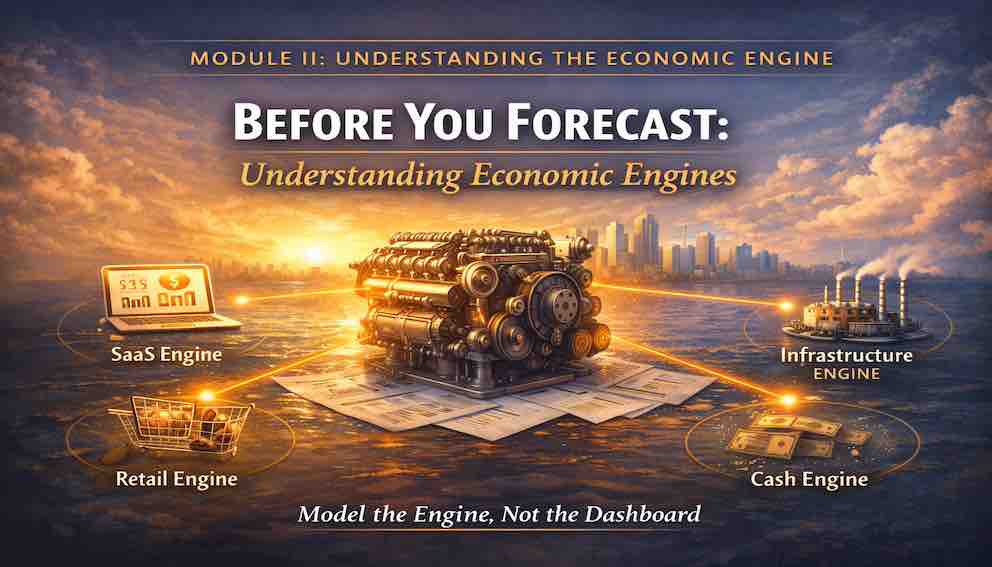
The principle that anchors this tutorial is simple: Model the engine, not the dashboard.
The dashboard shows outcomes such as revenue and EBITDA. The engine explains how those outcomes are generated.
Forecasting requires decomposing revenue into drivers, understanding cost structure, calculating contribution margin, identifying breakeven thresholds, analyzing sensitivity, and evaluating capital intensity.
Only after the mechanics are understood should the spreadsheet be built.
Spreadsheets are representations of assumptions about engines.
If the assumptions are shallow, the model will be fragile.
If the understanding is deep, the forecast will be resilient.
Conclusion: Understanding Before Projection
In this series, we began by learning that FP&A translates strategy into cash consequences. We then learned that profit is not cash and that liquidity determines survival.
In this tutorial, we moved beneath both profit and cash to examine the source of each: the economic engine.
We explored SaaS retention and acquisition efficiency, retail traffic and conversion mechanics, and infrastructure utilization and pricing power. We calculated lifetime value, payback periods, breakeven thresholds, and operating leverage effects. We examined sensitivity and capital intensity. We saw how small driver shifts can create large outcome changes.
We learned that revenue is not a driver. Revenue is an outcome.
Forecasting without understanding drivers is extrapolation disguised as analysis.
Financial models do not begin with spreadsheets. They begin with understanding how value is created.
If you model the engine, you can forecast profit with credibility.
If you forecast profit with credibility, you can forecast cash with discipline.
If you forecast cash with discipline, you protect liquidity.
And if you protect liquidity, you protect survival.
Understanding the economic engine is not a theoretical exercise. It is the structural foundation of every serious forecast.
About Swati Sharma
Lead Editor at MyEyze, Economist & Finance Research WriterSwati Sharma is an economist with a Bachelor’s degree in Economics (Honours), CIPD Level 5 certification, and an MBA, and over 18 years of experience across management consulting, investment, and technology organizations. She specializes in research-driven financial education, focusing on economics, markets, and investor behavior, with a passion for making complex financial concepts clear, accurate, and accessible to a broad audience.
Disclaimer
This article is for educational purposes only and should not be interpreted as financial advice. Readers should consult a qualified financial professional before making investment decisions. Assistance from AI-powered generative tools was taken to format and improve language flow. While we strive for accuracy, this content may contain errors or omissions and should be independently verified.