
Tutorial Categories
Last Updated: February 26, 2026 at 10:30
Forecasting Is Scenario Thinking, Not Prediction: Preparing for Multiple Futures in Financial Management
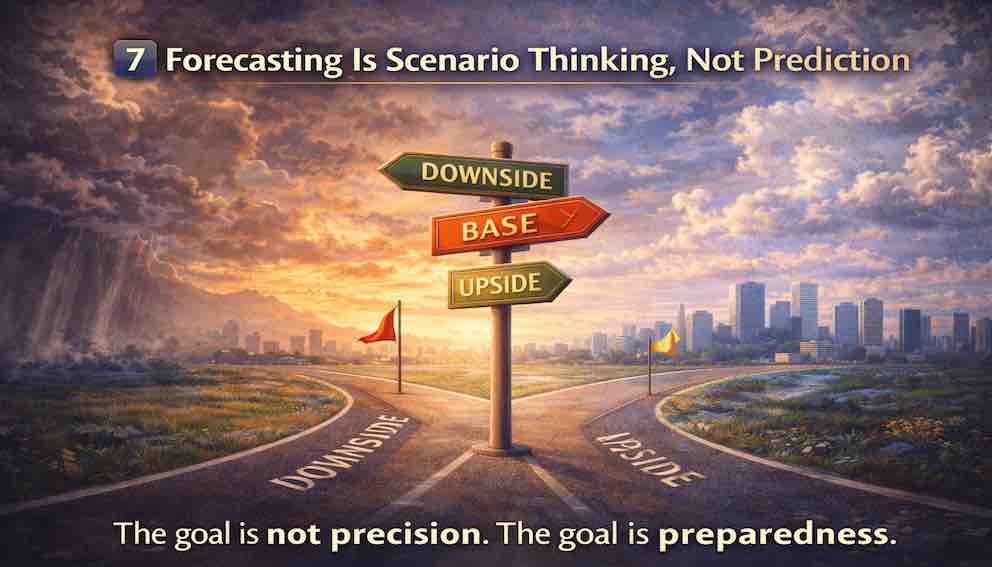
Forecasting is not about predicting the future with perfect accuracy; it is about preparing for uncertainty and using scenarios to guide decision-making. In this tutorial, we explore why forecasts should be viewed as tools for learning, early warning, and strategic action, rather than static targets. Learners will understand how to construct base, upside, and downside scenarios, perform sensitivity analyses, and identify key drivers of financial outcomes. By embracing scenario thinking, managers can navigate variability and respond proactively to changes, making forecasts a dynamic pillar of organizational planning. The ultimate goal is preparedness, not precision.
Introduction: From Budgeting and Planning to Scenario-Based Forecasting
Sarah(the Financial Planning & Analysis Lead) sits in the weekly leadership meeting. The CEO reads from the latest report: "Revenue projection for Q3 is £24.5 million. Everyone comfortable with this number?" Heads nod. The number looks reasonable. Slightly above last year. It aligns with the budget. It feels right.
But Sarah feels a familiar unease. She knows this number was created by taking last quarter’s actuals, applying a growth rate, and making minor adjustments. It looks precise. Authoritative. Predictive. Yet, it tells her nothing about the real uncertainties the company faces: a competitor’s early product launch, a worsening supply chain disruption, or an unexpectedly successful marketing campaign.
After the meeting, Sarah pulls out a document she prepared months ago but rarely shares: a scenario analysis for the same quarter. Three numbers, not one, each with probabilities, key drivers, and action plans. This is the kind of forecast that actually prepares the organization for multiple futures.
Forecasts, she knows, are not predictions. They are tools to understand the range of possibilities, anticipate risks, and seize opportunities.
The Problem with Prediction
Sarah recalls a company she advised early in her career. The finance team was measured solely on forecast accuracy. Miss by more than 2 percent, and consequences followed. Naturally, the team learned to sandbag: lowball revenue, pad expenses, build in buffers. Their forecasts were “accurate” on paper but meaningless for real decision-making.
When unexpected events occurred—a sudden market shift, supplier failure, or competitor move—the forecasts provided no guidance. They were frozen in place, designed for accountability rather than awareness.
Sarah explains to her team: "The problem is that we treat forecasts like predictions. But the future cannot be predicted. It can only be prepared for."
Forecasts Are Not Predictions
Forecasting is often misunderstood as producing a single number for revenue, cost, or profit. This approach is flawed because it ignores the inherent uncertainty of business environments: customer behavior shifts, markets fluctuate, supply chains fail, competitors act, regulations evolve.
If management treats a forecast of £24.5 million as a guarantee, the organization risks being blindsided. By contrast, treating forecasts as sets of plausible scenarios allows the company to respond with agility. Sarah emphasizes: "Forecasting is less about getting the number right and more about understanding the range of possible outcomes and the factors that drive them. The emphasis shifts from precision to preparedness."
Scenario Thinking: Embracing Multiple Futures
Scenario thinking acknowledges that the future is not a single line but a range of possibilities. Managers can explore these futures to stress-test assumptions and plan strategically.
Sarah demonstrates this with three scenarios:
- Base Scenario: The most likely outcome based on current assumptions. For example, if the company has grown revenue by 5 percent annually for three years, the base scenario projects a 5 percent increase this quarter, adjusted for known changes.
- Downside Scenario: What could happen if things go worse than expected. A competitor might launch aggressive pricing, or a supply chain issue could delay deliveries. This scenario allows managers to create contingency plans, such as adjusting inventory or reallocating marketing spend.
- Upside Scenario: A better-than-expected outcome. Perhaps a marketing campaign goes viral or a key client expands their order. Preparing for this scenario enables managers to seize opportunities without delay.
"By constructing multiple scenarios," Sarah says, "we cultivate a mental model that the future is a range of possibilities, not a single number. This reduces overconfidence and encourages proactive decision-making."
A Story of Two Forecasts
Two years ago, Sarah’s team prepared the Q4 forecast. The base case projected strong performance. The downside scenario highlighted a potential 15 percent revenue shortfall if a key client delayed their year-end purchase.
The sales leader dismissed the downside scenario as overly pessimistic. When approvals slipped by two weeks, revenue fell into the next quarter. Expenses had to be cut, credit lines were drawn, and the company scrambled.
"The forecast was right," Sarah reflects. "Not the base case. The downside case. We had the information. We just didn’t act."
Since then, her team attaches probabilities and action plans to each scenario, so that if downside indicators start to materialize, they can respond immediately.
Identifying Key Drivers
Scenario thinking is most effective when grounded in key drivers: the variables with the greatest influence on outcomes. Examples include sales volume, pricing, customer acquisition costs, raw material costs, labor productivity, and interest or exchange rates.
For a manufacturing company forecasting operating margin, key drivers might include:
- Raw material costs
- Labor efficiency
- Energy prices
- Production volume
Focusing on these drivers enables managers to build scenarios that explore how changes affect results. If energy prices spike, how is profitability impacted? If labor efficiency improves, what happens to margins? Identifying drivers transforms forecasts from abstract numbers into actionable insights.
Sensitivity Analysis: Testing Assumptions
Sensitivity analysis explores "what if" questions. For example:
- What happens if sales decline by 5 percent?
- What happens if production costs rise by 10 percent?
- What happens if the exchange rate shifts by 3 percent?
In Sarah’s manufacturing example, a 1 percent increase in energy costs reduces net profit by 0.5 percent, while a 1 percent rise in raw material costs reduces profit by 2 percent. Insights like these inform strategic focus: hedging raw materials, diversifying suppliers, or negotiating longer-term contracts. Sensitivity analysis ensures management pays attention to what truly matters.
Probabilistic Thinking: Beyond the Single Number
Probabilistic thinking acknowledges uncertainty in each driver. Instead of asking, “What will revenue be next quarter?” managers ask, “What is the range of likely outcomes, and how probable is each?”
A software company might estimate:
- 50 percent probability of hitting £10 million in sales
- 30 percent probability of hitting £9 million
- 20 percent probability of hitting £11 million
Understanding probabilities helps management allocate capital wisely, plan inventory, and communicate with stakeholders. Probabilistic thinking naturally complements scenario planning and reinforces that forecasting is about preparedness, not perfection.
Forecasting as a Dynamic Early Warning System
Forecasts provide real-time signals about emerging trends and deviations from expectations. Unlike budgets, which are commitments, or long-range plans, which articulate vision, scenario-based forecasts guide timely decisions.
For instance, a consumer goods company noticed a slowdown in one region. Overall revenue was unaffected, but customer inquiries and early orders signaled risk. The scenario-based forecast highlighted the potential shortfall, prompting proactive adjustments in marketing, pricing, and inventory.
A Complete Example: The Technology Firm
Sarah walks her team through a quarterly forecast for a mid-sized technology firm:
- Base Scenario: 8 percent growth in subscriptions, modest marketing spend, stable operations.
- Downside Scenario: 12 percent revenue reduction due to churn from a competitor and slower product launch.
- Upside Scenario: 15 percent revenue growth from a successful partnership and marketing campaign.
Key drivers: subscription renewals, customer acquisition costs, product launch timing, partner performance.
Sensitivity analysis reveals revenue is most sensitive to churn and launch timing, less so to marketing spend. Probabilistic thinking shows: 60 percent chance of base, 25 percent downside, 15 percent upside.
Management is prepared: they adjust operational plans, allocate resources, and define triggers for action. Forecasting becomes a living, actionable tool.
Linking Back to the Three Pillars
- Budget: “The Contract.” Specifies commitments. Fixed for the year.
- Long-Range Plan: “The Vision.” Aspirational goals. Directional, not precise.
- Forecast: The bridge. Operational awareness, real-time feedback, and a tool to anticipate and act.
Scenarios, sensitivity analysis, and probabilistic thinking transform forecasts from static numbers into dynamic tools for decision-making. Management shifts from defending a number to understanding, insight, and preparedness.
Common Pitfalls to Avoid
- Treating Forecasts as Fixed Targets: Reduces adaptability.
- Ignoring Key Drivers: Leads to misguided decisions.
- Neglecting Probability: Overconfidence and vulnerability to surprises.
- Overcomplicating Scenarios: Creates confusion; three scenarios are usually sufficient.
- Failing to Update: Forecasts must be living documents. Regular review and adjustment are essential.
What Good Forecasting Looks Like
Excellent forecasting is not about accuracy; it is about preparedness:
- Three scenarios with probabilities
- Key drivers clearly identified
- Action plans for each scenario
- Proactive responses when indicators change
- Accelerating investment and decisions for upside opportunities
Organizations rarely hit forecasts exactly, but they are never surprised. They move with confidence, having already considered possible futures.
Conclusion: Preparedness Over Precision
Forecasting is about preparing for multiple plausible futures rather than predicting a single outcome. We explored how to construct base, downside, and upside scenarios, identify key drivers, perform sensitivity analysis, and apply probabilistic thinking. Scenario-based forecasting provides early warning signals and guides proactive action. When used effectively, it bridges the gap between the budget and long-range plan, transforming the forecast into a dynamic pillar of financial planning.
Preparedness, insight, and agility—not precision—are the ultimate goals. As Sarah prepares for the next leadership meeting, she knows that presenting three numbers with drivers, probabilities, and action plans will keep the organization ahead, no matter what the future brings.
About Swati Sharma
Lead Editor at MyEyze, Economist & Finance Research WriterSwati Sharma is an economist with a Bachelor’s degree in Economics (Honours), CIPD Level 5 certification, and an MBA, and over 18 years of experience across management consulting, investment, and technology organizations. She specializes in research-driven financial education, focusing on economics, markets, and investor behavior, with a passion for making complex financial concepts clear, accurate, and accessible to a broad audience.
Disclaimer
This article is for educational purposes only and should not be interpreted as financial advice. Readers should consult a qualified financial professional before making investment decisions. Assistance from AI-powered generative tools was taken to format and improve language flow. While we strive for accuracy, this content may contain errors or omissions and should be independently verified.