
Tutorial Categories
Last Updated: February 26, 2026 at 10:30
The Three Pillars of Financial Planning: Understanding Budget, Forecast, and Long-Range Plan for Strategic Success
This tutorial explores the three essential instruments of financial planning: the Budget, the Forecast, and the Long-Range Plan (LRP). Learners will understand how each serves a distinct purpose, from setting formal targets to reflecting reality and defining long-term ambition. By examining their differences in purpose, audience, flexibility, and time horizon, we show how these pillars work together to align operational execution with strategic goals. Through detailed examples and practical guidance, learners will see how short-term and long-term financial tools intersect to guide smarter decisions, maintain accountability, and ensure organizational agility.
Introduction: From the Monthly Close to Strategic Planning
Sarah(the Financial Planning & Analysis Lead) sits at her desk on a quiet Friday afternoon. The monthly close is complete. Variances have been analyzed. Conversations with department heads have concluded. The forecast has been updated. She has just finished comparing actuals against targets, noting gaps between reality and expectations. The pulse of the company—the monthly close—has spoken.
Now she turns her attention to a different set of documents. Three of them, actually: the budget, approved months ago; the latest forecast, updated just this week; and the long-range plan, a presentation she helped prepare for the board last quarter.
Three documents. Three purposes. Three audiences. Three time horizons.
Sarah has seen what happens when organizations confuse them. Leaders sometimes treat a forecast like a budget, holding people accountable for numbers that were never meant to be targets. Long-range plans are occasionally treated as commitments, creating rigidity when flexibility is needed. Budgets that are updated too frequently lose meaning and fail to anchor accountability.
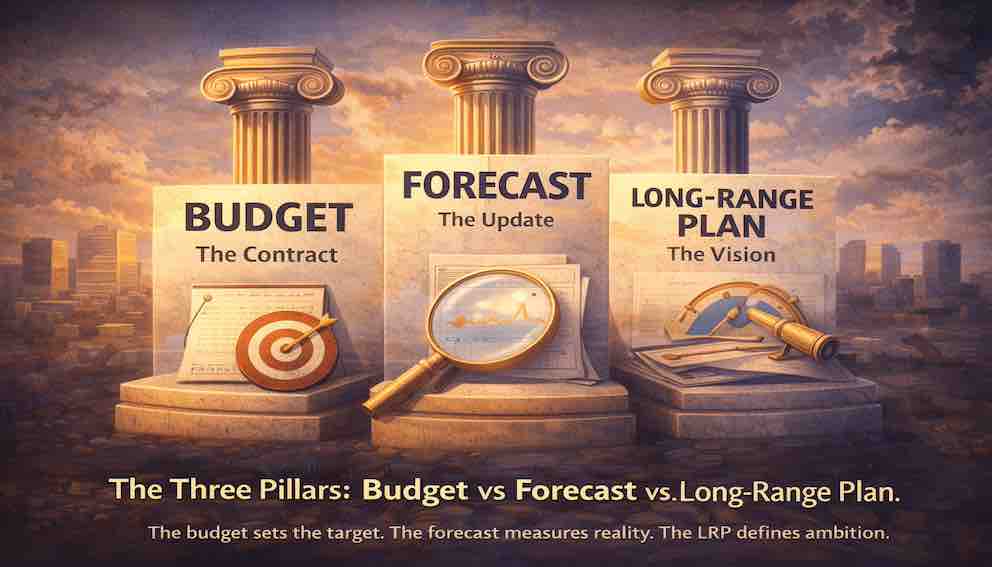
The three pillars of financial planning—Budget, Forecast, and Long-Range Plan—are often mentioned together, but they serve very different functions. Understanding these differences is not merely academic. It is essential for translating strategy into operational reality, ensuring accountability, and guiding the organization through uncertainty.
The Budget: "The Contract"
Sarah pulls the thick budget binder from her shelf. Detailed, reviewed, and approved after months of negotiation, it represents more than numbers—it embodies commitment.
Purpose and Function
"The budget is our commitment," she explains to a new analyst. "It is what we told the board, our investors, and ourselves that we would achieve this year."
The budget sets the formal annual plan for revenue, expenses, investments, and key operational metrics. It allocates resources, establishes accountability, and signals priorities across the organization.
For example, if the marketing department receives a budget of £2 million for the year, it is not a casual suggestion. It is a clear expectation: this is what must be spent, and this is what must be achieved with that spending. Deviations are not automatically acceptable. They require explanation, reallocation decisions, or approval.
Audience and Accountability
The budget communicates expectations broadly. Internally, it informs departments of what is expected of them. Externally, it provides the board, investors, and regulators with evidence of financial discipline.
When a department consistently operates outside its budget, it signals a problem. Either targets were unrealistic, or execution is faltering. Either way, corrective action is necessary.
Flexibility, Optionality, and Time Horizon
The budget is deliberately inflexible. Once approved, it serves as the standard against which performance is evaluated. This rigidity enforces discipline and ensures strategic priorities are respected.
Its time horizon is one fiscal year, aligning with annual reporting cycles, tax calendars, and performance reviews. Although it is fixed, managers can exercise strategic optionality around execution—deciding how to meet targets given real-world constraints—but the total target itself remains constant.
A Concrete Example
Sarah reviews a manufacturing division example. They budgeted £500,000 for equipment maintenance. In June, an unexpected breakdown requires £100,000 in additional repairs. Management must decide: reallocate funds from another area? Seek board approval? Delay other initiatives?
"The budget doesn’t change," Sarah says. "It is the benchmark. The decisions happen around it. That’s the optionality we exercise in practice."
The Forecast: "The Update"
Sarah clicks over to the forecast on her screen. Cleaner, more current, annotated with notes from this week’s operational conversations.
Purpose and Function
"The forecast answers a simple question," Sarah explains. "Given what we know today, what do we expect to happen?"
Unlike the budget, the forecast is dynamic. It adapts to actual results and emerging trends. It provides a rolling view of expected performance and allows management to anticipate deviations from plan.
For instance, if sales exceed expectations, the forecast captures this. If costs rise unexpectedly or a key customer delays an order, the forecast is updated.
"The forecast is our reality check," Sarah says. "It keeps us honest about what is actually happening."
Audience and Decision Use
Forecasts are primarily tools for management. They inform executives, operational leaders, and finance teams about near-term expectations and guide day-to-day decisions: adjusting production schedules, reallocating resources, or accelerating initiatives.
Unlike budgets, forecasts are not about accountability; they are about awareness, situational understanding, and timely course correction.
Flexibility, Optionality, and Time Horizon
Forecasts are highly flexible and are typically updated monthly, sometimes weekly when conditions change rapidly. Their rolling horizon—usually 12 to 18 months—captures seasonal patterns and planned initiatives while remaining relevant for operational decisions.
The forecast embodies operational optionality: managers can explore scenarios, test responses to new information, and adjust tactics without undermining the accountability that the budget ensures.
A Concrete Example
Sarah shows the software division forecast. The quarterly budget expected 10,000 new subscriptions. Midway through the quarter, only 6,000 are acquired, but marketing signals growing demand. The forecast predicts 9,000 subscriptions by quarter-end—short of the target, but better than current run rates suggest.
"That forecast guides action," Sarah explains. "It informs whether we need additional marketing support, but it doesn’t replace the budget as the accountability benchmark."
The Long-Range Plan (LRP): "The Vision"
Sarah opens the LRP presentation. Unlike the spreadsheet-based budget and forecast, this document tells a story—strategic narratives, multi-year projections, market analyses.
Purpose and Function
"The LRP answers a different question," Sarah says. "Where do we want to go, and how will we get there?"
The LRP looks three to five years ahead. It is directional, capturing ambition and guiding major investments. It provides context for annual budgets and rolling forecasts.
For example, a renewable energy company might aim to triple production capacity over five years. The LRP outlines the technology, workforce, and infrastructure investments required. These projections are aspirational, not commitments—they guide strategic decision-making while allowing flexibility to adapt to market changes.
Audience and Strategic Alignment
The primary audience for the LRP is senior leadership, boards, and investors. These stakeholders are focused on long-term outcomes rather than monthly fluctuations.
By articulating strategic intent, the LRP ensures that budgets and forecasts align with overarching goals. Annual decisions are not made in isolation—they are informed by the broader strategic vision.
Flexibility, Optionality, and Time Horizon
The LRP is moderately flexible. Reviewed annually, it is adjusted as market conditions, technology, or competitive dynamics evolve. It provides strategic optionality, allowing leadership to pivot investments, prioritize initiatives, or delay non-critical projects while maintaining a clear directional course.
Its time horizon is three to five years—long enough to guide meaningful investments, yet short enough to remain actionable.
A Concrete Example
Sarah shows the company’s expansion LRP. Revenue is projected to grow from zero to £50 million in four years. Investments include facilities, local hires, marketing spend, and regulatory compliance. Numbers are directional, assumptions are explicit, and annual adjustments are anticipated.
"The exact figures will change," Sarah says. "But the vision provides a guiding star."
The Confusion That Creates Chaos
Sarah recalls a company where pillars were constantly confused. Budgets were treated as forecasts and updated frequently, eroding accountability. Forecasts were treated as budgets, leading managers to sandbag expectations. Long-range plans were treated as commitments, locking leadership into outdated strategies.
"Each pillar has a job," Sarah explains. "When you mix them up, nothing works."
Comparing the Three Pillars: A Textual Summary
Sarah sketches a mental summary to clarify how the three pillars differ along four essential dimensions. Looking at them side by side makes it easier to understand why they cannot be used interchangeably.
Purpose
Budget — Commitment and accountability.
The budget exists to formalize what the organization has committed to achieve during the year. It sets performance targets and spending limits, and it becomes the benchmark against which results are evaluated. Its purpose is not to reflect reality as it evolves, but to define what success was supposed to look like at the start of the year.
Forecast — Reality and awareness.
The forecast exists to reflect what is most likely to happen given current information. It integrates actual performance, recent trends, and emerging risks so management can understand where things are heading. Its purpose is not to enforce commitment, but to create visibility and reduce surprises.
Long-Range Plan (LRP) — Ambition and direction.
The LRP articulates where the organization intends to go over the next several years. It frames strategic ambition, investment priorities, and long-term positioning in the market. Its purpose is to guide direction, not to serve as a short-term performance yardstick.
Audience
Budget — Organization-wide, including boards and investors.
The budget is communicated broadly because it defines expectations for the entire organization. Department heads use it to manage resources, employees are evaluated against it, and boards or investors rely on it as evidence of financial discipline. It is the formal expression of the organization’s annual commitments.
Forecast — Management and operational leaders.
The forecast is primarily a working tool for those making day-to-day and month-to-month decisions. Executives, finance teams, and operational leaders rely on it to adjust tactics and allocate resources in response to changing conditions. It is less about external communication and more about internal situational awareness.
LRP — Senior leadership and strategic stakeholders.
The LRP is designed for those responsible for shaping the organization’s long-term trajectory. Senior leadership, boards, and sometimes long-term investors use it to evaluate strategic initiatives and capital allocation plans. It provides context for major decisions rather than guidance for daily operations.
Flexibility and Optionality
Budget — Low flexibility, anchors accountability; optionality exercised around execution.
Once approved, the budget is intentionally fixed so that performance can be measured against a stable standard. While managers may adjust how they operate in order to meet targets, the targets themselves typically do not change. This limited flexibility preserves accountability and prevents the organization from redefining success midyear.
Forecast — High flexibility; optionality drives tactical adjustments.
The forecast is designed to change as new information becomes available. Its flexibility allows management to explore different tactical responses, assess emerging risks, and adjust short-term plans without undermining accountability. This adaptability creates operational optionality and supports timely decision-making.
LRP — Moderate flexibility; optionality informs strategic investment choices.
The LRP is not rigid, but it is also not updated constantly. It is reviewed periodically to reflect major shifts in market conditions, competitive dynamics, or strategic priorities. Its flexibility lies in guiding long-term investment decisions while allowing leadership to pivot direction when the external environment changes meaningfully.
Time Horizon
Budget — One fiscal year.
The budget typically covers a single fiscal year, aligning with reporting cycles and performance evaluation periods. Its annual focus reinforces discipline and clarity around short-term commitments. It answers the question: what are we responsible for delivering this year?
Forecast — Rolling 12 to 18 months.
The forecast usually extends beyond the current month into the next 12 to 18 months, continuously updating as time progresses. This rolling perspective allows management to anticipate seasonal effects, capacity constraints, and emerging risks. It answers the question: where are we likely heading if current trends continue?
LRP — Three to five years.
The LRP spans multiple years, often three to five, to capture strategic initiatives that cannot be executed within a single annual cycle. It provides a longer lens through which leadership can evaluate growth ambitions, investment programs, and structural changes. It answers the question: what kind of organization are we building over time?
How the Three Pillars Work Together
Sarah emphasizes the connections:
- LRP sets the direction—the long-term vision.
- Budget allocates resources—targets are set for the current year aligned with that vision.
- Forecast tracks progress—provides timely feedback for operational adjustment and informs the next budget cycle.
Examples Across Industries:
- Pharmaceutical Company: Five-year LRP outlines major trials. Annual budget allocates funds to research, trials, and compliance. Monthly forecasts track spending, enrollment, and regulatory milestones. Adjustments are made without losing sight of the five-year goal.
- Retail Company: LRP projects expansion from 50 to 120 stores over four years. Annual budget allocates capital for eight new stores and department-specific targets. Monthly forecasts track store performance and local market conditions, enabling course corrections while keeping long-term strategy intact.
Questions Each Pillar Answers:
- Budget: Did we achieve what we committed to?
- Forecast: What does reality look like, and what should we do differently?
- LRP: Are we still headed in the right direction, and what has changed in the world around us?
Practical Guidance for Leaders
For the Budget:
Set it once. Defend it. Use it for accountability. Ensure targets are realistic.
For the Forecast:
Update frequently. Use it to guide decisions. Connect to the budget to highlight variances and learn from gaps.
For the LRP:
Think directionally, not precisely. Review annually. Use it to guide major investments and strategic choices, allowing for flexibility where necessary.
Conclusion: Anchoring Operational Decisions in Strategic Context
By understanding the Budget, Forecast, and Long-Range Plan—and their distinct roles, audiences, flexibilities, and time horizons—organizations can maintain accountability, respond to emerging realities, and pursue ambitious objectives with confidence.
The monthly close informs the forecast. The forecast guides operational action. The budget enforces accountability. The LRP provides the long-term vision. Together, they form an interconnected system that turns strategy into reality, ensures agility, and guides sustainable success.
Sarah stands, stretches, and smiles. Monday will bring a new cycle: the budget will be reviewed, the forecast updated, and the LRP will continue to inform both.
Three pillars. One purpose: turning strategy into reality.
About Swati Sharma
Lead Editor at MyEyze, Economist & Finance Research WriterSwati Sharma is an economist with a Bachelor’s degree in Economics (Honours), CIPD Level 5 certification, and an MBA, and over 18 years of experience across management consulting, investment, and technology organizations. She specializes in research-driven financial education, focusing on economics, markets, and investor behavior, with a passion for making complex financial concepts clear, accurate, and accessible to a broad audience.
Disclaimer
This article is for educational purposes only and should not be interpreted as financial advice. Readers should consult a qualified financial professional before making investment decisions. Assistance from AI-powered generative tools was taken to format and improve language flow. While we strive for accuracy, this content may contain errors or omissions and should be independently verified.