Tutorial Categories
Last Updated: February 19, 2026 at 10:30
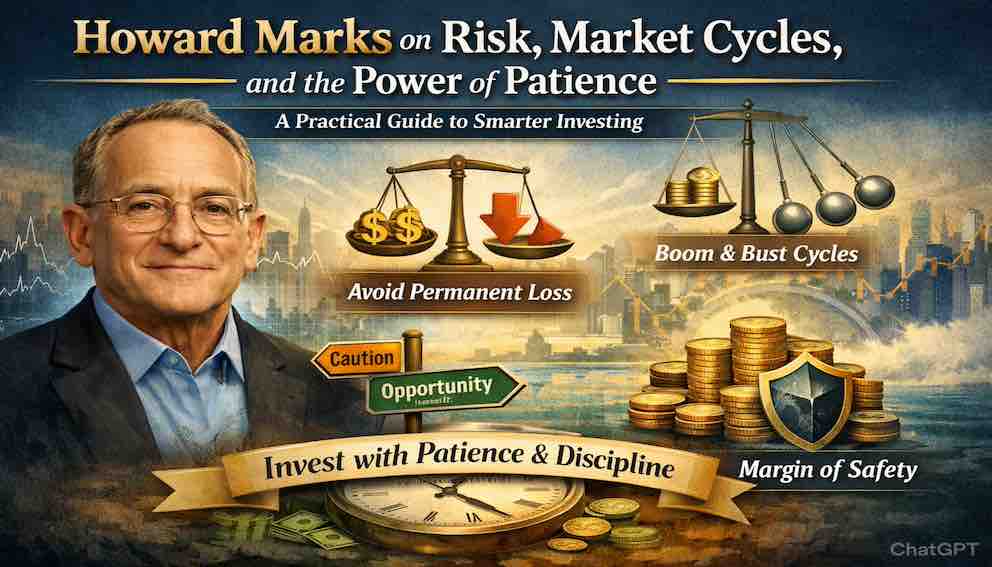
Howard Marks on Risk, Market Cycles, and the Power of Patience: A Practical Guide to Smarter Investing
This tutorial explores the investing philosophy of Howard Marks, one of the most respected thinkers in modern finance, focusing on his views about risk, market cycles, and the crucial role of patience. You will learn why avoiding permanent loss matters more than chasing high returns, how emotional extremes drive booms and busts, and why great investors concentrate on positioning rather than prediction. Through simple language and real-world examples, we will unpack how Marks thinks about uncertainty, valuation, and human behavior. By the end, you will understand how to build a calmer, more resilient approach to investing that survives across decades.
Introduction: Why Howard Marks' Thinking Matters
When people first encounter investing, they often expect it to resemble a puzzle that can be solved through intelligence alone. They imagine that if they read enough books, study enough charts, or learn enough formulas, they will eventually discover the secret method that produces consistently high returns. Over time, most serious investors discover something very different. They learn that investing is less about clever tricks and more about temperament, discipline, and an honest understanding of how uncertain the future really is.
One of the clearest and most influential voices explaining this reality is Howard Marks, co-founder of Oaktree Capital Management. For decades, Marks has written memos that are widely circulated among professional and individual investors alike. These memos are not filled with predictions about next quarter's earnings or the next hot stock. Instead, they focus on timeless ideas: risk control, market cycles, psychology, and patience.
Marks does not promise easy riches. He does not claim to know exactly what markets will do next. What he offers instead is a framework for thinking. His ideas help investors avoid the most damaging mistakes, especially those driven by fear and greed. Warren Buffett once said that when he sees a new memo from Howard Marks, he reads it immediately. That endorsement alone tells us something valuable.
Marks' philosophy can be summarized as a simple loop: Understand risk → Recognize cycles → Apply second-level thinking → Demand margin of safety → Act patiently → Repeat. This tutorial will walk through each element of that loop, building a complete picture of how one of the world's most respected investors approaches markets.
Understanding Risk—More Than Just Volatility
Risk Is Not the Same as Price Movement
Many people assume that risk simply means how much a stock's price goes up and down. If a stock is volatile, they call it risky. If a stock moves slowly, they call it safe. Howard Marks argues that this definition misses the real point.
In his view, risk is primarily about the possibility of permanent loss. Permanent loss means losing money in a way that you cannot reasonably recover from, such as when a company goes bankrupt or when you buy an asset at such an inflated price that future returns are severely limited for years to come.
To understand this distinction, imagine two situations:
Situation A: Company A is a solid business with steady profits. Its stock price drops 30% during a market panic, even though the company itself remains healthy. Customers still buy its products. Its balance sheet remains strong. The price drop feels painful, but the underlying business is intact.
Situation B: Company B is a weak business with heavy debt and declining sales. Its stock price barely moves for a while, giving the impression of stability. There is no dramatic volatility. But eventually the company collapses under its debt load, and shareholders lose most of their money.
In the first case, the price movement looks dramatic, but the underlying risk may be relatively low because the business still exists and can recover. In the second case, the price movement looks calm, but the true risk is enormous because the business foundation is weak.
Marks wants investors to focus less on how noisy prices are and more on what could permanently impair their capital. Volatility is temporary. Permanent loss is final.
The Relationship Between Price and Risk
One of Marks' most important insights is that risk is not an inherent property of an asset. Instead, risk depends heavily on the price you pay.
Think about a simple example using houses:
- If a modest house is worth $200,000 and you buy it for $100,000, your risk is relatively low. Even if the housing market weakens, you have a margin of safety. You could rent it out, wait, or sell at a small loss if necessary.
- If you buy the same house for $400,000 during a housing bubble, your risk is much higher, even though it is the exact same house. You now need prices to keep rising just to avoid a loss. You are dependent on finding someone willing to pay even more.
The asset did not change. The price changed. That change in price dramatically altered the risk.
Marks applies this idea to stocks, bonds, and all investments. A wonderful company can be a terrible investment if you pay too much. Think of investors who bought Microsoft or Coca-Cola at the peak of their popularity in the late 1990s. The companies remained excellent, but it took more than a decade for the stock prices to recover.
Conversely, a struggling company can sometimes be a good investment if the price is low enough to compensate for the problems. This is the essence of distressed investing, where Oaktree built its reputation.
This way of thinking pushes investors to ask a different set of questions:
- What am I paying for this asset?
- What assumptions about the future are already built into the price?
- How bad could things get, and would I still survive financially?
The Concept of Margin of Safety
Marks frequently emphasizes the importance of margin of safety, a concept popularized by Benjamin Graham. Margin of safety means building in a cushion between what you pay and what the asset is reasonably worth.
Imagine you estimate that a business is worth $100 per share based on conservative assumptions. If you buy it at $95, your margin of safety is small. A small mistake in your analysis, or a modest setback for the company, could leave you with a loss. If you buy it at $60, your margin of safety is large. You have room to be wrong.
A large margin of safety helps protect you from:
- Mistakes in your analysis
- Unexpected economic downturns
- Temporary business problems
- Emotional decision-making during declines
Marks believes that great investors do not rely on perfect forecasts. Instead, they rely on favorable odds created by buying assets cheaply relative to their true value. As he puts it: "You can't predict. You can only prepare."
The Market as a Pendulum
Marks often uses a powerful visual to describe market behavior: the pendulum.
A pendulum swings from one extreme to the other, spending very little time in the center. It never stops at the midpoint. It swings, pauses briefly at an extreme, then swings back.
Markets are the same. They swing between:
- Greed and fear
- Optimism and pessimism
- Risk tolerance and risk aversion
- Credulity and skepticism
When the pendulum is at one extreme, it feels permanent. In a bubble, it seems that optimism will last forever. In a crash, it seems that fear will never lift. But the pendulum always swings back.
This metaphor helps investors understand several important truths:
- Extremes are temporary. They cannot last.
- The middle ground is rarely stable. Markets are always moving toward one extreme or the other.
- The best opportunities appear when the pendulum has swung too far in one direction.
- The most dangerous moments occur when people believe the pendulum has stopped moving.
Marks does not try to predict exactly when the pendulum will reverse. He simply tries to recognize when it is near an extreme and position accordingly.
Market Cycles—Why Extremes Always Return
Markets Move in Patterns, Not Straight Lines
Howard Marks often says that markets are cyclical, not linear. This means that conditions swing back and forth between optimism and pessimism, rather than moving steadily upward forever.
Consider a simple cycle:
- A new technology or opportunity appears.
- Early investors make money.
- Stories spread about easy profits.
- More people pile in.
- Prices rise far beyond reasonable value.
- Reality disappoints.
- Prices collapse.
- Fear dominates.
- Eventually, value reappears, and the cycle begins again.
This pattern has occurred repeatedly across history, whether in railroads in the 1800s, the Nifty Fifty stocks of the 1970s, dot-com stocks in the 1990s, real estate in the 2000s, cryptocurrencies in the 2010s, or the AI frenzy of 2024–2025.
Marks does not claim to know exactly when cycles will turn. He does not try to predict the exact top or bottom. Instead, he focuses on recognizing where we are within a cycle. Are people euphoric and throwing caution aside? That suggests we are late in an upswing. Are people despondent and selling at any price? That suggests we may be near a bottom.
The Role of Human Emotion
At the core of market cycles is human psychology. Markets are not driven by calculators. They are driven by people, and people are emotional.
When things are going well, people become optimistic. They extrapolate recent success far into the future. They convince themselves that "this time is different." They lower their standards and accept higher prices and weaker businesses because they fear missing out. The phrase "FOMO"—fear of missing out—entered our vocabulary for a reason.
When things go badly, the opposite happens. People become pessimistic. They assume problems will last forever. They sell at low prices simply to escape the pain. They swear off stocks entirely, often at exactly the moment when opportunities are greatest.
Marks believes that these emotional extremes create the best and worst opportunities.
- The best opportunities appear when fear is widespread and prices are depressed. No one wants to buy. Sellers are desperate. Quality businesses trade at bargain prices.
- The worst opportunities appear when confidence is extreme and prices are inflated. Everyone wants to buy. Stories are exciting. Caution is forgotten.
Understanding this does not eliminate emotional pressure, but it helps investors resist it. When you recognize that euphoria is a warning sign and despair is an opportunity, you can make better decisions even when your feelings are pulling you in the opposite direction.
Example: The Cyclical Nature of Lending
Marks has extensive experience in credit markets, so he often discusses lending cycles. These cycles illustrate perfectly how emotions drive markets.
When times are good:
- Lenders compete aggressively for business.
- Standards loosen. Covenants weaken.
- Risky borrowers get easy access to money.
- Interest rates on risky loans fall because lenders are desperate to deploy capital.
This environment feels safe. Defaults are low. Everyone is making money. But it is actually dangerous because lenders are not being paid enough for the risks they are taking. The seeds of the next crisis are being planted.
When a downturn arrives:
- Losses appear.
- Lenders panic.
- Standards tighten dramatically.
- Even strong borrowers struggle to get loans.
- Interest rates on risky loans spike because no one wants to lend.
This environment feels scary. Defaults are rising. Headlines are terrible. But it can be attractive for investors who have capital and patience. The risks are now being properly priced. The seeds of the next recovery are being planted.
The same pattern applies to stock markets. Easy conditions breed excess. Harsh conditions create opportunity. As Marks often says, "The most dangerous thing is the belief that there is no risk."
Second-Level Thinking—How Great Investors Think Differently
Perhaps the most important intellectual tool Marks offers is the concept of second-level thinking. This is the ability to move beyond obvious conclusions and ask deeper questions.
First-Level vs Second-Level Thinking
First-level thinking is simple and superficial. It sounds like:
- "This company has great products. I should buy the stock."
- "Earnings are growing. The stock will go up."
- "Interest rates are falling. Bonds are attractive."
These statements may be true, but they are also obvious. Thousands of people are thinking the same thing. Markets have already incorporated these conclusions into prices.
Second-level thinking goes deeper. It asks:
- "This company has great products, but everyone knows that. Is the price so high that it already assumes perfection?"
- "Earnings are growing, but is that growth sustainable? What could cause it to slow?"
- "Interest rates are falling, but has the market already pushed bond prices up so far that future returns will be low?"
Second-level thinking considers not just the facts, but how those facts are reflected in prices, and what might be overlooked.
Why It Matters
Without second-level thinking, investors simply follow popular narratives. They buy what is already popular, often at exactly the wrong time. They sell what is already out of favor, often just before recovery.
Marks would say that first-level thinking leads to average results because it is what everyone else is doing. Second-level thinking is the path to superior results because it identifies what others miss.
Simple Examples
Example 1: A Popular Stock
- First-level thinking: "This is a wonderful company. I should own it."
- Second-level thinking: "This is a wonderful company, but it trades at 50 times earnings. That price assumes decades of perfect performance. If growth slows even modestly, the stock could fall sharply. The potential downside may exceed the upside."
Example 2: An Unpopular Market
- First-level thinking: "The economy is weak. Stocks are falling. I should sell."
- Second-level thinking: "The economy is weak, but stock prices have already fallen 40%. Current prices seem to assume a depression. If the economy merely stagnates, stocks could rise significantly. The potential upside may now exceed the downside."
Example 3: A New Technology
- First-level thinking: "This technology will change the world. I must invest."
- Second-level thinking: "This technology may indeed change the world, but hundreds of companies are chasing it. Most will fail. The ones that succeed may already be priced for perfection. Which ones have durable advantages and reasonable valuations?"
Second-level thinking does not guarantee correct answers. It simply asks better questions. And over time, asking better questions leads to better decisions.
Asymmetry—Upside vs Downside
Marks frequently frames investment decisions in terms of asymmetry: the relationship between what you could gain and what you could lose.
The Concept
Every investment has a range of possible outcomes. Some have large upside potential but also large downside risk. Others have more modest upside but limited downside. Marks consistently prefers the latter.
He asks two questions in sequence:
- "How much could I lose if I am wrong?"
- "How much could I gain if I am right?"
Only after answering these does he consider whether the investment makes sense.
Why Asymmetry Matters
Two investments can look equally attractive on the surface but be radically different:
Investment A:
- Possible gain: 20%
- Possible loss: 80%
Investment B:
- Possible gain: 50%
- Possible loss: 20%
Marks would almost always prefer Investment B, even if Investment A has more exciting stories attached. Why? Because the math of compounding favors avoiding large losses.
A 50% loss requires a 100% gain to recover. A 20% loss requires only a 25% gain. The smaller loss is easier to overcome, and the smaller drawdown preserves emotional stability.
Connection to Margin of Safety
Asymmetry is closely related to margin of safety. When you buy with a large margin of safety, your downside is naturally limited. The price is so low that even if things go wrong, you may still break even or suffer only a modest loss.
When you buy at high prices, your downside expands. There is little room for error.
Marks summarizes this by saying that great investments are not necessarily those with the highest potential returns. They are those where the upside meaningfully exceeds the downside. They are bets where the odds are in your favor.
Positioning, Not Prediction
Why Forecasting Is Overrated
Many investors spend enormous energy trying to predict:
- Next year's GDP growth
- Interest rate changes
- Election outcomes
- Short-term market movements
- Which sector will outperform next quarter
Howard Marks is deeply skeptical about this approach. He believes that the future is too complex and influenced by too many variables for precise forecasting to be reliable. Even the smartest people, with the most data, are regularly wrong about what happens next.
Instead of asking, "What will happen?" Marks encourages investors to ask, "What is the market assuming will happen?"
If prices already reflect extremely optimistic assumptions, then even good news may not push prices higher. The good news is already priced in. Conversely, if prices reflect extreme pessimism, then modestly good news can lead to large gains. The bad news is already priced in.
This shift in thinking—from prediction to analysis of current prices—is one of Marks' most valuable contributions.
Thinking in Terms of Ranges
Rather than predicting a single outcome, Marks thinks in terms of ranges of possibilities. This approach acknowledges uncertainty rather than pretending it does not exist.
For example, instead of saying, "This company will earn $5 per share next year," he might think:
- In a bad scenario, it might earn $2.
- In a normal scenario, it might earn $4.
- In a great scenario, it might earn $6.
He then considers whether the current price makes sense given these possibilities.
If the price is $80, that implies expectations are extremely high. The company would need to deliver the great scenario consistently. If the price is $20, expectations are very low. Even the bad scenario might be tolerable.
This framework helps investors avoid paying for perfection and instead find situations where the odds are in their favor.
Defensive Investing
Marks often describes his style as defensive. This does not mean avoiding risk entirely. It means structuring a portfolio so that it can survive bad outcomes.
Defensive investing involves:
- Avoiding excessive leverage. Borrowed money magnifies losses and can force you to sell at the worst possible time.
- Diversifying sensibly. No single investment should be able to destroy your portfolio.
- Insisting on margin of safety. Pay prices that leave room for error.
- Being willing to hold cash when opportunities are scarce. Cash preserves optionality.
- Focusing on what can go wrong, not just what can go right.
This mindset prioritizes survival first and growth second. Marks believes that if you avoid big losses, compounding will eventually do the rest. As he puts it: "If we avoid the losers, the winners will take care of themselves."
Patience as a Competitive Advantage
Why Patience Is Rare
Modern financial culture rewards activity. News flows constantly. Trading apps make buying and selling effortless. Social media highlights people who appear to be making fast money. The message is always the same: do something, do it now, or you will miss out.
In this environment, patience feels unnatural. Waiting feels like doing nothing, and doing nothing feels like falling behind. Yet Howard Marks argues that patience is one of the most powerful advantages an investor can have.
Most investors do the opposite of what they should:
- They buy when excitement is high and prices are elevated.
- They sell when fear is high and prices are depressed.
- They trade frequently, incurring costs and taxes.
- They chase whatever has performed well recently.
Patient investors try to do the opposite. They recognize that opportunities come and go. They are willing to wait.
Waiting for the Right Pitch
Marks often uses a baseball analogy borrowed from Warren Buffett. In baseball, batters do not have to swing at every pitch. They can wait for a pitch in their "sweet spot"—the one that gives them the best chance of hitting well.
In investing, this means waiting for situations where:
- Prices are clearly attractive
- Risk is manageable
- The odds are in your favor
- You understand what you are buying
This may not happen often. You might wait months or even years. The market may offer few compelling opportunities. But when such opportunities arise, patient investors are ready. They have cash. They have done their homework. They are not forced to act by anxiety or boredom.
Example: Buying During a Crisis
Imagine a severe market crash. Headlines are bleak. Friends are panicking. Television commentators are predicting further declines. Many investors sell to stop the pain.
A patient investor who has studied cycles understands that:
- Crashes eventually end, even though they feel endless while happening
- Quality businesses do not disappear overnight
- Prices during crises often imply unrealistically negative futures
- The best opportunities often appear when conditions feel worst
Instead of rushing to sell, this investor carefully looks for strong businesses trading at depressed prices. They ask: Which companies will survive? Which have durable advantages? Which have strong balance sheets?
This does not guarantee immediate success. Prices may fall further. But over time, as conditions normalize, such investments often perform well.
The investor who panicked sells low and buys back high later, if at all. The patient investor does the opposite.
The Cost of Impatience
Impatience has real costs:
- Transaction costs eat into returns.
- Taxes on short-term gains reduce compounding.
- Emotional exhaustion leads to poor decisions.
- Missing the best days in markets dramatically reduces long-term returns.
Studies have shown that investors who trade frequently consistently underperform those who trade less. The reason is simple: trading is expensive, and timing the market is extremely difficult.
Patience allows compounding to work. It allows good businesses to grow. It allows time to smooth out volatility.
Humility as an Investment Skill
Marks repeatedly emphasizes that the biggest investing errors come not from informational or analytical failures, but from psychological ones. At the center of psychology is humility—or the lack of it.
Knowing What You Don't Know
Most people overestimate their ability to predict the future. They read a few articles, hear a few opinions, and become confident in their views. This overconfidence leads them to take risks they do not fully understand.
Marks takes the opposite approach. He assumes that the future is uncertain and that his ability to predict it is limited. This assumption shapes everything he does:
- It leads him to demand a margin of safety.
- It leads him to avoid leverage.
- It leads him to diversify.
- It leads him to focus on positioning rather than prediction.
Why Humility Helps
Humility does not mean passivity. It means acknowledging that you cannot know what will happen next, so you must prepare for multiple possibilities.
A humble investor asks:
- "What if I am wrong?"
- "How could this investment fail?"
- "What am I missing?"
- "What assumptions am I making that could prove false?"
These questions are not signs of weakness. They are signs of wisdom.
Marks often quotes the philosopher Jacob Needleman: "The first step to wisdom is admitting you know nothing." In investing, the first step to long-term survival is admitting you cannot predict the future.
What Howard Marks Is Not Arguing
Before going further, it is worth clarifying what Marks is not saying. His philosophy is sometimes misunderstood, and these misunderstandings can lead readers to draw the wrong conclusions.
He is not against taking risk. Marks takes risk regularly. He simply wants to be compensated for it. He wants the odds in his favor. He wants asymmetry.
He is not always pessimistic. Marks has been optimistic at many points in his career, particularly when prices were depressed and fear was high. His stance depends on where we are in the cycle.
He does not believe in staying in cash forever. Cash is a tool, not a permanent home. It preserves optionality until opportunities appear.
He is not predicting constant crashes. Marks does not predict crashes. He simply notes that crashes happen, and he wants to be positioned to survive them and take advantage of them.
He is not anti-growth. Marks has invested in growth companies. He simply insists that the price must be reasonable relative to the growth. Growth at any price is speculation.
Understanding what Marks is not saying helps prevent misapplication of his ideas.
Practical Ways to Apply Marks' Ideas
1. Evaluate Price Before Story
When you hear about an exciting company, resist the urge to focus only on its narrative. The story may be compelling, but the price determines whether it is a good investment. Ask:
- How much am I being asked to pay?
- What growth is already assumed in this price?
- What could go wrong that would make this price look foolish?
2. Practice Second-Level Thinking
Before making any decision, ask the deeper questions:
- What does everyone else believe?
- What is being overlooked?
- What must happen for this investment to succeed?
- What happens if the consensus is wrong?
3. Assess Asymmetry
For any potential investment, ask:
- How much could I lose if I am wrong?
- How much could I gain if I am right?
- Is the upside meaningfully larger than the downside?
4. Track Your Emotional Temperature
Notice how you feel about markets. Your emotions can be useful signals:
- Are you feeling euphoric and confident that nothing can go wrong? This may be a warning sign.
- Are you feeling fearful and hopeless, convinced that markets will never recover? This may be an opportunity signal.
Extreme emotions often coincide with market extremes.
5. Build Cash as a Strategic Asset
Holding cash is often criticized as unproductive, especially in strong markets. Marks sees cash differently. Cash is not a returnless asset to be minimized. It is optionality. It gives you the ability to act when opportunities appear.
When prices are high and risks are elevated, holding cash preserves capital and patience. When prices collapse, cash becomes the fuel for future returns.
6. Accept Imperfection
You will never buy at the exact bottom or sell at the exact top. You will make mistakes. Some investments will fail. Marks emphasizes being roughly right rather than precisely wrong.
The goal is not perfection. The goal is a process that works over time.
7. Read Widely and Think Independently
Marks is an avid reader of history, philosophy, and psychology. He draws insights from many fields, not just finance. This broad perspective helps him see patterns others miss.
You do not need to read everything, but reading thoughtfully expands your mental toolkit.
Part XI: How Marks' Ideas Connect to Other Great Investors
Marks' philosophy stands on the shoulders of those who came before him, and it connects naturally to other great investors we have studied.
From Benjamin Graham, he takes the margin of safety and the distinction between price and value.
From Warren Buffett, he takes the emphasis on temperament and the importance of thinking like an owner.
From Charlie Munger, he takes the multidisciplinary approach and the focus on psychology.
From Peter Lynch, he takes the idea that ordinary observations can lead to insights, though Marks adds a heavier emphasis on cycle awareness and second-level thinking.
What Marks adds uniquely is his systematic thinking about risk asymmetry and his deep experience in credit markets, which makes his perspective especially valuable during times of stress.
Conclusion: What Endures
Howard Marks' investing philosophy is not a collection of tricks or predictions. It is a way of seeing the world. It asks us to accept that the future is uncertain and that our emotions will constantly try to lead us astray. It asks us to focus on what we can control—the price we pay, the margin of safety we demand, the patience we practice—and to let go of what we cannot.
The most successful investors are not those who make the boldest predictions. They are those who survive long enough for compounding to work. They are those who avoid catastrophic losses. They are those who recognize that markets swing between euphoria and despair, and that the wisest course is to buy when others are fearful and sell only when the story has fundamentally changed.
Second-level thinking teaches us to look beyond the obvious. Asymmetry reminds us to weigh downside against upside. The pendulum shows us that extremes always reverse. Humility keeps us grounded in the face of uncertainty.
Marks once wrote: "We may never know where we're going, but we'd better have a good idea where we are." That single sentence captures the heart of his teaching. We cannot see the future, but we can see the present. We can see whether prices are high or low. We can see whether optimism or pessimism dominates. And we can position ourselves accordingly.
In a world that celebrates speed, certainty, and action, Howard Marks reminds us that humility, patience, and preparation are the real sources of enduring success. His ideas will not make you rich overnight. They will not help you predict the next hot stock. But they will help you build a portfolio—and a mindset—that can survive anything the markets throw at you, and that, over a lifetime, is the only kind of success that truly matters.
Further Reading
- The Most Important Thing by Howard Marks (the essential starting point)
- Mastering the Market Cycle by Howard Marks (deeper exploration of cycles)
- The Oaktree memos (available free on Oaktree's website)
- The Intelligent Investor by Benjamin Graham (for foundational value investing principles)
About Swati Sharma
Lead Editor at MyEyze, Economist & Finance Research WriterSwati Sharma is an economist with a Bachelor’s degree in Economics (Honours), CIPD Level 5 certification, and an MBA, and over 18 years of experience across management consulting, investment, and technology organizations. She specializes in research-driven financial education, focusing on economics, markets, and investor behavior, with a passion for making complex financial concepts clear, accurate, and accessible to a broad audience.
Disclaimer
This article is for educational purposes only and should not be interpreted as financial advice. Readers should consult a qualified financial professional before making investment decisions. Assistance from AI-powered generative tools was taken to format and improve language flow. While we strive for accuracy, this content may contain errors or omissions and should be independently verified.