
Tutorial Categories
Last Updated: February 19, 2026 at 10:30
Lessons from History's Best and Worst Investors: Timeless Investing Wisdom You Can Apply Today
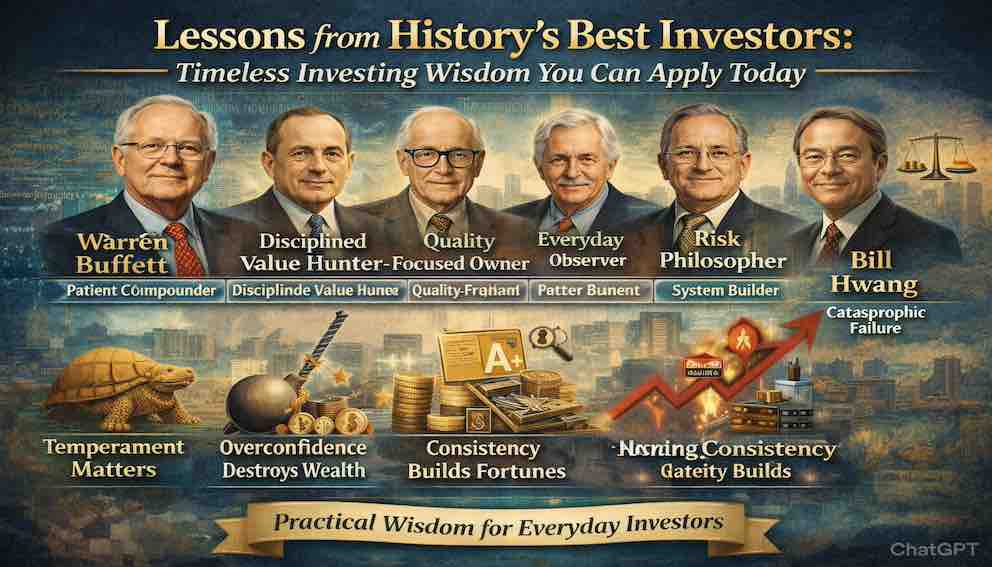
This tutorial explores the real-world lessons inside the successes and failures of history's most famous investors, and shows how their decisions can guide everyday investors today. By examining patient compounders, disciplined value hunters, quality-focused owners, everyday observers, risk philosophers, system builders, quantitative engineers, and catastrophic failures, we uncover patterns that repeat across decades and market cycles. You will learn why temperament matters more than intelligence, how overconfidence destroys wealth, why boring consistency quietly builds fortunes, and how forces like inflation, asset allocation, and taxes shape long-term outcomes. Every concept is explained with examples and stories rather than formulas. The goal is not to idolize famous investors, but to extract practical wisdom that can shape your own long-term investing behavior.
Introduction: Why Studying Investor History Matters
New investors often search for formulas, secret indicators, or hidden strategies that promise fast profits and easy wealth. This desire is deeply human: uncertainty feels uncomfortable, and money is tied to our sense of security and future well-being. A “perfect system” feels like it could remove uncertainty entirely.
History shows something very different. The most reliable investing wisdom rarely comes from clever tricks or complex formulas. It comes from observing how real people behaved over long periods, especially during moments of extreme success and devastating failure.
History offers what no textbook or spreadsheet can fully provide: stories of people making decisions under pressure, feeling fear and euphoria, suffering crushing losses and enjoying extraordinary gains, then living with the consequences. These stories reveal patterns—what tends to work over decades, and what repeatedly leads to ruin, regardless of era, technology, or asset class.
In this tutorial, we draw lessons from some of history's most respected investors, as well as from a few whose spectacular failures became cautionary tales. The purpose is not to place anyone on a pedestal or to mock those who stumbled. It is to understand the deeper principles behind their behavior, because those principles remain relevant for anyone who hopes to build wealth steadily and responsibly.
The Patient Compounder—Warren Buffett
Few investing names are as widely recognized as Warren Buffett. Over many decades, he turned modest beginnings into one of the largest personal fortunes in history, primarily through long-term ownership of high-quality businesses such as Coca‑Cola and Apple.
One of his core lessons is that wealth is often created not through frequent action, but through long periods of intelligent inactivity. His famous line, “Our favorite holding period is forever,” does not mean you should hold anything blindly. It means that when you own a strong business with durable competitive advantages, time becomes your greatest ally.
Consider a simple example. Imagine two investors, each with £10,000. The first buys shares of a solid company that grows earnings at 10% per year and holds for thirty years, reinvesting dividends. The second buys and sells dozens of stocks every year, chasing trends, paying trading costs, and triggering taxes. After three decades, the first investor has roughly £174,000; the second, even if equally intelligent in stock selection, is likely far behind because churn interrupts compounding and friction quietly erodes returns.
Buffett’s approach also emphasizes simplicity. He does not try to predict short-term price movements. He focuses on understanding a company’s business model, management quality, and ability to generate consistent cash flow. His investments in Coca‑Cola and Apple reflect a focus on brands with global recognition, pricing power, recurring cash flows, and long runways for growth.
Patient compounder checklist:
- Understand how the business makes money.
- Look for durable competitive advantages and strong cash flows.
- Pay a sensible price.
- Be willing to hold through downturns and boredom, not just good times.
Patience is not passive. It requires confidence, discipline, and emotional strength. When markets fall, patient investors must resist panic selling. When markets soar, they must avoid overpaying for excitement. Buffett’s career suggests that the ability to sit still during chaos is one of the most valuable investing skills a person can develop.
The Disciplined Value Hunter—Benjamin Graham
Benjamin Graham is the foundation for much of modern investing. His central contribution was the idea that stocks represent ownership in real businesses, not just symbols on a screen. He taught investors to look for situations where market price falls well below a conservative estimate of intrinsic value—a gap he called the margin of safety.
Graham’s life was shaped by the Great Depression. Heavy losses taught him that survival comes before profit. He never again assumed that markets would stay rational or that his analysis would always be correct. Instead, he built a cushion into every purchase.
For everyday investors, Graham’s lesson is simple but profound: price matters. A wonderful company purchased at a foolish price can still be a terrible investment. A mediocre company purchased at a deep discount can sometimes work out. The margin of safety is what allows you to be wrong and still survive.
The Quality-Focused Owner—Philip Fisher
Philip Fisher added an important layer to Graham’s thinking by emphasizing that some businesses are so exceptional that owning them for a very long time can outweigh modest differences in purchase price.
Fisher focused on management quality, innovation, customer loyalty, and long-term growth potential. He believed that a truly great company can keep expanding for decades, steadily increasing the value of the original investment. He was less concerned with statistical cheapness today and more concerned with whether the business would be larger and more profitable ten or twenty years from now.
His most famous investment was Motorola, which he held for decades. He practiced “scuttlebutt” research—talking to customers, suppliers, competitors, and former employees to build a full picture of a company’s strengths and weaknesses. This qualitative approach complemented Graham’s quantitative discipline.
Fisher’s lesson: not all bargains are equal. A wonderful business at a fair price will usually beat a fair business at a wonderful price over long periods.
The Everyday Observer—Peter Lynch
Peter Lynch managed the Fidelity Magellan Fund through one of the most successful runs in mutual fund history. His message was that ordinary people have advantages professionals lack. Everyday life—shopping, working, noticing products and services—can reveal investment ideas long before they appear on Wall Street’s radar.
A crowded restaurant, a product that keeps selling out, a growing regional chain—these are not investments on their own. They are prompts for research. Lynch’s discipline was to follow observation with homework: revenue growth, earnings consistency, debt, and valuation still had to make sense.
For everyday investors, Lynch’s lesson is empowering. You do not need privileged access or complex terminals. You need curiosity, patience, and a willingness to dig into basic business and financial information.
The Risk Philosopher—Howard Marks
Howard Marks, co‑founder of Oaktree Capital Management, has spent his career thinking about risk, cycles, and investor psychology. His central claim is that most people misdefine risk as volatility, when the true risk is permanent loss and being forced to sell at the bottom.
Marks emphasizes that risk depends heavily on the price you pay. A wonderful company at 100 times earnings can be extremely risky, because even a small disappointment can crush the stock. A struggling company at a deep discount to liquidation value may carry less risk, because much bad news is already in the price.
He also stresses second‑level thinking. First‑level thinking says: “This company is great, I should buy it.” Second‑level thinking asks: “Everyone knows this is great. Is that already in the price? What are the less obvious ways this could go wrong?” This deeper layer of analysis separates superior investors from the crowd.
Marks often notes that risk is highest when it feels lowest—periods of calm and optimism encourage reckless behavior, sowing the seeds of future trouble. His pendulum metaphor captures market behavior: it swings between euphoria and despair, rarely resting in the middle. The job is not to time every swing, but to recognize when it has gone too far and adjust accordingly.
He reminds investors that you cannot predict the future, but you can prepare for it. Building portfolios that can survive a range of outcomes, rather than betting on a single forecast, allows you to act when others are forced sellers.
The Humble Champion—John Bogle
John Bogle founded Vanguard and created the first index fund for individual investors. His message: for most people, the smartest move is not to try to beat the market at all.
Over long periods, most active investors underperform simple market indexes once fees, trading costs, and taxes are accounted for. Higher costs compound against you. For example, if two investors each put £10,000 into the market and earn the same 8% before costs, the one paying 0.05% in fees ends up with far more after 30 years than the one paying 1.5%—the gap can reach tens of thousands of pounds purely from fees.
Bogle also emphasized staying the course. Investors who jump in and out based on fear and greed usually earn less than those who hold diversified index funds through thick and thin.
The lesson is humbling but liberating: you do not need to be a brilliant stock picker to build wealth. You need to be low‑cost, diversified, and steady.
The System Builder—Ray Dalio
Ray Dalio, founder of Bridgewater Associates, approaches markets as interconnected systems. He asks how different assets behave across economic environments—rising or falling growth, rising or falling inflation—and then builds portfolios designed to survive many possible futures.
Dalio emphasizes diversification not just across stocks, but across asset classes and economic scenarios. His “all‑weather” idea aims for reasonable performance in most environments rather than maximum performance in any single one. The goal is resilience and steady progress, not heroics.
For individuals, Dalio’s lesson is humility and balance. No one knows the future. Portfolios that acknowledge uncertainty by spreading risk across different drivers are more robust than those built around a single bold forecast.
The Quantitative Engineer—Jim Simons
Jim Simons, a mathematician and former code‑breaker, built Renaissance Technologies into one of the most successful quantitative hedge funds in history. His approach looks almost nothing like traditional investing.
Simons and his team search for statistical patterns in vast data sets. They do not ask whether a business is “good.” They ask whether, in the data, certain conditions tend to precede particular short‑term price moves with a small edge. They then place thousands of tiny, diversified bets and let the law of large numbers and rigorous risk controls do the work.
Most individuals cannot replicate this. But the broader lesson is powerful: markets can be approached systematically, and removing emotion from decisions is a major advantage. Simons also illustrates that very different methods can succeed. There is no single right way. What matters is having a coherent edge that fits your temperament and sticking with it.
Interlude: The Invisible Forces Behind Every Strategy
Despite their differences, Buffett, Bogle, Dalio, Simons, and others share common foundations. Every successful strategy respects that markets are emotional, acknowledges uncertainty, and prioritizes survival over heroics. All recognize that the investor’s own psychology is the biggest variable.
Style matters less than consistency. Method matters less than discipline. The specific tools you use are less important than the character with which you use them.
That is why studying failures is as valuable as studying successes. Failures show what happens when discipline collapses, when ego overrides evidence, and when survival is forgotten in the chase for glory.
When Things Go Wrong—Cautionary Tales
Success shows us what works. Failure shows us what breaks. Both are necessary.
The Speculator: Jesse Livermore
Jesse Livermore was one of the most famous traders of the early twentieth century. He made and lost several fortunes. He often called market turns correctly, but repeatedly took huge risks, borrowed heavily, and refused to accept when he was wrong.
He died bankrupt and in debt. His story shows that intelligence and market insight are not enough. Without emotional control and risk discipline, you can be right about markets and still destroy yourself—much like modern traders who overuse leverage, average down on losing positions, or chase losses with options and CFDs.
The Leverage Addict: Long-Term Capital Management
Long-Term Capital Management (LTCM) was run by some of the brightest minds in finance, including Nobel laureates. Their models and strategies were sophisticated, but they relied on enormous leverage—debt ratios reportedly above 25:1 and effective exposures even higher—to amplify small edges.
When Russia defaulted in 1998 and markets moved in ways their models had deemed highly unlikely, losses escalated. Leverage turned modest mispricings into a near-fatal event for the financial system, requiring a coordinated private rescue organized by the Federal Reserve.
The lesson: even the smartest people cannot foresee every scenario. When you use high leverage, you sacrifice the ability to survive being wrong.
The Fraud Architect: Bernie Madoff
Bernie Madoff ran the largest Ponzi scheme in history, defrauding investors of tens of billions. He promised steady, low‑volatility returns year after year, regardless of market conditions—returns that were inconsistent with his purported strategy and market reality.
For decades, many investors did not question these numbers. Madoff’s lesson is that if something seems too good to be true, it probably is. Healthy skepticism—asking how returns are generated, whether they are plausible, and who is providing independent verification—is essential self‑protection.
The Hidden Risk-Taker: Nick Leeson
Nick Leeson, a trader at Barings Bank, hid mounting losses in an unauthorized account while reporting apparent profits. When the losses emerged, they exceeded the bank’s capital, leading to the collapse of a centuries‑old institution.
Leeson’s story shows how complex organizations can conceal dangerous risks. For investors, it underlines the need to understand what you own, look through to underlying exposures, and not rely solely on assurances from institutions or individuals.
The Concentrated Gambler: Bill Hwang
Bill Hwang’s Archegos Capital Management used borrowed money and derivatives to build massive, concentrated positions in a handful of stocks. When those stocks fell, margin calls hit simultaneously across prime brokers, triggering rapid liquidation and multi‑billion losses for banks involved.
Hwang’s story repeats a familiar pattern: leverage plus concentration equals fragility. No matter how confident you are, concentration in a few names financed with heavy borrowing leaves no margin for error.
The Ego-Trapped Genius: Bill Ackman
Bill Ackman is a talented and often successful investor, but his public, prolonged short campaign against Herbalife and his commitment to other controversial positions showed how ego and public staking of views can trap even skilled investors. He held losing positions long after the evidence weakened, partly because reversing course would be a public admission of error.
His story teaches that the ability to change your mind when evidence shifts is not weakness but wisdom. Commitment bias—clinging to a thesis because it is yours—can be as dangerous as bad analysis.
Failure pattern checklist:
- Excessive leverage.
- Over‑concentration in a few bets.
- Hidden or misunderstood risks.
- Overconfidence and ego.
- Stories or models that are not regularly challenged.
- Returns that look “too smooth” or “too good to be true.”
The Deeper Forces Most Investors Overlook
Beyond individual stories, several structural forces shape long-term outcomes.
Inflation: The Silent Destroyer
A portfolio growing at 5% in a world with 4% inflation is only increasing purchasing power by about 1% a year. Cash-heavy investors often feel safe while their real wealth slowly erodes.
This is why productive assets—stocks, real estate, businesses—have historically beaten cash over long periods. They represent ownership in entities that can raise prices, innovate, and grow. Inflation punishes inactivity just as volatility punishes panic.
Buffett and Bogle both understood this. Buffett favored businesses with pricing power that could pass inflation through to customers. Bogle advocated long-term equity ownership for ordinary investors to stay ahead of rising prices.
Asset Allocation: The First Decision
Most investors obsess over stock picking. History suggests that a more important decision is how much of your portfolio belongs in stocks at all.
The mix of stocks, bonds, cash, and other assets drives most of your portfolio’s volatility and long-term returns. A young investor with decades ahead can tolerate more equities. An older investor relying on savings needs more stability.
Dalio’s all‑weather idea and Bogle’s simple stock‑bond split are different answers to the same question: how do you balance growth and safety given your goals and time horizon?
Taxes and Friction: The Quiet Compounders
Frequent trading does more than interrupt compounding. It triggers taxes on gains and racks up costs. Over decades, this “tax and friction drag” can dramatically shrink your final outcome.
Buffett’s low‑turnover style is about more than patience. It also minimizes taxes and costs. Each extra year you hold, the government waits; each unnecessary trade accelerates tax payments and fees.
Using tax‑advantaged accounts, holding for the long term, and avoiding unnecessary trades are not minor details. They are essential to long-term success.
Choosing Your Own Path
After studying these figures, the natural question is: which path should you follow? The answer depends on who you are.
If you enjoy analyzing businesses and moats, Buffett, Fisher, and Lynch offer models you can adapt. You will need curiosity, patience, and comfort with reading financial statements and industry reports.
If you prefer simplicity and low effort, Bogle’s path is open to you. You do not need to analyze individual companies. You need the discipline to buy low-cost diversified funds and stay the course.
If you like macroeconomics and systems, Dalio’s approach may appeal. You will need to study how economies work and build portfolios that balance different environments rather than betting on one.
If you are drawn to data and patterns, Simons’ quantitative mindset is intellectually attractive, even if full replication is unrealistic. You can still apply the idea of rules‑based, pre‑defined decisions to reduce emotion.
The right path is the one you can stick with. Consistency over decades matters more than brilliance in any single year. A simple plan followed faithfully usually beats a clever plan that is abandoned.
Practical Foundations Before Investing
Before applying any of these lessons, a few practical foundations matter more than any strategy.
- Build an emergency fund. Cash reserves prevent you from becoming a forced seller in downturns, which is exactly the type of risk Marks warns about.
- Eliminate high‑interest debt. Paying 20% interest on debt is equivalent to a guaranteed negative 20% return on your net worth. No realistic investment can reliably offset that.
- Invest only long‑term capital. Money you will need within a few years does not belong in volatile assets. This reduces the pressure to sell at bad times and improves your odds of staying the course.
These steps are not glamorous, but they are the base that allows all other investing wisdom to actually work.
Conclusion: What Endures from the Best and the Worst
Looking across these stories, clear patterns emerge.
The best investors tend to share:
- Patience and long time horizons (Buffett, Bogle).
- Respect for risk and margin of safety (Graham, Marks).
- Independent, second‑level thinking (Marks, Dalio).
- Emotional stability in chaos (Buffett, Lynch).
- Humility about what they do not know (Bogle, Dalio).
The worst failures tend to share:
- Leverage that magnifies mistakes (LTCM, Hwang, Livermore).
- Overconfidence and ego (Livermore, Ackman).
- Concentration in a few bets (Hwang, Amaranth‑style stories).
- Hidden risks and poor controls (Leeson, Madoff).
- Trust in models or narratives without verification (LTCM, Madoff).
These patterns recur because they are rooted in human nature, not in any particular era. The same behavioral traps that ensnared Livermore in 1929 resurfaced at Archegos in 2021.
The central message is not that you must copy any one investor. Buffett shows that patience compounds. Graham shows that price matters. Fisher shows that quality endures. Lynch shows that everyday observation can be a starting edge. Marks shows that risk and cycles come first. Bogle shows that simplicity and humility work for most. Dalio shows that diversification across scenarios builds resilience. Simons shows that systematic, rules‑based approaches can work at scale.
On the other side, Livermore, LTCM, Leeson, Hwang, Madoff, and Ackman remind us that leverage, ego, opacity, and unchecked stories eventually meet reality. Beneath all of this lie slow, quiet forces: inflation erodes cash, asset allocation shapes most of your experience, and taxes and fees quietly compound against you.
Investing is ultimately about human behavior—yours and everyone else’s. Markets are crowds of people making decisions under uncertainty. The wisest investors learn to control themselves when others cannot. You do not need the highest IQ or the most complex model. You need patience, discipline, humility, and a willingness to learn from history rather than repeat it.
About Swati Sharma
Lead Editor at MyEyze, Economist & Finance Research WriterSwati Sharma is an economist with a Bachelor’s degree in Economics (Honours), CIPD Level 5 certification, and an MBA, and over 18 years of experience across management consulting, investment, and technology organizations. She specializes in research-driven financial education, focusing on economics, markets, and investor behavior, with a passion for making complex financial concepts clear, accurate, and accessible to a broad audience.
Disclaimer
This article is for educational purposes only and should not be interpreted as financial advice. Readers should consult a qualified financial professional before making investment decisions. Assistance from AI-powered generative tools was taken to format and improve language flow. While we strive for accuracy, this content may contain errors or omissions and should be independently verified.