
Tutorial Categories
Last Updated: February 19, 2026 at 10:30
Synthesis: Creating Your Personal Investment Philosophy
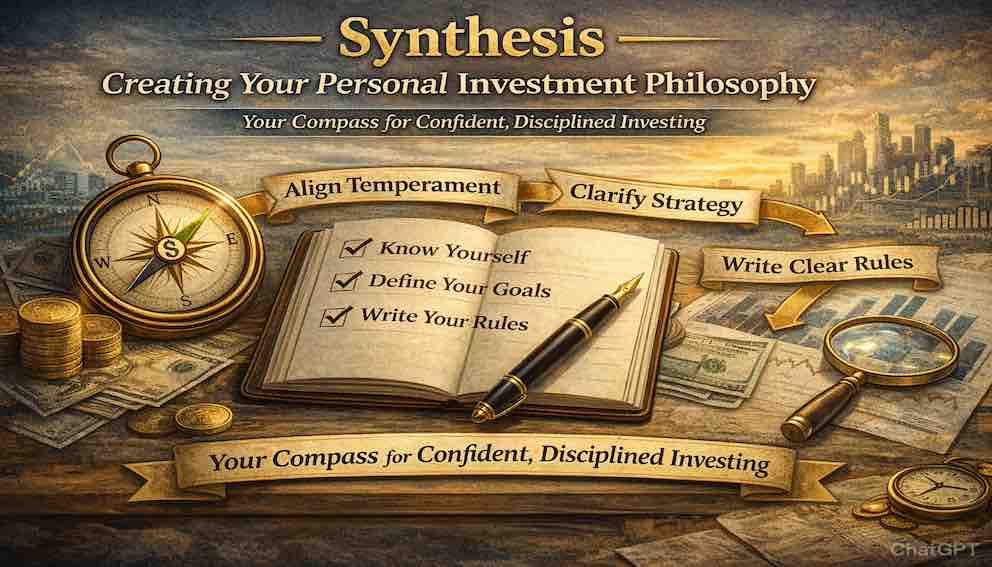
Creating your personal investment philosophy is the final step in becoming a confident, disciplined investor who can navigate markets without being swayed by noise or emotion. This tutorial walks you through aligning your temperament, financial goals, and investment strategy, explains how to write your own clear rules, and demonstrates why maintaining consistency in your approach is more effective than endlessly chasing optimization. Using real-life examples and simple explanations, you will learn how to create a philosophy that guides your decisions, supports long-term growth, and keeps you grounded during market volatility. By the end, you will understand how a thoughtfully crafted investment philosophy serves as a personal compass in the complex world of finance.
Introduction: Why a Personal Investment Philosophy Matters
When most people think about investing, they imagine picking the right stocks, timing the market perfectly, or finding the next hot investment trend. While these elements can influence short-term outcomes, they are rarely the foundation for long-term success. What truly separates successful investors from those who struggle is a personal investment philosophy—a guiding framework that combines your temperament, your financial goals, and a strategy that fits both.
Think of it like setting a course for a long voyage. You might encounter storms, temptations to veer off path, and sudden changes in conditions, but if you have a clear map and compass, you can navigate confidently. Your investment philosophy is that map and compass, providing guidance when uncertainty or market noise threatens to lead you astray.
Over the course of this series, we have explored the wisdom of history's greatest investors. Benjamin Graham taught us the margin of safety. Warren Buffett showed us the power of patience and quality. Charlie Munger gave us mental models to think more clearly. Peter Lynch demonstrated how ordinary observation can lead to insight. Howard Marks explained the nature of risk and cycles. And we studied both successes and failures to understand what works and what destroys.
Now it is time to bring all of these lessons together and create something uniquely yours. Not a copy of Buffett or Graham, but a long-term investing plan that fits your life, your temperament, and your goals.
Understanding Yourself First
Before you can create an investment philosophy, you must understand the person who will be implementing it. That person is you, with all your strengths, weaknesses, fears, and hopes.
Your Temperament and Risk Profile
Are you someone who naturally takes risks, or do you feel uncomfortable seeing your investments fluctuate? Are you patient, able to sit through years of slow compounding, or do you prefer quicker results? These questions matter more than any financial metric.
Consider two investors: Sarah and David.
Sarah enjoys research, reading annual reports, and patiently waiting for companies to grow over years. She feels calm when markets fall because she sees lower prices as opportunities. She thrives on slow, methodical investing. When a stock she owns drops 20%, she asks, "Has the business changed?" rather than "Should I sell?"
David, on the other hand, finds excitement in short-term opportunities. He checks prices daily, trades frequently, and often reacts emotionally to market news. When markets drop, his first instinct is to sell and stop the pain. When markets rise, he wants to buy more, often near peaks.
Their temperaments are different, which means the same strategy would not suit both of them. If Sarah tried to day-trade like David, she would likely become stressed and make impulsive mistakes. The constant activity would wear on her. If David tried to invest like Sarah, buying and holding for years with little action, he might feel bored, impatient, and tempted to abandon the strategy too early.
Understanding your temperament allows you to select strategies that you can comfortably maintain over the long term. There is no right or wrong temperament. There is only fit.
Risk Tolerance vs. Risk Capacity
It is important to distinguish between two related but different concepts: risk tolerance and risk capacity.
Risk tolerance is psychological. It is how comfortable you feel when your portfolio drops in value. Some people sleep soundly during market crashes. Others lie awake worrying even about small declines.
Risk capacity is financial. It is your ability to absorb losses without derailing your life goals. A young person with decades until retirement and a stable job has high risk capacity. A retiree living off savings has low risk capacity—they cannot afford to see their portfolio cut in half because they need that money now.
Successful investing requires aligning both. Someone may have high risk tolerance (they are not scared by volatility) but low risk capacity (they need the money soon). Investing aggressively in that situation would be dangerous. Another person may have high risk capacity but low tolerance—they can afford to take risk, but they will lose sleep doing so. That mismatch also leads to problems.
Understanding both dimensions helps you build a philosophy you can stick with emotionally and that will not fail you financially.
Your Goals and Financial Reality
Goals form the second pillar of your personal philosophy. Are you investing for early retirement, funding a child's education, building wealth for a future business, or creating a financial cushion for emergencies? Each goal requires a different approach to risk, time horizon, and liquidity.
Imagine two people with the same income and savings rate but different goals.
Maria is 30 years old and investing for retirement at 65. She has 35 years ahead of her. She can afford to tolerate market volatility and focus on growth-oriented investments such as stocks or equity mutual funds. A 30% drop in the market next year would feel painful, but she has decades to recover.
James is 45 and saving to buy a home in three years. His time horizon is short. He needs his money to be there when he is ready to make an offer. He cannot afford to see his down payment cut by a market downturn. He needs safer, more liquid options such as high-yield savings accounts or short-term bonds.
By aligning your investment strategy with your goals, you ensure that your investments serve your life, not the other way around.
Beyond goals, you must also consider your financial reality:
- Do you have an emergency fund in place? Before investing anything, you should have enough cash saved to cover three to six months of living expenses. This prevents you from becoming a forced seller when life throws unexpected expenses your way.
- Do you have high-interest debt? Paying off credit card debt at 18% interest is mathematically equivalent to earning a guaranteed 18% return. No investment strategy can reliably beat that.
- Are you investing money you will need in the next few years? If so, markets are the wrong place for it. Short-term money belongs in safe, liquid accounts.
These foundational questions are not glamorous, but they are essential. Skipping them is like building a house on sand.
Selecting a Strategy That Fits Your Life
Once you understand your temperament, goals, and financial reality, you can select a strategy that fits. The investing world offers many paths, and none is universally superior. The right one is the one you can stick with.
The Passive Path
For many people, the simplest and most effective approach is passive investing: owning broad market index funds and holding them for decades. This path, championed by John Bogle, requires no stock analysis, no market timing, and minimal emotional decision-making.
The passive path suits investors who:
- Do not enjoy or have time for research
- Want to minimize fees and taxes
- Believe that most active managers underperform over time
- Prefer simplicity over complexity
A passive investor might own just three funds: a total US stock market fund, a total international stock market fund, and a total bond market fund. They rebalance once or twice a year and otherwise do nothing.
The Active Value Path
For those who enjoy research and analysis, the active value path offers more involvement. This approach, rooted in Benjamin Graham and evolved by Warren Buffett, involves buying individual stocks when they trade below conservative estimates of intrinsic value.
The active value path suits investors who:
- Enjoy reading financial statements and studying businesses
- Have the patience to hold for years, even when prices fluctuate
- Can think independently and resist crowd behavior
- Understand that they will be wrong sometimes
An active value investor might own 15 to 25 individual stocks, each carefully researched and monitored. They hold for the long term, selling only when the original thesis changes.
The Growth Path
For investors who prefer companies with rapid earnings expansion, even if valuations appear high, the growth path may fit. This approach, associated with Philip Fisher and later investors, emphasizes business quality and long-term compounding over current cheapness.
The growth path suits investors who:
- Can identify durable competitive advantages
- Are comfortable paying higher multiples for exceptional businesses
- Think in terms of five to ten years, not quarters
- Understand that growth stocks can be volatile
The Hybrid Path
Many successful investors blend approaches. They might own index funds for core exposure while maintaining a smaller portfolio of individual stocks they enjoy researching. They might follow value principles but make exceptions for exceptional growth companies.
The hybrid path suits investors who:
- Want simplicity in some areas and engagement in others
- Are still discovering their preferences
- Value both diversification and the potential for outperformance
There is no requirement to fit neatly into one category. The goal is to build a long-term investing plan you can maintain consistently.
Writing Your Own Investment Rules
Understanding your temperament and selecting a strategy are essential, but they remain abstract until you translate them into concrete rules. Rules remove ambiguity and guide behavior during moments of uncertainty. They act as guardrails that prevent emotional reactions from undermining long-term performance.
Why Rules Matter
Consider an investor who notices a stock they own dropping 20% in a week. Without rules, they might panic and sell at the bottom, locking in a loss. Fear takes over, and logic disappears.
But with a rule that says, "Never sell a fundamentally strong stock unless its intrinsic value falls below a specific threshold," they can remain calm. They reassess the situation rationally. They ask whether the business has changed, not whether the price has moved.
Rules transform philosophy from thought into action.
Using mental models, such as inversion, can help you design better rules. Inversion means asking what would lead to failure, then creating rules to avoid those outcomes. An investor might ask, "What would destroy my wealth?" The answers might include panic selling during crashes, overpaying for hype stocks, or using too much leverage. Each answer suggests a rule to prevent that specific mistake.
Examples of Simple Investment Rules
Allocation Rules
- Maintain a 60/40 split between equities and bonds, rebalancing annually.
- Never let any single stock exceed 5% of the portfolio.
- Keep at least six months of living expenses in cash or cash equivalents.
Entry Rules
- Only invest in companies with at least five years of profitability.
- Require a price-to-earnings ratio below 20 unless growth is exceptional.
- Never buy a stock without reading the last three annual reports.
Exit Rules
- Sell if a stock's price exceeds my estimate of intrinsic value by 50%.
- Sell if the original investment thesis no longer holds.
- Sell if management changes in ways that undermine confidence.
Behavioral Rules
- Never make an investment decision on a day the market moves more than 2%.
- Wait 72 hours before acting on any "urgent" investment idea.
- Review the portfolio only quarterly to avoid daily emotional noise.
Rules do not need to be complicated. In fact, simpler rules are easier to follow consistently. Each rule should reflect your temperament, goals, and chosen strategy, creating a structured framework for decision-making.
The Writing Process
Writing your investment philosophy is not a one-time exercise. It is an evolving document that grows with your knowledge, experience, and changes in life circumstances.
Start by listing your core beliefs. These are statements about how you see markets, risk, and your own behavior.
For example:
- "I believe that over long periods, productive assets like stocks outperform cash and bonds."
- "I believe that trying to time the market leads to worse results than staying invested."
- "I believe that my own emotions are my greatest risk, not market volatility."
From these beliefs, derive your rules. If you believe market timing is futile, your rules might include automatic investing and no trading based on economic forecasts. If you believe your emotions are dangerous, your rules might include cooling-off periods and limited portfolio checking.
Finally, write it down. Keep it somewhere accessible. Review it periodically, especially during times of market stress. Ask yourself whether your rules still fit who you are and what you want.
Why Consistency Beats Optimization
One of the most dangerous traps in investing is the endless search for optimization. The belief that with enough effort, you can find the perfect strategy, the perfect entry point, the perfect allocation.
The Myth of Optimization
Many investors fall into this trap. They constantly shift from one mutual fund to another based on past performance. They tweak their allocation based on the latest economic forecast. They try to time their purchases to catch the exact bottom.
Each move might seem rational in isolation. The fund with better recent performance looks attractive. The economic forecast seems credible. The desire to buy low feels smart.
But over time, the costs accumulate. Each trade incurs fees and taxes. Each change resets the clock on compounding. Each decision adds emotional stress. And most damaging of all, frequent changes prevent you from experiencing the long-term results of any single strategy.
The Power of Consistency
Consistency, on the other hand, compounds. Sticking to a strategy that aligns with your temperament and goals allows small, repeated actions to accumulate into substantial wealth.
Consider a simple example. Two investors each save $500 per month.
Investor A puts the money into a diversified index fund every month without fail. They do not try to time the market. They do not switch funds. They simply invest automatically and hold.
Investor B tries to optimize. Some months they wait for a better entry point. Some months they switch to a different fund that has been performing well. Some months they sell because they fear a downturn.
After 20 years, Investor A has contributed $120,000. With average market returns, their portfolio might be worth $300,000 or more. Investor B has likely contributed less, earned lower returns, and paid more in fees and taxes.
The difference comes not from superior stock selection, but from consistency.
What Consistency Looks Like in Practice
Automatic Investing. Setting up recurring contributions ensures you invest regardless of market conditions. You do not need to decide each month whether now is a good time. The decision is made.
Periodic Rebalancing. Adjusting your portfolio once or twice a year to maintain your target allocation prevents overexposure to assets that have grown rapidly and forces you to buy assets that have fallen.
Holding Through Volatility. Maintaining your chosen strategy during market downturns prevents emotional mistakes and allows you to capture the recovery when it comes.
Ignoring Noise. Not reading daily market commentary, not checking prices obsessively, not acting on tips from friends or television. These are not missed opportunities. They are avoided distractions.
Consistency does not mean rigidity. As your life changes, your philosophy should evolve. A young investor saving for retirement becomes a near-retiree needing income. Rules should adapt. But adaptation should be thoughtful and infrequent, not constant.
The Role of Asset Allocation
Much of this tutorial has focused on selecting individual investments and writing rules. But one of the most important decisions you will make has nothing to do with which stocks or funds you choose. It is about how you divide your money across different asset classes.
Over long periods, research has shown that the choice of asset allocation—the mix of stocks, bonds, and other assets—explains the vast majority of a portfolio's variability in returns. Stock picking and market timing matter far less than most people believe.
A simple example illustrates why. Imagine two portfolios:
- Portfolio A: 80% stocks, 20% bonds
- Portfolio B: 20% stocks, 80% bonds
Over a decade, Portfolio A will almost certainly have higher returns if stocks perform well. But it will also experience deeper drawdowns during market crashes. Portfolio B will grow more slowly but feel much smoother.
Neither is right or wrong. The right allocation depends on your goals, your time horizon, and your ability to tolerate volatility. A young person with decades until retirement may choose Portfolio A. A retiree living off savings may choose Portfolio B.
The key is to make this decision intentionally, not by accident. Your allocation should reflect your personal investment strategy and your capacity for risk.
Building in Flexibility and Margin for Error
Even the best philosophy must allow for the unexpected. Life happens. Jobs are lost. Health fails. Families grow. Markets do things no one predicted.
This is where the concept of margin for error, borrowed from Benjamin Graham, applies to personal planning. Your philosophy should include buffers that protect you when things go wrong.
For example:
- Your emergency fund is margin for error against job loss or unexpected expenses.
- A conservative estimate of retirement needs is margin for error against living longer than expected.
- Diversification across asset classes is margin for error against any single investment failing.
- Keeping some cash during expensive markets is margin for error against having to sell at the worst time.
Flexibility does not mean abandoning your rules at the first sign of trouble. It means building rules that acknowledge trouble will come.
Common Pitfalls and How to Avoid Them
Even with a clear philosophy and well-written rules, challenges will arise. Knowing the most common pitfalls helps you prepare for them.
Pitfall 1: Abandoning Your Philosophy During Crisis
When markets crash, every instinct screams to sell. The pain is real. The uncertainty feels permanent. In these moments, even the most carefully constructed philosophy can feel foolish.
How to Avoid It: Revisit your written philosophy during calm times and remind yourself why you chose it. Understand that crises are precisely when your rules matter most. If your rules say to hold, hold. If they say to rebalance, rebalance. Trust the process you built when you were thinking clearly.
Pitfall 2: Chasing Recent Performance
After a period when a particular asset class or strategy has done well, it feels natural to want more of it. This is recency bias at work. The danger is that you buy what has already risen, often near peaks.
How to Avoid It: Build rebalancing into your rules. When an asset class grows beyond your target allocation, sell some and buy what has lagged. This forces you to do the opposite of what emotion suggests.
Pitfall 3: Overcomplicating
As you learn more, you may be tempted to add complexity. More funds, more strategies, more rules. Complexity often feels sophisticated, but it rarely improves results.
How to Avoid It: Periodically review your philosophy and ask whether each element serves a clear purpose. Simpler is usually better.
Pitfall 4: Comparing Yourself to Others
It is almost impossible not to notice what other investors are doing. A friend brags about a winning stock. A headline highlights a fund that doubled. These comparisons create envy and the urge to change.
How to Avoid It: Remember that you only see others' successes, rarely their failures. More importantly, their goals and temperament are not yours. Your philosophy is built for you. Comparing it to someone else's results is like comparing your map to someone else's destination.
A Worked Example
Let us walk through how one person might create their personal investment philosophy.
Step 1: Self-Assessment
Meet Elena. She is 35 years old, works as a teacher, and has a stable income. She is naturally cautious and does not enjoy taking big risks. She wants to retire comfortably at 65 but also wants to avoid the stress of watching her savings swing wildly.
Her temperament: cautious, patient, prefers stability over excitement.
Her risk tolerance: moderate—she can handle some volatility but not extreme swings.
Her risk capacity: high—she has decades until retirement and a stable job.
Her goals: retirement in 30 years, with some flexibility to retire earlier if possible.
Her financial reality: She has an emergency fund, no high-interest debt, and can save $500 per month.
Step 2: Strategy Selection
Given her temperament, a purely active stock-picking approach would cause too much anxiety. But she also wants some involvement and the potential for higher returns than a pure passive approach might offer.
She decides on a hybrid strategy:
- 80% of her portfolio in low-cost index funds (total US stock market, total international stock market, total bond market)
- 20% in a small collection of individual stocks she researches and enjoys following
Her target allocation: 70% stocks, 30% bonds across her entire portfolio.
Step 3: Writing Rules
Elena writes her philosophy down:
"My Personal Investment Philosophy"
Core beliefs:
- Over long periods, stocks outperform other assets.
- Trying to time the market leads to worse results than staying invested.
- My caution is a strength if I honor it, not a weakness to overcome.
- Simplicity helps me stay consistent.
Allocation rules:
- Maintain 70% stocks, 30% bonds across my entire portfolio.
- Within stocks, hold 80% in index funds, 20% in individual stocks.
- Never let any individual stock exceed 5% of my total portfolio.
- Rebalance once per year in December.
Entry rules for individual stocks:
- Only consider companies I understand and whose products I use.
- Require at least five years of profitability.
- Read the last three annual reports before buying.
- Never buy a stock with a P/E above 25 unless growth is exceptional.
Exit rules:
- Sell an individual stock if it exceeds 5% of my portfolio.
- Sell if the company's competitive position weakens.
- Sell if I no longer understand the business.
Behavioral rules:
- Check portfolio only once per month.
- Never make an investment decision on a day the market is down more than 2%.
- Discuss any major change with my partner before acting.
Step 4: Implementation
Elena sets up automatic monthly contributions to her index funds. She opens a brokerage account for her individual stocks and starts researching companies she already knows—a grocery chain she shops at, a utility company in her region, a consumer brand she trusts.
Step 5: Review and Adaptation
Each December, Elena reviews her portfolio and rebalances. She also reviews her philosophy, asking whether it still fits her life. As she gets older, she may adjust her stock-bond allocation. If her life changes—marriage, children, career shift—she will update her goals and rules accordingly.
Conclusion: Your Compass in a Complex World
Creating your personal investment philosophy is the culmination of all the lessons an investor learns over time. It is not about copying anyone else, not even the greatest investors in history. It is about understanding yourself clearly enough to build a framework that works for you.
By understanding your temperament and distinguishing between risk tolerance and risk capacity, you choose strategies you can maintain without constant stress. By defining your goals, you ensure your investments serve your life. By learning how asset allocation drives long-term outcomes, you focus on what matters most. By writing clear rules, you protect yourself from your own emotions during moments of weakness. By building in margin for error, you prepare for the unexpected. By embracing consistency over optimization, you allow time and compounding to do their work.
Your investment philosophy becomes your compass. When markets roar and everyone around you is euphoric, your compass reminds you of your rules. When markets crash and fear dominates every headline, your compass keeps you grounded. When you are tempted to chase someone else's success, your compass points back to your own path.
The markets will always be uncertain. Prices will always fluctuate. New technologies, new crises, and new opportunities will always emerge. But your philosophy, thoughtfully built and consistently followed, provides something markets cannot take away: clarity about what you are doing and why.
In the end, the greatest investment you can make is not in any stock or fund. It is in yourself—your discipline, your patience, and your commitment to a path that fits who you are. That investment pays dividends not just in wealth, but in the confidence and peace that come from knowing you are steering your own ship.
Further Reading
- The Intelligent Investor by Benjamin Graham (for foundational philosophy)
- The Little Book of Common Sense Investing by John Bogle (for the passive path)
- One Up On Wall Street by Peter Lynch (for the active path)
- The Most Important Thing by Howard Marks (for risk and cycle awareness)
- Your Money and Your Brain by Jason Zweig (for understanding your own psychology)
About Swati Sharma
Lead Editor at MyEyze, Economist & Finance Research WriterSwati Sharma is an economist with a Bachelor’s degree in Economics (Honours), CIPD Level 5 certification, and an MBA, and over 18 years of experience across management consulting, investment, and technology organizations. She specializes in research-driven financial education, focusing on economics, markets, and investor behavior, with a passion for making complex financial concepts clear, accurate, and accessible to a broad audience.
Disclaimer
This article is for educational purposes only and should not be interpreted as financial advice. Readers should consult a qualified financial professional before making investment decisions. Assistance from AI-powered generative tools was taken to format and improve language flow. While we strive for accuracy, this content may contain errors or omissions and should be independently verified.