
Tutorial Categories
Last Updated: April 18, 2026 at 10:30
GDP Deflator vs CPI vs PCE: Understanding the Three Measures of Inflation and Why They Sometimes Tell Different Stories
A Step-by-Step Guide to How Economists Measure Rising Prices, the Key Differences Between Inflation Indicators, and What They Mean for Policy and Your Wallet
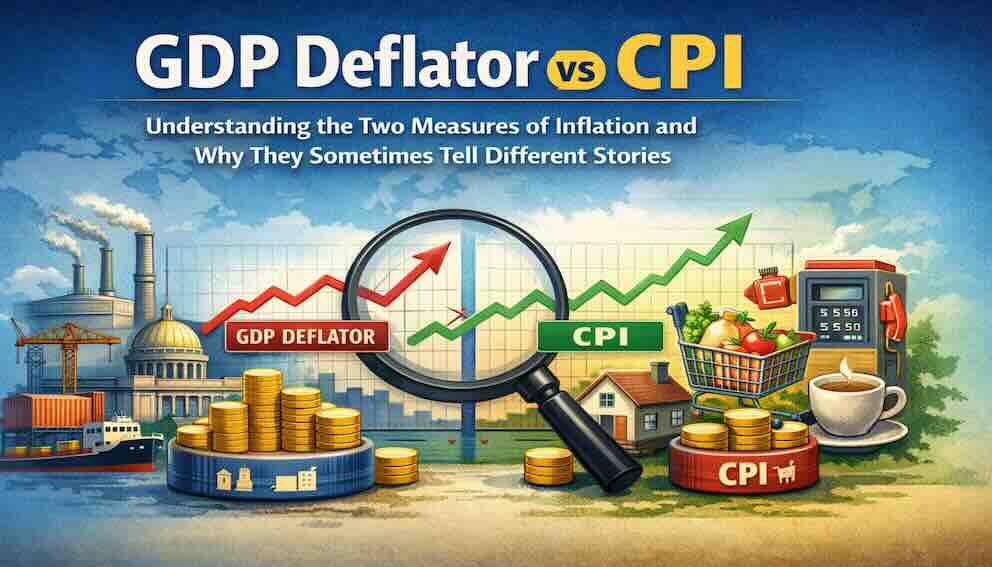
This tutorial explores the three most important measures of inflation: the Consumer Price Index (CPI), the GDP deflator, and the Personal Consumption Expenditures (PCE) price index. You will learn how the CPI measures price changes from the perspective of households using a fixed basket of goods; how the GDP deflator measures price changes across all domestically produced goods and services; and why the Federal Reserve and other central banks prefer the PCE index for setting monetary policy. Using a simple numerical example of apples and laptops, we will walk through the key differences between these measures—including scope, weighting, substitution bias, and treatment of imports—and explore what their divergences reveal about the economy. With real-world examples from the 1970s oil shocks, the 1990s technology boom, and the 2021–2023 inflation surge, and with practical guidance on where to find the data, this tutorial shows how understanding these differences is essential for interpreting economic news and understanding the policy decisions that affect your life.
Introduction: Three Lenses, One Inflation
Imagine you are trying to understand how much the cost of living has changed over the past year. You might look at the price of the things you buy regularly: groceries, rent, gasoline, your morning coffee. But what about the price of a new factory? What about the cost of building a new road? These are also part of the economy, but they do not directly affect your household budget. Now imagine you are a policymaker trying to decide whether the economy is overheating. You need to know whether prices are rising across the entire economy—not just for consumers, but for businesses and governments too. And if you are a central banker setting interest rates, you need a measure that captures underlying inflationary pressures while filtering out volatile swings.
This is why economists track not one or two but three measures of inflation: the Consumer Price Index (CPI) , the GDP deflator, and the Personal Consumption Expenditures (PCE) price index. Each measures inflation, but each does so from a different perspective and using different methods. The CPI measures inflation from the perspective of households—it tracks the prices of the goods and services that typical consumers buy. The GDP deflator measures inflation from the perspective of the entire economy—it tracks the prices of all domestically produced goods and services, including those bought by businesses, governments, and foreigners. The PCE price index, which is the Federal Reserve's preferred measure, tracks what households actually consume, using a more flexible methodology that accounts for changes in spending patterns.
These measures often move together, but they can also diverge in important ways. When they diverge, the difference tells us something about what is happening in the economy. A rise in the CPI without a corresponding rise in the GDP deflator might indicate that import prices are rising, while domestic prices remain stable. A rise in the PCE relative to the CPI might indicate that healthcare or other services are driving inflation. Understanding these differences is essential for interpreting economic data, following central bank policy, and making sense of the inflation numbers you see in the news.
In this tutorial, we will explore all three measures in detail. We will learn how each is constructed, walk through a simple numerical example to see the differences in action, and explore the key factors that cause them to diverge. We will then examine real-world episodes—the 1970s oil shocks, the 1990s technology boom, and the 2021–2023 inflation surge—to see what those divergences reveal about the economy. We will also explore the measurement problems that make inflation difficult to capture accurately, consider why central banks have come to prefer the PCE index for setting policy, and provide practical guidance on where to find the data.
The Consumer Price Index – Measuring Inflation from the Household Perspective
The Consumer Price Index (CPI) is the most widely recognized measure of inflation. When news reports say that "inflation rose to 3.2 percent last month," they are almost always referring to the CPI. The CPI measures the average change over time in the prices paid by urban consumers for a representative basket of goods and services.
How the CPI Is Constructed
The construction of the CPI begins with a survey of households to determine what people actually buy. The Bureau of Labor Statistics (BLS) conducts the Consumer Expenditure Survey, which asks thousands of households to track their spending on everything from food and housing to clothing, transportation, healthcare, and entertainment. From this survey, the BLS constructs a basket of goods and services that represents the typical spending patterns of urban consumers.
This basket is not a physical basket of goods; it is a statistical representation. It tells us that, for example, the average household spends 14 percent of its budget on food, 33 percent on housing, 17 percent on transportation, 6 percent on healthcare, and so on. These percentages become the weights used to calculate the overall price index. If the price of food rises, that will affect the CPI more than a rise in the price of, say, entertainment, because food has a larger weight in the average household budget.
Once the basket and its weights are established, the BLS sends price collectors—or, increasingly, uses electronic data—to track the prices of thousands of specific items across hundreds of geographic areas. They record the price of a specific loaf of bread at a specific grocery store, the rent of a specific apartment, the cost of a specific medical procedure. They do this every month, tracking price changes for the same items over time.
The CPI is then calculated as the weighted average of the price changes for all the items in the basket. If the average price of the basket rises by 3 percent from one year to the next, the inflation rate is 3 percent.
Base years and rebasing: The CPI basket is not fixed forever. The BLS periodically rebases the CPI—updating the basket and its weights—to reflect changes in what people actually buy. Currently, the CPI is based on spending patterns from 2019–2020. Rebasing ensures that the index remains relevant; without it, the CPI would gradually become outdated as new goods appear and spending patterns shift.
CPI as a Cost-of-Living Proxy
The CPI is often described as a cost-of-living index because it attempts to measure how much more money a consumer would need to maintain the same standard of living as prices change. If the CPI rises by 3 percent, the idea is that a consumer would need 3 percent more income to buy the same basket of goods. However, economists distinguish between a true cost-of-living index and the CPI. The CPI is a proxy—it approximates the cost of living but does not fully capture substitution behavior (consumers switching to cheaper alternatives when prices rise) or the benefits of new goods. This distinction matters because it means the CPI tends to overstate true inflation slightly, a bias that has been estimated at about 0.5 to 1.0 percentage points per year.
This is why the CPI is used to adjust Social Security benefits, tax brackets, and many wage contracts. When Social Security recipients receive a cost-of-living adjustment (COLA) each year, it is based on the CPI. When tax brackets are indexed to inflation, they are indexed to the CPI. The CPI is not just a statistic; it directly affects the incomes of millions of people.
Key takeaway: The CPI measures inflation from the perspective of households. It tracks the prices of a fixed basket of goods and services that represents what typical consumers buy. It is a proxy for the cost of living, though it tends to slightly overstate true inflation due to substitution bias. The basket is periodically rebased to remain relevant.
The GDP Deflator – Measuring Inflation Across the Entire Economy
While the CPI focuses on consumers, the GDP deflator takes a much broader view. The GDP deflator measures the average price level of all goods and services included in Gross Domestic Product (GDP). This includes not only consumer goods but also investment goods (like factories and machinery), government purchases (like roads and schools), and exports (goods sold to foreigners). It is a measure of inflation across the entire domestic economy.
How the GDP Deflator Is Constructed
Recall from our tutorial on real vs nominal GDP that the GDP deflator is calculated as:
GDP Deflator = (Nominal GDP / Real GDP) × 100
The GDP deflator is not constructed from a fixed basket of goods. Instead, it is a chain-weighted index that updates the basket each year to reflect changes in what the economy actually produces. This is a crucial difference from the CPI, which uses a fixed basket that is updated only periodically (typically every two years). The statistical agency uses a Fisher index—the geometric mean of a Laspeyres index (fixed base-year quantities) and a Paasche index (current-year quantities)—to calculate the chain-weighted measure.
To understand how this works, imagine that the economy produces two goods: computers and healthcare. In Year 1, computers are expensive and healthcare is relatively cheap. In Year 2, computers become much cheaper while healthcare becomes much more expensive. A fixed-weight index like the CPI would continue to give computers the same weight as in Year 1, potentially understating the impact of rising healthcare costs or overstating the impact of falling computer prices. The chain-weighted GDP deflator, by contrast, updates the weights each year, giving a more accurate picture of the overall price level.
What the GDP Deflator Includes
The GDP deflator includes:
- Consumer goods: the same goods that are in the CPI, but weighted according to their share of GDP rather than their share of household budgets.
- Investment goods: factories, machinery, equipment, housing construction. These are not in the CPI at all, yet they are a significant part of the economy.
- Government purchases: roads, schools, defense equipment, the salaries of government employees. The CPI includes government services only indirectly (through items like public transportation), but the GDP deflator includes them fully.
- Exports: goods and services sold to foreigners. These are not in the CPI at all because they are not consumed by domestic households.
The GDP deflator excludes imports because imports are not produced domestically. If the price of imported oil rises, that will affect the CPI (because consumers buy gasoline) but not the GDP deflator (because the oil was not produced in the United States). This is one of the most important differences between the two measures.
Key takeaway: The GDP deflator measures inflation across all domestically produced goods and services, including consumer goods, investment goods, government purchases, and exports. It is a chain-weighted index that updates its basket each year, and it excludes imports.
A Third Measure – The PCE Price Index
The Personal Consumption Expenditures (PCE) price index is the third major measure of inflation, and it is the one most closely watched by the Federal Reserve. When the Fed says it aims for "2 percent inflation," it is referring to the PCE price index. Understanding why requires looking at how the PCE differs from the CPI.
How the PCE Is Constructed
Like the CPI, the PCE measures inflation from the perspective of consumers. But there are important differences in how it is constructed. First, the PCE uses a chain-weighted index, like the GDP deflator, rather than a fixed basket. This means it automatically adjusts for substitution as consumers change their spending patterns in response to price changes. As a result, the PCE tends to show lower inflation on average than the CPI—typically about 0.3 to 0.5 percentage points lower per year.
Second, the PCE has broader coverage than the CPI. While the CPI measures out-of-pocket spending by households, the PCE includes spending on behalf of households, such as employer-paid health insurance premiums, Medicare, and Medicaid. This means the PCE captures the full cost of healthcare, which is a significant part of household consumption, while the CPI captures only what households pay directly. The PCE also includes financial services and other items that are difficult to measure in the CPI.
Third, the PCE weights are updated more frequently than the CPI's. While the CPI updates its basket every two years, the PCE updates its weights quarterly. This makes the PCE more responsive to changes in consumer behavior.
Why the Federal Reserve Prefers PCE
The Federal Reserve officially targets the PCE price index for several reasons. First, its chain-weighting makes it a more accurate measure of underlying inflation, less distorted by substitution bias. Second, its broader coverage means it captures a more complete picture of consumer spending. Third, the PCE is consistent with the GDP accounts, which makes it easier for policymakers to analyze the relationship between inflation and other economic variables. Fourth, historical data show that the PCE has been more stable and less volatile than the CPI, which helps the Fed communicate clearly about its inflation target.
When the Fed raises or lowers interest rates, it is reacting to the PCE. When it publishes its economic projections, it forecasts PCE inflation. The CPI still matters—it affects Social Security benefits and public perception—but for monetary policy, the PCE is the measure that matters.
Key takeaway: The Personal Consumption Expenditures (PCE) price index is the Federal Reserve's preferred inflation measure. It uses chain-weighting, has broader coverage than the CPI, and typically shows lower inflation. Its consistency with GDP accounts and its stability make it the primary guide for monetary policy.
A Simple Numerical Example – Apples and Laptops
To see how these measures differ in practice, let us work through a simple example with two goods: apples and laptops. This example will illustrate the key concepts of fixed-weight indices, chain-weighting, and substitution bias.
The Setup
Suppose an economy produces only two goods: apples and laptops. In Year 1:
- Apples cost $1 each, and 100 apples are sold.
- Laptops cost $1,000 each, and 10 laptops are sold.
- Total nominal GDP = (100 × $1) + (10 × $1,000) = $100 + $10,000 = $10,100.
In Year 2:
- Apples cost $2 each (a 100 percent increase), and 80 apples are sold (consumers buy fewer apples as the price rises).
- Laptops cost $500 each (a 50 percent decrease), and 15 laptops are sold (consumers buy more laptops as the price falls).
- Total nominal GDP = (80 × $2) + (15 × $500) = $160 + $7,500 = $7,660.
Calculating the CPI (Fixed-Weight Index)
The CPI uses a fixed basket of goods, typically based on spending patterns in a base year. Let us use Year 1 as the base year. The basket is 100 apples and 10 laptops.
In Year 1, the cost of the basket is (100 × $1) + (10 × $1,000) = $10,100.
In Year 2, the cost of the same basket is (100 × $2) + (10 × $500) = $200 + $5,000 = $5,200.
The CPI in Year 2 is ($5,200 / $10,100) × 100 = 51.5. This means the CPI suggests that the cost of living has fallen by about 48.5 percent. But wait—does that make sense? The price of apples doubled, but laptops became much cheaper. Because laptops have a large weight in the basket, the overall index fell.
Calculating the GDP Deflator (Chain-Weighted Index)
The GDP deflator uses current-year quantities, not fixed quantities. It is calculated as:
GDP Deflator = (Nominal GDP / Real GDP) × 100
To calculate real GDP, we need to value Year 2 quantities using Year 1 prices. Real GDP in Year 2 = (80 × $1) + (15 × $1,000) = $80 + $15,000 = $15,080.
Nominal GDP in Year 2 is $7,660. So the GDP deflator = ($7,660 / $15,080) × 100 = 50.8.
What the Gap Tells Us
The CPI (51.5) and the GDP deflator (50.8) are close but not identical. The small difference reflects the fact that the CPI uses fixed quantities (the Year 1 basket) while the GDP deflator uses current quantities (the Year 2 basket). Because consumers substituted away from apples (which became expensive) toward laptops (which became cheap), the GDP deflator shows a slightly lower inflation rate (or in this case, a slightly larger deflation). This is substitution bias in action: the fixed-weight CPI overstates the true cost of living because it does not allow consumers to change their spending patterns.
Now consider how the PCE would differ. The PCE, like the GDP deflator, uses chain-weighting and would show a result similar to the GDP deflator. But its broader coverage (including items like healthcare) would not be captured in this simple two-good example.
Key takeaway: This apples-and-laptops example illustrates substitution bias: the fixed-weight CPI overstates the true cost of living because it does not account for consumers switching to cheaper alternatives. The chain-weighted GDP deflator (and PCE) handle this more accurately.
Key Differences Between the Three Measures
Now that we have a concrete example, let us summarize the key differences between the CPI, GDP deflator, and PCE. There are five main dimensions along which they differ.
1. Scope: What Gets Included
- CPI: Consumer goods and services only. Includes imports; excludes investment, government, and exports.
- GDP Deflator: All domestically produced goods and services: consumer goods, investment goods, government purchases, exports. Excludes imports.
- PCE: Consumer goods and services, but with broader coverage than CPI (includes spending on behalf of households, like employer-paid health insurance). Includes imports.
This difference matters because it determines how each measure responds to different shocks. A rise in import prices affects CPI and PCE but not the GDP deflator. A rise in investment goods prices affects the GDP deflator but not CPI or PCE.
2. Weighting: Fixed vs Chain-Weighted
- CPI: Fixed-weight index (Laspeyres-type). Basket updated every two years.
- GDP Deflator: Chain-weighted (Fisher index). Weights updated each year.
- PCE: Chain-weighted (Fisher index). Weights updated quarterly.
Chain-weighting allows the GDP deflator and PCE to account for substitution behavior, making them more accurate measures of underlying inflation. The fixed-weight CPI tends to overstate inflation due to substitution bias.
3. Treatment of Imports
- CPI: Includes imports.
- GDP Deflator: Excludes imports.
- PCE: Includes imports (similar to CPI).
This means that when the dollar weakens and import prices rise, CPI and PCE will rise more than the GDP deflator. When the dollar strengthens and import prices fall, CPI and PCE will fall more.
4. Formula: What Each Measure Tells Us
There is a simple way to remember the core insight:
- CPI = what residents pay (including imports)
- GDP deflator = what the domestic economy produces (excluding imports)
- PCE = what residents consume (broader than CPI, chain-weighted)
This one-line contrast is the most powerful way to understand the differences.
5. Policy Relevance
- CPI: Used for Social Security COLAs, tax bracket indexing, and public perception.
- GDP Deflator: Used for measuring real GDP growth and productivity.
- PCE: Used by the Federal Reserve for monetary policy.
Key takeaway: There are five key differences between the three measures: scope (what they include), weighting (fixed vs chain-weighted), treatment of imports, formula, and policy relevance. Understanding these differences is essential for interpreting inflation data.
Headline vs Core – And Why Central Banks Look Through Volatility
One of the most important distinctions in inflation measurement is between headline inflation and core inflation. Headline inflation includes all items in the basket. Core inflation excludes food and energy prices.
Why exclude food and energy? Because these prices are notoriously volatile. A drought in Brazil can send coffee prices soaring. A war in the Middle East can send oil prices spiking. These price movements are often driven by supply shocks rather than domestic demand conditions. They can cause headline inflation to spike even when underlying inflationary pressures are tame. Conversely, they can cause headline inflation to fall even when the economy is overheating.
Central banks focus on core inflation because it gives a clearer signal of underlying inflationary pressures. If core inflation is stable but headline inflation spikes due to an oil shock, a central bank might "look through" the spike, recognizing that it is temporary. If core inflation is rising, it suggests that inflationary pressures are becoming entrenched across the economy—a signal that may require a policy response.
However, looking through energy shocks carries risks. If an energy shock persists, it can feed into core inflation through higher transportation costs, higher wages as workers demand compensation, and higher prices for a wide range of goods. This is what happened in the 1970s: an oil shock that initially looked temporary became embedded in expectations and led to sustained high inflation. This is why central banks monitor both headline and core—and why the distinction between them is so important.
Key takeaway: Headline inflation includes all items; core inflation excludes food and energy to reveal underlying trends. Central banks focus on core inflation but watch for signs that temporary shocks are becoming persistent.
The Housing Component – A Critical Difference Between CPI and PCE
Housing is the largest component of both the CPI and the PCE, but they measure it differently. This difference contributes to persistent gaps between the two measures.
The CPI measures housing using rental equivalence. For renters, it uses actual rent paid. For homeowners, it estimates what they would pay if they rented their home—based on surveys of rents for similar properties. This approach treats homeownership as a service that homeowners consume from themselves.
The PCE also uses rental equivalence, but with important differences. The PCE includes the same imputed rent for homeowners, but it also includes spending on utilities and household operations that are treated differently in the CPI. More importantly, the PCE's broader coverage means that the weights for housing differ.
During the 2021–2023 inflation surge, housing was a major driver of inflation. Rents surged as housing demand boomed. The CPI, with its larger weight on housing (about 33 percent), was more affected by rent increases than the PCE (where housing has a smaller weight). This contributed to the gap between the two measures during this period.
Key takeaway: Housing is measured differently in the CPI and PCE, contributing to persistent gaps. The CPI has a larger weight on housing, making it more sensitive to rent changes.
Sticky vs Flexible Prices – Why Services Inflation Matters
Not all prices adjust at the same speed. Economists distinguish between sticky prices and flexible prices.
- Flexible prices change quickly in response to supply and demand. Gasoline, food, and many goods fall into this category. They can spike or crash rapidly.
- Sticky prices change slowly. Rent, wages, healthcare, and many services fall into this category. They are often set by contracts, habits, or regulatory processes and adjust only gradually.
This distinction is crucial for inflation dynamics. Flexible prices can cause headline inflation to swing wildly, but they do not necessarily indicate persistent inflation. Sticky prices, by contrast, are harder to reverse once they start rising. If rent increases, it is difficult to bring it back down. If wages rise, they rarely fall.
During the 2021–2023 inflation surge, services inflation—especially rent and wages—became the central concern for the Federal Reserve. Goods inflation fell quickly as supply chains healed, but services inflation remained elevated. This suggested that inflationary pressures might be more persistent than initially hoped. The Fed's aggressive interest rate hikes were aimed at cooling the labor market and bringing down services inflation.
Key takeaway: Flexible prices (like food and energy) can swing rapidly; sticky prices (like rent and wages) adjust slowly and are harder to reverse. The persistence of services inflation was a key concern in the 2021–2023 period.
Inflation Expectations – The Self-Fulfilling Prophecy
One of the most powerful forces in inflation dynamics is inflation expectations. What people expect to happen to prices in the future can shape what happens today.
If workers expect high inflation, they will demand higher wages to compensate. Those higher wages become costs for firms, which raise prices to cover them, creating the very inflation workers expected. If businesses expect high inflation, they will raise prices preemptively. If consumers expect high inflation, they will rush to buy now, driving up demand and prices. Expectations can become self-fulfilling.
This is why central banks spend so much effort "anchoring" inflation expectations. If the public believes that the central bank will keep inflation low and stable, that belief itself helps keep inflation low and stable. Workers do not demand excessive wage increases; businesses do not preemptively raise prices. If expectations become unanchored—if people begin to doubt the central bank's commitment to low inflation—even a small shock can trigger a persistent inflationary spiral.
Inflation expectations are measured in two ways:
- Surveys: The University of Michigan Survey of Consumers asks households what they expect inflation to be over the next year and the next five to ten years. The Federal Reserve Bank of New York's Survey of Consumer Expectations provides similar data.
- Market-based measures: The difference between nominal Treasury yields and Treasury Inflation-Protected Securities (TIPS) yields gives the "breakeven inflation rate"—the market's expectation of inflation over the life of the bond.
During the 2021–2023 inflation surge, the Fed watched these measures closely. As long as longer-term expectations remained anchored, the Fed could tolerate temporary spikes in headline inflation. If longer-term expectations had become unanchored, the policy response would have needed to be even more aggressive.
Key takeaway: Inflation expectations can become self-fulfilling. Central banks monitor expectations through surveys and market-based measures, and they work to keep them anchored to their inflation targets.
Real-World Examples – When the Measures Diverge
To see these concepts in action, let us walk through three historical episodes where the CPI, GDP deflator, and PCE told different stories. In each case, the gap between the measures revealed something important about the structure of inflation.
The 1970s Oil Shocks: Imports Drive CPI Higher
In the 1970s, OPEC imposed an oil embargo, causing the price of crude oil to quadruple. The United States was heavily dependent on imported oil. The CPI, which includes gasoline and heating oil, surged. Between 1973 and 1975, the CPI rose by nearly 20 percent. The GDP deflator, which excludes imports, rose by about 15 percent over the same period. The gap between the two measures—about 5 percentage points—reflected the fact that much of the price increase was for imported oil. What did this gap tell policymakers? It told them that the inflation was partly an external shock, not purely domestic overheating. This insight was crucial for designing policy responses, though the Fed ultimately learned that looking through energy shocks carries risks if they persist.
The 1990s Technology Boom: Substitution Bias and Chain-Weighting
In the 1990s, the price of computers and other technology goods fell sharply while the prices of services (like healthcare and education) rose steadily. The CPI, with its fixed weights, gave computers a weight based on 1990s spending patterns. As computers became cheaper and households spent a larger share of their budgets on technology, the fixed weights became outdated. The result was that the CPI overestimated inflation because it did not fully capture the decline in technology prices. The GDP deflator and PCE, with their chain-weighting, adjusted for these changes and showed lower inflation. The gap between the measures—which persisted for years—reflected the challenge of measuring inflation during periods of rapid technological change and highlighted the superiority of chain-weighted measures for tracking underlying trends.
The 2021–2023 Inflation Surge: Services Inflation and the PCE Gap
The most recent episode of high inflation provides a complex picture of divergence. In 2021 and 2022, all three measures rose sharply—the CPI peaked at over 9 percent, the PCE peaked at around 7 percent, and the GDP deflator peaked at around 7 percent as well. But the gap between them told an important story.
The CPI rose more than the PCE and GDP deflator because of the role of imports and volatile food and energy prices. The prices of imported goods—especially automobiles, electronics, and industrial supplies—surged due to supply chain disruptions. Additionally, food and energy prices, which have larger weights in the CPI than in the PCE, rose sharply. The gap between CPI and PCE highlighted the fact that headline CPI was being driven by volatile components that the Fed tends to look through.
More importantly, the episode revealed the growing importance of services inflation. Unlike goods prices, which fell as supply chains healed, services prices—especially rent, healthcare, and wages—proved to be sticky. Housing, measured differently in the CPI and PCE, contributed to the gap. The Fed watched the services components closely because they are more persistent and harder to reverse once entrenched. The divergence between goods inflation (which fell) and services inflation (which remained elevated) was a key signal that the inflation surge might be more persistent than initially hoped, and it shaped the Fed's aggressive policy response.
Key takeaway: In the 1970s, the gap between CPI and GDP deflator reflected imported oil. In the 1990s, chain-weighting showed lower inflation than the fixed-weight CPI. In 2021–2023, the gap between CPI and PCE reflected volatile food, energy, and import prices, while the persistence of services inflation and the housing measurement difference became central concerns for policymakers.
Where to Find the Data – A Practical Guide
If you want to track inflation yourself, here is where to find the data:
- CPI: Produced by the Bureau of Labor Statistics (BLS). The monthly release is called the "Consumer Price Index" and is typically published around the 10th–15th of each month. You can find it at www.bls.gov/cpi. The BLS also publishes the "Chained CPI" (C-CPI-U), which is a closer proxy for a cost-of-living index.
- GDP Deflator: Produced by the Bureau of Economic Analysis (BEA). It is released as part of the quarterly GDP report, typically about 30 days after the end of each quarter. You can find it at www.bea.gov under the "Gross Domestic Product" release.
- PCE: Also produced by the BEA. The PCE price index is released as part of the monthly "Personal Income and Outlays" report, typically about 30 days after the end of each month. The "core PCE" (excluding food and energy) is the Fed's primary inflation gauge. You can find it at www.bea.gov under the "Personal Income and Outlays" release.
- Inflation Expectations: The University of Michigan Survey of Consumers (monthly) and the Federal Reserve Bank of New York's Survey of Consumer Expectations (monthly) provide survey-based measures. Market-based measures (TIPS breakevens) are available from the Federal Reserve Bank of St. Louis's FRED database.
- Trimmed Mean and Median Inflation: The Federal Reserve Bank of Cleveland publishes "trimmed mean" inflation measures that exclude the most extreme price changes. These are available at www.clevelandfed.org.
Key takeaway: CPI data is from the BLS; GDP deflator and PCE data are from the BEA. Inflation expectations data are available from surveys and market-based measures. The Cleveland Fed publishes trimmed mean measures for a more stable view of underlying inflation.
Which Measure Should You Trust? – A Policy Perspective
Given the differences and measurement problems, which measure of inflation should you trust? The answer depends on what you want to know.
If you want to know how the cost of living is changing for households, the CPI is the right measure. It is designed specifically to track consumer prices, and it is the measure used to adjust Social Security benefits and tax brackets. Despite its limitations, it is the best measure we have for understanding how rising prices affect household budgets.
If you want to know how prices are changing across the entire economy—including investment goods, government purchases, and exports—the GDP deflator is the right measure. It is broader, it is chain-weighted, and it is less affected by substitution bias and import prices.
If you want to understand what the Federal Reserve is thinking and what it will do with interest rates, the PCE price index is the measure to watch. The Fed officially targets 2 percent PCE inflation. When the Fed says it is "committed to bringing inflation back to 2 percent," it is referring to the PCE. Moreover, the Fed looks at core PCE, which excludes food and energy, to gauge underlying inflationary pressures. It also monitors trimmed mean measures for additional signals.
Why do central banks care so much about the distinction? Because policy mistakes can be costly. If policymakers react only to CPI spikes driven by imports (like oil) or volatile food prices, they risk tightening policy unnecessarily, causing a recession when the underlying economy is not overheating. Conversely, if they ignore persistent services inflation because it is not showing up in volatile headline measures, they risk allowing inflation to become entrenched. The PCE, with its broader coverage and chain-weighting, gives a clearer picture of the underlying trend.
If you want to understand how inflation affects your own budget, you might look at your own spending. The CPI is an average; your personal inflation rate may be different if you spend more on rent than the average household, or if you drive more than average, or if you have different healthcare needs. The BLS provides a "personal inflation calculator" that allows you to estimate your own inflation rate based on your spending patterns.
Key takeaway: The CPI is best for understanding changes in the cost of living for households. The GDP deflator is best for understanding inflation across the entire economy. The PCE is best for understanding the inflation measures that guide Federal Reserve policy. Your personal inflation rate may differ from all of them.
Conclusion: Three Lenses, One Inflation
Measuring inflation sounds like it should be simple. Prices either go up or they don't. But the moment you try to measure how much they go up, you run into a deeper question: up for whom, and for what? A retired couple spending heavily on healthcare experiences a very different inflation than a young family buying groceries and paying rent. An economy shifting toward services experiences different price pressures than one dominated by manufacturing. There is no single, neutral vantage point from which to observe inflation — only different positions, each revealing something true and something partial.
That is what the CPI, the GDP deflator, and the PCE really are. Not competing attempts to get the same answer, but three genuinely different questions wearing the same label. When they diverge, the divergence itself is informative — it tells you something about who is bearing the burden of rising prices, where in the economy the pressure is concentrated, and how households are adapting their behavior.
The deeper lesson is that economic measurement is never purely technical. Every index embeds choices about whose experience counts, which goods matter, and how to handle a world that keeps changing. Understanding those choices doesn't make the numbers less useful — it makes you a more intelligent reader of them, capable of asking not just what is inflation but inflation as experienced by whom, measured how, and for what purpose.
About Swati Sharma
Lead Editor at MyEyze, Economist & Finance Research WriterSwati Sharma is an economist with a Bachelor’s degree in Economics (Honours), CIPD Level 5 certification, and an MBA, and over 18 years of experience across management consulting, investment, and technology organizations. She specializes in research-driven financial education, focusing on economics, markets, and investor behavior, with a passion for making complex financial concepts clear, accurate, and accessible to a broad audience.
Disclaimer
This article is for educational purposes only and should not be interpreted as financial advice. Readers should consult a qualified financial professional before making investment decisions. Assistance from AI-powered generative tools was taken to format and improve language flow. While we strive for accuracy, this content may contain errors or omissions and should be independently verified.