Tutorial Categories
Last Updated: April 18, 2026 at 10:30
Limitations of GDP & Beyond GDP: Understanding What the Most Famous Economic Indicator Leaves Out
A Step-by-Step Guide to the Informal Economy, Environmental Costs, Inequality, Digital Services, and the Search for Better Measures of National Progress
This tutorial explores the critical limitations of Gross Domestic Product (GDP) as a measure of societal well-being and the efforts to develop alternative indicators that capture what GDP leaves out. You will learn why GDP does not account for non-market activities like household work, the underground economy, environmental degradation, the distribution of income, or the value of free digital services—and why these omissions matter for understanding whether a country is truly progressing. We will walk through the concept of the informal economy in both advanced and developing nations, examine the environmental costs of growth and the debate between weak and strong sustainability, confront the reality of inequality and the Easterlin Paradox on happiness, and explore the modern challenge of measuring the value of free digital goods. Finally, we will survey alternative measures—from the Genuine Progress Indicator (GPI) to the Human Development Index (HDI) to the Inclusive Wealth Index—and consider how policymakers in New Zealand, the OECD, and the European Union are moving toward dashboard approaches that capture multiple dimensions of progress. Using real-world examples from the 2008 financial crisis, the COVID-19 pandemic, and long-term trends in inequality and environmental degradation, this tutorial shows why we need to look beyond GDP to understand true progress—and why GDP remains a vital tool when used alongside other measures.
Introduction: The Number That Measures Everything – Except What Matters
Imagine you are a doctor assessing a patient's health. You take their temperature, check their blood pressure, listen to their heart, and run blood tests. But what if you stopped there? What if you never asked whether the patient was in pain, whether they could walk, whether they had meaningful relationships, whether they were happy? You would have a lot of data, but you would not know whether the patient was actually healthy.
This is the problem with Gross Domestic Product (GDP). It is the most famous economic indicator in the world, the number that tells us whether the economy is growing or shrinking, the figure that dominates news headlines and political debates. But GDP was never designed to measure everything that matters. It measures the market value of goods and services produced within a country's borders. It does not measure whether those goods and services are making people's lives better. It does not subtract the cost of pollution or resource depletion. It does not count the value of unpaid care work, the hours parents spend raising children, or the contributions of volunteers. It says nothing about whether the benefits of growth are shared fairly or whether the economy is sustainable for future generations. And in the digital age, it struggles to capture the immense value of free services like search engines, social media, and online encyclopedias—services that have transformed how we live but are largely invisible in the national accounts.
The creator of the modern system of national accounts, Simon Kuznets, understood this. When he presented his work to the U.S. Congress in 1934, he warned: "The welfare of a nation can scarcely be inferred from a measurement of national income." Nearly a century later, that warning is more relevant than ever. GDP has become a proxy for progress, but it is a flawed proxy.
This tutorial explores those flaws. We will begin by laying out a framework for understanding what GDP leaves out, then examine each limitation in turn. We will then ask why GDP is still used—despite its flaws—and explore how policymakers are moving toward dashboard approaches that combine multiple measures. Finally, we will consider what it would mean to build an economy that serves people, not just the numbers on a spreadsheet.
A Framework – What GDP Measures and What It Leaves Out
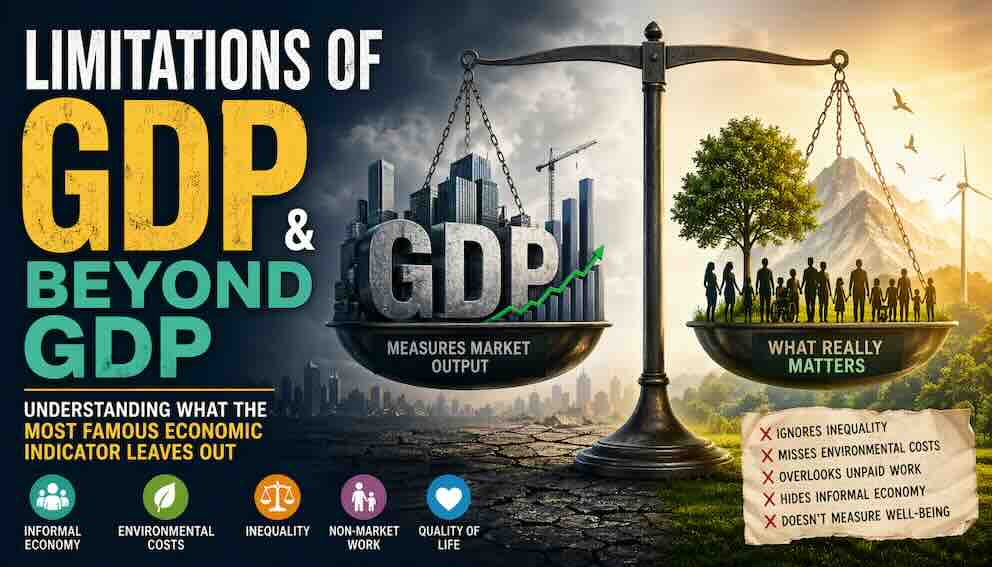
Before we dive into the limitations, let us establish a clear framework. GDP measures the market value of all final goods and services produced within a country's borders in a given period. It is a measure of market output. What does it leave out?
- Non-market production: Unpaid care work, household production, volunteering. Activities that create value but are not bought and sold.
- The informal economy: Cash payments, unreported work, illegal activities. Economic activity that is hidden from tax authorities and official surveys.
- Environmental costs: Pollution, resource depletion, climate change. Costs that are not subtracted from GDP.
- Inequality: The distribution of income. GDP tells us the size of the pie, not how it is divided.
- Quality of life: Health, education, leisure time, social connections, political freedom. The things that make life worth living.
- Digital value: Free services like Google, Wikipedia, social media. Value that is created without a market price.
These are not minor omissions. They represent vast areas of human activity and well-being. In the sections that follow, we will explore each in depth.
A deeper framework: types of capital
To understand why these omissions matter, it helps to think about different types of capital. Economists distinguish between:
- Produced capital: Factories, machines, roads, buildings. This is what traditional economics focuses on.
- Natural capital: Forests, fisheries, minerals, clean air, a stable climate. GDP treats depletion of natural capital as income, not as consumption of assets.
- Human capital: The skills, knowledge, and health of the population. GDP counts spending on education and healthcare as consumption, not investment in human capital.
- Social capital: Trust, institutions, social networks, community cohesion. GDP does not measure this at all.
Sustainable development requires maintaining all forms of capital, not just produced capital. GDP tells us about the production of goods and services, but it does not tell us whether we are maintaining or depleting the capital that makes that production possible.
Key takeaway: GDP measures market output. It leaves out non-market production, the informal economy, environmental costs, inequality, quality of life, and digital value. Thinking in terms of produced, natural, human, and social capital helps us understand why these omissions matter.
The Informal Economy – The Work That GDP Does Not See
Every day, around the world, billions of dollars of economic activity take place outside the view of government statisticians. This is the informal economy—sometimes called the underground economy, the shadow economy, or the cash economy. It includes everything from a neighbor who babysits for cash to a construction worker paid off the books to illegal activities like drug trafficking. GDP misses most of this activity because it is not reported to tax authorities and does not appear in official surveys.
The Informal Economy in Developing Nations
In developing countries, the informal economy is not a marginal activity; it is central to how people live and work. In India, for example, the informal sector employs about 80 percent of workers—street vendors, domestic workers, small farmers, construction laborers, artisans—many of whom are paid in cash and do not appear in official statistics. For many families, informal work is not a choice; it is the only option. Formal jobs are scarce, and the costs of registering a business, paying taxes, and complying with regulations are prohibitive.
In sub-Saharan Africa, the informal economy accounts for more than half of GDP in many countries. It is not a "shadow" to be eliminated; it is the main economy. People build their own homes, grow their own food, trade in local markets, and support each other through extended family networks. GDP misses most of this activity, creating a picture of poverty that is more extreme than the reality, while also missing the resilience and resourcefulness of communities.
The Informal Economy in Advanced Economies
In advanced economies, the informal economy is smaller but still significant. In Italy, the informal economy is estimated to be about 12 to 15 percent of GDP. This includes everything from waiters who underreport tips to tradespeople who offer discounts for cash payments to avoid taxes. In Greece, the informal economy is even larger—estimates range from 20 to 25 percent of GDP. When Greece's official GDP fell during the debt crisis, the informal economy provided a cushion that official numbers did not capture.
In the United States, the informal economy is estimated at about 7 to 8 percent of GDP. It includes domestic workers paid off the books, undocumented workers in construction and agriculture, and the growing gig economy where platforms make it easy to earn cash without formal employment arrangements. During the COVID-19 pandemic, when millions lost formal jobs, many turned to informal work to make ends meet. GDP missed much of this activity.
Why the Informal Economy Matters
The informal economy matters for several reasons. First, it means that GDP systematically undercounts economic activity. When a country has a large informal sector, official GDP understates the true level of production and income. This can lead policymakers to underestimate the size of the economy, the tax base, and the resources available for public services. Second, workers in the informal economy often lack protections—no unemployment insurance, no health insurance, no retirement benefits, no workplace safety regulations. Their well-being is not captured in official statistics, and their needs are often invisible to policymakers. Third, in developing countries, the informal economy is not just a flaw to be fixed; it is a feature of how people survive and thrive. Policies that ignore it risk doing more harm than good.
How Economists Try to Measure What GDP Misses
Statisticians have developed methods to estimate the size of the informal economy. They look at discrepancies between reported income and reported consumption; they conduct surveys that ask people about unreported work; they analyze electricity consumption (since even informal businesses use electricity) and compare it to official output. The International Monetary Fund (IMF) and the World Bank publish estimates of the informal economy for most countries. But these estimates are rough, and they are often revised. The informal economy remains a blind spot in official statistics—a reminder that what we measure shapes what we see, and what we do not measure can be just as important.
Key takeaway: The informal economy—cash payments, unreported work, illegal activities—is significant in every country. In developing nations, it is often the main economy. GDP misses it, leading to undercounting and invisibility for millions of workers. Statisticians use indirect methods to estimate it, but it remains a fundamental limitation of GDP.
Environmental Costs – The Growth That Destroys Its Own Foundation
When a factory produces goods worth $1 million, that $1 million is added to GDP. If that factory pollutes a river in the process, the pollution is not subtracted. If an oil spill occurs and cleanup crews are hired, the spending on cleanup adds to GDP. If a forest is cut down and the timber is sold, the timber adds to GDP, but the lost ecosystem services—clean air, water filtration, biodiversity—are not subtracted. This is one of the most profound limitations of GDP: it treats the depletion of natural resources and the degradation of the environment as if they were irrelevant to economic progress.
The Problem of Externalities
Economists call environmental damage a negative externality—a cost that is not reflected in market prices. The factory that pollutes does not pay for the damage to the river; the cost is borne by the community downstream. The oil company that spills does not pay for the full cost of the environmental damage; some of it is absorbed by the ecosystem and future generations. GDP, by ignoring these costs, creates a distorted picture. It counts the benefits of production but not the costs of pollution. It treats the depletion of natural resources as income, not as the consumption of capital.
Consider the example of oil extraction. When a country extracts oil from the ground and sells it, that adds to GDP. But the oil is a finite resource. Once it is gone, it is gone. GDP treats this as income, but a better accounting would treat it as the conversion of one form of wealth (natural capital) into another (financial capital). If a country uses the proceeds to invest in renewable energy, education, or infrastructure, it may be maintaining its overall wealth. If it spends the money on consumption, it is depleting its natural capital without building anything to replace it. GDP does not distinguish between these two scenarios.
Weak vs Strong Sustainability
This brings us to a key debate in environmental economics: weak sustainability versus strong sustainability. Weak sustainability holds that as long as total capital (produced + natural + human) is maintained, it does not matter if natural capital is depleted and replaced by produced capital. For example, if we cut down a forest but build a factory with the proceeds, weak sustainability would say we are no worse off. Strong sustainability argues that certain natural assets—like the climate, biodiversity, or the ozone layer—are irreplaceable. Produced capital cannot substitute for them. If we destroy the climate, no amount of factories can compensate.
Climate change is the ultimate test case for this debate. The burning of fossil fuels has powered economic growth for two centuries. That growth has been counted in GDP. The carbon emissions that result have been ignored. The costs of climate change—rising sea levels, more frequent extreme weather, agricultural disruption, loss of biodiversity—will be borne by future generations. From a weak sustainability perspective, the loss of natural capital might be offset by the growth in produced capital. From a strong sustainability perspective, the climate is irreplaceable, and the growth has come at an unacceptable cost.
Climate Change and GDP
Climate change is the most dramatic example of GDP's environmental blind spot. The burning of fossil fuels has powered economic growth for two centuries. That growth has been counted in GDP. The carbon emissions that result have been ignored. The costs of climate change will be borne by future generations. But they are not subtracted from today's GDP. In fact, when a hurricane destroys homes and businesses, the rebuilding effort adds to GDP. When farmers suffer crop failures, the aid they receive adds to GDP. When people fall ill from heat-related illnesses, the healthcare spending adds to GDP. In the current accounting system, the economy can appear to grow even as its environmental foundation is being destroyed.
The Role of Technology
There is an optimistic counterargument: technological progress will solve environmental problems. As we get richer, we can afford cleaner technologies. This has happened with local pollution—air and water in advanced economies are much cleaner than they were a century ago, even as GDP has grown. The question is whether this will also happen with global problems like climate change. Proponents of technological optimism point to falling costs of solar and wind power. Critics point to the scale of the problem and the difficulty of coordinating global action. This debate is central to environmental economics, and it is not settled.
The Concept of "Green GDP"
In response to these limitations, economists have developed the concept of Green GDP. The idea is simple: subtract the costs of environmental degradation from traditional GDP. If a country extracts oil, Green GDP would subtract the value of the depleted resource. If a country pollutes, Green GDP would subtract the cost of the damage. If a country invests in renewable energy, Green GDP would count that as investment in natural capital.
Several countries have experimented with Green GDP. China, facing severe air and water pollution, developed a Green GDP measure in the 2000s. When it was first calculated, it showed that environmental damage accounted for about 3 to 5 percent of GDP—a significant drag on true progress. The results were controversial, and the government eventually stopped publishing them. But the effort showed that accounting for environmental costs changes the picture of economic performance.
The challenge of Green GDP is that environmental costs are difficult to value. How much is a clean river worth? How much is a stable climate worth? How much is a species worth? These are not market prices; they require value judgments. But the fact that they are difficult to measure does not mean they are zero. GDP treats them as zero, which is a value judgment in itself—one that systematically overstates progress.
Key takeaway: GDP ignores environmental costs, treating pollution and resource depletion as if they did not matter. Climate change is the most dramatic example. The debate between weak and strong sustainability frames the question of whether produced capital can substitute for natural capital. Green GDP attempts to subtract environmental costs, but it faces challenges in valuing what markets do not price.
Inequality – The Growth That Leaves People Behind
GDP tells us the size of the economic pie, but it tells us nothing about how that pie is divided. A country can have rising GDP while most of its citizens see their incomes stagnate. This is not just a theoretical possibility; it has been the reality for many countries in recent decades.
The Great Divergence
In the United States, GDP per capita has more than doubled since 1980. That sounds like progress. But the benefits of that growth have been distributed unevenly. The top 1 percent of earners have seen their incomes grow by more than 200 percent. The bottom 50 percent have seen almost no increase in real incomes. Median household income—the income of the typical family—has grown much more slowly than GDP per capita. A rising tide has not lifted all boats equally.
This pattern is not unique to the United States. In many advanced economies, the share of national income going to labor (wages and salaries) has declined, while the share going to capital (profits) has risen. The top 1 percent have captured a growing share of total income. The middle class has stagnated or shrunk. These trends are invisible in GDP. A country could have strong GDP growth and rising inequality at the same time, and GDP would tell you only about the growth.
Why Inequality Matters
Inequality matters for several reasons. First, it affects the relationship between GDP and well-being. If GDP grows but most people see no improvement in their living standards, then GDP is not a good measure of progress for the majority.
Second, high inequality can undermine economic stability. When too much income is concentrated at the top, the middle and lower classes lack the purchasing power to sustain demand. This can lead to slower growth and more frequent recessions. The 2008 financial crisis was, in part, a crisis of inequality: middle-class households took on unsustainable debt to maintain their living standards, and when the bubble burst, the whole economy collapsed.
Third, inequality can erode social cohesion and trust. When people feel that the system is rigged against them, they lose faith in institutions, in democracy, and in each other. This has been a growing concern in many countries, with consequences that go far beyond economics.
The Easterlin Paradox – Does Money Buy Happiness?
The relationship between GDP and happiness is not straightforward. The Easterlin Paradox, named after economist Richard Easterlin, observes that while richer people within a country tend to be happier than poorer people, richer countries are not necessarily happier than poorer countries. Once a country reaches a certain level of income—enough to meet basic needs—further increases in GDP do not reliably increase average happiness. This suggests that beyond a threshold, what matters for well-being is not absolute income but relative income, social connections, health, and security.
The Easterlin Paradox has been debated. Some economists argue that happiness does continue to rise with GDP, even at high levels. Others argue that the relationship is complex and depends on inequality, social support, and other factors. But the paradox highlights a fundamental limitation of GDP: it measures market output, not the things that make life worth living.
How Economists Measure What GDP Misses
To understand inequality, economists look beyond GDP to measures of income distribution. The Gini coefficient is the most common measure: it ranges from 0 (perfect equality) to 1 (one person has all the income). The U.S. Gini coefficient has risen steadily since the 1970s, reflecting growing inequality. Other measures include the share of income going to the top 1 percent, the ratio of CEO pay to average worker pay, and the gap between median and mean incomes. These measures tell us what GDP does not.
Key takeaway: GDP tells us the size of the economic pie but nothing about how it is divided. In many countries, growth has been accompanied by rising inequality. The Easterlin Paradox suggests that beyond a point, higher GDP does not reliably increase happiness. Measures like the Gini coefficient capture what GDP misses.
Non-Market Activities – The Work That Makes Life Possible
GDP counts only activities that are bought and sold in markets. This means that much of the work that makes life possible—and that occupies a huge amount of people's time—is invisible in the national accounts.
Unpaid Care Work
Consider the work of raising children. The hours that parents spend feeding, bathing, teaching, and caring for their children are not counted in GDP. If they hired a nanny to do the same work, that spending would be counted. The value is the same, but the accounting is different. This is not just a technical quirk; it systematically undervalues the work that is traditionally done by women. Around the world, women spend more time on unpaid care work than men. By not counting this work, GDP reinforces gender inequality and makes it harder to see the full picture of economic activity.
The COVID-19 pandemic brought this into sharp focus. When schools and daycares closed, millions of parents—mostly mothers—left the workforce to care for children. This showed up in GDP as a loss of paid work. But the work they were doing at home—the childcare, the homeschooling, the cooking—was not counted. GDP told us the economy was shrinking, but it did not tell us that people were working harder than ever, just without pay.
Volunteering and Community
Volunteering is another invisible activity. When someone volunteers at a food bank, coaches a youth soccer team, or serves on a community board, they are creating value for others. That value is not counted in GDP. If they were paid for the same work, it would be. This means that GDP systematically undervalues the social fabric—the networks of mutual support and community engagement that make societies function.
Household Production
Even basic household activities—cooking, cleaning, home maintenance—are invisible in GDP. If you hire someone to clean your house, that spending is counted. If you do it yourself, it is not. The result is that as more household work is outsourced to the market, GDP rises even if the actual amount of work being done has not changed. This can create a misleading picture of progress: a society that outsources more of its household work appears to be growing faster, even if the underlying well-being of its citizens has not changed.
Defensive Expenditures
A related concept is defensive expenditures—spending that does not make us better off but merely protects us from getting worse. Examples include locks on doors, security systems, pollution cleanup, and some forms of healthcare. In the national accounts, these count as GDP. But from a well-being perspective, they are not progress; they are a cost of living in a less safe or less healthy environment. The Genuine Progress Indicator subtracts defensive expenditures from GDP to give a clearer picture of true progress.
Key takeaway: GDP counts only market transactions, ignoring unpaid care work, volunteering, and household production. This undervalues the work traditionally done by women and makes the social fabric invisible. Defensive expenditures—spending that protects us rather than improves our lives—are counted as progress but should be seen as costs.
The Digital Economy – Measuring Value Without Prices
The rise of the digital economy has created a new and profound measurement problem for GDP. Much of the value created by digital platforms is delivered at a price of zero. When users rely on services like Google, Wikipedia, social media, or free email, they receive enormous value that is not reflected in market transactions. GDP, which counts only what is bought and sold, struggles to capture this value.
The Problem of Zero-Price Goods
Think about how much value you get from Google Maps. It helps you navigate unfamiliar cities, find the fastest route to work, discover nearby restaurants. But you do not pay for it. That value is not counted in GDP. Similarly, Wikipedia provides free access to the sum of human knowledge. Social media connects you with friends and family across the world. These services have transformed how we live, work, and communicate. But because they are free, they are largely invisible in the national accounts.
Economists have attempted to estimate the value of free digital services. One study found that if consumers had to pay for Facebook, they would be willing to pay about $40 per month. If that were a market transaction, it would add billions to GDP. But because it is free, it adds nothing. The same is true for search engines, email, and countless other digital services.
Data as Value
Beyond free services, the digital economy also creates value through data. When you use a service, you generate data that companies use to improve their products, target advertising, and develop new services. That data has economic value, but it is not captured in GDP. The production of data—the activity of millions of users generating information—is a massive economic activity that is invisible in traditional statistics.
Why This Matters
The digital economy measurement problem means that GDP is increasingly out of step with how people live. A country could have high GDP growth driven by traditional manufacturing, while missing the enormous value being created in the digital sphere. Conversely, a country could have stagnant GDP but rapidly improving digital infrastructure that is transforming people's lives. In both cases, GDP would give a misleading picture.
This is not just an academic problem. When policymakers rely on GDP to guide decisions, they may underinvest in digital infrastructure, fail to regulate tech platforms effectively, or miss the ways that digital services affect well-being. Measuring the digital economy is one of the most important challenges facing statisticians today.
Key takeaway: The digital economy creates enormous value through free services like Google, Wikipedia, and social media. Because these services have a price of zero, GDP does not capture their value. This is a major modern critique of GDP and a challenge for statisticians working to update the national accounts.
Why GDP Is Still Used – A Defense
Given all these limitations, why do economists and policymakers still use GDP? The answer is that despite its flaws, GDP has important strengths that make it indispensable.
Standardization Across Countries
GDP is calculated using internationally agreed standards (the System of National Accounts). This means that GDP figures for the United States, China, Germany, and Brazil are comparable. No other measure of economic activity has this level of standardization. When we want to compare the size of economies or track global growth, GDP is the only game in town.
High-Frequency, Reliable Data
GDP is released quarterly (or monthly in some countries) with a relatively short lag. The data is produced by professional statistical agencies using consistent methods. While revisions occur, the data is reliable enough for real-time decision-making. No alternative measure has this combination of timeliness and reliability.
Strong Correlation with Important Outcomes
Despite its limitations, GDP is strongly correlated with things that matter: employment, tax revenue, business investment, and poverty reduction. When GDP falls, unemployment rises. When GDP grows, tax revenues increase, enabling public services. For all its flaws, GDP remains the best single indicator of short-run economic conditions.
A Common Language
GDP is understood by policymakers, businesses, journalists, and the public. It provides a common language for discussing economic performance. When the Federal Reserve says it wants to avoid a recession, everyone knows what that means. No alternative measure has this level of public recognition.
The challenge is not to abandon GDP but to use it alongside other measures. GDP tells us about market output. That is important. But it does not tell us about inequality, environmental sustainability, or well-being. The goal should be a dashboard of indicators—GDP plus measures of health, education, environment, and distribution—that together give a fuller picture of progress.
Key takeaway: Despite its limitations, GDP is standardized across countries, timely, correlated with important outcomes, and widely understood. The goal is not to abandon GDP but to supplement it with other measures that capture what it misses.
Moving Beyond GDP – Alternative Measures and Policy Applications
Recognizing the limitations of GDP, economists, policymakers, and international organizations have developed alternative measures and dashboard approaches that attempt to capture a fuller picture of progress.
The Genuine Progress Indicator (GPI)
The Genuine Progress Indicator (GPI) starts with personal consumption expenditures (the largest component of GDP) and makes a series of adjustments. It adds the value of household work and volunteering. It subtracts defensive expenditures like crime, pollution cleanup, and commuting costs. It accounts for income inequality by weighting consumption according to the Gini coefficient. It subtracts the cost of resource depletion and environmental degradation. The result is a measure that often tells a very different story from GDP. In the United States, GPI per capita rose in the decades after World War II but flattened out around 1980—even as GDP continued to rise. This suggests that while the economy was growing in market terms, the well-being of the average American was not improving.
The Human Development Index (HDI)
The Human Development Index, developed by the United Nations Development Programme, combines three dimensions: life expectancy (a measure of health), education (years of schooling and expected years of schooling), and income (GNI per capita). It does not try to monetize everything; instead, it recognizes that health, education, and income are all important for human flourishing. The HDI often ranks countries differently than GDP per capita. Costa Rica, for example, has a much higher HDI ranking than its GDP per capita would suggest, reflecting its strong health and education outcomes. The United States, despite its high GDP, ranks lower on HDI than many countries with lower GDP, reflecting its lower life expectancy and inequality in educational outcomes.
The Inclusive Wealth Index (IWI)
The Inclusive Wealth Index, developed by the UN Environment Programme, takes a capital-based approach. It measures a country's wealth across three categories: produced capital (machines, buildings, infrastructure), natural capital (forests, minerals, fisheries), and human capital (skills, education, health). The IWI tracks whether a country's total wealth is increasing or decreasing over time. A country could have growing GDP but declining inclusive wealth if it is depleting its natural resources or neglecting education. This measure directly addresses the sustainability critique of GDP.
The OECD Better Life Index (BLI)
The OECD's Better Life Index takes an even broader approach. It allows users to weight 11 dimensions according to what matters to them: housing, income, jobs, community, education, environment, civic engagement, health, life satisfaction, safety, and work-life balance. The BLI recognizes that well-being is multidimensional and that different people value different things. It does not produce a single number; instead, it invites users to create their own index based on their own priorities.
Bhutan's Gross National Happiness (GNH)
The most famous alternative measure comes from Bhutan, a small country in the Himalayas. In the 1970s, Bhutan's fourth king declared that "Gross National Happiness is more important than Gross National Product." The country has since developed a sophisticated GNH index that includes nine domains: psychological well-being, health, education, time use, cultural diversity, good governance, community vitality, ecological diversity, and living standards. The GNH index is not just a slogan; it is used to guide policy. Bhutan has enshrined it in its constitution, and all legislation is evaluated for its impact on GNH. While no other country has adopted GNH as official policy, it has inspired a global conversation about what we should measure when we ask whether a country is progressing.
Policy Applications: Dashboard Approaches
In recent years, several countries and international organizations have moved toward dashboard approaches that combine multiple measures rather than relying on a single number.
- New Zealand's Wellbeing Budget: In 2019, New Zealand became the first country to base its national budget on well-being indicators rather than just economic growth. The government publishes a Living Standards Framework that tracks dozens of indicators across multiple domains, and each budget is evaluated for its impact on well-being.
- OECD's Well-Being Framework: The OECD has developed a comprehensive well-being framework that includes material conditions (income, jobs, housing) and quality of life (health, education, environment, social connections, safety). The OECD publishes regular reports on well-being across its member countries.
- European Union's Beyond GDP Initiative: The European Union has been a leader in the "Beyond GDP" movement, developing indicators like the Sustainable Development Goals (SDGs) dashboard and the Environmental Economic Accounts. The EU's statistics agency, Eurostat, publishes a wide range of well-being indicators alongside traditional GDP data.
These dashboard approaches represent a shift in how governments think about progress. They recognize that GDP is one measure among many and that good policy requires looking at multiple dimensions of well-being.
Key takeaway: Alternative measures like GPI, HDI, IWI, BLI, and GNH attempt to capture what GDP leaves out. Policy dashboards in New Zealand, the OECD, and the EU are moving toward a multidimensional view of progress. The goal is not to replace GDP but to supplement it with measures of health, education, environment, and well-being.
Real-World Applications – When GDP Misleads
To see why these limitations matter, let us look at three real-world episodes where GDP told a misleading story.
The 2008 Financial Crisis
In the years leading up to the 2008 financial crisis, U.S. GDP was growing. The economy appeared healthy. But beneath the surface, inequality was rising, household debt was ballooning, and the housing bubble was inflating. GDP captured none of this. When the bubble burst, the economy collapsed. The growth that GDP had recorded was, in part, an illusion—built on unsustainable debt and speculation rather than real productive investment. The crisis revealed the limits of GDP as a guide to economic health.
The COVID-19 Pandemic
During the COVID-19 pandemic, GDP fell sharply in the second quarter of 2020—the sharpest decline on record. But GDP did not capture what was happening in people's lives. Millions of people who lost paid jobs devoted more time to caring for children, cooking meals, and supporting neighbors—none of which appeared in GDP. The stress, anxiety, and loss of life were not captured. GDP told us the economy was contracting, but it did not tell us about the human cost.
Conversely, when GDP surged in 2021, it was driven in part by government stimulus and a reopening economy. But GDP did not capture the fact that supply chains were strained, that prices were rising, that workers were quitting in record numbers, and that many people were struggling with burnout. The growth was real in market terms, but it was not a pure measure of progress.
The Counterintuitive Example: A Car Crash Increases GDP
Here is a classic example of GDP's limitations. Imagine a car crash. The crash itself is a tragedy—people are injured, cars are damaged, lives are disrupted. But what happens to GDP? The insurance payments for repairs add to GDP. The hospital bills add to GDP. The replacement cars add to GDP. The lawyers' fees add to GDP. In the national accounts, a car crash can actually increase GDP. Yet clearly, the crash has reduced well-being. This example—sometimes called the "GDP of a car crash"—illustrates the absurdity of treating GDP as a measure of progress. It captures spending, not well-being. It counts the cost of misfortune as if it were a benefit.
Key takeaway: The 2008 crisis showed that GDP can grow on the back of unsustainable debt. The COVID-19 pandemic showed that GDP misses the value of unpaid care work and the human cost of crisis. A car crash shows that GDP can rise when well-being falls. Each example reveals a different limitation of GDP.
Conclusion: Measuring What Matters
We began this tutorial with Simon Kuznets's warning: "The welfare of a nation can scarcely be inferred from a measurement of national income." Nearly a century later, that warning is more relevant than ever. GDP has become the default measure of progress, but it is a flawed measure. It counts the informal economy poorly, ignores environmental costs, says nothing about inequality, overlooks the value of unpaid care work, fails to capture the immense value of free digital services, and cannot distinguish between a car crash (which adds to GDP) and a thriving community (which may not).
And yet, GDP is not useless. It is standardized across countries, timely, correlated with employment and tax revenue, and widely understood. The challenge is not to abandon GDP but to use it wisely—to recognize what it tells us and what it does not.
Here are a few rules of thumb for interpreting GDP:
- Rising GDP does not necessarily mean rising living standards. Always ask: who benefited? What did it cost the environment? What was left out?
- Always ask "for whom?" GDP tells you the average; inequality tells you whether the average reflects the experience of most people.
- Check inequality, environment, and health alongside GDP. A country with high GDP but high inequality, poor health, and environmental degradation is not necessarily better off than a country with moderate GDP and strong social outcomes.
- Remember that GDP counts spending, not well-being. A car crash increases GDP. A forest preserved adds nothing. A free service like Wikipedia creates enormous value that GDP does not capture.
The alternative measures we have explored—GPI, HDI, IWI, BLI, GNH—are not replacements for GDP. They are supplements. They remind us that progress is multidimensional, that well-being cannot be captured by a single number, and that the goal of economic policy should be to improve people's lives—not just to grow the numbers on a spreadsheet.
The movement beyond GDP is not about rejecting markets or growth. It is about recognizing that markets are a means, not an end. The purpose of an economy is to serve people—to provide the goods and services that enable flourishing lives, to do so sustainably so that future generations can also flourish, and to do so fairly so that the benefits are widely shared. GDP measures one part of that. The challenge of the coming decades is to build the measures that will help us see whether we are succeeding at the rest.
If GDP is like a patient's temperature, then what we need is a full set of vital signs: blood pressure (inequality), oxygen levels (environmental health), heart rate (social cohesion), and a conversation about how the patient is feeling (well-being). No doctor would diagnose a patient based on temperature alone. No economist should diagnose a country based on GDP alone.
The next time you read that GDP grew by 2.5 percent, you will know to ask: who benefited? What did it cost the environment? What was left out? You will understand that GDP is one measure among many, and that a complete picture of progress requires looking at inequality, environmental sustainability, health, education, and the things that make life worth living. Simon Kuznets knew this. Now you do too.
About Swati Sharma
Lead Editor at MyEyze, Economist & Finance Research WriterSwati Sharma is an economist with a Bachelor’s degree in Economics (Honours), CIPD Level 5 certification, and an MBA, and over 18 years of experience across management consulting, investment, and technology organizations. She specializes in research-driven financial education, focusing on economics, markets, and investor behavior, with a passion for making complex financial concepts clear, accurate, and accessible to a broad audience.
Disclaimer
This article is for educational purposes only and should not be interpreted as financial advice. Readers should consult a qualified financial professional before making investment decisions. Assistance from AI-powered generative tools was taken to format and improve language flow. While we strive for accuracy, this content may contain errors or omissions and should be independently verified.