
Tutorial Categories
Last Updated: April 18, 2026 at 10:30
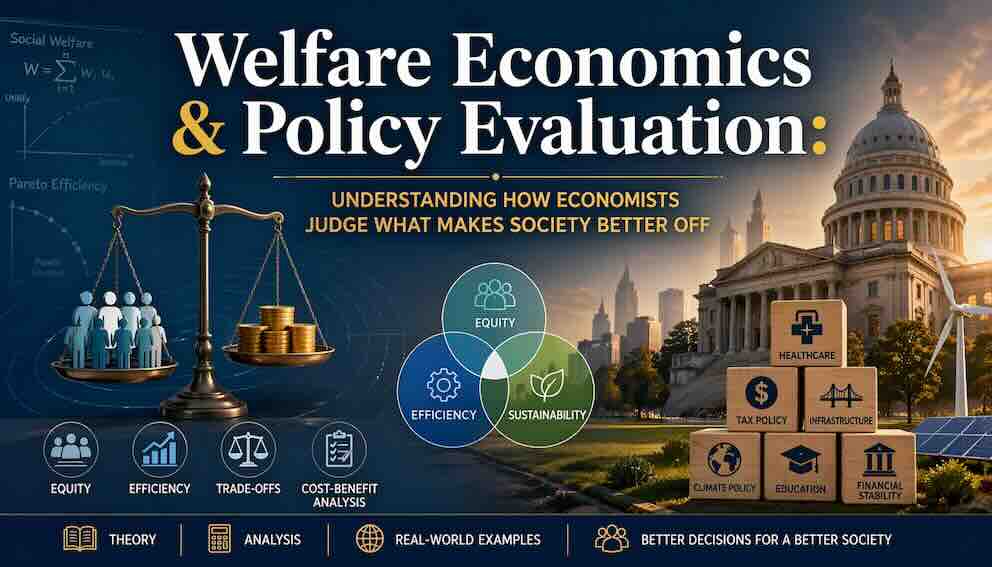
Welfare Economics & Policy Evaluation: Understanding How Economists Judge What Makes Society Better Off
A Step-by-Step Guide to Pareto Efficiency, Social Welfare Functions, the Equity-Efficiency Trade-off, and Cost-Benefit Analysis in Macroeconomic Policy
This tutorial introduces welfare economics—the branch of economics that asks how we can judge whether one economic outcome is better than another. You will learn the foundational distinction between positive economics (describing what is) and normative economics (prescribing what should be). We will explore Pareto efficiency, the Fundamental Theorems of Welfare Economics, and why markets sometimes fail—due to externalities, public goods, information problems, or market power. We will examine social welfare functions, the tools economists use to weigh the well-being of different individuals, and the central tension between equity and efficiency. Finally, we will walk through cost-benefit analysis—including concepts like the value of a statistical life, compensating variation, and the social discount rate—and introduce Kaldor–Hicks efficiency, the standard used in real-world policy evaluation. Using a running example of a carbon tax and real-world debates over the social cost of carbon, this tutorial shows how economists think about the ethical and practical questions at the heart of economic policy.
Introduction: How Do We Know What Makes Society Better?
Imagine you are a policymaker faced with a difficult choice. You can cut taxes on the wealthy, which might encourage investment and grow the economy, but it will also increase inequality. Or you can raise taxes on the wealthy to fund social programs that help the poor, but this might discourage work and reduce growth. Which is the better outcome? How do you decide?
This is not a question about facts. The facts—how much investment will increase, how much inequality will change—are matters of empirical analysis. The deeper question is about values: what do we mean by "better"? Should we care more about total output or about how it is distributed? Should we prioritize the well-being of the poorest or the average person? Is it acceptable to make some people worse off if it makes many more people much better off?
These are the questions that welfare economics seeks to answer. Welfare economics is the branch of economics that provides a framework for evaluating economic outcomes. Before we dive in, it is essential to understand the distinction between positive economics and normative economics. Positive economics describes what is—it is about facts, data, and cause-and-effect relationships. "A carbon tax will reduce emissions" is a positive statement. Normative economics prescribes what should be—it is about values, ethics, and judgments. "The government should impose a carbon tax" is a normative statement. Welfare economics is normative. It does not tell you what your values should be, but it gives you the tools to trace the consequences of your values and to see the trade-offs clearly.
In this tutorial, we will explore these tools. We will start with the concept of utility—the measure of satisfaction or well-being that underlies welfare economics. We will then examine Pareto efficiency, a foundational idea that tells us when an outcome is efficient. We will turn to the Fundamental Theorems of Welfare Economics, which explain why competitive markets tend toward efficiency and why redistribution is often better than regulation. We will examine market failures—the reasons markets sometimes do not work well—and the policy responses they require. We will then move to social welfare functions, the tools economists use to make value judgments about distribution. We will confront the central trade-off in policy: equity versus efficiency, the tension between fairness and getting the most from our resources. And we will explore cost-benefit analysis, the practical tool used to evaluate policies, including concepts like the value of a statistical life, compensating variation, and the social discount rate.
Throughout the tutorial, we will use a running example: a proposed carbon tax. A carbon tax is a policy designed to address climate change by putting a price on carbon emissions. It raises revenue, reduces emissions, and affects different groups in different ways. It is a perfect case for exploring the questions of welfare economics. Let us begin.
Utility – The Measure of Well-Being
Before we can talk about what makes society better, we need a way to talk about what makes individuals better off. Economists use the concept of utility. Utility is a measure of satisfaction, happiness, or well-being. It is not a tangible thing like a dollar; it is a way of representing preferences. If a person prefers A to B, we say that A gives them higher utility.
In principle, utility could be measured in "utils"—a hypothetical unit of satisfaction. In practice, economists rarely need an absolute measure. They often care about whether a change increases or decreases utility. For small changes, they use the concept of marginal utility—the additional utility from consuming one more unit of a good. The law of diminishing marginal utility says that as you consume more of something, the additional utility from each extra unit gets smaller. This is why a dollar means more to a poor person than to a rich person: the marginal utility of income is higher for the poor.
Utility is the building block of welfare economics. When we talk about making someone better off, we mean increasing their utility. When we talk about comparing outcomes for different people, we are comparing their utilities. But as we will see, comparing utility across people is not straightforward.
Key takeaway: Utility is a measure of satisfaction or well-being. The law of diminishing marginal utility says that an extra dollar means more to a poor person than to a rich person. This is the foundation for thinking about distribution.
Pareto Efficiency – A Minimal Criterion for Good Outcomes
The starting point for welfare economics is the concept of Pareto efficiency, named after the Italian economist Vilfredo Pareto. A situation is Pareto efficient (or Pareto optimal) if there is no way to make one person better off without making someone else worse off. If such a change exists—if you can make someone better off without harming anyone—then the current situation is not Pareto efficient. Pareto efficiency is a minimal criterion: it does not tell us that an outcome is good; it tells us that it is not obviously wasteful.
A Simple Example
Imagine two people, Alice and Bob, and a single resource: a cake. They have to decide how to divide it. If they divide it so that Alice gets the whole cake and Bob gets nothing, is that Pareto efficient? Yes, because the only way to make Bob better off is to give him some of Alice's cake, which would make Alice worse off. The outcome is efficient, even though it is wildly unfair. Pareto efficiency says nothing about fairness; it only says that resources are not being wasted.
Now imagine that they divide the cake so that half of it sits uneaten. If they could give that uneaten half to Bob without taking anything from Alice, that would be a Pareto improvement—a change that makes someone better off without harming anyone. The original situation was not Pareto efficient. This is the power of Pareto efficiency: it helps us identify waste. If there are unexploited opportunities to make someone better off at no cost to others, we are not using resources efficiently.
Limitations of Pareto Efficiency
Pareto efficiency is a useful starting point, but it has serious limitations. First, it does not help us choose between efficient outcomes. As the cake example shows, there are many efficient divisions of the cake—from Alice getting everything to Bob getting everything. Pareto efficiency tells us that both are efficient, but it does not tell us which is better. Second, Pareto efficiency is silent on distribution. A society where one person has everything and everyone else has nothing can be Pareto efficient. Third, Pareto efficiency is static; it does not consider how outcomes come about. A situation achieved through theft or exploitation could be Pareto efficient.
For these reasons, Pareto efficiency is a minimal criterion, not a complete guide to policy. Most real-world policies involve trade-offs: some people gain, some people lose. Pareto improvements—changes that help some without harming others—are rare. This is why we need stronger tools.
Key takeaway: Pareto efficiency is the idea that an outcome is efficient if no one can be made better off without making someone else worse off. It helps identify waste but says nothing about fairness and does not help us choose between efficient outcomes. Most real-world policies involve trade-offs that require more sophisticated tools.
The Fundamental Theorems of Welfare Economics – Markets and Efficiency
Pareto efficiency is a useful concept, but it raises a deeper question: under what conditions do markets produce efficient outcomes? This is answered by the Fundamental Theorems of Welfare Economics, two of the most important results in all of economics.
The First Welfare Theorem
The First Welfare Theorem states that, under certain conditions, a competitive market equilibrium is Pareto efficient. The conditions are demanding: perfect competition (no firm or consumer has market power), no externalities (all costs and benefits are reflected in market prices), perfect information (consumers and producers know what they need to know), and complete markets (all goods and services can be traded). When these conditions hold, the market outcome is efficient. There is no waste. No one can be made better off without making someone else worse off.
This theorem is the intellectual foundation for the argument that markets work. It tells us that when markets are competitive and complete, they allocate resources efficiently. But notice the conditions. When they fail—when there is pollution (an externality), or monopoly power, or information problems—the market outcome may not be efficient. The First Welfare Theorem tells us when markets work, and by doing so, it tells us when we might need to intervene.
The Second Welfare Theorem
The Second Welfare Theorem is the mirror image. It states that any Pareto efficient allocation can be achieved by a competitive market, provided we can redistribute initial endowments appropriately. In other words, efficiency and equity can be separated. If we want a more equal outcome, we do not need to regulate markets; we can redistribute resources (through taxes, transfers, or initial endowments) and then let markets operate. The market will then produce an efficient outcome that reflects the new distribution.
This theorem has profound implications for policy. It suggests that the best way to achieve equity is not to control prices or restrict trade, but to redistribute income and then let markets do their work. Of course, this assumes that redistribution is possible without distorting incentives—which, in the real world, it is not. But the theorem provides a benchmark: it tells us that, in principle, we can separate the goal of efficiency (let markets operate) from the goal of equity (redistribute). This is why many economists prefer policies like tax credits and cash transfers to price controls or quantity regulations.
Key takeaway: The First Welfare Theorem says competitive markets are Pareto efficient under ideal conditions. The Second Welfare Theorem says any efficient allocation can be achieved with redistribution plus markets. Together, they explain why economists often prefer redistribution over heavy regulation.
Market Failures – When Markets Are Not Efficient
If markets are so efficient, why do governments intervene so much? The answer is market failures—situations where the conditions of the Welfare Theorems are violated. Understanding market failures is essential for knowing when policy might improve on market outcomes.
Externalities
An externality occurs when an activity imposes costs or benefits on people who are not involved in the transaction. Pollution is the classic example: when a factory burns coal, it emits carbon dioxide, which contributes to climate change. The cost of that damage is not reflected in the price of the factory's products. This is a negative externality. The market produces too much of the good because it does not pay for the full cost. A carbon tax is designed to correct this externality by making polluters pay for the damage they cause.
Positive externalities also exist. Education, for example, benefits not just the person who is educated but also society (through higher productivity, lower crime, better civic engagement). Because the social benefit is higher than the private benefit, the market may produce too little education. Subsidies or public provision can correct this.
Public Goods
A public good has two characteristics: it is non-rival (one person's use does not reduce availability for others) and non-excludable (people cannot be prevented from using it). National defense is the classic example. The market will underprovide public goods because there is no way to charge people for using them—people can "free ride." This is why governments provide defense, roads, and basic research.
Information Asymmetries
In many markets, one party has more information than the other. In healthcare, doctors know more about treatment options than patients. In finance, sellers of securities know more about risks than buyers. These information asymmetries can lead to market failures. For example, if patients cannot judge the quality of medical care, markets may not provide the right amount or quality of care. This is why governments regulate healthcare, require disclosure, or provide it directly.
Market Power
When a firm has market power—the ability to raise prices above competitive levels—it produces less than the efficient quantity and charges higher prices. Monopolies, oligopolies, and cartels all create inefficiencies. This is why governments have antitrust laws and regulate natural monopolies like utilities.
What This Means for Policy
When a market failure exists, there is a potential rationale for government intervention. But intervention is not automatically justified; it must be weighed against the costs of government failure (bureaucracy, rent-seeking, imperfect information). The existence of a market failure tells us that the market outcome is not efficient. It does not tell us that the government can do better. This is where cost-benefit analysis comes in.
Key takeaway: Markets fail when there are externalities, public goods, information asymmetries, or market power. These failures provide a rationale for policy intervention, but intervention must be justified on its own terms. The carbon tax addresses a negative externality—carbon emissions—by making polluters pay for the damage they cause.
Kaldor–Hicks Efficiency – The Workhorse of Policy Analysis
Recall that Pareto improvements—changes that make everyone better off—are rare. Most policies create winners and losers. How then do we evaluate them? The standard answer in policy analysis is Kaldor–Hicks efficiency.
A change is Kaldor–Hicks efficient if the winners could hypothetically compensate the losers and still be better off. Notice: compensation does not actually have to happen. It is a thought experiment. If the gains to the winners exceed the losses to the losers, the policy passes the Kaldor–Hicks test. This is sometimes called a potential Pareto improvement.
Why does this matter? Because Kaldor–Hicks efficiency is the theoretical foundation of cost-benefit analysis. When we add up benefits and costs in a CBA, we are implicitly asking: do the benefits exceed the costs? If so, the policy is Kaldor–Hicks efficient. The winners could compensate the losers and still come out ahead.
Consider a carbon tax. It imposes costs on fossil fuel producers, energy-intensive industries, and households that rely on fossil fuels. But it generates benefits: reduced climate damages, cleaner air, and revenue that can be used to cut other taxes or fund investments. If the total benefits exceed the total costs, the carbon tax passes the Kaldor–Hicks test. It is efficient, even though some people lose. This is the standard used in virtually every regulatory impact analysis, infrastructure evaluation, and environmental policy assessment.
Key takeaway: Kaldor–Hicks efficiency (or potential Pareto improvement) is the standard used in cost-benefit analysis. A policy passes if winners could compensate losers and still be better off. The carbon tax passes this test if its total benefits—from reduced emissions, cleaner air, and recycled revenue—exceed its total costs.
Social Welfare Functions – Weighing Individual Well-Being
Kaldor–Hicks efficiency tells us whether a policy increases total benefits relative to costs. But it treats a dollar to a rich person the same as a dollar to a poor person. If we care about distribution, we need a social welfare function—a rule for ranking outcomes based on the well-being of individuals.
The Problem of Interpersonal Comparisons
Before we can add up utility, we need to compare it across people. This is one of the deepest problems in welfare economics. If a dollar gives more utility to a poor person than to a rich person, then redistributing income from rich to poor increases total utility. But how much more? Is it twice as much? Ten times? There is no scientific answer. Any social welfare function involves a value judgment about how to compare the well-being of different people.
Utilitarianism: The Sum of Utility
The oldest and most famous social welfare function is utilitarianism. The utilitarian social welfare function adds up the utility of all individuals. The best outcome is the one that maximizes the sum of utilities. This sounds simple, but it has radical implications. If we assume diminishing marginal utility of income—that an extra dollar gives more utility to a poor person than to a rich person—then utilitarianism favors redistributing income from the rich to the poor. This is the logic behind progressive taxation and social welfare programs.
But utilitarianism also has troubling implications. If we could make one person extremely happy by torturing many others, would that maximize total utility? Utilitarians would say no, because the suffering of the many would outweigh the happiness of the one. But the example shows that utilitarianism depends entirely on how we measure utility and whether we treat all utilities as comparable. Moreover, utilitarianism requires cardinal utility (measuring intensity), not just ordinal utility (ranking preferences). This is a strong assumption.
The Rawlsian Approach: Maximizing the Minimum
The philosopher John Rawls proposed a different social welfare function. Rawls argued that we should judge society by how well it treats its worst-off members. The Rawlsian social welfare function says that the best outcome is the one that maximizes the well-being of the least well-off individual. This is sometimes called the "maximin" criterion (maximize the minimum). Rawls's argument is based on the idea of the "veil of ignorance": if you did not know your position in society—whether you would be rich or poor, talented or disabled—you would choose a society that protects the worst-off.
The Rawlsian approach has clear policy implications: prioritize the poor. Tax policies, healthcare, education, and social safety nets should be designed to improve the lives of those at the bottom. It is a deeply egalitarian view. But it also has limitations. A society that makes the poorest slightly better off at the cost of making everyone else much worse off might be preferred by the Rawlsian criterion, even if total well-being falls dramatically.
Intermediate Approaches: Inequality Aversion
Most economists use social welfare functions that fall between utilitarianism and Rawlsianism. These functions incorporate inequality aversion: they care about total well-being but give extra weight to the well-being of the poor. A common form is the Atkinson social welfare function, which includes a parameter that measures how much society dislikes inequality. As the inequality aversion parameter increases, the social welfare function places more weight on the poor.
These intermediate approaches capture the intuition that we care about both efficiency and equity. We want the pie to be as large as possible, but we also care about how it is divided. Different societies—and different political philosophies—will choose different levels of inequality aversion.
Arrow's Impossibility Theorem: A Note of Caution
The economist Kenneth Arrow proved a profound result: no social welfare function can satisfy a set of seemingly reasonable criteria (non-dictatorship, Pareto efficiency, independence of irrelevant alternatives, and unrestricted domain). This is Arrow's Impossibility Theorem. It tells us that there is no perfect way to aggregate individual preferences into a social ranking. Any social welfare function involves compromises. This does not mean we should abandon the effort, but it reminds us that all social welfare functions are imperfect and involve value judgments.
Applying These to the Carbon Tax
How does a carbon tax fare under different social welfare functions? Under a utilitarian approach, if the revenue from the tax is used to cut taxes on the poor or fund programs that benefit them, the total utility gain could be positive even if the tax itself is regressive. Under a Rawlsian approach, the policy would be evaluated by its effect on the poorest households. If the tax is not accompanied by compensation, it could fail the Rawlsian test. This is why many carbon tax proposals include rebates or dividends to low-income households—to ensure that the worst-off are not harmed.
Key takeaway: Social welfare functions are rules for ranking outcomes based on individual well-being. Utilitarianism sums utility; Rawlsianism maximizes the minimum; intermediate approaches incorporate inequality aversion. Arrow's theorem shows that no perfect social welfare function exists. A carbon tax's appeal depends on how the revenue is used and which social welfare function we adopt.
The Equity-Efficiency Trade-off – A Central Tension in Policy
The most enduring tension in welfare economics is the equity-efficiency trade-off. Equity refers to fairness in the distribution of resources. Efficiency refers to getting the most out of available resources. The trade-off arises because policies that promote equity often reduce efficiency, and policies that promote efficiency often increase inequality.
The Classic Example: Taxation
Consider income taxation. To fund social programs that help the poor, the government must raise taxes. If it taxes the rich, they may work less, invest less, or move their money offshore. This reduces economic output—a loss of efficiency. The tax raises revenue (which can be used for equity) but distorts incentives (reducing efficiency). The optimal tax system balances these two forces: it raises enough revenue to fund desired social programs without distorting incentives so much that the economy shrinks significantly.
This is the equity-efficiency trade-off in action. The trade-off is not a law of nature; it depends on how elastic behavior is. If the rich respond to taxes by working a little less, the efficiency cost is small. If they respond by moving their money to tax havens, the cost is large. The empirical question of how elastic behavior is—how much people respond to incentives—is central to tax policy debates.
The Carbon Tax and the Trade-off
A carbon tax illustrates the equity-efficiency trade-off. On the efficiency side, it corrects an externality: it makes polluters pay for the damage they cause, leading to a more efficient allocation of resources. On the equity side, a carbon tax can be regressive: poor households spend a larger share of their income on energy, so they bear a larger burden relative to their income. This creates an equity-efficiency trade-off. The solution is to use the revenue from the tax to compensate low-income households—through a rebate, a tax cut, or increased social spending. This preserves the efficiency benefits while mitigating the equity costs. The trade-off is not unavoidable; good policy design can reduce it.
Second-Best Theory: A Complication
The Fundamental Theorems assume ideal conditions. Second-best theory states that if one condition for efficiency is violated, correcting another condition may not improve efficiency. For example, if there are existing distortions in the tax system (like high corporate taxes), adding a carbon tax could make things worse if the revenue is not used to reduce those distortions. This is why the design of a carbon tax—how the revenue is used—matters enormously. A carbon tax that is revenue-neutral (returned to households) may be more efficient than one that increases government spending, because it does not add to the overall tax burden.
Healthcare Policy
The equity-efficiency trade-off also appears in healthcare. Universal healthcare systems aim to provide healthcare to everyone—an equity goal. But they may reduce efficiency if they lead to long wait times, reduce incentives for innovation, or cause overuse of services. Market-based systems may be more efficient in some ways—they can respond to demand and reward innovation—but they leave many people uninsured or underinsured. The choice between systems involves weighing these trade-offs.
The Great Recession and the Trade-off
The 2008 financial crisis illustrated the equity-efficiency trade-off in macroeconomic policy. The government faced a choice: bail out the banks (which many saw as unfair) or let them fail (which risked a deeper recession). The bailout was an equity concern: it seemed unfair to reward the bankers who had caused the crisis. But the efficiency concern—that letting the banks fail would cause a collapse in lending, massive unemployment, and a prolonged recession—ultimately won out. The government bailed out the banks. This was a classic equity-efficiency trade-off: policymakers chose efficiency (preventing a deeper recession) over equity (not rewarding bad behavior).
Key takeaway: The equity-efficiency trade-off is a central tension in policy. Policies that promote fairness often reduce economic output, and policies that maximize output often increase inequality. The carbon tax illustrates this: it is efficient (corrects an externality) but can be regressive. Using revenue to compensate low-income households reduces the trade-off. Second-best theory reminds us that piecemeal policies can backfire if they ignore existing distortions.
Cost-Benefit Analysis – The Practical Tool for Policy Evaluation
While welfare economics provides a theoretical framework for evaluating outcomes, cost-benefit analysis (CBA) is the practical tool used by governments and organizations to evaluate specific policies. CBA asks a simple question: do the benefits of a policy outweigh its costs? In practice, CBA operationalizes the Kaldor–Hicks criterion.
The Basic Idea
Cost-benefit analysis involves identifying all the effects of a policy, placing a monetary value on them, and summing them up. If the total benefits exceed the total costs, the policy is potentially worth doing. If costs exceed benefits, it is not. This sounds straightforward, but it is fraught with challenges.
Consider a carbon tax. The benefits include reduced climate damages (from lower emissions), improved air quality (from less coal burning), and revenue that can be used to cut other taxes or fund investments. The costs include higher energy prices for households and businesses, reduced competitiveness for energy-intensive industries, and the administrative costs of implementing the tax. CBA attempts to quantify all of these and compare them.
Valuing Intangibles: The Value of a Statistical Life
The biggest challenge in CBA is placing monetary values on things that are not bought and sold in markets. How much is a saved life worth? How much is a cleaner river worth? How much is a shorter commute worth? Economists have developed methods for estimating these values.
The value of a statistical life (VSL) is one of the most important concepts in policy analysis. It is not the value of a known life—which is infinite in moral terms—but the value of a small reduction in risk, aggregated across a population. VSL is estimated by looking at how much people are willing to pay for safety features in cars, for safer jobs that pay higher wages, or for medical treatments that reduce risk. In the United States, VSL is typically estimated between $10 million and $15 million. This number is used in evaluating regulations that save lives—like air pollution standards, workplace safety rules, and highway design. For a carbon tax, the benefits include avoided premature deaths from air pollution, which can be valued using VSL.
Compensating Variation and Equivalent Variation
When economists measure how much a policy affects people, they use two related concepts. Compensating variation is the amount of money that would need to be given to a person after a policy change to make them as well off as they were before. Equivalent variation is the amount of money that would need to be taken from a person before the policy change to make them as well off as they would be after. These are the theoretical foundations for measuring "willingness to pay" for a benefit and "willingness to accept" compensation for a loss. In practice, they are approximated by looking at how people respond to price changes.
The Social Discount Rate
Many policies have costs and benefits that occur at different times. A carbon tax imposes costs today but yields benefits—reduced climate damages—decades from now. How do we compare a dollar today with a dollar in the future? Cost-benefit analysis uses discounting—converting future values into present values using a discount rate.
The choice of discount rate is one of the most contentious issues in policy analysis. There are two broad approaches. The descriptive approach uses market interest rates as a guide, arguing that they reflect the opportunity cost of capital. This typically yields a discount rate of 3 to 7 percent. The prescriptive approach argues that society should use a lower rate to reflect the ethical value of future generations. This yields rates closer to 1 to 2 percent. The choice has enormous implications for climate policy. A high discount rate reduces the value of future benefits, making long-term investments like climate policy look less attractive. A low discount rate increases the value of future benefits, making long-term investments look more attractive. The debate over the discount rate is a debate about how much we value the welfare of future generations—a value judgment, not a scientific fact.
The Social Cost of Carbon
The social cost of carbon (SCC) is the shadow price of carbon emissions—the marginal damage caused by emitting one ton of carbon dioxide. It is calculated using integrated assessment models that combine climate science and economics. The SCC depends critically on the discount rate and on assumptions about future damages. Under the Obama administration, the U.S. government used an SCC of about $51 per ton (in 2020 dollars). Under the Trump administration, it was reduced to about $1 per ton, based largely on a higher discount rate and a narrower geographic scope. Under the Biden administration, it was raised back to around $51 per ton. This is not a technical disagreement; it is a disagreement about values. The SCC is a real-world example of how value judgments—about discounting, about the welfare of future generations, about the value of avoiding risks—shape policy analysis.
Shadow Pricing and Uncertainty
When markets do not exist or are distorted, economists use shadow prices—estimates of what a good or service would cost in a competitive market. The social cost of carbon is one example. Others include the shadow price of labor (the social value of employing a worker) and the shadow price of capital (the social return on investment).
Cost-benefit analysis also must account for risk and uncertainty. Some outcomes are uncertain: we do not know exactly how much climate damage will occur, or how quickly technology will evolve. CBA typically uses expected value—the probability-weighted average of outcomes. But when outcomes are deeply uncertain—when we do not even know the probabilities—some economists argue for a precautionary approach that gives extra weight to catastrophic risks.
Applying CBA to the Carbon Tax
A full CBA of a carbon tax would estimate:
- Benefits: Reduced climate damages (using the social cost of carbon), avoided premature deaths from air pollution (using VSL), and revenue that can be used to cut distortionary taxes (which has a "double dividend" effect).
- Costs: Higher energy prices, reduced output in energy-intensive industries, and administrative costs.
Most CBAs find that the benefits of a carbon tax exceed the costs—especially when revenue is used to cut other taxes. But the result depends critically on the discount rate and the social cost of carbon. This is why the policy remains debated.
Key takeaway: Cost-benefit analysis is the practical tool for policy evaluation. It requires valuing intangibles (like lives saved), choosing a discount rate for future benefits, and accounting for uncertainty. The social cost of carbon is a real-world example of how value judgments shape policy analysis. For a carbon tax, the results depend critically on the discount rate and the social cost of carbon.
Behavioral Welfare Economics – A Modern Extension
The framework we have presented assumes that people are rational, have stable preferences, and act in their own best interest. But behavioral economics has challenged these assumptions. People have bounded rationality: they use mental shortcuts that can lead to systematic errors. They have present bias: they value the present much more than the future, leading to under-saving, under-exercising, and over-eating. They are influenced by how choices are framed, not just by the underlying costs and benefits.
These findings have led to behavioral welfare economics. If people do not always act in their own best interest, then policy can potentially improve outcomes not just by correcting market failures but by helping people make better decisions. This is the rationale for nudges—policies that steer people toward better choices without restricting their freedom. Examples include automatic enrollment in retirement savings plans, default options for organ donation, and calorie labels on menus.
How does this apply to the carbon tax? Behavioral insights suggest that people may undervalue future climate damages (present bias) and may not respond to a carbon tax as predicted by standard models. They may also perceive the tax as a loss, which they dislike more than an equivalent gain. This suggests that the revenue from the tax might be more effective if returned as a "dividend" (framed as a benefit) rather than used to cut other taxes (framed as less of a loss). Behavioral economics does not replace the standard framework, but it adds nuance.
Key takeaway: Behavioral economics challenges the assumption of perfect rationality. People have present bias, bounded rationality, and are influenced by framing. This has led to "nudge" policies and adds nuance to how we design and evaluate policies like a carbon tax.
Political Economy Constraints – The Limits of Technocratic Policy
Throughout this tutorial, we have treated the policymaker as a neutral optimizer, choosing the policy that maximizes social welfare. In reality, policymaking is shaped by political constraints: lobbying, voting incentives, institutional structures, and the distribution of power.
Even if a policy is welfare-improving, it may not be politically feasible. The losers from a policy are often concentrated and vocal, while the winners are diffuse and silent. This is the concentrated benefits, diffuse costs problem. For example, a carbon tax imposes concentrated costs on fossil fuel producers and energy-intensive industries—groups that are well-organized and politically powerful. The benefits—reduced climate damages—are diffuse across the entire population and far into the future. This asymmetry makes carbon taxes politically difficult, even if they are efficient.
Similarly, policies that create clear winners and losers can be blocked by those who lose, even if the gains to winners are much larger. This is why compensation is not just an ethical consideration; it is often a political necessity. Proposals to return carbon tax revenue as a dividend are not just about equity; they are about building a coalition of support.
Key takeaway: Even welfare-improving policies can be blocked by political constraints. The concentration of costs and diffuseness of benefits creates barriers to policies like a carbon tax. Compensation is often necessary not just for equity but for political feasibility.
A Policy Evaluation Checklist – Putting It All Together
To make these concepts actionable, here is a framework for evaluating any policy. Use it as a mental checklist.
1. Is it a Pareto improvement?
- Does it make everyone better off (or at least no one worse off)? If yes, the case is clear. If not, we need to weigh gains and losses.
2. Who gains and who loses?
- Identify the winners and losers. Be specific: which groups, industries, or regions benefit? Which are harmed?
3. What market failure does it address?
- Is there an externality (like pollution)? A public good (like defense)? Information asymmetry (like healthcare)? Market power (like monopoly)? If not, why is government intervention needed?
4. What is the equity-efficiency trade-off?
- Does the policy improve efficiency but worsen equity? Or vice versa? Can the trade-off be reduced through design (like using revenue to compensate losers)?
5. Do benefits exceed costs (Kaldor–Hicks efficiency)?
- Use cost-benefit analysis. What is the value of the benefits? What are the costs? What discount rate is appropriate? How sensitive are the results to assumptions?
6. What social welfare function are we implicitly using?
- Are we maximizing total utility (utilitarian)? Protecting the worst-off (Rawlsian)? Something in between? The choice of social welfare function determines how we weigh gains to different groups.
7. Are there behavioral considerations?
- Do people have present bias or other cognitive limitations that affect how they will respond? Could a nudge improve outcomes?
8. What are the political constraints?
- Is the policy feasible given the distribution of power and interests? Can compensation build a coalition of support?
Now apply this checklist to the carbon tax. It is not a Pareto improvement (some lose). The winners are future generations, people who benefit from cleaner air, and taxpayers if revenue is recycled. The losers are fossil fuel producers, energy-intensive industries, and households that bear higher energy costs. It addresses a market failure (negative externality). The equity-efficiency trade-off is significant but can be reduced with a rebate. Benefits likely exceed costs under standard assumptions. A utilitarian would favor it if revenue is used well; a Rawlsian would demand compensation for the poor. Behavioral factors suggest framing matters. Political constraints are severe, which is why carbon taxes have been difficult to pass.
Key takeaway: This checklist provides a systematic way to evaluate any policy. Applying it to the carbon tax reveals its strengths (efficiency, addressing externalities) and challenges (distributional impacts, political feasibility).
Conclusion: The Art of Choosing
We began this tutorial with a policymaker facing a difficult choice: cut taxes on the wealthy to encourage growth, or raise taxes to fund programs for the poor. We have seen that welfare economics does not give a single answer to this question. Instead, it provides a framework for thinking about it.
Pareto efficiency tells us that if there is a way to make someone better off without harming anyone, we should take it. The Fundamental Theorems tell us that competitive markets are efficient under ideal conditions—and that we can separate equity from efficiency by redistributing resources and then letting markets work. Market failures—externalities, public goods, information problems, market power—explain why real-world markets often need intervention. Kaldor–Hicks efficiency gives us the standard for cost-benefit analysis: a policy is efficient if winners could compensate losers and still be better off.
Social welfare functions force us to confront value judgments about how to weigh the well-being of different people. The equity-efficiency trade-off is the central tension in policy. Cost-benefit analysis is the practical tool, but it is not value-neutral: the choice of discount rate reflects how we value the future; the decision to use distributional weights reflects our concern for equity; the valuation of a saved life reflects how we think about risk. Arrow's theorem reminds us that there is no perfect way to aggregate preferences.
Behavioral economics reminds us that people are not always rational, and political economy reminds us that policies must be feasible, not just optimal. The policy evaluation checklist gives us a systematic way to think through these questions.
The deepest lesson of welfare economics is that there are no purely technical answers to policy questions. Every policy choice involves value judgments about what we care about, how we weigh competing interests, and how we value the well-being of future generations. Economics cannot tell you that equality is more important than efficiency, or that the welfare of future generations matters as much as the welfare of people today. But it can show you the implications of different value judgments. It can help you see the trade-offs clearly. And it can give you the tools to evaluate whether a policy is likely to achieve the goals you care about.
Welfare economics does not tell us what is right—it tells us what we are choosing when we decide. The next time you hear a debate about tax policy, healthcare reform, or climate change, you will recognize the underlying questions. Is this a Pareto improvement? If not, who gains and who loses? How should we weigh those gains and losses? What is the equity-efficiency trade-off? How do we value the future? These are not just economic questions; they are questions about what kind of society we want to build. Welfare economics gives us the language and the tools to have that conversation. It does not tell us which path to take. It tells us what lies down each path. And in a democracy, that is the most important thing it can do.
About Swati Sharma
Lead Editor at MyEyze, Economist & Finance Research WriterSwati Sharma is an economist with a Bachelor’s degree in Economics (Honours), CIPD Level 5 certification, and an MBA, and over 18 years of experience across management consulting, investment, and technology organizations. She specializes in research-driven financial education, focusing on economics, markets, and investor behavior, with a passion for making complex financial concepts clear, accurate, and accessible to a broad audience.
Disclaimer
This article is for educational purposes only and should not be interpreted as financial advice. Readers should consult a qualified financial professional before making investment decisions. Assistance from AI-powered generative tools was taken to format and improve language flow. While we strive for accuracy, this content may contain errors or omissions and should be independently verified.