Tutorial Categories
Last Updated: April 20, 2026 at 10:30
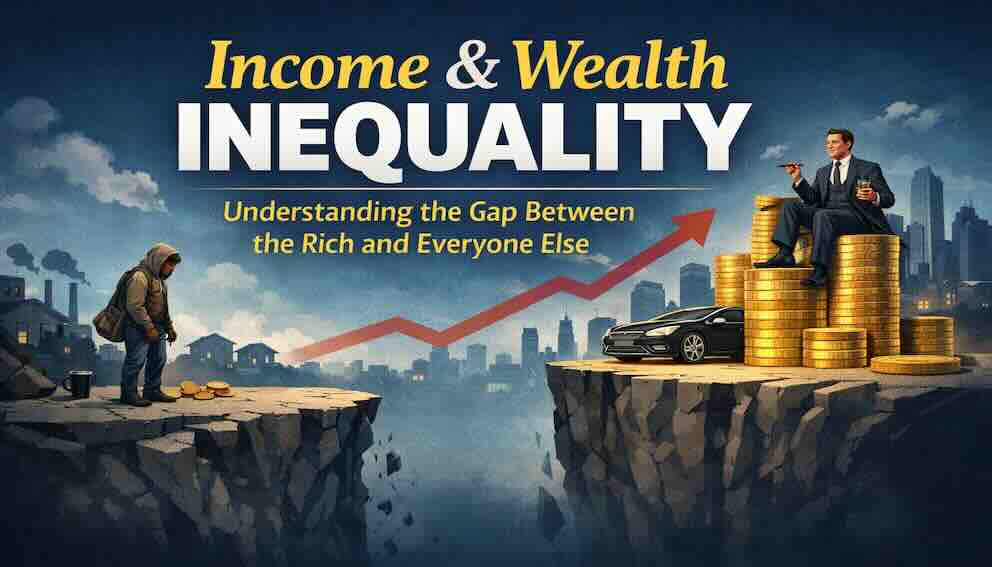
Income & Wealth Inequality: Understanding the Gap Between the Rich and Everyone Else
A Step-by-Step Guide to Measuring Inequality, the Difference Between Income and Wealth, the Forces That Drive Them Apart, and Why Inequality Matters for the Economy
This tutorial explores one of the most pressing issues in modern economics: the growing gap between the rich and everyone else. You will learn how economists measure inequality using tools like the Gini coefficient and top income shares, and why it is crucial to distinguish between income (the flow of earnings) and wealth (the stock of assets). We will examine the forces driving inequality—from technological change and globalization to shifts in labor market institutions, the rise of superstar firms, the role of housing, and the distributional effects of monetary policy—and consider the macroeconomic consequences, including slower growth, financial instability, and the erosion of social trust. Using real-world examples from the United States, where inequality has risen dramatically since the 1980s, and from countries like Sweden and Brazil, which have taken different paths, this tutorial shows how inequality intersects with race, gender, and geography, and how policy choices shape the trajectory of inequality.
Introduction: The Two Americas
Imagine two families. One lives in a comfortable suburb, with two cars in the driveway, a mortgage on a modest house, and a steady income that covers their needs and leaves a little for savings. The other family lives in the same city, but their experience is different. They rent a small apartment, struggle to pay the bills, and live paycheck to paycheck. They have no savings, and an unexpected car repair or medical bill could push them into debt. Now imagine that over the past forty years, the first family has seen their income grow substantially, while the second family has seen almost no increase at all. Their houses—the ones they own and the ones they rent—have become more expensive. The gap between them has widened. This is not a hypothetical scenario; it is the story of the United States and many other advanced economies since 1980.
Now imagine another layer. The first family is white, and the second is Black. The first family lives in a thriving coastal city, and the second lives in a declining rural town. The first family works in technology or finance; the second works in manufacturing or retail. The gaps multiply. Inequality is not one thing; it is many things, layered on top of each other. It is about income and wealth, but it is also about race, gender, geography, and the quality of jobs. It is about the structure of the economy and the choices we make about how to run it.
In this tutorial, we will explore the economics of inequality. We will learn how economists measure inequality, using tools like the Gini coefficient and the top 1 percent share. We will distinguish between income (the flow of earnings from work and investments) and wealth (the stock of assets owned). We will examine the forces driving inequality—from technological change and globalization to shifts in labor market institutions, the rise of superstar firms, the role of housing, and even the effects of monetary policy. And we will consider the macroeconomic consequences: how inequality affects growth, stability, and the social fabric. We will also explore how inequality intersects with race, gender, and geography, and consider the policy choices that shape the trajectory of inequality. Using real-world examples from the United States, Sweden, Brazil, and other countries, we will see that inequality is not just a moral issue but a central macroeconomic concern shaped by policy choices.
Measuring Inequality – The Tools Economists Use
Before we can understand inequality, we need to measure it. Economists have developed several tools for capturing different dimensions of inequality. The most widely used is the Gini coefficient, but it is not the only one.
The Gini Coefficient
The Gini coefficient is a single number that summarizes the distribution of income or wealth in a society. It ranges from 0 to 1. A Gini coefficient of 0 means perfect equality: everyone has exactly the same income. A Gini coefficient of 1 means perfect inequality: one person has all the income, and everyone else has nothing. In reality, countries fall somewhere in between.
The Gini coefficient is calculated from the Lorenz curve, a graphical representation of inequality. The Lorenz curve plots the cumulative share of income against the cumulative share of the population, sorted from poorest to richest. If everyone had the same income, the Lorenz curve would be a straight diagonal line (the line of perfect equality). The more the curve bends away from this line, the greater the inequality. The Gini coefficient is the area between the Lorenz curve and the line of perfect equality, divided by the total area under the line of perfect equality.
To make this concrete, consider two countries. Sweden, which has a relatively equal distribution of income, has a Gini coefficient around 0.27. The United States, which has much higher inequality, has a Gini coefficient around 0.48. South Africa, one of the most unequal countries in the world, has a Gini coefficient around 0.63. These numbers allow us to compare inequality across countries and over time.
A Simple Numerical Example
To see how the Gini coefficient works, consider a simple society with five people. Their incomes are: $10,000, $20,000, $30,000, $40,000, and $100,000. The total income is $200,000. The poorest person has 5 percent of total income; the poorest two have 15 percent; the poorest three have 30 percent; the poorest four have 50 percent; and the richest has 50 percent. The Lorenz curve would show these cumulative shares. The area between this curve and the diagonal line would give the Gini coefficient—in this case, about 0.36. If the richest person had $200,000 and everyone else had $0, the Gini would be 0.8. If everyone had $40,000, the Gini would be 0.
Top Shares: The 1 Percent
The Gini coefficient is useful, but it is a summary statistic. It tells us about overall inequality but does not tell us specifically what is happening at the very top or the very bottom. For that, economists look at top shares: the share of income or wealth going to the top 1 percent, the top 10 percent, or the top 0.1 percent.
This is the measure that has captured public attention. In the United States, the share of income going to the top 1 percent has risen from about 10 percent in 1980 to over 20 percent today. The share going to the top 0.1 percent has risen even more dramatically. These numbers tell a story about where the gains from growth have been concentrated.
The Palma Ratio and Other Measures
Because the Gini coefficient can be less sensitive to changes at the top and bottom, some economists prefer the Palma ratio, which compares the share of income going to the top 10 percent to the share going to the bottom 40 percent. This measure is more responsive to the extremes that often drive inequality debates.
Other measures include the 90/10 ratio (the income of the person at the 90th percentile divided by the income of the person at the 10th percentile), which captures the gap between the upper middle class and the lower middle class. And the 50/10 ratio captures the gap between the median and the bottom.
Each measure tells a different story. The Gini coefficient gives a broad overview. Top shares tell us about concentration at the very top. The Palma ratio tells us about the extremes. Together, they give a fuller picture.
Measurement Limitations: How Reliable Are the Numbers?
Before we go further, it is important to understand the limitations of inequality data. Measuring inequality is harder than measuring GDP because much of the data comes from surveys, and the rich are notoriously difficult to survey. People may underreport their income, especially if it comes from investments or business ownership. Wealth is even harder to measure, as much of it is held in assets like private businesses, offshore accounts, and trusts that are not easily observed.
Economists like Thomas Piketty, Emmanuel Saez, and Gabriel Zucman have developed methods to combine survey data with tax records to get a more accurate picture. Tax records capture top incomes better than surveys, but they also have limitations: they do not capture income that is not reported, and they reflect tax definitions rather than economic definitions. Despite these challenges, the broad trends—rising inequality since 1980, concentration at the top—are robust across different data sources and methods.
Key takeaway: The Gini coefficient summarizes overall inequality; top shares capture concentration at the very top; the Palma ratio focuses on the extremes. Each measure reveals a different dimension. However, inequality data has limitations, including underreporting and difficulty measuring wealth, requiring careful interpretation.
Income vs Wealth – Two Sides of the Same Coin
When we talk about inequality, we must distinguish between income and wealth. These are two different concepts, and they can tell very different stories.
Income: The Flow
Income is the flow of earnings over a period of time—a year, a month, a week. It includes wages from work, interest from savings, dividends from stocks, rents from property, and business profits. Income is what people use to pay for their daily needs: food, housing, transportation, healthcare. For most people, income comes primarily from wages and salaries.
Income inequality has risen sharply in many countries. In the United States, the gap between the top earners and the middle has widened dramatically. But income inequality captures only part of the picture. A person who has high income but also high debt may be less well-off than a person with moderate income but substantial savings.
Wealth: The Stock
Wealth is the stock of assets owned at a point in time. It includes the value of homes, stocks, bonds, savings accounts, businesses, and other assets, minus any debts. Wealth is what people have accumulated over time. It provides security—a cushion against unexpected expenses, the means to retire, the ability to pass resources to children.
Wealth inequality is even more extreme than income inequality. In the United States, the top 1 percent of households own about 30 to 35 percent of all wealth. The top 10 percent own about 70 percent. The bottom 50 percent own less than 2 percent. This concentration of wealth is the result of decades of accumulation, and it matters because wealth begets more wealth through investment returns and inheritance.
Why the Distinction Matters
The distinction between income and wealth matters for several reasons. First, wealth provides security and opportunity that income alone does not. A person with a high income but no wealth is vulnerable to job loss or illness. A person with moderate income but substantial wealth has a safety net.
Second, wealth is more persistent than income. Income can change from year to year; wealth is accumulated over a lifetime and passed across generations. High wealth inequality today is likely to lead to high wealth inequality tomorrow, as the wealthy invest their assets and pass them to their children.
Third, income and wealth interact. High income allows people to save and build wealth. Wealth generates income through dividends, interest, and capital gains. This is the wealth-income spiral: the rich get richer, and the gap widens.
The Role of Housing in Wealth Inequality
One of the most important drivers of wealth inequality in recent decades has been housing. In the United States, the United Kingdom, and many other countries, house prices have risen much faster than incomes. For those who own homes, this has been a source of wealth accumulation. For those who rent, it has been a drain on income and a barrier to building wealth.
Homeownership is highly unequal. Wealthier families are more likely to own homes, and they tend to own more expensive homes. When house prices rise, the gap in housing wealth widens. Moreover, homeownership is often passed from parents to children, either through inheritance or through help with down payments. This means that housing inequality reinforces wealth inequality across generations.
Consider two families. One owns a home that has appreciated in value by $500,000 over thirty years. The other rents, paying rising rents but accumulating no housing wealth. The first family can pass that wealth to their children; the second cannot. This is a major driver of inequality in countries with expensive housing markets.
Capital vs Labor Share: A Macro Perspective
A related concept is the labor share of income—the proportion of national income that goes to workers in the form of wages and salaries. In many countries, the labor share has been declining, while the capital share—the proportion going to owners of capital (profits, dividends, interest)—has been rising.
This matters for inequality because capital income is more concentrated than labor income. The wealthy own most of the capital; the middle class and the poor rely primarily on labor income. When the capital share rises, the share of income going to the wealthy rises, and inequality increases. This shift from labor to capital is a key macroeconomic driver of inequality.
Key takeaway: Income is the flow of earnings; wealth is the stock of assets. Wealth inequality is more extreme and more persistent than income inequality. Housing has become a major driver of wealth inequality, and the shift from labor to capital income has concentrated income at the top.
Pre-Tax vs Post-Tax Inequality – The Role of Redistribution
When we look at inequality, we must distinguish between market inequality (income before taxes and transfers) and disposable inequality (income after taxes and transfers). This distinction is crucial because countries differ enormously in how much they redistribute.
Market Inequality: What Markets Produce
Market inequality is the inequality that results from wages, salaries, business profits, and investment income, before any government intervention. In the United States, market inequality is very high—comparable to other advanced economies. But the U.S. does less to redistribute than many other countries.
Disposable Inequality: After Taxes and Transfers
Disposable inequality is what people actually have to spend after taxes are taken out and transfers (like Social Security, unemployment benefits, and welfare) are added. This is the inequality that affects people's living standards.
The gap between market inequality and disposable inequality is a measure of fiscal redistribution. Countries vary enormously in how much they redistribute. Sweden, for example, has market inequality similar to the United States? Actually, Sweden's market inequality is lower than the U.S., but it also redistributes much more. The result is that Sweden's disposable inequality is much lower than the U.S.
A Comparative Example: U.S. vs Sweden
Imagine two countries with the same market income distribution. In the first country, taxes are low and transfers are limited. The rich keep most of their income, and the poor receive little. Disposable inequality is almost as high as market inequality. This is roughly the U.S. model. In the second country, taxes are high on the rich, and transfers are generous to the poor. Disposable inequality is much lower. This is the Nordic model.
The U.S. redistributes much less than most other advanced economies. The top 1 percent pay a lower effective tax rate than they did decades ago, and the safety net is less generous. As a result, the gap between market inequality and disposable inequality in the U.S. is smaller than in many European countries. This is a policy choice, not an economic necessity.
Key takeaway: Market inequality is what markets produce; disposable inequality is what people actually have after taxes and transfers. Countries differ enormously in how much they redistribute. The U.S. redistributes less than many other advanced economies, contributing to higher disposable inequality.
Absolute vs Relative Inequality – Two Ways of Seeing the Gap
When we talk about inequality, we can focus on relative inequality (how income shares compare) or absolute inequality (the actual dollar gaps). These two concepts can tell different stories.
Relative Inequality: Shares and Ratios
Relative inequality is measured by shares (like the top 1 percent share) or ratios (like the 90/10 ratio). If everyone's income doubles, relative inequality stays the same. This is the standard measure used in most economic research.
Absolute Inequality: Dollar Gaps
Absolute inequality measures the actual difference in dollars between the rich and the poor. If everyone's income doubles, absolute inequality doubles. This matters because the lived experience of inequality is partly about what you can afford. A poor person in a rich country may have a higher absolute standard of living than a poor person in a poor country, even if relative inequality is similar.
Why the Debate Matters
The debate between relative and absolute inequality is not just technical. It reflects different values. Some argue that relative inequality matters more because it affects social cohesion, status, and political power. Others argue that absolute inequality matters more because what matters is whether people can afford a decent life.
In practice, both matter. A country with high relative inequality but high absolute living standards for the poor may be more acceptable than a country with low relative inequality but widespread poverty. This is why economists look at both measures.
Key takeaway: Relative inequality measures shares and ratios; absolute inequality measures actual dollar gaps. Both matter for understanding inequality, and they can tell different stories depending on whether living standards are rising for everyone.
Inequality of Opportunity vs Inequality of Outcome
Another crucial distinction is between inequality of outcome (unequal results) and inequality of opportunity (unequal starting points). These are related but distinct concepts.
Inequality of Outcome
Inequality of outcome is what we have been discussing: differences in income, wealth, and consumption. This is what the Gini coefficient and top shares measure.
Inequality of Opportunity
Inequality of opportunity refers to the degree to which a person's life chances are determined by circumstances beyond their control—their parents' income, their race, their gender, their geography. A society with high inequality of opportunity is one where where you start determines where you end up.
Mobility as the Bridge
Social mobility—the ability to move up or down the income ladder—is the bridge between opportunity and outcome. High mobility means that outcomes are not predetermined by birth; low mobility means they are. The Great Gatsby Curve shows that countries with high inequality tend to have low mobility. This suggests that inequality of outcome and inequality of opportunity are linked.
In the United States, mobility is lower than in many other advanced economies. A child born to poor parents is much less likely to reach the top than a child born to rich parents. This is true even controlling for education, ability, and effort. The American Dream—the idea that anyone can succeed through hard work—has become harder to achieve.
Key takeaway: Inequality of outcome is about unequal results; inequality of opportunity is about unequal starting points. Social mobility is the link between them. The Great Gatsby Curve shows that high inequality tends to come with low mobility.
The Dimensions of Inequality – Race, Gender, and Geography
Inequality is not just about the gap between the top and the bottom; it is also about how that gap is distributed across different groups. Race, gender, and geography are critical dimensions that intersect with income and wealth inequality.
Racial Inequality
In the United States, the racial wealth gap is staggering. The median white household has about ten times the wealth of the median Black household. The median white household has about eight times the wealth of the median Hispanic household. These gaps are not new; they are the result of centuries of discrimination in housing, education, employment, and criminal justice. Redlining—the practice of denying mortgages to Black families—prevented generations from building home equity. Unequal access to education and employment has perpetuated income gaps. And the wealth gap persists even when controlling for education, income, and other factors. The racial wealth gap is a stark reminder that inequality is not just about individual effort; it is about history, institutions, and ongoing discrimination.
Gender Inequality
The gender pay gap has narrowed over the past fifty years, but it persists. In the United States, women earn about 82 cents for every dollar earned by men. The gap is larger for women of color. The reasons are complex: occupational segregation (women are concentrated in lower-paying fields), differences in work experience (due to caregiving responsibilities), discrimination, and the "motherhood penalty." Wealth gaps by gender are even larger, as women have lower lifetime earnings and are less likely to own assets. The COVID-19 pandemic highlighted these inequalities, as women left the workforce in disproportionate numbers to care for children and elderly relatives.
Geographic Inequality
Inequality is not just between individuals; it is also between places. The gap between thriving cities and struggling rural areas has widened dramatically. In the United States, the "Rust Belt"—once the heart of American manufacturing—has seen decades of decline, while coastal tech hubs like Silicon Valley, Seattle, and Boston have boomed. The result is a geography of inequality. People in prosperous cities have high incomes, high home values, and access to good jobs. People in declining regions face unemployment, falling home values, and limited opportunities. This geographic inequality drives political polarization, as the interests of cities and rural areas diverge. It also creates a self-reinforcing cycle: talented young people leave struggling regions for prosperous cities, leaving behind an aging population and a shrinking tax base.
Key takeaway: Inequality intersects with race, gender, and geography. The racial wealth gap is enormous and persistent. The gender pay gap remains significant. Geographic inequality between thriving cities and struggling regions has widened, driving political polarization and self-reinforcing decline.
The Rise of Inequality – A Story of the Last Four Decades
To understand the forces driving inequality, we need to look at the data. The story of inequality in the United States is dramatic, but it is not unique.
The United States: A Widening Gap
In 1980, the United States was a relatively equal country by historical standards. The share of income going to the top 1 percent was about 10 percent, similar to levels in the 1950s and 1960s. The bottom 50 percent earned about 20 percent of all income. Over the next forty years, these numbers reversed. By 2020, the top 1 percent earned over 20 percent of all income, while the bottom 50 percent earned less than 13 percent. The share of wealth owned by the top 1 percent rose from about 25 percent to over 30 percent. The bottom 50 percent saw their share of wealth fall from about 5 percent to near zero.
This pattern was not inevitable. Other advanced economies took different paths. In Germany and France, the top 1 percent share increased modestly, but inequality remains much lower than in the United States. In Sweden, which had very low inequality in the 1980s, inequality has risen but remains below U.S. levels. The Nordic countries still have much more equal distributions of income and wealth than the United States.
A Global Perspective: Within-Country vs Between-Country Inequality
It is important to distinguish between within-country inequality (inequality within nations) and between-country inequality (inequality across nations). Over the past three decades, between-country inequality has fallen dramatically, driven by the rapid growth of China, India, and other developing countries. The gap between the average person in a rich country and the average person in a poor country has narrowed.
However, within-country inequality has risen in many places. In the United States, the United Kingdom, and many other advanced economies, the gap between the rich and the poor has widened. In China, inequality has risen sharply as the country has transitioned to a market economy. The global picture is complex: the world is becoming more equal between countries, but many countries are becoming more unequal internally.
Key takeaway: Inequality has risen dramatically in the United States since 1980. Other countries have taken different paths, showing that inequality is shaped by policy. Globally, between-country inequality has fallen, but within-country inequality has risen in many places.
The Causes of Inequality – Why Has the Gap Widened?
The rise of inequality is the result of multiple forces that have been operating for decades. No single factor explains the trend; rather, it is the interaction of technological change, globalization, institutional shifts, policy choices, and structural changes like housing and the rise of superstar firms.
Technological Change: Skill-Biased Technical Change
One of the most important drivers of inequality is skill-biased technical change—the idea that new technologies have disproportionately benefited workers with higher skills while displacing workers with lower skills. The computer revolution, automation, and artificial intelligence have increased the demand for highly educated workers in fields like engineering, finance, and management. At the same time, they have reduced the demand for workers in routine jobs—manufacturing, clerical work, and some services.
This has created a polarization of the labor market. High-skill, high-wage jobs have grown, and low-skill, low-wage jobs have grown (like food service and personal care), but middle-skill jobs have shrunk. This "hollowing out" of the middle class has contributed to rising inequality.
Globalization: Trade and Offshoring
Globalization has also played a role. The integration of China, India, and other countries into the global economy has exposed workers in advanced economies to competition from low-wage countries. This has put downward pressure on wages for workers in manufacturing and other tradable sectors. For high-skill workers in advanced economies—those in finance, technology, and professional services—globalization has created new opportunities and higher incomes. The result has been a widening gap between those who can compete globally and those who cannot.
The Rise of Superstar Firms
In recent decades, a small number of "superstar firms" have come to dominate many industries. In technology, a handful of companies—Google, Apple, Amazon, Meta—capture a large share of profits and pay very high wages to a relatively small number of workers. In retail, Walmart and Amazon have displaced thousands of smaller businesses. In finance, a few large banks dominate. These superstar firms contribute to inequality in two ways. First, they capture a growing share of profits, which flow to their owners (the wealthy). Second, they reduce competition, which can suppress wages and reduce employment in the broader economy.
Declining Unionization and Labor Market Institutions
The decline of labor unions has been another important factor. In the United States, union membership has fallen from over 30 percent of workers in the 1950s to about 10 percent today. Unions historically helped reduce inequality by bargaining for higher wages and better benefits for their members, and by setting norms that affected non-union workers as well. The decline of unions has been associated with a decline in the share of income going to labor and a rise in the share going to capital.
Other labor market institutions have also weakened. The minimum wage, adjusted for inflation, is lower today than it was in the 1960s. Labor protections have eroded. These changes have shifted bargaining power away from workers and toward employers.
Financialization and Executive Compensation
The growth of the financial sector—sometimes called financialization—has contributed to inequality in several ways. The financial sector itself pays very high salaries and bonuses, concentrating income at the top. Financialization has also changed corporate governance, with a focus on shareholder value that has led to higher pay for executives and lower wages for workers. The ratio of CEO pay to the average worker has skyrocketed, from about 20 to 1 in the 1960s to over 300 to 1 today.
The Role of Inheritance and Dynastic Wealth
Wealth is not just about current earnings; it is also about inheritance. The children of wealthy parents start life with substantial advantages: they can afford better education, they can take risks in their careers, they can receive down payments for homes, and they can inherit assets that generate income. This dynastic wealth perpetuates inequality across generations. The ability to pass wealth from parents to children means that the advantages of the rich compound over time.
In the United States, the share of wealth that comes from inheritance has been rising. Studies estimate that between 40 and 60 percent of wealth is inherited, not earned. This suggests that the United States is moving toward a society where birth matters more than merit—a departure from the American ideal of opportunity.
Tax Policy and Redistribution
Finally, tax policy has played a role. In the decades after World War II, top marginal tax rates were high—over 70 percent in the United States—and capital gains were taxed at higher rates. Since the 1980s, tax rates on the wealthy have been cut repeatedly. The Tax Reform Act of 1986, the Bush tax cuts of 2001 and 2003, and the Trump tax cuts of 2017 all reduced taxes on high incomes and wealth. At the same time, the social safety net has been eroded in many countries. The combination of lower taxes on the rich and weaker redistribution has amplified the effects of market-driven inequality.
The Distributional Effects of Monetary Policy
Monetary policy—the setting of interest rates by central banks—also has distributional effects. When interest rates are low, asset prices (stocks, bonds, real estate) tend to rise. The wealthy, who own most of these assets, benefit directly. Low interest rates also make it easier for the wealthy to borrow to invest. At the same time, low interest rates do little for those who rely on wages and have little savings. In fact, low rates can hurt savers who rely on interest income. Since the 2008 financial crisis, central banks around the world have kept interest rates at historically low levels. This has contributed to the rise in asset prices and, some argue, to the concentration of wealth.
Key takeaway: The rise of inequality is driven by multiple forces: skill-biased technological change, globalization, the rise of superstar firms, declining unionization, financialization, rising executive pay, inheritance, tax policies that have favored the wealthy, and the distributional effects of monetary policy. These forces interact, and their effects vary across countries depending on institutions and policy choices.
The Macroeconomic Consequences – Why Inequality Matters
Inequality is not just a moral issue; it has real macroeconomic consequences. A highly unequal society can be less stable, less dynamic, and less democratic than a more equal one.
Inequality and Growth
The relationship between inequality and economic growth is contested. Some economists argue that inequality is necessary for growth because it provides incentives for innovation and risk-taking. Others argue that excessive inequality undermines growth by reducing demand, limiting opportunity, and creating instability.
The evidence suggests that the relationship depends on the level of inequality. Moderate inequality may be associated with growth, but high inequality appears to be harmful. A landmark study by the International Monetary Fund found that a 1 percentage point increase in the share of income going to the top 20 percent reduces GDP growth over the next five years, while a 1 percentage point increase in the share going to the bottom 20 percent increases growth. In other words, growth is higher when the benefits are more widely shared.
Why would inequality harm growth? One channel is through demand. The wealthy save a larger share of their income than the poor. When income is concentrated at the top, aggregate demand is weaker because the rich do not spend as much of their income as the middle class and the poor would. This can lead to slower growth and even recessions. The 2008 financial crisis is often interpreted as a crisis of inequality: middle-class households took on unsustainable debt to maintain their consumption, and when the bubble burst, the economy collapsed.
Another channel is through opportunity. High inequality often means that children from poor families have limited access to quality education, healthcare, and networks. This leads to a waste of human potential and lower productivity growth. If talented children cannot afford to go to college or cannot take risks because they lack a safety net, the economy loses their contributions.
Inequality and Financial Instability
High inequality has been linked to financial instability. When the rich have a large share of income, the middle class and the poor may borrow to maintain their consumption. This increases household debt, making the economy vulnerable to shocks. The 2008 financial crisis was preceded by a massive increase in household debt, much of it taken on by middle-class households trying to keep up. When housing prices fell, the debt became unsustainable, and the crisis erupted.
Inequality and Political Stability
High inequality can erode political stability and trust in institutions. When people feel that the system is rigged against them, they lose faith in democracy, in the rule of law, and in each other. This can lead to populism, extremism, and social unrest. The rise of populist movements in the United States and Europe in the 2010s is often linked to the frustrations of those left behind by globalization and technological change.
In the United States, the top 1 percent now earn more than the bottom 50 percent combined. This concentration of income has been accompanied by a concentration of political power. Studies show that the political preferences of the wealthy have much more influence on policy than the preferences of the middle class or the poor. This creates a vicious cycle: inequality leads to policy that favors the wealthy, which exacerbates inequality.
The Political Economy Feedback Loop
This brings us to the political economy feedback loop. High inequality gives the wealthy disproportionate political power, through campaign contributions, lobbying, and influence over media. They use that power to shape policy in their favor—lower taxes, weaker regulation, reduced social spending. Those policies then increase inequality further. This feedback loop can trap a country in a cycle of rising inequality and declining democracy.
Inequality and Social Well-Being
Beyond economics, inequality affects social well-being. Countries with higher inequality tend to have worse health outcomes, higher crime rates, lower life expectancy, and lower levels of trust. The "status competition" that comes with high inequality can lead to stress, anxiety, and social breakdown. These effects are not just about poverty; they affect the entire society.
Key takeaway: High inequality has macroeconomic consequences: it can reduce growth, increase financial instability, erode political stability, and lower social mobility. The political economy feedback loop shows how inequality can reinforce itself through policy. Beyond economics, inequality affects health, crime, and social trust.
Predistribution vs Redistribution – Two Approaches to Policy
Before turning to policy solutions, it is useful to distinguish between predistribution and redistribution. These are two different philosophies for addressing inequality.
Redistribution: After the Market
Redistribution is what we usually think of when we talk about inequality policy: taxes and transfers. The government takes money from the rich (through progressive taxes) and gives it to the poor (through cash transfers, food assistance, housing subsidies, and public services). This is the approach of the welfare state.
Redistribution can be effective, but it has limitations. It does not change the underlying market distribution; it just compensates for it. And it can be politically unpopular, as it is seen as "taking from the rich and giving to the poor."
Predistribution: Shaping the Market
Predistribution is about shaping the market distribution before taxes and transfers. It includes policies that affect wages, employment, and the structure of the economy. Examples include minimum wages, collective bargaining, antitrust enforcement, corporate governance reform, investments in education, and policies that encourage worker ownership.
The idea behind predistribution is that a more equal market distribution requires less redistribution. If workers have more bargaining power, if competition is stronger, if education is more equal, then the market outcome will be more equal to begin with. Predistribution is often less politically contentious because it is less visible than redistribution; it changes the rules of the game rather than explicitly transferring money.
In practice, most countries use a mix of predistribution and redistribution. The Nordic countries, for example, have strong labor market institutions (predistribution) and generous welfare states (redistribution). The United States has weaker predistribution and weaker redistribution, resulting in higher inequality.
The Piketty Framework: r > g
The French economist Thomas Piketty, in his book Capital in the Twenty-First Century, argued that a central driver of inequality is the tendency for the return on capital (r) to exceed the growth rate (g). When r > g, wealth grows faster than the economy. The rich, who own most of the wealth, see their fortunes grow faster than the incomes of everyone else. This leads to a concentration of wealth over time.
Piketty's work sparked a massive debate. Critics argue that the relationship is not deterministic, that taxes and other policies can offset it. Supporters argue that it explains the long-term trend toward rising wealth inequality. Whether or not one accepts Piketty's full framework, his work brought the issue of wealth inequality to the forefront of economic debate.
Key takeaway: Redistribution (taxes and transfers) addresses inequality after the market. Predistribution (minimum wages, unions, antitrust, education) shapes the market distribution to be more equal to begin with. Piketty's r > g framework highlights the tendency for wealth to concentrate over time absent countervailing policies.
Policy Responses – What Can Be Done?
If inequality is driven by a combination of market forces, institutional shifts, and policy choices, then policy can also shape the trajectory. There is no single solution, but a range of tools is available. Each involves trade-offs that must be weighed.
Taxation and Redistribution
One of the most direct ways to reduce inequality is through progressive taxation and redistribution. Higher taxes on the wealthy—through higher marginal income tax rates, higher capital gains taxes, and wealth taxes—can raise revenue that can be used to fund public services and transfers. The earned income tax credit (EITC) in the United States is an example of a well-targeted redistribution program that boosts the incomes of low-wage workers without creating disincentives to work.
The trade-off: High taxes can reduce incentives to work, save, and invest. The goal is to design taxes that raise revenue without excessively distorting behavior. Evidence suggests that moderate increases in top tax rates have limited effects on growth, while dramatically reducing inequality.
Predistribution: Labor Market Policies
Strengthening labor market institutions can reduce inequality at its source. Raising the minimum wage, supporting collective bargaining, and strengthening labor protections can boost wages for low- and middle-income workers. The decline of unions in the United States has been a major factor in rising inequality; policies that make it easier to unionize could help reverse this trend.
The trade-off: Some argue that higher minimum wages and stronger unions can reduce employment, especially for low-skilled workers. Evidence is mixed; well-designed policies can raise wages without significant job loss.
Predistribution: Antitrust and Corporate Governance
The rise of market power—the ability of large corporations to set prices above competitive levels—has contributed to inequality by reducing wages and increasing profits. Stronger antitrust enforcement and changes in corporate governance (like requiring worker representation on corporate boards) could shift the balance back toward workers.
The trade-off: Stronger regulation may reduce profits and investment. But breaking up monopolies and increasing competition can also boost innovation and growth.
Predistribution: Education and Human Capital
Investing in education is one of the most effective ways to address inequality in the long term. High-quality early childhood education, affordable college, and vocational training can help level the playing field. Countries with more equal educational outcomes tend to have more equal income distributions.
The trade-off: Education investments take time to pay off. They also require resources that must be raised through taxes. But the long-term returns—in productivity, growth, and equality—are substantial.
Wealth Taxes and Inheritance Taxes
Because wealth is so concentrated, policies that tax wealth directly can be effective in reducing inequality. Many European countries have wealth taxes, though they have been difficult to administer. Inheritance taxes are another tool; they prevent the concentration of wealth across generations and fund public investments. In the United States, the federal estate tax applies only to the largest fortunes, and it has been weakened over time.
The trade-off: Wealth taxes can be difficult to administer because wealth is hard to value and easy to hide. But they target the most concentrated form of inequality.
Universal Basic Income and Other Innovations
More radical proposals, like universal basic income (UBI), aim to provide every citizen with a guaranteed income regardless of work status. Proponents argue that UBI could provide security in an era of automation and help reduce inequality. Critics worry about the cost and the potential disincentive to work. Several countries have experimented with versions of UBI, but the evidence is still emerging.
The trade-off: UBI is expensive. It would require significant tax increases. But it could simplify the welfare state and provide a universal floor.
Key takeaway: Policy can reduce inequality through redistribution (progressive taxes and transfers) and predistribution (minimum wages, unions, antitrust, education, wealth taxes). Each tool involves trade-offs between equity and efficiency, and the right mix depends on a country's values and institutions.
Real-World Examples – Three Countries, Three Paths
To see how these forces play out, let us look at three countries that have taken different paths on inequality.
The United States: Rising Inequality, Low Mobility
The United States has experienced the most dramatic rise in inequality among advanced economies. The share of income going to the top 1 percent has more than doubled. Social mobility is lower than in many other countries. The American Dream—the idea that anyone can succeed through hard work—has become harder to achieve. The combination of technological change, globalization, declining unions, and tax cuts for the wealthy has created a society that is more unequal and less mobile than it was a generation ago. Racial and geographic inequalities compound these trends.
Sweden: High Equality, High Mobility
Sweden took a different path. In the 1980s, Sweden had one of the most equal distributions in the world. Inequality has risen since then, but it remains much lower than in the United States. The top 1 percent share is about half of the U.S. level. Social mobility is high. What explains this? Sweden has a strong social safety net, high-quality public education, active labor market policies, and a tax system that redistributes income. It also has strong unions and a tradition of social partnership between labor and business. Sweden shows that it is possible to have a dynamic economy with relatively low inequality.
Brazil: From Extreme Inequality to Progress
Brazil was historically one of the most unequal countries in the world. In the 1990s, the Gini coefficient was over 0.6. But beginning in the 2000s, Brazil made significant progress. The Gini coefficient fell to about 0.5 by the 2010s. What happened? Brazil expanded access to education, implemented conditional cash transfer programs (Bolsa Família) that lifted millions out of poverty, raised the minimum wage, and improved labor market conditions. These policies reduced inequality, though Brazil remains highly unequal. The Brazilian experience shows that even countries with deep-seated inequality can make progress with sustained policy effort.
Key takeaway: The United States has seen rising inequality and declining mobility. Sweden has maintained low inequality and high mobility through strong institutions and redistribution. Brazil made significant progress in reducing inequality through education, cash transfers, and labor market policies. These examples show that inequality is shaped by policy choices.
A Conceptual Summary – Putting It All Together
To make sense of the forces we have discussed, it helps to have a framework. Think of inequality as the outcome of a process:
Inequality = Market forces × Institutions × Policy → Outcomes → Feedback
- Market forces: Technology, globalization, demographics, superstar firms. These create the initial distribution of earnings and wealth.
- Institutions: Unions, labor market rules, corporate governance, education systems, housing markets, monetary policy frameworks. These shape how market forces translate into outcomes.
- Policy: Taxes, transfers, regulation, public investment, antitrust, minimum wages. These directly affect disposable income and wealth, and they shape institutions over time.
- Outcomes: Income and wealth distributions, measured by the Gini coefficient, top shares, and other indicators. Also, outcomes in health, education, mobility, and social trust.
- Feedback: Outcomes affect future policy and institutions through political influence, social stability, and public opinion. The political economy feedback loop can reinforce or mitigate inequality.
This framework shows that inequality is not inevitable. It is shaped by choices—about how we organize our economy, what we tax and spend, what we invest in, and how we govern.
Key takeaway: Inequality is the result of market forces, institutions, and policy, which feed back into future outcomes. This framework shows that inequality is shaped by choices, not determined by fate.
Conclusion: The Gap That Shapes Everything
The gap between the rich and everyone else is not just a matter of individual fortune; it is a reflection of the forces shaping the economy. These forces are not impersonal or inevitable—they result from technological change, policy choices about taxes, unions, education, antitrust, housing, and monetary policy, as well as globalization and history.
Economists measure inequality with tools like the Gini coefficient (overall dispersion) and top shares (concentration at the very top). Income—the flow of earnings—differs from wealth—the stock of assets—and wealth inequality is even more extreme. Market inequality (before taxes and transfers) differs from disposable inequality (after redistribution), and countries vary in how much they redistribute. Relative and absolute inequality offer complementary perspectives. Inequality also intersects with race, gender, and geography: the racial wealth gap, the gender pay gap, and divides between thriving cities and struggling regions all reflect systemic patterns.
The forces driving inequality include skill-biased technological change, globalization, superstar firms, declining unions, financialization, rising executive pay, inheritance, and tax policies favoring the wealthy. These forces interact with institutions and policy to shape outcomes. High inequality affects growth, financial stability, political influence, and social well-being, creating feedback loops that can reinforce itself across generations.
Ultimately, inequality is not inevitable. It is shaped by the choices we make—about how we organize our economy, what we tax and spend, what we invest in, and how we govern. Understanding these dynamics is the first step toward designing policies that can narrow the gap, improve mobility, and create a fairer society.
About Swati Sharma
Lead Editor at MyEyze, Economist & Finance Research WriterSwati Sharma is an economist with a Bachelor’s degree in Economics (Honours), CIPD Level 5 certification, and an MBA, and over 18 years of experience across management consulting, investment, and technology organizations. She specializes in research-driven financial education, focusing on economics, markets, and investor behavior, with a passion for making complex financial concepts clear, accurate, and accessible to a broad audience.
Disclaimer
This article is for educational purposes only and should not be interpreted as financial advice. Readers should consult a qualified financial professional before making investment decisions. Assistance from AI-powered generative tools was taken to format and improve language flow. While we strive for accuracy, this content may contain errors or omissions and should be independently verified.