
Tutorial Categories
Last Updated: April 19, 2026 at 10:30
Recessionary Gaps & Inflationary Gaps: Understanding When the Economy Falls Short or Overshoots
A Step-by-Step Guide to Output Gaps, Underemployment Equilibrium, and Why Policy Must Sometimes Intervene
This tutorial explores one of the most important concepts in macroeconomics: the output gap—the difference between what an economy actually produces and what it could produce at full capacity. You will learn about recessionary gaps, when the economy operates below its potential, leaving workers unemployed and factories idle; and inflationary gaps, when the economy operates above its potential, straining resources and pushing prices upward. Using real-world examples from Japan's Lost Decade, the European debt crisis, the dot-com boom, and the Volcker disinflation of the early 1980s, this tutorial shows how understanding output gaps is essential for diagnosing economic problems and designing effective policy responses.
Introduction: The Gap Between What Is and What Could Be
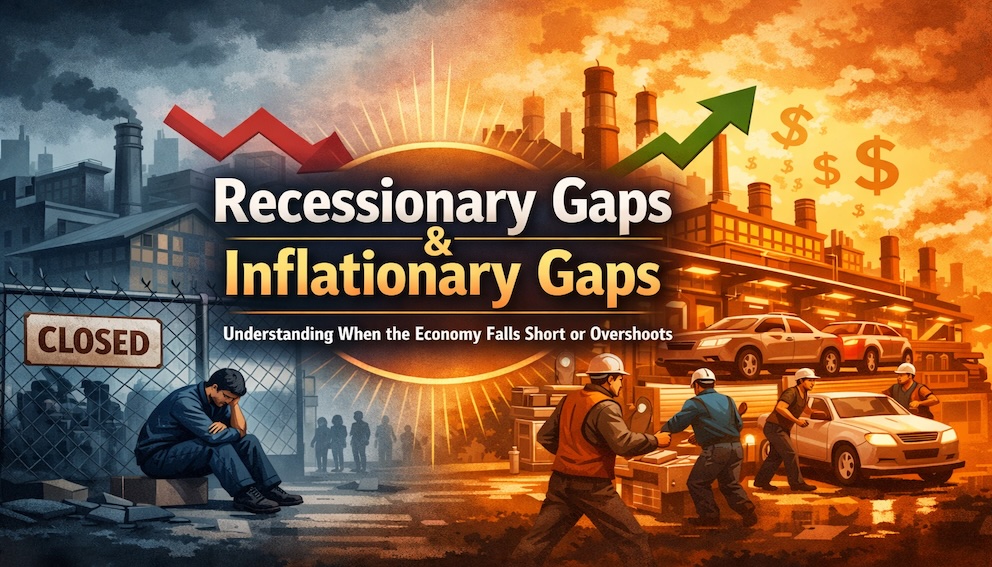
Imagine a factory that is designed to produce one hundred cars a day. It has the workers, the machines, and the materials to do it. But today, only sixty cars roll off the assembly line. Forty workers are standing idle. The machines are silent. The factory is operating below its capacity. Now imagine the opposite: the factory is trying to produce one hundred and twenty cars a day. Workers are exhausted, machines are overheating, and quality is slipping. The factory is operating above its capacity—for a while, it can do it, but not without strain, not without costs.
This is the essence of the output gap. The economy, like the factory, has a capacity—a level of output it can sustain without generating inflationary pressures. This is called potential output. When the economy produces less than potential, there is a recessionary gap. Resources—workers, factories, machines—are idle. When the economy produces more than potential, there is an inflationary gap. Resources are stretched thin, and prices rise.
The output gap is one of the most important concepts in macroeconomics because it tells us whether the economy is underperforming or overheating. It tells us whether unemployment is too high or inflation is too high. It tells us whether policy should stimulate demand or cool it down. Understanding output gaps is essential for diagnosing economic problems and for understanding why policymakers sometimes act aggressively—and sometimes hold back.
In this tutorial, we will explore what output gaps are, how they arise, and what they mean for the economy. We will examine recessionary gaps, when the economy is stuck below its potential, and inflationary gaps, when it overshoots. We will explore the concept of underemployment equilibrium—the troubling idea that an economy can settle at a level of output with persistent unemployment, with no automatic forces pushing it back to full employment. We will examine the link between output gaps and unemployment through the lens of the Phillips Curve, and we will consider the policy implications: how governments and central banks can use fiscal and monetary policy to close these gaps and restore the economy to balance. Using real-world examples from Japan's Lost Decade, the European debt crisis, the dot-com boom, and the Volcker disinflation, we will see the output gap in action.
What Is Potential Output? The Economy's Speed Limit
Before we can understand output gaps, we need to understand what the economy is capable of producing. Potential output—also called full-employment output or the natural level of output—is the level of real GDP the economy can produce when all resources are used at their normal, sustainable rates. It is not a maximum; the economy can temporarily produce more than potential, just as a factory can run overtime. But it is the level consistent with stable inflation and full employment.
Potential output is determined by supply-side factors: the quantity of labor (the size of the workforce and the hours people are willing to work), the stock of capital (factories, machinery, infrastructure), the level of technology (how efficiently we can combine labor and capital), and the quality of institutions (the rules and norms that govern economic activity). These factors grow over time. As the population grows, as we invest in education and equipment, as we invent new technologies, potential output rises.
Closely related to potential output is the natural rate of unemployment, sometimes called the NAIRU (Non-Accelerating Inflation Rate of Unemployment). This is the level of unemployment consistent with stable inflation. When unemployment is below the natural rate, the economy is operating above potential—an inflationary gap. When unemployment is above the natural rate, the economy is operating below potential—a recessionary gap. The natural rate is determined by structural factors: the match between workers' skills and employers' needs, the strength of labor market institutions, demographic trends, and the design of unemployment insurance and other social programs.
But potential output is not directly observable. It is an estimate—a judgment about what the economy could produce if it were running at full capacity. In the United States, the Congressional Budget Office (CBO) publishes quarterly estimates of potential output. These estimates are based on statistical techniques that smooth out business cycle fluctuations, production function approaches that estimate potential based on labor, capital, and technology, and survey-based measures of capacity utilization. In real time, these estimates are uncertain and subject to revision. During the dot-com boom of the late 1990s, some economists believed the economy was operating above potential; others argued that productivity gains from information technology had raised potential output, meaning the gap was smaller than it appeared. The same debates occurred during the housing boom of the mid-2000s and the post-pandemic recovery. Getting the estimate wrong can lead to policy mistakes: tightening too soon can choke off a recovery; waiting too long can allow inflation to build.
The output gap is the difference between actual output and potential output, usually expressed as a percentage of potential output:
Output Gap = (Actual Output − Potential Output) / Potential Output × 100
When the output gap is negative, the economy is producing less than its potential—a recessionary gap. When it is positive, the economy is producing more than its potential—an inflationary gap.
Key takeaway: Potential output is the level of output the economy can sustain without generating inflationary pressures. It is determined by labor, capital, technology, and institutions. The natural rate of unemployment is the level of unemployment consistent with stable inflation. The output gap is the difference between actual and potential output. A negative gap means the economy is underperforming; a positive gap means it is overheating.
Recessionary Gaps – When the Economy Falls Short
A recessionary gap occurs when actual output falls below potential output. The economy is producing less than it could. Resources are idle: workers are unemployed, factories are running below capacity, machines are sitting idle. The gap is a measure of waste—of human potential unused, of productive capacity left idle.
How a Recessionary Gap Arises
Recessionary gaps are typically caused by a fall in aggregate demand. When spending collapses—when households stop buying, businesses stop investing, exports fall, or government cuts spending—the AD curve shifts left. The economy moves down the SRAS curve to a new equilibrium with lower output and a lower price level. This new equilibrium is below potential output.
In the AD-AS model, a recessionary gap appears as a short-run equilibrium to the left of the LRAS curve. The economy is producing less than it could, and unemployment is above the natural rate. This is directly linked to the Phillips Curve: a negative output gap is typically associated with unemployment above its natural rate, putting downward pressure on inflation.
The Dynamic Adjustment Mechanism
In the long run, the economy tends to move back toward potential output through adjustments in wages and prices. In a recessionary gap, excess unemployment puts downward pressure on wages. Unemployed workers may accept lower wages to get jobs; workers who fear losing their jobs may be reluctant to demand raises. Over time, nominal wages begin to fall. Falling wages reduce firms' costs, shifting the SRAS curve to the right. As SRAS shifts right, output increases and the price level falls. The economy moves down along the AD curve, gradually closing the recessionary gap.
However, as Keynes argued, these adjustments can be slow and painful—especially downward wage adjustments, which are resisted by workers and constrained by contracts and social norms. This is why recessionary gaps can persist for years, and why policy intervention is often necessary.
Japan's Lost Decade: A Persistent Recessionary Gap
Japan in the 1990s and 2000s offers a textbook example of a prolonged recessionary gap. In the late 1980s, Japan experienced a massive asset price bubble in stocks and real estate. When the bubble burst in 1990–1991, the economy entered a period of stagnation that lasted more than a decade. The output gap was persistently negative. Growth was near zero. Prices fell—deflation took hold. Unemployment, which had been below 3 percent, rose to over 5 percent, high by Japanese standards.
What made Japan's experience so striking was the persistence of the gap. The economy did not bounce back. It drifted below potential for an entire generation. Policy responses were slow and often inadequate. The Bank of Japan cut interest rates, but by the time it did, rates were already near zero—a trap that limited further monetary stimulus. Fiscal stimulus was tried, but it was often reversed too early. The result was a lost decade—in fact, two lost decades—of underperformance.
Japan's experience also illustrates the concept of hysteresis—the idea that recessions can cause permanent damage to the economy's productive capacity. As workers remained unemployed for years, their skills atrophied. Young people who graduated into the downturn struggled to find stable employment, with lasting effects on their careers and lifetime earnings. Investment was deferred, and the capital stock aged. The potential output of the economy was permanently reduced. A recessionary gap that persists long enough can become a permanent scar.
The European Debt Crisis: Austerity and Stagnation
The European debt crisis of the early 2010s provides another powerful example of a recessionary gap, this one driven by policy choices. In the aftermath of the 2008 financial crisis, several Eurozone countries—Greece, Spain, Italy, Portugal, and Ireland—faced soaring government debt. In response, they implemented austerity policies: sharp cuts in government spending and increases in taxes.
The effect on output was devastating. Greece's GDP fell by over 25 percent from its pre-crisis peak. Unemployment soared to over 25 percent; youth unemployment exceeded 50 percent. Spain's unemployment rose to over 26 percent. Output gaps were enormous and persisted for years. Unlike a sharp collapse like 2008, this was a slow, grinding stagnation. The economy did not bounce back; it stayed below potential for years.
What made the European debt crisis particularly instructive was that the recessionary gap was, in part, policy-induced. Austerity reduced aggregate demand at a time when private demand was already weak. The result was a deep and prolonged output gap. This experience reinforced the Keynesian insight that fiscal policy matters—that cutting spending during a downturn can deepen and extend a recession. It also highlighted the challenges of monetary policy in a currency union, where countries like Greece and Spain could not devalue their currencies or set their own interest rates to stimulate demand.
Key takeaway: A recessionary gap occurs when actual output is below potential. It is caused by a fall in aggregate demand. Japan's Lost Decade shows how a recessionary gap can persist for decades and cause hysteresis—permanent damage to potential output. The European debt crisis shows how austerity policies can create and prolong recessionary gaps. Underemployment equilibrium is the idea that the economy can get stuck below full employment, with no automatic forces to restore it—a key rationale for policy intervention.
Inflationary Gaps – When the Economy Overshoots
An inflationary gap occurs when actual output rises above potential output. The economy is producing more than it can sustain. Resources are stretched thin. Workers are working overtime; factories are running at capacity; supply chains are strained. Inflationary pressures build as demand outruns supply.
How an Inflationary Gap Arises
Inflationary gaps are typically caused by a surge in aggregate demand. When spending booms—when households are confident, businesses invest heavily, exports surge, or government increases spending—the AD curve shifts right. The economy moves up the SRAS curve to a new equilibrium with higher output and a higher price level. This new equilibrium is above potential output.
In the AD-AS model, an inflationary gap appears as a short-run equilibrium to the right of the LRAS curve. The economy is producing more than it can sustain, and unemployment is below the natural rate. Through the Phillips Curve, a positive output gap is associated with unusually low unemployment and rising inflation.
The Dynamic Adjustment Mechanism
In an inflationary gap, the economy also tends to self-correct, but through the opposite mechanism. When output is above potential, labor markets are tight. Workers have bargaining power; they demand higher wages. Firms, facing rising labor costs, raise prices. Over time, nominal wages rise. Rising wages increase firms' costs, shifting the SRAS curve to the left. As SRAS shifts left, output falls and the price level rises. The economy moves up along the AD curve, gradually closing the inflationary gap.
But this self-correction comes at a cost: it produces inflation. And if inflation expectations become unanchored, the adjustment can be prolonged and painful. When people expect inflation to persist, they demand higher wages, firms raise prices in anticipation, and the Phillips Curve shifts—the trade-off worsens. This is why central banks work so hard to "anchor" inflation expectations. The Volcker disinflation of the early 1980s succeeded partly because it convinced the public that inflation would not be allowed to persist, resetting expectations.
The Dot-Com Boom: A Demand-Driven Inflationary Gap
The late 1990s in the United States offer a classic example of a demand-driven inflationary gap. The economy was booming. GDP grew at over 4 percent per year. Unemployment fell below 4 percent—far below what most economists considered the natural rate. Investment surged, fueled by optimism about the internet and the dot-com revolution. The stock market soared. Consumer confidence was at record highs.
The output gap was positive. The economy was running hot. Inflation began to rise. The Federal Reserve, concerned about overheating, raised interest rates several times between 1999 and 2000. The dot-com bubble burst in 2000, and the economy slipped into a mild recession. The inflationary gap was temporary—it corrected without causing lasting damage. But it illustrated the risks of letting the economy run above potential: rising inflation, speculative excess, and the eventual need for policy tightening. It also raised questions about financial stability: the dot-com bubble was not just an inflationary gap but a speculative bubble that, when it burst, had significant economic consequences.
The UK Barber Boom: A Policy-Driven Inflationary Gap
In the early 1970s, the United Kingdom experienced a classic inflationary gap driven by policy miscalculation. The Chancellor of the Exchequer, Anthony Barber, introduced a highly expansionary budget in 1972—cutting taxes and increasing spending in an attempt to boost growth. The economy responded strongly. Output surged. Unemployment fell. But inflation soon followed. By 1973, inflation had risen to over 10 percent.
The Barber Boom was a deliberate attempt to push the economy beyond its limits. It created a positive output gap—the economy was operating above potential. But the boom was unsustainable. When the oil shock hit in 1973, the inflationary pressures exploded, and the UK entered a deep recession. The Barber Boom became a cautionary tale about the dangers of overheating the economy and the limits of demand management.
The Volcker Disinflation: A Policy-Induced Recessionary Gap
Sometimes, policymakers must create a recessionary gap to fix an inflationary problem. This was the case in the early 1980s. Inflation had become entrenched in the 1970s, reaching over 14 percent by 1980. The Federal Reserve, under Chairman Paul Volcker, decided that drastic action was needed. The Fed raised interest rates dramatically—the federal funds rate peaked at over 20 percent in 1981.
The result was a severe recession. Output fell. Unemployment rose to nearly 11 percent—the highest since the Great Depression. The output gap was deeply negative. But the policy worked. Inflation fell from over 14 percent to below 4 percent by 1983. Inflation expectations, which had become unanchored, were brought back under control. The Volcker disinflation showed that credible commitment to price stability could break the back of entrenched inflation—but at a high short-run cost.
The Volcker disinflation also raised questions about financial stability. High interest rates caused a debt crisis in emerging markets, particularly in Latin America, and contributed to the savings and loan crisis in the United States. The trade-offs involved in closing an inflationary gap extend beyond inflation and unemployment to include financial stability—a lesson that remains relevant today.
Key takeaway: An inflationary gap occurs when actual output is above potential. It is caused by a surge in aggregate demand and leads to rising prices. The dot-com boom shows a temporary demand-driven gap; the Barber Boom shows a policy-driven gap that ended badly. The Volcker disinflation shows that sometimes policymakers must create a recessionary gap to bring inflation under control, accepting short-run pain for long-run stability—and that financial stability considerations matter too.
Output Gaps and the Phillips Curve – The Link to Unemployment
The output gap is intimately connected to unemployment through the Phillips Curve. Named after economist A.W. Phillips, the Phillips Curve describes an inverse relationship between unemployment and inflation in the short run. When the economy is booming (positive output gap), unemployment falls below its natural rate, and inflation tends to rise. When the economy is in recession (negative output gap), unemployment rises above its natural rate, and inflation tends to fall.
This relationship is captured by the expectations-augmented Phillips Curve, which states that inflation depends on expected inflation and the output gap:
Inflation = Expected Inflation + β × Output Gap + (Supply Shocks)
When the output gap is positive, inflation rises above expected inflation. When it is negative, inflation falls below expected inflation. This is why central banks watch output gaps so closely: they are a leading indicator of inflationary pressure.
The role of inflation expectations is critical. If expectations are well-anchored—if people trust that the central bank will keep inflation low—then a positive output gap will cause only a temporary rise in inflation. But if expectations become unanchored—if people begin to doubt the central bank's commitment—then a positive output gap can trigger a persistent inflationary spiral. The Volcker disinflation succeeded because it convinced the public that inflation would not be allowed to persist, resetting expectations.
The 1970s oil shocks complicated this relationship. Supply shocks shifted the Phillips Curve, creating stagflation—a negative output gap (recession) alongside rising inflation. This showed that the output gap alone does not determine inflation; supply shocks matter too. But the core insight remains: a negative output gap typically means unemployment is above the natural rate; a positive output gap means unemployment is below it.
Key takeaway: The output gap is directly linked to unemployment through the Phillips Curve. A negative gap means unemployment is above the natural rate; a positive gap means unemployment is below it. Inflation expectations play a critical role: well-anchored expectations keep inflation stable; unanchored expectations can lead to spirals.
Output Gaps and Welfare – Not All Gaps Are Equal
It is important to note that not all deviations from estimated potential output reflect inefficiency. Sometimes what appears to be an inflationary gap may instead reflect an increase in productivity or labor supply that has not yet been incorporated into estimates of potential output. The dot-com boom of the late 1990s is a case in point: some economists argued that the productivity gains from information technology had raised potential output, meaning that the output gap was smaller than it appeared. The same debates occurred during the post-pandemic recovery.
Conversely, a negative output gap may reflect structural problems—not just weak demand but also mismatches in skills, geographic immobility, or institutional barriers to employment. Japan's Lost Decade combined demand deficiency with structural problems in the banking sector and labor market. The European debt crisis combined demand collapse with structural rigidities that made adjustment slow and painful.
This distinction matters for policy. A demand-driven recessionary gap can be closed with expansionary fiscal and monetary policy. A structural gap—one caused by skills mismatches, regulatory barriers, or institutional failures—requires supply-side reforms: education and training, labor market deregulation, investment in infrastructure. Using demand-side tools to close a structural gap will not work; using supply-side tools to close a demand-driven gap will not work either. Getting the diagnosis right is essential.
Key takeaway: Not all output gaps are equally harmful or require the same policy response. A positive gap may reflect temporary productivity gains; a negative gap may reflect structural problems. Demand-driven gaps call for demand-side policy; structural gaps call for supply-side reforms.
Output Gaps and the Business Cycle – Putting It All Together
Output gaps are the bridge between the business cycle and policy. When the economy is in a recession, there is a negative output gap. When it is in an expansion that has gone too far, there is a positive output gap. The goal of stabilization policy is to keep the output gap as close to zero as possible—to keep the economy operating at its potential.
The Costs of Output Gaps
Recessionary gaps are costly. They represent wasted resources—workers who could be producing, factories that could be running, ideas that could be pursued. The costs are not just economic; they are human. Japan's Lost Decade saw a generation of young people struggle to find stable employment, with lasting effects on their careers and incomes. The European debt crisis saw youth unemployment exceed 50 percent in Greece and Spain—a lost generation. The human toll of prolonged output gaps is immeasurable.
Inflationary gaps are also costly. They erode purchasing power, distort economic decisions, and create uncertainty. If inflation becomes entrenched, the costs of bringing it down can be severe. The Volcker disinflation created a deep recession, with unemployment reaching nearly 11 percent, but it succeeded in breaking inflation expectations. The trade-off between short-run pain and long-run stability is one of the most difficult choices policymakers face.
The Policy Challenge
The policy challenge is to keep the economy as close to potential as possible. When there is a recessionary gap, the prescription is to increase aggregate demand—through lower interest rates (monetary policy), increased government spending, or tax cuts (fiscal policy). When there is an inflationary gap, the prescription is to decrease aggregate demand—through higher interest rates, reduced government spending, or tax increases.
But policy works with lags and under uncertainty. By the time policymakers recognize an output gap, it may already be closing. By the time policy takes effect, the economy may have moved to a new phase. And policy can have unintended consequences: stimulus that is too large can cause inflation; tightening that is too aggressive can trigger a recession.
Key takeaway: Output gaps are the measure of how far the economy is from its potential. Recessionary gaps call for expansionary policy; inflationary gaps call for contractionary policy. But policy works with lags and under uncertainty, making the management of output gaps one of the most challenging tasks in macroeconomics.
Conclusion: The Gap That Defines Policy
The output gap is the distance between what the economy is and what it could be. When the gap is negative, the economy is underperforming—workers are idle, factories are silent, human potential is wasted. When the gap is positive, the economy is overheating—resources are stretched, prices are rising, and instability is building.
We have explored the two types of output gaps: recessionary gaps, where output falls below potential, and inflationary gaps, where output rises above potential. We have seen how these gaps arise from shifts in aggregate demand and aggregate supply, and how the economy's self-correcting mechanisms—adjustments in wages and prices—work to close them, though often slowly. We have examined the link between output gaps and unemployment through the Phillips Curve, and we have considered the subtlety that not all gaps reflect inefficiency—some may be measurement errors or structural shifts.
We have traced these concepts through real-world examples. Japan's Lost Decade showed how a recessionary gap can persist for a generation, causing hysteresis—permanent damage to potential output. The European debt crisis showed how austerity policies can create and prolong output gaps. The dot-com boom showed a temporary inflationary gap driven by optimism and investment, with lessons about financial stability. The UK Barber Boom showed the dangers of policy-driven overheating. And the Volcker disinflation showed the painful trade-offs involved in bringing inflation down—short-run pain for long-run stability.
Understanding output gaps is essential for understanding why economies experience recessions and inflation, why unemployment rises and falls, and why policymakers sometimes act aggressively and sometimes hold back. It is the bridge between the abstract models of macroeconomics and the concrete decisions that affect jobs, incomes, and prices.
The output gap will never be zero. There will always be shocks that push the economy off course. There will always be uncertainty about where potential output lies. There will always be lags between policy action and economic response. But the goal remains: to keep the economy as close to its potential as possible, to minimize the waste of recessionary gaps and the instability of inflationary gaps. Because behind every output gap—whether negative or positive—are real people: workers who want jobs, families who want security, communities that want stability.
About Swati Sharma
Lead Editor at MyEyze, Economist & Finance Research WriterSwati Sharma is an economist with a Bachelor’s degree in Economics (Honours), CIPD Level 5 certification, and an MBA, and over 18 years of experience across management consulting, investment, and technology organizations. She specializes in research-driven financial education, focusing on economics, markets, and investor behavior, with a passion for making complex financial concepts clear, accurate, and accessible to a broad audience.
Disclaimer
This article is for educational purposes only and should not be interpreted as financial advice. Readers should consult a qualified financial professional before making investment decisions. Assistance from AI-powered generative tools was taken to format and improve language flow. While we strive for accuracy, this content may contain errors or omissions and should be independently verified.