Tutorial Categories
Last Updated: April 19, 2026 at 10:30
What Is Money? Understanding the Essential Tool That Makes Modern Economies Possible
A Step-by-Step Guide to the Definition, Functions, Types, and Evolution of Money—From Barter to Digital Currency
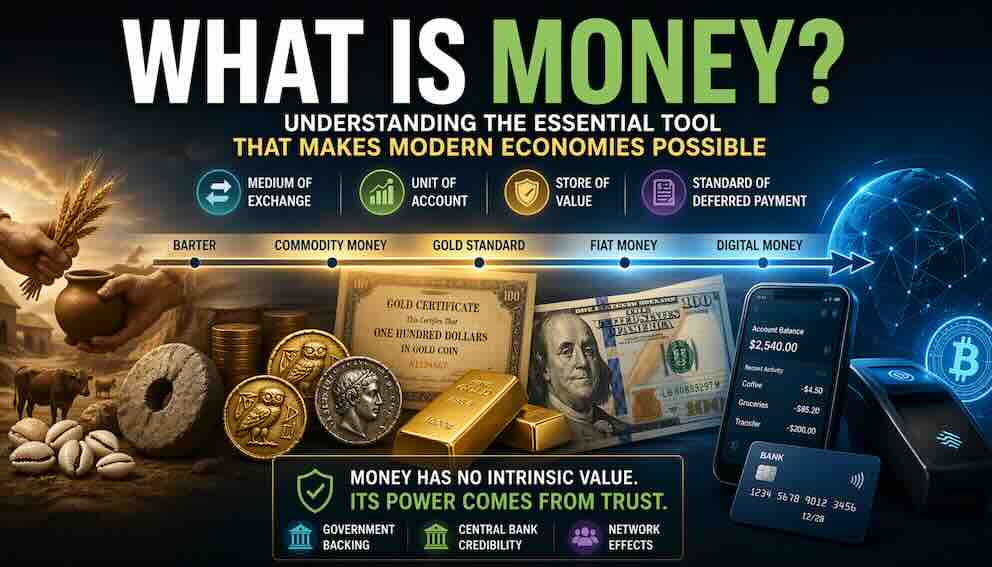
This tutorial explores one of the most fundamental concepts in economics: money. You will learn what qualifies as money—anything that is generally accepted as a medium of exchange—and why money is distinct from wealth, income, and liquidity. We will examine the four essential functions of money: as a medium of exchange that overcomes the inefficiencies of barter, as a unit of account that measures value, as a store of value that preserves purchasing power over time, and as a standard of deferred payment that enables credit and debt. Using real-world examples from hyperinflation in Zimbabwe and Weimar Germany to illustrate the fragility of money as a store of value, and from the transition from the gold standard to modern fiat money to show the evolution of trust, this tutorial explains why modern money works despite having no intrinsic value—and why trust, backed by government, central bank credibility, and network effects, is the foundation of any monetary system.
Introduction: The Invisible Tool That Makes Everything Work
Imagine a world without money. You are a baker who needs a new coat. The tailor who makes coats does not want bread; she wants a pair of shoes. So you must find a shoemaker who wants bread, trade your bread for shoes, then trade the shoes for a coat. This is barter—the direct exchange of goods and services for other goods and services. It is cumbersome, time-consuming, and inefficient. Every transaction requires a double coincidence of wants: you must find someone who has what you want and wants what you have.
Now imagine a different world. You have a piece of paper with a number printed on it. You give it to the tailor, and she gives you a coat. The tailor, in turn, gives that piece of paper to the shoemaker for shoes. The shoemaker gives it to the baker for bread. The paper has no value in itself—it is not edible, not wearable, not useful for anything except exchange. Yet everyone accepts it. This is money. It is the invisible tool that makes modern economies possible.
Money is so familiar that we rarely stop to think about what it is. We use it every day—to buy coffee, pay rent, settle debts. But what makes a piece of paper money? Why do people accept it? Why does a $20 bill have value when it is just a piece of paper with ink on it? These questions take us to the heart of how economies work.
In this tutorial, we will explore what money is, what it does, and how it has evolved over time. We will distinguish money from wealth, income, and liquidity—concepts that are often confused. We will examine the four functions of money: medium of exchange, unit of account, store of value, and standard of deferred payment. We will trace the evolution of money from barter to commodity money to fiat money to digital currency. And we will see why modern money works despite having no intrinsic value—because it is built on trust: trust in the government, trust in the central bank, and trust in the network of people who accept it.
What Is Money? The Core Definition
At its simplest, money is anything that is generally accepted as a medium of exchange. If you can use it to buy goods and services, and if people are willing to accept it in payment, then it is money. This definition is broader than the coins and banknotes in your wallet. It includes the balances in your bank account, which you can use with a debit card. It includes, in some contexts, digital currencies like Bitcoin, though their acceptance is limited. It does not include assets that you must first sell to spend, like a house or a car.
This definition is functional, not material. Money is not defined by what it is made of but by what it does. A gold coin is money not because it is gold but because people accept it in exchange. A paper bill is money because people accept it. A digital entry in a bank account is money because you can use it to pay for things.
Currency vs Money: A Subtle Distinction
People often use the words "money" and "currency" interchangeably, but they are not the same. Currency refers specifically to physical notes and coins—the tangible forms of money you can hold in your hand. Money is a broader concept. It includes currency, but it also includes bank deposits, checking accounts, and other forms that can be used for transactions. In modern economies, most money is not currency. When you are paid, your employer deposits money into your bank account. When you use a debit card, you are spending money, but no currency changes hands. Understanding this distinction is essential for understanding how the financial system works.
What Counts as Money in Practice?
Now that we have a definition, we can ask: what actually counts as money in a modern economy? The narrowest measure of money, called M1, includes physical currency (notes and coins) and checking account deposits—money that can be spent immediately. But there is also M2, which includes M1 plus savings accounts, money market funds, and other "near-money" assets that can be converted to cash relatively easily.
The key insight is that in modern economies, most money is not cash—it is bank deposits. When you are paid, your employer deposits money into your bank account. When you use a debit card, the money moves from your account to the merchant's account. No physical cash changes hands. This digital money is still money—it is generally accepted as a medium of exchange. Understanding this is essential for later tutorials on how banks create money and how central banks manage the money supply.
Money vs Wealth vs Income vs Liquidity
People often confuse money with wealth or income, but these are very different concepts.
Income is a flow—the amount of money you receive over a period of time. Your salary is income. The rent you collect from a property is income. The dividends you earn on stocks are income. Income is measured per unit of time: dollars per week, per month, per year.
Wealth is a stock—the total value of what you own at a point in time. Your wealth includes your house, your car, your investments, your savings account, and any other assets you have, minus any debts you owe. Wealth can be in many forms: real estate, stocks, bonds, art, jewelry—only a small part of it is held as money.
Money is a specific kind of asset—one that is used as a medium of exchange. Your wealth might be one million dollars, but only a small fraction of that is held in forms that can be spent directly. The rest is tied up in assets that must be sold before they can be spent.
Liquidity is the ease with which an asset can be converted into money without loss of value. Money itself is perfectly liquid—it is already money. A house is illiquid; selling it takes time and may require accepting a lower price. Stocks are relatively liquid—they can be sold quickly, but their value fluctuates. Understanding liquidity is essential for understanding financial markets and the risks of bank runs, which we will explore in later tutorials.
Seigniorage: The Profit from Issuing Money
One important concept that explains why governments want to control the money supply is seigniorage. Seigniorage is the profit a government makes from issuing money. It costs only a few cents to print a $100 bill, but it is worth $100. The difference is seigniorage. For centuries, seigniorage was an important source of government revenue. Today, it is less significant for most advanced economies, but it remains important for understanding why governments historically controlled the money supply and why central banks are independent—to prevent governments from printing money to finance spending, which can cause inflation.
Key takeaway: Money is anything generally accepted as a medium of exchange. Currency is a subset of money—the physical notes and coins. In practice, most money is not cash but bank deposits. Money is distinct from income (a flow), wealth (a stock), and liquidity (ease of conversion). Seigniorage is the profit from issuing money. Understanding these distinctions is essential for understanding how people spend, save, and invest.
The Functions of Money – What Money Does
Now that we understand what money is, we can ask a deeper question: what does money actually do in an economy? For something to function as money, it must serve four essential purposes. These functions are what make money indispensable.
Medium of Exchange: Solving the Double Coincidence Problem
The primary function of money is to facilitate transactions. Without money, we would have to rely on barter. Barter requires a double coincidence of wants: you must find someone who has what you want and wants what you have. If you are a baker who needs a haircut, you must find a barber who wants bread. If the barber wants shoes, you are out of luck.
Money solves this problem. You sell your bread for money, then use that money to buy a haircut. The barber takes the money and uses it to buy shoes. Everyone gets what they want without having to find a perfect trading partner. Money acts as an intermediary—it separates the act of selling from the act of buying.
This function is so fundamental that we rarely think about it. But imagine trying to run a modern economy without money. Every transaction would be a negotiation. Every purchase would require finding someone who wanted exactly what you had to offer. Specialization—the foundation of modern prosperity—would be impossible. A surgeon who saves lives cannot trade surgery for food directly; she needs money.
Unit of Account: Measuring Value
Money also serves as a unit of account—a common measure of value. We express the prices of goods and services in money. A loaf of bread costs $3. A haircut costs $20. A car costs $30,000. These prices allow us to compare the value of different goods. We know that a haircut is worth about seven loaves of bread, and a car is worth about 1,500 haircuts.
Without a unit of account, we would have to express every price in terms of other goods. The price of bread would be expressed in haircuts; the price of haircuts in shoes; the price of shoes in bread. This would be chaotic. Money provides a single, consistent measure that makes economic calculation possible. Businesses use it to track profits and losses. Governments use it to budget. Individuals use it to plan their spending.
Store of Value: Preserving Purchasing Power
For money to work, it must be able to hold its value over time. If you earn $100 today, you expect to be able to buy roughly the same amount of goods with it next month. This is the store of value function.
Money does not always perform this function well. Inflation erodes the purchasing power of money. If prices rise, your money buys less. In periods of high inflation, money becomes a poor store of value. People rush to spend it before it loses more value.
The most dramatic examples come from hyperinflation. In the Weimar Republic in the 1920s, prices doubled every few days. People were paid twice a day and rushed to spend their money before it became worthless. Wheelbarrows of cash were needed to buy a loaf of bread. Money had ceased to function as a store of value. In Zimbabwe in the late 2000s, hyperinflation reached such extremes that the central bank printed a 100 trillion dollar note—which at its peak was worth about $30 US. Today, that note is a collector's item, but it is a reminder of what happens when money loses its store of value.
Even moderate inflation erodes purchasing power over time. If inflation is 2 percent per year, the value of your money halves every 36 years. This is why people invest—to preserve their wealth against inflation. But for short periods, money remains a reasonably good store of value.
Standard of Deferred Payment: Enabling Credit and Debt
Money also serves as a standard of deferred payment—a way to settle debts that are payable in the future. When you take out a loan, you agree to repay a certain amount of money in the future. When you sign a lease, you agree to pay rent for the coming year. When a company issues bonds, it promises to pay back the principal plus interest.
This function depends on the stability of money. If inflation is unpredictable, lenders will demand higher interest rates to compensate for the risk that the money they are repaid will be worth less than expected. If deflation occurs, borrowers may find themselves unable to repay debts that become more burdensome over time. A reliable standard of deferred payment is essential for credit markets to function.
Key takeaway: Money serves four essential functions: medium of exchange (overcoming barter's double coincidence problem), unit of account (providing a common measure of value), store of value (preserving purchasing power over time), and standard of deferred payment (enabling credit and debt). Hyperinflation in Weimar Germany and Zimbabwe shows what happens when money fails as a store of value.
Types of Money – From Commodity to Digital
Now that we understand what money does, we can ask: what forms has money taken? Throughout history, different things have served as money. The form has evolved, but the functions remain the same.
Commodity Money: Value in Itself
The earliest forms of money were commodity money—objects that had value in themselves, aside from their use as money. Gold and silver are the classic examples. Gold is rare, durable, divisible, and portable. It was used as money for thousands of years. Salt, cattle, shells, and even large stone disks have been used as commodity money in different cultures.
Commodity money has intrinsic value. A gold coin can be melted down and used for jewelry or industrial purposes. This gave people confidence in its value. But commodity money has drawbacks. It is heavy to carry. Its supply is limited by the availability of the commodity. And it can be subject to sudden changes in value if new sources are discovered.
Representative Money: Backed by Something
Representative money is a claim on a commodity. In the 19th and early 20th centuries, paper money was often backed by gold or silver. You could take a banknote to the bank and exchange it for a fixed amount of gold. The paper itself had no intrinsic value, but it represented a claim on something that did.
Representative money was lighter and more convenient than carrying gold. But it still depended on the backing. If people lost confidence that the bank could redeem the notes, the money would lose its value. Bank runs—where depositors rushed to withdraw their gold—were common in the 19th and early 20th centuries.
Fiat Money: Value by Decree
Modern money is fiat money. It is not backed by gold or silver. It has no intrinsic value. A $20 bill is just a piece of paper with ink on it. It is money because the government declares it to be legal tender—and, more importantly, because people accept it.
Legal tender means that if you owe a debt, the creditor must accept the official currency in settlement. This creates a guaranteed demand for the currency. Combined with the requirement that taxes be paid in that currency, legal tender gives fiat money a firm foundation.
Fiat money works because of trust. But trust is not abstract. It rests on three concrete pillars:
- Government backing: The government declares the currency to be legal tender, meaning it must be accepted for payment of debts. More importantly, the government requires taxes to be paid in that currency, creating a constant demand for it.
- Central bank credibility: The central bank manages the money supply to maintain its value. If it prints too much money, inflation erodes trust. If it maintains price stability, trust grows. The credibility of institutions like the Federal Reserve or the European Central Bank is the foundation of modern money.
- Network effects: People accept money because they know that others accept it. This is a self-reinforcing cycle. The more people use a currency, the more useful it becomes. This is why switching from one currency to another is so difficult—the network is already established.
The transition from representative money to fiat money happened gradually. For centuries, the gold standard provided a form of trust based on the intrinsic value of gold. But the gold standard was rigid; it made it difficult to respond to economic crises. When the United States ended the convertibility of the dollar into gold in 1971, it was a leap of faith. Would people still trust paper money? They did—because central banks built credibility over time, managing inflation and maintaining stability. The transition succeeded, but it required building new forms of trust.
Digital Money: The Modern Form
Most money today is not physical. It exists as entries in bank accounts—digital money. When you are paid, your employer deposits money into your bank account. When you use a debit card, the money moves from your account to the merchant's account. No physical cash changes hands. Services like Apple Pay, Google Pay, and contactless payments make this even more seamless.
Digital money is still fiat money; it is just a different form. Bank deposits are backed by the banking system and by government deposit insurance. They are widely accepted and convenient. But they depend on the stability of the banking system. A bank failure can wipe out deposits—which is why deposit insurance and bank regulation are so important.
Crucially, most of this digital money is created by commercial banks when they issue loans—a process we will examine in detail later. Banks do not simply lend out existing deposits; they create new money when they make loans. This is one of the most important insights in monetary economics.
Central Bank Digital Currencies (CBDCs) are a new form of digital money being explored by many central banks. A CBDC would be digital cash—a liability of the central bank, not of commercial banks. Unlike bank deposits, which carry the risk of bank failure, CBDCs would be as safe as physical currency. Whether and how CBDCs will be implemented is an active area of debate.
Cryptocurrencies like Bitcoin are a different kind of digital money. They are not issued by any government. They rely on cryptography and decentralized networks to verify transactions. Proponents argue that they are resistant to inflation and censorship. Critics point to two major limitations. First, they are not widely accepted as a medium of exchange—you cannot use Bitcoin to buy groceries at most stores. Second, they are highly volatile; Bitcoin's price can swing by 10 percent or more in a single day, making it a poor store of value. Whether cryptocurrencies will become a widely accepted form of money remains to be seen.
A Comparison of Types of Money
To help organize these concepts, consider how different types of money compare:
- Commodity money (gold, silver) has intrinsic value and is not backed by any institution. It is rarely used today.
- Representative money (gold-backed paper) had indirect intrinsic value through its backing. It is now historical.
- Fiat money (modern currencies) has no intrinsic value and is not backed. It works because of trust in government and central banks.
- Digital money (bank deposits) is fiat money in electronic form. Most money today is digital.
- CBDCs would be digital cash—a liability of the central bank.
- Cryptocurrencies are not issued by governments and have no backing. Their acceptance and stability are limited.
Key takeaway: Money has evolved from commodity money (intrinsic value) to representative money (backed by commodities) to fiat money (value by decree) to digital money (bank deposits, CBDCs, cryptocurrencies). Modern money works because of trust—backed by government, central bank credibility, and network effects. The transition from the gold standard to fiat money was a leap of faith that succeeded because central banks built credibility over time.
The Evolution of Money – A Journey Through Time
Now that we understand the different types of money, we can trace how money evolved over time. This journey shows how societies solved the problem of exchange in increasingly sophisticated ways.
Barter: The Starting Point
Before money, people traded directly. A farmer exchanged grain for a tool. A hunter exchanged meat for clothing. Barter worked in small, close-knit communities where people knew each other and traded regularly. But as societies grew more complex, barter became impractical. The double coincidence of wants problem made trade difficult.
Commodity Money: The First Solution
The first money emerged from barter. Certain commodities—salt, cattle, shells, and eventually precious metals—became widely accepted as mediums of exchange. They had intrinsic value, were durable, and were relatively easy to transport. Gold and silver emerged as the dominant forms of commodity money because they were rare, divisible, and did not corrode.
Coins and Paper: The Standardization of Money
The invention of coinage was a revolution. Coins were standardized—each coin had a fixed weight and purity. This made trade easier because people no longer had to weigh and test gold each time they made a transaction. Governments played a key role in minting coins and guaranteeing their quality.
Paper money emerged as a convenience. Merchants and goldsmiths issued receipts for gold deposited with them. These receipts circulated as money because they were easier to carry than gold. Eventually, governments began issuing paper money themselves. At first, it was backed by gold—you could exchange it for a fixed amount of the precious metal. But over time, governments realized they could issue more paper than they had gold to back it.
The Gold Standard and the Leap to Fiat
The gold standard provided a form of trust based on the intrinsic value of gold. But it was rigid; it made it difficult to respond to economic crises. During the Great Depression, countries abandoned the gold standard to pursue expansionary policies. After World War II, the Bretton Woods system created a modified gold standard, with the dollar backed by gold and other currencies backed by the dollar. In 1971, the United States ended the convertibility of the dollar into gold, and the world moved to fiat money.
This was a leap of faith. Would people still trust paper money? They did—because central banks built credibility over time, managing inflation and maintaining stability. The transition succeeded, but it required building new forms of trust.
Fiat Money: The Modern System
Today, all major currencies are fiat money. Governments have greater control over the money supply, allowing them to manage inflation and respond to economic crises. Central banks like the Federal Reserve, the European Central Bank, and the Bank of England manage the money supply, set interest rates, and work to maintain confidence in the currency. Their credibility is the foundation of modern money.
Digital Money: The Next Frontier
The digital revolution is transforming money. Most money today is already digital—entries in bank accounts. New technologies are creating new forms of money: mobile payments, cryptocurrencies, and central bank digital currencies (CBDCs). The future of money is likely to be even more digital, but the fundamental functions of money remain the same.
Key takeaway: Money evolved from barter to commodity money to coins to paper money backed by gold to fiat money to digital currency. The transition from the gold standard to fiat money was a leap of faith that succeeded because central banks built credibility. The digital revolution is transforming how we use money, but the core functions remain unchanged.
Why Modern Money Works – The Role of Trust
If a $20 bill is just a piece of paper, why does it have value? The answer is trust. But trust is not abstract. It is built on three concrete pillars.
First, government backing. The government declares the currency to be legal tender—it must be accepted for payment of debts. More importantly, the government requires taxes to be paid in that currency. This creates a constant demand for money. As long as people need to pay taxes, they need the currency.
Second, central bank credibility. The central bank manages the money supply to maintain its value. If it prints too much money, inflation erodes trust. If it maintains price stability, trust grows. The credibility of institutions like the Federal Reserve is built over decades. This is why central banks are designed to be independent from political pressure—so they can make the sometimes unpopular decisions needed to maintain price stability.
Third, network effects. People accept money because they know that others accept it. This is a self-reinforcing cycle. The more people use a currency, the more useful it becomes. This is why switching from one currency to another is so difficult—the network is already established. It is also why a currency can persist even if people have doubts about the government—because everyone else still uses it.
The Acceptability vs Stability Trade-off
Not all forms of money succeed equally. Some are widely accepted but unstable—think of currencies during hyperinflation. People still use them because they have to, but they rush to spend them as quickly as possible. Others are stable but not widely accepted—cryptocurrencies like Bitcoin have a limited user base and are not accepted by most merchants.
For something to function effectively as money, it must balance acceptability and stability. A currency that is stable but not accepted is useless for transactions. A currency that is accepted but unstable fails as a store of value. The most successful forms of money—like the US dollar—achieve both: they are widely accepted and reasonably stable.
The Fragility of Trust
This trust can be fragile. Hyperinflation destroys it. When prices rise rapidly, people lose faith in money. They rush to spend it before it loses more value, which accelerates inflation. In extreme cases, people abandon the official currency and use foreign currencies or barter instead. Rebuilding trust after hyperinflation requires painful measures: central bank independence, fiscal discipline, and a commitment to price stability.
In normal times, however, the system works. People accept money because they trust that they can use it to buy what they need. This trust is what makes modern money possible. It is a collective agreement—an invisible contract that binds society together.
Key takeaway: Modern money works because of trust—trust in the government (legal tender and taxes), trust in the central bank (price stability), and trust in the network (others accept it). The most successful forms of money balance acceptability and stability. Hyperinflation shows what happens when trust collapses.
Money as a Social Technology – A Deeper Perspective
Money is not just an object. It is a social technology—a system of shared belief that allows strangers to cooperate at scale. A $20 bill has value because millions of people agree that it does. This agreement is reinforced by government, by central banks, and by the simple fact that everyone else uses it.
Think about what this means. You can hand a piece of paper to a stranger on the other side of the world, and that stranger will give you food, shelter, transportation. The paper itself is worthless. But the system behind it—the laws, the institutions, the shared expectations—is not. Money is the most widespread social technology in human history. It enables trade between people who do not know each other, who do not trust each other, who will never meet again. It is the foundation of modern civilization.
This perspective helps us understand why money works even when it has no intrinsic value. It is not the paper that matters; it is the agreement. And that agreement, once established, is extraordinarily powerful.
Key takeaway: Money is a social technology—a system of shared belief that enables cooperation at scale. It works not because of what it is made of but because of the institutions, laws, and expectations that support it.
Inside Money and Outside Money – A Preview
One final distinction that will be important in later tutorials is the difference between inside money and outside money. Outside money is money created by the central bank—physical currency and reserves. Inside money is money created by commercial banks—bank deposits. Understanding this distinction is essential for understanding how the banking system works and how money is created. We will explore it in depth when we turn to the topics of banking and the money supply.
Key takeaway: Outside money is created by the central bank; inside money is created by commercial banks. This distinction will be central to later tutorials on banking and monetary policy.
Conclusion: The Invisible Foundation of Economic Life
We began this tutorial with the image of a baker trying to trade bread for a coat in a world without money. That world is hard to imagine because money is so fundamental to how we live. It is the tool that makes trade possible, that allows specialization, that enables savings and investment, that underpins credit and debt. Without money, modern economies could not function.
We have learned that money is anything generally accepted as a medium of exchange. We have distinguished money from currency, income, wealth, and liquidity—concepts that are often confused. We have examined the four functions of money: medium of exchange, which overcomes the double coincidence of wants; unit of account, which provides a common measure of value; store of value, which preserves purchasing power over time; and standard of deferred payment, which enables credit and debt. We have seen what happens when money fails as a store of value, in the hyperinflations of Weimar Germany and Zimbabwe.
We have traced the evolution of money from barter to commodity money to coins to paper money backed by gold to fiat money to digital currency. We have seen how the transition from the gold standard to fiat money was a leap of faith that succeeded because central banks built credibility over time. We have understood that modern money works not because of intrinsic value but because of trust—trust in the government (legal tender and taxes), trust in the central bank (price stability), and trust in the network of people who accept it. We have considered the acceptability vs stability trade-off, and we have seen that the most successful forms of money achieve both.
And we have reflected on money as a social technology—a system of shared belief that allows strangers to cooperate at scale. This perspective helps us see that money is not just a tool but a foundation. It is what makes modern civilization possible.
Money is so familiar that we rarely think about it. But when we do, we see that it is a remarkable invention. It is a piece of paper that has value because we all agree that it does. It is a number in a bank account that can be sent across the world in seconds. It is the invisible foundation of economic life—the tool that allows us to specialize, to trade, to save, to invest, to build. Understanding what money is, how it works, and why it matters is the first step toward understanding how economies work. And in a world where money is becoming ever more digital, that understanding has never been more important.
About Swati Sharma
Lead Editor at MyEyze, Economist & Finance Research WriterSwati Sharma is an economist with a Bachelor’s degree in Economics (Honours), CIPD Level 5 certification, and an MBA, and over 18 years of experience across management consulting, investment, and technology organizations. She specializes in research-driven financial education, focusing on economics, markets, and investor behavior, with a passion for making complex financial concepts clear, accurate, and accessible to a broad audience.
Disclaimer
This article is for educational purposes only and should not be interpreted as financial advice. Readers should consult a qualified financial professional before making investment decisions. Assistance from AI-powered generative tools was taken to format and improve language flow. While we strive for accuracy, this content may contain errors or omissions and should be independently verified.