Tutorial Categories
Last Updated: April 17, 2026 at 10:30
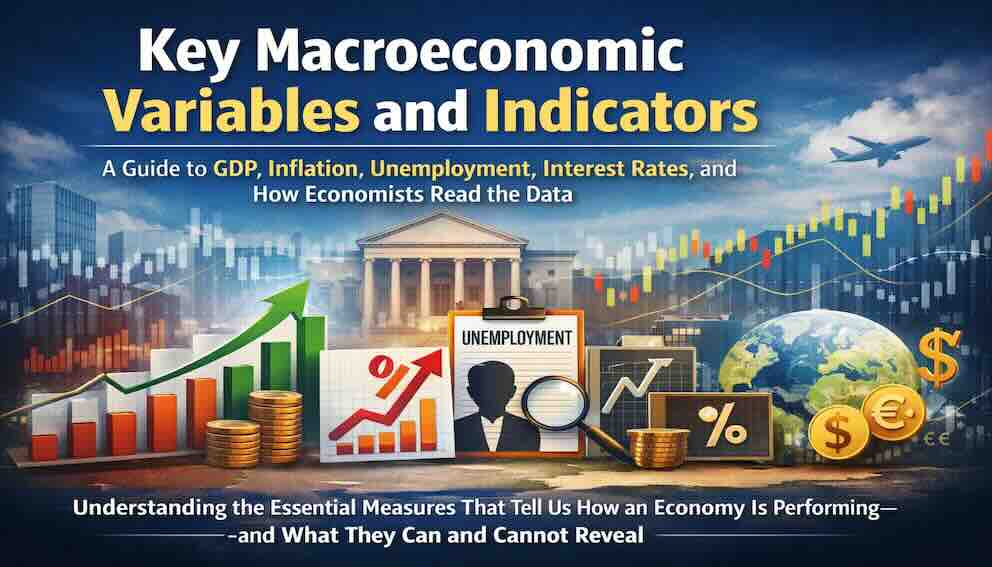
Key Macroeconomic Variables and Indicators: A Guide to GDP, Inflation, Unemployment, Interest Rates, and How Economists Read the Data
Understanding the Essential Measures That Tell Us How an Economy Is Performing—and What They Can and Cannot Reveal
This tutorial introduces the key variables and indicators that macroeconomists use to measure the health of an economy. You will learn what Gross Domestic Product (GDP) tells us about growth and recession, how inflation and unemployment are defined and measured, and why interest rates and exchange rates matter for everyone from central bankers to ordinary households. We will explore the crucial distinction between leading, lagging, and coincident indicators—tools that help economists forecast the future, confirm the present, and understand the past. The tutorial also examines how concepts like expectations, the Phillips Curve, fiscal policy, global interdependence, and productivity shape the way economists interpret data, using real-world examples from the 2008 financial crisis, the COVID-19 recession, and the 2021–2023 inflation surge to bring these ideas to life.
Introduction: The Vital Signs of the Economy
When a doctor examines a patient, they do not rely on a single measure to determine health. They take temperature, check blood pressure, listen to the heart, and run blood tests. Each measurement tells them something different, and no single number provides a complete picture. Only by looking at all the vital signs together—and understanding how they relate to one another—can the doctor diagnose what is happening and recommend a course of action.
Macroeconomics operates in much the same way. An economy is an enormously complex system, and economists cannot observe it directly. They must rely on a set of key variables and indicators that serve as the vital signs of economic health. These measures—GDP, inflation, unemployment, interest rates, exchange rates—are the raw material of macroeconomic analysis. They tell us whether the economy is growing or contracting, whether prices are stable or spiraling, whether workers are finding jobs or losing them, and whether the cost of borrowing is encouraging investment or restraining it.
But knowing what these numbers are is only the first step. The real skill lies in understanding how to interpret them. Some indicators tell us what happened in the past; others give clues about where the economy is heading. Some confirm what we already suspect; others flash warning signals that something is changing. Economists must also consider how expectations about the future shape current behavior, how different variables interact, and how policy—both monetary and fiscal—responds to the data. This tutorial will introduce you to these essential measures, explain how they are constructed, and walk you through how economists use them to make sense of the economic world.
The Three Pillars – GDP, Inflation, and Unemployment
When macroeconomists want to assess the overall health of an economy, they begin with three fundamental measures. These are the core vital signs, the numbers that appear in every economic report and occupy the thoughts of policymakers, central bankers, and financial markets. Each captures a different dimension of economic performance, and together they provide the foundation for almost all macroeconomic analysis.
Gross Domestic Product: Measuring the Size of the Economy
Gross Domestic Product, or GDP, is the most comprehensive measure of economic activity. It represents the total market value of all final goods and services produced within a country's borders during a specific period, typically a quarter or a year. If you imagine the economy as a giant machine, GDP is the measure of how much it is producing.
There are three equivalent ways to think about GDP. One is to add up everything the country produces—every car manufactured, every haircut given, every house built. Another is to add up everything everyone spends—consumption by households, investment by businesses, government spending, and net exports. A third is to add up all the income earned—wages, profits, rents, and taxes. These three approaches—production, expenditure, and income—all arrive at the same total because everything produced is either bought by someone or becomes income for someone.
A crucial distinction when looking at GDP is the difference between nominal and real values. Nominal GDP is measured using the prices that prevailed at the time of production. Real GDP adjusts for inflation, stripping out price changes to measure only changes in the quantity of goods and services produced. This distinction matters enormously. During the 1970s, for example, nominal GDP in the United States grew rapidly—often at double-digit rates—but much of that growth was simply the result of soaring prices. Real GDP, which adjusts for inflation, grew much more slowly, and the decade became known as a period of economic stagnation. When economists talk about economic growth, they almost always mean real GDP growth; nominal numbers can be deeply misleading during periods of high inflation.
GDP tells us whether the economy is growing or contracting. When real GDP rises from one quarter to the next, the economy is expanding; when it falls for two consecutive quarters, economists often—though not always—declare a recession. The 2008 financial crisis provides a stark illustration. In the fourth quarter of 2008, U.S. real GDP fell at an annual rate of 8.5 percent, the sharpest contraction in nearly three decades. This sharp decline was reflected in real economic activity, as factories closed their doors, construction projects halted, and households pulled back on spending in ways that reinforced the downward spiral.
But GDP has important limitations. It tells us the size of the economic pie but not how that pie is divided—a country can have growing GDP while a significant portion of its population experiences stagnant incomes or economic insecurity. GDP also does not capture the value of digital goods and services that are provided for free, like search engines or social media platforms, even though they contribute enormously to well-being. And GDP says nothing about sustainability—whether current growth is being achieved by depleting resources or accumulating debt that future generations will have to repay. Recognizing these limitations, economists and statisticians have developed alternative measures such as the Genuine Progress Indicator (GPI), which adjusts for factors like income inequality and environmental degradation, and the Human Development Index (HDI), which combines income with health and education outcomes. These alternatives are not replacements for GDP but supplements that help paint a fuller picture of societal well-being.
Inflation: The Measure of Rising Prices
If GDP tells us how much the economy is producing, inflation tells us what is happening to the prices of the things it produces. Inflation is the rate at which the general level of prices for goods and services is rising, and it erodes the purchasing power of money over time. When inflation is high, a dollar today buys less than it did a year ago; when inflation is negative—a phenomenon called deflation—prices are falling, which can be equally problematic for an economy.
Inflation is most commonly measured by the Consumer Price Index, or CPI. The CPI is constructed by surveying a representative basket of goods and services that a typical urban household buys—food, housing, transportation, medical care, and so on. Government statisticians track the prices of these items over time and calculate how much the cost of the basket has changed. However, the CPI is not a perfect measure. It struggles to account for substitution—when consumers switch from expensive goods to cheaper alternatives—and it does not fully capture quality improvements over time. A smartphone today costs more than a basic mobile phone did twenty years ago, but it also does infinitely more; whether that price increase represents inflation or simply paying for more capability is a difficult judgment.
The experience of the early 2020s brought inflation back to the forefront of economic concern after decades of relative stability. In 2021 and 2022, as economies reopened from pandemic lockdowns and supply chains struggled to keep pace with surging demand, inflation in the United States reached forty-year highs, peaking at over nine percent. For ordinary households, this meant that grocery bills rose sharply, rents increased, and the cost of filling a gas tank climbed week after week. For the Federal Reserve, it meant a dramatic policy shift: after years of keeping interest rates near zero to support employment, the central bank embarked on the most aggressive campaign of rate hikes since the 1980s.
Inflation matters not only because it erodes purchasing power but also because it redistributes income and wealth in ways that are not always obvious. Borrowers with fixed-rate loans benefit from inflation, because they repay their debts with money that is worth less than the money they borrowed. Savers and people living on fixed incomes suffer, because the purchasing power of their savings and pensions declines. Workers whose wages do not keep up with rising prices see their real incomes fall. These distributional effects mean that inflation is not merely a technical economic problem but a deeply political and social one.
Unemployment: Measuring the Labor Market
The third pillar of macroeconomic measurement is unemployment. The unemployment rate is the percentage of the labor force—people who are either working or actively looking for work—who are currently without a job. It is one of the most emotionally resonant economic indicators because it captures something that affects people directly: whether they can find work to support themselves and their families.
The unemployment rate is calculated through a survey of households. The government asks a representative sample of the population about their employment status, and from those responses it estimates how many people are employed, how many are unemployed but actively seeking work, and how many are outside the labor force altogether—neither working nor looking for work. The unemployment rate is the number of unemployed divided by the total labor force.
But the unemployment rate, like GDP, conceals as much as it reveals. This is why economists also pay close attention to the labor force participation rate—the percentage of the working-age population that is either employed or actively seeking work. During the COVID-19 recession of 2020, the headline unemployment rate shot up to 14.8 percent, the highest since the Great Depression. Yet this number, staggering as it was, did not capture the full scale of the labor market collapse. Millions of people who lost jobs were not counted as unemployed because they had stopped actively looking for work—often because schools were closed and they had to care for children, or because their industries had effectively shut down. The labor force participation rate fell dramatically, revealing that the true picture of labor market distress was far worse than the unemployment rate alone suggested. When the unemployment rate fell rapidly in 2020 and 2021, participation remained depressed for much longer, reminding us that a falling unemployment rate can sometimes mean people have given up looking for work, not that they have found it.
Economists distinguish among different types of unemployment. Frictional unemployment is the short-term unemployment that occurs as workers move between jobs; it is a normal and even healthy feature of a dynamic economy. Structural unemployment occurs when there is a mismatch between the skills workers have and the skills employers need—a factory worker displaced by automation, for example, who may need retraining to find new employment. Cyclical unemployment is the unemployment that rises during recessions and falls during expansions; it is the type of unemployment that macroeconomic policy is most concerned with addressing. The 2008 financial crisis produced severe cyclical unemployment, as the collapse in aggregate demand meant that even workers with the right skills could not find jobs because there simply were not enough jobs to go around.
A related concept is the natural rate of unemployment, sometimes called NAIRU (Non-Accelerating Inflation Rate of Unemployment). This is the level of unemployment below which inflation tends to rise. It is not a fixed number but shifts over time with changes in demographics, labor market institutions, and technology. When unemployment falls below the natural rate, the labor market becomes so tight that employers bid up wages, and those wage increases feed into higher prices. The 2021–2023 inflation surge was, in part, a classic case of unemployment falling below most estimates of the natural rate, contributing to the upward pressure on prices.
The Relationship Between the Pillars – The Phillips Curve and the Nature of Shocks
One of the most important frameworks for understanding how GDP, inflation, and unemployment relate to one another is the Phillips Curve. Named after economist A.W. Phillips, who first documented the relationship in the 1950s, the Phillips Curve suggests an inverse relationship between unemployment and inflation in the short run: when unemployment is low, inflation tends to rise; when unemployment is high, inflation tends to fall.
The logic behind this relationship is intuitive. When unemployment is low, the labor market is tight—businesses must compete for workers by offering higher wages. Those higher wages increase production costs, and businesses pass those costs along to consumers in the form of higher prices. Conversely, when unemployment is high, workers have less bargaining power, wage growth slows, and inflationary pressures ease.
The Phillips Curve played a central role in macroeconomic policy for decades, suggesting that policymakers faced a trade-off: they could choose lower unemployment at the cost of higher inflation, or lower inflation at the cost of higher unemployment. But the relationship proved unstable. In the 1970s, the United States experienced both high unemployment and high inflation—a phenomenon known as stagflation—which the simple Phillips Curve could not explain. Economists came to understand that the trade-off exists only in the short run and that in the long run, unemployment returns to its natural rate regardless of inflation.
Understanding why inflation rises requires distinguishing between two types of shocks. Demand shocks occur when something causes aggregate demand—total spending in the economy—to increase or decrease rapidly. The pandemic stimulus payments of 2020 and 2021 were a demand shock: they put more money in people's pockets, which increased spending, which pushed up prices when supply could not keep up. Supply shocks occur when something disrupts the economy's ability to produce goods and services. The oil embargoes of the 1970s were classic supply shocks: they drove up energy prices, which raised production costs across the economy, leading to both higher inflation and lower output. The 2021–2023 inflation surge was a hybrid: a demand shock from stimulus and pent-up consumption combined with supply shocks from pandemic-related factory closures, shipping bottlenecks, and, later, the energy price spikes following Russia's invasion of Ukraine.
Distinguishing between demand and supply shocks is essential for policy. A central bank facing a demand shock can raise interest rates to cool spending, bringing inflation down without causing a severe recession. A central bank facing a supply shock faces a much more difficult trade-off: raising rates to fight inflation will deepen the output loss, but not raising rates risks allowing inflation to become entrenched. This was the dilemma confronting the Federal Reserve in 2022.
Prices That Connect Economies – Interest Rates and Exchange Rates
Beyond the three pillars, two other variables play an essential role in macroeconomic analysis. These are not measures of economic outcomes in the same way that GDP or unemployment are; rather, they are prices that shape economic behavior across entire economies and connect national economies to one another.
Interest Rates: The Price of Money
Interest rates are the price of borrowing money. When a business takes out a loan to build a new factory, the interest rate determines how much that loan will cost. When a family buys a home with a mortgage, the interest rate determines the monthly payment and, ultimately, whether they can afford the house. When a government borrows to finance its spending, the interest rate determines the cost of servicing its debt.
But interest rates are also the primary tool of monetary policy. Central banks set a benchmark interest rate that influences all other interest rates in the economy. When the central bank lowers this rate, borrowing becomes cheaper, which encourages businesses to invest and households to spend. This tends to boost economic activity and employment, but it can also fuel inflation if the economy is already running hot. When the central bank raises rates, borrowing becomes more expensive, which cools spending and investment, helping to bring inflation down but potentially slowing growth and raising unemployment.
The housing market is one of the most important transmission channels for interest rate policy. When the Federal Reserve raised rates in 2022 and 2023, mortgage rates—which had been below three percent—climbed to over seven percent. The effect on the housing market was immediate and dramatic. Housing starts, which measure the number of new homes beginning construction, fell sharply. Existing home sales collapsed as sellers who had locked in low-rate mortgages were unwilling to give them up, and buyers who could no longer afford the higher monthly payments withdrew from the market. The surge in home prices that had characterized the pandemic years gave way to a slowdown, and in some regions, outright declines. This outcome reflects the intended mechanism through which higher interest rates cool an overheating economy.
Financial markets extend far beyond central bank rates. Bond markets, where governments and corporations borrow, provide crucial information about how investors view the economy. The yield curve—the difference between short-term and long-term bond yields—is one of the most closely watched indicators in finance. When short-term rates rise above long-term rates, the yield curve inverts, and an inverted yield curve has historically been one of the most reliable predictors of recession. Credit spreads—the difference in interest rates between safe government bonds and riskier corporate bonds—signal how concerned investors are about defaults and financial stress. During the 2008 financial crisis, credit spreads widened dramatically as investors fled anything perceived as risky, reflecting a freezing of the financial system that conventional interest rate measures alone could not capture.
Exchange Rates: The Price of One Currency in Terms of Another
If interest rates are the price of money within an economy, exchange rates are the price of one country's money in terms of another's. The exchange rate between the U.S. dollar and the euro tells you how many euros one dollar can buy; the exchange rate between the yen and the pound tells you how many yen one pound can buy.
Exchange rates matter because they determine the prices of imports and exports. When a country's currency strengthens—appreciates—its goods become more expensive for foreign buyers, which tends to reduce exports. At the same time, imports become cheaper for domestic consumers, which can help keep inflation in check but also puts pressure on domestic industries that compete with imports. When a country's currency weakens—depreciates—the opposite happens: exports become cheaper and more competitive abroad, while imports become more expensive, which can add to inflationary pressures.
The exchange rate is determined by the interaction of supply and demand for currencies in global foreign exchange markets. These markets are enormous—the largest financial markets in the world—and they are influenced by a complex mix of factors: interest rate differentials between countries, trade flows, investor sentiment, geopolitical events, and expectations about future economic conditions. A central bank raising interest rates, for example, typically strengthens its currency because higher rates attract foreign investment seeking higher returns. This is exactly what happened in 2022: as the Federal Reserve raised rates more aggressively than other major central banks, the U.S. dollar surged to its highest level in two decades.
The global financial system is deeply interconnected. Capital flows move rapidly across borders in search of returns, and financial conditions in one country can spill over to others. When the Federal Reserve raises interest rates, it does not only affect the U.S. economy; it also tightens financial conditions around the world, as dollar-denominated debt becomes more expensive to service and capital flows out of emerging markets. This dynamic was painfully evident in many emerging economies during 2022 and 2023, as a strong dollar drove up the local currency cost of imports and added to inflationary pressures that these countries had limited tools to combat.
Leading, Lagging, and Coincident Indicators – Reading the Economy's Story
So far, we have discussed what the key macroeconomic variables are. But economists do not simply look at these numbers in isolation; they use them to tell a story about where the economy has been, where it is now, and where it is likely to go. To do this, they classify indicators into three categories based on whether they change before, during, or after the economy as a whole changes.
Leading Indicators: Signals of What Is to Come
Leading indicators are economic measures that tend to change direction before the overall economy changes. They are the closest thing economists have to a crystal ball—not a perfect predictor, but a useful signal of what might lie ahead. When leading indicators begin to rise, they suggest that the economy is likely to expand in the coming months; when they begin to fall, they suggest that a slowdown or recession may be approaching.
One of the most closely watched leading indicators is the stock market. Stock prices reflect investors' expectations about future corporate profits, which in turn reflect expectations about the broader economy. A sustained decline in stock prices often precedes a recession, as it did in 2000 and 2007. Another important leading indicator is consumer confidence. When consumers are optimistic about the future, they are more likely to spend; when they are pessimistic, they tend to save, which can slow economic growth. Surveys of consumer sentiment therefore provide an early glimpse into future spending patterns.
Other leading indicators include building permits for new homes—since construction begins with permits, changes in permit issuance signal future activity in the housing market—and manufacturers' new orders for durable goods, which indicate whether businesses expect demand to strengthen or weaken. Average weekly initial claims for unemployment insurance also serve as a leading indicator: a sustained rise in claims signals that layoffs are increasing, which typically precedes a broader slowdown.
It is important to understand that leading indicators do not cause the economy to change; they simply tend to change first. A decline in the stock market does not itself cause a recession, but it may reflect underlying conditions—tightening credit, falling profits, or shifting expectations—that will eventually produce a recession. Misreading the timing of indicators can lead to serious policy mistakes. If policymakers react too late to a leading indicator that has already turned, they may find themselves fighting the last war, implementing stimulus after the economy has already begun to recover or tightening policy after a downturn has already begun.
Coincident Indicators: A Picture of the Present
Coincident indicators are measures that change at roughly the same time as the overall economy. They tell us what is happening right now. When economists want to know whether the economy is currently in expansion or recession, they look at coincident indicators.
The most important coincident indicator is GDP itself, but GDP is reported with a lag—the numbers for a given quarter are not released until well after the quarter has ended. For a more timely picture, economists look at measures like industrial production, which tracks the output of factories, mines, and utilities; personal income, which captures the earnings of households; and retail sales, which measure consumer spending at stores and online. Employment figures—the number of payroll jobs added or lost each month—are also considered a coincident indicator, because hiring and firing decisions reflect current economic conditions.
During the early months of the COVID-19 pandemic, coincident indicators provided a real-time picture of an economy in free fall. Payroll employment plunged by over twenty million jobs in April 2020 alone—a loss so sudden and severe that it was visible in the data as it happened. Retail sales collapsed, industrial production ground to a halt, and personal income, propped up by government stimulus payments, showed a bizarre spike that reflected policy intervention rather than underlying economic activity. For policymakers trying to respond to the crisis, these coincident indicators were essential: they confirmed the severity of the downturn and helped shape the scale and timing of the policy response.
Lagging Indicators: Confirming What Has Already Happened
Lagging indicators are measures that change after the overall economy has already changed. They do not help predict the future or even diagnose the present; instead, they confirm what has already occurred. Lagging indicators are useful because they provide a complete picture of economic cycles and help economists and policymakers understand the full scope of what has happened.
The unemployment rate is often considered a lagging indicator. Even after a recession has officially ended and GDP has begun to grow again, the unemployment rate typically continues to rise for months or even years. This is because businesses are cautious about rehiring until they are confident that the recovery is sustainable. The unemployment rate is a lagging indicator of recovery: it tells us that the economy was in bad shape, but it does not tell us that the economy is now improving.
Other lagging indicators include the duration of unemployment—how long people have been out of work—which tends to peak well after a recession has ended. The ratio of consumer installment credit to income, corporate profits, and labor cost per unit of output are also considered lagging indicators. Interest rate changes can also be thought of as lagging indicators in the sense that policy actions respond to conditions that have already occurred; the Federal Reserve's rate hikes in 2022 and 2023, for example, were a response to inflation that had already surged.
Fiscal Policy and the Government's Role
While monetary policy—central bank interest rate decisions—has occupied much of our discussion so far, governments also play a crucial role in shaping macroeconomic outcomes through fiscal policy. Fiscal policy refers to the use of government spending and taxation to influence the economy.
When the economy enters a recession, governments can increase spending or cut taxes to boost aggregate demand. This was the logic behind the stimulus packages enacted during the 2008 financial crisis and, even more dramatically, during the COVID-19 pandemic. In 2020 and 2021, the U.S. government passed multiple rounds of stimulus, sending direct payments to households, expanding unemployment benefits, and providing loans and grants to businesses. These measures were designed to do what monetary policy alone could not: put money directly into the pockets of people who would spend it, sustaining demand through a period of unprecedented economic disruption.
Fiscal policy also operates through automatic stabilizers—mechanisms that automatically increase spending or decrease taxes when the economy slows, without the need for new legislation. Unemployment insurance is a classic automatic stabilizer: when people lose jobs, they automatically become eligible for benefits, which cushions the blow to their incomes and helps sustain spending. The tax system works similarly: when incomes fall, tax revenues fall automatically, leaving households with more disposable income than they would otherwise have.
But fiscal policy involves trade-offs. Increased government spending or tax cuts can lead to larger budget deficits and higher public debt. In the short run, deficits can be a useful tool for stabilizing the economy. Over the long run, however, high levels of debt can crowd out private investment, raise borrowing costs, and constrain the government's ability to respond to future crises. The debate over how much debt is sustainable, and how aggressively governments should use fiscal policy to manage the business cycle, is one of the central ongoing debates in macroeconomics.
Expectations – The Hidden Driver
Throughout this tutorial, we have referred to expectations as a factor influencing economic behavior. It is worth pausing to make this concept explicit because expectations are one of the most powerful forces in macroeconomics. What people expect to happen tomorrow shapes what they do today, and those actions, in turn, help determine what actually happens tomorrow.
Consider inflation. If businesses and households expect inflation to rise, they will adjust their behavior in ways that can bring about that outcome. Workers demand higher wages to keep up with expected price increases. Businesses raise prices in anticipation of higher costs. Consumers rush to make purchases before prices go up further. These actions can create a self-fulfilling spiral: expectations of inflation lead to behavior that generates inflation.
This is why central banks care so deeply about inflation expectations. If the public believes that the central bank will keep inflation low and stable, then that belief itself helps keep inflation low and stable—workers do not demand excessive wage increases, businesses do not preemptively raise prices, and the central bank's job becomes easier. If, however, expectations become unanchored—if people begin to doubt the central bank's commitment to controlling inflation—then even a small shock can trigger a persistent inflationary spiral. Much of the Federal Reserve's communication strategy during the 2021–2023 inflation surge was aimed at preventing exactly this: convincing the public that the central bank would do whatever was necessary to bring inflation back down, thereby keeping expectations anchored even as actual inflation spiked.
Expectations also shape investment and hiring decisions. A business will not build a new factory if it expects demand to weaken in the coming years. A household will not buy a new home if it expects prices to fall or its job prospects to deteriorate. Surveys of business confidence and consumer sentiment are so closely watched because they capture these expectations, providing a window into the future that GDP and employment data—which describe the past—cannot offer.
Productivity and Long-Run Growth
The indicators we have discussed—GDP, inflation, unemployment, interest rates—primarily tell us about short- to medium-term fluctuations in the economy. But there is another dimension of macroeconomic performance that operates over decades rather than months: long-run growth. The driver of long-run growth is productivity.
Productivity is the amount of output produced per unit of input—typically measured as output per hour worked. When productivity rises, the economy can produce more goods and services with the same amount of labor, which translates into higher living standards, higher wages, and more resources to invest in public goods like education, healthcare, and infrastructure.
Productivity growth comes from several sources. Technological innovation allows workers to produce more with the same tools. Improvements in education and training increase human capital—the skills and knowledge that workers bring to their jobs. Better institutions, including stable property rights, effective regulation, and efficient financial systems, create an environment in which investment and innovation can flourish. Infrastructure—roads, ports, broadband networks—reduces the costs of transportation and communication, making the entire economy more efficient.
The slowdown in productivity growth in advanced economies since the 1970s is one of the most important and puzzling macroeconomic trends of recent decades. While the digital revolution has transformed daily life, its impact on measured productivity growth has been more modest than previous technological waves like electricity or the internal combustion engine. Understanding the sources of productivity growth—and how policy can foster them—is essential for thinking about long-term economic performance, not just the ups and downs of the business cycle.
Putting It All Together – A Practical Data Walkthrough
To see how these concepts work in practice, let us walk through a hypothetical scenario using real-world patterns. Suppose an economist is looking at the following set of indicators:
GDP is growing at a strong annual rate of four percent. The unemployment rate has fallen to 3.8 percent, its lowest level in decades, and the labor force participation rate, while still below its pre-pandemic peak, has been rising steadily. Inflation, however, has been rising and is now at four percent, above the central bank's target. Consumer confidence surveys are near all-time highs, and businesses report that they are planning to increase investment. Building permits are surging, and the stock market has been setting new records. The yield curve, however, has begun to flatten, with long-term rates rising more slowly than short-term rates.
What story do these numbers tell? The combination of strong GDP growth, very low unemployment, and rising inflation suggests that the economy is operating above its sustainable capacity. Demand is strong—consumers are confident, businesses are investing, and construction is booming—but supply is struggling to keep up, pushing prices higher. The fact that the labor force participation rate is rising is a positive sign: more people are being drawn into the workforce, which helps ease labor market tightness without requiring the central bank to slow the economy. The flattening yield curve is a warning signal: if short-term rates continue to rise faster than long-term rates, an inversion could signal that a recession is on the horizon.
A policymaker looking at this picture might conclude that the economy is overheating and that monetary policy needs to tighten to bring inflation back under control. Higher interest rates would cool demand, slowing GDP growth and reducing inflationary pressures, but they would also risk pushing the economy into recession if tightened too aggressively. The challenge is to calibrate the response—tight enough to control inflation but not so tight that the economy tips into a downturn.
This is the kind of judgment that central bankers and policymakers must make regularly. No single indicator provides a definitive answer; the art lies in weighing all the evidence, understanding how the indicators interact, and making a judgment under uncertainty.
The Distributional Reality – What Aggregates Hide
Throughout this tutorial, we have discussed macroeconomic variables as if they affect everyone uniformly. But one of the most important lessons of modern economics is that these aggregates mask significant differences in how economic events impact different groups. A complete understanding requires looking not only at the size of the pie but at how it is divided.
Consider income and wealth inequality. GDP can grow robustly while median incomes stagnate, with the gains concentrated among the highest earners. The recovery from the 2008 financial crisis was a stark example: by many aggregate measures, the economy returned to health within a few years, but for many middle- and lower-income households, the recovery felt incomplete for much longer. Wealth inequality is even more pronounced than income inequality, with the top ten percent of households owning a disproportionate share of stocks, real estate, and other assets that appreciate during economic expansions.
These distributional patterns matter for macroeconomic stability. When growth benefits only a narrow segment of society, the broader population may lack the purchasing power to sustain demand, leading to slower growth over time. High levels of inequality can also create political pressures that distort policy or lead to instability. Moreover, distributional effects interact with the indicators we have discussed. Inflation, for example, affects borrowers and savers differently, homeowners and renters differently, workers in high-demand sectors and those facing stagnant wages differently. A complete macroeconomic analysis must account for these differences, recognizing that the story told by aggregates is never the whole story.
Conclusion: The Vital Signs in Context
We began this tutorial with the image of a doctor taking a patient's vital signs. We have now explored the economic equivalents: GDP, which tells us how much the economy is producing; inflation, which tells us what is happening to prices; unemployment, which tells us about the labor market; interest rates, which tell us the price of borrowing; and exchange rates, which tell us the value of one currency against another. We have seen how these measures are constructed, what they reveal, and where their limitations lie.
We have also examined the relationships between them. The Phillips Curve reminds us that inflation and unemployment are linked in the short run, though that relationship is shaped by expectations and the specific nature of economic shocks—whether they originate in demand or supply. We have explored how fiscal policy works alongside monetary policy, how expectations about the future shape current behavior, and how productivity drives long-run growth. We have learned to classify indicators as leading, lagging, or coincident—a framework that helps us understand not only where the economy is but where it might be heading. And we have confronted the distributional realities that aggregates hide, recognizing that how the pie is divided matters as much as its size.
The great economic events of recent memory—the 2008 financial crisis, the COVID-19 pandemic recession, the inflation surge of 2021–2023—have all been told through these indicators. We know the severity of the 2008 recession because we saw GDP contract and unemployment double. We understand the speed of the pandemic downturn because we watched payroll employment collapse in a matter of weeks. We track the persistence of inflation because we follow the Consumer Price Index month after month. These indicators are not abstract statistics; they are the language in which we narrate the economic lives of nations and the people within them.
To read that language fluently—to understand what the numbers mean, how they relate to one another, and how to weigh them against the messiness of reality—is to possess one of the most valuable tools of economic literacy. It allows you to follow policy debates with discernment, to interpret news reports with critical awareness, and to form your own judgments about the direction of the economy. The vital signs of the macroeconomy are not merely the province of economists and policymakers; they are a public resource, a shared vocabulary for understanding the forces that shape our collective well-being. Learning to read them is not an end in itself but a gateway to deeper engagement with the economic world.
About Swati Sharma
Lead Editor at MyEyze, Economist & Finance Research WriterSwati Sharma is an economist with a Bachelor’s degree in Economics (Honours), CIPD Level 5 certification, and an MBA, and over 18 years of experience across management consulting, investment, and technology organizations. She specializes in research-driven financial education, focusing on economics, markets, and investor behavior, with a passion for making complex financial concepts clear, accurate, and accessible to a broad audience.
Disclaimer
This article is for educational purposes only and should not be interpreted as financial advice. Readers should consult a qualified financial professional before making investment decisions. Assistance from AI-powered generative tools was taken to format and improve language flow. While we strive for accuracy, this content may contain errors or omissions and should be independently verified.