Tutorial Categories
Last Updated: April 21, 2026 at 10:30
Financial Markets & Intermediaries: How Savings Are Channeled into Investment
A Step-by-Step Guide to Money Markets, Capital Markets, Bonds, Stocks, Banks, Investment Funds, and the Critical Role of Risk and Liquidity
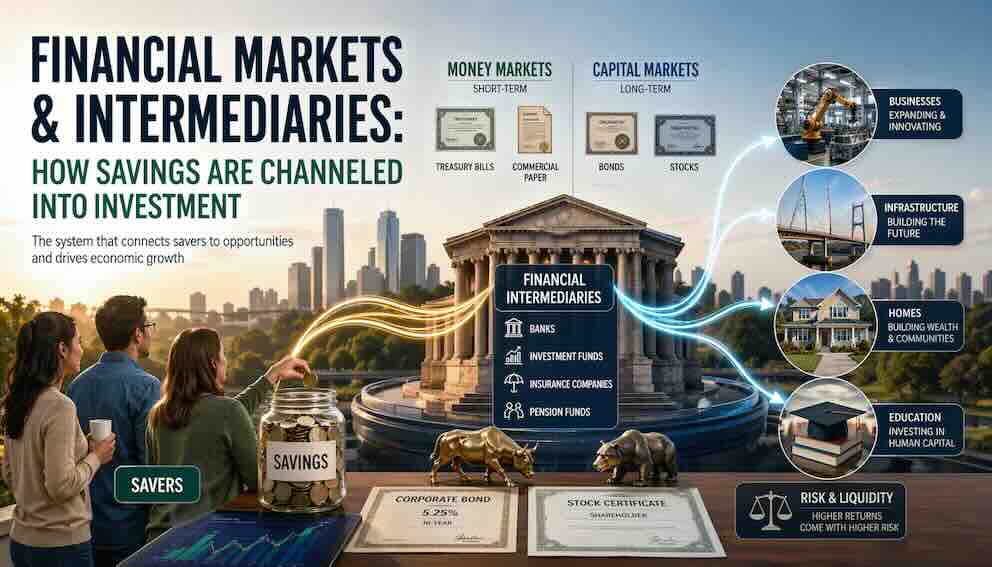
This tutorial explores the financial system—the complex network of markets and institutions that channel savings from households and businesses into productive investment. You will learn the difference between money markets (for short-term borrowing) and capital markets (for long-term financing), and how instruments like Treasury bills, commercial paper, bonds, and stocks serve different needs for borrowers and lenders. Using real-world examples from Apple's commercial paper, Tesla's bond issuances, Netflix's content financing, the collapse of Silicon Valley Bank, and China's Evergrande crisis, we will examine the role of financial intermediaries—banks, investment funds, insurance companies, and pension funds—in reducing transaction costs, providing liquidity, and managing risk. This tutorial explains why higher returns usually come with higher risk, and how the financial system connects savings to investment in the broader economy.
Introduction: The Economy's Circulatory System
Imagine the economy as a living body. Households and businesses generate savings—like blood rich with oxygen. But that blood needs to flow to where it is needed: to businesses that want to invest in new factories, to governments that need to build infrastructure, to entrepreneurs who have ideas but no money. The financial system is the circulatory system of the economy. It channels savings from those who have surplus funds to those who need funds for productive investment.
Without this system, a brilliant inventor with a world-changing idea would have no way to raise money. A young family wanting to buy a home would have to wait until they had saved the full purchase price. A company with a profitable expansion opportunity would be unable to grow. The economy would stagnate.
The financial system is vast and complex, but its core function is simple: it moves money from savers to borrowers. It does this through financial markets, where securities like bonds and stocks are traded, and through financial intermediaries, like banks and investment funds, that stand between savers and borrowers. Understanding how this system works is essential for understanding how economies grow, how risk is managed, and why financial crises happen.
In this tutorial, we will explore the different types of financial markets—money markets for short-term borrowing and capital markets for long-term financing. We will examine the key financial instruments: bonds (debt) and stocks (ownership). We will explore the role of financial intermediaries in reducing transaction costs, providing liquidity, and managing risk. And we will consider the fundamental trade-off between risk and return—why higher potential returns usually come with higher risk. Finally, we will tie everything together, showing how the financial system connects to the money creation and banking processes we explored in previous tutorials.
Types of Financial Markets – Short-Term vs Long-Term
Financial markets are typically divided into two broad categories: money markets for short-term borrowing and lending, and capital markets for long-term financing. Within each, there is also a distinction between primary markets (where new securities are issued) and secondary markets (where existing securities are traded among investors). A company raises new capital in the primary market when it issues bonds or stocks. After that, those securities trade among investors in the secondary market—like the New York Stock Exchange—where the company does not receive any additional funds. The secondary market provides liquidity, allowing investors to sell their holdings when they need cash.
Money Markets: Short-Term Borrowing
Money markets are where borrowers and lenders exchange funds for short periods—typically less than one year. These markets are used by governments, corporations, and financial institutions to manage their day-to-day cash needs.
The most important money market instrument is the Treasury bill (or T-bill). When the U.S. government needs to raise cash for a few weeks or months, it issues T-bills. Institutional investors—like money market funds, pension funds, and foreign central banks—buy them as a safe place to park cash. T-bills are considered one of the safest investments because they are backed by the full faith and credit of the United States government.
Another common money market instrument is commercial paper. Large corporations with strong credit ratings issue commercial paper to meet short-term funding needs—to pay suppliers, cover payroll, or manage seasonal fluctuations. Consider Apple. Even though Apple is one of the most profitable companies in the world, it still issues commercial paper. Why? Because Apple's cash is often held overseas, and bringing it back to the United States would incur taxes. By issuing commercial paper, Apple can borrow money in the U.S. at very low interest rates to fund its operations while leaving its overseas cash where it is. This is a classic example of how even the largest companies use money markets for short-term liquidity.
Commercial paper typically matures in 1 to 270 days. Unlike T-bills, it is not backed by the government; its safety depends entirely on the creditworthiness of the issuing corporation. In 2008, when fears about corporate solvency spiked, the commercial paper market froze—a key moment in the financial crisis.
Capital Markets: Long-Term Financing
Capital markets are where borrowers raise funds for long-term investments—typically for periods of one year or more. These markets provide the financing for factories, machinery, infrastructure, and other long-lived assets. The two primary capital market instruments are bonds and stocks.
When a corporation or government needs to raise money for a long-term project, it can issue bonds. A bond is a promise to pay: the borrower agrees to pay the lender a fixed amount of interest each year (the coupon) and to repay the principal (the face value) at a specified date in the future (the maturity date). Bonds are debt instruments; the bondholder is a creditor, not an owner.
Consider Tesla. In 2020, as Tesla was expanding its Gigafactories in the United States, Europe, and China, it raised billions of dollars by issuing bonds. Investors bought those bonds because they believed Tesla would succeed and repay them with interest. The bondholders did not own a piece of Tesla; they were lenders. If Tesla had failed, they would have had a claim on the company's assets before stockholders.
Similarly, Netflix has issued billions of dollars in bonds over the years to finance its content creation. When Netflix was spending heavily to produce original shows and movies, it needed capital. Issuing bonds allowed it to raise that capital without diluting the ownership of existing shareholders. The trade-off was that it had to pay interest—and bondholders expected to be repaid.
When a corporation wants to raise money without taking on debt, it can issue stock (also called equity). A stock represents ownership in the company. Stockholders are not creditors; they are owners. They share in the company's profits through dividends and benefit from increases in the company's value (capital gains). But they also bear the risk: if the company fails, stockholders are last in line to be repaid.
Consider a start-up in renewable energy. Suppose a group of engineers has developed a new, more efficient solar panel. They need $50 million to build a factory. They could go to a bank for a loan, but banks may be reluctant to lend to a company with no track record. They could issue bonds, but without a credit history, they would have to pay very high interest. Instead, they might issue stock—selling ownership shares to venture capitalists, private equity firms, or public investors. The investors who buy those shares are taking a risk: if the company fails, they lose their money. But if the company succeeds, their shares could be worth many times what they paid.
Primary vs Secondary Markets
It is important to understand that when a company issues bonds or stocks in the primary market, it raises new capital. That capital can be used to build factories, hire workers, or develop new products. After that, those bonds and stocks trade among investors in the secondary market—on exchanges like the New York Stock Exchange or NASDAQ. The company does not receive any additional funds when its stock is traded in the secondary market. But the secondary market serves a vital purpose: it provides liquidity. Investors are more willing to buy securities if they know they can sell them later if needed. Without a liquid secondary market, primary markets would be much smaller.
Key takeaway: Financial markets are divided into money markets (short-term borrowing, typically less than one year) and capital markets (long-term financing). Primary markets are where new securities are issued; secondary markets provide liquidity for existing securities. Money market instruments include Treasury bills (used by the government) and commercial paper (used by corporations like Apple). Capital market instruments include bonds (debt, used by companies like Tesla and Netflix) and stocks (ownership). Money markets manage liquidity; capital markets finance long-term investment.
Financial Instruments – Bonds and Stocks
To understand how capital markets work, we need to understand the two primary instruments traded in them: bonds and stocks.
Bonds: Lending Money to Borrowers
A bond is a loan. When you buy a bond, you are lending your money to the issuer—a corporation, a government, or a government agency. In return, the issuer promises to pay you interest at a specified rate (the coupon) and to repay the principal (the face value) on a specified date (the maturity date).
Bonds vary widely in their terms. A U.S. Treasury bond, backed by the full faith and credit of the United States, is considered one of the safest investments in the world. A corporate bond from a company with a shaky credit rating, sometimes called a "junk bond," is much riskier—but it pays a higher interest rate to compensate investors for that risk.
Investors rely on credit rating agencies—Moody's, S&P, and Fitch—to assess the creditworthiness of bond issuers. These agencies assign ratings ranging from AAA (highest quality) to D (default). A bond rated AAA is considered extremely safe; a bond rated BB or below is considered "speculative" or "junk." When a company's credit rating is downgraded, the price of its bonds falls, and it becomes more expensive for the company to borrow in the future.
One of the most important relationships in bond investing is the inverse relationship between bond prices and yields. When interest rates rise, the price of existing bonds falls. Why? Because a bond that pays a fixed interest rate becomes less attractive when new bonds are issued with higher rates. Conversely, when interest rates fall, bond prices rise. This relationship is fundamental to understanding how bond markets work.
A Cautionary Tale: China's Evergrande Crisis (2021)
In 2021, China's Evergrande Group—one of the largest real estate developers in the world—faced a massive debt crisis. Evergrande had issued billions of dollars in bonds to finance its rapid expansion. But when the Chinese government cracked down on excessive borrowing in the property sector, Evergrande could not refinance its debt. Credit rating agencies downgraded Evergrande's bonds to "default" status. Bondholders worried they would not be repaid. The price of Evergrande's bonds collapsed, falling to pennies on the dollar. This was a stark illustration of credit risk: the risk that a borrower will default. Evergrande's crisis sent shockwaves through global financial markets, showing how the failure of one large borrower can affect investors around the world.
Stocks: Owning a Piece of a Company
A stock represents ownership in a company. When you buy a share of stock, you become a part owner of that company. Your ownership entitles you to a share of the company's profits, usually paid as dividends, and to a share of the company's value if it grows.
Stockholders are not creditors; they are owners. This means they bear more risk than bondholders. If a company goes bankrupt, bondholders are paid first from the company's remaining assets. Stockholders are last in line; they often receive little or nothing. But stockholders also have more upside. If a company succeeds, its stock price can rise dramatically, and stockholders share in that success through capital gains.
The Rise and Fall of SPACs (2020–2022)
Between 2020 and 2022, a financial innovation called SPACs (Special Purpose Acquisition Companies) captured the imagination of investors. A SPAC is a shell company that raises money through an initial public offering (IPO) with the sole purpose of merging with a private company, taking it public. During the boom, hundreds of SPACs raised billions of dollars, often targeting high-growth, speculative companies in electric vehicles, space technology, and other emerging sectors. Investors poured money in, hoping to get in on the ground floor of the next big thing.
Then the boom turned to bust. Many of the companies that went public through SPACs had little revenue and questionable business models. When interest rates rose and investors became more cautious, the bubble burst. Some SPAC-backed companies went bankrupt; others saw their stock prices fall by 90 percent or more. This episode illustrates the risk-return trade-off in vivid terms: investors who bought in early hoped for enormous returns, but many ended up with enormous losses.
The Risk-Return Trade-Off
The difference between bonds and stocks, and the stories of Evergrande and SPACs, illustrate a fundamental principle of finance: the risk-return trade-off. Investments that offer the potential for higher returns typically come with higher risk.
Consider the spectrum of risk. U.S. Treasury bonds are very safe; the government has never defaulted on its debt. But they also pay relatively low interest rates. Corporate bonds are riskier; some companies default. But they pay higher interest to compensate investors for that risk. Stocks are riskier still; stock prices can fall by 50 percent or more in a bear market. But over the long term, stocks have historically provided higher returns than bonds.
It is important to note that when we talk about returns, we usually mean real returns—returns adjusted for inflation. If a bond pays 3 percent interest but inflation is 2 percent, the real return is only 1 percent. If inflation is higher than the interest rate, the real return can be negative. This is why investors care about inflation: it erodes the real value of their returns.
Key takeaway: Bonds are debt instruments; bondholders lend money and receive fixed interest payments. Stocks are ownership shares; stockholders share in profits and bear the risk of loss. Credit rating agencies help investors assess risk. The risk-return trade-off means that investments with higher potential returns typically come with higher risk. Investors care about real returns—adjusted for inflation.
Financial Intermediaries – The Institutions That Connect Savers and Borrowers
Financial markets allow savers and borrowers to connect directly. But most savers do not have the time, expertise, or resources to research individual bonds and stocks. And most borrowers cannot easily find individual savers willing to lend them money. This is where financial intermediaries come in.
Banks: The Original Intermediaries
Banks are the oldest and most familiar financial intermediaries. They accept deposits from savers and make loans to borrowers. In doing so, they perform several critical functions.
First, banks reduce transaction costs. Instead of each saver having to find a borrower directly, banks aggregate deposits from many savers and lend them to many borrowers. This is far more efficient.
Second, banks provide liquidity. Your deposit in a bank is liquid—you can withdraw it at any time. But the bank lends your money out for years at a time. This is called maturity transformation: banks transform short-term deposits into long-term loans. This is a core function of banking—and a source of vulnerability. If too many depositors demand their money back at once, the bank may not have enough liquidity to meet the demand. This is a bank run.
Third, banks manage risk. Banks evaluate borrowers' creditworthiness, spreading risk across many loans. They also diversify across industries and geographies. An individual saver could not do this as effectively.
The Collapse of Silicon Valley Bank (2023)
In March 2023, Silicon Valley Bank (SVB) failed in the second-largest bank failure in U.S. history. SVB was a regional bank that specialized in lending to technology start-ups and venture capital firms. It had grown rapidly as the tech sector boomed. But SVB had a vulnerability: its deposits were concentrated in a few industries, and its assets (long-term bonds) lost value when interest rates rose. When depositors began to withdraw their money, a classic bank run ensued. The bank could not meet the demand. The FDIC stepped in, and the bank was closed.
SVB's collapse illustrates several key points about banking. First, even banks can fail if they take too much risk. Second, banks that are heavily concentrated in one industry are especially vulnerable. Third, maturity transformation—funding long-term loans with short-term deposits—can be a source of systemic risk. The SVB collapse was a stark reminder that banks are not risk-free and that financial stability depends on careful management of risk.
Systemic Risk
The collapse of a single bank can sometimes trigger a cascade of failures across the financial system. This is called systemic risk. When SVB failed, there were fears that other regional banks with similar vulnerabilities might also fail. The government stepped in to guarantee deposits at all banks, not just those covered by standard deposit insurance, to prevent panic from spreading. Systemic risk is why regulators pay close attention to the largest and most interconnected financial institutions.
Investment Funds: Pooling Money for Scale
Investment funds—mutual funds, exchange-traded funds (ETFs), hedge funds—pool money from many investors to buy a diversified portfolio of securities. They allow individual investors to access markets that would otherwise be out of reach.
Consider an individual who wants to invest in the stock market. Instead of researching and buying dozens of individual stocks, she can buy an S&P 500 index fund. For a small fee, she gets a share of the 500 largest U.S. companies. Her money is pooled with millions of other investors, allowing her to achieve diversification that would be impossible on her own. An ETF can be bought and sold like a stock, providing liquidity along with diversification.
Pension Funds: Saving for Retirement
Pension funds manage the retirement savings of workers. The California Public Employees' Retirement System (CalPERS) is one of the largest pension funds in the world, managing over $400 billion in assets for more than 2 million public employees. CalPERS invests in a diversified portfolio of stocks, bonds, real estate, private equity, and infrastructure. Its investment horizon is measured in decades, which allows it to hold long-term, illiquid assets that individual investors could not easily access.
When a teacher in California contributes to CalPERS, her money is pooled with that of millions of other workers. It is invested globally—in companies, real estate, and infrastructure projects. Over her career, her savings grow. When she retires, CalPERS pays her a pension. This is the role of pension funds: turning today's savings into tomorrow's retirement income.
Insurance Companies: Managing Risk Across Policyholders
Insurance companies are another type of financial intermediary. They collect premiums from policyholders and invest those funds in bonds, stocks, and other assets. When policyholders suffer losses—from accidents, illness, death, or property damage—the insurance company pays claims.
Insurance companies are major investors in capital markets. Their liabilities (the claims they may have to pay) are long-term, so they tend to invest in long-term assets like corporate bonds and mortgages. They are significant players in the bond market.
The Core Role of Intermediaries
All financial intermediaries perform the same core functions. They channel savings into investment, moving funds from those who have surplus capital to those who need it. They reduce transaction costs, making it cheaper and easier for savers to invest and for borrowers to raise funds. And they provide liquidity, allowing savers to access their money when they need it while providing borrowers with long-term funding.
Consider a household with a mortgage. The bank that lent them the money took deposits from many households and lent them to the family. The family gets to buy a home. The depositors earn interest. The bank earns a profit. This is the financial system at work. Consider a retiree who owns an S&P 500 ETF in her brokerage account. Her savings are pooled with millions of others and invested in hundreds of companies. Those companies use the capital to expand, creating jobs and growth. The retiree's savings grow, providing for her retirement.
Key takeaway: Financial intermediaries—banks, investment funds, insurance companies, pension funds—channel savings into investment, reduce transaction costs, and provide liquidity. Banks perform maturity transformation (short-term deposits into long-term loans), which can create systemic risk. Investment funds provide diversification. Pension funds and insurance companies manage long-term risk and provide capital for long-term investment.
Risk and Liquidity – The Two Sides of Financial Assets
Every financial asset involves some degree of risk and some degree of liquidity. Understanding these concepts is essential for making informed investment decisions.
Types of Risk
Investors face several types of risk when they buy financial assets.
Credit risk (also called default risk) is the risk that the borrower will fail to make interest payments or repay the principal. This is the primary risk for bondholders. Government bonds generally have low credit risk; corporate bonds vary depending on the company's financial health. The Evergrande crisis was a dramatic example of credit risk: bondholders faced the real possibility of losing their entire investment.
Market risk is the risk that the price of an asset will fall due to changes in market conditions. This is the primary risk for stockholders. Stock prices fluctuate with news about the company, the industry, and the broader economy. Even a well-managed company can see its stock price fall in a market downturn. The SPAC bust was a classic example of market risk: investors who bought at the peak saw their investments lose most of their value.
Liquidity risk is the risk that you will not be able to sell an asset quickly without taking a significant price discount. A stock traded on a major exchange is highly liquid; you can sell it almost instantly. A piece of real estate is illiquid; selling it can take months, and you may have to accept a lower price to sell quickly. During the 2008 financial crisis, many investors discovered that assets they thought were liquid—like mortgage-backed securities—were not, in fact, liquid when everyone was trying to sell at once.
Systemic risk is the risk that the failure of one institution can trigger a cascade of failures across the financial system. This is why regulators are concerned about "too big to fail" institutions and why central banks act as lenders of last resort.
Liquidity: The Ease of Converting to Cash
Liquidity is the ease with which an asset can be converted into cash without loss of value. Cash itself is perfectly liquid. A Treasury bill is nearly as liquid; you can sell it quickly for close to its face value. A stock is liquid, but its price may fluctuate. A house is illiquid; selling it takes time, and you may have to accept a lower price.
There is a trade-off between liquidity and returns. Highly liquid assets tend to have lower returns. Cash earns almost nothing. Treasury bills earn a small amount. Stocks are less liquid than T-bills (their prices fluctuate), but they have historically offered higher returns over the long term. Real estate is even less liquid, and its returns vary widely.
Why Higher Returns Mean Higher Risk
The risk-return trade-off is one of the most important concepts in finance. Investors demand a higher expected return to compensate them for taking on higher risk. This is why stocks have historically outperformed bonds, and why corporate bonds pay higher interest than government bonds.
This trade-off is not a guarantee. A risky investment can lose money; a safe investment can gain. But over the long term, the relationship holds. Investors who want higher returns must accept higher risk. Understanding your own tolerance for risk is essential for making investment decisions.
Key takeaway: Risk comes in many forms—credit risk (default), market risk (price fluctuations), liquidity risk (difficulty selling), and systemic risk (cascading failures). Liquidity is the ease of converting an asset to cash. There is a trade-off: higher returns usually come with higher risk and often with lower liquidity. Understanding this trade-off is essential for making informed investment decisions.
The Role of Central Banks in Financial Markets
Central banks play a critical role in financial markets. They are not just regulators; they are active participants. Through open market operations, central banks buy and sell government bonds to influence the money supply and interest rates. When the central bank buys bonds, it injects reserves into the banking system, which tends to lower interest rates. When it sells bonds, it drains reserves, which tends to raise interest rates.
In extraordinary circumstances, central banks engage in quantitative easing (QE) —buying large quantities of government bonds and sometimes other assets to inject liquidity into financial markets and lower long-term interest rates. The Federal Reserve, European Central Bank, and Bank of England all used QE extensively after the 2008 crisis and during the COVID-19 pandemic.
These operations affect financial markets directly. When the central bank buys bonds, bond prices rise and yields fall. This influences the cost of borrowing for corporations and governments. It also pushes investors to seek higher returns in riskier assets like stocks, driving up stock prices.
Key takeaway: Central banks participate directly in financial markets through open market operations and quantitative easing. These actions influence interest rates, liquidity, and asset prices, affecting the entire financial system.
How Everything Connects – Money Supply, Banks, and Financial Markets
Now that we have explored the financial system in detail, we can step back and see how it all fits together. The financial system is not a collection of separate pieces; it is an integrated whole that connects savings, investment, and the money supply.
The Flow of Savings into Investment
Let us trace a dollar of savings through the system.
A household deposits $1,000 in a bank. That deposit is part of the bank's liabilities; the bank owes the household $1,000. The bank, operating under fractional reserve banking, lends most of that money to a small business that needs to buy new equipment. The loan creates a new deposit in the business's account—new money.
The business spends the money to buy equipment. The equipment manufacturer deposits the money in its bank. That bank lends a portion of it to a corporation that is issuing bonds to build a new factory. The corporation uses the bond proceeds to hire workers and buy materials. The workers deposit their paychecks in their banks. Some of those deposits flow into pension funds and mutual funds. The pension funds invest in stocks and bonds, providing capital for other companies.
This flow—from household savings to bank deposits to loans to corporate investment to wages to pension funds to more investment—is the circulatory system of the economy. Every dollar of savings eventually becomes a dollar of investment.
How Money Supply Connects
As we learned in previous tutorials, the money supply has two components. The monetary base (M0) is created by the central bank—physical currency and reserves. But most money is created by commercial banks when they make loans. When a bank makes a loan, it creates a new deposit—new money. That money circulates through the economy, becoming deposits in other banks, which can then make new loans.
The central bank sets the foundation. It controls the base money and sets interest rates that influence the cost of lending. But the amount of money in the economy depends on banks' willingness to lend and borrowers' willingness to borrow. When banks lend freely, the money supply expands. When they tighten lending, it contracts.
How Financial Markets Allocate Money
Financial markets allocate the money that banks create to its most productive uses. A company with a promising new technology can issue stock to raise capital. A government can issue bonds to finance infrastructure. A young family can take out a mortgage to buy a home.
Financial markets ensure that money flows to where it can generate the highest returns. They do this through the price mechanism. If a company is expected to be profitable, its stock price will be high, allowing it to raise capital cheaply. If a company is struggling, its stock price will be low, and it will have difficulty raising funds. This discipline ensures that capital is allocated efficiently.
The Role of Interest Rates
Interest rates are the price that connects the entire system. The central bank sets a policy rate that influences all other interest rates. When rates are low, borrowing is cheap, encouraging investment and spending. When rates are high, borrowing is expensive, cooling the economy.
Low interest rates also affect financial markets. When bond yields are low, investors seek higher returns in stocks and other riskier assets. This can drive up stock prices, making it easier for companies to raise capital. But it can also lead to speculative bubbles, as we saw with SPACs.
The Integrated System
Together, the central bank, commercial banks, and financial markets form an integrated system. The central bank sets the foundation by controlling base money and interest rates. Commercial banks create the money that circulates in the economy. Financial markets allocate that money efficiently across the economy.
When the system works well, savings are channeled into productive investment, the economy grows, and living standards rise. When the system breaks down—as it did in 2008—credit freezes, money contracts, and the economy suffers.
Key takeaway: The financial system is an integrated whole. Household savings flow into banks, which lend to businesses and individuals. Banks create money through lending. Financial markets allocate that money to its most productive uses. Interest rates, set by the central bank, influence the entire system. When the system works, savings are channeled into investment and the economy grows. When it breaks down, the consequences can be severe.
Conclusion: The System That Makes Growth Possible
We began this tutorial with the image of the financial system as the economy's circulatory system. Like the circulatory system, it is vast and complex, but its function is simple: it moves savings from those who have surplus funds to those who need funds for productive investment.
We have explored the different types of financial markets: money markets for short-term borrowing and capital markets for long-term financing. We have distinguished primary markets (where new securities are issued) from secondary markets (where they trade). We have examined the key financial instruments: bonds, which are debt; and stocks, which are ownership. Through examples like Apple's commercial paper, Tesla's bonds, Netflix's content financing, the Evergrande crisis, and the SPAC boom and bust, we have seen how these instruments work in practice.
We have examined the role of financial intermediaries—banks, investment funds, insurance companies, pension funds—in channeling savings into investment, reducing transaction costs, and providing liquidity. We have learned about maturity transformation, credit rating agencies, and systemic risk. Through the story of Silicon Valley Bank's collapse and the example of CalPERS, we have seen both the risks and the benefits of intermediation.
We have explored the concepts of risk and liquidity, understanding why some investments are safe but earn little, while others are risky but offer the potential for high returns. We have seen how central banks participate in financial markets through open market operations and quantitative easing. And we have traced the flow of a dollar of savings through the system, seeing how it becomes a dollar of investment, fueling economic growth.
Finally, we have tied everything together, seeing how the central bank, commercial banks, and financial markets form an integrated system. The central bank sets the foundation; commercial banks create money; financial markets allocate it efficiently. When the system works, savings are channeled into investment, and the economy grows.
The financial system is not just a collection of institutions and markets. It is the mechanism by which a society transforms its savings into the factories, technologies, and infrastructure that drive prosperity. It is the bridge between the present and the future—between the sacrifices of savers today and the rewards of investment tomorrow.
The next time you deposit money in a bank, buy an S&P 500 ETF, take out a mortgage, or receive a paycheck that goes into your retirement account, remember: you are participating in this vast, complex, and essential system. Your savings are not sitting idle; they are flowing through the financial system, becoming the loans, bonds, and equity that build factories, create jobs, and fuel growth. The mortgage that lets a family buy a home, the student loan that sends a young person to college, the venture capital that launches a start-up—all of these are made possible by the financial system. Understanding how it works is essential for understanding how economies grow—and how we can ensure that they grow for everyone.
About Swati Sharma
Lead Editor at MyEyze, Economist & Finance Research WriterSwati Sharma is an economist with a Bachelor’s degree in Economics (Honours), CIPD Level 5 certification, and an MBA, and over 18 years of experience across management consulting, investment, and technology organizations. She specializes in research-driven financial education, focusing on economics, markets, and investor behavior, with a passion for making complex financial concepts clear, accurate, and accessible to a broad audience.
Disclaimer
This article is for educational purposes only and should not be interpreted as financial advice. Readers should consult a qualified financial professional before making investment decisions. Assistance from AI-powered generative tools was taken to format and improve language flow. While we strive for accuracy, this content may contain errors or omissions and should be independently verified.