Tutorial Categories
Last Updated: April 21, 2026 at 10:30
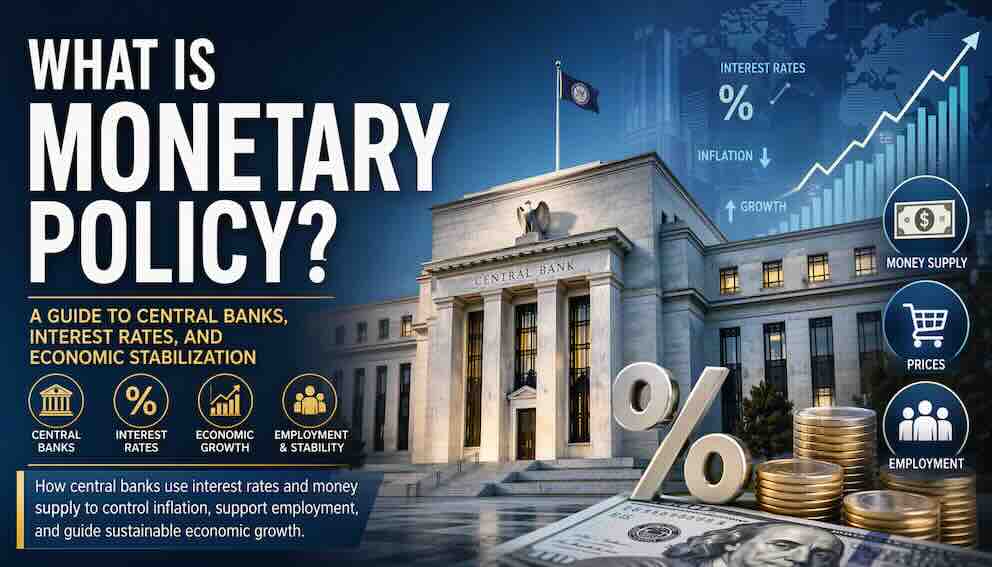
What Is Monetary Policy? A Complete Guide to How Central Banks Manage Interest Rates, Money, and Economic Stability
Understanding the Federal Reserve, the Bank of England, and How Decisions About Borrowing Costs Affect Your Mortgage, Your Job, and the Price of Groceries
This tutorial explains monetary policy, the central bank's primary tool for managing the economy. You will learn how lowering interest rates makes borrowing cheaper to fight recessions and unemployment, and how raising rates cools down an overheating economy to control inflation. The guide walks you through the five ways a rate change reaches your wallet—from bank lending to stock market wealth to the value of your currency—and uses real stories like the 2008 financial crisis, the 1970s oil shocks, and the 2021–2023 inflation surge to make abstract concepts concrete. By the end, you will understand why central bankers obsess over expectations, why they fight to stay independent from politicians, and why the trade-off between inflation and unemployment is the central dilemma of modern macroeconomics.
The Big Picture: What Is Monetary Policy and Why Does It Matter to You?
Let us start with a question that you might have asked yourself while watching the evening news. Why do reporters get so excited when the Federal Reserve or the Bank of England announces a tiny change in interest rates, sometimes as small as a quarter of one percent? The answer is that this tiny change, through a long and winding chain of cause and effect, eventually determines whether you can afford a house, whether your small business can buy a new delivery truck, whether your savings account earns anything at all, and whether the raise you asked for at work gets eaten up by rising prices.
Monetary policy is the name we give to everything a central bank does to influence the economy by controlling the availability of money and the cost of borrowing. Think of the central bank as the operator of the economy's thermostat. When the economy is too cold—meaning businesses are closing, people are losing jobs, and spending has frozen up—the central bank turns up the heat by making money cheap and easy to borrow. When the economy is too hot—meaning prices are rising so fast that your paycheck buys less every month—the central bank turns down the heat by making money expensive and harder to borrow.
The central bank cannot do this with a simple switch. Instead, it uses a single main lever: the interest rate that banks charge each other for overnight loans. When that lever moves, it sets off a cascade of changes that take more than a year to fully work through the economy. That long delay is what makes monetary policy so difficult and so fascinating. The central bank has to predict the future while acting in the present, and by the time it sees the results of its actions, the economy may have already changed direction.
In the sections that follow, we will walk through exactly how this cascade works, what the central bank is trying to achieve, and why even professional economists sometimes disagree about whether a particular policy decision was wise. By the end, you will have a mental map of the entire process, from the central bank's meeting room to your own monthly budget.
What Is the Central Bank Trying to Achieve? The Three Goals
Before we get into the mechanics of how monetary policy works, we need to understand what the central bank wants to accomplish. Every central bank in the developed world pursues three main goals, although they sometimes phrase them slightly differently.
The first goal is price stability. This is a fancy way of saying that the central bank wants inflation to be low, stable, and predictable. Most central banks target an inflation rate of around two percent per year. Why two percent and not zero? Because a tiny amount of inflation greases the wheels of the economy. When prices are rising very slowly, people and businesses have an incentive to spend and invest rather than hoarding cash under their mattresses. Zero inflation sounds good, but it often tips over into deflation, which is when prices actually fall. Deflation is dangerous because if you know that prices will be lower next month, you delay every purchase you can, spending collapses, and the economy spirals downward. So the central bank wants a small, steady amount of inflation—not so much that it erodes your savings, but enough that the economy keeps moving.
The second goal is maximum employment. This does not mean zero unemployment. There will always be some people who are between jobs, who have just graduated and are looking for their first position, or who are learning new skills. What it means is that the economy is operating at a level where anyone who wants a job and is able to work can find one within a reasonable amount of time. When unemployment is very low, workers have the power to ask for raises, families have money to spend, and businesses have customers to serve. But when unemployment is too low for too long, it can actually cause problems, because employers start bidding against each other for workers, wages rise quickly, and businesses raise prices to cover their higher labor costs. That is how low unemployment can feed into higher inflation.
The third goal is moderate long-term interest rates and sustainable economic growth. This goal is closely related to the first two, but it deserves its own attention because interest rates are the central bank's main tool. When long-term interest rates are stable and predictable, a business can confidently borrow money to build a factory that will take five years to complete, because it knows what its borrowing costs will be. When interest rates jump around unpredictably, that same business delays the factory, and the economy grows more slowly. The central bank wants to create an environment where borrowing costs are neither so high that investment is impossible nor so low that they encourage reckless speculation and dangerous asset bubbles.
These three goals sometimes work together and sometimes pull in opposite directions. When the economy is in a recession, all three point toward lower interest rates. But when the economy is overheating, the central bank faces a painful choice: raise rates to fight inflation and accept higher unemployment, or keep rates low to protect jobs and accept that prices will keep rising. That choice is the central drama of monetary policy, and we will return to it again and again.
How Does a Central Bank Rate Change Actually Reach Your Wallet? The Five Channels
Now we come to the heart of the tutorial. The central bank changes its policy rate by a quarter point. A few bankers in a meeting room in Washington, D.C., or London, or Frankfurt, make a decision. How does that decision end up affecting whether you buy a car, whether your employer hires more workers, or whether the price of milk goes up? The answer is that the rate change travels through five separate channels, each one affecting a different part of the economy. We will walk through each channel slowly, with concrete examples.
The Interest Rate Channel
This is the most direct channel, and it is the one that people usually think of first. The central bank sets a target for the interest rate that banks charge each other for overnight loans. In the United States, this is called the federal funds rate. When the central bank wants to stimulate the economy, it lowers this rate. When it wants to cool the economy down, it raises this rate.
Why does this matter to you? Because commercial banks pass their borrowing costs along to their customers. When the central bank lowers its rate, banks lower the prime rate, which is the rate they charge their best business customers. Car loans become cheaper. Credit card interest rates fall. Adjustable-rate mortgages adjust downward. Business loans for new equipment or new hires become more affordable. When the central bank raises its rate, all of these loan rates rise as well.
Let us make this concrete with numbers. Imagine you are buying a house and you need a $300,000 mortgage. At an interest rate of 3 percent, your monthly payment (excluding taxes and insurance) is about $1,265. At an interest rate of 6 percent, your monthly payment is about $1,800. That is a difference of $535 every single month. Over thirty years, that lower rate saves you nearly $200,000. This is why families watch the central bank's announcements so closely. A single percentage point change in interest rates can be the difference between being able to afford a home and being locked out of the housing market entirely.
The Credit Channel
The interest rate channel is about the price of borrowing. The credit channel is about the availability of borrowing. Even if interest rates stayed exactly the same, the economy would still feel it if banks suddenly became more willing to say yes to loan applications or more likely to say no.
Here is how the credit channel works. When the central bank expands the money supply, banks find themselves holding more reserves. They have more money sitting in their accounts at the central bank. To make a profit on those reserves, they need to lend them out. So they become more aggressive about finding borrowers. They relax their lending standards. They approve loans that they might have rejected before. Small businesses that were told "not right now" suddenly hear "how much do you need?"
When the central bank contracts the money supply, the opposite happens. Banks have fewer reserves, so they become more cautious. They tighten their lending standards. They ask for higher credit scores, larger down payments, and more collateral. Loans that would have been approved last year are rejected this year. Even creditworthy borrowers find that the door to credit has swung partly shut.
The most dramatic example of the credit channel in action was the 2008 financial crisis. Banks had suffered huge losses on mortgage-backed securities, and they were terrified that more losses were coming. Even though the Federal Reserve lowered interest rates to zero, banks stopped lending to each other and to businesses. The credit channel froze completely. The only reason the economy did not collapse entirely was that the Federal Reserve stepped in to lend directly to banks and even to large corporations, effectively bypassing the frozen credit channel and forcing money into the system.
The Wealth Effect Channel
Have you ever noticed that when the stock market is rising, people seem more willing to spend money on restaurants, vacations, and new cars? That is the wealth effect in action.
The wealth effect channel works through asset prices, such as stock prices and house prices. When the central bank lowers interest rates, investors find that bonds and savings accounts offer very low returns, so they shift their money into stocks, real estate, and other assets that might offer higher returns. This increased demand pushes up the prices of those assets. A family that owns a house sees its value rise. A family with a retirement account sees its balance grow. Even though their income has not changed, they feel wealthier. And when people feel wealthier, they spend more.
This is not just a feeling. Economists have measured the effect carefully. A typical estimate is that for every dollar increase in housing wealth, households spend about five to seven cents more per year. For every dollar increase in stock market wealth, they spend about two to four cents more. These numbers sound small, but when you multiply them across millions of households and trillions of dollars of asset value, the total effect on spending is enormous.
When the central bank raises interest rates, the wealth effect runs in reverse. Asset prices fall, households feel poorer, and they cut back on spending. This is one reason why central banks pay close attention to stock market movements. They do not care about the profits of wealthy investors for their own sake. They care because when the stock market falls sharply, the wealth effect reduces spending throughout the economy, and that reduction in spending helps cool off inflation.
The Exchange Rate Channel
The exchange rate channel only matters for countries that trade with other countries, which is to say, every country in the modern world. But it matters more for some countries than others. The United States, with its large domestic economy, is somewhat insulated from exchange rate movements. The United Kingdom, with its smaller economy and high dependence on trade, is more exposed.
Here is how it works. When the central bank raises interest rates, international investors find that country's bonds more attractive because they earn a higher return. To buy those bonds, they need the country's currency. So they buy pounds if the Bank of England has raised rates, or dollars if the Federal Reserve has raised rates. This increased demand for the currency causes it to appreciate, which means it becomes stronger relative to other currencies.
A stronger currency makes imports cheaper. If you live in the United Kingdom and the pound strengthens against the euro, then German cars, French cheese, and Spanish olives all become cheaper in pound terms. This directly reduces inflation because the prices of imported goods fall. However, a stronger currency also makes exports more expensive for foreign buyers. A British car that costs £30,000 might cost a European buyer €35,000 when the pound is weak but €40,000 when the pound is strong. That higher price reduces demand for British exports, which hurts British manufacturers and can slow economic growth.
When the central bank lowers interest rates, the exchange rate channel runs in reverse. The currency weakens, which makes exports cheaper (good for growth) but imports more expensive (bad for inflation). Central banks have to weigh these two effects against each other. A small, open economy like the United Kingdom or Canada cares a great deal about the exchange rate channel. A large, relatively closed economy like the United States cares less, but it still matters.
The Expectations Channel
Now we come to the most important channel in modern monetary policy, and the one that separates today's central banking from the failed policies of the 1970s. The expectations channel is simple to state but profound in its implications: what people expect to happen in the future shapes what they do today.
Think about this for a moment. If you expect that the price of a new laptop will be twenty percent higher next year than it is today, you will buy the laptop now, even if you have to borrow to do it. If you expect that prices will be twenty percent lower next year, you will wait. If you expect that your job is secure and your income will rise, you will feel comfortable taking on a car loan. If you expect that a recession is coming and you might be laid off, you will save every extra dollar instead of spending it.
The same logic applies to businesses. If a business expects that inflation will be high next year, it will raise its prices today to get ahead of the curve. If it expects that its suppliers will raise prices, it will buy extra inventory now. If it expects that the central bank will keep interest rates low for a long time, it will borrow money to build that new factory. If it expects that rates will rise sharply next year, it will delay its borrowing.
This means that the central bank spends as much time managing expectations as it does setting interest rates. When the Federal Reserve announces that it will keep interest rates low for a long time, a policy called forward guidance, it is trying to convince businesses and families that borrowing will remain cheap, so they should invest and spend now. When the Bank of England says that it is "committed to bringing inflation down," it is trying to convince people that future inflation will be low, so they should not demand large wage increases and businesses should not raise prices aggressively.
The expectations channel depends entirely on credibility. If people do not believe that the central bank will follow through on its promises, the channel stops working. If the central bank says it will keep rates low but then raises them unexpectedly, no one will believe its next promise. If it says it is committed to low inflation but then allows inflation to run high for years, its statements become meaningless. This is why modern central banks have become much more transparent than they used to be. They hold press conferences after every meeting. They publish detailed economic forecasts. They explain their decisions in plain language. They do all of this to build and maintain the credibility that makes the expectations channel work.
Putting It All Together
Let us step back and see the whole picture. The central bank changes its policy rate by a quarter point. That change affects the cost of borrowing directly through the interest rate channel. It affects the availability of credit through the credit channel. It affects household wealth through the wealth effect channel. It affects the currency and trade through the exchange rate channel. And it affects what people expect about the future through the expectations channel. All five channels work together, and all five channels take time. The full effect of a single rate change typically takes twelve to eighteen months to work through the economy. That long delay is why central banks must constantly look ahead, trying to predict where the economy will be a year or two from now, and why monetary policy is as much an art as a science.
How Is Money Actually Created and Controlled? A Short Detour into Banking
Before we continue, we need to clear up a common misunderstanding. Many people think that the central bank creates money by printing banknotes and then spending them into the economy. That is not how it works in a modern economy. Most of the money in your wallet is not physical cash at all. It is digital entries in bank accounts. And most of that digital money is created not by the central bank but by commercial banks when they make loans.
Here is how it works. When you go to a bank and take out a $10,000 loan, the bank does not pull $10,000 from a vault that the central bank printed. Instead, the bank creates a new deposit account in your name with a balance of $10,000. That deposit is new money that did not exist before. You spend that money, it moves to someone else's bank account, and that bank now has more deposits, which allows it to make more loans, which creates more money. This is called fractional reserve banking, and it means that the money supply expands naturally when banks lend and contracts when loans are repaid.
The central bank controls this process indirectly by setting the policy rate and by buying and selling bonds. When the central bank buys bonds from banks, it pays for them by adding reserves to the banks' accounts at the central bank. Those reserves are the raw material for new lending. More reserves mean banks can make more loans, which creates more broad money (the money that people and businesses actually use). When the central bank sells bonds, it drains reserves from the banking system, which reduces the capacity for new lending and slows the creation of broad money.
This distinction matters because it explains a puzzle from the 2010s. After the 2008 financial crisis, the Federal Reserve created trillions of dollars of new reserves through quantitative easing. Many people predicted that this would cause hyperinflation. But inflation remained very low for years. Why? Because the new reserves sat idle in bank accounts at the Federal Reserve. Banks were too scared to lend, so the reserves never turned into new loans and new broad money. The central bank can create reserves, but it cannot force banks to lend. That is a crucial limitation of monetary policy.
Expansionary and Contractionary Policy: The Accelerator and the Brake
Now that we understand how monetary policy works, we can talk about the two directions it can take. Expansionary policy is like pressing the accelerator pedal. The central bank lowers interest rates, increases the money supply, and tries to push more spending into the economy. Contractionary policy is like pressing the brake pedal. The central bank raises interest rates, reduces the money supply, and tries to pull spending out of the economy.
Expansionary policy is used when the economy is in a recession. GDP is falling. Unemployment is rising. Businesses are closing. Families are cutting back. In this situation, the central bank lowers its policy rate, buys bonds to inject reserves into the banking system, and uses forward guidance to convince everyone that rates will stay low for a long time. The goal is to make borrowing so cheap and so available that businesses decide to invest despite the weak economy, and families decide to buy houses and cars despite their worries about the future.
The most aggressive expansionary policy in modern history occurred during the 2008 financial crisis. The Federal Reserve lowered its policy rate to zero, which was as low as it could go. When that was not enough, it started buying trillions of dollars of government bonds and mortgage-backed securities, a policy called quantitative easing. It also made emergency loans directly to banks, to large corporations, and even to the commercial paper market where companies borrow to meet their payrolls. Many economists believe that without this aggressive expansionary policy, the recession would have turned into a second Great Depression.
Contractionary policy is used when the economy is overheating. GDP is growing faster than its sustainable rate. Unemployment is so low that employers cannot find workers, and wages are rising quickly. Inflation is above the central bank's target and climbing. In this situation, the central bank raises its policy rate, sells bonds to drain reserves from the banking system, and signals that rates will continue to rise until inflation comes back down. The goal is to make borrowing more expensive, which reduces spending, which reduces demand for goods and services, which reduces the pressure on prices to rise.
The most famous example of contractionary policy is the Volcker shock of 1979 to 1982. Paul Volcker, the chair of the Federal Reserve, inherited an economy with double-digit inflation and rising public expectations that inflation would stay high forever. He raised interest rates dramatically, pushing the federal funds rate above nineteen percent. Mortgage rates exceeded eighteen percent. Car loans were nearly impossible to afford. The economy plunged into a deep recession, and unemployment reached nearly eleven percent. But Volcker held his course, and by 1983, inflation had fallen to around three percent. The recession was brutal, but it broke the back of inflation, and the United States enjoyed stable prices for the next two decades. The Volcker shock is the textbook case of a central bank choosing to accept a painful recession now to prevent even more painful inflation later.
The Taylor Rule: Is There a Formula for Interest Rates?
Given how much is at stake, you might wonder whether central bankers have a formula that tells them exactly where interest rates should be. The most famous answer to this question is the Taylor Rule, proposed by the economist John Taylor in 1993. The Taylor Rule is not a law that central banks must follow, but it is a useful benchmark that helps economists evaluate whether policy is too tight or too loose.
The Taylor Rule says that the central bank's policy interest rate should depend on three things: the neutral real interest rate (the rate that would keep the economy growing at its potential without pushing inflation up or down), the current inflation rate, and how far inflation and output are from their targets.
Here is the formula in words: the recommended policy rate equals the neutral real interest rate plus the current inflation rate plus half of the inflation gap (the difference between actual inflation and the target) plus half of the output gap (the difference between actual GDP and potential GDP).
Let us walk through a concrete example. Suppose the neutral real interest rate is 2 percent. The central bank's inflation target is 2 percent. Current inflation is 3 percent, so the inflation gap is 1 percent. The output gap is also 1 percent, meaning the economy is running 1 percent above its potential. The Taylor Rule would recommend: 2 (neutral) + 3 (inflation) + 0.5 (half the inflation gap) + 0.5 (half the output gap) = 6 percent. So the policy rate should be 6 percent.
Now suppose the economy falls into a recession. Inflation falls to 1 percent (an inflation gap of negative 1 percent) and output falls to 2 percent below potential (an output gap of negative 2 percent). The Taylor Rule would recommend: 2 + 1 + (-0.5) + (-1) = 1.5 percent. So the policy rate should be cut to 1.5 percent.
The Taylor Rule is useful because it shows that monetary policy can be systematic rather than arbitrary. When economists criticize a central bank for keeping rates too low for too long, they often mean that the actual policy rate was below what the Taylor Rule would have recommended. When they criticize a central bank for raising rates too high too fast, they often mean that the actual rate was above the Taylor Rule recommendation. However, central banks are not bound by the Taylor Rule. They may deviate from it for good reasons, such as financial stability concerns, or for bad reasons, such as political pressure. The rule is a benchmark, not a straitjacket.
Nominal vs. Real Interest Rates: Why the Number You See Is Not the Whole Story
Here is a concept that confuses many students at first but becomes perfectly clear with a simple example. The nominal interest rate is the rate you see advertised. Your credit card statement says you are paying 18 percent. Your savings account says you are earning 2 percent. Those are nominal rates. The real interest rate is the nominal rate minus the inflation rate. The real rate tells you how much your purchasing power actually increases or decreases after accounting for the erosion of inflation.
Why does this distinction matter for monetary policy? Because what matters for borrowing and spending decisions is not the nominal rate but the real rate. If you borrow money at 5 percent and inflation is 2 percent, you are effectively paying 3 percent in real terms because the money you pay back is worth less than the money you borrowed. If you borrow money at 5 percent and inflation is 6 percent, you are effectively being paid to borrow, because the real interest rate is negative 1 percent.
This situation actually happened in 2021 and 2022. Nominal interest rates were very low, around 0 to 0.25 percent. But inflation was running at 7, 8, even 9 percent. So real interest rates were deeply negative, around negative 7 or 8 percent. Even though nominal rates had not changed, the real cost of borrowing had fallen dramatically. This negative real rate was one reason that spending remained strong even as the Federal Reserve began to hint that it would raise rates. Borrowers were rushing to lock in loans at negative real rates before the central bank could act.
Conversely, in 1981, nominal interest rates were above 19 percent, but inflation was falling from its peak. The real interest rate reached levels that had never been seen before or since, peaking somewhere around 8 to 10 percent. That meant that borrowing was incredibly expensive in real terms, which crushed investment and sent the economy into a deep recession. Understanding the difference between nominal and real rates allows you to see that a high nominal rate might be cheap borrowing if inflation is even higher, and a low nominal rate might be expensive borrowing if inflation is even lower.
The Liquidity Trap: What Happens When Interest Rates Hit Zero
We have been talking about the central bank lowering interest rates to stimulate the economy. But what happens when the central bank lowers rates all the way to zero and the economy is still in a deep recession? This situation is called a liquidity trap, and it represents a serious limitation on the power of conventional monetary policy.
The problem is that nominal interest rates cannot go much below zero. If a bank tried to charge you negative 1 percent interest on your savings account, you would simply withdraw your money as cash and stuff it under your mattress. Cash pays zero interest, and it always will. So the effective lower bound for interest rates is somewhere around negative 0.5 to negative 1 percent, which is the cost of storing and insuring large amounts of physical cash. Once the central bank hits that bound, it cannot lower rates any further. It has run out of ammunition for conventional policy.
The classic example of a liquidity trap is Japan in the 1990s and 2000s. The Bank of Japan lowered interest rates to zero, and then kept them there for years, but the economy remained stuck in deflation and slow growth. Borrowers did not want to borrow because prices were falling, which meant that even zero nominal rates translated into positive real rates. Lenders did not want to lend because they were afraid of defaults. The economy was trapped.
When the 2008 financial crisis pushed the United States and Europe into liquidity traps, central banks had to invent new tools. They turned to quantitative easing, which is the purchase of long-term government bonds and other securities to lower long-term interest rates directly. They used forward guidance, promising to keep rates at zero for years to convince businesses and families that borrowing would remain cheap. Some central banks, including the European Central Bank and the Bank of Japan, even pushed rates slightly negative, charging banks for holding reserves to encourage them to lend. These unconventional tools worked, but they are less well understood and more controversial than conventional interest rate changes. The liquidity trap is the reason why economists say that monetary policy is very good at fighting inflation but less reliable at fighting deep recessions, and why fiscal policy (government spending and tax cuts) must sometimes take the lead.
The Phillips Curve: The Painful Trade-Off Between Inflation and Unemployment
We have mentioned several times that the central bank faces a trade-off between inflation and unemployment. Now it is time to explain that trade-off properly, because it is the central dilemma of monetary policy.
The Phillips Curve, named after the economist A.W. Phillips who first identified the relationship in 1958, shows that in the short run, when unemployment is low, inflation tends to be high, and when unemployment is high, inflation tends to be low. The logic is straightforward. When almost everyone who wants a job has one, employers have to compete for workers by offering higher wages. Those higher wages are a cost for businesses, so they raise their prices to protect their profits. Higher prices mean higher inflation. When unemployment is high, workers have little bargaining power, wages rise slowly or not at all, and prices rise slowly as well.
This trade-off presents the central bank with a painful choice. If it wants to reduce unemployment, it can lower interest rates and accept that inflation will rise. If it wants to reduce inflation, it can raise interest rates and accept that unemployment will rise. There is no way to have both low inflation and low unemployment in the short run. The central bank has to choose which problem is more urgent.
However, the trade-off only holds in the short run. In the long run, there is no trade-off because people adjust their expectations. Imagine that the central bank tries to keep unemployment permanently below its natural rate by accepting higher and higher inflation. At first, this works. Workers see their wages rising and their jobs secure. But then they notice that prices are rising just as fast. They demand even higher wages to keep up. Businesses raise prices even more. The economy settles back at the natural rate of unemployment, but with higher inflation. The only way to keep unemployment below the natural rate is to keep accelerating inflation, which is impossible in the long run. This is why the long-run Phillips Curve is vertical: there is no permanent trade-off.
The natural rate of unemployment, sometimes called the NAIRU (non-accelerating inflation rate of unemployment), is not a fixed number. It changes over time due to demographics, technology, labor market regulations, and many other factors. In the 1970s, the natural rate was probably around 6 percent. In the 2010s, it may have been as low as 4 percent. The central bank has to estimate the natural rate in real time, which is very difficult, and getting it wrong can lead to policy mistakes. If the central bank thinks the natural rate is 4 percent when it is actually 5 percent, it will keep rates too low for too long and cause inflation to rise. If it thinks the natural rate is 5 percent when it is actually 4 percent, it will raise rates too high and cause an unnecessary recession. This uncertainty is one of the reasons why monetary policy is so challenging.
Central Bank Independence: Why Politicians Should Not Set Interest Rates
Imagine that an election is coming up in six months. The economy is sluggish, and the incumbent politicians are worried about being voted out. They have the power to set interest rates. What would they do? Almost certainly, they would lower rates to stimulate spending and create the appearance of prosperity. Lower rates mean cheaper car loans, rising stock markets, and more construction jobs. Voters would feel better about the economy, and the incumbents might win reelection.
But what happens a year later, after the election? The stimulus from the low rates wears off, but inflation starts to rise because the economy was pushed beyond its capacity. The politicians are safely reelected, but now the central bank has to raise rates sharply to bring inflation back down, causing a recession. The next election comes around, and the cycle repeats. This is called the political business cycle, and it was a serious problem in many countries before central bank independence became the norm.
The solution is to make the central bank independent of the government. The Federal Reserve, the Bank of England, and the European Central Bank are all independent central banks. Their leaders are appointed for long terms—the Chair of the Federal Reserve serves four years but can be reappointed, and the Governors serve fourteen-year terms—and they cannot be fired simply for making unpopular decisions. They do not take orders from the president, the prime minister, or the finance ministry. They have their own sources of revenue and do not depend on annual appropriations from the legislature.
Independence allows the central bank to make painful but necessary decisions. A central banker who knows that she will still have her job next year can raise interest rates before an election if inflation is rising, even though the politicians will be furious. She can keep rates high during a recession if inflation expectations are becoming unmoored, even though the public will blame her for the unemployment. Independence gives the central bank the credibility it needs to manage expectations, because the public knows that the central bank will not bow to political pressure.
The trade-off is that independent central banks are not directly accountable to voters. The usual solution is to give the central bank a clear mandate, such as a specific inflation target, and to require transparency and regular reporting to the legislature. The European Central Bank is arguably the most independent major central bank, but it is also the most constrained by its mandate to focus primarily on price stability. The Bank of England has a more flexible mandate that includes both inflation and employment. The Federal Reserve has a dual mandate for price stability and maximum employment. Each model has its advantages and disadvantages, and the debate over the right balance between independence and accountability continues.
Financial Stability: The Risk of Bubbles and Crashes
We have focused mostly on inflation and unemployment, but there is a third concern that has become much more important since the 2008 financial crisis: financial stability. Financial stability means that the banking system and financial markets are functioning properly, that banks have enough capital to absorb losses, and that a panic or a crash in one part of the system will not spread to the rest of the economy.
Monetary policy affects financial stability in two opposite ways. First, when interest rates are very low for a very long time, investors search for higher returns by taking on more risk. They buy riskier stocks, lower-quality corporate bonds, or speculative real estate projects. This behavior can inflate asset bubbles, where the prices of stocks or houses rise far above their fundamental values. Everyone is making money, and no one wants to be the first to sell. But when the bubble eventually bursts, the resulting losses can cause banks to fail and the economy to crash. The housing bubble of the early 2000s, fueled by low interest rates and lax lending standards, led directly to the 2008 crisis.
Second, when the central bank raises interest rates suddenly and sharply, it can also threaten financial stability. Households and businesses that borrowed heavily at low rates may find that they cannot afford their payments at the higher rates. They default on their loans. The banks that made those loans suffer losses. If the losses are large enough, banks fail, and the failure of one bank can trigger a panic that brings down others. The Savings and Loan crisis in the United States in the 1980s was caused in part by rising interest rates that made it impossible for savings and loan associations to pay depositors while earning enough on their long-term loans.
Central banks therefore have to walk a fine line. They want to use interest rates to control inflation, but they do not want to raise rates so fast that they trigger a financial crisis. They also want to avoid keeping rates so low for so long that they inflate dangerous bubbles. Since the 2008 crisis, central banks have added financial stability as an explicit goal, and they have developed new tools, such as stress tests and capital requirements, that are specifically designed to make the banking system more resilient. But the tension remains: low rates can cause bubbles, and high rates can pop them. There is no easy answer.
Rules vs. Discretion: Should Central Bankers Follow a Formula or Use Their Judgment?
We have already seen the Taylor Rule, which is a formula for setting interest rates based on inflation and output. But should central bankers follow such a rule mechanically, or should they use their discretion to adjust for circumstances that the rule does not capture? This debate has been at the center of macroeconomics for decades.
The argument for rules is that they are credible and predictable. If the central bank commits to following a rule, businesses and families can plan around that rule, and the expectations channel works more smoothly. Rules also prevent the central bank from falling into the time inconsistency problem, which is the tendency to promise one thing and then do another when the moment arrives. For example, a central bank might promise to keep inflation low, but then when a recession hits, it might be tempted to lower rates to stimulate the economy, even if that means higher inflation later. If the public expects this behavior, they will not believe the promise in the first place, and inflation expectations will rise. A rule commits the central bank to a course of action, making its promises credible.
The argument for discretion is that no simple rule can capture all the complexity of the real economy. The Taylor Rule does not account for financial stability concerns, for supply shocks, for changes in the natural rate of unemployment, or for the zero lower bound. A central banker with discretion can respond to these factors in ways that a rule cannot. The problem is that discretion also allows for mistakes, for political pressure, and for the time inconsistency problem to reemerge.
The modern consensus is a compromise. Most central banks follow something like a rule most of the time, but they retain the discretion to deviate when unusual circumstances arise. The Federal Reserve, for example, does not have a legislated rule, but its decisions are broadly consistent with the Taylor Rule in normal times. During the 2008 crisis and the COVID-19 pandemic, it deviated sharply because the circumstances were anything but normal. The key is that when the central bank deviates from the rule, it must explain why. Transparency is the bridge between rules and discretion.
A Story of Success and Failure: The 1970s, the Volcker Shock, and the Lessons for Today
To bring all of these concepts together, let me tell you a story. It is the story of how the United States learned the hard way that monetary policy matters, that expectations matter, and that central bank independence matters.
In the late 1960s and early 1970s, the Federal Reserve was not independent in the way it is today. It was under heavy political pressure to keep interest rates low and to keep unemployment down. Inflation began to rise, but the Federal Reserve was slow to respond. By 1974, inflation had reached 11 percent. The public began to expect that inflation would stay high forever. Workers demanded cost-of-living adjustments in their contracts. Businesses raised prices automatically every quarter. The expectations channel was working, but it was working in the wrong direction.
In 1979, Paul Volcker became the chair of the Federal Reserve. He was a tall, chain-smoking economist who believed that the only way to break inflation was to cause a recession. He raised interest rates dramatically. By 1981, the federal funds rate was above 19 percent. Mortgage rates exceeded 18 percent. The economy plunged into a deep recession. Unemployment reached nearly 11 percent. Farmers blockaded the Federal Reserve building with their tractors. Home builders sent Volcker two-by-fours through the mail. Car dealers shipped him the keys to unsold cars.
Volcker did not flinch. He kept rates high until inflation fell. By 1983, inflation was down to around 3 percent. The recession ended, and the economy began a long period of expansion. Volcker had broken the back of inflation, and he had restored the credibility of the Federal Reserve. When he left office, inflation expectations were anchored. The public believed that the central bank would keep inflation low, and that belief became self-fulfilling.
The lesson of the Volcker shock is that fighting inflation is painful but necessary. If the central bank does not act decisively, inflation expectations become unmoored, and the economy suffers for years. The lesson also is that central bank independence is essential. Volcker could not have done what he did if he had to worry about being fired by the president or overruled by Congress. He had the independence to make an unpopular decision that was right for the country in the long run.
The 2021–2023 inflation surge was a milder version of the 1970s. The causes were different—supply chain disruptions, pandemic stimulus, energy shocks—but the central bank faced the same basic choice. It could raise rates aggressively and risk a recession, or it could raise rates slowly and risk that inflation expectations would become unmoored. It chose to raise rates aggressively, and by late 2023, inflation was falling. Whether this was the right decision will be debated for years. Some economists argue that the rate hikes were necessary to prevent a 1970s-style spiral. Others argue that the hikes were excessive and that inflation would have fallen on its own as supply chains healed. What is not disputed is that the central bank learned from the 1970s. It acted faster than Volcker did. It communicated more clearly. And it maintained its independence. The jury is still out on whether it acted too much or too little, but no one doubts that it acted.
Conclusion
Let me leave you with one final thought. Monetary policy is not about abstract formulas or mysterious financial instruments. It is about the simple, human reality that when money is cheap to borrow, people spend more, and when money is expensive to borrow, people spend less. That spending, multiplied across millions of families and thousands of businesses, is what determines whether the economy is growing or shrinking, whether prices are rising or stable, and whether people who want to work can find jobs. The central bank sits at the center of this system, turning a single dial—the interest rate—and waiting more than a year to see the full effect of its turn. It makes decisions with imperfect information, facing trade-offs that have no perfect answer, and it is held accountable for results that depend on factors far beyond its control. The next time you hear that the Federal Reserve or the Bank of England has raised or lowered interest rates, do not think of it as a distant financial event. Think of it as a signal that is traveling, slowly and through many channels, toward your own wallet. It will affect the price of your next car loan, the value of your retirement account, the strength of your currency when you travel abroad, and the likelihood that your employer will give you a raise next year. That is why monetary policy matters. That is why it is worth understanding. And now, you do understand it.
About Swati Sharma
Lead Editor at MyEyze, Economist & Finance Research WriterSwati Sharma is an economist with a Bachelor’s degree in Economics (Honours), CIPD Level 5 certification, and an MBA, and over 18 years of experience across management consulting, investment, and technology organizations. She specializes in research-driven financial education, focusing on economics, markets, and investor behavior, with a passion for making complex financial concepts clear, accurate, and accessible to a broad audience.
Disclaimer
This article is for educational purposes only and should not be interpreted as financial advice. Readers should consult a qualified financial professional before making investment decisions. Assistance from AI-powered generative tools was taken to format and improve language flow. While we strive for accuracy, this content may contain errors or omissions and should be independently verified.