Tutorial Categories
Last Updated: April 21, 2026 at 10:30
The Core Tools of Monetary Policy: A Complete Guide to How Central Banks Control Interest Rates, Manage Money Supply, and Stabilize the Economy
Understanding Interest Rates, Open Market Operations, Reserve Requirements, Quantitative Easing, Forward Guidance, and How Each Tool Affects Your Mortgage, Your Job, and Your Savings
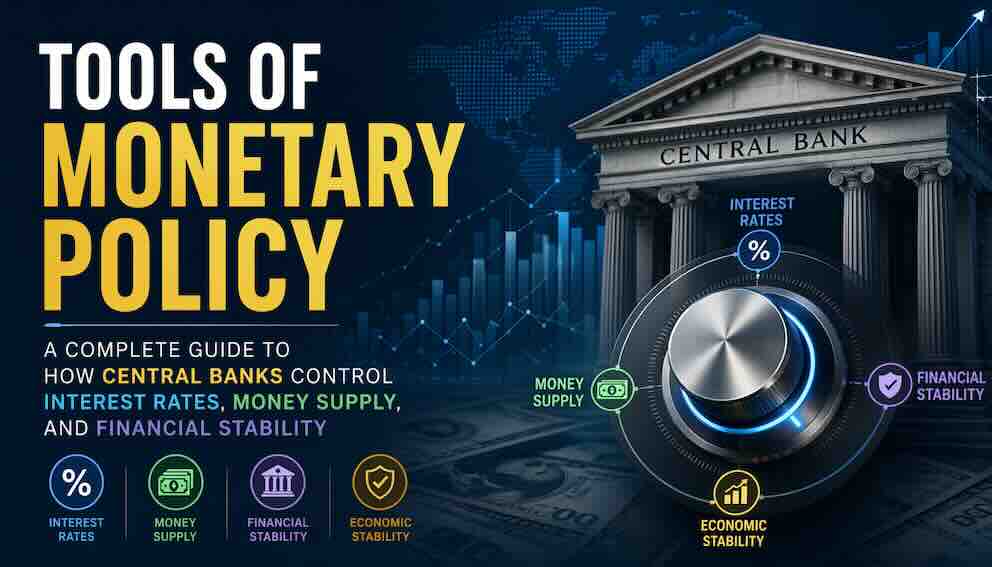
This tutorial explains the full set of tools that central banks use to implement monetary policy, from conventional tools like interest rates and open market operations to unconventional tools like quantitative easing and forward guidance. You will learn how each tool works step by step, why central banks had to invent new tools after the 2008 financial crisis, and how tools like interest on reserves create a floor under borrowing costs. Using vivid examples including a bakery owner deciding whether to buy a new oven, a family struggling with mortgage payments, and the Federal Reserve's response to the COVID-19 pandemic, the tutorial compares the tools across speed, strength, and appropriate use cases. The evaluation section presents both sides of the debate over quantitative easing and explains why central banks sometimes struggle to shrink their balance sheets after a crisis ends.
The Big Picture: What Are the Tools of Monetary Policy and Why Do They Matter?
Imagine for a moment that you are the chair of the Federal Reserve. You have just received the latest economic data, and the news is not good. Inflation is running at six percent, well above your two percent target. Unemployment is low, but wages are rising so quickly that businesses are raising prices to cover their higher labor costs. The economy is overheating, and you need to cool it down. What do you actually do?
You cannot simply announce that inflation will be lower. You cannot wave a magic wand. You have to use specific, concrete tools that will, through a long chain of cause and effect, eventually bring inflation back down. You have to decide whether to raise interest rates, and if so, by how much. You have to decide whether to sell bonds to pull money out of the banking system. You have to decide whether to change the rules that govern how much banks must hold in reserve. And you have to decide what to tell the public about your future plans, because what people expect to happen matters just as much as what actually happens.
These decisions are what we mean by the tools of monetary policy. A tool, in this context, is a specific action that the central bank can take to influence the availability and cost of money in the economy. Some tools are used every day, quietly and without fanfare. Other tools are used only in emergencies, when the normal tools have stopped working. Some tools are fast and precise. Other tools are slow and powerful, and using them feels a bit like swinging a sledgehammer when what you really need is a screwdriver.
In this tutorial, we will walk through each of the main tools that central banks use. We will start with the conventional tools: the policy interest rate, open market operations, and reserve requirements. Then we will move to the unconventional tools that central banks developed after the 2008 financial crisis: quantitative easing, forward guidance, and emergency lending facilities. We will also discuss two important modern implementation tools: interest on reserves and negative interest rates.
For each tool, we will trace the step-by-step mechanism that connects the central bank's action to the final effect on inflation and employment. We will use concrete examples, sometimes following a single small business owner named Maria and a single family named the Chens, to show how these abstract tools affect real people. And we will compare the tools against each other, not with a table but with a careful discussion of when and why a central banker would choose one tool over another.
By the end of this tutorial, you will have a complete picture of the central bank's toolbox. You will understand not just what the tools are, but how they work, why some are used more often than others, and why central bankers sometimes disagree about which tool is right for the job.
A Quick Note on Conventional vs. Unconventional Tools
Before we dive into the individual tools, we need to understand an important distinction. Central bankers divide their tools into two categories: conventional and unconventional.
Conventional tools are the ones that central banks used for decades before the 2008 financial crisis. These include the policy interest rate, open market operations, and reserve requirements. Conventional tools work by influencing short-term interest rates and the quantity of bank reserves. They are well understood, their effects are reasonably predictable, and they are sufficient for most economic conditions.
Unconventional tools are the ones that central banks had to invent or greatly expand after the 2008 crisis. These include quantitative easing, forward guidance, and emergency lending facilities. Unconventional tools are used when the policy rate has already been lowered to zero and the economy still needs more stimulus. In that situation, the conventional tools have run out of ammunition, and the central bank has to get creative.
The distinction matters because unconventional tools are less well understood, their effects are harder to predict, and they carry risks that conventional tools do not. Some economists worry that central banks have become too reliant on unconventional tools and that they will be slow to return to normal policy. Other economists argue that unconventional tools are here to stay and that central banks should embrace them as permanent additions to the toolkit. We will return to this debate in the evaluation section.
The Policy Interest Rate: The Central Bank's Main Lever
Let us start with the most important tool, the one that central bankers reach for first and use most often. The policy interest rate is the interest rate that banks charge each other for very short-term loans, usually overnight. In the United States, this is called the federal funds rate. In the United Kingdom, it is called the Bank Rate. In the eurozone, it is called the main refinancing operations rate.
When you hear on the news that the Federal Reserve has "raised interest rates" or "cut interest rates," this is the rate they are talking about. But here is a subtle but important point: the central bank does not actually set this rate directly. It sets a target for the rate, and then it uses other tools to push the actual market rate toward that target. In normal times, the central bank is very good at this, and the actual rate stays very close to the target. But technically, the central bank's tool is the target, not the rate itself.
Let me explain how the interest rate tool works, step by step, using a concrete example.
Step one: The central bank announces a new target for the policy rate. Let us say that inflation is too high, so the Federal Reserve announces that it is raising its target for the federal funds rate from 4 percent to 5 percent. This announcement alone moves financial markets. Bond traders adjust their positions, and long-term interest rates often move immediately in anticipation of the change.
Step two: The central bank uses its implementation tools (which we will discuss in the next section) to make the actual market rate move to the new target. It sells bonds to pull reserves out of the banking system, which pushes the federal funds rate up to 5 percent.
Step three: Commercial banks adjust their own interest rates. When the federal funds rate rises, banks raise the prime rate, which is the rate they charge their best customers. They raise rates on car loans, on credit cards, on adjustable-rate mortgages, and on business lines of credit. A typical pattern is that when the Federal Reserve raises its rate by 1 percent, banks raise their prime rate by 1 percent, and mortgage rates rise by about 0.5 to 0.75 percent.
Step four: Households and businesses change their borrowing and spending decisions. Let me give you a concrete example. Remember Maria, the bakery owner? She has been thinking about buying a new industrial oven for $50,000. At an interest rate of 4 percent, her monthly payment would be about $920, and she calculates that the new oven will increase her sales enough to cover that payment. At an interest rate of 5 percent, her monthly payment rises to about $940. That is not a huge difference, so she might still buy the oven. But at an interest rate of 8 percent, her monthly payment jumps to about $1,015, and suddenly the math no longer works. She postpones the oven. The bakery equipment supplier loses a sale, so it lays off a worker. That worker stops buying coffee at the café next door. The café reduces its hours. One small change in Maria's borrowing decision, multiplied across millions of businesses and millions of families, adds up to a significant change in total spending across the entire economy.
Step five: The change in total spending affects inflation and output. When interest rates are low and spending increases, businesses see higher demand for their products. They raise prices more quickly, which increases inflation. They also hire more workers and produce more goods, which increases output and reduces unemployment. When interest rates are high and spending decreases, businesses see lower demand. They raise prices more slowly, which reduces inflation. They may also lay off workers and reduce production, which reduces output and increases unemployment.
The entire process from a rate change to a measurable change in inflation typically takes twelve to eighteen months. This long delay is one of the most frustrating aspects of monetary policy. The central bank has to act based on forecasts of where the economy will be in a year or two, not based on where it is today.
The policy interest rate is a powerful tool, but it has a critical limitation: it cannot go much below zero. If the central bank lowers its target to zero and the economy is still in a recession, it cannot lower it further. This is called the zero lower bound, and it is the reason central banks had to develop unconventional tools after 2008. When the policy rate hits zero, the central bank has to reach for other tools.
Open Market Operations: The Engine Behind the Interest Rate
Now that we understand the policy interest rate target, we need to understand how the central bank actually makes the market interest rate move to that target. The traditional answer is open market operations.
Open market operations are simply the buying and selling of government bonds by the central bank. The name comes from the fact that the central bank does these transactions in the "open market," meaning it buys and sells bonds from and to any bank that wants to participate, not from a specific chosen bank.
Let me walk you through how open market operations work, step by step.
Step one: The central bank decides whether it wants to add reserves to the banking system or remove reserves from the banking system. If it wants to lower interest rates, it adds reserves. If it wants to raise interest rates, it removes reserves.
Step two: The central bank goes into the open market and either buys or sells government bonds. To lower interest rates, the central bank buys bonds from banks. It pays for those bonds by creating new money and depositing that money directly into the banks' reserve accounts at the central bank. Suddenly, the banks have more reserves than they need. Banks earn very little interest on reserves, so they have a strong incentive to lend those excess reserves to other banks that might need them. When many banks are trying to lend excess reserves, the interest rate that banks charge each other for overnight loans falls. That rate is the policy rate, and it falls exactly to the central bank's target.
To raise interest rates, the central bank does the opposite. It sells bonds to banks. The banks pay for those bonds by transferring reserves from their accounts at the central bank to the central bank's own account. The banks' reserves fall. With fewer reserves, banks become more cautious about lending. Some banks may find themselves short of reserves and need to borrow from other banks. When more banks need to borrow and fewer banks have excess reserves to lend, the interest rate that banks charge each other rises to the central bank's target.
Step three: The change in the policy rate spreads through the economy exactly as we described in the previous section.
Open market operations are the central bank's workhorse tool for day-to-day policy implementation. Every business day, the Federal Reserve buys or sells small amounts of bonds to keep the federal funds rate within a narrow range around its target. Most people never notice this happening, but it is happening constantly.
However, open market operations have a limitation that became painfully clear after 2008. They work by making reserves more or less scarce. But after the financial crisis, the Federal Reserve created so many reserves through quantitative easing that reserves were no longer scarce. Banks had trillions of dollars of excess reserves, so adding or removing a few billion dollars through open market operations had almost no effect on the policy rate. The old mechanism stopped working. This is why central banks had to develop a new implementation tool: interest on reserves.
Interest on Reserves: The Modern Implementation Tool
Let me explain interest on reserves, because it is not a tool that most people learn about in introductory economics, but it has become essential for understanding how modern central banking actually works.
Before 2008, central banks kept the supply of reserves relatively scarce. Banks held only the minimum reserves they needed, and the central bank could move the policy rate up or down by adding or removing a relatively small amount of reserves. But after 2008, the Federal Reserve and other central banks created trillions of dollars of new reserves through quantitative easing. Suddenly, banks had enormous piles of excess reserves. In this new environment, the old open market operations stopped working because banks did not need to borrow reserves from each other. They already had plenty.
The solution was for the central bank to start paying interest on the reserves that banks hold. Here is how it works, step by step.
Step one: The central bank announces the interest rate it will pay on bank reserves. This is a policy decision, just like setting the federal funds rate target. In fact, the Federal Reserve now sets its interest on reserves rate as its primary policy rate.
Step two: Banks compare the interest they can earn by holding reserves at the central bank with the interest they can earn by lending those reserves to other banks. Because the central bank is completely safe, banks will never lend reserves to each other at a rate lower than they can earn by simply holding them at the central bank. This means that the interest rate on reserves becomes a floor under market interest rates. The policy rate cannot fall below the interest rate on reserves.
Step three: The central bank can raise the policy rate simply by raising the interest rate it pays on reserves. Banks will not lend reserves to each other for less than they can earn at the central bank, so market interest rates rise to match the new, higher rate.
Step four: The central bank can also lower the policy rate by lowering the interest rate it pays on reserves. But there is a catch: the interest rate on reserves cannot go much below zero, because if the central bank tried to charge banks for holding reserves, banks would simply withdraw their reserves as physical cash. This is why the zero lower bound still exists even with interest on reserves.
This mechanism is how modern central banks control interest rates in a world of abundant reserves. The Federal Reserve, the Bank of England, and the European Central Bank all use interest on reserves as their primary implementation tool. Open market operations still happen, but they are no longer the main mechanism. Interest on reserves is not a separate policy tool in the sense of stimulating or contracting the economy; it is an implementation tool that makes the interest rate tool work in the modern financial system.
6. Reserve Requirements: The Blunt Tool That Fell Out of Favor
Let us now turn to a tool that was once very important but is now rarely used: reserve requirements. Reserve requirements are rules that force banks to hold a certain percentage of their deposits as reserves, either as cash in their vaults or as deposits at the central bank.
Here is how reserve requirements work, step by step.
Step one: The central bank changes the required reserve ratio. This is the percentage of deposits that banks must hold as reserves. For example, if the reserve requirement is 10 percent, then for every $100 that a bank takes in as a deposit, it must hold $10 as reserves and can lend out the remaining $90. If the central bank lowers the reserve requirement to 5 percent, the bank can lend out $95 of every $100 deposit instead of $90. That extra $5 of lending capacity, multiplied across thousands of banks and millions of deposits, adds up to a significant increase in the total money supply.
Step two: Banks adjust their lending in response to the new reserve requirement. When the requirement is lowered, banks suddenly find that they have excess reserves that they are no longer required to hold. They lend those excess reserves out, which creates new deposits at other banks, which creates more excess reserves, which leads to more lending. This is called the money multiplier effect. When the requirement is raised, banks find that they are short of reserves. They must call in loans or sell assets to raise reserves, which reduces lending and contracts the money supply.
Step three: The change in lending affects spending and inflation. More lending means more spending, which pushes inflation up and unemployment down. Less lending means less spending, which pushes inflation down and unemployment up.
Reserve requirements are a very powerful tool, but they are also very blunt. Let me explain what I mean by blunt. A small change in the reserve requirement affects every bank in the country, from the smallest community bank to the largest international bank, in exactly the same way. But these banks are not the same. A community bank that makes mostly local small business loans has a different lending pattern than a giant bank that makes mostly corporate loans. A bank that specializes in mortgages has a different risk profile than a bank that specializes in credit cards. The one-size-fits-all nature of reserve requirements means that a change intended to affect the whole economy might hit some banks much harder than others, in ways that the central bank cannot predict or control.
For this reason, most major central banks have stopped using reserve requirements as an active tool. The Federal Reserve set reserve requirements to zero percent in March 2020 and has not changed them since. The Bank of England and the European Central Bank have also moved away from using reserve requirements actively. The tool still exists, and it could be revived in an emergency, but for now, it sits in the toolbox, unused.
7. Quantitative Easing: Buying Bonds on a Massive Scale
Now we come to the tool that everyone has heard of but few people fully understand: quantitative easing, often abbreviated as QE. Quantitative easing is the large-scale purchase of financial assets by the central bank when the policy rate is already at zero and cannot go lower.
Let me explain why quantitative easing became necessary. After the 2008 financial crisis, the Federal Reserve lowered its policy rate to zero. But the economy was still in a deep recession. Banks were not lending. Businesses were not investing. Families were not spending. The central bank had used its conventional tool (the interest rate) as much as it could, and it was not enough. It needed a new way to stimulate the economy.
Here is how quantitative easing works, step by step.
Step one: The central bank announces a large-scale asset purchase program. It might say, for example, that it will buy $100 billion of government bonds per month for six months, or that it will buy $800 billion of bonds and mortgage-backed securities in total. The scale is enormous. Normal open market operations might involve buying or selling a few billion dollars of bonds. Quantitative easing involves buying hundreds of billions or even trillions of dollars.
Step two: The central bank creates new money and uses it to buy bonds from banks, pension funds, insurance companies, and other financial institutions. Just like with open market operations, the central bank pays for these bonds by adding reserves to the sellers' accounts. But unlike normal open market operations, the goal is not to lower the overnight policy rate, which is already at zero. The goal is to lower long-term interest rates, such as the ten-year government bond rate.
Step three: The large-scale purchases drive down long-term interest rates. When the central bank buys a large quantity of ten-year government bonds, it increases the demand for those bonds. Higher demand pushes up the price of the bonds, and when bond prices go up, the interest rate on those bonds goes down. This is a mechanical relationship: bond prices and bond yields move in opposite directions.
Let me give you a concrete example. Suppose that before quantitative easing, the ten-year government bond yields 4 percent. The Federal Reserve starts buying billions of dollars of these bonds every month. The increased demand pushes the price up, and the yield falls to 3 percent. That one percentage point drop in long-term interest rates might not sound like much, but it has enormous effects. Mortgage rates are closely tied to ten-year bond yields, so mortgage rates fall. A family buying a $300,000 house saves about $170 per month for every one percentage point drop in their mortgage rate. That is real money that they can spend on other things.
Step four: The central bank's purchases also create a portfolio balance effect. Pension funds and insurance companies that sell their government bonds to the central bank now have cash that they need to invest. They cannot earn much interest by holding cash, so they look for other assets to buy. They might buy corporate bonds, which pushes down corporate borrowing costs and makes it cheaper for companies to invest. They might buy stocks, which pushes up stock prices and makes households feel wealthier, encouraging them to spend more. This is sometimes called the "reach for yield" effect, and it is a deliberate part of quantitative easing.
Step five: The lower long-term interest rates and higher asset prices stimulate spending, which increases inflation and output. The entire process takes time, just like with conventional interest rate changes, and the effects are harder to predict because quantitative easing works through multiple channels that are not as well understood.
Quantitative easing was used extensively after the 2008 financial crisis by the Federal Reserve, the Bank of England, the European Central Bank, and the Bank of Japan. It was used again during the COVID-19 pandemic. Whether it works effectively and whether its side effects are worth the benefits are questions we will explore in the evaluation section.
Before we leave quantitative easing, I should mention one more thing: the exit problem. Once a central bank has bought trillions of dollars of bonds, how does it ever sell them back without causing interest rates to spike? This is a real concern. If the Federal Reserve tried to sell all the bonds it bought during QE, the sudden increase in supply would push bond prices down and interest rates up, potentially causing a recession. So central banks have been very cautious about shrinking their balance sheets. The Federal Reserve has tried several times to "normalize" its balance sheet, and each time it has run into problems. This is one of the main criticisms of quantitative easing: it is easy to start but very hard to stop.
Forward Guidance: Shaping Expectations Without Moving a Muscle
Now we come to a tool that many introductory treatments miss entirely, but that has become one of the most important tools in the modern central bank's arsenal. Forward guidance is simply communication about future policy. The central bank announces what it plans to do with interest rates or quantitative easing in the future, and that announcement shapes expectations and behavior today.
Let me explain why forward guidance is so powerful. Remember that monetary policy works partly through the expectations channel. What people expect to happen in the future shapes what they do today. If you expect that interest rates will rise next year, you might delay borrowing until after the rise, or you might borrow now to lock in today's lower rates. If you expect that rates will stay low for years, you might feel confident taking out a mortgage or a business loan.
The central bank can influence these expectations simply by talking. It does not have to actually change the policy rate. It does not have to buy or sell any bonds. It just has to make a credible promise about the future.
Here is how forward guidance works, step by step.
Step one: The central bank makes a public statement about its future policy intentions. There are different forms of forward guidance. Calendar-based guidance says something like "we will keep rates at zero until the end of 2024." State-based guidance says something like "we will not raise rates until unemployment falls below 5 percent." Open-ended guidance says something like "we will keep rates low for a considerable period." The form matters, but the principle is the same: the central bank is making a promise about the future.
Step two: Financial markets and the public update their expectations based on this guidance. If the central bank promises to keep rates low for two years, investors believe that short-term rates will remain low, so they buy longer-term bonds, which pushes down long-term interest rates immediately. Businesses that were unsure about investing because they feared rising rates now feel confident that borrowing will remain cheap, so they invest now rather than waiting. Families who were worried about their mortgage payments resetting higher now know that payments will stay low, so they feel more secure and spend more.
Step three: These changes in long-term interest rates and confidence affect spending and inflation today, even though the central bank has not actually changed its policy rate yet. This is the magic of forward guidance: it works through expectations to move the economy before any action is taken.
Step four: The central bank must eventually follow through on its guidance, or else it will lose credibility. If the central bank says it will keep rates low for two years but then raises rates after one year, no one will believe its next forward guidance. Credibility is everything for forward guidance. This is why central banks are very careful about what they promise and why they sometimes use state-based guidance that depends on economic conditions rather than calendar-based guidance that depends on time.
A powerful real-world example of forward guidance occurred during the COVID-19 pandemic. In March 2020, the Federal Reserve lowered its policy rate to zero and announced that it would keep rates at zero until the economy had recovered and inflation was on track to exceed two percent. This forward guidance reassured financial markets that rates would not rise anytime soon, which lowered long-term interest rates and supported the economic recovery even as the pandemic raged.
Another example comes from the European Central Bank, which used forward guidance to fight deflation in the 2010s. The ECB promised to keep rates low and to continue its bond-buying program until inflation was sustainably above its target. This guidance helped to raise inflation expectations and prevent deflation from becoming entrenched.
Forward guidance is not a magic bullet. It only works if the central bank is credible. If the central bank has a history of breaking its promises, forward guidance will have little effect. This is why central banks work so hard to build and maintain their reputations for honesty and consistency.
Emergency Lending Facilities: The Lender of Last Resort
Before we move to the comparison and evaluation sections, let me briefly mention one more tool that central banks have: emergency lending facilities. When the financial system is in crisis and banks cannot borrow from each other, the central bank can step in as the lender of last resort. It lends directly to banks, and sometimes to large corporations or even to entire financial markets, to prevent a collapse.
The classic example is the 2008 financial crisis. After Lehman Brothers failed, the interbank lending market froze. Banks were so afraid of each other that they refused to lend, even overnight. The Federal Reserve responded by creating a series of emergency lending facilities. It lent directly to banks through the discount window. It lent to investment banks through the Primary Dealer Credit Facility. It lent to the commercial paper market so that companies could meet their payrolls. These emergency loans were not normal monetary policy; they were crisis management.
Emergency lending facilities are not used for normal monetary policy. They are used only in extreme circumstances when the normal tools are not enough and when the financial system is at risk of collapse. But they are an important tool in the central bank's toolbox, and understanding them helps you understand why central banks exist in the first place: to prevent financial panics from destroying the economy.
Comparing the Tools: Which One When?
Now that we understand each tool, let us compare them. Instead of using a table, I will walk you through the trade-offs that central bankers consider when choosing which tool to use.
Let us start with speed. How quickly does each tool affect the economy? The policy interest rate is relatively slow, taking twelve to eighteen months for the full effect. But the initial signal is instantaneous: as soon as the central bank announces a rate change, financial markets react. Open market operations are very fast in terms of their effect on the policy rate, but the broader economy is still slow. Reserve requirements are also slow because banks need time to adjust. Quantitative easing is the slowest, taking two to three years for the full effects. Forward guidance, by contrast, can be very fast. Because it works through expectations, its effects can be seen in financial markets within minutes of the announcement.
Now consider strength. How powerful is each tool? The policy interest rate is very strong in normal times. Moving the rate by one or two percentage points can end a recession or stop an inflation surge. But when rates hit zero, the tool has no more strength. Open market operations are as strong as the interest rate tool because they are the mechanism. Reserve requirements are extremely strong, almost too strong, which is why central banks avoid using them. Quantitative easing is of moderate strength. It can lower long-term rates and provide liquidity, but it is not as powerful as conventional rate cuts when those are available. Forward guidance can be very strong when the central bank is credible, but it is only as strong as the central bank's reputation.
Finally, consider typical use. When does a central banker reach for each tool? The policy interest rate is used in almost all normal conditions. Open market operations are used daily to implement the interest rate target. Reserve requirements are rarely used at all. Quantitative easing is used only when the policy rate is already at zero and the economy still needs stimulus. Forward guidance is used either when rates are at zero and the central bank wants to provide additional stimulus, or when rates are positive but the central bank wants to manage expectations.
Let me put this in human terms. Imagine you are driving a car. The policy interest rate is the accelerator pedal. You use it constantly to control your speed. Open market operations and interest on reserves are the engine itself. You do not think about them separately because they are what makes the accelerator work. Reserve requirements are the emergency brake. It is very powerful, but using it is jarring, so you keep it off unless absolutely necessary. Quantitative easing is a secondary engine that you can turn on when the main engine has stalled. It provides some power, but it is less efficient and more controversial than the main engine. Forward guidance is your announcement of where you plan to go next. It costs nothing, it works immediately, but it only works if you have a reputation for telling the truth.
Real-World Examples: Tools in Action
Let us understand this with real-world episodes that you may not have encountered in every other economics tutorial. Each episode shows a different set of tools being used in different circumstances, and together they illustrate the full range of the central bank's toolkit.
The Volcker Disinflation of 1979 to 1982: Using the Interest Rate Tool with Brutal Force
Before we discuss unconventional tools, it is worth understanding the most dramatic use of the conventional interest rate tool in modern history. In 1979, Paul Volcker became the chair of the Federal Reserve, and he inherited an economy that was falling apart. Inflation had reached 11 percent and was still rising. Gasoline prices had doubled. Workers demanded cost-of-living adjustments in their contracts. Businesses raised prices every quarter automatically. Inflation expectations had become unmoored, which meant that the expectations channel was working in the wrong direction.
Volcker decided that he had to break inflation, no matter what it cost. He raised the federal funds rate target dramatically. In October 1979, he announced a series of rate hikes that would push the policy rate above 17 percent. By 1981, the rate peaked at 19 percent. Let me put that number in perspective. A 19 percent interest rate means that a family with a $100,000 mortgage would have been paying nearly $1,600 per month in interest alone. A business borrowing $1 million for a new factory would have been paying $190,000 per year just in interest. Borrowing effectively stopped.
The result was a severe recession. Unemployment rose to nearly 11 percent, the highest level since the Great Depression. Construction workers stood in breadlines. Farmers blockaded the Federal Reserve building with their tractors. Car dealers sent Volcker the keys to unsold cars. Home builders mailed him two-by-fours. The political pressure was intense. Members of Congress called for Volcker's resignation. The White House privately begged him to ease up.
But Volcker held his course. He kept rates high until inflation fell. By 1983, inflation was down to around 3 percent. The recession ended, and the economy began a long period of expansion. Volcker had broken the back of inflation, and he had restored the credibility of the Federal Reserve. When he left office, inflation expectations were anchored. The public believed that the central bank would keep inflation low, and that belief became self-fulfilling.
The Volcker disinflation teaches us two important lessons about the interest rate tool. First, the tool is powerful enough to end even the most entrenched inflation, but it requires courage and a willingness to accept short-term pain for long-term gain. Second, the tool works partly through the expectations channel. By demonstrating that he was serious about fighting inflation, Volcker convinced the public to expect lower inflation in the future, which helped to bring inflation down even before the full effects of the rate hikes had been felt. This is why modern central bankers talk constantly about their "credibility." They learned from Volcker that what you say matters just as much as what you do.
The Japanese Lost Decade and Beyond: A Cautionary Tale of the Zero Lower Bound
Now let us travel to Japan in the 1990s. Japan had experienced a massive bubble in stock prices and real estate in the 1980s. When the bubble burst in 1990 and 1991, stock prices fell by 60 percent and land prices fell by 70 percent. Banks were left with enormous bad loans. Businesses stopped investing. Families stopped spending. The economy went into a recession that would last, in various forms, for more than two decades.
The Bank of Japan, Japan's central bank, did what central banks are supposed to do. It lowered interest rates. It lowered them again. And again. By 1995, the policy rate had fallen to 0.5 percent. By 1999, it had fallen to zero. The Bank of Japan had hit the zero lower bound. It could not lower rates any further.
But the economy was still stuck. Prices began to fall. This was deflation, the opposite of inflation, and it was even more dangerous. When prices are falling, people delay purchases because they know that things will be cheaper next month. Businesses delay investment because they know that equipment will be cheaper next year. The economy stops moving. The Bank of Japan had run out of conventional ammunition.
So Japan became the first major economy to try unconventional tools. In 2001, the Bank of Japan launched the world's first quantitative easing program. It started buying government bonds from banks on a large scale, creating new money to pay for them. The goal was to increase the money supply and push up inflation expectations. The Bank of Japan also began using forward guidance, promising to keep rates at zero until deflation was defeated.
But here is the difficult truth: for more than a decade, these tools did not seem to work very well. Japan remained stuck in deflation and slow growth. The economy would have brief periods of recovery, but then it would slip back. By 2013, Japan had experienced fifteen years of falling or stagnant prices. The Bank of Japan had tried everything, and nothing had produced a sustained recovery.
What changed? In 2013, the Bank of Japan launched a new, much more aggressive quantitative easing program under a new governor, Haruhiko Kuroda. The bank announced that it would double the money supply and aim for 2 percent inflation. It bought government bonds on an unprecedented scale, eventually owning more than half of all Japanese government bonds outstanding. It used forward guidance to promise that it would not stop until inflation was firmly above target.
And this time, it worked. Inflation rose to 2 percent. The economy grew. Japan finally escaped from deflation. The lesson is that quantitative easing and forward guidance can work, but they need to be done on a large enough scale and with enough commitment to be credible. Half measures are not enough. When a central bank is at the zero lower bound, it must be willing to use its unconventional tools aggressively and to promise to keep using them until the job is done.
The Japanese experience also teaches us about the limits of monetary policy. Even after Japan escaped deflation, its growth rate remained modest. The underlying problems in the Japanese economy were not monetary. They were demographic (an aging population), structural (rigid labor markets and protected industries), and fiscal (a very high government debt burden). No amount of quantitative easing could solve those problems. This is an important limitation of all monetary policy tools: they can smooth out the business cycle, but they cannot fix fundamental structural problems in the economy.
Sweden and Negative Interest Rates: Below Zero
When most people hear about interest rates, they assume that rates cannot go below zero. Why would anyone pay to borrow money? Why would anyone accept a negative return on their savings? And yet, several central banks have pushed their policy rates below zero. The most interesting example is Sweden.
In 2009, the Swedish central bank, the Riksbank, became the first central bank in the world to push its policy rate below zero. It lowered its deposit rate to negative 0.25 percent. This meant that commercial banks were charged for holding reserves at the Riksbank. Instead of earning interest on their reserves, banks had to pay a fee.
Why would the Riksbank do something so strange? Because Sweden was facing a deep recession and the policy rate was already at zero. The central bank wanted to provide more stimulus, but it could not lower rates further in the conventional way. So it tried negative rates. The idea was to punish banks for holding reserves and to encourage them to lend instead. If holding reserves costs you money, you will lend that money out, even if you have to accept a very low interest rate on the loan.
The negative rate experiment worked better than many economists expected. Banks did increase lending. The economy did recover. The Riksbank kept its policy rate negative for several years, eventually pushing it as low as negative 0.50 percent. Other central banks followed. The European Central Bank took its deposit rate to negative 0.50 percent. The Bank of Japan took its policy rate to negative 0.10 percent. The Swiss National Bank went even further, to negative 0.75 percent.
However, negative interest rates have limits. If a central bank pushes rates too far negative, banks will simply withdraw their reserves as physical cash and store it in vaults. Cash pays zero interest, so it is better than paying a fee to hold reserves. The cost of storing and insuring large amounts of cash creates a floor for how negative rates can go. Most economists think the practical limit is somewhere around negative 0.75 percent to negative 1 percent.
Negative interest rates also have side effects. They hurt banks' profitability, because banks cannot easily pass negative rates on to their depositors. If a bank tried to charge you a negative interest rate on your checking account, you would withdraw your money and put it under your mattress. So banks are stuck paying the negative rate on their reserves while still paying zero to their depositors, which squeezes their profits. This can make banks more fragile, which is the opposite of what a central bank wants.
The Swedish experiment with negative rates ended in 2019, when the Riksbank raised its policy rate back to zero. The European Central Bank and the Bank of Japan have kept their rates negative for longer. The lesson is that negative interest rates are a possible tool when the central bank has hit the zero lower bound, but they are not a first choice. They are awkward, they have side effects, and they cannot go very far below zero. They are a tool of last resort, used only when all other options have been exhausted.
The 1994 Bond Market Massacre: When Forward Guidance Goes Wrong
Forward guidance is a powerful tool, but it can also backfire spectacularly. The best example of forward guidance gone wrong is the bond market crash of 1994, which is sometimes called the "Great Bond Massacre."
Let me set the scene. In the early 1990s, the Federal Reserve had kept interest rates very low to help the economy recover from a recession. The Fed had communicated clearly that it intended to keep rates low for a long time. Bond markets believed this guidance, so they pushed long-term interest rates down to very low levels. Investors poured money into bonds, confident that rates would stay low.
But then, in February 1994, the new Federal Reserve chair, Alan Greenspan, surprised everyone. The Fed raised interest rates. Not by a small amount, but by a quarter point. Then it raised them again in March. Then again in April. Then again in May. By the end of the year, the Fed had raised rates seven times, from 3 percent to 5.5 percent.
The bond market was caught completely off guard. Investors had believed the Fed's forward guidance that rates would stay low. When the Fed raised rates instead, bond prices plummeted. Remember that bond prices and interest rates move in opposite directions. When interest rates rise, existing bonds with lower rates become less valuable. The losses were enormous. Some hedge funds lost all their money. Orange County, California, a wealthy county that had borrowed heavily using derivatives, went bankrupt. The bond market lost more than $1 trillion in value.
What went wrong? The Federal Reserve had provided forward guidance that was too vague and too optimistic. It had said that rates would stay low, but it had not explained the conditions under which it might raise rates. When the economy recovered faster than expected, the Fed felt that it had to raise rates to prevent inflation. But the market had not anticipated this, because the Fed had not communicated its reaction function clearly.
The lesson of 1994 is that forward guidance is only useful if it is credible and if it is conditional on economic conditions. Modern central banks have learned from this mistake. They now use state-based forward guidance that explicitly ties their future actions to economic data. For example, the Federal Reserve said after the 2008 crisis that it would keep rates low until unemployment fell below 6.5 percent. This kind of conditional guidance gives the market a clear framework for understanding when rates might rise, so there are no surprises.
The 1994 bond market massacre is a reminder that all monetary policy tools carry risks. Even something as simple as talking about the future can, if done poorly, cause enormous damage.
Evaluation: How Well Do These Tools Work, and What Are the Risks?
Now that we have seen the tools in action, let us step back and evaluate them. Each tool has strengths and weaknesses, and economists disagree about how effective some of the newer tools really are.
The Interest Rate Tool: Powerful but Limited
The interest rate tool is the most effective tool in normal times. It is precise: the central bank can raise or lower rates by a quarter point, wait to see what happens, and then adjust again. It is predictable: the transmission channels are well understood, even if the lags are long. And it is politically sustainable: raising or lowering rates by small amounts does not provoke the kind of controversy that quantitative easing does.
But the interest rate tool has two major limitations. The first is the zero lower bound. Once rates hit zero, the tool stops working. This is why Japan, the United States, and Europe all had to turn to unconventional tools after their recessions. The second limitation is that the interest rate tool is a blunt instrument in a different sense. When the central bank raises rates, it affects the entire economy, even parts that do not need cooling down. A family that was responsible with its borrowing and did not take on too much debt still has to pay higher mortgage rates. A business that is thriving and wants to expand still faces higher borrowing costs. The central bank cannot target its rate changes to help some sectors while leaving others alone.
Quantitative Easing: Effective but Controversial
Let me present both sides of the quantitative easing debate fairly, because reasonable economists disagree.
The case for quantitative easing is that it works when nothing else does. After the 2008 crisis, the Federal Reserve lowered rates to zero, but the economy was still in free fall. Quantitative easing provided additional stimulus that prevented a depression. By lowering long-term interest rates, it made mortgages cheaper and supported the housing market. By boosting stock prices, it created a wealth effect that encouraged spending. By buying mortgage-backed securities, it kept the housing finance system functioning. And by signaling that the Fed was committed to fighting deflation, it anchored inflation expectations. Without quantitative easing, the recession would have been much worse.
The case against quantitative easing is that the benefits are small and the costs are large. Critics point to Japan, where quantitative easing failed to produce sustained growth for more than a decade. They argue that the effects on long-term interest rates are modest at best, and that most of the benefit comes from the signal effect, which could be achieved with forward guidance alone. They also point to the side effects. Quantitative easing inflates asset bubbles. The low interest rates of the QE era pushed investors into riskier and riskier assets, creating bubbles in stocks, bonds, and real estate. When those bubbles eventually burst, the economy suffers. Quantitative easing also worsens inequality. The wealthy own most of the assets that QE pushes up in value, so they benefit directly. Ordinary workers see little benefit, especially if the recovery is weak and wages do not rise.
My balanced judgment is that quantitative easing is a useful tool in a crisis, but it is overused in normal times. When the financial system is frozen and the economy is in free fall, as in 2008, quantitative easing can be a lifesaver. But central banks have been too slow to exit from QE, and they have used it in situations where conventional tools would have been sufficient. The best approach is to treat quantitative easing as a tool of last resort, to be used only when the policy rate is at zero and the economy is still in a severe recession, and to be withdrawn as quickly as possible once the crisis has passed.
Forward Guidance: Powerful but Dangerous
Forward guidance is a very effective tool when used correctly, but it carries serious risks. The main benefit of forward guidance is that it works instantly and at no cost. The central bank does not have to buy any bonds or change any rates. It just has to talk. And because it works through expectations, it can lower long-term interest rates and boost confidence almost immediately.
The main risk of forward guidance is that it can backfire if the central bank is wrong about the future. In 1994, the Federal Reserve's forward guidance that rates would stay low turned out to be wrong, and the result was a bond market crash. More recently, central banks have struggled with forward guidance during the inflation surge of 2021 to 2023. The Federal Reserve had been saying that inflation was "transitory" and that rates would stay low. When inflation proved persistent, the Fed had to reverse its guidance abruptly, which damaged its credibility.
The other risk is that forward guidance can trap the central bank. If the Fed promises to keep rates low until unemployment falls to 5 percent, but then inflation spikes when unemployment is at 5.5 percent, the Fed has to choose between breaking its promise (which damages credibility) and letting inflation run hot (which damages the economy). This is why modern central banks use conditional forward guidance that gives them room to maneuver. They might say "we will keep rates low until labor market conditions have improved substantially, subject to inflation remaining well-behaved." The vague language gives them flexibility, but it also makes the guidance less powerful.
Negative Interest Rates: Awkward but Sometimes Necessary
Negative interest rates are a tool that works in theory but is awkward in practice. The theoretical case is clear: if the central bank wants to provide more stimulus but cannot lower positive rates any further, it can push rates slightly negative. This encourages banks to lend rather than hoard reserves.
The practical problems are significant. Negative rates hurt bank profits, which can make the financial system more fragile. They also create strange incentives. If a central bank charges banks for holding reserves, banks might simply lend that money to anyone, even risky borrowers, just to avoid the fee. This can inflate asset bubbles and lead to bad loans. And negative rates have a hard floor: banks can always hold physical cash instead of reserves, so the central bank cannot push rates much below zero.
The evidence on negative rates is mixed. Sweden had a positive experience with them, and the Swedish economy recovered well. The European Central Bank has kept rates negative for years, and the eurozone economy has grown slowly but steadily. Japan's experience with negative rates has been less impressive. On balance, negative interest rates are a tool that central banks should keep in their toolbox, but they should be used sparingly and only when the benefits clearly outweigh the costs.
Emergency Lending Facilities: Essential in a Crisis
Emergency lending facilities are not a tool for normal monetary policy, but they are essential for financial stability. When the financial system freezes, as it did in 2008, the central bank must step in as the lender of last resort. This is not controversial among economists. The only debate is about the terms of the lending: should the central bank lend only to banks, or also to non-bank financial institutions? Should it demand collateral, and if so, what kind? Should it publicize which institutions have borrowed from it, or keep the loans secret to avoid stigma?
The 2008 crisis showed that central banks need broad authority to lend to a wide range of institutions. The Federal Reserve's emergency lending facilities lent to investment banks, to money market funds, to the commercial paper market, and even to large corporations like General Electric. These loans prevented a complete collapse of the financial system. The lesson is that emergency lending facilities are not just a tool; they are a core responsibility of any central bank.
Putting It All Together: Choosing the Right Tool for the Right Job
Let me leave you with a framework for thinking about which tool a central banker should use in which situation.
If the economy is in a normal recession, with inflation below target and unemployment above the natural rate, the central banker should use the interest rate tool. Lower the policy rate by a quarter point or a half point, wait to see what happens, and then adjust again. This is the standard, well-understood, low-risk approach.
If the economy is in a normal expansion, with inflation above target and unemployment below the natural rate, the central banker should also use the interest rate tool. Raise the policy rate gradually, communicating clearly that more rate hikes may follow. This is also standard and well understood.
If the economy is in a severe recession and the policy rate has already been lowered to zero, the central banker should consider unconventional tools. Forward guidance is the first unconventional tool to try, because it costs nothing and works through expectations. The central banker should announce that rates will stay low until specific economic conditions are met. If forward guidance is not enough, the central banker should consider quantitative easing. The scale of QE should be large enough to be credible. Small, timid QE programs do not work, as Japan learned in the 2000s.
If the economy is in a financial crisis and the banking system has frozen, the central banker must use emergency lending facilities. This is not a choice; it is a necessity. The central banker should lend freely to solvent institutions against good collateral, at a penalty rate. This is the classic Bagehot rule, named after the nineteenth-century economist who first articulated it.
If the economy is in a deflationary trap and the central banker has tried everything else, negative interest rates are an option. But they should be used with caution, and the central banker should have a clear exit strategy.
The most important lesson of all is that no single tool is right for every situation. The central banker must be like a carpenter with a full toolbox, not a handyman who only knows how to use a hammer. The Volcker disinflation required the brutal use of the interest rate tool. The Japanese lost decade required patience and experimentation with unconventional tools. The 1994 bond market massacre was a lesson in the dangers of poor communication. The Swedish negative rate experiment showed that sometimes you have to do something that seems strange. The best central bankers are the ones who understand their tools deeply and who have the wisdom to choose the right tool for the job.
Conclusion
Let me leave you with a final reflection on the tools of monetary policy. A central bank is not a magician. It cannot simply wave a wand and make inflation disappear or make unemployment fall. It has a set of tools, each with its own strengths and weaknesses, each suited to different economic conditions, and each carrying its own risks. The interest rate tool is the workhorse, the tool that central bankers reach for first and use most often. Open market operations and interest on reserves are the quiet mechanisms that make the interest rate tool work, invisible to the public but essential to the functioning of the system. Reserve requirements are the old tool that has been set aside, still in the toolbox but rarely touched. Quantitative easing is the new tool, invented in response to the crisis of 2008, powerful but controversial, effective in some conditions and less effective in others. Forward guidance is the communicator's tool, cheap and fast but dangerous if used carelessly. Emergency lending facilities are the firefighter's tool, used only in emergencies but absolutely essential when those emergencies arrive.
Each tool works through a different mechanism, affects the economy at a different speed, and carries different risks. The art of central banking is knowing which tool to use, when to use it, how hard to use it, and when to stop. That art has been learned through decades of trial and error, through successes like the Volcker disinflation and failures like the 1994 bond market massacre, through the Japanese lost decade and the Swedish negative rate experiment. The next time you read that a central bank has raised interest rates, launched a quantitative easing program, or issued a new statement of forward guidance, you will understand not just what they are doing, but why they chose that particular tool over the alternatives. You will understand the trade-offs they face, the risks they are taking, and the limits of what monetary policy can achieve. And you will understand that behind every decision about interest rates or bond purchases is a human judgment about an uncertain future, a judgment that requires courage, humility, and a deep respect for the power of the tools in the central bank's hands.
About Swati Sharma
Lead Editor at MyEyze, Economist & Finance Research WriterSwati Sharma is an economist with a Bachelor’s degree in Economics (Honours), CIPD Level 5 certification, and an MBA, and over 18 years of experience across management consulting, investment, and technology organizations. She specializes in research-driven financial education, focusing on economics, markets, and investor behavior, with a passion for making complex financial concepts clear, accurate, and accessible to a broad audience.
Disclaimer
This article is for educational purposes only and should not be interpreted as financial advice. Readers should consult a qualified financial professional before making investment decisions. Assistance from AI-powered generative tools was taken to format and improve language flow. While we strive for accuracy, this content may contain errors or omissions and should be independently verified.