Tutorial Categories
Last Updated: May 7, 2026 at 18:30
The Monetary Policy Transmission Mechanism: How Central Bank Interest Rate Changes Actually Reach Your Wallet
Understanding the Interest Rate, Credit, and Asset Price Channels Through Which Monetary Policy Moves from the Central Bank's Meeting Room to Your Mortgage, Your Job, and Your Savings
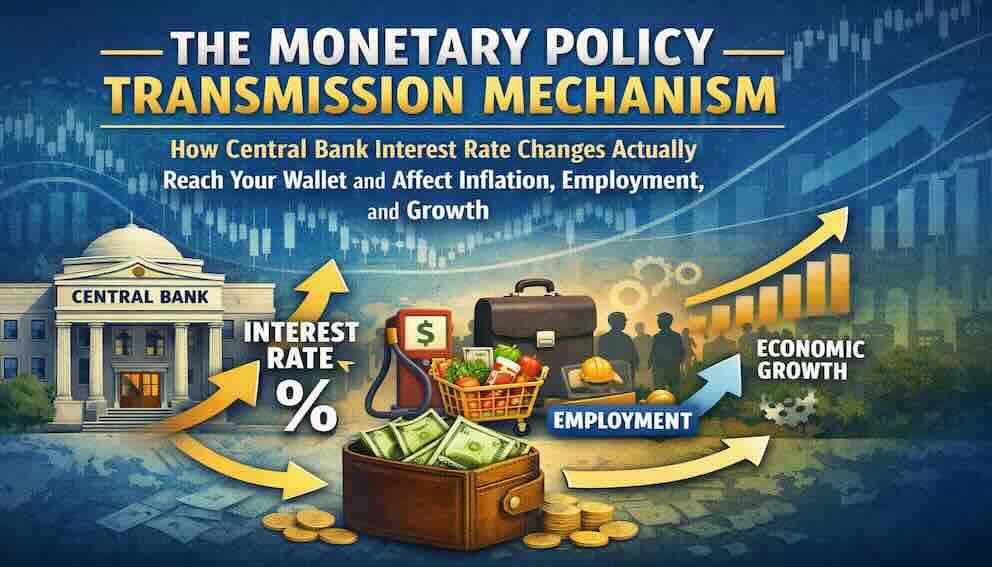
This tutorial explains the transmission mechanism of monetary policy—the causal chain through which a central bank's decision to raise or lower interest rates eventually affects inflation, output, and employment. You will learn how the interest rate channel makes borrowing cheaper or more expensive, how the credit channel changes banks' willingness to lend, and how the asset price channel influences household wealth through stocks and housing. Using real-world examples including the Swedish housing boom of the 2010s, the Swedish banking crisis of the early 1990s, and the United Kingdom's experience after the 2016 referendum, the tutorial shows why transmission sometimes works perfectly and other times breaks down. The evaluation section explains why the transmission mechanism weakens in a liquidity trap and why it depends on the health of the banking system.
What Is the Transmission Mechanism and Why Does It Matter?
Imagine you are the governor of the Bank of England. You announce that the Bank Rate will rise from 4 percent to 5 percent. Financial markets react instantly. But how long will it take for your decision to affect the price of bread, the unemployment rate, or the number of new houses being built?
The answer is what economists call the transmission mechanism of monetary policy: the process through which a change in the central bank's policy rate affects the broader economy, including inflation, output, and employment. It is called a mechanism because it is a sequence of events, each triggering the next, like falling dominoes.
Understanding the transmission mechanism is crucial for three reasons. First, it tells you why monetary policy works at all. Second, it tells you how long it takes—typically twelve to eighteen months for full effects. Third, it tells you when monetary policy might fail, such as in a liquidity trap or when the banking system is broken.
This tutorial walks through the three main channels: the interest rate channel (cost of borrowing), the credit channel (availability of borrowing), and the asset price channel (wealth effects). For each, we trace the causal chain step by step. We then evaluate when the mechanism works well and when it breaks down.
The Interest Rate Channel: The Most Direct Path
The interest rate channel is the direct effect of changes in the policy rate on the cost of borrowing for households and businesses.
Causal chain: Policy rate changes → commercial bank lending rates change → cost of borrowing changes → investment and consumption change → aggregate demand changes → inflation and output change.
Link One: From Policy Rate to Bank Lending Rates
When the central bank raises its policy rate, banks face higher costs for borrowing from each other. They pass these costs along to customers by raising the prime rate, mortgage rates, car loan rates, and credit card rates. When the central bank lowers the rate, the opposite happens.
The relationship is not one-to-one. Mortgage rates might rise by only 0.5 to 0.75 percent when the policy rate rises by 1 percent, because mortgages follow long-term bond yields. Credit card rates often rise by the full amount. But in normal times, the pass-through is reasonably complete.
Link Two: From Lending Rates to Borrowing Costs
Consider a family buying a £300,000 house with a 30-year mortgage. At 3 percent interest, their monthly payment is about £1,265. At 6 percent, it is about £1,800. That is a difference of £535 per month. Over the life of the loan, the lower rate saves nearly £200,000. This is why the interest rate channel is so powerful: small changes in the policy rate translate into large changes in household budgets.
For businesses, the effect is similar. A small business owner considering a £100,000 investment at 5 percent interest might see a viable project. At 8 percent, the same project may no longer make sense. She postpones. The equipment manufacturer loses a sale and reduces hours. Workers have less income and spend less. The effect multiplies.
Link Three: From Borrowing Costs to Spending
When borrowing becomes cheaper, households and businesses tend to borrow and spend more. When it becomes more expensive, they spend less. But this is not mechanical. A family already deep in debt might not borrow more even if rates fall. A pessimistic business might not invest even if credit is cheap. The interest rate channel is strongest when confidence is high and balance sheets are healthy.
In Sweden during the 2010s, the central bank kept rates very low, even slightly negative. Household borrowing surged. Swedes bought houses, renovated kitchens, and bought new cars. The economy grew steadily. But by the late 2010s, household debt reached nearly 200 percent of disposable income. When rates eventually rose, those highly indebted households faced severe payment shocks. The interest rate channel works powerfully in both directions.
Link Four: From Spending to Aggregate Demand to Inflation
When consumption and investment rise, aggregate demand rises. When aggregate demand rises faster than the economy's ability to produce, businesses raise prices and inflation increases. When demand falls below productive capacity, inflation decreases.
If the economy has spare capacity (unemployed workers, idle factories), an increase in demand mostly increases output and employment. If the economy is at full capacity, an increase in demand mostly increases inflation. This is why central bankers watch the output gap—the difference between actual and potential output.
The entire process from a rate change to a change in inflation takes twelve to eighteen months. This long lag is one of the most challenging aspects of monetary policy. The central bank must act based on forecasts of where the economy will be in a year or two.
The Credit Channel: When Banks Matter as Much as Interest Rates
The interest rate channel focuses on the price of borrowing. The credit channel focuses on the availability of borrowing. Even if interest rates are low, if banks will not lend, the transmission mechanism will not work.
Causal chain: Policy rate changes → bank reserves and capital change → banks' willingness to lend changes → availability of credit changes → investment and consumption change → aggregate demand changes → inflation and output change.
Link One: From Policy Rate to Bank Reserves and Capital
When the central bank lowers rates, it typically adds reserves to the banking system by buying bonds from banks. Banks have more capacity to lend. Also, when rates fall, the value of existing bonds held by banks rises, increasing bank capital. When bank capital is higher, banks are more willing to take risks, including making loans.
When the central bank raises rates, the opposite happens: reserves fall, bond values fall, bank capital falls, and banks become more cautious.
Link Two: From Bank Reserves to Willingness to Lend
When banks have plenty of reserves and strong capital, they relax lending standards. They approve loans they might have rejected. They offer lower down payments and longer terms. Small businesses that were told "not right now" suddenly hear "how much do you need?"
When banks are weak, they tighten standards. They require higher credit scores, larger down payments, and more collateral. Even creditworthy borrowers find the door to credit partly shut. Small businesses, which cannot easily issue bonds, are especially vulnerable.
Link Three: From Lending Availability to Spending
Consider a family that wants to buy a house. The interest rate is 5 percent, which is affordable. But the bank requires a 20 percent down payment, and the family only has 10 percent saved. The bank says no. The interest rate channel says they should buy. The credit channel says they cannot. The credit channel blocks transmission even when the interest rate channel is working.
This is why central banks pay close attention to bank lending surveys, which ask banks whether they are tightening or loosening standards. These surveys often predict economic activity better than the policy rate itself.
A Real-World Example: The Swedish Banking Crisis of the Early 1990s
In the late 1980s, Sweden experienced a massive boom in real estate and stock prices, fueled by rapid credit growth. Then the bubble burst. Real estate prices fell by more than 50 percent. Banks were left with enormous bad loans.
The Riksbank lowered interest rates sharply, from over 10 percent to under 4 percent. By the logic of the interest rate channel, this should have stimulated borrowing. But it did not. The credit channel had broken down. Banks were so damaged that they stopped lending almost entirely. Even creditworthy borrowers could not get loans. Unemployment rose from 2 percent to over 10 percent.
The government stepped in, creating a bank rescue agency that took over bad loans, closed weak banks, and recapitalized the rest. Once banks were healthy again, the credit channel started working, and the rate cuts began to stimulate the economy. Sweden recovered faster than almost any other country that experienced a similar crisis.
The lesson is that if the banking system is damaged, lower interest rates will not help much because banks will not lend.
The Asset Price Channel: How Interest Rates Affect Your Wealth
The asset price channel works through the effect of interest rates on the prices of stocks, bonds, and real estate. When these prices rise, households feel wealthier and spend more.
Causal chain: Policy rate changes → discount rates change → asset prices change → household wealth changes → consumption changes → aggregate demand changes → inflation and output change.
Link One: From Policy Rate to Discount Rates
The price of any financial asset is the present value of its future cash flows (dividends, interest payments, rent). The discount rate used to calculate present value is closely related to the policy rate. When the policy rate falls, the discount rate falls. When the discount rate falls, the present value of future cash flows rises. Lower interest rates mean higher asset prices.
Link Two: From Discount Rates to Asset Prices
When the central bank lowers rates, bond prices rise directly because existing bonds pay more than new bonds. Stock prices rise for two reasons: the discount rate falls, and lower rates make it cheaper for companies to borrow and invest, increasing future profits. House prices rise because lower mortgage rates increase demand and because the discount rate for future housing services falls.
The size of these effects depends on how long the rate change is expected to last. If the central bank signals that rates will stay low for a long time, the effect on asset prices is large. This is why forward guidance matters.
Link Three: From Asset Prices to Household Wealth
When asset prices rise, households that own those assets become wealthier. A family's house increases in value. A pension fund balance grows. A stock portfolio expands.
The distribution matters: wealthy households own most stocks and bonds; middle-class households own most housing wealth; poor households own very few assets.
Link Four: From Household Wealth to Consumption
When households feel wealthier, they spend more. A family whose house rises by £50,000 might take a more expensive vacation or renovate their kitchen. Estimates suggest that for every £1 increase in housing wealth, households spend 5 to 7 pence more per year. For stock market wealth, the figure is 2 to 4 pence. These numbers seem small, but multiplied across millions of households and trillions of pounds, the total effect is enormous.
A Real-World Example: The United Kingdom After the 2016 Referendum
After the Brexit vote in June 2016, there was widespread concern that the economy would slow sharply. The Bank of England cut rates from 0.5 percent to 0.25 percent and launched quantitative easing.
Lower rates caused bond yields to fall. Falling yields made pension funds shift into other assets, including commercial real estate. House prices, which had been flat, began to rise again. By the end of 2016, house prices were up 7 percent. Homeowners felt wealthier. Consumer confidence recovered. Spending held up much better than almost anyone had predicted.
The asset price channel had worked. But there was a cost: the same low rates that boosted house prices made it even harder for young people to buy their first home. The deposit required became larger. The transmission mechanism distributes its effects unevenly.
How the Three Channels Work Together
These three channels do not operate in isolation. They work together, reinforcing each other.
When the central bank lowers rates, the interest rate channel makes borrowing cheaper, the credit channel makes borrowing more available, and the asset price channel makes households wealthier. All three push toward more spending, higher inflation, and lower unemployment. When the central bank raises rates, all three push in the opposite direction.
The channels also interact. When house prices rise (asset price channel), households have more collateral, making banks more willing to lend (credit channel). This collateral effect amplifies monetary policy.
However, the channels can also conflict. Low rates boost asset prices but reduce the income of savers who rely on interest from bank deposits. In practice, the wealth effect usually dominates, but the income effect on savers is not zero.
Evaluation: Why the Transmission Mechanism Might Fail
The transmission mechanism is not a machine that always works perfectly. Under certain conditions, it can weaken or break.
The Liquidity Trap: When Rates Hit Zero
The most famous failure occurs at the zero lower bound. When the policy rate hits zero, the central bank cannot lower it further. The interest rate channel stops working. The asset price channel may still work through quantitative easing, but its effects are weaker. The credit channel may also work, but if the economy is in a deep recession, banks may be too damaged to lend.
Japan in the late 1990s and 2000s is the classic example. The Bank of Japan lowered rates to zero, but the economy remained stuck in deflation and slow growth. The transmission mechanism had largely broken down, leading to a lost decade.
Broken Banks: When the Credit Channel Fails
The credit channel can break down even when rates are positive. This happens when banks are so damaged by bad loans that they stop lending regardless of the policy rate. The Swedish crisis of the early 1990s, described above, is an example. The United States experienced a partial breakdown in 2008 and 2009, when banks tightened lending standards sharply even as the Federal Reserve lowered rates to zero.
Pessimistic Expectations: When Animal Spirits Fail
If households and businesses are deeply pessimistic, they will not borrow and spend even if credit is cheap and available. A family expecting to lose its job will not buy a new car. A business expecting a recession will not build a new factory. The term "animal spirits," coined by John Maynard Keynes, describes the instinctive confidence that drives economic activity. When animal spirits are low, the transmission mechanism weakens.
High Household Debt: When Transmission Works Too Well
In an economy with high household debt, the interest rate channel can become dangerously powerful. When the central bank raises rates, highly indebted households face large payment shocks and cut spending sharply, sometimes causing a deeper recession than intended. The transmission mechanism works too powerfully.
Asymmetry: Tightening Works Faster Than Easing
Rate hikes work faster and more reliably than rate cuts. Debt service effects are immediate: when rates rise, adjustable-rate mortgage payments increase the next month. When rates fall, households may save the extra money rather than spend it. Banks tighten lending standards quickly but loosen them slowly. And the zero lower bound means the central bank can always raise rates but cannot lower them below zero. As the saying goes, monetary policy is like pushing on a string when easing, but pulling a lever when tightening.
Conclusion
Monetary policy affects inflation through three main channels. The interest rate channel changes the cost of borrowing. The credit channel changes the availability of borrowing. The asset price channel changes household wealth and spending. All three operate with lags of twelve to eighteen months and depend on confidence, bank health, and the state of the business cycle.
The transmission mechanism can fail. At the zero lower bound, the interest rate channel stops working. When banks are damaged, the credit channel breaks down. When pessimism dominates, all channels weaken. And the mechanism is asymmetric: tightening works faster and more reliably than easing.
Two additional channels worth noting are the exchange rate channel (interest rates affect currency values, which affect net exports and import prices) and the expectations channel (central bank communications shape future expectations, which affect current decisions). These are important in open economies and in modern central banking, but they are beyond the scope of this introductory tutorial. Similarly, the distributional effects of monetary policy—winners and losers across borrowers and savers, homeowners and renters, young and old—are real and politically significant, though not central to understanding the core mechanism.
The transmission mechanism is the invisible infrastructure of monetary policy. It requires constant maintenance and occasional repair. The next time you hear that a central bank has changed interest rates, you will understand the long, uncertain journey that announcement takes through the economy before it finally affects the price of bread, the number of jobs, and the security of your own financial future.
About Swati Sharma
Lead Editor at MyEyze, Economist & Finance Research WriterSwati Sharma is an economist with a Bachelor’s degree in Economics (Honours), CIPD Level 5 certification, and an MBA, and over 18 years of experience across management consulting, investment, and technology organizations. She specializes in research-driven financial education, focusing on economics, markets, and investor behavior, with a passion for making complex financial concepts clear, accurate, and accessible to a broad audience.
Disclaimer
This article is for educational purposes only and should not be interpreted as financial advice. Readers should consult a qualified financial professional before making investment decisions. Assistance from AI-powered generative tools was taken to format and improve language flow. While we strive for accuracy, this content may contain errors or omissions and should be independently verified.