
Tutorial Categories
Last Updated: May 7, 2026 at 18:30
CBDCs Explained: How Central Bank Digital Currencies Work and Why They Matter
Understanding the Differences Between CBDCs, Cash, Bank Deposits, and Cryptocurrencies, and Why Central Banks Are Worried About Bank Runs and Privacy
This tutorial explains what Central Bank Digital Currencies are, how they differ from the money you already use every day, and why central banks from China to Sweden to the United Kingdom are exploring whether to issue their own digital money. You will learn how CBDCs would work in practice, including the crucial distinction between retail CBDCs available to the public and wholesale CBDCs restricted to financial institutions. The tutorial then examines the policy implications of CBDCs, including the potential for more precise control over the money supply and faster transmission of monetary policy, as well as the risks of bank disintermediation and deposit flight during financial crises. Using real-world examples including China's digital yuan, Sweden's e-krona project, and the Bahamas' Sand Dollar (the world's first fully deployed CBDC), the tutorial provides a balanced evaluation of the efficiency gains, transparency benefits, privacy concerns, and financial stability risks that central banks must weigh before deciding whether to issue digital currencies.
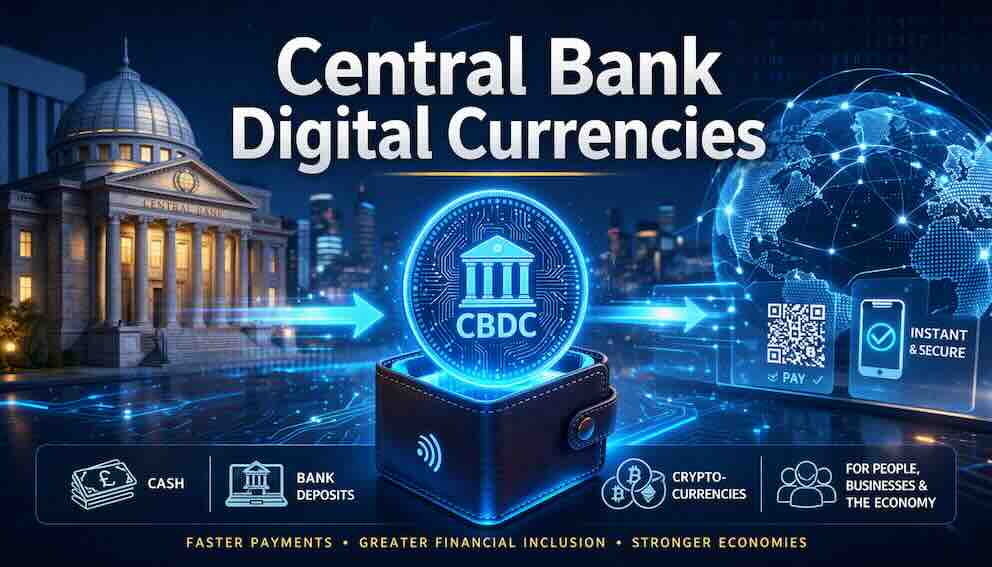
The Big Picture: What Is a Central Bank Digital Currency and Why Are Central Banks Suddenly Talking About It?
Two Possible Scenarios for Digital Cash
Imagine for a moment that you wake up tomorrow and discover that the physical cash in your wallet has been replaced by something purely digital. You can still pay for your coffee, still settle debts with your friends, still receive your salary. But instead of using paper banknotes or coins, you use a digital wallet provided by your central bank. Every transaction is instant. Every transaction is final. And every transaction is recorded on a ledger that the central bank controls.
Now imagine a different scenario. You wake up and discover that physical cash still exists, but alongside it there is a new form of digital money that you can use. You can choose to keep your money in your commercial bank account, as you always have, or you can shift some of it into a digital account at the central bank. This digital money is risk-free because it is a direct claim on the central bank, just like cash, but it is more convenient because you can use it for online payments and instant transfers.
Defining the CBDC
These two scenarios are different visions of what a Central Bank Digital Currency, or CBDC, might look like. A CBDC is a digital form of money that is issued directly by a central bank. It is a liability of the central bank, just like physical cash is a liability of the central bank. If you hold a £10 banknote in your hand, that banknote is a promise from the Bank of England to pay you £10. If you hold a CBDC in a digital wallet, that digital token is the same kind of promise from the Bank of England. The only difference is the form it takes: paper versus digital.
Why Central Banks Are Interested Now
The reason central banks are suddenly talking about CBDCs is that the way people pay for things is changing rapidly. In Sweden, only about 10 percent of retail transactions now involve cash. In China, mobile payment platforms like Alipay and WeChat Pay have become ubiquitous. This decline in cash use creates a problem because cash is the only form of central bank money that ordinary people can access. If cash disappears, ordinary people will no longer have access to risk-free central bank money. They will only have access to commercial bank deposits, which are not risk-free because banks can fail. A CBDC is a way for central banks to provide a digital alternative to cash.
The Main Risks in Brief
However, CBDCs also carry significant risks. The most frequently discussed risk is that a CBDC could cause bank disintermediation, which means that people might pull their money out of commercial banks and put it into CBDC accounts at the central bank. If enough people did this, banks would have less money to lend, which could reduce lending to households and businesses and slow down the economy. There are also serious concerns about privacy, because a central bank that runs a CBDC system could potentially see every transaction that every citizen makes. This tutorial walks through all of these issues step by step.
Core Theory: How a CBDC Differs from Cash, Bank Deposits, and Cryptocurrencies
Before we can understand the implications of a CBDC, we need to be very clear about what a CBDC is and what it is not. The best way to do this is to compare CBDCs to three other forms of money that you already know: physical cash, commercial bank deposits, and cryptocurrencies like Bitcoin.
Comparing CBDCs to Physical Cash
Physical cash is the most familiar form of central bank money. When you hold a £10 note, you hold a direct claim on the Bank of England with no counterparty risk. A CBDC is similar to cash in that it is also a direct claim on the central bank and also carries no counterparty risk. The difference is that cash is physical and anonymous, while a CBDC would be digital and, depending on how it is designed, might not be anonymous. When you pay with cash, no one records that transaction. With a CBDC, transactions would leave a digital trail. Another difference is that cash can be used offline, while a CBDC would require an internet connection or special offline-capable devices. Finally, cash pays no interest, while a CBDC could potentially be designed to pay interest, though most central banks are planning to pay zero interest to avoid competing with commercial banks.
Comparing CBDCs to Commercial Bank Deposits
Commercial bank deposits are the money that sits in your current account at a bank like Barclays or HSBC. When you have £1,000 in your bank account, you do not have £1,000 of central bank money. You have a claim on your bank, and that claim is not risk-free because banks can fail. Deposit insurance protects you up to a limit, but a CBDC would be fundamentally different because it would be a direct claim on the central bank with no risk of default. Another difference is that commercial bank deposits are the foundation of the lending system. When you deposit money in a bank, the bank lends most of that money out to borrowers. With a CBDC, money held in a CBDC wallet would not be lent out, so a shift of money from bank deposits to CBDCs could reduce bank lending.
Comparing CBDCs to Cryptocurrencies
Cryptocurrencies like Bitcoin are often confused with CBDCs, but they are fundamentally different. Bitcoin is decentralized. No central bank issues it or controls it. Its value is determined by supply and demand in private markets, which is why it is extremely volatile. A CBDC, by contrast, is centralized. It is issued and controlled by a central bank, and its value is stable because it is denominated in the national currency. One digital pound would always be worth one pound. A cryptocurrency is designed to eliminate the need for a central authority. A CBDC is designed to extend the reach of the central authority. They are opposites, not alternatives.
Retail Versus Wholesale CBDCs
Before moving on, we need to make one important distinction that is often overlooked. There are actually two types of CBDCs. A retail CBDC is available to the general public for everyday payments, which is what most people imagine when they hear the term. A wholesale CBDC is available only to financial institutions for interbank settlements and financial market transactions. Wholesale CBDCs are much less controversial because they do not create the risk of bank disintermediation. Ordinary people cannot hold them, so they cannot flee from bank deposits to the central bank. Most of the concerns about privacy and financial stability apply only to retail CBDCs, and it is retail CBDCs that this tutorial focuses on.
Mechanism: How a CBDC Would Work in Practice
There are two main models that central banks are considering for retail CBDCs, and the choice between them has enormous implications for the banking system.
The Direct Account Model
In the direct account model, the central bank would open accounts for every citizen and every business. Your CBDC wallet would be an account directly on the central bank's books. You could transfer money from your commercial bank account to your central bank account and make payments directly to other people's central bank accounts. This model is very simple and gives everyone direct access to central bank money. However, it also creates a serious risk. If everyone can hold an account at the central bank, why would anyone keep money in a commercial bank? Commercial bank deposits are not risk-free, while central bank deposits are risk-free. This could cause a mass exodus from banks, reducing their ability to lend. To prevent this, the central bank might impose limits on how much CBDC any person can hold or pay zero interest on CBDC while banks pay positive interest.
The Intermediated Model
In the intermediated model, which is the model most central banks prefer, the central bank does not open accounts directly for citizens. Instead, it issues CBDC to commercial banks, and the commercial banks distribute it to their customers. Your CBDC wallet is not directly on the central bank's books. It is on your bank's books, but your bank holds an equivalent amount of CBDC at the central bank to back your wallet. This model reduces the risk of bank disintermediation because your CBDC wallet is still held through your bank. The central bank does not compete directly with commercial banks for customer deposits. This is similar to how cash works today: the central bank issues banknotes to commercial banks, and the commercial banks distribute them to customers.
Payments System Integration
Regardless of which model is chosen, a CBDC would need to be integrated into the existing payments system. You would need to be able to move money between your commercial bank account and your CBDC wallet easily and instantly. You would need to be able to use your CBDC to pay for goods and services at shops, online, and person-to-person. One of the potential benefits of a CBDC is that it could make payments faster and cheaper by cutting out intermediaries like card networks. With a CBDC, you could potentially pay a merchant directly through the central bank's system with no fees. However, this efficiency gain comes at the cost of disintermediating the payment processors that currently handle these transactions.
The Offline Challenge
A practical challenge that is often underestimated is offline functionality. Physical cash works without electricity, without the internet, and without any working infrastructure. A CBDC that requires an internet connection cannot fully replace cash for people in areas with poor connectivity or during natural disasters. Some central banks are exploring offline CBDC solutions using special cards or devices that can store value and transfer it without an active internet connection, but this technology is not yet proven at scale. For now, any real-world CBDC would likely work only online, which means cash would need to remain available for offline situations.
Policy Implications: How CBDCs Would Change Monetary Policy
Central banks are not considering CBDCs just because the technology is interesting. They believe digital currencies could help them achieve their policy goals more effectively.
More Precise Control Over the Money Supply
One of the most interesting potential benefits is that a CBDC could give central banks much more precise control over the money supply. Today, central banks control the money supply indirectly. They set the policy rate, which influences commercial bank lending, which influences the amount of money in the economy. With a CBDC, the central bank could in theory control the money supply directly. If the central bank wants to stimulate the economy, it could simply create new CBDC and deposit it into citizens' wallets. This is sometimes called a digital helicopter drop because it is like the economist Milton Friedman's idea of dropping money from helicopters to fight deflation. The central bank could give every citizen a certain amount of CBDC, which they would then spend, boosting aggregate demand directly.
Programmable Money
A related idea is programmable money. Because a CBDC is digital, it could be programmed to behave in certain ways. Imagine that the government wants to stimulate the economy during a recession. Today, it can send stimulus payments to households, but once the money is in people's bank accounts, the government has no control over what happens next. Some people spend it, which is what the government wants, but others save it or use it to pay down debt. With a programmable CBDC, the government could program the money to expire if it is not spent within three months, forcing people to spend it rather than save it. It could program the money to be spendable only in certain sectors, such as restaurants and shops, to target the parts of the economy that need help most. However, no major central bank has committed to this kind of programmability, and the European Central Bank has explicitly said it will not make the digital euro programmable in this way. Programmability remains a theoretical possibility, not a settled feature of any CBDC.
Faster Transmission of Monetary Policy
A CBDC could also make the transmission of monetary policy faster. Today, when the central bank changes interest rates, it takes twelve to eighteen months for the full effects to be felt because commercial banks adjust their lending rates slowly. With a CBDC, the central bank could adjust the interest rate paid on CBDC balances directly and instantly. If the central bank raises the interest rate on CBDC, holding CBDC becomes more attractive, people shift money from bank deposits to CBDC, banks lose funding, and they raise their lending rates. The effect would be faster than waiting for banks to pass through policy rate changes voluntarily.
Financial Inclusion
Finally, a CBDC could increase financial inclusion. In many countries, a significant share of the population does not have a bank account. In the United Kingdom, about 1.5 million adults are unbanked. People without bank accounts often rely on cash for all their transactions, which makes it difficult to shop online or receive government benefits. A CBDC could provide a digital payment option for unbanked people because they would not need a commercial bank account to hold CBDC. However, to hold CBDC, you need a digital wallet, and to have a digital wallet, you need a smartphone. Many unbanked people also do not have smartphones, so a CBDC alone would not solve digital exclusion. The Bahamas has made financial inclusion a central goal of its Sand Dollar CBDC, giving people on remote islands access to digital payments without requiring them to travel to a bank branch.
Impact on the Banking System: The Risk of Disintermediation
Now we come to the most controversial aspect of CBDCs and the one that central bankers worry about the most. The banking system as we know it is built on deposits. When you put your money in a bank, the bank lends most of that money out to borrowers. This is how the financial system channels savings into investment.
What Is Disintermediation?
The most direct risk is that people will move their money out of commercial bank deposits and into CBDC accounts. Why would they do this? Because CBDC accounts are safer. Commercial bank deposits are only insured up to a certain limit, and even insured deposits are not instantly available if a bank fails. A CBDC account at the central bank carries no risk at all. If the CBDC account is also convenient, then why would you keep any money in a commercial bank? This is the disintermediation risk. If depositors leave banks, banks will have less money to lend. If banks have less money to lend, they will lend less to households and businesses. If lending falls, investment falls, consumption falls, and the economy slows down.
A Simple Balance Sheet Explanation
To understand why this matters, consider a simple balance sheet. A commercial bank's liabilities include the deposits that households and businesses have placed in the bank. Its assets include the loans it has made. When you convert your deposit into CBDC, the bank must send reserves to the central bank. The bank's liabilities fall because your deposit is gone. The bank's assets also fall because it has lost reserves. But the bank cannot call in the mortgage or business loan that it funded with your deposit. That loan is still outstanding. The bank must find another source of funding to replace your deposit, such as borrowing from other banks or issuing bonds. Both options are more expensive than deposits, so the bank will either raise its lending rates or lend less. If many people do this at the same time, the bank loses a large chunk of its deposit funding and the economy suffers.
How Central Banks Could Mitigate the Risk
Central banks are aware of this risk and have proposed several ways to mitigate it. The first is to impose limits on how much CBDC any one person can hold. If the limit is low, say £5,000, then people cannot move their entire life savings into CBDC. The second approach is to pay zero interest on CBDC while commercial banks pay positive interest. If your CBDC earns no interest but your bank account earns 3 percent, you will keep most of your money in your bank account. The third approach is to use the intermediated model, where your CBDC wallet is held through your commercial bank, keeping the bank involved in the transaction. None of these approaches is perfect. Limits reduce the usefulness of the CBDC. Zero interest makes the CBDC less attractive. The intermediated model reduces the risk but does not eliminate it entirely.
The Deposit Flight Risk in a Crisis
There is also a much more dangerous risk: the risk of rapid deposit flight during a financial crisis. Imagine that a major bank is rumored to be in trouble. Today, people can withdraw their money as cash, but there are limits. A bank branch does not keep enough cash on hand for everyone to withdraw their deposits. This friction slows down bank runs and gives regulators time to respond. With a CBDC, you could convert your bank deposit into CBDC instantly with a few taps on your phone. If enough people did this at the same time, the bank would lose its deposit funding almost instantly. The bank would have to sell assets quickly to raise cash, which could cause fire sales and further losses. The bank run would be faster and more severe than any run in history. This is perhaps the single biggest fear that central bankers have about retail CBDCs.
Real-World Examples: Countries Exploring or Piloting CBDCs
Several countries are already exploring or piloting CBDCs, and their experiences provide valuable lessons.
The Bahamas: The Sand Dollar
The Bahamas launched the Sand Dollar in October 2020, making it the world's first fully deployed retail CBDC. The Bahamas is an archipelago of more than 700 islands, many of which have few bank branches. The Sand Dollar was designed primarily to increase financial inclusion, giving people on remote islands access to digital payments without requiring them to travel to a bank branch. The results so far have been mixed. Adoption has been slower than hoped, partly because many Bahamians already had access to mobile payment apps and did not see a strong reason to switch. However, the Sand Dollar has been successful in reaching unbanked populations on remote islands, and it has reduced the cost of delivering government benefits.
China: The Digital Yuan
China is the world's largest and most advanced CBDC pilot. The People's Bank of China has been developing the digital yuan, or e-CNY, since 2014. The pilot has expanded to more than 25 cities and has involved hundreds of millions of transactions. The digital yuan is used for everyday purchases, for public transportation, and even for government salary payments. China's motivations are different from the Bahamas. The Chinese government wants to reduce its reliance on private payment platforms like Alipay and WeChat Pay, which it does not fully control. The digital yuan gives the central bank a direct role in the payments system and allows the government to track transactions. This has raised serious privacy concerns, as the People's Bank of China has access to all transaction data.
Sweden: The E-Krona
Sweden is one of the most cashless societies in the world. The Riksbank, Sweden's central bank, worries that if cash disappears entirely, the central bank will lose its ability to provide risk-free money to the public. The e-krona is the Riksbank's response. The e-krona pilot has tested both direct and intermediated models and has focused on understanding how an e-krona would work in practice. Sweden's experience is particularly relevant for other advanced economies that are also becoming cashless.
Nigeria: A Cautionary Tale
A cautionary note comes from Nigeria, which launched the eNaira in 2021. Adoption has been very low, with most Nigerians continuing to use cash or existing mobile payment apps. The lesson from Nigeria is that a CBDC is not automatically adopted just because it exists. People need a reason to switch. If the existing payment system works well, a CBDC that offers no clear advantage will struggle to gain traction. The transition from today's system to a CBDC system is not automatic. It requires careful planning, public education, and incentives for adoption. Central banks cannot simply launch a CBDC and expect everyone to start using it.
Evaluation: The Pros and Cons of CBDCs
Let me now provide a balanced evaluation of the arguments for and against retail CBDCs.
The Positive Case for CBDCs
On the positive side, a well-designed CBDC could make payments faster, cheaper, and more efficient by cutting out intermediaries and their fees. It could increase financial inclusion by giving unbanked people access to digital payments. It could give central banks a more direct tool for stimulating the economy in a recession, through digital helicopter drops. It could make monetary policy transmission faster by allowing direct adjustment of interest rates on CBDC balances. And it could reduce the power of private payment platforms that have become dominant in some countries, ensuring that the payments system remains a public infrastructure rather than a private monopoly.
The Negative Case Against CBDCs
On the negative side, a retail CBDC creates serious privacy concerns. Physical cash is anonymous. A CBDC would leave a digital trail. Depending on how it is designed, the central bank could potentially see every transaction you make. While some designs preserve more privacy than others, no retail CBDC can offer the same anonymity as cash. The financial stability risks are also significant. A CBDC could cause bank disintermediation, reducing bank lending and slowing the economy. In a financial crisis, it could accelerate bank runs to an unprecedented speed. The transition from today's system to a CBDC system is also a challenge. Existing payment processors, card networks, and banks would be disrupted, and it is not clear how the transition would be managed without causing significant economic harm.
The Legal Status Question
One important point about legal status is often overlooked. A CBDC might or might not be legal tender. Legal tender means that a shop is required to accept it as payment for a debt. In China, the digital yuan is legal tender. In the proposed digital euro, it would likely not be legal tender in the same way that euro banknotes are. This matters because if a CBDC is not legal tender, shops could refuse to accept it, which would limit its usefulness as a replacement for cash. The legal status of CBDCs is still being debated in most countries.
The Unavoidable Trade-Offs
The debate over CBDCs ultimately comes down to a set of trade-offs. A CBDC that is very convenient and widely available creates greater financial stability risks. A CBDC that is designed to be safe for the banking system (with low limits, zero interest, and friction) is less useful for everyday payments. A CBDC that preserves privacy makes it harder to track tax evasion and money laundering. There is no perfect design. Every central bank must choose which trade-offs it is willing to make. China has chosen convenience and control at the cost of privacy. The Bahamas has chosen financial inclusion at the cost of low adoption. The European Central Bank is leaning toward stability and privacy at the cost of some convenience. There is no single right answer.
Conclusion
A Central Bank Digital Currency is not science fiction. It is already here in the Bahamas and China, and it is coming to other countries in the coming years. But a CBDC is not a simple upgrade to the payments system. It is a fundamental change to the relationship between the central bank, commercial banks, and ordinary people. It offers real benefits: faster payments, greater financial inclusion, and more precise monetary policy tools. But it also carries real risks: bank disintermediation, accelerated financial crises, and the potential for unprecedented government surveillance.
The debate over CBDCs is not a debate about technology. It is a debate about values. How much privacy are we willing to give up for the convenience of digital payments? How much risk to the banking system are we willing to accept for the efficiency of direct central bank accounts? How much control over the money supply should the central bank have? These are not technical questions. They are political and social questions, and they will be answered differently in different countries. The technology of CBDCs is neutral. What matters is how we choose to design it, what limits we place on it, and what values we build into it. The central banks exploring CBDCs today are not just building new payment systems. They are making choices that will shape the financial system for decades to come, and those choices deserve the attention of every citizen who uses money.
About Swati Sharma
Lead Editor at MyEyze, Economist & Finance Research WriterSwati Sharma is an economist with a Bachelor’s degree in Economics (Honours), CIPD Level 5 certification, and an MBA, and over 18 years of experience across management consulting, investment, and technology organizations. She specializes in research-driven financial education, focusing on economics, markets, and investor behavior, with a passion for making complex financial concepts clear, accurate, and accessible to a broad audience.
Disclaimer
This article is for educational purposes only and should not be interpreted as financial advice. Readers should consult a qualified financial professional before making investment decisions. Assistance from AI-powered generative tools was taken to format and improve language flow. While we strive for accuracy, this content may contain errors or omissions and should be independently verified.