Tutorial Categories
Last Updated: May 7, 2026 at 18:30
How Governments Shape Your Wallet: A Complete Guide to Fiscal Policy, From Recessions to Inflation
Why Tax Cuts, Road Building, and Unemployment Benefits Matter More to Your Daily Life Than You Think
This tutorial explains fiscal policy – the government's use of spending and taxation to influence the economy – in plain language with vivid, real-world examples. You will learn why governments cut taxes or build bridges during recessions (expansionary policy) and why they sometimes raise taxes or cut spending when inflation heats up (contractionary policy). The guide walks you through the multiplier effect, where one pound of government spending can generate several pounds of economic activity, and explains automatic stabilisers like unemployment benefits that kick in without any politician lifting a finger. Using stories you can recognise – a local cafe owner during lockdown, a family worried about their mortgage, a retired person watching prices rise – this tutorial connects abstract economic concepts to the decisions governments make every day.
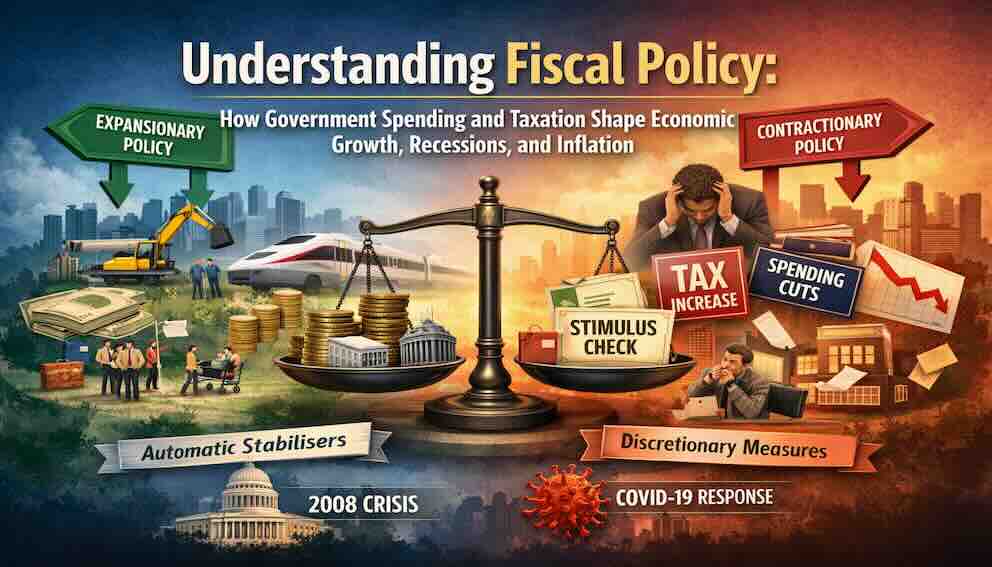
What Is Fiscal Policy and Why Should You Care?
Imagine you are walking down your local high street. On one side of the road, there is a cafe where you sometimes buy coffee. On the other side, there is a small hardware shop. Across the street, a builder's merchant supplies materials to local construction firms. Now imagine that a recession hits. The cafe owner sees fewer customers and stops ordering new supplies. The hardware shop lays off one of its two workers. The builder's merchant cancels its order for a new delivery van. Very quickly, one person's lost job becomes another person's lost customer, and before long, everyone on the street is worse off. This is the downward spiral of a recession, and it happens not because anyone is greedy or lazy but simply because spending has fallen.
Now imagine that the government steps in. It announces a new programme: every time the cafe owner sells a cup of coffee, the government will pay half the cost. It tells the hardware shop that it will give the laid-off worker a weekly payment to cover rent and food. It signs a contract with the builder's merchant to supply materials for a new school being built two miles away. Suddenly, the downward spiral stops and begins to reverse. The cafe owner hires back the teenager who makes the coffee. The hardware shop worker spends their government payment on new boots for winter. The builder's merchant buys the delivery van after all. This is fiscal policy in action – the government deliberately using its power to spend money and to move money around through taxes and transfers to keep the economy stable.
Fiscal policy is simply the collective name for all the decisions a government makes about two things: how much money to spend, and how much money to collect in taxes. That is it. Everything else – the debates in parliament, the headlines in newspapers, the arguments between economists – flows from these two simple levers. When the government spends more than it collects, we call that a deficit. When it collects more than it spends, we call that a surplus. And when it changes the settings on either lever, it is trying to achieve one or more of four objectives: faster economic growth, lower unemployment, stable prices (meaning low inflation), or a fairer distribution of income between rich and poor.
What makes fiscal policy so important is that you cannot escape its effects. When the government cuts taxes, you might find an extra fifty pounds in your pay cheque at the end of the month. When it raises taxes, you might decide not to eat out as often. When it spends money on a new railway line, the construction workers who get those jobs might be your neighbours. When it cuts spending on schools, your children's class sizes might grow. Fiscal policy is not a distant, abstract thing that happens in a capital city far away. It is the background music of your economic life, playing constantly whether you notice it or not.
The Simple Map of the Economy – Aggregate Demand
Before we go any further, we need a simple way to picture the whole economy. Economists use a concept called aggregate demand, which is just a fancy name for the total amount of spending happening in the country at any given time. Think of aggregate demand as the size of the national shopping basket. When the shopping basket is growing, businesses sell more, hire more workers, and invest in new equipment. When the shopping basket is shrinking, businesses sell less, lay off workers, and cancel investment plans.
Aggregate demand is made up of four parts. The first part is consumption, which is everything that households buy – food, rent, petrol, cinema tickets, new sofas, school shoes for the children. This is by far the largest part of most economies, usually accounting for sixty to seventy per cent of all spending. The second part is investment, which is what businesses spend on new machinery, buildings, software, and vehicles. Investment is not the same as buying shares or putting money in a savings account; in economics, investment always means spending on things that will be used to produce other things in the future. The third part is government spending, which includes everything from teachers' salaries and hospital beds to fighter jets and road maintenance. The fourth part is net exports, which is the value of goods sold to other countries minus the value of goods bought from other countries.
Here is the formula that economists use, and it is worth remembering because it appears in almost every macroeconomics exam:
Aggregate Demand = Consumption + Investment + Government Spending + (Exports − Imports)
Fiscal policy directly affects two of these four parts. When the government changes its own spending – building a bridge, hiring more nurses, cutting the budget for a defence programme – that changes the government spending part directly. When the government changes taxes or welfare payments, that changes consumption because households have more or less money left over after paying tax. A tax cut puts money into people's pockets, and most of that money gets spent. An increase in welfare benefits does the same thing. A tax rise or a cut to benefits takes money out of people's pockets, and they respond by spending less. Understanding this formula helps you see that fiscal policy is not mysterious. It is simply the government turning one of the dials on the economy's control panel.
Part Three: Expansionary Fiscal Policy – Fighting Recessions with Spending and Tax Cuts
Let us go back to the high street with the cafe, the hardware shop, and the builder's merchant. When a recession hits, the problem is that aggregate demand has fallen. People are scared to spend because they might lose their jobs. Businesses are scared to invest because they see no customers. The government's job, using expansionary fiscal policy, is to step in and spend when the private sector will not.
How Expansionary Policy Works
There are two main tools. The first tool is increasing government spending. The government can write a cheque for a new school, a road upgrade, or a hospital extension. It can increase welfare payments so that unemployed people have money to spend. It can give local councils more money to fix potholes or run libraries. Every pound the government spends becomes someone's income – the construction worker, the steel supplier, the architect, the cafe owner where those workers buy lunch. That income then gets spent again, creating more income for someone else, and so on. This is called the multiplier effect, and it is one of the most important ideas in all of macroeconomics.
The second tool is cutting taxes. When the government reduces income tax, households keep more of their earnings. When it reduces VAT or sales tax, goods become cheaper, so people can buy more with the same money. When it cuts corporate taxes, businesses have more profit to invest or to pay out as wages. A tax cut works by increasing consumption – remember the formula – because households have more disposable income to spend on goods and services.
The Multiplier Effect – A Story
Suppose the government spends one million pounds to build a new community sports centre. That money pays the wages of builders, plumbers, electricians, and architects. One of those builders, let us call her Maria, takes her weekly pay cheque and spends three hundred pounds at the local supermarket. The supermarket uses that money to pay its cashiers and to order more stock. One of those cashiers, a young man named Jamal, spends some of his wages on a new phone. The phone shop uses that money to pay its staff. Each round of spending is smaller than the last because some money leaks out – some is saved, some goes to the government as tax, some buys imported goods. But the total effect of the initial one million pounds might be one million five hundred thousand pounds or even two million pounds of total economic activity. The multiplier is the number that tells you how many pounds of total activity are generated by each pound of government spending.
In a simple world where households spend seventy per cent of any extra income and save thirty per cent, the multiplier is 1 divided by (1 minus 0.7), which equals 1 divided by 0.3, which is roughly 3.3. That means one million pounds of government spending could generate three million three hundred thousand pounds of total spending. In the real world, multipliers are smaller because of all the leakages – taxes, imports, and savings. But the principle holds: government spending does not just sit there; it circulates.
Real-Life Example You Have Lived Through – The Furlough Scheme
You almost certainly remember the COVID-19 pandemic lockdowns. In March 2020, the UK government introduced the Coronavirus Job Retention Scheme, better known as the furlough scheme. The government promised to pay eighty per cent of the wages of any worker who could not do their job because of lockdowns, up to two thousand five hundred pounds per month. Overnight, millions of workers who would otherwise have been fired became government employees in all but name. The cafe owner could keep paying his staff even though the cafe was closed. The airline could keep its pilots on the payroll even though planes were not flying. The theatre could keep its technicians even though the curtain was down.
This was expansionary fiscal policy on a scale never seen before in peacetime. The government spent billions of pounds that it did not have, borrowing the money by issuing bonds. And it worked. Unemployment rose far less than anyone predicted. When lockdowns ended, businesses could reopen almost immediately because their workers were still attached to them. The alternative – no furlough scheme – would have meant mass unemployment, repossessed homes, bankrupt businesses, and a much longer and deeper recession. You can see this for yourself if you compare the UK with a country that did very little fiscal stimulus during the pandemic. The difference in economic outcomes was stark.
Contractionary Fiscal Policy – Applying the Brakes When Inflation Runs Hot
Expansionary fiscal policy is about adding fuel to the fire when the economy is cold. Contractionary fiscal policy is about throwing water on the fire when the economy is too hot. The problem in a hot economy is not unemployment but inflation. Prices rise month after month, and your money buys less today than it did last year. For a retired person living on a fixed pension, inflation is a quiet disaster because each month they can afford fewer groceries or less heating. For a young family saving for a house deposit, inflation eats away at their savings because the price of houses rises faster than their bank account.
How Contractionary Policy Works
The government uses the same two levers but in reverse. Instead of increasing spending, it cuts spending – cancelling infrastructure projects, freezing public sector pay rises, reducing welfare payments. Instead of cutting taxes, it raises taxes – increasing income tax, raising VAT, introducing new taxes on wealth or property. Both actions reduce aggregate demand. When the government spends less, there is less income flowing to workers and suppliers. When taxes rise, households have less disposable income to spend, so consumption falls. With less total spending chasing the same amount of goods, prices stop rising so quickly.
Real-Life Example – Germany's Voluntary Austerity
Most examples of contractionary fiscal policy come from crises. Greece, for instance, was forced to cut spending and raise taxes after 2010 because it could no longer borrow money from international markets. But a cleaner and more interesting example is Germany between 2010 and 2015. Germany was not in a debt crisis. Its economy was growing. Yet the German government voluntarily adopted a constitutional rule called the debt brake, which severely limited how much money the government could borrow. To comply with this rule, Germany cut spending on infrastructure, reduced subsidies for various industries, and allowed public sector wages to lag behind inflation.
What happened? Germany's economy grew more slowly than it might have otherwise done. Roads and railways fell into disrepair. Digital infrastructure lagged behind other European countries. And critics argued that Germany's contractionary policy hurt not just Germany but the whole Eurozone. Because Germany is the largest economy in Europe, when it slows down, it buys fewer imports from its neighbours – from Greece, from Spain, from Italy – making their recoveries harder. This example shows that contractionary policy is often a choice, not a necessity, and that choosing it has consequences that ripple across borders.
A Note on Types of Inflation
It is important to understand that contractionary fiscal policy only works on one type of inflation. Demand-pull inflation happens when aggregate demand grows faster than the economy's ability to produce goods and services. Too much money chasing too few goods. This is the kind of inflation that fiscal policy can fight, because reducing demand will cool prices. But cost-push inflation happens when the cost of producing goods rises – because oil prices spike, or because a war disrupts grain supplies, or because a pandemic closes factories. Contractionary fiscal policy is much less effective against cost-push inflation because cutting demand does not fix a broken supply chain. This distinction is not just academic; it mattered enormously in 2022 when inflation surged partly because of demand (post-pandemic stimulus) and partly because of costs (the war in Ukraine driving up energy and food prices).
Automatic Stabilisers – The Government's Invisible Helpers
So far we have talked about deliberate government action – a minister announcing a tax cut, a parliament voting on a spending package. But some of the most important fiscal policy happens automatically, without any decision being made at all. These are called automatic stabilisers, and they are built into the structure of the tax and welfare system.
How Automatic Stabilisers Work
Think about what happens when you lose your job. The moment your income falls to zero, you stop paying income tax. That is automatic. You also become eligible for unemployment benefits. That is also automatic, assuming you meet the conditions. Both effects happen without any politician signing a law or any government department sending out a memo. The result is that when your private income falls, the government steps in – automatically – to replace some of it. Your spending does not fall as much as it would have done without these automatic stabilisers. The economy's downturn is cushioned.
Now think about what happens when the economy booms and you get a big pay rise. As your income climbs, you move into higher tax brackets (if the tax system is progressive), meaning you pay a larger percentage of your income in tax. That is automatic. You may also lose eligibility for certain benefits if your income exceeds a threshold. That is also automatic. The result is that when your private income rises, the government takes some of it back – automatically – reducing the amount of extra spending in the economy. The boom does not overheat as much as it would have done without these automatic stabilisers.
A Real-Life Example You Can Observe
If you know anyone who was made redundant during the 2008 financial crisis or during the COVID-19 pandemic, you might have seen automatic stabilisers at work. That person probably claimed Universal Credit or Jobseeker's Allowance. They probably stopped paying income tax. They might have received housing benefit to help with rent. All of these payments and tax reductions happened without any new law being passed. The system simply responded to their changed circumstances. Now imagine a world without those automatic stabilisers. A redundancy would mean a complete loss of income, overnight. The newly unemployed person would stop spending immediately – no more takeaways, no more new clothes, no more nights out. That sudden stop in spending would hit local businesses, which would then lay off more workers, creating a spiral. Automatic stabilisers are what prevent that spiral from accelerating.
Discretionary Policy – The Deliberate Decisions
If automatic stabilisers are the invisible helpers, discretionary fiscal policy is the visible hand. These are the deliberate decisions that governments make: passing a new law to cut taxes, announcing a new infrastructure programme, voting to increase the retirement age, deciding to cut welfare spending. Discretionary policy has two big advantages and two big disadvantages.
The advantages are targeting and flexibility. A government can design a discretionary policy to help a specific region, a specific industry, or a specific group of people. When the coal mines closed in South Wales in the 1980s, the government could have (and eventually did) create discretionary programmes targeted at that region – training schemes, investment incentives, relocation grants. Automatic stabilisers cannot do that because they just respond to income changes regardless of where the person lives. Similarly, if a government wants to encourage green investment, it can introduce a discretionary tax credit for companies that install solar panels. Flexibility means the government can respond to unexpected events – a pandemic, a war, a financial crisis – with policies designed specifically for that event.
The disadvantages are time lags and political risk. Time lags are the enemy of effective fiscal policy. First, there is a recognition lag: it takes months for economic data to be collected, processed, and published. By the time the government knows a recession has started, the recession may be three months old. Second, there is a legislative lag: drafting a bill, debating it in parliament, amending it, voting on it – this can take many months, especially if the government does not have a majority. Third, there is an implementation lag: even after a spending programme is approved, it takes time to sign contracts, hire workers, and get money flowing. A road-building project might take a year from approval to the first shovel going into the ground. By the time the stimulus arrives, the recession might already be over, and the policy could overheat the economy rather than rescuing it.
A Real-Life Example – The 1990-1991 US Recession
The 1990-1991 recession in the United States is a textbook case of time lags making fiscal policy ineffective. The recession was caused by an oil price shock after Iraq invaded Kuwait. President George H.W. Bush faced a divided Congress. Democrats wanted one kind of stimulus; Republicans wanted another. Months of argument followed. By the time a small stimulus package was finally passed, the recession had already ended. The policy arrived too late to do any good, and the political fight had consumed so much energy that no one had the appetite for a larger package. This is not a story of bad intentions; it is a story of how democratic politics can make discretionary fiscal policy slow and clumsy.
Crowding Out – When Government Spending Backfires
We have been assuming that when the government spends more, total spending in the economy rises. But there is a powerful counter-argument called crowding out. The idea is that government spending might simply replace private spending rather than adding to it. Here is how that could happen.
When the government runs a deficit – spending more than it collects in taxes – it must borrow the difference. It does this by selling government bonds to investors. To sell those bonds, the government may have to offer an attractive interest rate. As the government borrows more and more, it increases the total demand for loanable funds in financial markets. Basic supply and demand tells us that when demand for something rises, its price rises. The price of borrowing money is the interest rate. So government borrowing pushes up interest rates. Higher interest rates make it more expensive for private businesses to borrow. A small business thinking of borrowing to buy a new machine might decide the loan is too expensive now. A family thinking of borrowing to buy a house might decide to wait. If private investment falls by exactly the amount that government spending has risen, then total spending has not changed at all. The government has crowded out private spending.
But – and this is crucial – crowding out depends entirely on the state of the economy.
In a deep recession, crowding out is unlikely to happen. Why? Because in a recession, there is plenty of idle saving. People are scared and are saving more than usual. Banks are sitting on piles of cash that they are not lending. In that situation, when the government borrows, it does not push up interest rates because there is a glut of savings just sitting there waiting to be used. The government can borrow without competing with private businesses. In fact, in a deep recession, the problem is too much saving and too little spending, so government borrowing actually puts those idle savings to work. This is why almost all economists supported large fiscal stimulus in 2008 and in 2020, even though it meant massive government borrowing. The risk of crowding out was minimal because the economy was so weak.
In a booming economy with full employment, crowding out is much more likely. When everyone who wants a job has one, and factories are running at full capacity, then government borrowing does compete with private borrowing. Interest rates rise, and private investment falls. This is one reason why contractionary fiscal policy – cutting spending or raising taxes – can be necessary in a boom. It makes room for private investment by reducing government demand for loanable funds.
Ricardian Equivalence – The Strange Theory That Tax Cuts Might Not Work
Now we come to an idea that sounds bizarre at first but has a powerful logic behind it. Ricardian Equivalence is named after the 19th-century economist David Ricardo, who noticed something strange about how people might respond to tax cuts. The idea is this: when the government cuts taxes today and runs a deficit, it is borrowing money that will have to be repaid with higher taxes in the future. If households understand this, they might not spend their tax cut at all. Instead, they might save the entire tax cut to prepare for the future tax rise. If every household behaves this way, then the tax cut has no effect on consumption. Aggregate demand does not change. The fiscal policy is completely useless.
Will this happen in the real world? Most economists think not, for several reasons. First, many households do not think that far ahead. They see the extra money in their pay cheque and they spend it. Second, some households are credit-constrained – they are already borrowing as much as they can, so they cannot save even if they want to. Third, households do not live forever, so they might not care about taxes that will be paid after they die. Fourth, governments do not always raise taxes to repay debt; sometimes they grow the economy enough that the debt becomes manageable relative to national income, or sometimes they inflate away the debt (a controversial topic for another tutorial).
However, Ricardian Equivalence is important because it warns against assuming that all tax cuts work. If a tax cut is clearly temporary – for example, a one-year reduction in income tax that will expire automatically – households might indeed save most of it because they know taxes will go back up next year. This is why permanent tax changes are usually more effective than temporary ones. It is also why governments sometimes accompany tax cuts with spending cuts, to signal that future taxes will not have to rise.
How Governments Actually Pay for Spending – The Budget Constraint
We have talked a lot about deficits and borrowing, but we have not explained exactly how the government pays for its spending. This is a surprisingly important gap to fill. The government budget constraint is a simple accounting identity: government spending equals tax revenue plus the change in government debt plus money creation. In plain English, every pound the government spends must be financed in one of three ways. It can collect a pound in taxes. It can borrow a pound by selling a bond to an investor. Or it can print a pound of new money.
Taxation is the cleanest method but also the most unpopular. Borrowing is the most common method for large deficits, but it creates debt that must be serviced with future interest payments. Money creation – sometimes called monetary financing or, more crudely, printing money – is the most dangerous method because it can lead to very high inflation. If a government simply creates new money to pay its bills, it increases the money supply without any increase in goods and services. That extra money chases the same amount of goods, pushing up prices. In extreme cases, this can lead to hyperinflation, where prices double every month and money becomes worthless.
This is why central banks are usually independent of governments. A central bank can refuse to buy government debt, forcing the government to borrow from private investors instead. That independence is a guard against the temptation to print money to pay for spending. When you hear politicians arguing about the debt ceiling or about whether the central bank should be allowed to buy government bonds directly, this is the issue at stake.
Evaluating Fiscal Policy – Five Questions to Ask
If you want to judge whether a particular fiscal policy is likely to work, here are five questions to ask. They will serve you well in exams and in reading the news.
First, what is the size of the multiplier? A large multiplier means the policy will have a big effect. The multiplier is larger when the economy is in a deep recession (because there are lots of idle resources), when interest rates are low (so crowding out is minimal), and when the economy is relatively closed to trade (so less money leaks abroad through imports).
Second, what is the state of the economy? This is the most important question. In a recession with high unemployment, expansionary policy is likely to work well. At full capacity, it will mainly cause inflation. In a liquidity trap where interest rates are already zero, fiscal policy is especially powerful because monetary policy has run out of ammunition.
Third, what is the level of government debt? A government with low debt can borrow freely. A government with high debt may find that investors demand higher interest rates, or may be forced into austerity by bond markets. Greece in 2010 is the extreme example: its debt was so high that it lost the ability to borrow altogether and had to accept a bailout with harsh conditions.
Fourth, what is the state of confidence? If households and businesses believe the policy will work, they may respond strongly. If they believe the policy is temporary or will be reversed, they may save rather than spend. This is the insight of Ricardian Equivalence, even if it does not hold perfectly.
Fifth, how fast can the policy be implemented? A fast policy that arrives during the recession is good. A slow policy that arrives after the recession is over is worse than useless because it will overheat the economy. The 1990-1991 US recession shows how time lags can kill a policy's effectiveness.
A Note on Supply-Side Fiscal Policy
Almost everything we have discussed so far has been about managing aggregate demand in the short run. But some fiscal policies affect the long-run productive capacity of the economy – what economists call long-run aggregate supply. These are known as supply-side fiscal policies, and they matter because they determine how fast the economy can grow without causing inflation.
Spending on infrastructure – roads, railways, ports, broadband – increases the economy's productive capacity by making it cheaper and faster for businesses to move goods and access customers. Spending on education and training creates a more skilled workforce that can produce more output per hour. Tax incentives for research and development encourage firms to innovate. Tax incentives for investment encourage firms to buy new machinery and equipment. All of these policies shift the long-run aggregate supply curve to the right, meaning the economy can produce more goods and services at any price level.
The important distinction is between short-run demand management and long-run supply enhancement. A government can cut taxes to boost demand during a recession (short-run) while also spending on education to boost productivity (long-run). The two are not alternatives; they are complements. A country that neglects supply-side fiscal policy may find that its economy cannot grow without generating inflation, because any increase in demand quickly hits supply constraints.
Conclusion: Why Fiscal Policy Is Both Powerful and Imperfect
Fiscal policy is not a magic wand. It cannot solve every economic problem, and it comes with serious risks – debt accumulation, inflation if overused, crowding out if used at the wrong time, and political constraints that often prevent the right policy from being implemented quickly enough. But the alternative to active fiscal policy is not neutrality. The alternative is to accept the business cycle with all its human costs. When governments do nothing during a recession, unemployment rises, families lose their homes, businesses go bankrupt, and the productive capacity of the economy is permanently damaged as workers' skills erode and machinery falls into disrepair. When governments do nothing during an inflationary boom, the purchasing power of wages and savings is steadily eroded, and the resulting uncertainty chokes off the investment that is necessary for long-term growth. Fiscal policy, for all its imperfections, remains the primary line of defence against these outcomes. The governments that use it well – timing their interventions carefully, respecting the limits of debt, and coordinating with independent central banks – can smooth the peaks and troughs of the business cycle, saving millions of people from the worst ravages of recession and inflation. The governments that use it poorly, whether through excessive stimulus or premature austerity, can make things worse. Understanding the difference is the first step toward holding those governments accountable.
About Swati Sharma
Lead Editor at MyEyze, Economist & Finance Research WriterSwati Sharma is an economist with a Bachelor’s degree in Economics (Honours), CIPD Level 5 certification, and an MBA, and over 18 years of experience across management consulting, investment, and technology organizations. She specializes in research-driven financial education, focusing on economics, markets, and investor behavior, with a passion for making complex financial concepts clear, accurate, and accessible to a broad audience.
Disclaimer
This article is for educational purposes only and should not be interpreted as financial advice. Readers should consult a qualified financial professional before making investment decisions. Assistance from AI-powered generative tools was taken to format and improve language flow. While we strive for accuracy, this content may contain errors or omissions and should be independently verified.