Tutorial Categories
Last Updated: May 7, 2026 at 18:30
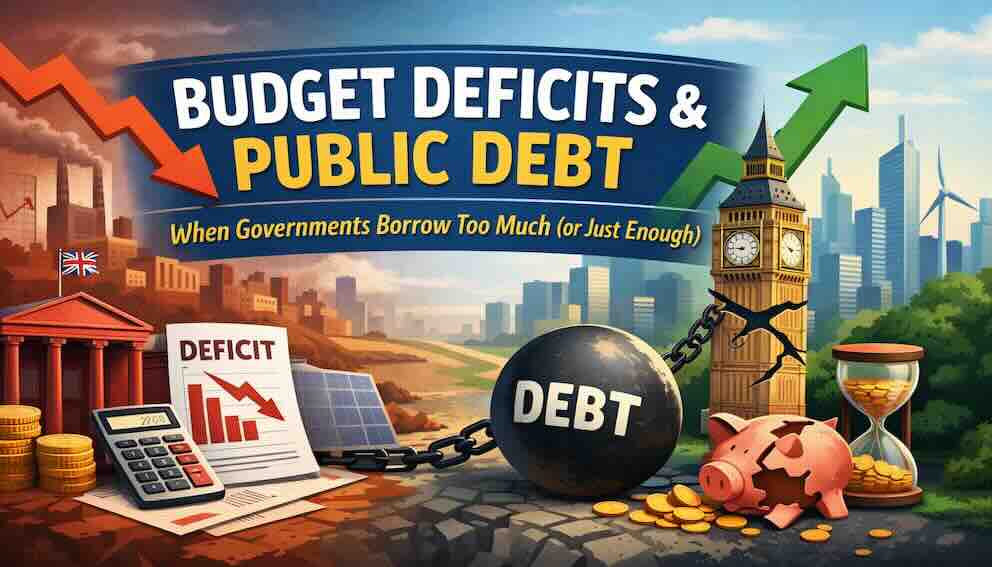
Budget Deficits and Public Debt: What Happens When Governments Borrow Too Much (or Just Enough)
A Clear Guide to Understanding the National Debt, the Deficit, and Whether Future Generations Really Get Stuck with the Bill
This tutorial explains the crucial difference between a budget deficit (the government's annual shortfall) and the national debt (the total pile of past borrowing), two terms that are constantly confused in news reports and political debates. You will learn why some deficits are temporary and caused by recessions (cyclical deficits) while others persist even in good times (structural deficits), and why this distinction matters enormously for policy decisions. The tutorial walks you through the concept of debt sustainability, showing how economists judge whether a government's debt is a manageable burden or a ticking time bomb using the relationship between growth rates, interest rates, and the primary budget balance. You will also explore the charged question of intergenerational equity – whether government borrowing unfairly burdens children and grandchildren – and discover that the answer depends entirely on what the borrowed money was spent on and who ultimately owes the debt.
The Two Most Confused Words in Economics
Pick up any newspaper or scroll through any financial news website, and you will see two words used almost interchangeably: deficit and debt. Journalists write about a country's "soaring debt" when they mean its rising deficit. Politicians promise to "eliminate the debt" when they actually mean balance the budget. Even well-educated people regularly mix them up, which is understandable because the two concepts are deeply connected. But the difference between them is not a petty technicality. It is the difference between a monthly credit card bill and the total balance you have accumulated over years of using that card. Confusing the two is like saying your household is drowning in debt because you spent more than you earned last month, even though you have paid off every previous month in full.
Let us start with the clearest definitions we can make. A budget deficit is an annual event. It happens in a single year when the government spends more money than it collects in taxes. If the government takes in eight hundred billion pounds in taxes but spends one trillion pounds, it has a deficit of two hundred billion pounds for that year. A budget surplus is the opposite: when tax revenue exceeds spending, so the government has money left over. And public debt (also called national debt or sovereign debt) is the total accumulation of all past deficits minus all past surpluses. Every year that the government runs a deficit, it adds to the debt. Every year that it runs a surplus, it subtracts from the debt.
Think of it this way. Imagine you keep a household budget. In January, you spend one hundred pounds more than you earn, so you put that hundred pounds on a credit card. Your deficit for January is one hundred pounds, and your debt is now one hundred pounds. In February, you spend two hundred pounds more than you earn. Your deficit for February is two hundred pounds, and your debt rises to three hundred pounds. In March, you earn fifty pounds more than you spend. Your surplus for March is fifty pounds, and you use that fifty pounds to pay down your credit card, so your debt falls to two hundred and fifty pounds. The deficit or surplus is the flow each month. The debt is the stock that has built up over time. The United Kingdom, as of 2024, has a national debt of roughly 2.6 trillion pounds, which is about one hundred per cent of its annual national income. That debt did not appear overnight. It is the accumulated result of every year when the government spent more than it collected, minus the rare years when it spent less. The COVID-19 pandemic alone added more than four hundred billion pounds to that debt because the government borrowed massively to pay for the furlough scheme, extra healthcare spending, and business support loans.
Why a Deficit Is Not Always a Sign of Recklessness
Many people hear the word deficit and immediately think of irresponsible government, profligate spending, and a mortgage that will be left for the grandchildren. But this instinct, while understandable, misses a crucial distinction that every economist learns in their first year of training. Some deficits are caused by bad decisions or structural problems, but others are caused by the normal functioning of the business cycle. A government that runs a deficit during a recession is not necessarily being irresponsible; it may simply be doing its job.
This brings us to the distinction between cyclical deficits and structural deficits. A cyclical deficit is the part of the deficit that appears automatically when the economy is in a downturn. When a recession hits, tax revenues fall because people earn less and companies make less profit. At the same time, government spending on unemployment benefits, welfare, and other social programmes rises because more people need help. Both effects push the budget toward deficit, and this happens without any new policy decisions. The cyclical deficit is the economy's built-in shock absorber. It appears in bad times and disappears (or even reverses into a surplus) in good times.
A structural deficit, by contrast, is the deficit that remains even when the economy is operating at full employment. This is the deficit that reflects underlying policy choices: tax rates that are too low relative to spending commitments, or spending programmes that are not matched by sustainable revenue. A structural deficit does not go away when the recession ends. It persists year after year, regardless of whether the economy is booming or busting. This is the kind of deficit that should concern citizens and policymakers because it represents a fundamental mismatch between what the government wants to spend and what it is willing to tax.
The real-world importance of this distinction became painfully clear during the Eurozone debt crisis that began in 2009. Before the crisis, Greece was running a large structural deficit even as its economy was booming. The government had promised generous pensions and public sector wages without raising enough taxes to pay for them. When the 2008 recession hit, Greece's deficit ballooned even further as the cyclical component added to the structural problem. By the time international investors noticed, Greece's debt had become unsustainable, and the country needed a bailout. In contrast, Germany also ran a deficit during the 2008 recession, but much of it was cyclical. When the German economy recovered, the deficit shrank, and Germany was able to adopt its debt brake rule. The difference was not the size of the deficit during the crisis; the difference was what happened to the deficit when the crisis was over.
The Three Numbers That Determine Everything
If you want to understand whether a country's debt is sustainable, you do not need a complex computer model or a PhD in economics. You need to watch three numbers and how they interact: the economic growth rate, the interest rate on government debt, and the primary budget balance (which is the government's surplus or deficit before paying interest on its existing debt). These three numbers tell you almost everything you need to know.
Here is the intuition. The debt-to-GDP ratio will fall if the economy grows faster than the interest rate on the debt, because the denominator (GDP) is expanding faster than the numerator (debt) is growing through interest. The debt-to-GDP ratio will also fall if the government runs a primary surplus, meaning it collects more in taxes than it spends on everything except interest, because that surplus can be used to pay down the debt. The debt-to-GDP ratio will rise if the opposite happens: if interest rates exceed growth rates and the government runs a primary deficit.
To see this in action, consider two different countries. Country X has an economy growing at three per cent per year, pays an interest rate of two per cent on its debt, and runs a primary balance of zero. Its debt-to-GDP ratio will fall steadily because the growth rate outruns the interest rate, shrinking the debt relative to the size of the economy, even though the government is not running a surplus. Country Y has an economy growing at one per cent per year, pays an interest rate of five per cent on its debt, and runs a primary deficit of two per cent of GDP. Its debt-to-GDP ratio will explode upward because the interest rate is much higher than growth and the government is adding to the debt each year. Both countries could have the same starting debt-to-GDP ratio of one hundred per cent. But Country X is on a sustainable path, and Country Y is heading for a crisis.
This is why Italy, which has a debt-to-GDP ratio of around one hundred and forty per cent, is considered a concern by economists while Japan, with a ratio over two hundred and sixty per cent, is not. Italy has very low growth (often near zero) and pays a moderate but positive interest rate on its debt. Japan has very low growth as well, but it pays an extremely low interest rate (often near zero) because Japanese investors trust the government and because the central bank buys a large share of the bonds. The difference is not the debt level. The difference is the gap between the growth rate and the interest rate. When growth exceeds the interest rate, even a high debt can be sustainable. When interest rates exceed growth, even a moderate debt can become dangerous
The Secret Weapon That Governments Never Admit – Inflation
There is a fourth number that can reduce debt, and it is the one that governments almost never talk about in public because it sounds like cheating. That number is inflation. When a government owes money in its own currency, moderate inflation quietly reduces the real value of that debt. Here is how it works. Suppose the government borrows one hundred pounds today. If there is zero inflation over the next ten years, the government must repay one hundred pounds in today's purchasing power. But if there is two per cent inflation each year, the government still repays one hundred pounds in nominal terms, but those pounds are worth much less in real terms. The debt has been inflated away. This is not a conspiracy theory or an accident. Historically, inflation has been one of the most important ways that governments have reduced their debt burdens after major wars or deep recessions. After the Second World War, both the United Kingdom and the United States had debt-to-GDP ratios well over one hundred per cent. They did not pay down that debt through surpluses. Instead, they allowed moderate inflation to erode the real value of the debt while the economy grew rapidly. The combination of growth and inflation halved the debt-to-GDP ratio within a decade in many countries, without any painful austerity.
However, there is a catch, and it is a big one. Inflation is a hidden tax on bondholders. People who lent the government money by buying bonds receive their money back in pounds that are worth less than the pounds they lent. Pension funds, insurance companies, and ordinary savers who hold government bonds are the ones who lose. Moreover, once investors expect inflation, they demand higher interest rates to compensate, which can neutralise the benefit. And if inflation gets out of control, as it did in the 1970s, it destroys confidence in the currency and makes future borrowing much more expensive. A little inflation helps the government. Too much inflation destroys the government's credibility. The art of debt management is knowing the difference.
Who Owns the Debt? Domestic Borrowing Versus External Borrowing
In Part Three, we mentioned that Japan can sustain a much higher debt-to-GDP ratio than Italy or Greece. The reason is not just interest rates and growth. It is also about who owns the debt. This distinction is so important that it deserves its own section.
Domestic debt is debt owed to lenders inside the country – to citizens, to domestic pension funds, to local banks, and often to the country's own central bank. When the government owes money to its own citizens, the debt is essentially a redistribution within the country. Some people (taxpayers) are paying interest to other people (bondholders). The money stays in the national economy. There is no transfer of resources to foreigners. Domestic debt can be very high without causing a crisis as long as the government maintains the confidence of its own citizens.
External debt is debt owed to lenders in other countries – to foreign governments, to foreign pension funds, to international banks, or to institutions like the International Monetary Fund. When the government owes money to foreigners, it must eventually transfer real resources (exports, gold, foreign currency reserves) to those foreigners to repay the debt. External debt is a genuine burden because it represents a claim by one country on the production of another country. A country with high external debt is vulnerable to a loss of confidence by foreign investors, who can sell their bonds and flee the country, causing a currency crisis.
The contrast between Japan and Argentina could not be starker. Japan's debt is almost entirely domestic, held by Japanese citizens, Japanese pension funds, and the Bank of Japan. Argentine debt, by contrast, has historically been held largely by foreign investors. When those foreign investors lost confidence in Argentina – which they have done many times, most famously in 2001 and again in 2014 and 2020 – they sold their bonds, the Argentine peso collapsed, and the government was forced to default. Argentina's debt-to-GDP ratio at the time of its 2001 default was around fifty per cent, much lower than Japan's ratio today. But because the debt was external and denominated in foreign currencies (mostly US dollars), Argentina could not inflate it away or manage it through domestic policy. The difference was not the size of the debt. The difference was who was owed the money.
The Central Bank's Secret Role – Why Modern Debt Is Different
Until very recently, most tutorials on government debt would have ended with Part Five. But something fundamental has changed in the last fifteen years. Central banks in advanced economies – the Federal Reserve in the United States, the Bank of England, the European Central Bank, the Bank of Japan – have started buying massive quantities of government bonds through a programme called quantitative easing (QE) . When a central bank buys government bonds, it is effectively lending money to the government at very low interest rates, and it is creating new money to do so. This blurs the line between fiscal policy and monetary policy. In a QE programme, the government issues bonds, and the central bank buys them with newly created money. The government gets the cash to spend. The central bank holds the bonds as assets on its balance sheet. The interest that the government pays on those bonds eventually flows back to the central bank, and most central banks then return their profits to the government. In effect, the government is borrowing from itself. (When a central bank buys bonds and holds them permanently rather than selling them later, this is sometimes called debt monetisation, and it is an even more direct form of money financing.)
What does this mean for debt sustainability? It means that for countries with their own central banks and the ability to conduct QE, the old rules have changed. A government that borrows from its own central bank does not need to worry about finding buyers for its bonds. It does not need to worry about rolling over its debt. And it pays interest to itself, which is not really a cost. This is one of the main reasons that Japan, the United States, the United Kingdom, and the Eurozone have been able to sustain much higher debt levels after 2008 and 2020 than anyone thought possible before the crisis. But there are limits. If a central bank creates too much money to finance government spending, the result can be inflation, as we discussed in Part Four. And if a central bank loses its independence and becomes simply a printing press for the government, the result can be hyperinflation, as happened in Zimbabwe in the 2000s or in Germany in the 1920s. The modern arrangement – an independent central bank that buys government bonds in a controlled way during crises but sells them or stops buying during booms – has worked so far. But no one knows how far it can be pushed. We are in the middle of a live experiment.
The Great Intergenerational Debate – Are We Burdening Our Children?
One of the most emotionally powerful arguments against government borrowing is the claim that it is unfair to future generations. The argument goes like this: when the government borrows money today, it is effectively spending now and making our children and grandchildren pay later through higher taxes or reduced public services. We get the benefit while they get the bill. This seems obviously unjust. But the fairness of government borrowing depends entirely on what the borrowed money is spent on and who ultimately owes the debt. There is a profound difference between borrowing to fund consumption and borrowing to fund investment.
Borrowing to fund consumption – spending on day-to-day government operations, welfare payments, public sector wages, or tax cuts that are not matched by spending cuts – transfers resources from the future to the present. Future generations will have to pay higher taxes or receive lower benefits to service the debt, but they will not have any new assets or productive capacity to show for it. This kind of borrowing does look unfair. It is like a parent who runs up credit card debt on luxury holidays and then expects their children to pay the bill. Borrowing to fund investment – spending on infrastructure like roads and railways, or on education and training, or on research and development – is a different story entirely. When the government borrows to build a new railway line, that railway line will still be there in thirty or fifty years. Future generations will benefit from faster travel and lower transport costs. They will also inherit the debt, but they will also inherit the asset. The question is whether the asset is worth more than the debt.
The real cost of government borrowing is not the debt itself, but the opportunity cost of what the money could have been used for instead. Every pound borrowed and spent on one thing is a pound not borrowed and spent on something else – or a pound not left in the private sector to be invested by households and businesses. When we evaluate whether debt is fair to future generations, we must ask not just whether they inherit the debt, but whether they inherit a more productive economy because of how the debt was used. Norway has almost no government debt because it saved its oil revenues in a sovereign wealth fund worth over one trillion pounds. Future generations of Norwegians will inherit that fund. South Korea, by contrast, has a moderate level of government debt. But South Korea borrowed heavily in the 1970s and 1980s to invest in education, heavy industry, and technology. That borrowing turned a poor, war-torn country into a high-income economy. South Korean children today are vastly richer than their grandparents were, even though they inherited debt, because the debt bought growth.
Political Constraints – Why Governments Often Do the Wrong Thing
Everything we have discussed so far assumes that governments act rationally, borrowing in recessions and saving in booms, investing in projects with high returns, and maintaining credibility with investors. But real governments do not work this way. They are run by politicians who face elections every four or five years, and those politicians have strong incentives to prioritise the short term over the long term. Cutting taxes is popular. Increasing spending is popular. Running a surplus – which means raising taxes or cutting spending – is unpopular. So politicians have a natural bias toward deficits, especially before elections. They want to give voters good news today and leave the difficult task of repaying debt to the next government, or the next generation. This is why structural deficits are so common. It is not that governments do not know how to balance budgets. It is that balancing budgets is politically painful, and the pain comes now while the benefits of low debt come later.
Norway is the exception that proves the rule. Norway saves its oil revenues in a sovereign wealth fund rather than spending them. It runs a budget surplus almost every year. But Norway can do this because its politicians have built a strong consensus across parties that saving is the right long-term policy. Most countries do not have that consensus. Italy has struggled with high debt for decades not because Italian economists do not understand sustainability, but because Italian voters have repeatedly rejected the austerity measures that would be required to reduce the debt. Argentina has defaulted on its debt nine times since independence, not because Argentine policymakers are stupid, but because the political pressure to spend and the difficulty of collecting taxes have repeatedly overwhelmed the commitment to repay. Debt sustainability is not just an economic question. It is a political question about whether a country can make credible promises to its creditors and to its own citizens.
Good Borrowing versus Bad Borrowing – Bringing It All Together
Bringing everything together, we can now define good borrowing and bad borrowing in a way that goes beyond simple slogans. Good borrowing is borrowing that finances investment with a high social return – projects that increase the economy's productive capacity, raise future incomes, or reduce future costs – and that is structured sustainably, with manageable interest rates, domestic ownership where possible, and a credible plan for repayment. Bad borrowing is borrowing that finances current consumption, wasteful spending, or tax cuts that do not generate any lasting economic benefit, especially when it is external, foreign-currency denominated, or undertaken when the economy is already at full employment.
Canada in the 1990s provides an example of good deficit reduction, not borrowing. Canada had a severe debt problem in the early 1990s, with a debt-to-GDP ratio approaching one hundred per cent and rising interest rates. The government cut spending sharply, raised taxes, and turned a large deficit into a surplus within a few years. The economy did not collapse; in fact, growth resumed. Canada then used the surplus to pay down debt and to create a cushion for future crises. When the 2008 recession hit, Canada was able to run expansionary policy without worrying about its debt. South Korea provides an example of good borrowing. In the 1970s and 1980s, South Korea borrowed heavily from abroad to invest in steel, shipbuilding, semiconductors, and education. That borrowing created the foundation for decades of rapid growth. South Korea today has a moderate debt-to-GDP ratio and a highly productive economy. The borrowing was good because it bought growth. Argentina provides an example of bad borrowing, repeatedly. Argentina has borrowed to finance consumption, to maintain an overvalued currency, and to pay for subsidies that voters liked. It has borrowed in US dollars, which it cannot control. And it has defaulted nine times. Each default damages Argentina's credibility, making future borrowing more expensive. The borrowing was bad because it bought nothing of lasting value.
Conclusion: Debt Is a Tool, Not a Judgment
The most important sentence in this entire tutorial is also the shortest. Debt is not about how much a government borrows. It is about whether that borrowing makes the country richer or poorer. Everything else – the deficit, the debt-to-GDP ratio, the interest rate, the growth rate, the ownership structure, the political constraints – is just a detail that helps you answer that one question. A country that borrows to build a bridge, educate a child, or cure a disease is making an investment in the future. A country that borrows to throw a party, bribe a voter, or fight a foolish war is stealing from the future. The debt number alone tells you nothing about which category a country falls into. The next time you hear a politician promise to eliminate the debt, or a news anchor warn about the dangers of the deficit, you will know to ask what the money was spent on, whether the economy is growing faster than the interest rate, who owns the debt, and whether the political system can be trusted to make good decisions. That is the only question that matters.
About Swati Sharma
Lead Editor at MyEyze, Economist & Finance Research WriterSwati Sharma is an economist with a Bachelor’s degree in Economics (Honours), CIPD Level 5 certification, and an MBA, and over 18 years of experience across management consulting, investment, and technology organizations. She specializes in research-driven financial education, focusing on economics, markets, and investor behavior, with a passion for making complex financial concepts clear, accurate, and accessible to a broad audience.
Disclaimer
This article is for educational purposes only and should not be interpreted as financial advice. Readers should consult a qualified financial professional before making investment decisions. Assistance from AI-powered generative tools was taken to format and improve language flow. While we strive for accuracy, this content may contain errors or omissions and should be independently verified.