
Tutorial Categories
Last Updated: May 7, 2026 at 18:30
Wage Rigidity and Labour Markets Explained: Why Wages Don't Fall and Unemployment Persists
Understanding Wage Stickiness, Efficiency Wages, Minimum Wage Debates, and Insider–Outsider Dynamics with Real-World Examples
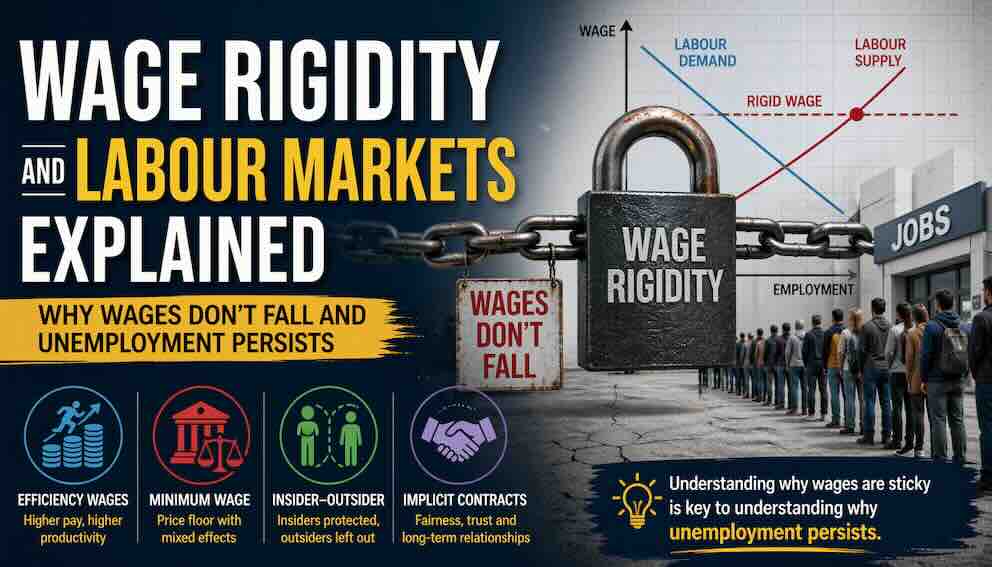
Why don't wages simply fall when there are too many workers and not enough jobs? This tutorial explores the concept of wage rigidity and explains why labour markets often fail to "clear" in the way basic economic models predict. You will learn the crucial distinction between nominal wage rigidity (wages resist being cut in money terms) and real wage rigidity (wages resist falling relative to other prices), and why both matter for unemployment persistence during recessions. The tutorial walks you through the four main efficiency wage models – shirking, turnover, adverse selection, and fairness – showing why firms may deliberately pay above-market wages as an investment in worker behaviour rather than a simple cost. Finally, you will discover how minimum wage laws can have unexpected effects in markets where employers have monopsony power, why insider–outsider dynamics can lock unemployed workers out of the labour market for years, and how unions, contracts, and labour laws systematically create downward wage rigidity while leaving upward flexibility intact.
Why Wages Don't Fall Easily – Introducing Wage Stickiness
Imagine you own a small coffee shop with ten employees, and a recession has hit your town. Fewer customers are coming through the door, and your revenue has dropped by twenty per cent. In a simple economics textbook, the solution would be straightforward: cut wages by twenty per cent, keep all ten workers, and your costs fall in line with your revenue. Everyone stays employed, just at a lower wage. But if you actually tried this, you would almost certainly fail. Your best barista would quit and go to work for a competitor who did not cut wages. The remaining workers would feel betrayed and angry. Their effort would drop. Some might even steal from the till to make up for their lost income. Within months, your coffee shop would be in worse shape than before.
This is the puzzle of wage rigidity. Wages are "sticky" – they do not fall easily even when there is a surplus of workers. During economic downturns, firms often lay people off rather than cutting wages across the board. They might freeze hiring, reduce bonuses, or cut hours, but they rarely implement large nominal wage cuts for existing employees. Understanding why this happens is the key to understanding why unemployment can persist even when workers are willing to accept lower wages in theory. Wage rigidity is especially important during recessions. When demand for goods falls, firms need to reduce costs. If wages could fall easily, employment might be preserved. But because wages are rigid, firms reduce employment instead. In this way, cyclical unemployment caused by a recession can persist and, over time, begin to resemble structural unemployment as workers lose skills and become disconnected from the labour market.
There is an important distinction to make at the outset between nominal wage rigidity and real wage rigidity. Nominal wage rigidity means that wages resist being cut in money terms – your coffee shop workers resist a cut from £15 per hour to £12 per hour. Real wage rigidity means that wages resist falling relative to other prices – workers may accept a nominal wage freeze if inflation is low, but they will resist a nominal wage freeze if inflation is high and their real purchasing power is falling. To make this concrete, consider two scenarios. In the first, a worker is told their wage will be cut from £15 to £13 per hour. They will almost certainly resist. In the second, there is five per cent inflation, so prices are rising, and the worker is told their wage will stay at £15 per hour. Their real wage is falling by five per cent, but they may accept this more readily because the cut is invisible and spread over time. Both are real wage cuts, but the first is a nominal cut and the second is a freeze. Nominal rigidity is the stronger force because workers experience a nominal pay cut as a direct loss, whereas a freeze during inflation feels like a gradual erosion.
There is also a crucial asymmetry to understand: wages are downward rigid but upward flexible. Firms raise wages relatively easily when the labour market is tight and they need to attract or retain workers. But they cut wages only with great difficulty, and often not at all. This asymmetry shapes long-run wage dynamics. Over time, wages tend to drift upward even in economies with stable inflation, but they rarely fall. The result is that the labour market has a built-in upward bias, and downward adjustments happen through layoffs and reduced hiring rather than through wage cuts.
Key Takeaway – Wage Stickiness: Wages do not fall easily during downturns because of worker morale, contracts, and social norms. Nominal rigidity (resistance to money cuts) is stronger than real rigidity (resistance to cuts relative to prices). Wages are downward rigid but upward flexible. This explains why firms often lay off workers rather than cutting wages, and why cyclical unemployment can become persistent.
Efficiency Wages – Why Firms Pay Above the Market Rate
One of the most important explanations for wage rigidity is the theory of efficiency wages. According to this theory, firms may deliberately choose to pay wages above the market-clearing level because doing so increases productivity and reduces other costs. At first glance, this seems counterintuitive. If firms want to minimise costs, why would they pay more than necessary? The answer is that in all four efficiency wage models, higher wages are not a cost alone – they are an investment in worker behaviour. The extra wage cost is offset by gains in effort, retention, worker quality, or morale. There are four main efficiency wage models, and each gives a different reason why this investment pays off.
The Shirking Model: The first and most famous efficiency wage model focuses on shirking. Monitoring workers perfectly is impossible for most jobs. A coffee shop owner cannot watch every employee every second. A call centre manager cannot listen to every call. A warehouse supervisor cannot follow every worker around with a clipboard. If wages are low, workers may not feel compelled to exert maximum effort because the consequences of being caught shirking are minor – they can just find another low-paying job. By paying higher wages, firms increase the cost of job loss for workers. A worker who earns £20 per hour has much more to lose from being fired than a worker who earns £10 per hour. This creates a strong incentive to work diligently. Higher wages act as a substitute for costly monitoring systems. The real-world implication is that firms in industries where monitoring is difficult – retail, hospitality, logistics – often pay above-market wages precisely to discourage shirking.
The Turnover Model: The second model focuses on worker turnover. Hiring and training new employees is expensive and time-consuming. A new worker must be recruited, interviewed, vetted, hired, trained, and then supervised until they reach full productivity. For skilled jobs, the cost of replacing a worker can be a year's salary or more. If wages are low, workers frequently leave for better opportunities, leading to constant turnover. By offering higher wages, firms can retain employees for longer periods. This stability allows workers to gain experience and become more productive over time, which benefits the firm in the long run. This is why large retailers like Costco pay significantly higher wages than competitors like Walmart – they have calculated that lower turnover and higher productivity more than offset the higher wage bill.
The Adverse Selection Model: The third model focuses on the quality of applicants. When a firm advertises a job at a low wage, it attracts a certain pool of applicants. When it advertises the same job at a higher wage, it attracts a larger and more qualified pool. The best workers – the most skilled, most reliable, most motivated – will not apply for low-wage jobs because they have better options. By paying a higher wage, the firm can select from a higher-quality pool of applicants. The extra cost of the higher wage is offset by the higher productivity of the workers it hires. This is why investment banks pay enormous salaries to new graduates: they want to attract the very best candidates from the top universities, and they are willing to pay for that privilege.
The Fairness Model: The fourth model focuses on worker psychology. People have a strong sense of what constitutes a fair wage. If workers believe they are being paid unfairly – especially if they learn that other workers doing the same job are paid more – their motivation and effort decline. They may work more slowly, take longer breaks, or even sabotage equipment. By paying a fair wage, firms maintain worker morale and productivity. This model explains why firms rarely cut wages during recessions. Even if workers would accept a pay cut in theory, the perception of unfairness would damage morale and reduce effort. The loss in productivity would outweigh the saving in wages.
The Result – Structural Unemployment: While efficiency wages can be beneficial for individual firms, they have important implications for the overall labour market. When many firms pay above the equilibrium wage, the quantity of labour supplied exceeds the quantity demanded. There are more people who want jobs at the prevailing wage than there are jobs available. This leads to structural unemployment – unemployment that persists even in the long run because of the way the labour market is organised. Workers who are unemployed may be willing to work for less, but firms do not lower wages because doing so would reduce productivity and increase costs in other ways.
Key Takeaway – Efficiency Wages: Firms pay above-market wages as an investment in worker behaviour – to reduce shirking (monitoring is costly), to reduce turnover (hiring and training is expensive), to attract better applicants (adverse selection), and to maintain fairness (worker morale matters). The result is structural unemployment.
Real-World Institutions – Unions, Contracts, and Labour Laws
Beyond the economic logic of efficiency wages, real-world labour markets are shaped by institutions that systematically create wage rigidity. These are not side details; they are core explanations for why wages resist downward adjustment, especially in European economies.
Collective Bargaining Agreements: In many countries, wages are not set by individual firms but through collective bargaining between unions and employer associations. These agreements often cover entire industries or regions and set minimum wage rates for different job categories. Once negotiated, these rates are fixed for a period of one to three years. During that time, firms cannot unilaterally cut wages even if business conditions worsen. The agreement protects workers from wage cuts, but it also means that wages cannot adjust downward in response to a recession. This creates explicit nominal wage rigidity.
Employment Protection Laws: Many countries have laws that make it difficult to fire workers. In France, Germany, Italy, and Spain, firms face significant costs if they want to lay off permanent employees – notice periods, severance payments, and the risk of legal challenges. These laws make firms cautious about hiring in the first place, but they also mean that when a recession hits, firms are reluctant to cut wages because they cannot easily adjust their workforce either. The combination of wage rigidity and employment protection can lead to very persistent unemployment, as seen in Southern Europe after the 2008 financial crisis.
Long-Term Contracts: Even in countries without strong unions or employment protection laws, many workers have individual employment contracts that fix wages for a set period. A firm cannot simply announce a wage cut mid-contract. The contract must be honoured, or the firm must negotiate a change with each worker individually – a time-consuming and conflict-ridden process. This contractual rigidity is a direct legal cause of downward wage stickiness.
These institutional explanations complement the efficiency wage models. Efficiency wages explain why firms might choose not to cut wages even if they could. Unions, laws, and contracts explain why firms often cannot cut wages even if they wanted to. Together, they provide a complete picture of downward wage rigidity.
Key Takeaway – Institutions: Collective bargaining agreements, employment protection laws, and long-term contracts systematically prevent wage cuts. These institutional rigidities are especially strong in European labour markets and help explain persistent unemployment.
Minimum Wage Effects – Price Floors and Monopsony Power
Minimum wage laws are another important source of wage rigidity. A minimum wage sets a legal lower bound on wages, meaning that employers cannot pay workers below a certain level. In the standard supply and demand model, a minimum wage acts as a price floor. If the minimum wage is set above the equilibrium wage, it creates a surplus of labour – more workers are willing to work at the higher wage, but fewer jobs are available because firms hire less labour at that wage.
To make this concrete, imagine that the equilibrium wage for entry-level retail workers in a city is £9 per hour. The government sets a minimum wage of £11 per hour. At this higher wage, more people are willing to work – students, retirees, and others who were not interested at £9 now want jobs. But firms, facing higher labour costs, may reduce hiring. They might replace some workers with self-checkout machines, reduce opening hours, or simply hire fewer staff. The result is unemployment among low-skilled workers. However, the size of this effect depends on three factors: how far the minimum wage is above the equilibrium wage (a small increase has a small effect; a large increase can be damaging), the elasticity of labour demand (how easily firms can substitute machines or reorganise work), and the structure of the labour market (whether firms have monopsony power).
Monopsony Power: The standard model assumes that firms are wage takers – they cannot influence wages because there are many other employers competing for workers. But in many real-world situations, firms have some degree of monopsony power. Monopsony means that a firm is the dominant employer in a local labour market. Imagine a small town with only one large factory. Workers in that town have few alternatives. If they do not like the factory's wages, they cannot easily move because their families, homes, and lives are in the town. The factory can set wages below the competitive level because workers have no other options. In this situation, a minimum wage can actually increase both wages and employment. By setting a higher wage floor, the government forces the monopsonist factory to pay more. Because the wage is higher, more people are willing to work. And because the factory was previously hiring too few workers (it restricted hiring to keep wages down), it may actually hire more workers at the higher wage.
The real-world evidence on minimum wages is mixed because the effects depend on how far the minimum is above equilibrium, the elasticity of labour demand, and the degree of monopsony power. Studies of fast-food restaurants in New Jersey and Pennsylvania in the 1990s found that a minimum wage increase did not reduce employment – a result that shocked many economists and suggested that monopsony power was significant. Studies of other industries and other regions have found small negative effects. The consensus among economists today is that moderate minimum wage increases do not cause large job losses, but very high minimum wages (like a £15 per hour national minimum in a low-wage region) probably do reduce employment, especially for young and low-skilled workers.
Key Takeaway – Minimum Wage: A minimum wage is a price floor. In competitive markets, it creates unemployment. In markets with monopsony power (one dominant employer), it can increase both wages and employment. The effects depend on how far the minimum is above equilibrium, the elasticity of labour demand, and the structure of the labour market. Moderate increases seem to have small negative effects; very high increases are more damaging.
Insider–Outsider Theory – Why the Unemployed Stay Unemployed
The insider–outsider theory, developed by economists Assar Lindbeck and Dennis Snower, provides another explanation for persistent unemployment. It focuses on the distinction between two groups in the labour market. Insiders are workers who are currently employed. They often have job security, experience, firm-specific skills, and established relationships with employers. They may be represented by unions, or they may simply be valued by their employers because replacing them would be costly. Outsiders are those who are unemployed or seeking to enter the labour market. They may be equally skilled and willing to work for lower wages, but they lack the connections and protections that insiders have.
Insiders typically have more bargaining power than outsiders. They can negotiate higher wages and better working conditions because the firm cannot easily replace them. If a firm tried to replace all its insiders with cheaper outsiders, it would face enormous costs: recruiting, screening, training, and the loss of productivity while new workers learned the ropes. Moreover, insiders may resist changes that threaten their positions. Unionised workers can strike. Non-unionised workers can engage in work-to-rule, slowdowns, or simply quit, leaving the firm with a sudden labour shortage. Because of these costs, firms prefer to retain insiders even if they are relatively expensive. Crucially, this insider power can prevent wages from falling even when unemployment is high. The presence of many unemployed outsiders does not force wages down because insiders protect their own wages and firms cannot easily replace them.
Outsiders face significant barriers to entry. Even if they are willing to work for lower wages, firms may not hire them because doing so would involve replacing insiders or disrupting existing arrangements. Consider a manufacturing plant where the existing workers have negotiated a wage of £20 per hour through collective bargaining. There are unemployed workers outside the gate who would happily work for £15 per hour. But the plant cannot simply fire the insiders and hire the outsiders. The union contract forbids it. Even without a union, the plant would face a collapse in morale, the risk of sabotage, and the loss of experienced workers. The outsiders remain unemployed despite their willingness to work. This is a direct link back to wage rigidity: insider power keeps wages high and outsiders out, even when the market would otherwise clear at a lower wage.
The insider–outsider theory helps explain why unemployment can persist over long periods and why long-term unemployment is so damaging. Once a worker becomes an outsider, they may remain excluded from the labour market because they lack the bargaining power and connections of insiders. Employers prefer to hire workers who are already employed (insiders) because they have recent experience and proven reliability. This is why long-term unemployment is a trap: the longer you are unemployed, the harder it is to get hired. This dynamic can be observed in many European economies, where labour market regulations protect insiders but make it difficult for outsiders to find work.
Key Takeaway – Insider–Outsider Theory: Insiders (employed workers) have bargaining power because replacing them is costly. This power can prevent wages from falling even when unemployment is high. Outsiders (unemployed workers) struggle to enter even if they would work for lower wages. This creates persistent unemployment and explains why long-term unemployment is a trap.
Implicit Contracts and Fairness – The Psychological Dimension
Beyond efficiency wages, minimum wages, institutions, and insider-outsider dynamics, there is a simpler and more human explanation for wage rigidity: implicit contracts and fairness. An implicit contract is an unwritten understanding between a firm and its workers. The firm promises to treat workers fairly and to provide stable wages and employment. In return, workers promise to work hard, to be loyal, and not to quit at the first opportunity. This implicit contract is not legally enforceable, but it is enforced by trust, reputation, and the fear of losing good workers.
When a firm cuts wages, it violates the implicit contract. Workers feel betrayed. They may respond by reducing effort, looking for other jobs, or even stealing from the firm. The loss in productivity and the increase in turnover can easily outweigh the saving from lower wages. This is why firms often prefer to lay off workers rather than cut wages across the board. A layoff is a one-time event that affects a minority of workers. A wage cut affects everyone and poisons the atmosphere for years.
The importance of fairness was demonstrated in a famous study of a manufacturing plant that imposed a pay cut on its workers. The workers responded by cutting their effort so dramatically that the plant's productivity fell by more than the saving from the wage cut. The plant eventually reversed the pay cut, but the damage to trust and morale took years to repair. This is not irrational behaviour. Workers have a strong sense of what is fair, and they punish firms that treat them unfairly, even at a cost to themselves. This psychological reality is one of the most important explanations for why wages are rigid downward, and it connects directly to the fairness model of efficiency wages.
Key Takeaway – Implicit Contracts and Fairness: Firms and workers have unwritten understandings about fair treatment. Wage cuts violate these implicit contracts, leading to reduced effort, higher turnover, and lower productivity. This is why firms prefer layoffs to across-the-board wage cuts.
Conclusion: The Labour Market Is Not an Auction
The simple model of supply and demand in the labour market is a useful starting point, but it is not the final word. Wages are not like the price of wheat or copper. They are shaped by human psychology, social norms, institutional arrangements, and the strategic behaviour of firms and workers. Efficiency wages explain why firms may deliberately pay above-market rates as an investment in worker behaviour – to reduce shirking, turnover, and adverse selection, and to maintain fairness. Real-world institutions like unions, employment protection laws, and long-term contracts systematically prevent wage cuts. Minimum wage laws show how policy interventions can have complex effects, especially in markets with monopsony power. Insider-outsider theory reveals how the bargaining power of employed workers can prevent wages from falling even when unemployment is high, locking outsiders out of the labour market. And implicit contracts remind us that firms and workers are not just trading partners but participants in a long-term relationship built on trust and fairness. Taken together, these ideas reveal that the labour market does not always clear because wages are downward rigid but upward flexible. Unemployment persists not because of a failure of imagination but because of the very real costs – to productivity, morale, and trust – that would follow from wage cuts. Understanding wage rigidity is not just an academic exercise. It is the key to understanding why cyclical unemployment can become persistent, why some economies suffer from high long-term unemployment, and why the labour market behaves so differently from simple auction markets. The labour market is not an auction. It is a human institution, and human institutions do not adjust instantly to supply and demand. That is both the frustration and the fascination of labour economics.
About Swati Sharma
Lead Editor at MyEyze, Economist & Finance Research WriterSwati Sharma is an economist with a Bachelor’s degree in Economics (Honours), CIPD Level 5 certification, and an MBA, and over 18 years of experience across management consulting, investment, and technology organizations. She specializes in research-driven financial education, focusing on economics, markets, and investor behavior, with a passion for making complex financial concepts clear, accurate, and accessible to a broad audience.
Disclaimer
This article is for educational purposes only and should not be interpreted as financial advice. Readers should consult a qualified financial professional before making investment decisions. Assistance from AI-powered generative tools was taken to format and improve language flow. While we strive for accuracy, this content may contain errors or omissions and should be independently verified.