
Tutorial Categories
Last Updated: May 7, 2026 at 18:30
Investment Theory in Macroeconomics Explained: How Firms Decide to Invest and Why It Matters for Growth
Understanding Tobin's Q, the Accelerator Model, Neoclassical Investment Theory, and the Real Drivers of Capital Spending
Investment is one of the most important components of an economy because it determines how much productive capacity will exist in the future – and understanding how firms decide to invest is essential for understanding economic growth and business cycles. This tutorial walks you through three major theories of investment: Tobin's Q (which links financial market valuations to real investment, encouraging spending when the market value of capital exceeds its replacement cost), the Accelerator Model (where investment depends on changes in output, not the level of output), and Neoclassical Investment Theory (which focuses on the user cost of capital and the desired capital stock). Using real-world examples from the dot-com bubble, the post-2008 recovery, the COVID-19 pandemic uncertainty, and post-Brexit UK investment, this guide shows why firms sometimes invest heavily even when interest rates are low, and why at other times they hesitate despite cheap borrowing. You will also learn about gross versus net investment, investment irreversibility, adjustment costs, financial constraints, and why expectations about the future are the common thread running through all investment theories.
Why Investment Matters – And Why It Is Volatile
Investment is one of the most important components of an economy because it determines how much productive capacity will exist in the future. When a firm invests in a new factory, a new machine, or new software, it is not simply spending money in the present; it is shaping the economy's ability to produce goods and services for years or decades to come. Investment is also one of the most volatile components of aggregate demand (AD = C + I + G + X - M). While consumption is relatively stable, investment can swing dramatically from boom to bust. In a typical recession, investment falls much more sharply than consumption. In a typical recovery, investment rises much more rapidly. Understanding why investment is so volatile – and what drives it – is essential for understanding business cycles and economic growth.
Before we dive into the theories, we need a crucial distinction: gross investment versus net investment. Gross investment is the total amount spent on new capital goods (machines, buildings, software) in a given period. Net investment is gross investment minus depreciation – the wearing out of existing capital. If a firm spends £10 million on new machines but £3 million of its existing machines wear out, net investment is £7 million. Net investment tells us whether the capital stock is growing (positive net investment), shrinking (negative net investment), or staying the same (zero net investment). Even during a recession, firms still invest to replace worn-out capital, so gross investment rarely falls to zero. But net investment can become negative, meaning the capital stock is shrinking. This distinction matters for growth: a country's future productive capacity depends on net investment, not just gross investment.
Key Takeaway – Gross vs Net Investment: Gross investment is total capital spending. Net investment = gross minus depreciation. Net investment determines whether the capital stock grows. During recessions, net investment often turns negative even when gross investment remains positive.
The Accelerator Model – Investment Driven by Changes in Demand
The Accelerator Model is one of the oldest and most intuitive theories of investment. It starts from a simple idea: firms need capital to produce output. If a firm wants to produce more goods, it needs more machines, more factories, or more space. Therefore, investment should be driven by changes in the demand for the firm's products.
The formal equation of the Accelerator Model is: I = α × ΔY. It is simply a compact way of expressing the idea that firms invest because they need additional capital when demand for their output increases. The term Delta Y represents the change in output or demand, which is the starting point of the whole process. If demand for a firm’s product rises, the firm must increase production to meet that demand. However, producing more output requires more capital, such as machines, factories, or equipment. This is where alpha(α), the capital-output ratio, comes in. It tells us how much capital is required to produce one unit of output. For example, if α=2, the firm needs £2 of capital to produce £1 of output each year. When demand increases by a certain amount, say £10 million, the firm calculates how much additional capital is needed to support that higher level of production. By multiplying the increase in output (ΔY) by the capital-output ratio (α), the firm determines the total investment required. In this case, £10 million of additional output would require £20 million of new capital, so investment rises to £20 million. What the equation is really saying, in simple terms, is that investment is the amount of new capital required to support an increase in demand. This also explains an important and sometimes unintuitive result: investment depends on the change in output, not the level of output. If output is high but not growing, then ΔY=0, and the model predicts no new net investment because the firm already has enough capital to sustain its current level of production. This is why investment is so sensitive and volatile in the real world. Even a small slowdown in the growth of demand leads to a reduction in ΔY\Delta YΔY, which in turn causes a large drop in investment, reinforcing economic fluctuations.
A real-world example can be seen in the global automotive industry. During periods of strong economic growth, rising incomes lead to increased demand for cars. Automobile manufacturers respond by investing in new production lines. During the 2010-2015 recovery from the financial crisis, car sales in the US rose sharply, and investment in auto plants followed. When the market became saturated and sales growth slowed, investment declined even though sales remained high. The Accelerator Model helps explain why investment is so volatile: a small slowdown in demand growth can cause a large fall in investment, which then reduces aggregate demand further, creating a downward spiral.
Key Takeaway – Accelerator Model: I = α × ΔY. Net investment depends on the change in output, not the level. A small change in demand growth causes a large change in investment. This explains investment volatility and the business cycle feedback loop.
Neoclassical Investment Theory – The User Cost of Capital
The Accelerator Model focuses on demand, but it does not tell us about the cost side of the investment decision. Neoclassical Investment Theory, developed by Dale Jorgenson in the 1960s, fills this gap. It emphasises the user cost of capital – the full cost of using a piece of capital for one period, including the interest cost of borrowing, depreciation, and taxes.
The user cost of capital can be expressed as: User Cost = (r + δ) × P_K, where r is the real interest rate, δ (delta) is the depreciation rate, and P_K is the price of capital goods. If the user cost is low, firms want more capital because it is cheap to use. The Neoclassical theory says that firms will invest until the marginal product of capital (the extra output produced by one more unit of capital) equals the user cost. This determines the firm's desired capital stock. Investment is then the process of adjusting from the current capital stock to the desired capital stock.
However, firms cannot adjust instantly. Adjustment costs – the costs of installing new capital, training workers, and reorganising production – mean that investment is gradual rather than instantaneous. A firm does not jump to its desired capital stock overnight. Instead, it spreads investment over time to avoid disruption. This explains why investment is sometimes smooth rather than lumpy, and why firms respond to changes in conditions with a delay.
The most important implication of the Neoclassical theory is that interest rates matter. When the central bank raises interest rates, r increases, raising the user cost. Firms want less capital, so investment falls. This is the primary channel through which monetary policy affects the economy. A real-world example is the response to the 2008 financial crisis: central banks cut interest rates to near zero, reducing the user cost of capital and encouraging investment, although the effect was weaker than expected because demand was also very weak.
Key Takeaway – Neoclassical Theory: User cost = (r + δ) × P_K. Firms invest until the marginal product of capital equals user cost. Adjustment costs mean investment is gradual. Lower interest rates reduce user cost and boost investment.
Tobin's Q – Linking Financial Markets to Real Investment
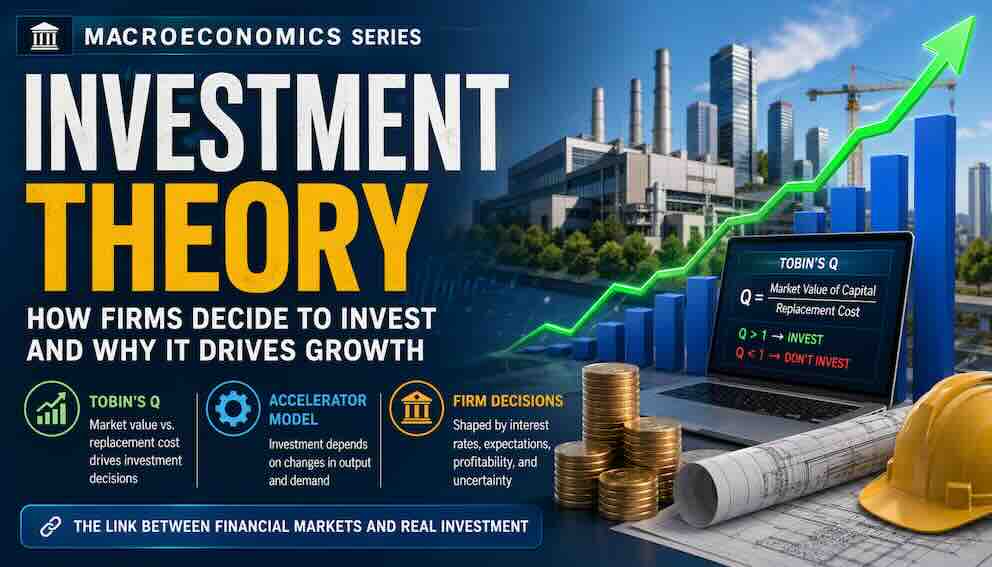
Tobin's Q, named after economist James Tobin, provides a direct link between financial market valuations and real investment decisions. It is defined as: Q = (Market Value of Capital) / (Replacement Cost of Capital) . The market value is what investors are willing to pay for the firm's assets (the stock market valuation). The replacement cost is how much it would cost to buy or build those assets new.
The decision rule is simple. If Q > 1, the market value exceeds the replacement cost. Each pound spent on investment adds more than one pound to market value, so firms should invest. If Q < 1, the market value is less than the replacement cost, so firms should not invest.
In theory, firms should base decisions on marginal Q – the value of an additional unit of capital. But marginal Q is unobservable. In practice, economists use average Q (market value divided by replacement cost) as a proxy. The dot-com bubble is a classic example: Q was far above 1 for tech firms, encouraging massive investment in servers, data centres, and fibre optic cables. When the bubble burst, Q fell below 1, and investment collapsed. More recently, Tesla's Q was very high in 2020-2021, and the firm invested heavily in new factories.
What makes Tobin's Q particularly powerful is that it captures expectations about the future in a single observable variable. Stock market valuations reflect investors' expectations of future profitability, demand, and costs. When investors are optimistic, Q is high and investment follows. When they are pessimistic, Q is low and investment lags.
Key Takeaway – Tobin's Q: Q = Market Value / Replacement Cost. If Q > 1, invest. Average Q is used as a proxy for unobservable marginal Q. Q captures future expectations and links financial markets to real investment.
Expectations as the Common Thread – Unifying the Theories
All three investment theories, despite their different emphases, ultimately depend on expectations about the future. This is the common thread that runs through modern investment theory, and making it explicit helps unify the frameworks.
In the Accelerator Model, firms invest because they expect current demand growth to persist. A firm that sees a temporary blip in sales will not invest in new capacity. It only invests when it expects the higher demand to last. So the Accelerator Model is really about expected changes in output, not just observed changes. In the Neoclassical Theory, firms compare the expected marginal product of capital (future output) with the user cost. If firms expect future demand to be weak, the expected marginal product is low, and investment falls – even if current demand is strong. In Tobin's Q, stock market valuations aggregate the expectations of millions of investors about future profitability. When those expectations are optimistic, Q is high; when they are pessimistic, Q is low.
This is why uncertainty is so damaging for investment. When firms are uncertain about the future – about demand, interest rates, trade policy, or regulation – they cannot form clear expectations. The option value of waiting (which we will discuss next) becomes very high. This is why investment fell sharply after the Brexit referendum in 2016 and during the early stages of the COVID-19 pandemic, even though interest rates were very low. Expectations, not just current conditions, drive investment.
Key Takeaway – Expectations as the Common Thread: All investment theories depend on expectations about future profitability, demand, and costs. Uncertainty damages investment by making expectations unclear and raising the option value of waiting.
Investment Irreversibility, Hysteresis, and Uncertainty – Why Firms "Wait and See"
Much investment is irreversible – once you build a factory, you cannot easily unbuild it. You can sell it, but you will likely get much less than you paid (sunk costs). This irreversibility creates an option value to waiting. If you wait, you get more information about future demand, interest rates, and costs. If conditions turn out to be good, you can invest then. If conditions turn out to be bad, you have saved yourself from a bad investment. This option value means that firms require a higher threshold of expected profitability before they invest. This is called hysteresis – current investment depends not just on current conditions but on the path of how we got here.
The COVID-19 pandemic provides a powerful example. Despite very low interest rates (low user cost) and in some cases strong demand (accelerator effects), many firms reduced investment in 2020 and early 2021. Why? Because uncertainty was extremely high. Firms did not know how long lockdowns would last, whether demand would return, or how supply chains would function. The option value of waiting was very high. So firms delayed investment until the picture became clearer. By 2021 and 2022, as uncertainty fell, investment recovered sharply.
A UK-specific example is the period following the 2016 Brexit referendum. Many firms delayed investment for years because of uncertainty about future trade arrangements with the European Union. Even though interest rates were low and demand was reasonably strong, the option value of waiting was high. Firms did not want to commit to irreversible investments (like building a new factory in the UK) until they knew what the trading relationship would look like. This investment strike contributed to the UK's weaker productivity growth compared to other advanced economies between 2016 and 2019.
Key Takeaway – Irreversibility and Hysteresis: Irreversible investment creates an option value to waiting. High uncertainty leads firms to delay investment even when current conditions favour it. This explains why investment fell during COVID and after the Brexit referendum despite low interest rates.
Lumpy Investment, Adjustment Costs, and Financial Constraints
Investment is also lumpy – firms do not invest continuously in small amounts. Instead, they invest in large, discrete chunks. A firm might go years without building a new factory, then spend £100 million on one. This lumpiness matters because it means that investment can be very sensitive to small changes in conditions. If a firm is on the fence about a large project, a small increase in expected demand or a small fall in interest rates can tip the balance and cause a large investment spike. Adjustment costs (installing new capital, training workers) contribute to lumpiness because there are fixed costs to any investment project.
Financial constraints also matter. The Neoclassical theory assumes that firms can borrow as much as they want at the market interest rate. In reality, not all firms face the same interest rate. Large, established firms can issue bonds or sell shares in capital markets at relatively low cost. Small and medium-sized enterprises (SMEs) often face credit constraints – banks are reluctant to lend to them, or charge very high interest rates. These firms rely on internal funds (retained earnings) to finance investment. When profits are high, they can invest. When profits are low, they cannot. This means that for SMEs, the effective cost of capital is much higher than the central bank interest rate – if they can access credit at all.
The 2008 financial crisis was a powerful example. Banks stopped lending, even to healthy firms. Investment collapsed not just because demand fell, but because firms could not access credit. Large firms with access to capital markets (like Apple or Microsoft) continued to invest. Small firms without internal funds could not. This is why financial policy – ensuring banks are willing to lend – is as important for investment as monetary policy.
Key Takeaway – Lumpy Investment and Financial Constraints: Investment is lumpy (large, discrete projects). Different firms face different costs of capital. Large firms access capital markets; small firms rely on bank credit or retained earnings. Credit freezes hurt small firms disproportionately.
Keynes's Marginal Efficiency of Capital – A Conceptual Bridge
Before closing, we should briefly mention Keynes's concept of the Marginal Efficiency of Capital (MEC) , which predates and influenced the theories we have discussed. The MEC is the expected rate of return on an additional unit of capital. Keynes argued that firms will invest as long as the MEC exceeds the interest rate. As more investment occurs, the MEC falls (because new capital reduces the profitability of further investment). Equilibrium occurs when MEC = interest rate.
This is very close to the Neoclassical idea that firms invest until the marginal product of capital equals the user cost. The main difference is that Keynes emphasised the role of animal spirits – waves of optimism and pessimism that cause the MEC to fluctuate. These animal spirits are what drive the volatility of investment, and they are closely related to the expectations we discussed earlier. The MEC concept is a useful bridge between Keynesian macroeconomics and the more formal Neoclassical and Tobin's Q approaches.
Key Takeaway – Marginal Efficiency of Capital: Keynes's MEC is the expected return on new capital. Firms invest until MEC equals the interest rate. Animal spirits (waves of optimism/pessimism) cause the MEC to fluctuate, explaining investment volatility.
Policy Transmission Channels – How Policy Affects Investment
We now have a rich understanding of what drives investment. This allows us to see how different policy tools affect investment through different channels.
Monetary policy (interest rates) affects investment through the user cost of capital (Neoclassical channel). When the central bank cuts rates, r falls, user cost falls, and the desired capital stock rises. This channel works best for large firms with access to credit. For small, credit-constrained firms, the effect is weaker because they face a different (higher) effective interest rate.
Fiscal policy (government spending and taxes) affects investment through the Accelerator channel. When the government increases spending or cuts taxes, aggregate demand rises. As demand rises, output grows, and the Accelerator (I = α × ΔY) predicts higher investment. This channel works best when there is spare capacity and firms are demand-constrained.
Financial policy (bank lending programmes, credit guarantees) affects investment through the financial constraints channel. By making it easier for small firms to borrow, or by providing credit guarantees that lower the risk for banks, policymakers can reduce the effective cost of capital for credit-constrained firms. This was a major focus of policy after 2008, with central banks providing cheap loans to banks on the condition that they lend to small businesses.
Confidence and uncertainty matter across all channels. Policies that reduce uncertainty – clear trade agreements, stable regulations, predictable tax policy – lower the option value of waiting and encourage investment. This is why the resolution of the Brexit uncertainty (however imperfect) was expected to boost UK investment, and why clear central bank communication is considered a form of policy.
Key Takeaway – Policy Transmission Channels: Monetary policy affects user cost (Neoclassical). Fiscal policy affects demand (Accelerator). Financial policy affects credit constraints. Reducing uncertainty boosts investment across all channels.
Investment, Productivity, and Long-Run Growth
We close with a crucial point that connects investment theory to long-run growth. Investment is not just about the quantity of capital. It is also about the quality – the technology embedded in new capital. A new machine is almost always more productive than the old machine it replaces because it incorporates newer technology. This is called embodied technical progress. When a firm invests in a new factory with robotics and automation, it is not just adding to the capital stock; it is upgrading the productivity of the entire production process.
This is why investment is so important for long-run growth. Countries that invest more tend to grow faster, not just because they have more machines, but because they adopt newer, better technologies faster. The rapid growth of East Asian economies (South Korea, Taiwan, China) was driven by very high investment rates. The slower growth of many European economies has been linked to weaker investment, especially in technology and intangible capital (software, data, research and development).
Understanding investment theory helps us see why policies that encourage investment – low interest rates, stable expectations, good financial systems, investment tax credits – are so important for long-run prosperity. Investment is the bridge between present sacrifice and future abundance. It is the mechanism through which an economy builds its future productive capacity.
Key Takeaway – Investment and Productivity: Investment embodies new technology. Countries that invest more grow faster because they adopt newer, better technologies faster. Investment is the bridge between present and future prosperity.
Conclusion: Investment as the Engine of Growth
Investment is unique among the components of aggregate demand because it is simultaneously spending in the present and a bet on the future. When a firm builds a factory, it contributes to current GDP. But it also creates capacity that will produce output for years or decades, shaping the economy's long-run growth path. This dual nature makes investment both powerful and unpredictable. The Accelerator Model shows us how changes in demand drive investment – a small increase in demand growth can cause a large increase in capital spending, while a slowdown can cause investment to collapse. Neoclassical Investment Theory shows us how the user cost of capital – interest rates, depreciation, taxes – matters for the desired capital stock. Tobin's Q shows us how financial markets, through stock market valuations, provide signals about future profitability that firms use to guide their decisions. And the refinements – irreversibility, hysteresis, adjustment costs, lumpy investment, financial constraints, and the Marginal Efficiency of Capital – show us that the real world is messier than any simple model. Firms do not invest continuously; they invest in large, discrete chunks. They fear uncertainty because much investment is irreversible. Different firms face different costs of capital. And expectations about the future – about demand, about costs, about policy, about technology – are the common thread running through all investment decisions. Understanding these theories allows us to see investment not as an isolated decision but as part of a larger system in which expectations, incentives, demand, costs, and financial conditions are constantly interacting. This perspective is essential for understanding how economies grow, how they respond to shocks, and how policy decisions – interest rate cuts, tax incentives, infrastructure spending, credit guarantees, uncertainty reduction – can influence the path of economic development over time. Investment is the engine of growth, and understanding how that engine works is one of the most important tasks in all of macroeconomics.
About Swati Sharma
Lead Editor at MyEyze, Economist & Finance Research WriterSwati Sharma is an economist with a Bachelor’s degree in Economics (Honours), CIPD Level 5 certification, and an MBA, and over 18 years of experience across management consulting, investment, and technology organizations. She specializes in research-driven financial education, focusing on economics, markets, and investor behavior, with a passion for making complex financial concepts clear, accurate, and accessible to a broad audience.
Disclaimer
This article is for educational purposes only and should not be interpreted as financial advice. Readers should consult a qualified financial professional before making investment decisions. Assistance from AI-powered generative tools was taken to format and improve language flow. While we strive for accuracy, this content may contain errors or omissions and should be independently verified.